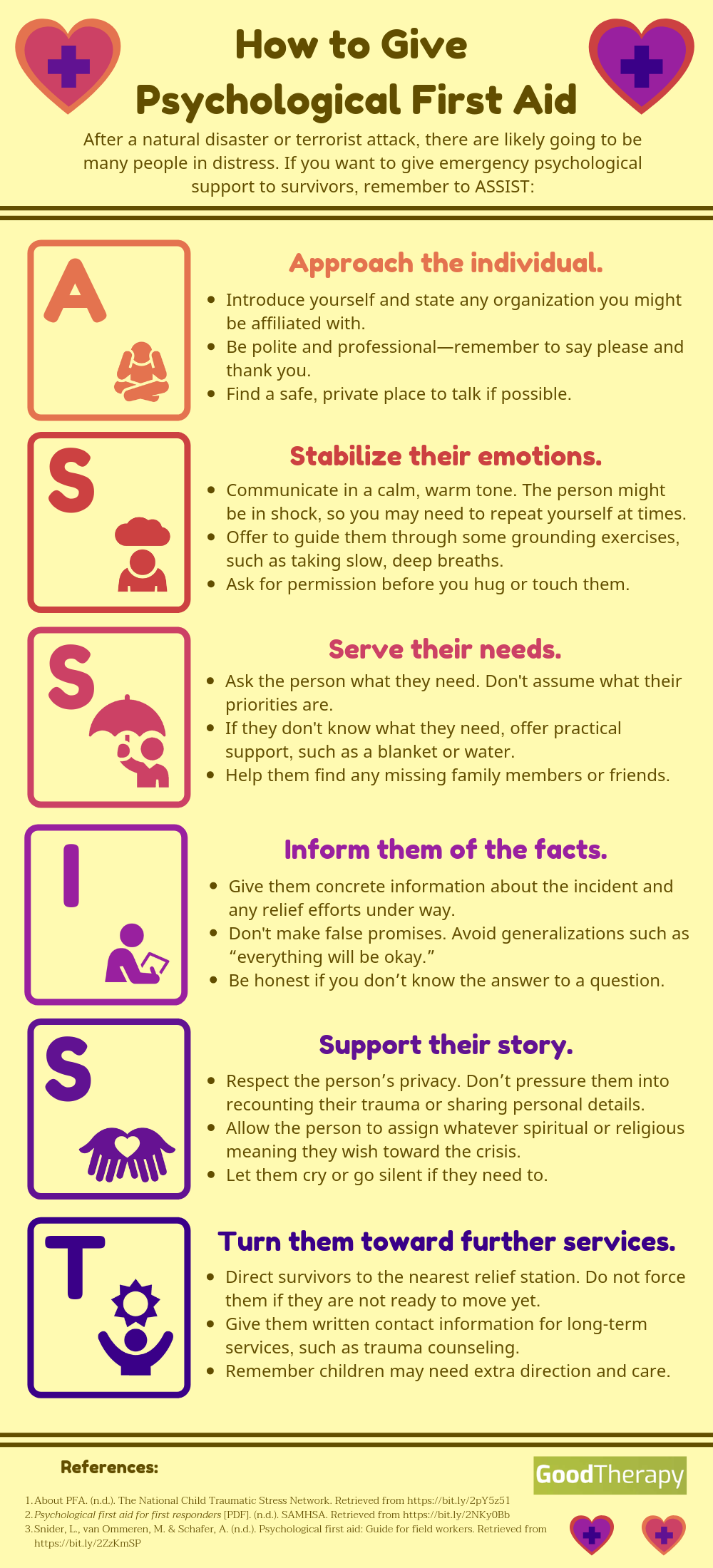
Infographic Text: How to Give Psychological First Aid
After a natural disaster or terrorist attack, there are likely going to be many people in distress. If you want to give emergency psychological support to survivors, remember to ASSIST:
Approach the individual.
- Introduce yourself and state any organization you might be affiliated with.
- Be polite and professional—remember to say please and thank you.
- Find a safe, private place to talk if possible.
Stabilize their emotions.
- Communicate in a calm, warm tone. The person might be in shock, so you may need to repeat yourself at times.
- Offer to guide them through some grounding exercises, such as taking slow, deep breaths.
- Ask for permission before you hug or touch them.
Serve their needs.
- Ask the person what they need. Don’t assume what their priorities are.
- If they don’t know what they need, offer practical support, such as a blanket or water.
- Help them find any missing family members or friends.
Inform them of the facts.
- Give them concrete information about the incident and any relief efforts under way.
- Don’t make false promises. Avoid generalizations such as “everything will be okay.”
- Be honest if you don’t know the answer to a question.
Support their story.
- Respect the person’s privacy. Don’t pressure them into recounting their trauma or sharing personal details.
- Allow the person to assign whatever spiritual or religious meaning they wish toward the crisis.
- Let them cry or go silent if they need to.
Turn them toward further services.
- Direct survivors to the nearest relief station. Do not force them if they are not ready to move yet.
- Give them written contact information for long-term services, such as trauma counseling.
- Remember children may need extra direction and care.
References:
- About PFA. (n.d.). The National Child Traumatic Stress Network. Retrieved from https://bit.ly/2pY5z51
- Psychological first aid for first responders [PDF]. (n.d.). SAMHSA. Retrieved from https://bit.ly/2NKy0Bb
- Snider, L., van Ommeren, M. & Schafer, A. (n.d.). Psychological first aid: Guide for field workers. Retrieved from https://bit.ly/2ZzKmSP
 Denial has been said to be the trademark of addiction, and it has been long identified in the field of psychology. Denial is also relevant to experiences of trauma. These include witnessing trauma, inflicting trauma, and surviving trauma. Furthermore, white denial of racial trauma is the breath of racism.
What Is Denial and Why Do People Do It?
Denial is a refusal to accept reality in order to protect oneself from a painful event, thought, or feeling. It is a common defense mechanism that gives a person time to adjust to distressing situations. For example, a person with drug or alcohol addiction will often deny that they have a problem. People indirectly dealing with the addiction, such as family or friends of the addicted person, may also deny the severity of the issue.
It is possible to deny some aspects of reality while accepting other aspects. For example, a person may acknowledge there is an issue (such as addiction) while denying the need to take action (such as quitting the drug).
Denial isn’t limited to individuals. It has also been recognized on a cultural scale. Current examples include conspiracy theorists’ claims that the Holocaust never occurred or the renunciation of global warming.
Some experts theorize that denial occurs in linear, progressive stages. These types of denial include the following:
- Denial of fact (“That’s not true”)
- Denial of awareness (“I had no idea”)
- Denial of responsibility (“It’s not my fault”)
- Denial of impact (“That wasn’t my intention”)
Denial is initially an unconscious adaptive response. It can also be one of the most primitive, meaning that while it can be very effective short-term, it is ineffective and potentially harmful in the long-term. Staying in denial interferes with change.
How Denial Can Contribute to Racism
The stigma associated with being racist often fuels white denial—the refusal to accept that racism exists. Racism can be defined as the discrimination and/or oppression inflicted upon individuals belonging to a socially constructed racial category. Racism happens at three levels:
- Institutional—Discrimination through laws or social norms.
- Individual—When one person discriminates against a minority group.
- Internalized—When a marginalized person believes stereotypes about their group and/or blames themself for any discrimination they face.
Racism requires the combination of prejudice, power, access, and privilege. It has been summarized as a pathology of power marked by ignorance.
The infamous photograph of the horrific lynching of Rubin Stacy in 1935 is a striking example of white denial. The photo shows a white child in the crowd dressed in her Sunday best. She is smiling while looking at the dead body of a black man hanging in the tree.
Transforming and healing the societal trauma of racism must include healing the numbness of people who benefit from racism.The child could be considered a visual representation of how the short-term coping response of denial evolves into a long-term strategy. The photo demonstrates how racism can be embedded in the culture we grow up in (institutionalized). It also shows how our belief system and our physiology can embody racism (individualized and internalized).
Studies on epigenetics reveal how trauma responses can be passed down through generations, not only through learning and conditioning, but also through genetics. One study shocked male mice while exposing them to the scent of a cherry blossom. The mice then showed a trauma response every time there was the scent, even without being shocked. The trauma response was also present in the mice’s children and grandchildren when they were exposed to the scent of a cherry blossom, even though they never experienced a shock. Their genes were altered.
The study suggests that a person may not have to directly experience a traumatic event to enact a trauma response. In other words, a traumatic response to a relevant trigger can occur even when a person doesn’t know what the original stimulus was. Regarding the photo, the loved ones grieving Rubin Stacy’s death could have passed down their trauma response to their descendants. Future descendants of the white child may embody her physiological response as well.
White denial, and the identified physiological response, may be relevant in the concept “the privilege of numbness”. The term refers to emotional numbness as an adverse effect of racism. This numbness may enable white individuals to ignore or perpetuate a system of racism that benefits them without feeling guilt about others’ suffering. Transforming and healing the societal trauma of racism must include healing the numbness of people who benefit from racism.
When Ignorance Is Intentional
Conscious acts of denying can also appear when people face ethical dilemmas. A study examining shopping behaviors found that if consumers were specifically told that a product was made in an unethical way, the consumers wouldn’t purchase the product. However, when consumers were given the choice to hear the backstory on the product, most people chose to not know.
Researchers asked participants to rank jeans by picking two of four categories to do so:
- Style
- Color
- Price
- Whether or not child labor was used to make the clothing
More than 85% of participants did not choose child labor as a category for their consideration. These results suggest the vast majority of participants were “willfully ignorant.” Researchers found the conscious act of denial was at least in part due to an unconscious fear of being upset by what would be discovered.
Next, researchers asked the willfully ignorant participants what they thought of consumers who chose to research a brand’s labor practices before making a purchase. The response? The willfully ignorant participants tended to degrade the ethical consumers, not just with criticism, but also with character attacks.
Why the hate? Research indicated the participants were unconsciously acting out due to their own guilty feelings. Perhaps even more concerning, a related study demonstrated that willfully ignorant consumers who degraded their ethical peers were less likely to support the social cause in the future.
Addressing Denial Through Self-Examination
Challenging denial is typically an ongoing process of self-examination and radical honesty. Denial is universal—everyone perceives events through personal bias. Therefore, confronting denial often starts at an individual level.
When challenging your own denial, remember to consider the following:
- Realize that denial and personal bias are largely implicit and unconscious processes. Uncovering and confronting social conditioning requires ongoing effort and outside feedback. We all have blind spots.
- Remove the blame and shame. Binary judgments of good/bad can further increase stigma. Stigma in turn can heighten defense mechanisms and trigger trauma reactions (i.e. denial).
- Replace blame and shame with vulnerability, curiosity, and humility. Embrace feelings that allow for growth. Seek understanding. Stretch your worldview.
- Befriend the body. Increase your awareness of your body. Understand how it reacts when you are stressed or ashamed. Learn to tell the difference between discomfort and pain.
- Focus on holding yourself responsible and accountable. Consider if your internal and external resources are being used in accordance with your values. Action often alleviates guilt.
Sometimes confronting personal bias or past mistakes can feel emotionally overwhelming. A licensed therapist can offer confidential support without judgment. You can find a therapist here.
References:
- Aizenman, N. (2016). Do these jeans make me look unethical? National Public Radio. Retrieved from https://www.npr.org/sections/goatsandsoda/2016/01/07/462132196/do-these-jeans-make-me-look-unethical
- Aldebot, S., & de Mamani, A. G. (2009). Denial and acceptance coping styles and medication adherence in schizophrenia. The Journal of Nervous and Mental Disease, 197(8), 580–584. doi:10.1097/NMD.0b013e3181b05fbe
- D’Angelo, R. (2011). White fragility. The International Journal of Pedagogy, (3) Retrieved from http://libjournal.uncg.edu/ijcp/article/view/249/116
- Kendi, I. X. (2018). The heartbeat of racism is denial. The New York Times. Retrieved from https://www.nytimes.com/2018/01/13/opinion/sunday/heartbeat-of-racism-denial.html
- Lewis, T. (2013). Fearful experiences passed on in mouse families. Live Science. Retrieved from https://www.livescience.com/41717-mice-inherit-fear-scents-genes.html
- Lynching of Rubin Stacy in Fort Lauderdale, Florida [Photograph]. (1935) Retrieved March 2019 from https://www.alamy.com/stock-photo-lynching-of-rubin-stacy-in-fort-lauderdale-florida-49908098.html
- Raheem, M. A., & Hart, K. A. (2019, March). Counseling individuals of African descent. Counseling Today, 61(9). Retrieved from https://ct.counseling.org/2019/03/counseling-individuals-of-african-descent
- Winn, M. E. (1996). The strategic and systemic management of denial in the cognitive/behavioral treatment of sexual offenders. Sexual Abuse, 8(1), 25–36. Retrieved from https://journals.sagepub.com/doi/10.1177/107906329600800104
 “Memories warm you up from the inside. But they also tear you apart.” Haruki Murakami
We all know from popular drama (TV shows, movies, etc.) that traumatic events are often forgotten by the sufferer. People who experience a devastating event such as a car accident, natural disaster, or terror attack often cannot remember the incident. It’s also common not to remember what took place right before or right after the incident. In a similar way, many adults who suffered child abuse have difficulty recalling large chunks of time from childhood. In these cases, problems with memory can continue into adulthood as well, particularly when faced with emotional distress.
Our brain and nervous system have evolved to do spectacular things: we can read, write, make music, and contemplate the meaning of life. But the brain’s first and foremost duty is to keep us alive. When it comes to traumatic events, the part of our brain that protects our physical and emotional well-being takes control. In this process, the parts of the brain that are responsible for higher thought processes, such as forming and retrieving memories, are suppressed.
How the Brain Forms Memories
On a regular stress-free day, memories for facts are made and stored in three steps: acquisition, consolidation, and retrieval.
- Acquisition occurs through the combination of sensory experience and emotion. The amygdala processes and interprets the experience so it can become a memory.
- The hippocampus consolidates the experience and sends the information off to the appropriate place for storage (memories are stored all over the brain).
- It is thought that retrieval of factual memories occurs as a function of the prefrontal cortex. When we want to think of a fact, such as the definition of a word, the prefrontal cortex retrieves it and we remember.
When we are confronted with life-threatening danger, the brain behaves differently. The amygdala sends an emergency signal to the hypothalamus, which in turn activates the fight or flight response. Corticosteroids are then released into the bloodstream in order to prepare the body for action. Blood pressure, heart rate, and respiratory function all increase to provide the body and brain with extra energy and oxygen. Our alertness increases, and our body is ready to move.
When this is happening, the amygdala inhibits the activity of the prefrontal cortex. When faced with danger, this is useful, as the prefrontal cortex operates substantially slower. While it is trying to work out what is happening, our body may be harmed. The quicker, action-oriented part of the brain enables us to respond rapidly and try to avoid danger. We act fast. Later, once we are safe, we have time to think. In respect to memory, the parts of the brain involved in memory formation are shut down when faced with a traumatic experience.
The activation of the fight or flight response prevents the parts of the brain responsible for creating and retrieving memory from functioning effectively. This is why we can forget what occurred around a traumatic event. In the case of ongoing trauma, such as with childhood abuse, ongoing problems with memory and the related process can occur, leading to what is understood as dissociation.
Dissociation and Memories
At the heart of dissociation is memory disruption.At the heart of dissociation is memory disruption. During dissociation, the normally integrated functions of perception, experience, identity, and consciousness are disrupted and do not thread together to form a cohesive sense of self. People with dissociation often experience a sense that things are not real; they can feel disconnected from themselves and the world around them. Their sense of identity can shift, their memories can turn off, and the connection between past and present events can be disrupted.
In understanding the human response to trauma, it is understood that dissociation is a central defense mechanism because it provides a kind of mental escape when physical escape is not possible. This type of defense is often the only kind available for children living in abusive situations. Posttraumatic stress (PTSD) and complex posttraumatic stress (C-PTSD) often go hand in hand with dissociation. In studies investigating the impact of PTSD and memory, researchers have found that people with dissociative symptoms have a greater impairment with both working memory and long-term memory.
Long-Term Impact of Memory Impairment
To understand the long-term impact of memory impairment due to dissociation, we need to look at the context from which it arises. Dissociation occurs as a result of ongoing trauma which is associated with chronic stress. A chronically stressed brain and nervous system have difficulty learning. The hippocampus, critical for memory formation and consolidation, can become damaged from ongoing exposure to stress hormones. Researchers have found that the hippocampus actually shrinks in people who suffer from major depression. In addition to the emotional impact of chronic stress and abuse, difficulties with learning and memory can occur as well.
Implications range from difficulties with academics to reduced on-the-job learning and performance. In terms of survival, the implications are serious, as we all need the ability to prepare for, find, and keep employment. Unfortunately, once a person frees him or herself from an abusive childhood, the effects can follow into adulthood in unexpected ways. A damaged hippocampus and overactive nervous system can make life more difficult than it has to be. Over time, self-esteem and confidence can be negatively impacted as well.
Fortunately, the prognosis of dissociation can be optimistic. Researchers have found treatment with antidepressants can increase hippocampal volume. Talk therapy and other therapeutic approaches that are designed to reduce stress and increase emotional resilience may also help.
If you are experiencing trauma or dissociation, you can find a mental health professional here.
References
- Bedard-Gilligan, M., & Zoellner, L. A. (2012). Dissociation and memory fragmentation in post-traumatic stress disorder: An evaluation of the dissociative encoding hypothesis. Memory, 20(3), 277-299. Retrieved from https://www.ncbi.nlm.nih.gov/pubmed/22348400
- Lanius, R. A. (2015). Trauma-related dissociation and altered states of consciousness: A call for clinical, treatment, and neuroscience research. European Journal of Psychotraumatology, 6(1), 27905. Retrieved from https://www.ncbi.nlm.nih.gov/pmc/articles/PMC4439425
- Nuwer, R. (2013, August 1) Why can’t accident victims remember what happened to them? Smithsonian. Retrieved from https://www.smithsonianmag.com/smart-news/why-cant-accident-victims-remember-what-happened-to-them-21942918
- Özdemir, O., Özdemir, P. G., Boysan, M., & Yilmaz, E. (2015). The relationships between dissociation, attention, and memory dysfunction. Nöro Psikiyatri Arşivi, 52(1), 36-41. Retrieved from https://www.ncbi.nlm.nih.gov/pmc/articles/PMC5352997
- Phelps, E. A. (2004). Human emotion and memory: Interactions of the amygdala and hippocampal complex. Current Opinion in Neurobiology, 14(2), 198-202. Retrieved from https://www.ncbi.nlm.nih.gov/pubmed/15082325
- Rosack, J. (2003, September 5) Antidepressants may prevent hippocampus from shrinking. Psychiatric News. Retrieved from https://psychnews.psychiatryonline.org/doi/full/10.1176/pn.38.17.0024
- Sapolsky, R. M. (2001). Depression, antidepressants, and the shrinking hippocampus. Proceedings of the National Academy of Sciences, 98(22), 12320-12322. Retrieved from https://www.ncbi.nlm.nih.gov/pmc/articles/PMC60045
 Migraine headaches are one of the most common chronic conditions worldwide. Depending on the study, chronic migraines affect around 1 in 10 people, with twice as many sufferers being female.
Migraine headaches are disabling and cause significant loss of productivity and quality of life. Once they strike, a migraine can last anywhere between 4 and 72 hours. In addition to substantially reducing quality of life, frequent migraines can place one’s job at risk and prevent daily functioning.
Currently, the causes of migraine headaches are not well understood. Genetics are thought to play a role as well as environmental effects and changes in the way the brain interacts with the trigeminal nerve, a pain pathway.
Maladaptive Response to Stress?
It may be that migraine headaches are a result of the brain’s maladaptive response to stress. Researchers have found that when a migraine is triggered, the body’s responses (pain, increases in stress hormones, nausea, and vomiting) are in excess of what is normal. Even during migraine-free periods, a migraine sufferer’s brain is more excitable in response to stimuli.
If we understand how the brain operates on a neural level, we know that much of what is going on inside the brain is inhibitory. It is not optimal to have cascades of neurochemicals circulating through the brain. Overexcitability in the brain reduces the effectiveness of the calming mechanisms in the brain and increase pain sensitivity. What this means is the brain’s response to stimuli between attacks is heightened in an abnormal way.
We know the experience of stress is a significant factor in migraines. Work stress and home stress contribute to the likelihood of a migraine episode.
Childhood Trauma and Headaches
We know that too much stress can change the brain and its reactivity to one’s inner environment, or thoughts, and one’s outer environment, or lights, sounds, and other stimuli. Adults who were exposed to ongoing stress or trauma while growing up often have an impaired ability to calm themselves both mentally and physiologically in response to stress.
A difficult childhood is not a life sentence of heightened stress and suffering. We can take steps to alter our response to stress.
When we look at migraine sufferers as a group, we see a connection between adverse childhood experiences (ACE) and migraine headaches. Examples of ACE are domestic violence, emotional neglect, emotional abuse, and sexual abuse.
Researchers have also begun to investigate the connection between adverse childhood experiences and headaches. Individuals who suffer from migraine headaches are more than twice as likely to have experienced ACEs such as domestic violence while growing up.
How Trauma Results in Migraine: A Possible Mechanism
The connection between childhood stress and migraines is likely linked, at least in part, through the hypothalamic-pituitary-adrenal axis (HPA axis).
The HPA axis is a complex set of interactions among the pituitary gland and the adrenal glands. This hypothalamic-pituitary-adrenal axis controls and regulates bodily processes related to stress reactions. It is easily understood as the fight or flight response. When an individual senses a threat, the body reacts appropriately. Energy is taken away from the digestive and immune systems and is moved to the muscles in order to get ready to run or fight. The adrenal glands are stimulated, and heart-rate, blood pressure, and breathing rates increase. This is an energy-expending state and not optimal for growth or restorative activities.
It is well understood that repeated exposure to stress and trauma during childhood often results in an impaired ability to regulate the stress response over one’s lifetime. Childhood trauma affects the HPA axis. What this means is that over time, the HPA axis loses its ability to effectively control the stress response. During times of upset, the person has an intense reaction that lasts too long. The result is overexposure of the body and brain to high levels of the stress hormone, cortisol.
Migraines may be tied to the same neurochemical conditions associated with trauma, depression, and anxiety, with an overactive stress response (de-regulation of the HPA axis) playing a role. An investigation into certain neurochemicals in migraine sufferers found abnormal patterns of hypothalamic hormonal secretion, a condition also associated with trauma and child abuse.
What Can We Do to Help?
A difficult childhood is not a life sentence of heightened stress and suffering. We can take steps to alter our response to stress. Exercise and meditation have been shown to help calm the mind and body. These activities can begin to reverse the damage caused by an overactive HPA axis. Cognitive behavioral therapy (CBT) is also an effective tool for learning coping strategies and allows individuals to take greater control of reactions to daily life events that cause stress.
Research on migraines and childhood trauma is relatively new and is not well understood. However, if we understand that stress plays a role in migraines, taking steps to reduce stress may help reduce the frequency and duration of migraine episodes. At the very least, a reduction in stress can help us in every area of life, giving us more resilience to deal with a migraine once triggered.
If you think stress or trauma are a source of migraines for you, learning how to manage your stress response in therapy could help. Begin your search for a licensed and compassionate counselor here.
References:
- Anda, R., Tietjen, G., Schulman, E., Felitti, V., & Croft, J. (2010). Adverse childhood experiences and frequent headaches in adults. Headache: The Journal of Head and Face Pain, 50(9), 1473-1481. doi: 10.1111/j.1526-4610.2010.01756.x
- Brennenstuhl, S., & Fuller‐Thomson, E. (2015). The painful legacy of childhood violence: Migraine headaches among adult survivors of adverse childhood experiences. Headache: The Journal of Head and Face Pain, 55(7), 973-983. doi: 10.1111/head.12614
- Dumas, P. (2014). Calling in sick? Good conversations about migraine at work. Retrieved from https://migraineagain.com/calling-sick-good-conversations-about-migraine-work
- Exercise and stress: Get moving to manage stress. (2018). Retrieved from https://www.mayoclinic.org/healthy-lifestyle/stress-management/in-depth/exercise-and-stress/art-20044469
- Maleki, N., Becerra, L., & Borsook, D. (2012). Migraine: Maladaptive brain responses to stress. Headache: The Journal of Head and Face Pain, 52(2), 102-106. doi: 10.1111/j.1526-4610.2012.02241.x
- Migraine. (2018). Retrieved from https://www.mayoclinic.org/diseases-conditions/migraine-headache/symptoms-causes/syc-20360201
- Goadsby, P. J. (2009). Pathophysiology of migraine. Neurologic Clinics, 27(2), 335-360. doi: https://doi.org/10.1016/j.ncl.2008.11.012
- Lubin, E. (2018). Migraine headache FAQs. Retrieved from https://www.emedicinehealth.com/migraine_headache_faqs/article_em.htm
- Nelson, S. M., Cunningham, N. R., & Kashikar-Zuck, S. (2017). A conceptual framework for understanding the role of adverse childhood experiences in pediatric chronic pain. The Clinical Journal of Pain, 33(3), 264-270. doi: 10.1097/AJP.0000000000000397
- Peres, M. F. P., Sanchez del Rio, M., Seabra, M. L. V., Tufik, S., Abucham, J., Cipolla-Neto, J., Silberstein, S. D., & Zukerman, E. (2001). Hypothalamic involvement in chronic migraine. Journal of Neurology, Neurosurgery, and Psychiatry, 71, 747-751. Retrieved from https://www.ncbi.nlm.nih.gov/pmc/articles/PMC1737637/pdf/v071p00747.pdf
- Understanding the stress response. (2018). Harvard Health Publishing. Retrieved from https://www.health.harvard.edu/staying-healthy/understanding-the-stress-response
- Woldeamanuel, Y., & Cowan, R. (2015). Worldwide migraine epidemiology: Systematic review and meta-analysis of 302 community-based studies involving 6,216,995. Neurology, 86(16). Retrieved from http://n.neurology.org/content/86/16_Supplement/P6.100
 Traumatic stress involves a threat to a person’s life or physical integrity. It can have a profound impact on the brain, nervous system, and peripheral bodily systems. The impact of trauma on our emotional and mental health is discussed at length in the literature. However, trauma’s impact on the peripheral body (the peripheral nervous system, as well as the muscles and internal organs it connects to) is less understood. Said impact is often not considered in primary health care or even a therapist’s office.
Physicians and therapists need to understand that trauma impacts more than emotional and mental health. While the mechanism is not fully understood, we know from large, population-based studies that traumatic stress is a factor in chronic diseases such as cardiovascular disease (CVD). An investigation that was conducted across diverse populations showed that people experiencing depression, posttraumatic stress disorder (PTSD), and anxiety are at an elevated risk of dying from cardiovascular disease.
How trauma affects the heart
Trauma is associated with behavioral factors that affect heart health and lead to an increased risk for CVD. Individuals with a history of trauma are more likely to:
- Begin smoking.
- Have low levels of physical activity.
- Abuse illicit substances and/or alcohol.
- Refuse to take medicines prescribed by doctors or follow doctors’ orders after a cardiac event.
In addition, evidence suggests there are biological effects of traumatic stress that occur independently of behavior. For example, individuals with past trauma show elevated biological markers of inflammation. In other words, traumatic stress increases inflammation in the body. In turn, inflammation has been shown to increase the risk of CVD. The effects of traumatic stress on inflammation and the subsequent link to CVD is likely to play a key role in the causal connection between trauma and CVD.
The effects of trauma on inflammation seem to hold over time. A study designed to assess trauma and inflammation looked at a sample of 1,021 individuals aged 40-90 years. Higher lifetime trauma exposure was linked to increased levels of biological markers of inflammation at baseline and after five years.
Complex trauma
Complex trauma and its related condition, Complex Posttraumatic Stress Disorder (C-PTSD), is different than PTSD. The cause of PTSD can be a one-time incident or group of incidents such as combat, a natural disaster, or a car accident. Meanwhile, complex trauma results from exposure to ongoing trauma over an extended period of time. Child abuse or neglect and ongoing interpersonal (relationship) trauma tend to meet the criteria for complex trauma.
The data suggest that taking steps to take better care of our bodies is extra important if we have a history of trauma. Prolonged trauma over the course of childhood results in a different cluster of symptoms and outcomes. It is sometimes more difficult to diagnose and treat. Clients with a history of prolonged trauma are exposed to elevated risk for CVD on multiple levels. Studies have found that the cumulative effects of prolonged trauma are associated with elevated levels of inflammation and have the most potent effects on one’s physical health.
What can be done today?
Studies show patients with CVD demonstrate higher biological markers of inflammation following acute mental stress as well as higher levels of circulating stress hormones. In addition to the ongoing physiological effects, childhood trauma exposure is also associated with unhealthy behaviors that further increase the risk of developing CVD.
In some cases, gaining a better understanding of how state-of-mind and health habits affect our bodies in a concrete way (such as cardiovascular risk) motivates us to make changes. The data suggest that taking steps to take better care of our bodies is extra important if we have a history of trauma. Similarly, taking steps to care for our mental health can mitigate the damage that PTSD and C-PTSD can inflict.
Therapeutic interventions are effective for PTSD and related symptoms. A trained professional can teach you strategies to deal with difficult emotions such as fear, worry, anger, and sadness. They can also help you with emotion regulation by providing the support necessary for healing.
Dealing with trauma needs to be a holistic venture, where the body, emotions, and mind are all addressed and nurtured. In addition to taking steps to improve physical health, individuals are also encouraged to seek therapy to protect their heart on every level possible.
References:
- de Assis, M. A., de Mello, M. F., Scorza, F. A., Cadrobbi, M. P., Schooedl, A. F., de Silva, S. G., … & Arida, R. M. (2008). Evaluation of physical activity habits in patients with posttraumatic stress disorder. Clinics, 63(4), 473-478.
- Feldner, M. T., Babson, K. A., & Zvolensky, M. J. (2007). Smoking, traumatic event exposure, and post-traumatic stress: A critical review of the empirical literature. Clinical Psychology Review, 27(1), 14-45.
- Giourou, E., Skokou, M., Andrew, S. P., Alexopoulou, K., Gourzis, P., & Jelastopulu, E. (2018). Complex posttraumatic stress disorder: The need to consolidate a distinct clinical syndrome or to reevaluate features of psychiatric disorders following interpersonal trauma?. World Journal of Psychiatry, 8(1), 12-19.
- Hendrickson, C. M., Neylan, T. C., Na, B., Regan, M., Zhang, Q., & Cohen, B. E. (2013). Lifetime trauma exposure and prospective cardiovascular events and all-cause mortality: findings from the Heart and Soul Study. Psychosomatic Medicine, 75(9), 849-855.
- Kop, W. J., Weissman, N. J., Zhu, J., Bonsall, R. W., Doyle, M., Stretch, M. R., … & Tracy, R. P. (2008). Effects of acute mental stress and exercise on inflammatory markers in patients with coronary artery disease and healthy controls. The American Journal of Cardiology, 101(6), 767-773.
- Kuhl, E. A., Fauerbach, J. A., Bush, D. E., & Ziegelstein, R. C. (2009). Relation of anxiety and adherence to risk-reducing recommendations following myocardial infarction. The American Journal of Cardiology, 103(12), 1629-1634.
- Martens, E. J., de Jonge, P., Na, B., Cohen, B. E., Lett, H., & Whooley, M. A. (2010). Scared to death? Generalized anxiety disorder and cardiovascular events in patients with stable coronary heart disease: The Heart and Soul Study. Archives of General Psychiatry, 67(7), 750-758.
- von Känel, R., Hepp, U., Kraemer, B., Traber, R., Keel, M., Mica, L., & Schnyder, U. (2007). Evidence for low-grade systemic proinflammatory activity in patients with posttraumatic stress disorder. Journal of Psychiatric Research, 41(9), 744-752.
 Stockholm syndrome is a psychological condition that occurs when a victim of abuse identifies and attaches, or bonds, positively with their abuser. This syndrome was originally observed when hostages who were kidnapped not only bonded with their kidnappers, but also fell in love with them.
Professionals have expanded the definition of Stockholm syndrome to include any relationship in which victims of abuse develop a strong, loyal attachment to the perpetrators of abuse. Some of the populations affected with this condition include concentration camp prisoners, prisoners of war, abused children, incest survivors, victims of domestic violence, cult members, and people in toxic work or church environments.
The Characteristics of Stockholm Syndrome
It may be easier to understand Stockholm syndrome as an actual survival strategy for victims. This is because it seems to increase victims’ chances of survival and is believed to be a necessary tactic for defending psychologically and physically against experiencing an abusive, toxic, and controlling relationship. Stockholm syndrome is often found in toxic relationships where a power differential exists, such as between a parent and child or spiritual leader and congregant. Some signs of Stockholm syndrome include:
- Positive regard towards perpetrators of abuse or captors.
- Failure to cooperate with police and other government authorities when it comes to holding perpetrators of abuse or kidnapping accountable.
- Little or not effort to escape.
- Belief in the goodness of the perpetrators or kidnappers.
- Appeasement of captors. This is a manipulative strategy for maintaining one’s safety. As victims get rewarded—perhaps with less abuse or even with life itself—their appeasing behaviors are reinforced.
- Learned helplessness. This can be akin to “if you can’t beat ‘em, join ‘em.” As the victims fail to escape the abuse or captivity, they may start giving up and soon realize it’s just easier for everyone if they acquiesce all their power to their captors.
- Feelings of pity toward the abusers, believing they are actually victims themselves. Because of this, victims may go on a crusade or mission to “save” their abuser.
- Unwillingness to learn to detach from their perpetrators and heal. In essence, victims may tend to be less loyal to themselves than to their abuser.
Anyone can be susceptible to Stockholm syndrome. Yes, there are certain people with abusive backgrounds that may be more likely to be affected, such as people with abusive childhoods; but any person can become a victim if the right conditions exist.
Battered partners or spouses are a prime example of Stockholm syndrome. Oftentimes, they are reluctant to press charges or initiate a restraining order, and some have attempted to stop police from arresting their abusers even after a violent assault. After the relationship has ended, victims of domestic violence may often make statements such as, “I still love him,” even after being brutally beaten.
Battered partners or spouses are a prime example of Stockholm syndrome. Oftentimes, they are reluctant to press charges or initiate a restraining order, and some have attempted to stop police from arresting their abusers even after a violent assault.
How Stockholm Syndrome Works
Stockholm syndrome occurs when certain dynamics are at play, and it happens within particular circumstances. Following is a list of ingredients that can contribute to the development of the syndrome in individuals:
- The condition can develop when victims of abuse believe there is a threat to their physical or psychological survival, and they also believe their abusers would carry out that threat.
- When victims of kidnapping are treated humanely or simply allowed to live, they often feel grateful and attribute positive qualities to their captors believing that they are, indeed, good people.
- Intermittent good/bad behavior can create trauma bonds. Stockholm syndrome is a form of trauma bond, where the victims “wait out” the bad behaviors for the “crumbs” of good behaviors bestowed on them.
- Victims are isolated from others. When people are in abusive systems, such as a kidnapping situation, access to outside input and communication is limited, or even nonexistent. This way, only the perpetrators’ input is allowed. It’s like “uber-propaganda.”
How to Help People Who May Have Stockholm Syndrome
Understanding the underlying psychology surrounding Stockholm syndrome can help you know how to help someone who has it. Stockholm syndrome is the victim’s response to trauma and involves many social dynamics. Some of these social dynamics include conformity, groupthink, deindividuation, romantic love, and fundamental attribution error, among others.
- Try psychoeducation. Psychoeducation involves teaching victims of Stockholm syndrome what is going on. Remember the saying, “Knowledge is power”? Knowing what you’re up against is the best offense to win the battle for your loved one’s freedom.
- Avoid polarization. Don’t try to convince the victim of the villainous traits of the abuser; this may cause the victim to polarize and defend the perpetrator.
- Use the Socratic method. Ask the victim questions about how they see the situation, how they feel and think, and what they believe needs to happen next.
- Listen without judgment. As the victim ponders everything that’s happened and processes their experience with the perpetrator, listen and use reflection to show concern and validation.
- Don’t give advice. Victims of abuse need to be empowered to make their own decisions. If you come along and tell them what to do because you “obviously know better,” then you are not helping the victim build their muscle of personal power. Remember, the road to healing from abuse is often to empower the victim to make their own decisions, to know this, and to own it.
- Address the cognitive dissonance. Being in a manipulative relationship can cause cognitive dissonance. This means the victim’s intuition has been damaged, and they may be confused about reality. Help them by validating their truth and encouraging them to trust themselves.
- Identify the “hook.” Victims of Stockholm syndrome can become dedicated to a cause or an unspoken desire. They may over-identify with the perpetrator in a dysfunctional way in order to fulfill a personal need. This is the “hook.” Help the victim identify what the underlying need is that is being fulfilled by the abusive relationship connection. Once the victim understands why they are so committed to the relationship, they can start making positive changes.
Examples of hooks include a variety of feelings, such as those of loyalty. They can be found in statements such as “I’ll be there no matter what,” or “It’s you and me against the world.” These types of needs tend to be unconscious and may have developed at an earlier stage of an individual’s life.
Being aware of the psychological underpinnings of Stockholm syndrome can help you understand how to best help someone with the condition. Its treatment is under-researched. While there is ample discussion of the legal ramifications of the disorder, very little has been written on how to help someone who has been affected. The bottom line, no matter what intervention you use to help someone who has this condition, is to remember to offer empathy always and coercion never.
If you think you or a loved one is experiencing Stockholm syndrome, a therapist may help you or them work through some of the steps to healing above. Start your search for the therapist best suited to helping you today.
References:
- Alexander, D. A. & Klein, S. (2009, January 1). Kidnapping and hostage-taking: A review of effects, coping and resilience. Journal of the Royal Society of Medicine, 1(102), 16–21. doi: 10.1258/jrsm.2008.080347
- Carver, J. M. (2014, December 20). Love and Stockholm syndrome: The mystery of loving an abuser, page 1. Retrieved from https://counsellingresource.com/therapy/self-help/stockholm
- Dittman, M. (2002). Cults of hatred. American Psychological Association, 10(33), 30. Retrieved from http://www.apa.org/monitor/nov02/cults.aspx
- Gray, M. D. (2017, January 16). How to treat Stockholm syndrome. Retrieved from https://health.onehowto.com/article/how-to-treat-stockholm-syndrome-7546.html
- Kerkar, P. (2017, August 28). What is a Stockholm syndrome & how is it treated? Retrieved from https://www.epainassist.com/mental-health/stockholm-syndrome
- Social psychology. (2010). Retrieved from https://www1.psych.purdue.edu/~willia55/120/LectureSocialF10.pdf
 Many of us develop emotion regulation skills naturally during childhood and as we mature into our adult years. We learn to down-regulate negative emotions such as anxiety or anger through constructive self-talk, distraction (if there’s nothing to be done about a distressing situation), or reaching out to a supportive person for help.
Complex trauma, as the name suggests is a more complex form of trauma that is caused by prolonged abuse and trauma (Herman, 1993). People who have experienced complex trauma or who grew up in an abusive or stressful environment often did not have the opportunity to learn emotion regulation. Abusive parents often increase negative emotional states in their child rather than offering helpful assistance.
For people with complex trauma, experiences of sadness, fear, or anger may be more intense and last longer. Ongoing negative emotions often seriously interfere with functioning and can cause distress in interpersonal relationships.
Fortunately, emotional regulation can be learned. Emotion-focused therapy (EFT) with a trained EFT therapist can help clients build skills for healthy responses to difficult emotions and learn ways to more effectively regulate their negative emotions.
What Is Emotion-Focused Therapy?
Emotion-focused therapy is an approach to psychotherapy that is based in the understanding that our emotions play a key role in who we are and how we function.
Our emotions are connected to our needs and behavior. Our feelings drive how we select goals and maintain the intensity of commitment to realizing our goals. Emotions inform our decision-making and play a central role in communicating our feelings and intentions to others.
Our emotions are connected to our needs and behavior. Our feelings drive how we select goals and maintain the intensity of commitment to realizing our goals.
Emotions also alert us to danger or unhealthy situations. In this way, they protect, guide, and motivate us. They also help us make sense of ourselves and the world around us (Greenberg, 2004).
Grounded in the theory that emotions are centrally important in human experience, EFT seeks to help clients identify, experience, make sense of, and flexibly manage emotions in order to bring about positive change and live vitally.
The Three Goals of Emotion-Focused Therapy
- Increasing awareness of emotion: The first goal of EFT is to increase the client’s ability to identify and name their emotions. While this may seem straightforward, many people, especially those who experienced abuse in childhood or other forms of complex trauma, do not naturally identify emotions. For example, depression may not be felt as sadness or despair, but instead as fatigue or lethargy. Anxiety may manifest as another emotion such as irritability.
- Enhancing emotional regulation: Emotional regulation may be thought of as the ability to control the intensity and duration of negative emotions as well as increase the experience of positive emotions.
- Transforming emotion: It is possible to transform emotions by changing a maladaptive emotion into more positive feelings.
Cognitive reasoning and the desire to change an emotion are not sufficient to transform one’s emotions. An EFT-trained therapist can teach clients to identify and name emotions, to regulate emotions, and to learn emotion transformation skills.
Using EFT to Overcome Complex Trauma
If you have complex trauma, you may find you have difficulty with heightened and prolonged feelings of sadness, fear, or anxiety. You may be unable to trust people or expect good things to happen in your life. Anger and rage may well up over small upsets, and it may take a long time to calm down afterward.
Given the difficulties in building and maintaining trust, complex trauma sufferers often face serious or prolonged challenges with interpersonal relationships. It may be difficult for your partner to understand your intense emotional states. Additionally, you may have difficulty naming or explaining your feelings and reactions to your partner and even to yourself.
EFT treatment goals are naturally aligned with the needs of many individuals with complex trauma. The goals of EFT are to help the client to identify, regulate, and transform negative emotions as well as to address the core symptoms of their complex trauma.
EFT for complex trauma is empirically supported. One study designed to examine the effectiveness of EFT for adult survivors of childhood abuse (physical, emotional, and sexual abuse) found that those who received 20 weeks of EFT therapy achieved significant improvements with multiple symptoms. The results of EFT have also held up over time. Over nine months after EFT sessions ended, clients were still maintaining improvements gained during therapy (Paivio & Nieuwenhuis, 2001).
If You Have Complex Trauma, There Is Hope
If you have complex trauma, consider meeting with a therapist. A therapist trained in EFT can help you manage and understand your emotional experience. You can develop and maintain healthier and more durable relationships. Emotions do not have to be maladaptive; you can learn to transform your emotions. Difficult feelings can be changed into adaptive and positive states that will enable you to live a higher quality of life as well as improve your overall health and well-being.
References:
- Ehring, T., Welboren, R., Morina, N., Wicherts, J. M., Freitag, J., & Emmelkamp, P. M. (2014). Meta-analysis of psychological treatments for posttraumatic stress disorder in adult survivors of childhood abuse. Clinical Psychology Review, 34(8), 645-657. doi: 10.1016/j.cpr.2014.10.004
- Greenberg, L. S. (2004). Emotion-focused therapy. Clinical Psychology and Psychotherapy, 1(11), 3-16. doi: 10.1002/cpp.388
- Herman, J. L. (1993). Posttraumatic stress disorder: DSM-IV and beyond. Washington D.C.: American Psychiatric Press.
- Paivio, S. C. & Nieuwenhuis, J. A. (2001). Efficacy of emotion focused therapy for adult survivors of child abuse: A preliminary study. Journal of Traumatic Stress, 14(1), 115-133. doi: 10.1023/A:1007891716593
- Pascual-Leone, A., Yeryomenko, N., Sawashima, T., & Warwar , S. (2017). Building emotional resilience over 14 sessions of emotion focused therapy: Micro-longitudinal analyses of productive emotional patterns. Psychotherapy Research. doi: 10.1080/10503307.2017.1315779
 I had an eye-opening insight during a recent training class. We were talking about the #MeToo movement and trauma that carries forward from one generation to the next. It suddenly struck me that sexual abuse and violence against women was a trauma all women bear. When I shared my newfound wisdom, many of the women in the class nodded and said something like, “No, duh!”
I could have felt embarrassed because I hadn’t understood the depth of the #MeToo movement and the impact that sexual assault has on women as a group. Instead, I felt even more connected to the women in the room. If we haven’t been abused ourselves, chances are we know someone who has. If that person is our mother, our grandmother, or our great-grandmother, we may hold the impact of that trauma in our own bodies.
How Common Is Abuse of Women?
According to the World Health Organization (WHO), 35% of women around the world have been physically or sexually abused at some point in their life. Risk factors include low income, less education, fewer job opportunities, and living in communities that value men more than women.
If you are a woman of color, your odds of being abused go up. According to the Department of Justice (DOJ), black women are 35% more likely than white women to experience violence at the hands of an intimate partner.
The WHO and DOJ studies don’t include emotional abuse or childhood emotional neglect, so I have to assume the problem is worse than the statistics show.
What Is Intergenerational Trauma?
How can abuse that happened to someone else affect us? Studies have shown that when you have a traumatic experience, it can alter your body chemistry and even change your genes. As a result, the stress from traumatic events or being sexually assaulted or abused can be passed down from one generation to the next.How can abuse that happened to someone else affect us? Studies have shown that when you have a traumatic experience, it can alter your body chemistry and even change your genes.
Rachel Yehuda, PhD, director of the Traumatic Stress Studies Division at the Mount Sinai School of Medicine, studied the impact of stress on people who survived the Holocaust and 9/11. As part of her study, she looked at whether the survivors passed the stress down to their children. When the environment turns a gene on or off, it is called an epigenetic change. Dr. Yehuda found survivors of both 9/11 and the Holocaust passed these changes on to their children.
These traumatic events didn’t just affect the survivors. Dr. Yehuda found that trauma actually changed their children’s genes. The children of survivors showed the same biological and emotional effects of stress from the trauma. They had lower levels of the hormone cortisol, which helps the body manage stress. As a result, they were more likely to have posttraumatic stress disorder (PTSD) and anxiety. The children’s bodies were affected by trauma even though they didn’t directly experience the traumatic event.
The Impact of Violence Against Women Across Generations
Today, women continue to be the victims of sexual and physical violence. In the United States, we live in a male-dominated society where women often have less power. Having less power can increase one’s risk of being abused.
Recent headlines about Harvey Weinstein, Bill Cosby, and other famous men who have been charged or convicted of sexual abuse are only part of the story. It’s not just high-profile cases or ultra-powerful men. One in four women is sexually harassed or assaulted in the military. They are raped on college campuses—23% of female undergraduates report being raped. One in four women in the United States is severely abused by an intimate partner. According to a new study, 81% of women reported they were sexually harassed on the job.
Women who feel helpless in the face of abuse pass that trauma and stress down to future generations.
In this country, women of color have even less power than white women do. Because women of color are a minority, they are often more vulnerable to abuse. Over the course of history, many generations of women of color have lived through sexual bullying, assault, and abuse. Even today, they may be ignored if they choose to say “no” or report the abuse. Women who feel helpless in the face of abuse pass that trauma and stress down to future generations.
Healing and Reason for Hope
The good news, as Dr. Yehuda explains, is that inherited changes work both ways. When we learn how to soothe and manage the symptoms and stress of trauma, we pass that healing down. Even if we’ve experienced trauma, we can create change when we learn how to self-soothe. And our children may be stronger for it.
That being said, self-soothing doesn’t come easily to everyone. It’s hard to manage stress if your body is sounding an alarm even when there’s no danger. This overactive stress response happens for some people who have experienced trauma. We now know it can also occur if your parent was traumatized. Trauma therapy can help you learn how to manage emotions and work through trauma in a safe, supportive environment. You learn tactics that teach your body to return to its ideal level of arousal. When your body learns it’s not constantly under attack, you begin to feel less stressed. If you feel you could benefit from trauma therapy, start your search for a therapist here.
Self-soothing strategies go a long way toward helping you manage the stress that comes with trauma. Learning to self-soothe could also help future generations by supporting genetic changes that make it easier to thrive. But if racism, bigotry, and violence against women and minorities continues, the trauma will also continue to affect victims, survivors, and their children. If we don’t make and create change, the legacy of trauma will continue for future generations of women. It’s time for all of us to do things differently.
References:
- Campus sexual violence: Statistics. (n.d.) RAINN. Retrieved from https://www.rainn.org/statistics/campus-sexual-violence
- Chatterjee, R. (2018, February 21). A new survey finds 81 percent of women have experienced sexual harassment. NPR. Retrieved from https://www.npr.org/sections/thetwo-way/2018/02/21/587671849/a-new-survey-finds-eighty-percent-of-women-have-experienced-sexual-harassment
- Military sexual assault fact sheet. (n.d.) Protect Our Defenders. Retrieved from https://www.protectourdefenders.com/factsheet
- Rodriguez, T. (2015, March 1). Descendants of holocaust survivors have altered stress hormones. Retrieved from https://www.scientificamerican.com/article/descendants-of-holocaust-survivors-have-altered-stress-hormones
- Statistics. (n.d.). National Coalition Against Domestic Violence. Retrieved from https://ncadv.org/statistics
- Tippett, K. (2015, July 30). How trauma and resilience cross generations. Retrieved from https://onbeing.org/programs/rachel-yehuda-how-trauma-and-resilience-cross-generations
- Violence against women. (2017, November 29). World Health Organization. Retrieved from http://www.who.int/news-room/fact-sheets/detail/violence-against-women
- Women of color network facts & stats: Domestic violence in communities of color. (2006). Retrieved from https://www.doj.state.or.us/wp-content/uploads/2017/08/women_of_color_network_facts_domestic_violence_2006.pdf
 The influence of trauma in mental and chemical health treatment is getting more and more attention.
When we hear the word “trauma,” we tend to think of events that lead to death or injury. These events might include sexual violence, accidents, war crimes, and/or natural disasters. This is an accurate description of trauma. It also fulfills the criteria for a diagnosis of posttraumatic stress (PTSD).
But the transmission of the effects of trauma may be far broader and more complicated. Thus, it is important that the intricacies of trauma-related symptoms within interpersonal or systemic contexts continue to gain recognition. When we, as therapists and other helping professionals, increase our awareness of trauma and its varied symptoms, we can better serve people seeking our help.
How Is Trauma Defined in the DSM?
The fifth and newest edition of the Diagnostic and Statistical Manual of Mental Disorders broadened the definition of trauma to include direct or indirect recurring exposure to traumatic events. The broadened definition refers to two types of trauma.
- Complex trauma, which is the result of repetitive, prolonged trauma that occurs in interpersonal relationships with an uneven power dynamic. This type of trauma might include neglect or abuse from a caregiver, for example.
- Vicarious or secondary trauma may be defined as indirect exposure to trauma firsthand or through narratives of the event. In other words, this type of trauma is often experienced by helping professionals such as therapists.
Symptom criteria in the DSM-5 for a PTSD diagnosis includes four categories beyond trauma exposure.
- Intrusive symptoms, such as flashbacks or distressing memories
- Avoidance symptoms, including avoidance of internal or external reminders
- Negative alterations in mood or cognition. In other words, a person might have a persistent negative emotional state or negative beliefs about the self or the world.
- Hyperarousal symptoms, such as anger, reckless behavior, or difficulty concentrating
If some symptoms are present and interfere with typical function, but not all symptom criteria is met, a diagnosis of Other or Unspecified Trauma- and Stressor-Related Disorder may be given.
How Can a Broader Diagnostic Definition Help?
Exploration of trauma helps broaden the diagnostic definition. Recent findings in neuroscience may also be relevant to the understanding of the contextual factors in interpersonal traumas. Research has found that social exclusion and rejection are mediated by the same aspects as our physical pain system.
Human physiology does not differentiate between social and physical pain. Trauma-related symptoms may result when someone feels threatened or experiences physical harm or injury, either directly or indirectly. But experiences of social exclusion or rejection are likely to result in the same symptoms.
Transgenerational or Intergenerational Trauma
First identified in the 1960s, this type of trauma describes the symptoms experienced by descendants of Holocaust survivors. It occurs when trauma symptoms are present within generations of the same family, beyond the generation of the person who experienced the trauma. This particular trauma may also be present in the context of immigration-related traumas.
Research suggests symptoms may be transmitted to later generations when a parent’s unresolved grief, depression, anxiety, and/or other symptoms interfere with the ability to establish healthy or secure attachment with their children and consistently meet the emotional needs of their children.
Historical Trauma
This type of trauma also involves a subjective reexperiencing and recollection of traumatic events by an individual or a community over multiple generations. The term has origins in the 1980s and is based on the studied traumas of the colonization, relocation, and assimilation of the Native Americans.
The experience of historical trauma is absorbed into the cultural memory of the group, flowing from generation to generation. This is similar to the way non-traumatic aspects of the culture regenerate. Traumatic stress may be altered in each generation as members continue to witness the effects of trauma on previous generations. As a result, each successive generation may begin to exhibit unique symptoms of trauma.
Racial Trauma
In 2001, the U.S. Surgeon General identified racial trauma as the attributing factor to ethnic and racial disparities. This type of trauma considers the symptoms that may result when a person experiences racism. Some forms of race-based trauma include:
Trauma-related symptoms may result when someone feels threatened or experiences physical harm or injury, either directly or indirectly. But experiences of social exclusion or rejection are likely to result in the same symptoms.
- Experiencing and/or witnessing racial harassment
- Ethnoviolence
- Microaggressions
- Institutional racism
- The constant threat of racial or ethnic discrimination
Research indicates that the more subtle forms of racism lead to constant vigilance, or a kind of “cultural paranoia,” which may serve as a defense mechanism. Experiences of racism may be subtle, but the culmination of these types of race-based trauma often result in traumatization.
Systemic Trauma
In spite of the above knowledge of the many contexts of traumatic experiences, many socially relevant forms of trauma are not always considered traumatic, even by mental health care providers. This shows the relevance of systemic, or institutional, trauma.
Also known as institutional trauma or betrayal, this type of trauma is defined as the institutional action and inaction that can worsen the impact of traumatic experience. Systemic trauma regards the contextual features that give rise to, maintain, and impact trauma-related responses. There are parallels between the interpersonal and institutional trauma. These include factors of trust and dependency, as well as a lack of sustained awareness across contexts.
How Can We Improve Trauma Treatment?
As trauma professionals, it is necessary to acknowledge the above and incorporate systemic approaches in order to better assess, diagnose, and treat trauma. For instance, I ask you to consider an African-American whose current lived experience includes transgenerational trauma, historical trauma, racial trauma, and systemic trauma. Their trauma-related symptoms, such as anger or distrust, may then be interpreted by others—including those in power—as character flaws. This only heightens the trauma response, on every level.
It can be challenging to expand our paradigms of trauma. A broadened conceptual framework is necessary, both scientifically and ethically. This perspective extends the conceptualizations of trauma to consider the influence of environments beyond the person themselves. These might include the following:
- Schools and universities
- Churches and other religious institutions
- The military
- Workplace settings
- Hospitals, jails, and prisons
- Agencies and systems such as police, foster care, immigration, federal assistance, disaster management, and the media
- Conflicts involving war, torture, terrorism, and refugees
- Dynamics of racism, sexism, discrimination, bullying, and homophobia
- Issues pertaining to conceptualizations, measurement, methodology, teaching, and intervention.
When we consider all these factors, we can provide more specialized treatment to people seeking trauma treatment. Above all, we must remember that context matters.
References:
- American Psychiatric Association. (2013). Diagnostic and statistical manual of mental disorders (5th ed.). Arlington, VA: American Psychiatric Publishing.
- Carter, R. T. (2006, December 1). Race-based traumatic stress. Psychiatric Times, 23(14). Retrieved from http://www.psychiatrictimes.com/cultural-psychiatry/race-based-traumatic-stress
- Goldsmith, R. E., Martin, C. G., & Smith, C. P. (2014, March 11). Systemic trauma. Journal of Trauma & Dissociation, 15(2), 117-132.
- MacDonald, G., & Leary, M. R. (2005). Why does social exclusion hurt? The relationship between social and physical pain. Psychological Bulletin, 131(2), 202-223.
- Phipps, R. M., & Degges-White, S. (2014, July 1). A new look at transgenerational trauma transmission: Second-generation Latino immigrant youth. Journal of Multicultural Counseling & Development, 42(3), 174-187.
- Smith, C. P., & Freyd, J. J. (2014). Institutional betrayal. American Psychologist, 69(6), 575-587.
- Williams, M. T., & Leins, C. (2016). Race-based trauma: The challenge and promise of MDMA-Assisted psychotherapy. Multidisciplinary Association for Psychedelic Studies (MAPS) Bulletin, 26, 32-37.
 Life does not always turn out the way we’d like. We carry our stories. In some moments, we might feel like kings. In others, we feel like failures. We feel grotesque. For some, the story says, “I’m too much.” For others, it might say, “I will never be enough.” In certain states, every line of the story reminds us we are defective, unsafe, lacking power to choose our life. Some stories empower and open up the world before us. Others isolate us, from people or from goals that seem unattainable.
Some stories confirm themselves. Despite our best intentions, some might appear to play out again and again as our behaviors sabotage our desires or elicit the reactions we fear most. It might seem as if we’re doomed to repeat the play forever.
Meaning-Making and Automating Our Reactions
“The real connection we long for is the connection with ourselves; the connection with where we are here and now…When the connection with our own presence is broken everything just starts to feel empty.” —Jeff Foster
We carry stories. These stories are about our identity in the world, our connection to others, our purpose, what we are allowed, what they are permitted, our motives, and their intentions. These stories are the underlying codes that dictate the most mundane of choices. These choices might include what we eat, how we present our bodies when in public, or how we react to a romantic partner’s facial expression. These stories, created in response to experience, shape our predictions of every interaction between Self, Other, and World. While only occasionally accurate, they become the automatic, unquestioned backdrop of life. [fat_widget_right]
Subconsciously, we keep watch at an animal level. We track bodily reactions and micro-expressions of others, internalizing these as reflections of our identity in the world and creating rules around the best ways to navigate social interactions. At every emotionally charged moment, we are either building new stories or confirming old ones, and confirmation is easier.
We adapt, invisibly—especially in childhood as our templates are being set—to the surrounding culture and climate. We take it in and recreate it internally. And often in that process we separate from parts of Self. We reject or contain parts that threaten our survival in those settings, opting instead to present or create parts that harmonize with our environment.
This is the original trauma: disconnection from Self.
And in those overwhelmed, transformative moments, we forget our choices. We forget the parts we’ve exiled. We land in other parts of consciousness, and we often fail to recognize that our experience has changed because our relationships have changed. We don’t remember any other way of being. We simply go on, saying, “This is who I am.”
This is a dissociation, a disconnection. It’s also a new story, now running in the background, invisibly directing our play.
The parts of Self we contain remain present at some level. Unchanged, hidden within, they insinuate themselves into our daily choices. They are present in the ways we respond to emotion, our confusion, our unwanted thoughts or behaviors, our nameless depressions or anxieties, our reactive tantrums or withdrawals in romantic relationships.
These are the lower layers of experience. They’re the real agents behind our choices and behaviors.
When it comes to trauma, we cannot change the past. There is no do-over. Our storyteller simply weaves our experience into our narrative.
But while we can’t change the past, we can change its meaning. We can change the stories. And if we have patience and intention, if we bring the secret stories up to awareness, we can change our connection to Self, Other, and World.
Parts Framework
A parts framework simply echoes what we know from neurological studies: the brain is constantly making sense, forming a story, building a cohesive picture out of scattered and unrelated fragments. It finds patterns and creates the illusion of a cohesive whole.
In mindful exploration, we come to recognize that we are both the judge and the judged. We experience both simultaneously in our bodies. With practice, we can actually land fully in either position. We might be the abandoned or oppressed child one moment and then flip to become the part that hates that child or some part that feels love and empathy for the child.
By separating our experience into parts, we can observe the relationship between parts. We can recognize and mediate internal conflicts. We can step in and out of states, accessing them for the purpose of learning about them and finding empathy for them.
This is the work.
In these tiny moments of genuine empathy for the parts of Self that have survived trauma, we integrate. We acknowledge, accept, embrace, and join. In these moments, we are feeling what could not be felt in the past. We are seeing it through new eyes and gifting it a new story. This new story, something more palatable, releases us from the need for internal containment. We are providing some hurting parts with the love they need, the relational connection that should have happened after a traumatic moment.
The framework itself invites curiosity, decreases judgment and conflict, and opens up windows of access through which we can provide this missing experience. The end result is a felt sense of gentle witness. We feel seen, heard, felt, known, accepted, and loved.
Regulation First: External, then Internal—Other, Then Self.
“A friend is one to whom one may pour out the contents of one’s heart, chaff and grain together, knowing that gentle hands will take and sift it, keep what is worth keeping, and with a breath of kindness, blow the rest away.” —George Eliot
At a subconscious level, we track surroundings and social connections for physical and interpersonal threats. Doing with others utilizes our sympathetic nervous system. Being with someone is healing. Accessing our parasympathetic branch allows us to rest and digest, both physically and metaphorically.
External regulation occurs when we can witness the body of someone else in close proximity, remaining externally present to our experience without physical overwhelm on their part. When their body calms, smiles warmly, looks back at us with soft eyes, and remains connected to ours, our body calms. This is co-regulation. This is where we feel free and welcome to express ourselves with the knowledge that an Other is not burdened by us, wants us, will see the best of our intentions and “get” us. This is also an antidote to shame, an invitation to reveal those parts we thought we had to hide in exile.
Someone else can provide the regulation, by remaining calm and offering verbal assurance, validation, and permission, for example. But once we have internalized this experience at some point in life (whether with another person or even through watching movies), we can also provide our own calming as an internal process.
Many of us default to dissociation, controlling, fixing, placating, distracting, or other methods of internal management. These are often reactions internalized from early life caregivers. But our bodies naturally calm when internal parts are finally met in the ways they have yearned to be met.
Mindfulness and Distancing: States, Transitions, and Cycles
As trauma is stored in parts or states, with particular networks formed during traumatic periods, the way to heal is to head toward and access those states. By doing so, we bring new energy and kinder eyes. We amend an old story that was written with limited perspective. Each state comes with its own state-dependent memories, perceptions, expectations, rules of engagement, emotions, physical posture, and beliefs. Meeting each as a part—as a different version of you with its own persona—requires development of an observer. In other words, a part that is outside and separate that can provide empathy and support.
With practice, many people find state-shifting becomes easier. Quick shifts might require nothing more than remembering a friend’s smile or imagining a favorite place in nature. Longer-term shifts come when actually bringing novel experience, or missing experience, to some part of self that is expecting and preparing for negative outcomes.
Life becomes a bit easier when we recognize we are not our thoughts, not our sensations, and not our emotions. We can do this through mindful awareness, or by observing mind and bodily reactions. These will all play out on their own, and we can observe them safely, from a chosen distance. When we start to actually feel our own physical responses to each internal/external stimuli, when we give each response a name, we remove the mystery from these micro-transactions. Things may then become a bit more predictable, a bit more understandable, a bit more acceptable. We recognize that we’re okay, that things are as they are and nothing more. We recognize a story that makes sense, coming from a source we trust, and our body calms.
When it comes to trauma, we cannot change the past. There is no do-over. Our storyteller simply weaves our experience into our narrative. But while we can’t change the past, we can change its meaning. We can change the stories.
This in itself is a missing experience.
For many of us, there was nobody in childhood just sitting with us, looking at us with soft eyes, saying, “This is what you’re feeling in your body… It’s okay to feel this. It makes sense. Everyone feels this. This is a word we use to describe it… This is what you can expect… It will pass. You will be okay. I’m here with you. I’m not going anywhere, and I’m not burdened at all by your experience. Let’s just sit and feel it together.”
In working mindfully, we can observe all of these processes in real time. By accessing states, we can witness physical reactions, notice changes in perception and expectation, and begin mapping out the different parts that arise in response to triggers and resources. (In this case, triggers describe anything connected to defeating beliefs and resources describe anything connected to empowering beliefs.)
We come to see patterns in the way we relate to others, by observing internal reactions in triggered moments. We notice protective parts that seek confirmation of our worst fears, present evidence by bringing up memories, and project old fears into present experience. And in this, we find choice points: windows of opportunity to respond instead of react.
We can begin a relationship with these parts, once we differentiate from them. When we meet a stranger and feel our body constrict, we can recognize this reaction as that of the child inside, reacting to meeting a male that reminds it of its father. We can talk to the child, meet it, give it assurance and validation.
Transitions, too, come with stories. Transitions between physical settings, between internal states, or between modes and strategies used to navigate present needs. With practice, we can feel our body respond. Maybe it contracts to protect or expands to connect. In this, we can learn to tolerate uncomfortable states for longer periods of time, even breaking them down to simple bodily sensations. Those who are avoidantly attached may find peace in physically calming with an Other. For those on the anxious end of attachment, we can find genuine connection internally, ever present and responsive.
Distancing allows both space and connection. This is the process of stepping out of a hurting part and landing in a more safe or neutrally-observing part. We separate in order to meet, in order to experience an Other at an internal level.
In moving toward more cognitive distancing techniques, we might notice ourselves calming as we head toward “big picture” thinking. Outside of our present states, we may elicit curiosity, awe, and wonder when stepping back to observe patterns and cycles. From the simple in-and-out of our breath to the contractions and expansions of our life and the universe, to the rhythms of connection and disconnection in the present moment.
Sometimes just imagining hovering above our own body can create a distance that helps us differentiate from internal parts that are experiencing intense emotion. And this separation is actually what gives us the ability to come back and be with those parts in a healing manner. [amazon_affiliate]
Rather than being in the pain, we learn to be with it.
If you would like help beginning this process, contact a compassionate counselor today.
Read on for Part 2: Mindfully Heading Toward Discomfort
References:
- Gendlin, E. T. (1981). Focusing. New York: Bantam Books.
- Kurtz, Ron. (1985). The organization of experience in Hakomi Therapy. Hakomi Forum Professional Journal, 3(1), 3-9. Retrieved from http://www.hakomiinstitute.com/Forum/Issue3/OrganizationExperience.pdf
- Lewis, T., Amini, F., & Lannon, R. (2000). A general theory of love. New York: Random House.
- Noricks, J. S. (2011). Parts psychology: A new model of therapy for the treatment of psychological problems through healing the normal multiple personalities within us: Case studies in the psychotherapy of mental disorders. Los Angeles, CA: New University Press.
- Porges, S. W. (2011). The polyvagal theory: Neurophysiological foundations of emotions, attachment, communication, and self-regulation. New York, NY: W. W. Norton.
- Schwartz, R. C. (1995). Internal family systems therapy. New York, NY: The Guilford Press.
- Siegel, D. J. (2010). Mindsight: The new science of personal transformation. New York: Bantam Books.
- Van der Kolk, B. (2014). The body keeps the score. New York, NY: Viking.
 The two most common and well-known mental health issues are depression and anxiety. About 19% of Americans experience depression at least once in their lives. The figure for anxiety is as high as 30%, though that’s not quite as bad as it sounds because there is significant overlap. For most psychologists, treating depression and anxiety is their bread and butter. These are also the diagnoses for which medication is most often prescribed.
But saying anxiety and depression are the most common mental health diagnoses is a bit like saying pain is the most common bodily health diagnosis. If a doctor diagnosed you with chronic back pain or pain disorder unspecified, you wouldn’t be very impressed. Your back doesn’t hurt because you have back pain, since back pain is just another way of saying your back hurts. A symptom is not a diagnosis. What is true for the body is also true for the mind.
Symptom, Disorder, or Emotions?
Terms like major depression or separation anxiety are descriptions of a pattern of symptoms, not of an underlying disorder. This can be easily seen in the way the definitions change from time. For example, in the transition from the fourth edition of the Diagnostic and Statistical Manual to the fifth edition, the bereavement exclusion for depression was removed. This means you can now be diagnosed with depression without a waiting period after the death of a loved one. [fat_widget_right]
I believe we can, and should, go one step further. It is more accurate to see depression and anxiety as symptoms than disorders. But it is more accurate still to think of them as what they truly are: emotions or feelings. It has become something of a cliche in the mental health profession to say this, but it remains just as true: feeling depressed or anxious is not in itself a problem. It is only when these feelings become excessively strong and persistent that they should be considered a problem. Disordered emotional patterns are a manifestation of underlying concerns. Often—many would argue extremely often—they are manifestations of complex trauma or C-PTSD.
Thinking about mental health in this way reminds us of the need to think about all negative emotions and feelings, not just about anxiety and depression.
One of the most important of these emotions is shame. There is no such thing as “generalized shame disorder.” People seeking therapy are rarely given a psychological assessment for their levels of shame, though these assessments do exist. But shame often plays a central role in many mental health concerns, both in terms of the subjective experience of the person experiencing them and the mechanism that causes distress and prevents recovery. Complex posttraumatic stress (C-PTSD) in particular is characterized by the central role shame plays in its function and expression.
C-PTSD happens when a person experiences repeated suffering or prolonged abuse at the hands of someone they have a personal relationship with. Most often this person is a parent or caregiver, and the abuse often occurs during childhood.
Symptoms of C-PTSD are diverse. They can include:
Shame often plays a central role in many mental health concerns, both in terms of the subjective experience of the person experiencing them and the mechanism that causes distress and prevents recovery. Complex posttraumatic stress (C-PTSD) in particular is characterized by the central role shame plays in its function and expression.
- Depression
- Anxiety
- Dissociation
- Affect dysregulation
- Learned helplessness
The expression and range of symptoms vary greatly from person to person. But they can all be understood to be a process of learning to survive under adverse conditions. For example, dissociative episodes in which a person feels detached from what is happening to them might have originated as a way of surviving painful abusive episodes from which they could not escape.
Shame as a Symptom
Shame is another important symptom of C-PTSD. It can also be understood in terms of a process of adaptation to traumatic circumstances. When someone frequently faces abuse at the hands of someone they rely on for food, shelter, or other basic needs, they might begin to cope by internalizing feelings of hatred the abuse naturally evokes. When a victim blames themselves for what is happening, it may be easier to relate to the abuser as a caregiver when necessary.
This process of learning to self-blame can instill deep feelings of shame that persist long into later life. People with C-PTSD often find themselves gripped by intense feelings of shame that debilitate them and trap them in a cycle of despair. Intense and uncontrollable feelings of shame can be a major obstacle to recovery. They prevent people from being able to confront what happened in the past. But this is a necessary part of the healing process.
Just like depression, anxiety, and stress, shame is not inherently bad in all situations. It can be helpful to keep this in mind. For example, imagine a situation where you have done something wrong or immoral. You know no one is likely to find out about it, but your actions still caused harm to another person. Do you confess and try to make amends? We would all hope to answer “yes.” But if you do pass this moral test, what emotion prompted you to do so? The answer is shame. Shame is the voice that tells us, in this case correctly, that we have done something wrong.
The path to long-term recovery from C-PTSD takes us through a new process of learning and adaptation. On this journey, the various emotions and feelings that make up the human personality can find their proper balance. If you would like support exploring symptoms and beginning to work toward healing, seek help from a qualified, compassionate therapist or counselor today.
References:
- Crittenden, P. M., Heller, M. B. (2017). The roots of chronic posttraumatic stress disorder: Childhood trauma, information processing, and self-protective strategies. Chronic Stress, 1, 1-13. Retrieved from http://journals.sagepub.com/doi/10.1177/2470547016682965
- Kessler, R. C., & Bromet, E. J. (2013). The epidemiology of depression across cultures. Annual Review of Public Health, 34, 119–138. Retrieved from https://www.annualreviews.org/doi/10.1146/annurev-publhealth-031912-114409
- Lawson, D. M. (2017, June 17). Treating adults with complex trauma: An evidence-based case study. Journal of Counseling and Development, 95(3), 288-298. Retrieved from https://onlinelibrary.wiley.com/doi/abs/10.1002/jcad.12143
- Sar, V. (2011, March 7). Developmental trauma, complex PTSD, and the current proposal of DSM-5 . European Journal of Psychotraumatology, 2(1). Retrieved from https://www.tandfonline.com/doi/full/10.3402/ejpt.v2i0.5622
- Tarocchi, A., Aschieri, F., Fantini, F., & Smith, J. D. (2013, March 25). Therapeutic assessment of complex trauma: A single-case time-series study. Clinical Case Studies, 12(3), 228–245. Retrieved from http://journals.sagepub.com/doi/10.1177/1534650113479442
 Since the United States Department of Justice announced its “Zero Tolerance Policy for Criminal Illegal Entry,” over 2,000 children have been separated from their guardians. Affected families include both those legally seeking asylum and those illegally crossing the border.
In the wake of public outcry, President Trump signed an executive order that may halt the practice of separating immigrants from their children. “It is also the policy of this Administration to maintain family unity, including by detaining alien families together where appropriate and consistent with law and available resources,” the order said in part.
The order has drawn criticism for its failure to reunite the children who have already been taken from their parents. The American Psychological Association published a statement on June 20 about its concerns.
[fat_widget_right]
“While we are gratified that President Trump has ended this troubling policy of wresting immigrant children from their parents, we remain gravely concerned about the fate of the more than 2,300 children who have already been separated and are in shelters. These children have been needlessly traumatized and must be reunited with their parents or other family members as quickly as possible to minimize any long-term harm to their mental and physical health. In the interim, they should be assessed for and receive any needed mental or physical health care by qualified health care professionals.
“Decades of psychological research show that children separated from their parents can suffer severe psychological distress, resulting in anxiety, loss of appetite, sleep disturbances, withdrawal, aggressive behavior, and decline in educational achievement. The longer the parent and child are separated, the greater the child’s symptoms of anxiety and depression become,” said APA President Jessica Herndon Daniel in the statement.
How Separating Parents From Children Harms Families
The Society for Research in Child Development (SRCD) has also published a brief on the subject. The brief says even temporary separations can have long-lasting consequences for physical and mental health. The separations can impact parents, children, and communities.
The longer the parent and child are separated, the greater the child’s symptoms of anxiety and depression become.The brief draws on many studies of children separated from their parents. The research dates back to the forced separations of World War II.
The SRCD refers to parent-child separations as a “toxic stressor.” A stressor is an event that activates the body’s stress management system. A toxic stressor can cause a body to stay on high alert for a prolonged period.
Parent-child separations also remove children’s main buffer against other stressors. Many of the migrants attempting to cross the border have faced trauma such as gang violence, war, and rape. Children who are exposed to trauma do better when they have the support of their parents. Family separation can worsen the child’s stress from preexisting traumas.
Much research has focused on the separation of young children from their parents. Yet older children suffer too. Adolescent stress is often cumulative. For example, a teen exposed to the stress of gang violence in childhood will suffer even more trauma when separated from a parent. Stress experienced in adolescence may not produce symptoms till adulthood.
Long-Term Effects of Parent-Child Separation
The effects of parent-child separation can last well into adulthood. Family separation can put a child at greater risk for psychological issues such as:
- Posttraumatic stress (PTSD)
- Anxiety
- Low self-esteem
- Depression
- Attachment issues (meaning the child may have difficulty bonding with other people)
Family separation can also cause long-term changes in how the body responds to stress. These changes may make children more vulnerable to physical health problems as adults. Medical issues could include stunted growth, heart disease, stroke, and cancer. A child may also develop an increased risk of premature death.
Previous research suggests countries with “supportive” immigration policies tend to have better overall mental health among child populations.
Witnessing parent-child separations can be stressful even for those with no direct connection to the issue. Lawyers, social workers, and others who work with families at the border may suffer vicarious trauma. Immigrant families may worry about their own safety. Those who have survived border separation may need help to recover.
If you have been affected by parent-child separation, even indirectly, a therapist can help you process your emotions. Therapy can offer support, hope, and resources. There is no shame in seeking help.
References:
- Bouza, J., Camacho-Thompson, D. E., Carlo, G., Franco, X. . . .White, R. M. (2018). The science is clear: Separating families has long-term damaging psychological and health consequences for children, families, and communities. Society for Research in Child Development. Retrieved from https://www.srcd.org/policy-media/statements-evidence/separating-families
- Cheng, A. (2018, June 21). Fact-checking family separation. ACLU. Retrieved from https://www.aclu.org/blog/immigrants-rights/immigrants-rights-and-detention/fact-checking-family-separation
- Hendry, E. R. (2018, June 20). Read Trump’s full executive order on family separation. PBS. Retrieved from https://www.pbs.org/newshour/politics/read-trumps-full-executive-order-on-family-separation