 Oppositional defiant disorder (ODD) is a behavioral issue most often diagnosed in childhood. The Diagnostic and Statistical Manual of Mental Disorders (DSM-5) lists it in the category of disruptive, impulse-control, and conduct disorders.
ODD presents as a pattern of defiance, argumentativeness, anger, irritable mood, and/or vindictive behavior. For a diagnosis of ODD, the behavior must last 6 months or longer and occur with at least one person besides a sibling.
Children with mild ODD might only show symptoms at home or with family. Some children show behavioral symptoms without anger or irritation. But children who have mood symptoms usually also show argumentative and defiant behavior. Children who have ODD tend to justify their behavior, often blaming outbursts on unfair rules or the actions of others.
ODD and Mental Health
Children with ODD often have other mental health concerns, which may sometimes be mistaken for ODD. Issues commonly occurring alongside ODD include:
- Attention-deficit hyperactivity (ADHD)
- Anxiety
- Major depression
- Learning issues
- Communication difficulties
- Conduct disorder
Recognizing co-occurring mental health issues is important, in part because ODD symptoms often improve when other concerns are treated. Symptoms that go untreated can make ODD more challenging to treat, and symptoms may get worse. An accurate diagnosis usually leads to the most improvement.
ODD Stigma and Associated Myths
Children with symptoms of ODD are often judged or viewed negatively because of their behavior. ODD may become a label to describe them. This stigma can have a negative effect on development and growth, especially when it stems from the (false) assumption that ODD can’t be treated.
If parents or teachers decide a child is problematic or will always misbehave, they may not pay attention to them or try to help them improve. Children may continue to act out as a result, and their behavior may get worse. They may continue to struggle at home or school. Having trouble developing friendships and other relationships is common. Children may also frequently come into conflict with authority figures throughout life.
If parents or teachers decide a child is problematic or will always misbehave, they may not pay attention to them or try to help them improve. Children may continue to act out as a result, and their behavior may get worse.
ODD may be partially stigmatized due to a fear of outbursts, violence, or aggressive behavior. While it is not typically characterized by violence, children may throw tantrums, attempt to annoy others and provoke reactions, and be difficult to work with in other ways. Stigma, and the isolation that results, can contribute to serious concerns, including depression, suicidal ideation, and substance abuse.
Stigma and myths about mental health issues often go hand-in-hand. Here are some common myths about ODD—and the facts to dispel them.
1. ODD only occurs in children.
While ODD is most often diagnosed in children, teenagers and adults can also have ODD. Symptoms of ODD usually first appear in childhood. When they aren’t diagnosed or treated, they can persist into adulthood.
Adults who have ODD typically show similar symptoms of anger and irritability. They might have difficulty concentrating, a tendency to hold grudges or seek revenge when they feel wronged, and a pattern of trying to control or disobey others. It’s common for adults with ODD to struggle in relationships and experience conflict with people in authority. Conflicts may lead to unemployment or legal concerns.
2. ODD and conduct disorder are the same thing.
Along with ADHD, conduct disorder is the condition that most commonly occurs with ODD. Having ODD, especially severe ODD, also increases the risk of developing conduct disorder, which affects about 30% of children with ODD, according to the American Academy of Child & Adolescent Psychiatry.
ODD involves irritable, argumentative, and defiant behavior. Those with ODD may defy or ignore rules or requests from authority figures, but behavior that’s violent or outright illegal isn’t common with ODD. Conduct disorder involves repeated violence, illegal activity, and/or disregard for others’ rights or property.
3. ODD is always a result of trauma.
It’s not fully known what causes ODD, but experts believe the condition most likely results from a combination of factors. While ODD may occur after an individual experiences trauma, this is not always the case.
Possible biological risk factors include family history of ODD, family history of mood issues, being exposed to toxins (including cigarette smoke), malnourishment, and brain impairment.
Possible social risk factors include poverty, neglect, unstable home life, and lack of supervision and involvement from parents.
Possible psychological risk factors include difficulty understanding social cues or developing relationships with peers. Having a parent who is frequently away or doesn’t seem to care is also a risk factor.
4. ODD is a result of bad parenting.
It’s true that ODD is associated with absent or neglectful parenting, but children with loving and present parents can also develop the condition. Research hasn’t determined a clear cause of ODD, but it’s likely to result from more than just parenting style. Some children may be genetically more likely to develop ODD. Other mental health and developmental issues can also contribute. When children first show symptoms of ODD, the way peers and parents respond can affect whether these behaviors get better or worse.
5. Punishment is the best way to correct behavior.
Research has shown that punishing behaviors associated with ODD does not help. In fact, harsh discipline is a risk factor for developing the condition. Inconsistent, severe punishment often leads to worse behavior. Experts also agree sending children to camps or retreats for “problem children†is unhelpful.
Finding the best way to discipline a child with ODD can be challenging. Strategies for parents of children with ODD include parent-management training, which teaches ways to positively respond to and discipline inappropriate and disruptive behavior.
6. ODD is impossible to treat. Expecting the behavior of individuals with ODD to improve is pointless.
ODD is very treatable. More than 65% of children with ODD see their symptoms go away in 3 years or less. It’s recommended that parents and teachers who note disruptive behavior consider underlying conditions instead of simply punishing or ignoring the child.
Treating children as if they’ll never improve can become a self-fulfilling prophecy. Children who are written off may doubt themselves or believe no one cares. As a result, they may be unmotivated to work on behavior, which may become worse.
When working with a child or young adult who has ODD, patience and compassion are key factors. It’s important to show children they’re loved and accepted, no matter how they act.
Helpful approaches to treatment may include:
- Parent-child interaction therapy (PCIT), which involves therapist coaching for effective parenting
- Parent-management training
- Family therapy, which can help family members learn helpful approaches to communication
- Individual counseling, especially when other mental health issues are present
- Social skills training
Start here to find a licensed and compassionate therapist in your area who can help you, your family, or a loved one work through ODD and any co-occurring issues.
References:
- American Psychiatric Association. (2013). Diagnostic and statistical manual of mental disorders, fifth edition. Arlington, VA: American Psychiatric Association. 103-110.
- Biederman, J., Faraone, S. V., Milberger, S., Jetton, J. G., Chen, L., Mick, E., Greene, R. W., & Russell, R. L. (1996). Is childhood oppositional defiant disorder a precursor to adolescent conduct disorder? Findings from a four-year follow-up study of children with ADHD. Journal of the American Academy of Child & Adolescent Psychiatry, 35(9). Retrieved from https://www.jaacap.org/article/S0890-8567(09)63494-8/abstract
- Hamilton, S. S., & Armando, J. (2008). Oppositional defiant disorder. American Family Physician, 78(7). Retrieved from https://www.aafp.org/afp/2008/1001/p861.html
- Mental health: Overcoming the stigma of mental illness. (2017, May 24). Mayo Clinic. Retrieved from https://www.mayoclinic.org/diseases-conditions/mental-illness/in-depth/mental-health/art-20046477
- ODD: A guide for families by the American Academy of Child and Adolescent Psychiatry. (2009). American Academy of Child and Adolescent Psychiatry. Retrieved from https://www.aacap.org/app_themes/aacap/docs/resource_centers/odd/odd_resource_center_odd_guide.pdf
- Oppositional defiant disorder. (2013). American Academy of Child & Adolescent Psychiatry. Retrieved from https://www.aacap.org/aacap/families_and_youth/facts_for_families/fff-guide/Children-With-Oppositional-Defiant-Disorder-072.aspx
- Oppositional defiant disorder (ODD). (2018, January 25). Mayo Clinic. Retrieved from https://www.mayoclinic.org/diseases-conditions/oppositional-defiant-disorder/symptoms-causes/syc-20375831
- Oppositional defiant disorder (ODD) in children. (n.d.). Johns Hopkins Medicine Health Library. Retrieved from https://www.hopkinsmedicine.org/healthlibrary/conditions/mental_health_disorders/oppositional_defiant_disorder_90,p02573
- Signs & symptoms of oppositional defiant disorder. (n.d.). Valley Behavioral Health System. Retrieved from https://www.valleybehavioral.com/disorders/odd/signs-symptoms-causes
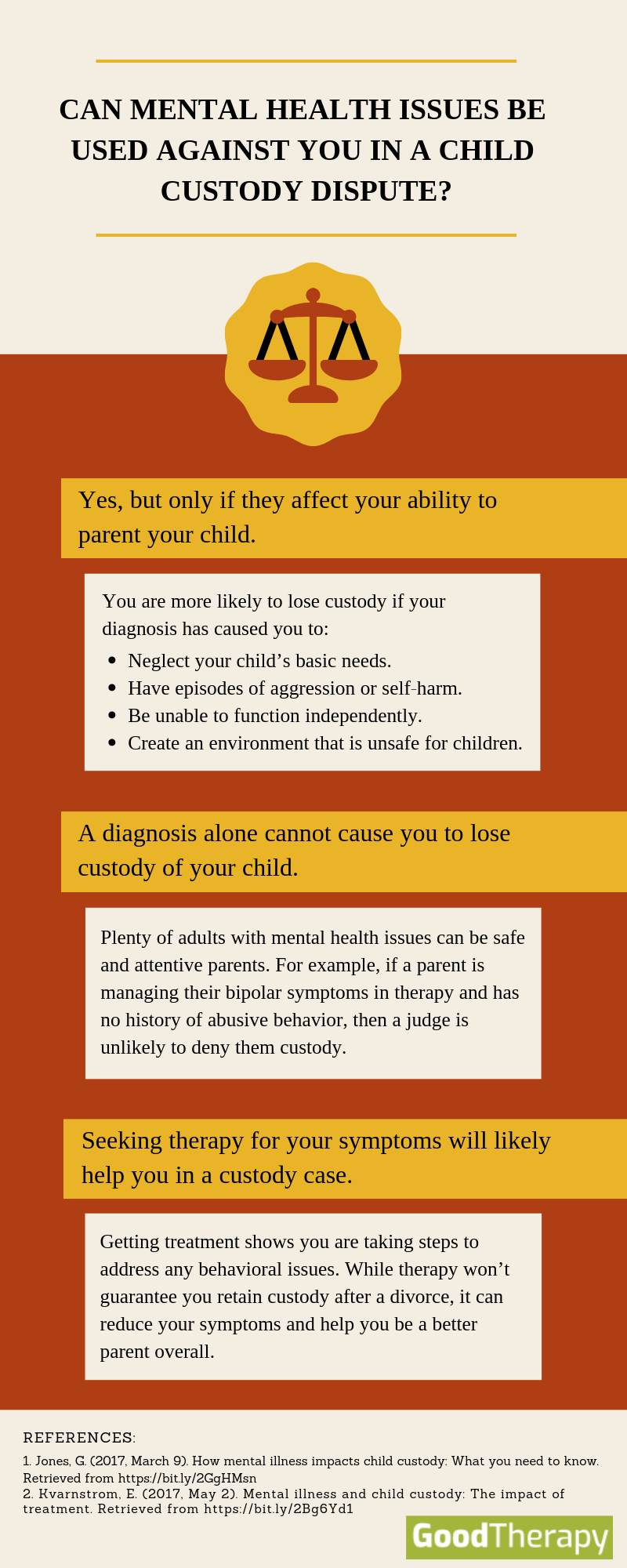
Infographic Text: Can mental health issues be used against you in a child custody dispute?
Yes, but only if your condition affects your ability to parent your child. Â You are more likely to lose custody if your diagnosis has caused you to:
- Neglect your child’s basic needs.
- Have episodes of aggression or self-harm.
- Be unable to function independently.
- Create an environment that is unsafe for children.
A diagnosis alone cannot cause you to lose custody of your child. Plenty of adults with mental health issues can be safe and attentive parents. For example, if a parent is managing their bipolar symptoms in therapy and has no history of abusive behavior, then a judge is unlikely to deny them custody.
Seeking therapy for your symptoms will likely help you in a custody case. Getting treatment shows you are taking steps to address any behavioral issues. While therapy won’t guarantee you retain custody after a divorce, it can reduce your symptoms and help you be a better parent overall.
References:
- Jones, G. (2017, March 9). How mental illness impacts child custody: What you need to know. Retrieved from https://www.goldbergjones-or.com/child-custody/mental-illness-impacts-child-custody
- Kvarnstrom, E. (2017, May 2). Mental illness and child custody: The impact of treatment. Retrieved from https://www.bridgestorecovery.com/blog/mental-illness-and-child-custody-the-impact-of-treatment
 Imagine driving home from work, exhausted. Your mind is running through a to-do list to get through before bedtime. Make dinner. Clean up after dinner. Homework check. Showers. Bedtime routine. And so on.
But once you get home, you find that that to-do list is interrupted by your crying 4-year-old, your picky 10-year-old, and sibling conflict. It feels like it is you against the children. You find yourself yelling at them, threatening them, and feeling out of control.
You are not alone. Many parents struggle just like you do (even if they don’t Instagram those difficult times and all you see if how perfect their lives are).
The good news is, parenting doesn’t have to be this difficult. You don’t have to be frustrated with your kids and feel like you have to fight them to cooperate with you all day, every day. Now, I’m not saying your kids are never going to challenge you and every day will run smoothly, because that’s impossible. What is possible is reducing the amount of conflict you have at home and feeling more in control during conflict.
Here are five tips for reducing parent-child conflict:
1. MAKE EYE CONTACT
Many times kids are not listening when parents speak to them. Their eyes are glued to the TV, or they’re engrossed in a game they’re playing. Many parents respond by getting upset and yelling, making children “tune out the noise.”
What you can do is walk over to your child, get on eye level with them, make eye contact, and speak to them. If you have never done this before, your child might challenge you, but keep your cool and give them clear directives.
2. A-C-T
If you find your child doing something they are not supposed to be doing, you can use the A-C-T technique:
- A—Acknowledge the feeling. Use one sentence to let your child know you understand how they feel or their desire.
- For example, “Johnny, I know you want to shoot your brother with the dart gun…”
- C—Communicate the limit. Let them know what the limit to their behavior is.
- For example, “but your brother is not for shooting.â€
- T—Target alternative. Give your child an alternative behavior so they don’t fixate on the inappropriate one.
- For example, “We can draw a target and you can shoot at it instead.â€
When you use this technique, you can validate your child while letting them know there are healthy limits. The alternative behavior can keep them from feeling as if they are not allowed to have fun.
3. SET CLEAR CONSEQUENCES
If you have tried the A-C-T technique and your child is still not listening, you can follow with a natural and related consequence to their behavior. For example, if your child cannot use the dart gun responsibly, then they lose the privilege of using it.
Setting a consequence like this places the responsibility on the child to make an appropriate behavior choice, rather than feeling like you are punishing them by not letting them watch their favorite show. Losing TV privileges is not a consequence that will likely make sense to your child. They may not see a connection between their favorite show and the dart gun.
4. GIVE CHOICES
When your child is not listening to a directive you give them, you can give them two choices. A choice can let your child feel valued. It can also keep the child from feeling as if they are stuck with a decision made by their parent.
For example, if it’s time for dinner, but your child won’t stop playing a video game to come to the dinner table, you can say, “Johnny, you can choose to play for 2 more minutes and then come to the dinner table, OR you can choose to have me turn off the game in 2 minutes and you will not play the game tomorrow.â€
If you have to turn the game off for your child, you need to follow through with not letting them play tomorrow. By giving your child choices, you can give them the feeling of being in control and teach them responsibility.
5. CREATE A ROUTINE
Most children thrive on routine. It typically makes them feel safe and secure because they know what will come next.
If your children go to school, they have a routine at school which helps them go through their day in an organized way. When they get home, they can relax, but they still need routine. You can give them some free time when they get home, but let them know they have a set amount of time to relax and then homework time will follow.
If your children can’t tell time, you can use a timer and give them time to transition from downtime to homework time. Think of what your routine was when you were a kid and whether that worked for you. Talk to other parents about the routines they have for their kids and what is working for them.
Following these tips can help improve your relationship with your child and reduce conflict. It may not be easy at first, but if you keep at it, these behaviors often become easier with time. If you and your child continue to struggle, feel free to contact a family therapist or child counselor for support.
Reference:
Bratton, S. C., Landreth, G. L., Kellam, T., & Blackard, S. R. (2006). Child parent relationship therapy (CPRT) treatment manual. New York, NY: Routledge Taylor & Francis Group.
 “Don’t you walk away when I’m talking to you!”
“But Mom!”
“Don’t ‘but Mom’ me. I’m not finished here!”
Sigh. Eye roll.
“You’re losing your phone for a week for being so disrespectful.”
Bedroom door slams.
“Make that two, you ungrateful little brat!”
Maybe things aren’t this bad in your home. Maybe they are worse.
The adolescent years are difficult for many families. To make things more complicated, puberty begins earlier and children leave home permanently later than in any previous generation. This means parents may spend more time navigating changes and challenges that arise as their children become adults. [fat_widget_right]
Developmental stages are determined by internal biological clocks. The age at which a child learns to walk, begins talking, understands object permanence, understands that death is permanent, or develops romantic attractions is determined mostly by biology, not parenting. It is often easier for a parent not to personalize their 4-year-old repeatedly asking “why?” than it is not to take the individuation attempts of a teen personally. On top of stress that may occur as teenagers find their independence, parents are often exhausted from work, household responsibilities, parenting obligations, and extended family needs.
Burnout and Parents of Teenagers
Many households are run by single parents or have a disabled parent in the home. Trying to squeeze in a little self-care, exercise, and time with friends may seem nearly impossible when it’s needed most.
I invite parents who seek counseling with me to first consider if heated exchanges at home are, in part, a signal they are burned out. When parents are sleep-deprived, experiencing relationship issues, or neglecting activities that recharge their emotional batteries, it is often apparent in the tone they set for the household.
Why Is Your Teenager Disrespectful?
Adolescent anger or angst is not a parent’s fault. In fact, outward expressions of anger may be a sign of adolescent depression. If this is a concern, calmly take your teen to a licensed counselor or to their physician to be evaluated. Most tension between parents and adolescents is a normal part of individuation. Remember, it is up to the adult, not the adolescent, to stop the back-and-forth.
Adolescents do not have the insight, power, or privileges adults do. They can’t sign legal documents or stay out past curfew, and they depend on their parents for finances, health care, extracurricular activities, vacations, clothes—nearly everything. A teenager’s dependency is often at odds with their strong emotional desire for independence. This battle rages within the teen and more often than not, spills over onto those closest to them.
Handling Disrespectful Behavior: Be the Example
Respecting a teen’s feelings is not the same as giving them everything they want. Validating that an adolescent has the right to hope and dream for anything without caving in to their demands can build mutual respect and foster dignity. In households where parents are confident in the parameters they set, the teen can express their frustration, agitation, even anger, and the parent does not take their emotions personally.
It is impossible to teach an adolescent respect by displaying disrespect. Scolding, shouting, belittling, redundancy, physical aggression, and humiliating, no matter how deserving of these the teen may seem at the moment, will only result in the same tactics being used against the parent.
Adolescent moods can change moment to moment. Parents who focus primarily on making a teen happy tend to defend themselves, try to get the teen to see things their way, and shame the teen if they express uncomfortable emotions about the parent’s decision. When parents are clear they are responsible for their own emotions and don’t blame others (including their children) for how they feel, it’s easier for a teen to understand they are also responsible for their own feelings.
It is impossible to teach an adolescent respect by displaying disrespect. Scolding, shouting, belittling, redundancy, physical aggression, and humiliating, no matter how deserving of these the teen may seem at the moment, will only result in the same tactics being used against the parent. These are often employed by the teen in less sophisticated or polite ways.
6 Tips for Parents with Disrespectful Teens
What is the alternative for parents? Those with disrespectful teens may find the following tips helpful.
1. Model respect.
Set up expectations ahead of time. Write them down. Be consistent and don’t change your mind at the last minute. If you feel resentful about a privilege you are giving, set up a predictable reward system and have your adolescent earn that privilege. Doing so may make it easier not to hold privileges over their head when you feel taken for granted.
2. Don’t get sucked into arguments about facts or perceived facts.
Your teen has much more time and energy than you do to collect good argument data. Remember that you have the right to set a boundary just because you’re comfortable with it.
If you are clear with yourself about what you will contribute (phone, computer, driving to a friend’s house, money, shopping, entertainment, etc.), you may spend less time in conversations defending yourself and your decisions. You might also have more energy to validate your teen’s feelings. Use phrases such as, “I can see you are disappointed,” “It’s okay to be upset,” and “It looks like you’re frustrated.” Don’t try to show your teen a different way to look at the situation. They may interpret this as an attempt to change how they feel or think that you believe how they feel is wrong.
3. Practice active listening.
Demonstrate you are really listening and that you have compassion for their frustration. Adolescents are trying to figure out who they are, separate from their parents. They are experimenting with ways to cope with strong emotions. The more methods for handling strong feelings you demonstrate, the more ideas they may have to choose from.
4. Take time for yourself.
Spend time with quality friends, exercise, pursue a creative outlet, listen to music, dance, laugh, write, plan outings, eat healthy foods, learn something new, organize your surroundings, go to therapy, garden, or volunteer where you feel appreciated. Show your adolescent that everyone is responsible for their own happiness and peace of mind.
5. Be sure to laugh.
Lead conversations with humor. Don’t take every conversation so seriously. Laughter lightens up a household, but sarcasm or belittling humor do not.
6. Give compliments.
So many seemingly bad behaviors in teenagers stem from a desire to be addressed. Be sure you are giving at least five compliments for every one directive, which is telling your teen what to do or how to change. Finding things to compliment may be hard to do in a defiant adolescent. Push yourself a bit. The more you model that you admire your child, the more they may see what respect looks like.
If you continue to feel frustrated with the arguments and attitudes in your home, consider family therapy. The sooner a family seeks treatment, the easier it can be to begin moving toward a harmonious, respectful household.
With some focused effort, the opening conversation in this article can sound more like:
“I can see you’re done talking about this. I’ll send you a text with the rest of what I want to say.â€
“But Mom…!â€
“It’s okay, I’ll text you. It’s a good strategy to spend some quiet time alone.â€
Sigh. Eye roll.
“We’ll talk later.â€
Bedroom door slams.
“I know this is hard. Hang in there, we’ll get through this. I love you.â€
Reference:
Sawyer, M. S., Azzopardi, P. S., Wickremarathne, D., & Patton, G. C. (2017, January 17). The age of adolescence. The Lancet: Child and Adolescent Health, 3(2), 223-228. doi:Â https://doi.org/10.1016/S2352-4642(18)30022-1
 To gather information about the parent-child relationship, I often ask parents, “If you could wish for one thing for your child, what would that wish be?†I might also ask,“What do you want for your child as they transition into adulthood?â€
Exploring a parent’s wishes for their child can help increase understanding of the parent-child relationship. This is important whether you are working with parents in a school setting or in private work.
Generally, the responses I hear do not vary all that much. Parents say they want their child to be “happy†and experience “success.†When I push parents to define what these things look like, things can get interesting. Through a parent’s definition of “happiness†and “success,†I often learn more about their family values, approaches to parenting, and the pressures a child may be experiencing.
Parents often ask me if they answered “correctly†or how I would answer the same question. I share my own greatest goal for children: That, as they transition into adulthood, they possess the skills to be empathetic and independent adults. [fat_widget_child_counselor_right]
How can we help children become independent adults? An essential step toward accomplishing this goal is educating parents about the self-determination theory and autonomy-supportive parenting.
The Self-Determination Theory
The self-determination theory explains the three basic psychological needs people need to fulfill:
- Autonomy, or the need to feel free to choose their own behavior
- Competence, or the need to feel capable of effectively interacting with their environment
- Relatedness, or the need to feel close to and meaningfully connected to others
It’s important for these needs to be supported by a child’s environment in order for them to emotionally evolve and develop in a healthy way. A positive family environment can promote and support a child’s basic psychological needs. On the other hand, a negative family environment can hamper healthy psychological development (Deci and Ryan, 2000).
Autonomy-Supportive Parenting
How can we help children become independent adults? An essential step toward accomplishing this goal is educating parents about the self-determination theory and autonomy-supportive parenting.
Parents can practice autonomy-supportive parenting by creating an environment that supports autonomy. Parents who support the development of autonomy are involved in their child’s life but encourage independence and problem-solving skills. It’s important for parents to give children both age-appropriate autonomy and agency. By doing so, they help them develop at an appropriate level. This can have the effect of greater emotional well-being.
When children are autonomous, they are more likely to feel capable of making their own healthy choices. By supporting children in the development of autonomy and agency, parents also help children learn about family values, social norms, and essential rules.
Parents can support the development of autonomy by:
- Providing a rationale and explanation for family rules and behavior expectations. When children and adolescents understand reasons for rules and the context behind them, they have an easier time supporting and following those rules.
- Labeling and validating a child’s feelings and perspectives. Validating feelings is an essential component of mental health and growth. By normalizing emotions, parents can help them understand that everyone has challenging moments. This also helps children learn that strong feelings are nothing to be ashamed of.
- Minimizing judgement and control. Many parents may try to control their kids. Psychologist Dr. Ross Greene recommends parents try to influence children instead. Parents who attempt to control children can become dependent on power-oriented strategies. By adopting a more collaborative parenting style, as Greene suggests, parents make room for children to develop greater autonomy. This in turn helps children develop the skills necessary to become independent adults.
- Allowing children to make choices. By providing age-appropriate opportunities for children to make independent choices and decisions, parents are giving them a healthy sense of agency and control.
- Supporting growth and new challenges by scaffolding and practicing new skills with children. In construction, scaffolding helps supply extra support to the building being erected. When the building is finished, the scaffolding is removed, and the structure is able to stand independently. Parents who use scaffolding education offer children similar support. Scaffolding skills incorporate information and skills children already have. This approach helps foster greater autonomy and independence.
- Letting children solve problems on their own. Parents often feel as if they should swoop in and rescue their child when they encounter a challenge. But when problems arise, it’s often better to brainstorm together and list possible solutions to the challenge at hand. Offer guidance when needed but encourage youngsters to problem-solve independently.
- Letting children struggle (safely). Every child encounters failure at some point. Trying and making mistakes or failing is part of growth. If children do not develop healthy coping mechanisms around failure, they are more vulnerable to anxiety. It is essential for parents to model that failure and making mistakes are essential parts of the learning process. By letting children learn from their mistakes, we are giving them an important opportunity to develop resilience, grit, confidence, and coping skills.
If you want to learn more about how you can help your children develop autonomy, please reach out. A counselor trained in child and family counseling can offer support and guidance. [amazon_affiliate]
References:
- Deci, E. L., & Ryan R. M. (2000). The ‘what’ and ‘why’ of goal pursuits: Human needs and the self-determination of behavior. Psychological Inquiry, 11(4), 227–268.
- Greene, R. W. (2017, August 15). Raising human beings: Creating a collaborative partnership with your child. New York, NY: Scribner.
 I am a therapist. But I am also a mother of three young children. And as I navigate the challenging yet rewarding years of parenthood, I am thankful for my psychology background and training.
It takes a lot of strength to raise a household of young children. It may take even more strength to do so while remaining positive, affirming our children, and communicating in a loving manner. Understanding children from a developmental lens can help immensely.
Erikson’s Stages of Development
One thing I continue to rely on is Erik Erikson’s stages of psychosocial development. This tool has been extremely helpful as my children progress through the toddler years. One of them is three years old, or, as some of my fellow parents put it, a “threenager.”
Erikson terms this stage of development as autonomy vs. shame and doubt. During this phase, a toddler’s developmental task is to become independent from their parents. As they seek to understand their identity, toddlers make their needs and desires clear. It can often feel like every choice they make is a new battle. My “threenager†has opinions about her clothes, her shoes, and the way she wants to wear her hair. I think I am helping her out by doing small things for her. But I am often met with resistance and the response, “No, Mommy, I want to do it myself.†[fat_widget_right]
Erikson held that when these attempts to express themselves are met with encouragement, toddlers will develop a sense of autonomy and independence. If these attempts are met with resistance or punishment, on the other hand, the toddler will develop a sense of shame and doubt and carry it into adulthood. (The term “threenager†is fitting because this stage closely resembles the teenage years, where the developmental task also involves creating an identity separate from a teenager’s parents.)
The Developing Brain
It has also been helpful for me to understand not only what developmental changes are happening, but also what is going on in terms of brain development.
The ability to integrate right-brain emotional experiences with left-brain logic and understanding is key to a healthy brain. How can we help our young children begin this process?Â
According to Siegel and Bryson, parents must learn to understand how their child’s brain works. This knowledge is useful because it can help us parent more effectively. One of the most important concepts to understand is left to right brain integration. Siegel and Bryson explain that a healthy brain is an “integrated brain.†This means the healthy brain uses left and right brain hemispheres to understand, make meaning, and organize experiences. The integration process takes a lifetime to perfect. But we can help our children begin this process early in life.
We first need to understand the difference between the left and right hemispheres of the brain.
The left hemisphere of the brain:
- Creates order
- Helps us understand things logically
- Describes cause and effect relationships.
The right hemisphere of the brain:
- Is holistic
- Is emotional
- Stores and retrieves autobiographical memories
The ability to integrate right-brain emotional experiences with left-brain logic and understanding is key to a healthy brain. How can we help our young children begin this process?
Consider a toddler who has become overwhelmed by emotions. Toddlers can easily become emotionally flooded. When emotions overwhelm them, they might throw a tantrum, yell, or cry uncontrollably. This happens because their brains are right-brain dominant. In other words, they are not driven by logic, responsibilities, and time. This makes sense from a development perspective. The left-brain hemispheres do not start to kick in until a child is around four years old.
So how can we effectively handle this situation? First, we need to remember not to dismiss or deny their feelings. Avoid saying things like:
- “It’s not that bad.”
- “You’re fine.”
- “You need to be more careful.”
Instead, acknowledge what your child might be feeling. Help them tell a story about what happened. You might say something like, “Wow, that looked like it hurt. You were running, and then you fell and scraped your knee.â€
Some time later, when you are connecting with your child and they are not emotionally flooded, help them understand the lesson in the story. You can even do this on a different day. You might say, “Remember when you fell and scraped your knee on the asphalt at school? Maybe you should slow down on the asphalt at school.â€
Helpful Tools for Parents of Toddlers
Parenting toddlers may be extremely difficult at times. But there are many tools that can help. A recent study from the Department of Psychology at Arizona State University surveyed over 2000 mothers to help understand factors that contribute to overall well-being. Of those surveyed, 46% had a graduate degree, 37% had a college degree, and the remaining 16% had a high school education.
The mothers were asked about satisfaction with parenting, parenting guilt, and parenting role overload. The survey also assessed for maternal adjustment with questions related to emptiness, fulfillment, life satisfaction, and perceptions of their child.
Some results indicated that three areas were consistently linked with maternal depression:
- Role overload, or feeling overwhelmed by their responsibilities
- Maternal guilt, or feeling as if they weren’t doing enough for their children
- Child negative behaviors, or observing their child is distant, rude, or disrespectful to them.
However, the following four areas of personal support helped provide a buffer against maternal depression:
- Unconditional acceptance
- Feeling comforted when needed
- Authenticity in relationships
- Friendship satisfaction
Even when mothers scored high in the three areas linked to maternal depression, when they also scored high in the buffer areas, they were more likely to score high on parenting satisfaction scale.
How can mothers (or any parent) apply these findings to their own experiences in parenting? The old saying “it takes a village†rings true here. If you are a parent, attempt to create a supportive culture of other parents who:
- Are honest about the highs and lows of parenting
- Support each other even when they are not “perfect parentsâ€
- Provide comfort when you feel overwhelmed with responsibilities
Some aspects of parenting toddlers can be a real challenge. Research supports that. Finding strength and support from other parents who are experiencing the same difficulties (and who are also honest about their struggles) is a key element in parental satisfaction. If you are currently struggling, consider seeking help. A compassionate, qualified counselor can offer support and help you explore strategies for parenting satisfaction and success.
References:
- Crain, W. (2005, August 12). Theories of development: Concepts and applications (5th ed.). Upper Saddle River, New Jersey: Prentice Hall
- Luther, S. S. & Ciciolla, L. (2015). Who mothers mommy? Factors that contribute to mothers’ well-being. Developmental Psychology, 51(12). 1812-1823.
- Siegel, D. J. & Bryson, T. P. (2011). The whole-brain child: 12 revolutionary strategies to nurture your child’s developing mind. New York, NY: Random House, Inc.
Children are a significant part of most parents’ lives. While the act of parenting is not always easy, most parents feel it is worthwhile. Some research indicates having children can increase well-being. It is more likely to do so if raising the child contributes a sense of meaning and purpose to the parent’s life.
Some of these quotes describe the joy of being a parent. Others reveal insights about its challenges. Psychologists often speak to the subject of children and parents. This is because parents have such great influence over how their children may grow and develop.
If you are a parent yourself or have been impacted by parents or parental figures, these quotes are for you. Share a quote with someone close to you or join the conversation on Facebook or Twitter!








[fat_widget_right]
Good parents can prepare future generations to live functional and meaningful adult lives. A childhood lacking in parental support may result in trauma that echoes through generations.
Parenting often focuses on the bond between parent and child. The nature of this relationship can be tumultuous. Toddlers may cause stress through their often messy tendencies. Teens may push back against even reasonable boundaries. Mental health issues may also complicate these relationships.
If parenting is causing you distress, a therapist may help. Reaching out to a therapist about parenting matters does not mean you have failed as a parent. If anything, it means you are taking necessary steps to ensure the healthiest outcome for your child and family. Many people grow up with bad or abusive parents. Acting out negative parenting examples only passes the problem on. Therapy may allow parents to confront these patterns. Therapists can help parents learn new, healthy parenting skills. Parents may then be less likely to repeat a negative cycle of behavior toward their children.
Reference:
Nelson, S. K., Kushlev, K., & Lyubomirsky, S. (2013). The pains and pleasures of parenting: When, why, and how is parenthood associated with more or less well-being? Psychological Bulletin, 3(140), 846-895. doi: 10.1037/a0035444
 Many aspects of a person’s life can influence their parenting style. The way an adult was parented, as well as parenting books and other guides, are a few factors. A parent’s unique fears and hopes for their child are another major influence. Cultural factors, such as gender roles, the community in which the family lives, religion, politics, socioeconomic status, and ethnic norms also play a role.
When parenting styles clash, children get inconsistent messages from their parents. This can cause confusion in children about how to act and what to expect in response to their behavior. Differences in parenting style may also increase conflict in a relationship. Parenting can be difficult and time-consuming even when parents agree. When they don’t, parenting approaches can be a source of near-constant bickering.
It is possible for parents to get along and send a consistent message to children even when their styles conflict. In fact, different parenting styles can even complement one another.
The Four Parenting Styles
Parenting style has two main components. One is the degree of control a parent attempts to exert over the child. The other is the amount of warmth and affection a parent shows. [fat_widget_right]
Researchers often divide parenting style into four categories. Those types, and how each might handle a child having a tantrum, follow:
- Authoritarian. These parents are strict and exert high levels of control over their kids. They may show little warmth. An authoritarian parent might respond to a child having a tantrum with punishment or yelling. They would not likely wish to understand why the child had the tantrum or address the child’s feelings about it.
- Authoritative. Authoritative parents are relatively strict and enforce the rules they make. They also display affection for their kids. An authoritative parent might respond to a tantrum by setting clear boundaries about what is and is not acceptable. They may then remove the child from the situation that triggered the tantrum. Authoritative parents are more likely to discuss why the child had the tantrum and to be concerned about a child’s intense emotions.
- Permissive. These parents show plenty of love and affection but enforce few boundaries. A permissive parent might not respond to a tantrum at all. Alternatively, they might respond by giving the child a gift or otherwise appeasing them.
- Uninvolved or neglectful. Neglectful parents don’t enforce clear rules. They may display little or no interest in the child. An uninvolved parent might not notice a tantrum or be somewhere else when a tantrum occurs.
Most research shows authoritative parenting is the most effective parenting style. Authoritative parenting blends respect for the child with attention to social norms.
Authoritarian parenting, by contrast, may produce children who are too obedient. These children may need to be told what to do often once they are adults. Some research links authoritarian parenting with an increased risk of problem behavior. One such behavior is substance abuse.
Permissive parents may support good self-esteem. But the lack of boundaries may also increase the risk of problem behavior. Children who are not highly self-motivated may struggle in school. Parents who try to appease children who show bad behavior may also encourage future misbehavior.
Neglectful parenting can be harmful. It may produce children who have little support and a weak understanding of social norms. They may struggle to know how to behave, learn, or interact with others.
Parenting style may shift and change. Parents who know their current style can incorporate qualities that lend balance to their approach. For example, a parent who realizes they are uninvolved may focus on learning how to be more engaged in their child’s life.
How Conflicting Parenting Styles Can Affect a Relationship
Any difference in parenting style can lead to conflict. Even two parents who share a similar style may argue. For instance, two authoritative parents may agree on the importance of rules and affection. But they may disagree about what this means. Are time-outs acceptable? At what points should a child be rewarded or punished? Which behaviors are forbidden?
Significant differences in parenting style can be even more challenging. Some common clashes include:
Disagreements can make it difficult to present a united front. They may even lead to problem behavior in children.
- Authoritarian vs. Authoritative. These parents may disagree about how much affection to give. They may argue over whether to punish a child, when, and how severe the punishment should be. These parents may also disagree about whether to give rewards for good behavior.
- Authoritative vs. Permissive. Permissive and authoritative parents may agree about the need for love and affection. But they may have strong disagreements about which rules to enforce and how to enforce them.
- Permissive vs. Uninvolved. Permissive parents want to give their children a lot of love. Uninvolved parents may want few or no substantive interactions with their children. This may cause the permissive parent to feel overwhelmed by the amount of care they must provide.
- Authoritarian vs. Permissive. Authoritarian and permissive parents may disagree over when and whether to punish children. Permissive parents might even view authoritarian parents as abusive. Meanwhile, authoritarian parents may see permissive parents as neglectful.
- Authoritative vs. Uninvolved. Authoritative parenting is high-effort parenting. It offers significant guidance and much affection. Uninvolved parents may prefer to stay on the sidelines. Parents who differ in this way could encounter ongoing conflicts.
Differences in parenting style are just one point of conflict for parents. Cultural values, beliefs about social norms, or political views may lead to major parenting disagreements. For instance, some parents see spanking as a form of abuse. Others see it as necessary discipline.
Tips for Getting Along When Parenting Styles Differ
Parenting can be exhausting and emotionally intense work. Some people derive much of their self-image from their role as parents or from their child’s behavior. When parents disagree, they may feel angry or misunderstood. Arguments can make it difficult to present a united front. They may even lead to problem behavior in children. A few strategies may help:
- Explore how your parenting styles complement each other. For instance, a permissive parent may help an authoritarian parent be more affectionate. Meanwhile, an authoritarian parent may support a permissive parent in setting boundaries.
- Develop a set of family rules on which everyone can agree. These include rules for the children as well as rules about how to discipline them. Two parents might agree that spanking is never acceptable. They may decide children must lose privileges or face another penalty if they hit others.
- Don’t undermine one another. Parents must present a united front. Unless a child is in danger—such as from a parent who is berating or injuring them—it is best to discuss conflicts later. Support your partner’s parenting decisions even when they are not ones you would have made.
- Learn about parenting together. Read parenting books and discuss them, or join a parenting support group. Select parenting experts you both trust.
When other strategies don’t work, family counseling can help. It may allow family members to better understand each other. It can also help with challenging child behavior. In addition, parents may benefit from couples therapy. This can teach couples what underlies their parenting style clashes and how to bridge the gap.
References:
- Garey, J. (2016, October 20). Conflicts over parenting styles. Retrieved from https://childmind.org/article/conflicts-over-parenting-styles
- Hadfield, J. (2016, May 26). Teens and alcohol study: Parenting style can prevent binge drinking. Retrieved from https://news.byu.edu/news/teens-and-alcohol-study-parenting-style-can-prevent-binge-drinking
- Joseph, M. V., & John, J. (n.d.). Impact of parenting styles on child development. Global Academic Society Journal: Social Science Insight, 1(5). Retrieved from http://scholararticles.net/impact-of-parenting-styles-on-child-development
- Parenting in America. (2015, December 17). Retrieved from http://www.pewsocialtrends.org/2015/12/17/parenting-in-america
 Social anxiety causes feelings of panic or fear during interactions with people. It can occur only in certain situations or nearly all of the time. For adults, it often means avoiding other people, groups, or large crowds. But social anxiety can show up much earlier in life. In infants and toddlers, social anxiety will look much different that it does in adults.
Where Does Social Anxiety Come From?
It can be hard to pinpoint what causes social anxiety in infants and young children. One study found infants could learn socially anxious behavior from their mothers. A mother with social anxiety may display those behaviors to a child through interactions with strangers. The study indicated these nonverbal cues could teach the child that strangers are a source of anxiety.
Genetics also affect whether a child will have social anxiety. Genes help determine an infant’s disposition, or personality. Research shows certain genetic traits can increase risk for anxiety and situational phobias. Some of these traits may include inhibition and fear of being judged. Fear in low-threat situations could also help predict social anxiety.
Home life and environment can exacerbate risk factors. Trauma could trigger social anxiety at a young age. Addressing these issues with children early may pave the way for good mental health in the future. In addition, the severity of a child’s social anxiety can vary. Some children grow out of it as they develop, while others internalize the anxiety when they are older. [fat_widget_right]
Signs of Social Anxiety in Infants and Toddlers
Social anxiety may look similar to shyness, separation anxiety, or autism. There is no set age when symptoms start to appear. It is common to notice social anxiety in preschool or other social settings. However, parents may notice signs that could predict social anxiety in children from the time they are newborns.
Signs of social anxiety in infants may include:
- Fear of or disinterest in new things
- Difficulty calming down
- Strong reactions to small changes
- Being upset by new noises or people
- Seeming overly sensitive to mild discomfort
These behaviors can be stressful for parents. Infants cannot communicate clearly what is causing them distress. Parents may worry their child is in pain or that they have done something wrong.
As infants grow into toddlers, their social anxiety may appear in other ways. It may be easier to understand what is causing a toddler stress. But knowing how to deal with a socially anxious toddler can still be challenging.
Signs of social anxiety in toddlers may include:
- Fears and phobias
- Refusal to give up routines
- Noise or tactile sensitivity
- Dislike for getting dirty
- Lengthy rituals
- Picky eating
- Following parents constantly
- Shyness or distrust of strangers
- Sleep problems
Parents of a socially anxious toddler may worry they are raising a “difficult†child. This causes some parents to punish their child for anxious behavior. Punishing a child for signs of social anxiety can have the opposite effect of what is intended. Toddlers who are punished for anxiety-rooted behavior may “close off†from parents. One study showed that harsh parenting may cause an already fearful toddler to become even more anxious. It also led to lowered neural processing ability in preschool.
A therapist can help address behavior issues that stem from social anxiety. They can show parents how to work with the behavior constructively.
How Are Separation Anxiety and Social Anxiety Related?
Reading books or watching movies that depict confident young children can give watching toddlers a hero to mimic.
Separation anxiety can be normal in young children. They may cry or become worried when a parent drops them off or leaves the room. But separation anxiety may be soothed in the short term. Some parents use entertaining distractions to help kids settle into social situations.
But for toddlers with social anxiety, distractions may not improve the situation. Social anxiety can cause children to worry about being around others as well as separation from parents.
Social anxiety can stem from separation anxiety, or both may occur together. Toddlers with social anxiety may seem afraid to participate in group activities or play with peers. If they also have separation anxiety, it may be difficult to calm them after a parent leaves. This can make preschool or daycare a stressful event.
Tips for Parents of Socially Anxious Infants and Toddlers
If an infant shows signs of social anxiety, it can help to model calm, self-soothing behavior. Modeling healthy reactions in social settings can help teach young children these behaviors. In addition, giving toddlers a chance to practice before new situations may help them feel more confident. For example, a parent might invite them to practice show-and-tell before the big day. Reading books or watching movies that depict confident young children can give watching toddlers a hero to mimic.
Instead of feeding into fearful behaviors, it can be more helpful when parents give enthusiastic praise when toddlers try something new. Explaining a child’s anxiety to any caregivers, teachers, and other parents will help them understand their behavior. This can help inform how they act around the child. Caregivers can help by fostering positive interactions. This can reinforce the idea that others do not have to be a source of anxiety.
Medication and Socially Anxious Infants and Toddlers
It is considered best practice to not give medication to children under the age of 5, except in extreme cases. Social anxiety does not typically warrant medication at this age. Young children are sensitive to the effects of medication. Medicating too early may cause unwanted side effects. If the anxiety persists when the child is older, consult a professional about the next step for treatment.
How Therapy Can Help Infants and Toddlers with Social Anxiety
It may be too soon to tell if an infant or toddler has social anxiety. A therapist can help parents or caregivers address behaviors that indicate a child’s discomfort in social settings. Some therapists specialize in mental health issues in young children. They may give an assessment that more clearly reveals where the child is struggling.
Seeing a family therapist together can be helpful for parents. It can give them guidance for any difficulties they have in helping their child. Seeing parents talk calmly with a therapist can help children with social anxiety understand the social setting is safe for them. A therapist may also be able to identify root causes of a child’s social anxiety.
Children grow and change over time. Understanding that it is always okay to ask for help is a lesson they are likely to take with them through the rest of their life.
References:
- A guide for community child serving agencies on psychotropic medications for children and adolescents. (2012). American Academy of Child & Adolescent Psychiatry. Retrived from https://www.aacap.org/App_Themes/AACAP/docs/press/guide_for_community_child_serving_agencies_on_psychotropic_medications_for_children_and_adolescents_2012.pdf
- Brooker, R. J., & Buss, K. A. (2014). Harsh parenting and fearfulness in toddlerhood interact to predict amplitudes of preschool error-related negativity. Developmental Cognitive Neuroscience, 9, 148-159. doi: 10.1016/j.dcn.2014.03.001
- Buss, K. A. (2011). Which fearful toddlers should we worry about? Context, fear regulation, and anxiety risk. Developmental Pscyhololgy, 3(47), 804-819. Doi: https://doi.org/10.1037/a0023227
- Cuncic, A. (2018, February 16). How to cope as a parent of a preschooler with social anxiety. Retrieved from https://www.verywellmind.com/preschool-child-with-social-anxiety-3024286
- de Rosnay, M., Cooper, P. J., Tsigaras, N., & Murray, L., (2006). Transmission of social anxiety from mother to infant: An experimental study using a social referencing paradigm. Behaviour Research and Therapy, 8(44), 1165-1175. Doi: https://doi.org/10.1016/j.brat.2005.09.003
- Kendler, K. S., Prescott, C. A., & Meyers, J. (2003, January 9). The structure of genetic and environmental risk factors for common psychiatric and substance use disorders in men and women. Arch Gen Psychiatry, 9(60), 929-931. doi: 10.1001/archpsyc.60.9.929
- Rogers, C. E., Sylvester, C. M., Mintz, C., Kenley, J. K., Shimony, J. S., Barch, D. M., & Smyser, C. D. (2017). Journal of the American Academy of Child & Adolescent Psychiatry, 2(56), 157-166. doi: https://doi.org/10.1016/j.jaac.2016.11.005
- Schwartz, C. E., Wright, C. I., Shin, L. M., Kagan, J., & Rauch, S. L. (2003, June 20). Inhibited and uninhibited infants “grown upâ€: Adult amygdalar response to novelty. Science, 5627(300), 1952-1953. doi: https://doi.org/10.1126/science.1083703
- Social anxiety: Risk factors. (n.d.). Retrieved from https://childmind.org/guide/social-anxiety-disorder/social-anxiety-disorder-risk-factors
- Versfeld, P. (n.d.). The highly sensitive child and behavioral inhibition. Retrieved from https://skillsforaction.com/highly-sensitive-child
 Social media is nearly impossible for parents to avoid. Alarming stories of cyberbullying, suicides following social media abuse, and catfishing may tempt parents to forbid their children from using it.
Yet social media also offers some benefits. It can connect kids to peers and provide an outlet for exploring new identities. It may even offer support for people with depression.
New Technology, New Challenges: Social Media and Kids
Kids spend more time in front of screens than ever before. A 2007 study of children ages 0-6 found that 75% of kids watch TV each day, for an average of an hour and 20 minutes. Twenty-seven percent of 5- to 6-year olds used a computer each day. Research published in 2018 found that 90% of kids ages 13-17 have used social media. Seventy-five percent have at least one active profile. Fifty-one percent say they use social media daily.
The American Academy of Pediatrics recommends limiting screen time for toddlers and preschoolers. They suggest parents avoid digital media altogether for children under 18 months. Also recommended is that each family develop a “family media plan.†This can help outline how the family plans to use digital media.
The AAP emphasizes it’s important for children to have plenty of time for physical play and creative learning. They also remind us that screen time can be beneficial when correctly used. [fat_widget_right]
How Social Media Can Affect Kids’ Mental Health
Social media use presents a number of dangers, including:
- Internet addiction
- Cyberbullying, which affects nearly 1 in 4 children
- Sexual harassment
- Low self-esteem. This may occur when children are teased or bullied. It may also crop up when they negatively compare themselves to people they follow online.
- Privacy concerns
- Cyberstalking
- Avoiding in-person social interaction
- Spending less time playing, exercising, or reading offline
- Pressure to conform
Not all social media use is harmful. Social media can also:
- Help children connect with friends and relatives
- Offer support to children with alternative identities
- Provide support for mental health issues such as depression and anxiety
- Help children feel less isolated
- Encourage self-expression
- Support learning about other people and cultures
Tips for Managing Child Social Media Use
Therapists often help families better understand and safely use social media. Some expert strategies that may help include:
Lead by example.
Barrie Sueskind, MA, MFT acknowledges that social media allows children to stay connected with peers. But social media may amplify the “Fear of Missing Out,” or FOMO, for kids and teens. “There is always someone whose life looks better on social media. It’s easy to feel inferior by comparison,†says Sueskind. “Remind your kids that social media is about image, which is superficial in comparison to real world interactions and meaningful relationships. Make sure you set aside tech-free time to connect as a family. Establish a rule that meals are device-free and follow it yourself. If you can’t tear yourself away from your phone, you can’t expect your kids to willingly part with theirs. Teach your kids by example the value of being present with the people around them.â€
Set limits and educate.
Katelyn Alcamo, LCMFT suggests that delaying access to having a smartphone until teen years is a good start. Children who are younger may not be developed or mature enough to handle the responsibility that comes with owning a smartphone. If parents are concerned about safety, Alcamo suggests providing a basic phone that can be used for making calls.
- Educate: “No matter how hard parents try, kids will find a way to access things like Instagram and Snapchat,†Alcamo says. “One of the most important things is to teach your kids healthy technology habits. Teach them about the importance of privacy settings and not sharing too much personal information online. Teach them what to do if they are being cyberbullied or see a peer being cyberbullied. Let them know it is important and safe that they come to you when they don’t know how to handle a situation online or come across something they were not supposed to.â€
- Set limits: Alcamo acknowledges it can be easy for kids and adults to become engrossed with tech devices for long hours. She suggests addressing this by setting limits on how long kids can be on a device. “I also recommend a technology curfew for kids. This means all devices should be stored with the parents after a certain time of night. This is the time when most kids get into trouble with their social media use, as it is often unsupervised. There is no one available to support them if something negative happens,†she says.
Being curious, opening up respectful conversations, and using digital media as a platform to better understand your child is every bit as important as setting limits and being vigilant.
Alcamo recommends keeping tech devices in communal areas. This way, parents can observe what is going on and check in with their children. But if you notice something concerning, your response is important. “Don’t approach them punitively, but explore their feelings about what happened. Help them determine better choices for the future,†says Alcamo.
Be curious.
Lois V. Nightingale, PhD points out an opportunity parents often miss when setting rules for computer activities, like social media and video games: asking their kids what they like about their favorite online activity. Do they enjoy inspiring others who may have a similar challenge or interest? Or are they just trying to get as many followers as possible?
“Being curious, opening up respectful conversations, and using digital media as a platform to better understand your child is every bit as important as setting limits and being vigilant,†says Nightingale.
Spend time with your kids.
Monica Lake, PsyD, NCSP says strong relationships help children and parents communicate about social media. They allow parents to better understand their children’s use of social media.
“Parents must have a strong bond with their children. Doing fun things together like playing board games, taking silly pictures, remodeling a room, and volunteering can enhance this bond. It also increases the time parents and children spend together. These activities give parents more insight on their child’s social media beliefs and behaviors. Parents can also model good decision-making during these activities by guiding children through their thought process. For example, a simple statement such as, ‘Nice move. What made you think of that?’ can help children think about their own behaviors and promote good decision-making in the future,†Lake suggests.
Follow your children on social media.
Angela Avery, MA, LLPC, NCC says, “The advice I most often give parents about social media is to follow their children on each social media platform so they can stay informed on what their children are posting and liking. What children and teens ‘like’ can and should be discussed.â€
“For example, ‘I see that you liked Kylie Kardashian’s post. What do you like about it?’ This allows for conversation on influential topics that shape culture today, which you may or may not want your children to value. By discussing topics related to the posts, you plant seeds of broader thinking on a topic. ‘I saw that your friend posted a picture wearing a bikini. I wonder what her motivation was.’ In addition, parents have the duty to monitor social media accounts for safety and security purposes. It’s always appropriate to discuss what and what not to post.â€
Understand Why Children Use Social Media and What It Offers
Social media is merely a platform. It is neither good nor bad. Talking openly with children about why they use social media and what they feel they gain from its use can foster good communication. Parents should also learn as much as they can about social media—both benefits and risks. This knowledge empowers parents to understand new technology. It can help them make informed decisions about how their children can most effectively use it.
If you are concerned about how your children use social media, seek help from a therapist or other expert. Family therapy can support parents and children to set mutually agreed-to boundaries. Therapists often help families work through social media disputes and find healthy ways to engage with this emerging media.
Dear GoodTherapy.org,
Like most little boys, my 6-year-old son is messy. He tracks mud in the house, gets finger paint on the couch, and is basically a whirlwind of chaos. Until recently, it’s been a struggle to get him to wash his hands or take a bath. I come from a family of neat freaks, so sometimes I’m stricter with him than the situation deserves.
One day, my son came home after swimming in the creek down the road. When he grabbed a slice of pizza with his still-wet hands, my germaphobe alarm went off. I sat my son down and explained to him what germs were and how they could be on anything, even things that didn’t look dirty. I said he should always wash his hands so germs wouldn’t make him sick.
[fat_widget_right]
My boy always ignored my lectures before, but this time he took me seriously. Too seriously. Now he washes his hands after touching anything: his stuffed frog, the TV remote, even doorknobs! If he plays outside, he’ll wash his hands twice over. The skin on his knuckles is literally raw from all the washing. When the hand soap in his room ran out, he had an honest-to-goodness meltdown.
I have tried to explain that he doesn’t need to wash his hands ALL the time, just after using the bathroom or playing outside. My words didn’t help. He’s deathly afraid of getting sick. You’d think there was a plague going on from how anxious he gets.
I feel as if I’ve broken my boy, and I don’t know how to fix him. I had no idea my words would give him such a severe phobia. I’d take it all back if I could. Please tell me, how do I help my son? —Crisis of Cleanliness
Submit Your Own Question to a Therapist
Dear Crisis,
I imagine that feeling as if you have “broken†your boy and not knowing how to “fix†him creates a tremendous amount of pain for you—regret and guilt were palpable as I read your question.
It’s hard for parents to know how something is going impact their children. You say your son usually ignores your lectures, so you had no idea he would react like this. You make the best decisions you can with the information you have at the time. Unfortunately, things go a bit awry sometimes. Try to be gentle with yourself and remember you were only trying to get him to be better about washing his hands, which is a reasonable and responsible parenting goal.
A therapist could be instrumental in helping your son identify his feelings and develop coping strategies.
I wonder if your son would be comforted by the fact exposure to some germs is good for developing the immune system. Perhaps you two could spend a little time reviewing reputable websites that cover this concept. Maybe you could even schedule an appointment with his pediatrician to talk about it. You seem to have his attention on this issue, so perhaps he would be interested in learning more.
It’s also possible that, in time, the issue will take care of itself. Children go through phases. Sometimes a behavior or fear that arises with great intensity just fades out.
If educating him on germs—not just the danger they pose, but the value they hold—and/or time don’t resolve the issue, it might be helpful to partner with a therapist to further explore his feelings. If he has a heightened sense of anxiety in general, it’s possible this issue has simply become the focus. A therapist could be instrumental in helping your son identify his feelings and develop coping strategies.
However you proceed, I hope you will remember that your intention was simply to get him to wash his hands more—a good thing. You couldn’t have anticipated such a dramatic response, especially given his propensity for ignoring your lectures. Issues sometimes arise despite parents’ best efforts. The fact you are reaching out for help and trying to work with your son to move past this shows what a loving and dedicated parent you are.
Best wishes,
 It will come as no surprise that in my work as a middle school therapist, I come across kids who test boundaries, break rules, and make poor choices. It is also not uncommon to meet with parents at a loss for what to do and how to regain control.
Raising an adolescent is one of the most challenging jobs a parent will have. Suddenly you go from raising a sweet and affectionate child to managing a moody and rebellious teen. You might wonder what happened to the child you once knew. You also might find that the parenting strategies you once relied on no longer work.
While it is not all bad, it is easy for parents to get overwhelmed by the social, emotional, and behavioral changes that happen during adolescence.
Many parents don’t reach out for help until things have gotten out of control. When I meet a family for the first time, I am often meeting desperate parents who have tried everything in their bag of tricks to improve things, to little or no avail. By that point, the family has become quite entrenched in negative patterns.
[fat_widget_right]
During the first session or so, I explore with the parents the strategies they have used to address any concerns. Often parents report that they yell, lecture, threaten consequences, or try to rationalize with their teen. I follow up by asking which strategies have worked and which have not. No surprise, yelling often leads to escalation; lecturing doesn’t garner the desired response, and how can one rationalize with an irrational teenage brain?
Despite their desperation to change things, many parents tell me that they don’t often follow through with any threatened consequences. And why not? “Because they’ll be mad at me,†I’m inevitably told.
I am often incredulous. Of course teens will be mad when there is a consequence, especially a meaningful one. Trying to prevent a teen from being mad at you is like trying to prevent a baby from crying. Good luck.
So why this avoidance of angering a teenager? I believe the reason is both selfish and selfless. First, what parent wants to deal with a sulking, bitter, angry teenager? No parent I know, including me. And it is understandable for parents to want to be loved by their children. We sacrifice so much and work so hard to love and care for our kids. It is validating to get that love in return.
We are programmed to want to make our children happy. This desire often translates to avoidance of anything that makes our child upset, including enforcing consequences for negative behaviors.
Why would we want to make our child upset when there is enough adversity in the world? Let me tell you.
Despite how they may act, teens need rules and boundaries so they can both test them and feel protected by them. Creating structure and having predictable responses helps teens learn to self-regulate. It also helps them learn from their mistakes.
Rules and consequences are important for every child. Despite how they may act, teens need rules and boundaries so they can both test them and feel protected by them. Creating structure and having predictable responses helps teens learn to self-regulate. It also helps them learn from their mistakes.
Raising a teen is like bowling with bumpers. Sometimes the bumpers take the form of support and validation and sometimes they’re in the form of rules and consequences. Regardless, they serve to gently guide teens down a healthy and successful path. Not having rules and consequences is like removing the bumpers before your teen has developed the skills to function in the world.
Allowing your child to express anger in a safe environment also helps them to develop emotional intelligence. If you are constantly shielding them from frustration, anger, or sadness, they may not learn how to regulate these emotions or how to express them in socially appropriate ways. It is important to remember that parenting isn’t about being liked. Giving in on rules and consequences makes it harder for teens to engage in a world where there are rules and consequences.
So what can you do?
- Set realistic rules and consequences: This helps in many ways. First, it’s easier to enforce and stand behind rules you believe are logical and reasonable. Second, if you set realistic rules, your child may be more likely to abide by those rules. Realistic consequences are also important. Don’t threaten something you can’t enforce. Kids notice when parents are inconsistent in enforcing consequences and will take advantage.
- Don’t feel guilty, and don’t take it personally: Again, many parents avoid giving consequences because they fear their child will be upset—specifically with them. Remember, as long as your rules are realistic and your consequences fair, you are helping your child learn not only how to make better choices but to regulate their emotions. Be prepared for guilt trips from your child. Losing their phone privileges or being grounded is upsetting to them, so expect them to try anything they can to get you to change your mind. Know that their guilt, tantrums, and bad behavior is often nothing more than an attempt to get you give in. Once they learn to expect consistency from you, the pleading and manipulation will likely stop. They will come to understand that when you set a rule and a consequence, you mean business.
- Model healthy emotion regulation: Help your kids learn healthy ways of managing emotions. Give them space and permission to feel angry and disappointed when they are faced with a consequence for their behavior. These upsetting feelings will help them to make better choices. You can validate their feelings and suggest coping strategies without giving in.
- Start young: It is important to start young in helping kids learn about rules and consequences. I often see parents who didn’t have to do much of that because there were few problems when their kids were little. As a result, they were often lenient the few times their kids did make poor choices. However, things change when kids become adolescents. Not only are the stakes higher, but the pushback may be more intense if they don’t understand their behavior has consequences. While it is not impossible to change your parenting strategy after your child has come to expect no consequences, you will likely face a bumpier road.
The bottom line: rules and consequences are your friends. Make sure they are realistic and fair, and don’t let your child’s emotions and attempts at manipulation deter you.