 According to Ross and Halpern (2011), there are several definitions of dissociation. One of them (referred to as “the general systems meaning of dissociationâ€) is “the opposite of association†or the disconnection of two or more things that were once associated with each other. Another definition, presented by Steinberg and Schnall (2001), defines dissociation as “an adaptive defense in response to high stress or trauma characterized by memory loss and a sense of disconnection from oneself or one’s surroundings.â€
Dissociation occurs when someone disconnects from some part of himself or herself or the environment. It can occur in a number of different ways, including disconnection from one’s emotions, body sensations, memories, senses, etc. A normal and common phenomenon, dissociation can happen in mild forms even when there is not imminent danger or stress. Think of a time you drove somewhere, arrived, and then couldn’t remember the drive because your mind was wandering; an instance when you lost track of time because you were engrossed in a riveting television show; or when you disconnected from body sensations to avoid going to the bathroom when you were on a tight deadline at work.
[fat_widget_trauma_ptsd_right]
Dissociation is something we all do, and it is a vital part of our ingrained survival system. It is a part of the system that helps us to cope with stressful situations, which may otherwise feel overwhelming (Steinberg and Schnall, 2001). It is built in and is not pathological (Ross and Halpern, 2011). However, when a trauma occurs, sometimes this built-in system disconnects to a greater degree in an effort to protect the individual from traumatic material, body sensations, emotions, or memories that may be overwhelming.
Dissociation related to trauma occurs in varying degrees. On the lower end of the dissociation spectrum, for example, let’s say someone was in a car accident. A few days after the accident, the person finds that he or she cannot recall parts of the accident, even though reports of others were that he or she was conscious and responsive during those times he or she cannot recall. On the other end of the spectrum, someone who was severely abused throughout life can dissociate to the point that he or she has more than one personality, all of whom display and contain their own characteristics and who hold different memories associated with the trauma.
The goal in therapy is not to eliminate dissociation completely, but rather to help the brain and body to update to the current circumstances. Specifically, this would include helping a person to integrate current information about the present circumstances in which they live.
For the traumatized individual, dissociation may help him or her to survive circumstances that may have otherwise been intolerable. Dissociation can help a person feel as if situations, his or her body sensations, emotions that would have been overwhelming, etc., are muted and distorted so he or she can then go into “autopilot†mode and survive extreme situations and circumstances. When trauma is ongoing, dissociation can become “fixed and automatic†(Steinberg and Schnall, 2001). When this is the case, integration of memories becomes difficult for the brain, and the brain also continues to send of signals of danger, even when the traumatic situation is over (Steinberg and Schnall, 2001). This can continue for years after a traumatic situation has ended.
According to Steinberg and Schnall (2001), the five central symptoms of dissociation are:
- Amnesia: Loss of memory for short or long periods of time. This can include not recalling all or part of an incident or time period.
- Depersonalization: Feeling detached from yourself, parts of your body, and your emotions—like you are on autopilot or robotic.
- Derealization: Feeling detached from your surroundings and people who were once familiar—like the world around you isn’t real.
- Identity confusion: Feeling “uncertainty, puzzlement, or conflict about who you are†(Steinberg and Schnall, 2001).
- Identity alteration: Alterations in personality and behavior that others notice. Sometimes this manifests as feeling as if you don’t have control over other personalities or your body.
For someone who is concerned that he or she is experiencing a more-than-normal incidence of dissociative symptoms, help is available. Several accurate tests are available through therapists and psychologists who have been specially trained in diagnosing and treating dissociation and trauma.
The goal in therapy is not to eliminate dissociation completely, but rather to help the brain and body to update to the current circumstances. Specifically, this would include helping a person to integrate current information about the present circumstances in which they live. If no danger currently exists, helping the brain and body to learn how to be safe would be one part of treatment. Working toward being able to maintain awareness of the present moment, body sensations, emotions, surroundings, etc.—also known as mindfulness—is one way to start to address dissociation, especially prior to any trauma work that needs to be addressed.
As a therapist, I appreciate dissociation as a valuable gift our brains are able to give us when we endure trauma. I emphasize to the people I work with in therapy that dissociation has helped them to survive, and we can acknowledge that this is a defense that has perhaps worked for longer than it was intended. It is important to remember that experiencing more than a regular level or type of dissociation as a result of trauma does not make a person defective. Rather, it shows that he or she has been able to live through and survive extraordinary circumstances that no one would be able to endure without the brain’s ability to dissociate.
References:
- Ross, C., and Halpern, N. (2009). Trauma Model Therapy: A Treatment Approach for Trauma, Dissociation and Complex Comorbidity. Richardson, Texas: Manitou Communications.
- Steinberg, M., and Schnall M. (2001). The Stranger in the Mirror. New York, New York: Harper.
Thank you for your question, and congratulations on your sobriety! Fifteen months is great; clearly, in spite of your current woes, you’re doing something right.
I think the answer to your question is in the question itself. Very often relationships that feel “broken,†dysfunctional, and so on lead to an overall bad feeling about ourselves, or low self-worth or self-esteem that, actually, may precede the relationship itself. I have found in my clinical practice that it is not just the relationship that isn’t working; it is the negative way we have come to see ourselves that defines who we seek as partners.
[fat_widget_addiction_right]
If we have a negative self-concept—and I know few newly sober people who don’t—then we may seek out partners who have similar challenges with self-esteem, who then tend to act negatively toward others. Why should we act lovingly toward anyone “dumb enough†to be with us? Or, the flipside of the same coin: we feel we must treat with utmost deference anyone who would be gracious enough to come into our lives, since he or she is doing us such a tremendous favor. We therefore tend to dish out or absorb hurtful behavior that reflects a primal woundedness, unhealed and unconscious, guaranteed to keep us in relational unhappiness until squarely faced.
Your boyfriend treats you with much less than the respect and care you deserve—and you are obviously a caring soul—leaving you in a state, I would imagine, of bewilderment and pain. I would assert that abusive relationships, too, are cunning, baffling, and powerful, probably because there is an aspect of the partner that is “good†or caring and aware of the hurtful outbursts, perhaps even expressing remorse after the curses and fists have flown. We also might feel we “get†the person more than anyone else—that he or she is a sheep in wolf’s clothing, etc., and deserves a chance when everyone else is so against him or her. (Surprisingly, I see a lot of abused husbands and boyfriends in my private practice.) But then it happens yet again, similar to a person with alcoholism who rages while drunk and then makes “never again†promises or refuses to talk about it.
If we have a negative self-concept—and I know few newly sober people who don’t—then we may seek out partners who have similar challenges with self-esteem, who then tend to act negatively toward others.
It is not at all uncommon for people who have gotten clean and sober to discover a secondary “addiction†or compulsive behavior (or even relationship or some kind). What you have going for you here is a dawning awareness that there is, indeed, something wrong with this picture: an excellent place to start. Try to keep your eyes and senses open to what your actual experience is here, rather than what “ought†to happen or the “tomorrow†that might be better. I also suggest that you try one or two possible options, namely Al-Anon or CoDA (Co-Dependents Anonymous), as well as counseling, since the roots of your own relationship perceptions and beliefs probably, I venture, go very deep indeed. You might also seek out a women’s group in AA or a women’s group where you can talk about these issues (often shameful and painful to discuss with others) and find proper support and feedback from others who have walked in your shoes (or similar shoes). It can be even more difficult to “quit†an abusive (or something like it) relationship, since we so often feel a strong tie with the “caring†or more aware part of the person per the above, even if he/she can’t or won’t stop. (And don’t believe for a second, in your case, that he can’t; he can, trust me, if there is enough consequence for his not doing so—i.e., losing the relationship!)
It’s time to learn new ways to enforce boundaries, in other words, just as you have done so superbly with the drugs and booze: here again I suggest you define and then communicate to him and, if need be, enforce these boundaries against any verbal, emotional, or physical behavior that crosses the line. There’s no shame in the fact this is difficult, given longstanding beliefs and convictions about ourselves and what we do and don’t deserve, beliefs which may again be unconscious or unarticulated. If we grew up in an abusive environment, we learned that we “must†tolerate chaotic or hurtful behaviors that become commonplace.
Finally, regarding the idea that your kids “should be enoughâ€: watch out for “shouldsâ€; they only make us feel worse about ourselves. A relationship with children—and congratulations on making amends in that regard, by the way—is naturally quite different than one with a partner. It’s rather like saying, “Why do I need to eat vegetables, I eat plenty of protein and grainsâ€; holistically speaking, we seek and desire different types of love, and naturally, parental love is quite different than intimate or romantic love, which is different than having good friends, etc.
Also, try to remember that you are a role model for your children. You don’t say if you have daughters or sons, but in either event your children will look to you as a prime example of what to expect from women (if they’re male) or how/what women ought to tolerate in their lives from men (if they’re female). Also, I wonder if your ex-husband might feel more comfortable with expanding visitation times if he knew the boyfriend had stopped his acting out or (if he won’t) were out of the picture? Is it safe for your kids if he is around? I don’t know the details, but it’s something to consider. Thanks again for writing. And keep up the good work in your recovery!
Best wishes,
Darren
 The continuum of exposure to domestic violence ranges from chronic arguing and yelling to controlling behaviors, threats, and intimidation, to physical threats, threats of suicide or murder, to threats involving weapons, to serious injuries and fatal assaults. While domestic violence takes many forms, there is always a destructive undercurrent of power and control, with offenders commonly and compulsively grasping for in a surrogate what is lacking within themselves: control.
Any pattern of behaviors in intimate relationships marked by coercive control can be a signal or foreshadowing of abuses. And when children are involved, they are always significantly affected, remaining at risk not only of direct victimization but long-term effects stemming from exposure itself.
The Centers for Disease Control and Prevention have reported that in homes where violence between partners occurs, there is a 45% to 60% chance of co-occurring child abuse, a rate 15 times higher than the average. Even when they are not physically attacked, children witness 68% to 80% of domestic assaults.
With April marking National Child Abuse Prevention Month, these numbers are a sobering reminder of the toll a violent environment takes on kids.
[fat_widget_right]
The circumstances of domestic violence leave caregivers, emotionally and otherwise, unavailable and unresponsive, activating a primal fear in kids beneath and between a host of other raw, complex, and unresolved emotions. The pioneering psychiatrist and researcher Daniel Siegel has written, “The mind develops as the brain responds to ongoing experience. … The pattern of firing of neurons is what gives rise to attention, emotion, and memory.†And what fires together—in a combination of overtly violent exposures and the child’s underlying neurobiological experience—wires together.
The unavoidable attention given, emotions felt, and memories imprinted onto a child’s brain in moments of stress become inextricably linked together and forever taint—or else filter—feelings, beliefs, and choices in relationships and all of life. These children are not merely innocent bystanders. They are victims.
We must better understand the psychological aftermath, which can include fear of harm or abandonment, excessive worry, sadness, or guilt, inability to experience empathy or guilt, habitual lying, low frustration tolerance, emotional distancing, poor judgment, shame about the past, and fear about the future.
The unavoidable attention given, emotions felt, and memories imprinted onto a child’s brain in moments of stress become inextricably linked together and forever taint—or else filter—feelings, beliefs, and choices in relationships and all of life. These children are not merely innocent bystanders. They are victims.
Although they may be unintended victims, living within a climate of chronic emotional volatility and near acute incidents of aggression has a way of searing a neurophysiological muddle—painful and isolating emotions existing alongside ongoing and frequently unmet needs for affection and attachment.
Parents who are themselves batterers are more irritable, less involved in child rearing, more likely to use severe and erratic physical punishment, and less able to distinguish their children’s needs from their own. Both parents, regardless of culpability, risk poor emotional attunement with their children and, consequently, a decreased capacity to recognize stress and danger, protective factors which might increase a child’s resiliency.
Compared with other kids, those who have witnessed domestic violence experience far greater incidence of insomnia, bed wetting, verbal, motor, and cognitive issues, learning difficulties, self-harm, aggressive and antisocial behaviors, depression and anxiety, as well as, most troubling, adult domestic violence, with boys often becoming offenders, victims, or both, and girls more likely to become victims (Brown and Bzostek, 2003).
A growing body of literature has revealed that children who have been exposed to domestic violence are more likely than their peers to experience a wide range of difficulties, from anger, oppositional behavior, and disobedience to fear, low self-worth, and withdrawal to poor sibling, peer, and social relationships. Studies have found evidence of much higher rates of pro-violence attitudes, rigid stereotypical gender beliefs involving male privilege, animal abuse, bullying, assault, property destruction, and substance abuse.
A study by Kilpatrick, Litt, and Williams (1997) concluded that witnessing domestic violence is an experience in and of itself sufficiently intense to precipitate posttraumatic stress in children. The ongoing Adverse Childhood Experiences (ACE) Study led by the CDC has classified exposure to domestic violence as one of several adverse childhood experiences contributing to poor quality of life, premature death, as well as risk factors for many of the most common causes of death in the United States.
In addition to the exposure itself, additional factors influence impact, including the nature of the violence, age of the child, elapsed time since exposure, the child’s gender, and presence of physical or sexual abuse.
Children who witness fewer incidents of violence and experience positive interactions between caregivers may be, for instance, less detrimentally impacted than those exposed to frequent and extreme aggression. Younger children exhibit more concerning levels of psychological distress than older, more developmentally mature, children. Children are typically highly anxious and fearful immediately after witnessing an incident of domestic violence and less observably so as time passes, but of course this should not be assumed to indicate an absence of anxiety or fear. Boys exhibit more externalizing behavior problems such as aggression and acting out, while girls exhibit more internalizing behavior problems such as withdrawal and depression.
It nearly goes without saying that children who are exposed to domestic violence and are also physically or sexually abused are at a higher risk for emotional and psychological problems than those who witness such violence and are not physically or sexually abused.
Thank goodness there are protective factors that reduce the worst impacts, including a child’s literacy and overall intelligence, the extent to which the child is outgoing and socially competent, and whether the child has safe and supportive relationships with at least one influential adult (Carlson, 2000; Edleson, 2011; Hughes, et al., 2001). Those surrounding the most difficult situations have opportunity to inject resiliency through academic, emotional, and social support. We must all grapple with whether there are ways we might more effectively intervene within our families, schools, and communities to instigate help and healing.
References:
- Brown, B., and Bzostek, S. (2003, August). Violence in the lives of children. Crosscurrents, 1. Bethesda, MD: Child Trends. Retrieved from http://www.childtrends.org/wp-content/uploads/2003/01/2003-15ViolenceChildren.pdf
- Carlson, B.E. (2000). Children exposed to intimate partner violence: Research findings and implications for intervention. Trauma, Violence, and Abuse, 1 (4), 321-342.
- Edleson, J. (2011). Emerging responses to children exposed to domestic violence. Harrisburg, PA: VAWnet, a project of the National Resource Center on Domestic Violence/Pennsylvania Coalition Against Domestic Violence. Retrieved from http://www.vawnet.org/Assoc_Files_VAWnet/AR_ChildrensExposure.pdf
- Hughes, H. M., Graham-Bermann, S. A., and Gruber, G. (2001). Resilience in children exposed to domestic violence. In S. A. Graham-Bermann (Ed.). Domestic violence in the lives of children (pp. 67-90). Washington, DC: American Psychological Association.
- Kilpatrick, K.L., Litt, M., and Williams, L.M. (1997). Post-traumatic stress disorder in child witness to domestic violence. American Journal of Orthopsychiatry, 67 (4), 639-644.
- Siegel, D., and Hartzell, M. (2004). Parenting from the inside out: How a deeper self-understanding can help you raise children who thrive. New York, NY: Tarcher.
 Sexual assault, a difficult subject for many people to talk or even think about, is an unfortunate reality for the approximately 250,000 people who are sexually assaulted in the United States each year.
April is nationally recognized as Sexual Assault Awareness and Prevention Month, and April 7 is the designated Day of Action. These campaigns exist as a means to raise awareness of sexual assault in the U.S., so that people not only begin to think about sexual assault and its implications, but start doing something about it, as well.
You have the power to make a difference. Here are eight ways you can help raise sexual assault awareness and also work to prevent its occurrence in the future.
1. Educate Yourself about Sexual Assault
Sexual assault is any unwanted sexual contact that a person is coerced or forced to participate in against their will. According to the results from a Centers for Disease Control and Prevention (CDC) survey released in 2014, nearly one in five women has experienced rape or an attempted rape in her lifetime. Research also paints a grim picture for males. Studies show that one in six men experiences some form of unwanted or abusive sexual experience in his lifetime, as well.
Sexual assault impacts the lives of both men and women, and the resulting trauma often goes far beyond the event itself. People who experience sexual assault are more likely to experience posttraumatic stress, depression, anxiety, suicidal thoughts, drug and alcohol addictions, problems with intimate relationships, and difficulty at school and/or work.
You can help raise national awareness of sexual violence simply by educating yourself and your family. There are several national organizations that provide information and resources on sexual violence. Two of the leading organizations are:
- RAINN (Rape, Abuse, and Incest National Network) is the largest anti-sexual violence organization in the United States. RAINN operates the National Sexual Assault Hotline 24-7, which anonymously links callers to a counselor at a rape crisis center nearest them. RAINN also offers online support, resources, and information.
- The NSVRC (National Sexual Violence Resource Center) creates and shares resources to help prevent and respond to sexual violence in the United States and around the globe. They coordinate Sexual Assault Awareness Month (SAAM), operate an online resource library, sponsor national conferences and events, and help integrate research with community projects.
2. Volunteer
There are many ways you can personally get involved in the fight to raise awareness and prevent sexual violence in your local community.
You can volunteer at a crisis center, staff a hotline, participate in fundraising events, advocate for survivors, help raise awareness and improve safety measures on college campuses, or get creative and host your own educational or advocacy event.[fat_widget_right]
3. Lobby Your Representatives
You can speak for those who do not have a voice or are not able to express it. Congress needs to hear from citizens who support legislation to improve the criminal justice system, provide support to survivors, and help prevent further violence. The RAINN Action Center has pre-written letters and tweets available to send to members of Congress asking them to support measures related to sexual assault prevention and support. You can use the RAINN hashtag #ActWithRAINN when posting about sexual violence advocacy measures this month.
4. Use Social Media
Connect with the cause and share it on social media to help increase awareness among those in your network. You can use the RAINN hashtag #ActWithRAINN to talk about the cause and connect with @RAINN01 to stay informed.
The NSVRC hosts a twitter discussion every Tuesday in April at 11Â a.m. PDT. Follow the conversation or get involved through the hashtag #TweetAboutIt.
5. Learn How to Help Those Who Experience Sexual Assault
It can be difficult to know how to reach out to a loved one who has experienced sexual assault. Below are some tips to help if you are unsure of what to do:
- Lend a compassionate, nonjudgmental ear. Many people just want to be heard. They do not necessarily need advice or comments.
- Be patient and considerate. Don’t try to force your friend or loved one into seeking support or taking action if he or she is not yet ready for it.
- If the person plans to seek support or medical attention, offer to be there. As simple as it may seem, your presence alone can make a significant difference.
- If someone you know is sexually assaulted, your reaction can have an impact on his or her recovery from the trauma. Do not question what he or she was wearing or why he or she was not able to stop the assault. One of the most important things you can say to a sex abuse survivor is, “I believe you.â€
6. Engage the Community
Consider reaching out to your local community to help with prevention efforts. You might talk to bar owners about the role their employees can play in prevention, seek support from faith-based or youth organizations, or encourage college faculty and staff to raise awareness and improve safety on campus.
7. Become an Advocate against Military Sexual Assault
Military sexual violence is one of the most overlooked forms of sexual assault. An estimated 19,000 service members become victims of military sexual assault each year, and at least half of those victims are men, with an estimated 38 military men being sexually assaulted every day. Unfortunately, many of these cases go unreported, as survivors rarely speak up.
You can also get involved and spread the word about prevention and support programs for military sexual violence survivors. RAINN operates a Department of Defense Safe Hotline and website for victims of military sexual assault to obtain crisis intervention, emotional support, and other related resources.
8. Donate
There are several nonprofit organizations against sexual violence that rely mostly on monetary donations from supporters to survive. Even if you cannot volunteer or take any other action, you can still help the cause by providing a donation to the organization of your choice. In addition to RAINN and NSVRC, there are several other nonprofit organizations working to prevent sexual violence and provide support, including:
- 1 in 6: an organization that helps men who have experienced sexual abuse.
- MCSR (Men Can Stop Rape): an organization that seeks to prevent male violence against women by redefining masculinity and male strength.
- NAESV (National Alliance to End Sexual Violence): an organization that helps educate the policy community about federal laws and legislation that prevent and work toward ending the cycle of sexual violence in the United States.
In addition to national organizations, there are a variety of support and prevention resources available on the local level as well. Get involved in your community. If you are unsure what projects exist near you, the NSVRC provides an online directory of local organizations and projects working to eliminate sexual violence.
We hope you will join us during Sexual Assault Awareness and Prevention Month in supporting several important organizations working toward a safer community for all. On April 7, the Day of Action, we urge you to pick out at least one item and help us create a ripple effect of positive change for those who are suffering, those who have been victimized, and for those who we hope never have to experience the trauma of sexual assault.
References:
- Help Someone You Care About. Rape, Abuse, and Incest National Network. (RAINN). Retrieved from: https://rainn.org/get-help/help-a-loved-one
- Kearl, H. (April 1, 2013). 10 Ways to Mark Sexual Assault Awareness Month. American Association of University Women. (AAUW). Retrieved from: http://www.aauw.org/2013/04/01/sexual-assault-awareness-3/
- Penn, N. (2014). Military Sexual Assault: Male Survivors Speak Out. com. Retrieved from: http://www.gq.com/long-form/male-military-rape
- Prevalence and Characteristics of Sexual Violence, Stalking, and Intimate Partner Violence Victimization — National Intimate Partner and Sexual Violence Survey, United States, 2011. (2014). Centers for Disease Control and Prevention. Retrieved from http://www.cdc.gov/mmwr/preview/mmwrhtml/ss6308a1.htm?s_cid=ss6308a1_e
- RAINN Action Center. Rape, Abuse, and Incest National Network. (RAINN). Retrieved from: https://rainn.org/public-policy/rainn-action-center
- Resource Directory. National Sexual Violence Resource Center (NSVRC). Retrieved from: http://www.nsvrc.org/organizations?tid=8&tid_1=All
- SAAM Day of Action (2015). Sexual Assault Awareness Month. National Sexual Violence Resource Center (NSVRC). Retrieved from http://www.nsvrc.org/saam/current-campaign/day-of-action
- The 1 in 6 Statistic. 1 in 6. Retrieved from: https://1in6.org/the-1-in-6-statistic/
 Matt and Michele, as we’ll call them, had a pretty good engagement period. Matt spoiled Michele with flowers and sweet, little notes. They went to movies, took long walks, had heart-to-heart talks. Why, then, did she have some kind of unpleasant, gnawing feeling inside?
Well, there was the one time that their phone conversation didn’t go very well. Matt had been out of town on business and a friend invited Michele to a party. She never dreamed going would be a problem, but it was. When Matt returned from his trip, he accused her of flirting with other men, not loving him, disloyalty, and more.
‘Tip of the Iceberg’ Phenomenon
Michele has a soft heart. “He is just upset,” she told herself. “He’s insecure. He doesn’t mean anything by it.”
That was her first mistake. These little signs are generally not anomalies. When a person shows you a glimpse of something concerning, don’t overlook it. Don’t dismiss it. While it is true that Matt is insecure and this burst of nasty accusations comes from his insecurity, that doesn’t make it OK to make them.
[fat_widget_relationships_right]
It appears Matt has trust issues. Perhaps he has seen infidelity or experienced it before. He needed to open up to Michele and explain to her that this is his problem. But you know what? People with trust issues are often afraid to do that. That’s exactly what a trust issue looks like. So he’s stuck: He wants her. He doesn’t trust her. And he’s too insecure to tell her. He’s also too insecure to give up the relationship.
Somehow, he got the distorted view that if he lashes out, her fear of him will keep her in her place. Is that the foundation of a relationship?
Since the answer to this question is obvious (no, it is not the foundation of a relationship), Michele should have taken note. She should have backed off from a potentially toxic relationship. But like so many people, she wanted to overlook what may be the tip of the iceberg.
Once the Knot Is Tied
There were many charming qualities in Matt: He was nice, a wonderful conversationalist, full of dreams and hope, and he did little, loving things for her, like buying her a book she’d been mentioning she wanted to read. He once made a dinner just for her at his apartment. OK, it was takeout, but the thought was there.
So they got married and the good stuff did not go away. Matt still brought her flowers and there were love notes attached. He poured her coffee in the morning and he tiptoed around at night when she was sleeping. The problem was that Matt’s insecurities and anxieties propelled a constellation of destructive behavior. The accusations did not go away, and he added yelling and anger to those. Sometimes he would spice it all up with sarcasm, which he called “humor.”
But the knot had been tied. What is Michele to do? Should she give up on a person she loves even though she feels that, underneath it all, Matt has a good soul? Or should she be the “helpmate” that she wants to be and try to help him overcome this?
The old saying that a person can change only if he or she wants to is partially correct. Usually, people don’t realize that they need to change, and telling them that they do just puts them on the defensive. Nevertheless, there are solid approaches Michele can take.
Making the Decision
Fixing the problem may not be a quick and easy process. In fact, it almost certainly won’t be. Matt may resist the idea that he is hurtful; after all, nobody wants to see themselves that way.
Nevertheless, if Michele tells Matt that their relationship is not working and needs fixing, he may perk his ears up. If he truly cares—and takes responsibility—then he will ask Michele what can be done about it.
At this point, they have several options: see a therapist, clergyperson, or neutral friend; order a self-help marriage course or book; or Matt can join a group for people who struggle with abusive behavior. Enough time must be allowed to pass, several months, for meaningful changes to take place. When people are committed, they will work hard to repair problems. Matt will not only benefit from anger management but needs to overcome his insecurities, recognize when his insecurities are dictating his reactions, and learn to trust people, especially his wife.
While this is a tall order that can take years to fully realize, family members and friends should start to see some changes in three months or so. If you can see that the direction Matt is headed is positive, then the rest should take care of itself with therapy and time. I have seen countless people make wonderful first steps in these areas—if they are sincere about working on themselves. If Michele works on her own hurts—how to express them and be assertive (but not aggressive)—there is true hope for this relationship.
Of course, the possibility exists that Matt will apologize but continue to do the same, old thing. Tears don’t work; when Michele cries, he may say, “What about me?” Begging doesn’t work, either; Matt may just tell her she needs help and should get therapy. Never mind that he is the cause of her distress. He may not seek out help, and when other people hint that maybe it would be useful, he may brush it off.
If this happens, Michele is getting a message. The message is: expect this kind of treatment for the rest of your life. While sad for Michele, she can use that information to learn how to be more in tune with her qualms in the next relationship.
 A friend, loved one, or family member pulls you aside to talk. He or she is normally quiet and reserved; this seems out of the ordinary.
“I have something very important to tell you. It’s very hard for me to say,†the person admits. “I have been sexually abused.â€
How do you respond?
Do you recognize how powerful this moment is for the person talking?
For mental health professionals and non-mental health folks alike, being in the position of listener may seem daunting. In my work as a therapist, I have encountered many survivors of sexual abuse at various stages of the healing process. Most often, such people describe abuse starting in childhood and reoccurring throughout life.
In addition to the trauma inflicted by the abuse itself, many survivors, if not all, describe a bad experience when they chose to disclose the abuse to someone they trusted. Disclosing abuse is an enormously important and highly stressful event that can mark a golden opportunity for the survivor to begin the healing process.
[fat_widget_right]
If navigated poorly by the listener, however, it can easily be a step backward.
Many survivors of abuse hold on to memories of their abuse for years, typically denying, avoiding, or dissociating from them. It often takes an unthinkable amount of trust and vulnerability to motivate a survivor of abuse to disclose these events and make them “real.â€
For those of us who have been on the listening end, it can be difficult to know what to do. The experience can be scary, and the unexpected and uncharted nature of the event may make us feel anxious. We may feel dismissive or defensive if the person identified as the abuser is a close friend, loved one, or family member. In some situations, inadvertently or otherwise, we may even shift blame to the victim by saying things like, “Why didn’t you say stop or call for help?†or, “Were you drunk when this happened?†or, “What were you dressed like?†These reactions are antithetical to the help that the survivor worked so hard to seek.
Before we cover what a person in the position of listener should do, let’s explore what may have prevented a survivor from disclosing abuse earlier. Sexual abuse, especially if perpetrated by someone the survivor knows and has an ongoing relationship with (family member, friend, friend of a friend, etc.), typically comes with threats if the survivor speaks up or alerts authorities. Aside from direct threats from the perpetrator, survivors will often harbor their own fears of consequences of disclosure, including:
- Threats that the abuser will harm nonabusing peers or loved ones
- Fear of judgment, embarrassment, alienation, and abandonment from nonabusing peers or loved ones
- Consequences to the survivor’s social structure and/or family, especially if the abuser is a valued person within his or her social or family structure
- Worry that because the events were so confusing to the survivor, he or she will not be able to properly communicate what happened
- Concern that because the trust of nonabusing adults or peers had previously been damaged, he or she cannot turn to them for protection or help
- In the event of childhood sexual abuse, the child may fear dissolving the only relationship he or she currently has
When someone tells you about his or her experience with sexual abuse, simply saying “I believe you” is the most valuable form of help you can offer. Validation is the first step in breaking the cycle of fear and isolation. Survivors of sexual abuse are often groomed or primed by their abusers to fear the revelation event, so feeling socially rewarded for it will introduce a much-needed new perspective and sense of safety. Additionally, feeling believed when disclosing abuse may also lead to breaking the person’s negative coping skills (denial, avoidance, dissociating). Once the abuse has been revealed and validated, the person may finally feel able to fully confront the reality of what happened and begin the healing process.
Abuse often leaves the survivor feeling powerless. An individual who has felt out of control of his or her body, emotions, and environment may feel a rush of empowerment and hope knowing that someone believes his or her truth. It might even be the impetus to the survivor going to the authorities or seeking legal protection.
What happens when we react with skepticism, blame, or defensiveness? The fears and paranoia nurtured and reinforced by the abuser are validated instead. Rather than seizing an opportunity for healing, the survivor may feel rejected and thus retreat into hiding. In psychotherapy, we call this retraumatizing. When a person feels retraumatized, it may stand as an obstacle for the person to seek help in the future.
If someone you know and love tells you that he or she has been sexually abused, remain calm, listen and speak with empathy, and leave the person no doubt that you are on his or her team. You may help the person take the first step out of a very dark place.
Reference:
Sanderson, C. (2006). Counseling adult survivors of child sexual abuse (3rd ed.). London; Philadelphia: Jessica Kingsley.
 It is the nature of abuse within families to be as behaviorally nuanced and emotionally complex as the individuals involved. Relationship abuses nearly inevitably reveal a life-draining and self-perpetuating dynamic of power and control. It is within this dynamic that abuse is perpetuated.
Abuse may manifest as physical (throwing, shoving, grabbing, blocking pathways, slapping, hitting, scratches, bruises, burns, cuts, wounds, broken bones, fractures, damage to organs, permanent injury, even murder), sexual (suggestive flirtatiousness, propositioning, undesired or inappropriate holding, kissing, fondling of sexual parts, masturbation, oral sex, or any kind of forceful sexual activity), or emotional (neglect, harassment, shaming, threatening, malicious tricks, blackmail, unfair punishments, cruel or degrading tasks, confinement, abandonment).
Abuse may also involve what I call strategic accusation in an attempt to maintain perceived leverage in the context of families and social circles—for instance, communicating to family and friends that the victim has engaged in affairs that have not occurred, or even using the mere threat of spreading such a rumor. There may also be implicit threats, such as, for instance, the open display of weapons. Perpetrators may drive recklessly in order to generate fear and emphasize a position of control.
Financial or what you might call economic abuses may also exist. For instance, many perpetrators maintain individual, or even secret, bank accounts as a way to withhold money. They may also ensure that bills and credit cards be placed under the name of the victim as a measure of self-protection.
[fat_widget_right]
In all of these, the dynamic of abuse commonly takes shape in varying modes of manipulation, intimidation, aggression, and terrorism.
And though we often think of abuse as being inflicted by a perpetrator on a victim, or else between two perpetrators, we must be careful to recognize another disposition, an often secretly performed dynamic of abuse, that is inflicted by an emotionally troubled person onto himself or herself.
Recognizing that those trapped in such dynamics embody varying forms of what psychology has long referred to as sadism and masochism, psychologist David Shapiro (1981) instructed:
Each disposition involves, in its own way, a defensive, usually angry assertion of will; each is driven by a sense of inferiority, shame, or humiliation; each is deeply and self-consciously concerned with relative position, rank, and measure, with superiority and inferiority—but the sadistic person from the superior position, and the masochistic person from the inferior one.
The sadistic impulse occurs when a person dominates others as a way of attempting to gain in a surrogate what they lack within themselves and in life: control. The masochistic impulse occurs when a person grasps for such control through harmful forms of self-soothing.
Eating disorders, cutting, and substance abuse are indicative of a masochistic coping style and often of entrenched emotional dominance or avoidance within a family system.
Child abuse occurs far more commonly than most people realize. The Centers for Disease Control and Prevention began a study in the 1990s that has tracked child abuse and reported that there are more than three million reports made each year involving more than six million children, and that between four and seven children die each day due to abuse or neglect in the United States.
And then there is violence between lovers. Michael Johnson (2006) identified four major types of intimate partner violence—situational couple violence, intimate terrorism, violent resistance, and mutual violent control—and defined them “in terms of the control motives of the violent member[s] of the couple, motives that are identified operationally by patterns of controlling behavior that indicate an attempt to exercise general control over one’s partner.â€
Intimate terrorism, which most frequently involves men abusing women, is the most extreme form of domestic violence. Another form of chronic domestic violence is a pattern in which both husband and wife are controlling and physically violent, two intimate terrorists battling for control, what Johnson labeled “mutual violent control.†These types of chronic abuse are products of two quite different evolutionary histories and psychological profiles: “one type broadly sociopathic and violent, the other deeply emotionally dependent on their relationship with their partner†(Skolnick and Skolnick, 2003).
Lipman-Blumen (1984) defined power in relationships as “the process by which individuals gain the ability to impose their will on others.†Abuse is often preceded by a more subtle power dynamic. Newman (1999) noted that early stages of abuse may be primarily emotional and difficult to detect:
For instance, when a husband anticipates his wife’s angry response to his desire for her to do more around the house, he may decide not to voice his concerns in order to avoid conflict. Thus, she has successfully exerted power over him [by preventing him from speaking his mind] without any direct confrontation. Such invisible power is important since it can maintain inequality even in those marriages that appear harmonious and conflict free.
Victims of relationship abuses often enter into therapy in the midst of a dualistic emotional experience—an affectionate emotional bond interlaced with anger, resentment, and fear.
Those who find themselves in therapy are obviously often experiencing painful and isolating feelings and possibly ambiguity of emotions, such as love and anger, which may be felt simultaneously. Unless a therapist is highly empathic, victims may be unwilling to expose themselves. The first tasks in therapy should always be to empathize with the person amid the emotions brought into the therapy room and to ensure an immediate plan for safety should a disclosure of abuse be made.
References:
- Centers for Disease Control. Adverse Childhood Experiences (ACE) Study. Retrieved from http://www.cdc.gov/violenceprevention/acestudy/index.html.
- Johnson, M.P. (2006). Conflict and control: Gender symmetry and asymmetry in domestic violence. In Violence Against Women (12) 11, 1003-1018. Thousand Oaks, CA: Sage Publications.
- Lipman-Blumen, J. (1984). Gender roles and power. Englewood Cliffs, NJ: Prentice-Hall.
- Newman, D.M. (1999). Sociology of families. Pine Forge Press: Thousand Oaks, CA.
- Shapiro, D. (1981). Autonomy and rigid character. United States: Basic Books.
- Skolnick, A. S., and Skolnick, J. H. (2003). Family in transition (12th ed.). Boston: A&B.
 Victims of domestic violence will sometimes display specific behaviors or attitudes that make loved ones unsure about how they can help. Please keep in mind that victims of domestic violence are very capable and strong. Their reactions to their experiences are normal, human reactions in the face of abuse and complex emotions, including issues with children, finances, and love and attachment to the abuser, among many other complexities that accompany this type of situation.
Below are five common reactions that victims of domestic violence may exhibit and how you can respond and help.
[fat_widget_right]
1. Denial
In this scenario, the victim is in denial that the abuse is happening. Even though his or her loved ones are noticing abusive behaviors, he/she pretends everything is great.
- How to respond: Start by trying to talk to the individual one on one. Bring up specific examples of behaviors you have noticed that are concerning. Even if he or she brushes it off, reiterate that you are concerned and want him or her to know that you are here, without judgment. Reiterate that you are not judging the person or his/her choices, as feeling judged can be a huge barrier to getting help.
2. Defensiveness
In this scenario, the victim comes to the defense of the abuser and is not open to discussing the abuse or leaving the situation.
- How to respond: Don’t escalate the situation by trying to argue. Be mindful of not saying negative things about the abuser, especially while the victim is feeling defensive, as this usually results in polarization of the victim toward becoming more defensive in favor of the abuser. Instead, listen and validate that he or she is feeling some strong emotion. Let him or her know that you want to do whatever you can to support him/her and that you respect that he/she is in charge of making decisions about his/her life. It is important that the victim feels empowered. Often, victims of domestic violence feel as though others view them as weak or stupid, which just increases the level of defensiveness. Approach the issue again when the person is less defensive.
3. Wishy-Washiness
This is a situation in which the person goes from one extreme to the other. The victim will ask for help and either leave the relationship or express a strong desire to leave. A short time later, he or she justifies the abuser’s behavior and returns to the relationship. This can be very frustrating for loved ones; sometimes, loved ones may feel like giving up on the person.
- How to respond: Don’t give up! It is OK to have boundaries with the person and to share concerns about the situation, but giving up puts the person in a more dangerous situation. If he or she feels there is nowhere to go, the chances of him or her leaving in the future lessens greatly. It is not unusual for a victim of domestic violence to have to leave the relationship several times before he/she can leave for good. Loved ones should hang in there and get their own professional support to cope through this situation.
4. Withdrawal
It is not uncommon for victims of domestic violence to become completely withdrawn and hard for loved ones to access. This could partially be due to the abuser isolating the victim to gain more control over him/her and could be compounded by depression and negative self-views, which is common in victims of domestic violence.
- How to respond: Try to reach out to the victim and be as persistent as is safe. It is important to remember that there are some situations that may increase abuse in a domestic violence situation. It is imperative to know the most ideal times to contact the victim and through which method (cell phone, email, in person, etc.). DO NOT say negative things about the abuser, as it is not uncommon for the abuser to be monitoring the correspondence the victim has with others. Just let the person know you are there for him or her and try to meet with the person in private in order to discuss safety planning and making future contact as safe as possible. See the below response for those who express a desire to leave but have a great deal of fear.
5. Fear
In this scenario, the victim expresses he or she wants to leave, but has fears about leaving. These fears are valid, and major barriers to leaving a violent relationship do exist. Common barriers are threats by the abuser of killing the victim and/or children if he or she leaves, harming pets or children, and financial concerns and constraints, to name only a few.
- How to respond: It is tempting to try to tell the victim there is nothing to be afraid of, but this is invalidating. Instead, let the victim know that the concerns he or she has are reasonable and legitimate. A professional who works with domestic violence is often helpful to figure out the safety and legal issues that exist in these situations. Acknowledge that waiting to leave is sometimes safer than just leaving without a plan. Help the person to get in touch with an organization such as the National Domestic Violence Hotline (1-800-799-7233) to make a plan that will be safe and supported by outside agencies.
Of course, it is important to keep in mind that every situation and person is going to be different. It is not uncommon to see a combination of the above reactions. Keep in mind that these are complex situations that don’t always have simple solutions. If you suspect that someone you love is in an abusive relationship, connect with the National Domestic Violence Hotline, your local domestic violence coalition, or click here for additional suggestions and support.
 The topic of domestic violence entered the media spotlight well ahead of Domestic Violence Awareness Month this year. October has been dubbed domestic violence awareness month since 1987, and each October, we see a flurry of media content dedicated to raising awareness about the alarming numbers of people who are affected by violence in the home. This year, widespread media coverage of a professional football star’s appalling abuse of his then fiancée, made more horrific through video footage, rallied forces to stand up and speak out against domestic violence several weeks ahead of October.
But domestic abuse, or intimate partner violence, is not limited to sports stars or to any particular month. Domestic violence occurs in millions of households every day, and a huge number of these incidents go unreported. Violence in the home affects everyone within the household, whether or not family members are victims of abuse themselves, and it extends well beyond the confines of the home, affecting neighbors, family, friends, coworkers, and the community at large.
The sources of domestic violence are many, and both the abuser’s and the victim’s backgrounds play a part. Over the years, GoodTherapy.org has published a number of articles addressing the complexity of intimate partner violence. This October, we’re highlighting our top five picks that help illuminate statistics, dispel myths, and illustrate the nature of violent relationships.
 Why Do Abuse Victims Stay with Their Abusers?
Our GoodTherapy.org correspondent, Zawn Villines, addresses the recent media coverage of the physical abuse Baltimore Ravens’ Ray Rice inflicted on his partner, Janay, and the popular response, or bafflement, as to why Janay chose to stay with her abuser. Villines outlines some of the reasons an abuse victim might choose to remain in an abusive relationship.
The Psychological Wounds of Domestic Violence Â [fat_widget_right]
 [fat_widget_right]
This comprehensive article takes a look at intimate partner violence in the United States today, examining the characteristics and complications associated with violent relationships. Statistics and data on prevalence, psychological outcomes, and resources are provided as well.
Seen, Heard, Felt, Hidden: Recognizing Domestic Violence Signs
A therapist provides a case example to highlight the ways that people in violent relationships can’t see or refuse to see the signs of abuse. Particularly in the absence of physical abuse, it may be difficult to identify controlling behaviors, put-downs, and emotional manipulation as ongoing abuse.
 Emotional Outcomes for Child Witnesses to Domestic Violence
The psychological ramifications for children who witness domestic violence in the home can be damaging and lasting. They may experience social or academic problems, anxiety, depression, behavioral issues, or somatic symptoms, such as stomachaches. Later in life, children who witness abuse may end up as abusers or victims themselves.
Domestic Violence in Same-Sex Couples
Therapist and LGBT issues Topic Expert Susan Leviton dispels the myth that domestic abuse is solely a heterosexual issue, and she addresses some of the misconceptions surrounding domestic violence in same-sex couples, such as the notion that violence between LGBT partners is always mutual. She also points out that internalized homophobia may account for some couples’ experiences and acceptance of abuse.
GoodTherapy.org also offers readers an opportunity to share their experiences with issues like intimate partner violence and the therapeutic interventions that helped them along the way through the Share Your Story section of the Good Therapy Blog. Several readers have shared their experiences with domestic abuse, including one woman who found she was brought back to life with therapy: ‘I Don’t Need Therapy:’ Why I Was Wrong.
 For many people, there are few things that evoke a more reassuring sense of warmth, comfort, stability, and safety than going home. Many people see their home as a personal stronghold—a bastion of unconditional love and support. At home we tend to have more freedom, more time for family, and for a few hours, at least, we are afforded an escape from the hustle of the day. For victims of domestic violence, however, the home is anything but a refuge.
According to the National Coalition Against Domestic Violence (NCADV), domestic violence is the intentional physical assault, intimidation, battery, sexual assault, and/or use of other threatening behavior by one member of a household against another. Other less obvious forms of abusive behavior include stalking, the use of threatening looks or gestures, attempts to control the reproductive health of an intimate partner (for example, refusing to use contraception during intercourse), and displays of psychological aggression such as putting down, humiliating, or isolating an intimate partner.
The Shocking Prevalence of Domestic Violence in America
Intimate partner violence (IPV), a more narrowly defined term for domestic violence, affects both men and women, married (spousal abuse) or unmarried. The US Department of Justice estimates that 1.3 million women and 835,000 men are victims of physical violence by an intimate partner each year.
The NCADV also reports that among all domestic violence victims, 85% are women; on average, one in every four American women will experience domestic violence in her lifetime. Crime statistics also indicate that close to one-third of all female homicide victims were killed by an intimate partner.
Domestic Violence: The Psychological and Emotional Wounds
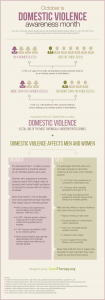
Broken, bruised, and battered features are the obvious signs of domestic abuse. However, just as physical injuries demand our care and attention, it is imperative that the psychological and emotional wounds suffered from these traumatic events also get addressed.
The American Psychological Association (APA) explains that psychological trauma is “an emotional response to a terrible event …” which interferes with an individual’s ability to function as he or she would under normal circumstances. While the psychological impact of a particular incident will vary from person to person, most individuals experience increased levels of emotional distress after going through traumatic events. Thankfully, these feelings of distress often subside if adequate support is received from family members, friends, mental health professionals, and other social networks.
For victims of spousal abuse and other types of intimate partner violence, however, the situation is not always so clear-cut. Fear of retaliation from the abusive partner might prevent victims from seeking needed assistance. Feelings of shame and embarrassment, especially among male victims, can also be a major hindrance to seeking out services or aid. This lack of emotional support can lead to heightened fear, anxiety, depression, anger, posttraumatic stress, social withdrawal, the use of illicit drugs, alcohol dependence, and even suicidal ideation.
It is clear that the psychological and emotional wounds of domestic violence are devastating. They can potentially haunt victims for many years and rob them of the ability to live a rich, full life. These wounds are completely undetectable by x-rays and too often go untreated.
The Social Impact of Domestic Violence
Domestic violence often has a ripple effect that tears through the fabric of the victim’s life. The psychological, emotional, and social impacts of domestic violence can linger long after the violence has subsided, and even after the victim has left the abusive partner.
The National Center for PTSD, a prominent research and education organization that studies the psychological effects of trauma, has identified several scenarios that indicate red flags in an unhealthy relationship. An unhealthy relationship may be indicated when one partner:
- Has complete control of all household finances.
- Limits or completely closes off the other partner’s social life. He or she may isolate the other partner from friends and family.
- Consistently threatens to ruin the reputation of the other partner, especially after he or she has expressed a desire to end the relationship.
- Repeatedly tries to scare the other by breaking things, punching holes in the wall, and hurting or threatening to hurt pets.
- Systematically evokes feelings of guilt or shame in the other partner.
These types of coercive and controlling behaviors are often present in cases of domestic violence, and can have a profound impact on how a victim of abuse is able to function socially, even after leaving an abusive relationship. If an individual is financially dependent on his or her abusive partner, any decision to escape the abuse carries with it the real possibility of homelessness. One study (2003) showed that among a sample of 110 women who had experienced domestic abuse, 38% reported homelessness.
Issues of poverty and homelessness are closely linked to the abusive act of isolating an intimate partner from family, friends, and other sources of social support. Under normal circumstances, a person with strong social connections will look to his or her relatives and/or peers when assistance is needed. However, isolation from these support groups may cause the connections to wither. In the end, people who experience domestic violence might reason that they are completely alone in their struggles and former resources are no longer available.[fat_widget_right]
Even if a survivor is successful in escaping from a violent relationship, the scars of past abuse can significantly influence future intimate relationships. The National Center for PTSD explains that some people who have endured IPV may not even believe that healthy relationships exist. Thus, they might enter new relationships with the same unhealthy expectations that they had previously. Other challenges could include intrusive memories of past abuse (for example, during intimate moments with a new partner), nightmares, communication challenges, and feelings of worthlessness.
The Effect of Domestic Violence on Children
Research shows that a child’s development can be adversely affected by domestic abuse. One study conducted by Appel and Holden (1998) even emphasizes a large overlap between households where there is IPV and child abuse. The National Center for PTSD estimates this overlap to be about 40-60%. According to statistics from the NCADV, boys who are exposed to domestic violence are twice as likely to abuse their intimate partners and children when they grow up.
Similarly revealing statistics from the American Bar Association show that girls with a history of physical or sexual abuse were more likely than non-abused girls to engage in risky behavior such as smoking (26% versus 10%), drinking (22% versus 12%), and substance abuse (30% versus 13%). Abused girls were also more likely to binge eat and purge than non-abused girls (32% versus 12%). In another study involving 2,245 children and teenagers, it was highlighted that recent exposure to domestic abuse was a primary factor in predicting future violent behavior. Even children are not directly abused, they are affected by witnessing domestic violence.
Where and How You Can Get Help
If you or a loved one is a victim of domestic abuse, please seek help. The longer abuse persists, the more damage it can cause physically and psychologically. There is support nationally and in your community to help you end the cycle of violence and move beyond it. Here are some resources if you are in trouble:
- If you are hurt or in immediate danger, please call 911 and do what you can to get in a safer situation.
- Contact the National Domestic Violence Hotline at 800-799-SAFE (7233) or 800-787-3224 (TDD). The national hotline can guide you to local shelters in your community and/or vital services.
- For local resources, visit this section of womenshealth.gov to find support and safe haven in your state.
- If you are searching online for help, be sure to clear your Internet browsing history so that your abusive partner cannot track your searches. Firefox, Internet Explorer, and Google Chrome all have options to clear browsing history located in the upper-right corner below the red X to close the window.
Even after the violence has subsided, the psychological effects of domestic violence can stick around. Seeking the help of a mental health professional such as a counselor or a therapist can be critical to helping a victim finding peace. If you or a loved one is a victim of domestic violence, consider talking to a professional with the experience and knowledge to help a person overcome the psychological wounds of domestic violence.
References:
- American Bar Association, Commission on Domestic and Sexual Violence. (n.d.). Domestic violence statistics. Retrieved September 26, 2014, from http://www.americanbar.org/groups/domestic_violence/resources/statistics.html
- American Psychological Association. (n.d.). Trauma. Retrieved September 26, 2014, from http://www.apa.org/topics/trauma/
- Appel, A. E., & Holden, G. W. (1998). The co-occurrence of spouse and physical child abuse: A review and appraisal. Journal of Family Psychology, 12, 578–599.
- Australian Psychological Society. (n.d.). Understanding and managing psychological trauma. Retrieved September 26, 2014, from http://www.psychology.org.au/publications/tip_sheets/trauma/
- Baker, C.K., Cook, S.L. & Norris, F.H. (2003). Domestic violence and housing problems. A contextual analysis of women’s help-seeking, received informal support, and formal system response [Abstract]. Violence Against Women, 9(7), 754-783. doi:10.1177/1077801203009007002
- Black, M.C., Basile, K.C., Breiding, M.J., Smith, S.G., Walters, M.L., Merrick, M.T., Chen, J., & Stevens, M.R. (2011). The National Intimate Partner and Sexual Violence Survey (NISVS): 2010 Summary Report. Atlanta, GA: National Center for Injury Prevention and Control, Centers for Disease Control and Prevention.
- Centers for Disease Control and Prevention. (2013). Intimate partner violence: Consequences. Retrieved September 26, 2014, from http://www.cdc.gov/violenceprevention/intimatepartnerviolence/consequences.html
- National Coalition Against Domestic Violence. (n.d.). Domestic violence facts. Retrieved from http://www.ncadv.org/files/DomesticViolenceFactSheet%28National%29.pdf
- National Coalition Against Domestic Violence. (n.d.). Male victims of violence. Retrieved from http://www.ncadv.org/files/MaleVictims.pdf
- S. Department of Veterans Affairs, National Center for PTSD. (2014). Intimate partner violence. Retrieved September 26, 2014, from http://www.ptsd.va.gov/public/types/violence/domestic-violence.asp
It can be hard to know for certain whether what you have been experiencing is, in fact, a series of previously repressed memories or something else. It is very possible to rediscover memories that have been tucked away and buried for years and not just traumatic ones. Sometimes a smell, a sound, a place, or an experience brings something back to us in vivid detail that had previously been hidden. Sometimes we just get a glimpse of it, an impression, but the effect can be quite unsettling and even disturbing.
I have had the experience of suddenly recalling an event from decades earlier with vivid detail. I had to call a family member to confirm if what I was remembering was accurate (it was). My event was not traumatic or upsetting; I was far more troubled by the fact of its absence than by its reappearance.
[fat_widget_left]
It is possible that your memory, triggered by your experience with your friends’ children, is accurate. You may be remembering an event or an amalgamation of a series of events. It is not unusual for children to engage in play with dolls that explores sexual themes. What seems troubling is the violent nature of the play you are describing. Perhaps you were acting out something you witnessed or heard about. My hope would be that, if you had experienced something so violent in your childhood, someone in your family would have known or been aware that something had happened. Is there anyone you can check in with who might know if what you are remembering happened or who can lend insight?
In regards to your dream about possible child pornography, our dreams are often a way of processing information that we aren’t able to make meaning of during our waking hours. Your dream may be connected to an experience you had, but it may also be something else. If your dreams and memories are causing you distress, which it sounds as if they are, I strongly urge you to connect with a licensed professional to explore what may be at the root of this and how to reduce your distress in the present.
The second part of your question, however, brings up another set of concerns. You mention being drawn to abusive relationships in your older years. No matter the reasons or the root causes, this is something I strongly encourage you to get support with. If you find yourself in an unhealthy relationship or unhealthy patterns of relationships, there are steps you can take to change that. A history of abuse in childhood can contribute to adult relationship patterns, but that history doesn’t limit or determine the kinds of relationships we are capable of having.
Best of luck,
Erika
 Most everyone has at least one traumatic memory embedded in their brains. One that still resonates for me was the time my mother left me alone when I was six years old to take the babysitter home. When I looked apprehensive, she told me not to worry. “I’ll be right back,†she said, smiling brightly, and drove off. As it got dark, I became more and more frightened that something had happened to her and she wasn’t coming back.
By the time she returned I was totally terrified. She found me standing outside wailing. She scolded me and took me inside. Years later, whenever my wife was late coming home I would become worried and anxious. My heart would begin to pound, and more than once when she was particularly late, I had a full-blown panic attack.
I know I’m not alone. Some have memories from a car accident, a rape, a natural disaster, a violent parent, a drunk husband, a hospital stay, an assault, the horrors of war. Experiences like these are more common than you might think, with an estimated 60% or more of Americans who have experienced at least one of these at some point in life. Not all of these memories cause people to experience trauma later in life, but they can cause problems for many, and for some they can be debilitating. People with posttraumatic stress (PTSD) can become hypersensitive, with nerves on a permanent state of high alert. Fear and anxiety recur without warning, and nightmares can ruin sleep.
Memories and Trauma
But now there are simple, yet effective, ways to actually erase the traumatic emotions that often accompany these memories so that they can finally be put to rest. Many people can do this work on their own. For more difficult traumatic memories, working with a therapist who specializes in healing trauma can be helpful.
[fat_widget_right]
In his book Hardwiring Happiness: The New Brain Science of Contentment, Calm, and Confidence, neuropsychologist Rick Hanson says, “Your brain was wired in such a way when it evolved, it was primed to learn quickly from bad experiences but not so much from the good ones.†It’s why traumatic memories so often stick in our brains, while positive memories seem to slip away. “It’s an ancient survival mechanism that turned the brain into Velcro for the negative, but Teflon for the positive,†Hanson concludes.
Fortunately, new findings from the field of affective neuroscience can help people heal traumatic memories that can contribute to PTSD, depression, bipolar, and even Alzheimer’s. One of the things we are learning about memories is critically important: Though the brain is particularly good at recording bad memories, they are not permanently locked into the brain’s memory banks, as we once thought. Whenever we actively recall a memory, it transforms and becomes vulnerable to modification.
When we recall a memory it becomes a little unstable and for a window of perhaps two or three hours, it’s possible to modify it before it settles down again, or “reconsolidates,†in the brain. That’s why, paradoxically, recalling bad memories can help us heal from old wounds. Reliving traumatic moments again in a condition of safety can help a person disconnect the memory from the painful “alarm†mechanisms that are the source of so much discomfort.
In the book The Archeology of Mind: Neuroevolutionary Origins of Human Emotions, Jaak Panksepp and Lucy Biven say, “Emotional memories remain forever malleable, subject to influence by future events—through a phenomenon called reconsolidation.†This is the basis of various treatment approaches for healing trauma including prolonged exposure therapy, supportive psychotherapy, emotional freedom techniques (tapping), eye movement desensitization and reprocessing (EMDR), trauma-based cognitive behavior therapy, and MDMA-assisted psychotherapy.
How to HEAL
Based on the latest in neuroscience finds Rick Hanson offers a simple, yet effective, method for rewiring the brain from the negative emotions associated with trauma to the positive emotions associated with health and wellness. In his book, he describes a four step process using the acronym HEAL.
- Have a positive experience.
Step 1 activates a positive mental state, and steps 2, 3, and 4 install it in your brain. In step 1 we notice a positive experience that’s already present in the foreground or background of your awareness. In the example I offered at the beginning, I tuned into an experience where I felt safe and supported, and brought to mind experiences of safety and security.
- Enrich it.
Too often we spend minutes, and sometimes hours and days, ruminating over a negative experience, but we gloss over the positive. Here we take time to deepen the positive experience. I would open myself to the feelings of support I have in my life. I would picture and my wife and friends and the many supports I have, filling my inner conscious with at least 10 to 20 seconds of positive memory.
- Absorb it.
Here we imagine ourselves drinking in the experience. I imagine all my cells being infused with the experience. I feel it sinking into me and becoming part of my brain and all the parts of my being.
- Link positive and negative material.
Hanson describes this as an optional step. We don’t want to become overwhelmed by the negative, but to hold the negative in consciousness while it is infused with the positive. Hanson uses the image of a garden. We imagine the beauty of beautiful flowers we are planting. We become aware of the weeds and gently pull them out so there’s room for growth. He concludes by saying, “Whenever you want, let go of all negative material and rest only in the positive. Then, to continue uprooting the negative material, a few times over the next hour be aware of only neutral or positive things that may have been associated with the negative.
I bought back the memories of being left by my mother and some of the associated experiences of getting anxious whenever someone I cared about was late. Focusing on the negative while activating positive experiences can actually “erase†the fearful feelings from the past. I still remember my mother leaving me alone and being angry with me when she returned, but it doesn’t grab me and shake me up like it used to do and I’m much less anxious when my wife is late coming home.
I describe other techniques for healing old pain in my book, Stress Relief for Men: How to Use the Revolutionary Tools of Energy Healing to Live Well. I often use them along with the ones that Dr. Hanson teaches. In this engaging TED talk Dr. Hanson describes how we can rewire the brain for joy and happiness and heal from trauma. In another show he describes how our mind can change the brain from being Velcro for the negative and Teflon for the positive.
Even when traumatic memories don’t reach a level of discomfort associated with PTSD, they can still be destructive. Hanson notes that unresolved trauma “increases inflammation, weakens your immune system, and wears on your cardiovascular system. No one has to live with traumatic memories from the past. They can truly be healed now and forever.