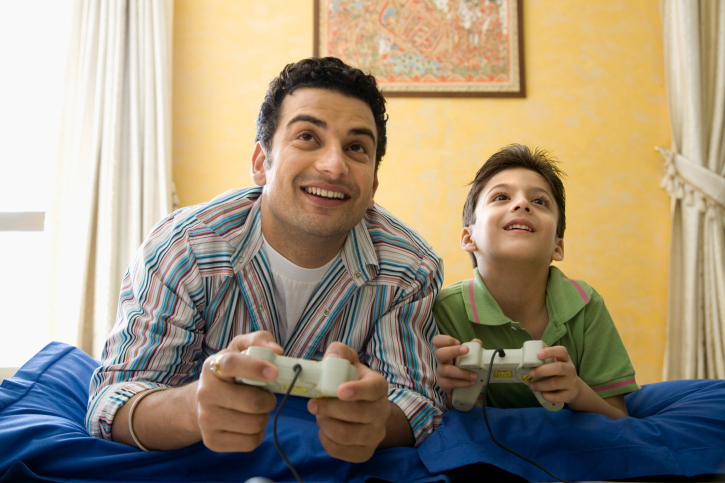
 Parents who play video games with their children may have a better understanding of how those games affect children, according to a study by researchers from the University of Oxford and Cardiff University published in PeerJ.
The effects of video games on children remains a contested topic. A 2015 American Psychological Association task force report asserted a link between violent video games and aggression. Some studies—including a 2015 study of 200 children—undermine this claim, finding no association between video games and violence. Video games may also affect children’s mental health. A 2016 study found a slight association between video game play and depression and conduct issues.
Should Parents Play Video Games with Kids?
The study involved three trials designed to assess attitudes toward video games. The first study polled 959 men and 1,019 women about their attitudes toward and experience with video games. Attitudes toward video games were more positive among those who played games frequently.
The second study assessed 483 men and 517 women on their attitudes toward video games, including their belief in inaccurate assertions about video games, such as the assumption that games cause mass shootings. That study determined older groups, as well as those with only limited game-play experience, were more likely to have negative views of video games and to endorse inaccurate assertions about games. They were also more likely to believe law should restrict game access.
A third study of 929 men and 987 women assessed experience with video games, but also asked about the participants’ status as parents. Researchers asked parents if they played video games with their children and how they believed video games affected their children.
[fat_widget_right]Parents who played video games with their children were more likely to have a nuanced view of video game play, citing both benefits and drawbacks. Women reported less exposure to game play, either by themselves or with their children, and were more likely to hold negative beliefs about video game exposure. Overall, parents who regularly played games with their children were about three times as likely to have accurate beliefs about the effects of video gaming.
The study’s authors say their results point to the ways inexperience can contribute to bias in perceptions of gaming.
Video Game Recommendations
The American Academy of Pediatrics (AAP) still recommends no “screen time†in front of televisions or digital media for children under age 2. For older children, the organization no longer proposes a hard limit on screen time. Instead, it suggests parental involvement matters, parents should evaluate the content of the media their children consume, and children need limits to prevent technology from interfering with other activities. The AAP also points to the importance of other activities, such as outdoor time and reading, and encourages parents to establish “screen-free zones.â€
References:
- Media and children. (n.d.). Retrieved from https://www.aap.org/en-us/advocacy-and-policy/aap-health-initiatives/pages/media-and-children.aspx
- Parents know best about effects of video games on children (2016, April 12). Retrieved from http://medicalxpress.com/news/2016-04-parents-effects-video-games-children.html
- Przybylski, A. K., & Weinstein, N. (2016). How we see electronic games. PeerJ,4. doi:10.7717/peerj.1931
- Shapiro, J. (2015, September 30). The American Academy of Pediatrics just changed their guidelines on kids and screen time. Retrieved from http://www.forbes.com/sites/jordanshapiro/2015/09/30/the-american-academy-of-pediatrics-just-changed-their-guidelines-on-kids-and-screen-time/#5d4e61d7137c
 Students who are homeschooled get more sleep than peers who attend either public or private school, according to a study published in Behavioral Sleep Medicine.
Some advocates, including the National Sleep Foundation, say early school start times interfere with healthy sleep. This may be especially true among teenagers, whose circadian rhythms may shift toward later waking times. In 2015, another study found high rates of sleep deprivation among teenagers.
Does Homeschooling Improve Sleep?
Researchers looked at 2,612 students, including nearly 500 homeschooled kids. On average, homeschooled students slept 90 minutes more each night than their public and private school peers. Children who attended school outside of the home awoke early enough to be in class an average of 18 minutes before homeschooled children awoke.
Overall, 55% of homeschooled students got an adequate amount of sleep each week, though just 24% of children attending school outside of the home slept enough. About 16% of homeschooled children got “insufficient†sleep during the week, compared to 44% of private and public school students.
The Importance of Healthy Sleep
[fat_widget_right]The study suggests differences in sleep can alter student performance and well-being. Students who attend high schools with later start times, for example, have higher graduation rates and fewer instances of tardiness. Though some parents might insist the solution is for teens to go to bed earlier, the study’s authors caution that biological changes during adolescence can make this difficult. Most teens’ biological clocks shift forward about two hours during adolescence, necessitating later bedtimes and later waking times.
The National Sleep Foundation recently changed its sleep recommendations for children and young adults:
- Children ages 6-13 should get 9-11 hours of sleep each night.
- Teenagers ages 14-17 need 8-10 hours of sleep each night.
- Young adults ages 18-25 need 7-9 hours of sleep each night.
References:
- National Sleep Foundation recommends new sleep times. (2015, February 2). Retrieved from https://sleepfoundation.org/media-center/press-release/national-sleep-foundation-recommends-new-sleep-times
- Study: Homeschooled kids sleep more than others. (2016, March 2). Retrieved from http://www.eurekalert.org/pub_releases/2016-03/m-shk030216.php
 There are few events in life that are as transformative as becoming a parent. So many aspects of your life—your identity, the dynamics with your partner, your sense of control (or lack thereof)—change in ways you can’t possibly imagine or emotionally prepare for. In these ways, having a second child is far less transformative. Nonetheless, there are aspects of having a second child that are novel and unpredictable, and the transition can be quite disruptive to the family system, particularly in terms of its impact on your firstborn.
Fortunately, despite the many disruptions and unknowns, there are some things you can predict about having a second child. Preparing your first child for the arrival of your baby, and yourself to handle issues as they arise after your baby comes home, can greatly help. If you can find ways to include your child in preparations for the baby, set aside time to spend with your child after the baby arrives, set firm limits with your child (particularly around aggressive behavior), and tolerate your feelings of guilt (and your child’s feelings of anger), you may help ease this transition and create an environment of safety and reassurance for your family.
How Can I Prepare My Child for the Arrival of a Sibling?
Unless you are face to face with one, “baby†is a pretty abstract concept, particularly for a child. Before the baby comes home, one of the few concrete manifestations of this concept is pregnancy (assuming the birth mother is part of the family). Children can have very different reactions to watching their mother’s belly grow. Some worry about the health of their mother; others feel alienated and uncomfortable with their mother’s changing body; others still may feel protective toward their mother.
[fat_widget_child_counselor_right]
As a mother, reassuring your child that you are OK and explaining the growth of the fetus along the way is one way to help make the whole baby thing a bit less mysterious and scary. There are also several age-appropriate books that show the growth of the fetus and the journey to birth that you can read to your child.
If you are adopting or using a surrogate, you may not be able to follow the process of pregnancy in vivo. Nonetheless, there are several other ways for adoptive as well as all parents to make the arrival of a second child more concrete for firstborn children.
The more you can share with your child the concrete steps needed to prepare for the baby’s arrival—picking out a crib, buying diapers, etc.—the more real it may feel to your child, and the greater sense of ownership they may have (“It’s my baby, too!â€). It’s also a good idea to discuss with your child what is going to happen when you go to the hospital (or, if adopting, go to pick up the baby), and any changes that may affect your child’s schedule (“Grandma is coming to help take care of the baby”). Children need routine and predictability. The fewer surprises and changes to their schedule during this time, the better.
This might also be a good time look at your child’s baby photos with your child, to remind your child they were a baby once, too, and to plant a seed for identification with the baby (“The baby is going to be like meâ€). You may also want to read your child some books on babies—what they do (eat, sleep, and cry, mostly) as well as books on being a big sibling. Using photos and books as a springboard, you may ask your child about any feelings your child is having about the arrival of the baby, both negative and positive. Given how abstract the birth is at this stage for your child, do not be surprised or disappointed if your child does not wish to discuss or cannot discuss their feelings yet.
What Can I Expect My Child to Feel After the Arrival of the Baby?
Imagine this: Your partner comes home one evening and announces that, as much as they love you, they have met someone new they also love, and this person will now be moving in with the two of you. For many children, the arrival of a younger sibling feels much the same, at least at the beginning. Children typically feel a bit stunned initially, and then start to feel some anger (along with other, positive feelings) toward the baby and/or you.
What Will I Be Feeling After the Baby Comes Home?
Well, imagine that now you are the one who brings home your new great love to live with your partner. How do you think you’d feel toward your partner? Guilt city! One of the hardest things about becoming a parent a second time around is the guilt. It can feel like you are destroying your child’s life, that you have done this horrible, cruel thing. When you have these feelings, it can be helpful to remember that while this transition may be rough on your child, ultimately it is gift you are giving your child (albeit one that may not pay off for a few years).
While there are things you can do to help your child with the transition and offer reassurance of your love, many children struggle with feelings of anger, hurt, confusion, etc., when a sibling is brought home. You may simply not be able to love away these feelings, which means in addition to having to tolerate a certain amount of guilt, you also have to tolerate a certain amount of hurt and anger on your child’s part. Accepting that your child might have a tough time for a while and reminding yourself (and your child) of your love for them may take the edge off this emotional burden.
How Can I Help My Child Through This Difficult Transition?
Feeling guilty can make it difficult to know what’s best for your child and yourself. Learning to tolerate your guilt and set reasonable expectations for yourself, and spending special time with your older child while continuing to set limits, may provide the foundation for your child feeling safe and secure and for you staying grounded.
Feeling guilty can make it difficult to know what’s best for your child and yourself. Learning to tolerate your guilt and set reasonable expectations for yourself, and spending special time with your older child while continuing to set limits, may provide the foundation for your child feeling safe and secure and for you staying grounded.
Although it may be difficult, especially at the beginning, spending baby-free time with your child can go a long way toward reassuring your child that your feelings have not changed and that you still value the intimacy of your relationship. Even if you can’t spend much time alone, set whatever time you do have aside as “special†time where you do something one-on-one, preferably on a regular, routine basis. This way, you and your child can anticipate your date in advance, which might help your child when they are feeling neglected.
If you have to leave your child to attend to the baby and your child seems upset, acknowledge these feelings (“I know it’s hard when I have to leave our game to go take care of the babyâ€). If your child is interested, you can include your child in helping out with the baby—diapering, bathing, etc. Feeling that they are part of taking care of the baby can be a very bonding experience for your child with the baby and give your child a sense of ownership and responsibility for the baby. There can also be a “well, if you can’t lick ’em, join ’em†quality to these activities.
You may find that there are certain times of the day when your older child becomes more jealous or angry, times such as bath time or bedtime, when your child is used to having all the attention focused on them. Consider alternating care with your partner or caregiver so that you can spend some time with your older child.
Breastfeeding obviously makes this more difficult. Even if you can’t change your behavior at these difficult times, you might give your child a heads-up beforehand (“Hey, I have to feed the baby in a few minutes, and I know that’s a hard time for youâ€) and, if the child is old enough, ask if they have any ideas about how to make it easier.
How Do I Handle Negative Behavior in My Child?
Children have different ways of handling their negative feelings regarding the arrival of a younger sibling. Some children seem totally happy, but might start regressing in some aspects of their development, such as toilet training, becoming more dependent, showing signs of separation anxiety, etc. Some children may be very sweet with the baby but get very angry with the parents. And, of course, some children may act aggressively toward the baby.
Regression
Regression during this phase is normal. Many children do not feel ready to give up their status as baby or young child. Others see how much attention their baby sibling is getting and want some of that. To a large extent, regression is a call for attention. As such, if you are able to tolerate the regression without focusing too much on it, and give your child positive attention where possible, this behavior generally passes relatively quickly. If your child wants to pretend to be a baby and crawl around and cuddle in your lap from time to time, why not? To some extent, all of our children, no matter how old, are still our babies, and need this reassurance from time to time. Telling our children that they have to be “big kids” now may very well feel like a withdrawal of love or attention.
This is not to say you should allow your 4-year-old to go back to wearing diapers. However, when saying no to your child, you might want to offer an alternative activity, such as being rocked in your lap, etc., that allows your child to regress and feel loved in that special, nurturing way.
Anger at Parents
Some children start to express aggression toward their parents when a sibling arrives, such as hitting, temper tantruming, or acting out in other ways. The tricky part here is that because parents often feel responsible for or guilty about their child’s anger, they find it hard to set limits.
While it is important to be empathic with your child during this time and make some allowances for how difficult this period might be for them, setting firm limits when your child is acting out or being aggressive is still very important, as much for the child as for you. No child wants to feel like a monster or feel out of control.
Anger at the Baby
If there is one activity that sweeps away our guilt over having a second child and gets us in touch with our anger, it is witnessing our child acting aggressively toward our baby. Evolution has hardwired us to protect our baby, and those instincts need to be heeded. We must protect the baby from harm, first and foremost. This means making it clear to our child that aggressive acts—hitting, pushing, shaking, etc.—will not be tolerated.
When children are acting aggressively toward baby siblings, their intention generally is not to harm the baby (though maybe getting the baby to cry would be fun). The issue is that children simply do not always know what is safe. Our job is to teach our children how to be safe around the baby and how to express their anger and resentment in other, more appropriate ways. Limits must be implemented firmly in the area of baby safety.
Feelings-wise, though, when children say they hate their baby siblings, our role is not to tell them they do not hate the baby or that it is not OK to hate the baby, but to acknowledge their feelings and help make the feelings less scary. If “hate†is not a word that you are comfortable with, you can always mirror back to your child, “You are really angry at the baby right now.†If your child says they want the baby dead, you can restate it as, “You really don’t want the baby here right now!†In this way, you are both validating your child’s negative feelings (all feelings are OK) and making those feelings less scary. Your child will learn that although there are moments when they do hate the baby or wish the baby was gone, these are just feelings, not actions, and they will pass and change over time. It is rare for siblings to love each other without hating each other at times, or at least having some negative feelings.
Reading books to your child is another great way to help children express their negative feelings about a younger sibling. When my second child was born, my older child, then 3 years old, could not get enough of Julius, the Baby of the World by Kevin Henkes (1995)—a book about, well, a child who hates her baby sibling … at least at first.
In Julius, the Baby of the World and, for the most part, in life, siblings do come, over time, to love each other (and sometimes even like each other), and your gift of a younger sibling to your older child will become just that, a gift. In the meantime, if you can hold tight and tolerate your and your child’s tough feelings, spend alone time with your child, and maintain firm limits, you will be well on your way!
 Children with disabilities bring a unique set of challenges, and opportunities, to their families. Depending on the nature of the disability, the challenges can be quite significant. At the same time, though, they have the potential to deepen connection between parents as well as the parent-child bond.
Aside from the energy required to manage a child’s physical and emotional needs, there are often huge financial considerations. A child’s disability may require the family to retrofit their home, or obtain housing that is accessible. In addition, equipment, social services, and health care are often pricey and are not always covered by insurance or entitlement programs. Families able to get some or all of these expenses covered often have to advocate for them on their own, and navigating disorganized government programs associated with these benefits can be an extremely taxing process in its own right.
Because it can be quite time consuming to address these issues, many families are forced to give up large portions of their leisure time. Often, one parent takes on a primary caretaking role with the child, while the other parent becomes the primary provider, deeply involved in his or her work in order to help with the finances. Primary caretakers sometimes have to partially or completely forgo any job aspirations of their own.
[fat_widget_right]
If these decisions are not talked about and processed carefully, they can lead to divisions within the family that may become deeply entrenched and long-lasting. Caretakers may feel as if they do an unfair amount of the work for the child, and may feel resentful about having to sacrifice their careers. Providers, meanwhile, may feel isolated within their families, as though everyone is against them, and may come to perceive the bond between the caretaking parent and the child as impenetrable.
The Importance of Communication
To help with this, I suggest that parents openly discuss how caretaking responsibilities are divided. Are there ways to make these responsibilities more evenly managed? What types of feelings does each person have about it? These are important considerations that should be discussed regularly.
Another consideration for parents is the emotional impact of having a child with a disability. Parents sometimes have to adjust their expectations regarding what their child can become, which is frequently experienced as loss and may be accompanied by a mourning process. The process of adjusting expectations to conform to the reality of the circumstances can be challenging and varied depending on the nature of the disability.
Regardless of the specific disability, the family has to come to accept that the child’s life may be limited in some way, and that additional care may be needed for the remainder of the child’s life. This process can be a loaded one and has potential to drive parents apart.
In general, the more ambiguity in the disability, the more difficult it is for the family to adjust. Degenerative diseases, which are less understood than more standard physical disabilities, can be among the most difficult to adjust to. The lack of information about how quickly the disease will develop and impact the child’s life can create enormous anxiety and stress. Cognitive disorders such as mental retardation are also difficult in that parents often cannot tell how much information their children take in.
Regardless of the specific disability, the family has to come to accept that the child’s life may be limited in some way, and that additional care may be needed for the remainder of the child’s life. This process can be a loaded one and has potential to drive parents apart. I suggest that couples set time aside regularly to discuss their feelings about their child’s disability, either in counseling or on their own.
Much is made of accomplishments in Western society, and children are too often measured by what they do instead of who they are. If couples keep an open line of communication and feelings regarding the challenges they face, the experience of parenting a child with a disability can bring them closer together and help them learn to accept and love their child for who they are.
References:
- Boyse, K. (2009). Siblings of Kids with Special Needs. Retrieved from http://www.med.umich.edu/yourchild/topics/specneed.htm
- Reichman, N., Corman, H., & Noonan, K. (2008). The Impact of Child Disability on the Family. Retrieved from http://www.medscape.com/viewarticle/581577_2
- Solomon, A. (2013). Far From the Tree. New York, NY: Scribner.
Thank you for your question, which sounds like just about every parent’s nightmare—one that’s more common than you might think.
For me, the key to the answer is in your last two questions. You seem to assume that you did something “wrong,†leading to feelings of guilt, shame, anger (at yourselves or each other and/or your son), and say you want to get your son “back.†I assume you mean the way he was before he took on the appearance of a “rebel†from a bad 1950s movie.
He is still the kid you love, still good—just struggling with something beneath all of that strange and troubling behavior. I would hesitate to conclude he is definitely “ruining his life†because I would bet, in the larger context of his life, his behavior probably makes some sense. Most teens go through a rebellious phase, whose aim in part is to annoy or even frighten the living hell out of parents. So I wouldn’t take the bait completely. Of course this is very concerning and needs to be investigated, and consequences are crucial (provided they are communicated clearly and enforced consistently), but something tells me “tough love†or drawing a line in the sand may only alienate him. The trick is reaching to connect with the kid behind all this behavior (fighting, smoking) that also keeps his teenage need for individuation and autonomy in mind. Not the easiest relational dance by any means, which is why the teen years can be very difficult indeed, and why a good school counselor or family therapist can help.
[fat_widget_right]
Seeing this as a family problem, not his problem or your problem, is key. Drawing in teachers and school counselors is good, as is including the parents of the other “troublemakers†he runs with. Something is attracting him to this crowd; what is it?
And again, what was happening before? Was he a good student? Fortunately, this is all happening now more or less under your roof, which tells me this is in part a communication to you—a rebellious, perhaps angry communication at that. As if he’s saying, “I’m making my own rules, got it?†But what might be happening in the family dynamic such that he feels compelled to “say†and do these things? And why isn’t he fearful of consequences? The compulsion to do these things, which includes numbing or distancing from certain thoughts and feelings, means whatever feelings he’s pushing away and expressing via behavior are more powerful than the fear of going off track in school and developing “shady†friends.
Why might he identify with these friends, incidentally? Try to really put yourself in his shoes and forget black/white, right-and-wrong thinking. The harder you push for “the right side†of the line, the more he’ll likely stand on the other side and dig in. Welcome to the teen years. But keep in mind this may be the only way he knows how to express whatever is happening inside him, probably inexpressible.
Of course your concerns are understandable, given his behavior at school and his alarming drug/alcohol use. Yes, many teens experiment with booze and pot, but in this case 15 is pretty early for him to be using it in such a casual way (as opposed to sneaking a beer or joint with friends at a concert). Again, it’s as if he wants you to know about it, as it’s happening, right under your nose.
In some cases, children have tried to be “good†for so long that this goodness becomes a burden, often privately felt, leading to a swing in the opposite direction. Or there’s an anxiety or hurt that drugs and booze cover up. Could your son find some rebellious expression in arenas besides pot—such as music, drama, filmmaking, sports, etc.? Something assertively geeky or super cool where he can stand out and feel good about himself? Teens want to be cool and feel cool, in all ways, be it computer programming or punk rock. These other kids he hangs with make him feel cool, though I wonder why he has embraced this particular incarnation. Of course, many of our greatest innovators were rebels; the challenge is finding an outlet that is free from self-destruction and liberates/transcends rather than medicates the difficult emotions of adolescence. (It’s difficult for parents, too!) It’s likely that underneath all this tough-guy stuff is fear and/or anxiety. It sounds like you may be anxious also, which is why you need to be a role model of calm. Anxiety is contagious throughout a family “system.â€
It’s good that he wants to feel cool and have friends; what’s not cool is that his current behavior will lead him nowhere positive in the long run.
Has your son demonstrated an interest in anything previously that might provide for his self-expression? Anything creative rather than destructive? Can you or a counselor or teacher help him find such a direction? Anything that can “hook†his interest can help him find a way back into engagement with school, such as a magnet school for music or technology, for instance. Volunteer work, too. Karate. Photography. Fly fishing. Think outside the box; offer him incentives for trying something new. Maybe his dad or grandpa or someone could even try doing it with him for the first time or two. I’d bet he has an untapped passion.
You and your husband ought to decide, first, what is and isn’t acceptable to you both. Make sure you’re both on the same page. The calmer you are in general, the safer he’ll feel bringing his troubles to you. I recommend tough love if and after the other ideas flop.
And now, consequences. I imagine you have leverage, since he’s 15 and, I’m presuming, approaching driving age. He’ll want driving lessons, need car insurance, and so on. Here’s where you get to be loving but firm parents and decide what is and isn’t acceptable. Anything less than a “B†average, for example, means no driving. Missing a curfew means no car (and possibly phone) for the next __ days. Drinking and driving means no car keys for the next __ months, minimum, and the loss of other privileges (social media, etc.).
You and your husband ought to decide, first, what is and isn’t acceptable to you both. Make sure you’re both on the same page. The calmer you are in general, the safer he’ll feel bringing his troubles to you. I recommend tough love if and after the other ideas flop.
Usually a child his age struggles with developmental challenges. He may not be completely comfortable talking to you about them, which isn’t your fault. Is there a school counselor or teacher who can get involved? What do these folks, probably seasoned observers of teens, think might be happening? What about the parents of his pals?
Does your son have an uncle or grandpa, some adult he trusts, who can spend some time with him and help him open up about what’s going on? Can they go to a movie or a ballgame? It takes a village, as they say, and parents are often the wrong messengers for the right message because of the rebellion factor. Also, children need to complain and gripe about their folks a bit; sometimes “delinquency†is a kind of grandiose, covered-up lament or expression of hurt feelings that they feel can’t be expressed any other way.
What do the parents of these “bad influences†have to say? The more communication among all of you, the better. You need to know where your son is, within reason, and to let him and his friends know that caring eyes are watching.
Also, what is your own attitude toward drinking and drug use (including pills)? That may have some bearing on your son, if you or your husband tip too far toward rigidity or looseness; at any rate, his drinking and smoking is a symptom of something deeper, but neither is helpful to his development if overdone.
It would be interesting to reflect upon how and when the “old version†of your son changed, and what may have been going on in the overall context of his life. We all change. But was there any big change? New neighborhood, new school, the loss of a girlfriend? If he is self-medicating with drugs and alcohol, why? What might be causing anxiety, worry, or other troublesome feelings? Is he worried about dating, college, becoming a man? I think it is important to remember he is still the boy you love, struggling as manhood fast approaches. It’s a confusing world, and teens are bombarded with all kinds of conflicting messages. Personal identity questions around freedom, autonomy, and self-expression are all being worked out, often awkwardly, as a new “family†of peers is developed. Again, the calmer you are—and the less your emotional security is dependent on his behavior—the better.
Also, what bothers you about this behavior? Are you concerned you or others will deem yourself a parental “failure� Are you imagining the worst—i.e., he is headed for the penitentiary if this doesn’t stop yesterday? Are you already preparing the care package you’ll take to the visiting center, where he’ll be waiting in an orange jumpsuit? Try not to panic, as this may alienate him and scare him off. I know many productive, happy adults who went through a “dark period†in their teens. In fact, it’s better to get it out of the way now. He could also be testing you, to see how far he can go before losing (or not) your love of him. The trick as parents is loving the child without necessarily condoning certain behavior. Easier said than done. But he is and will always be your boy (even if he doesn’t express it that way). Often in the mid- to late twenties, there is a period of reconciliation where kids, now adults, realize how hard adult life really is.
Finally, the most important point of all, which may sound somewhat counterintuitive (but here goes): Take care of yourself. One thing parents forget, and I include myself here, is that we are most of all role models for our children, even when they act like we’re invisible (or annoying). Sometimes, our children will “counter-identify,†meaning they’ll take on the “reverse†identity of a parent, to distinguish themselves as different. Your son’s behavior is communicating something important to you, most likely unconsciously; it’s a good idea to try to “decode†what he’s trying to say. There’s no harm in some family therapy to seek some help in this.
Children often bridle at the implication that they are responsible for their parents’ emotional well-being. This only decreases and constrains the very freedom they’re itching to define. Of course parents get upset or angry or anxious when a child is in trouble—that’s normal—but I’m talking about something more profound, a core, existential sense of OK-ness. Parents who feel, consciously or not, that “my child’s ‘performance’ is a direct reflection of my own core worthiness†are setting themselves up for trouble.
I like the concept from recovery programs of “attraction, not promotion.†You want to provide an attraction to a peaceful sense of stability, calm, and strength which you personally embody. Not pounce and pick apart all of his behavior, which will only make him defensive and/or angry. In a way, you and his dad are the guardrails for safety, in deed and not just word. The guardrail needs to be flexible but not breakable, solid but not overly foreboding (or flimsy). Our children provoke our own need to grow and stretch as a person, and again there’s no shame in getting help. This might include therapy, Al-Anon, or a parents’ support group so you can learn from others—which would also be good role modeling for him. And any non-pressured family time, in whatever form (movies, ballgames, let him choose), will hopefully cultivate unity.
Finally, the National Institute on Drug Abuse has a page for parents on teens. There are other good resources for parents on the Internet also.
Thanks for writing, and warmest wishes to you and your family.
Darren
 So often when I ask people in my therapy office (mostly children and teens) to brainstorm strategies for coping with certain difficult situations, the initial answer I get is something along the lines of “I need to toughen up,†“I need to just deal with it,†or “I’ve got to be a man.†The difficult situation itself could be a disagreement with a sibling, a problem with a peer, or an uncomfortable issue with a teacher at school.
Children pick up these quick-fix mantras from a variety of places—television, school, peers, and parents among them. When a child gets emotional, often the quick, easy fix is to say, “toughen up,†especially when whatever caused the child to be upset seems minor. The message is clear: Let’s move on, kid, because we’ve got things to do and worrying about this doesn’t fit into my schedule.
Is there anything wrong with that? What, if any, damage is done when a child is told to “toughen up� Let’s break down the ripple effect this type of response has on a child’s psyche over time.
- Five minutes later: The child feels minimized. The situation that caused the initial reaction has been left unresolved. The child may be thinking he or she is dumb or weak for bringing up the situation in the first place. He or she may also resent the person who instructed the child to “just deal with it†because that person doesn’t seem to care. [fat_widget_right]
- Five months later: The child hesitates to mention a problem when it occurs, fearing the reprimand of not being “tough enough.†This teaches the child to “stuff†emotions instead of verbalizing them and learning to process them. Acting out may increase as the uncomfortable emotions aren’t dealt with promptly. For their part, the adults in the child’s life may not understand what is causing the unwelcome behaviors. If an adult attempts to discuss the child’s emotions, the child may resist and have increasing difficulty sharing those emotions because he or she has been taught to ignore them.
- Five years later: The child—perhaps now a teenager or young adult—has a difficult time empathizing with others about their emotions because he or she expects others to “toughen up†or “deal with it†when something doesn’t go their way. The child may be more likely to perpetuate the belief that many emotionally difficult situations should be ignored.
The biggest problem with telling a child to toughen up is that it undermines true resilience, which is learned by experiencing adversity or uncomfortable feelings, processing why they occur, and learning new and more positive ways to reframe those situations.
There is, of course, something to be said for “letting go†of certain minor situations that are upsetting. However, that needs to come from within the child and not from the belief that getting upset by something means there is something wrong with him or her.
Why ‘Being a Man’ Isn’t All It’s Cracked Up to Be
Finally, a note about boys who think they need to “be a man†when something doesn’t go their way: The children I see in my practice who use phrases such as this are, in my experience, more likely to be aggressive in the responses they give others.
Aside from what it suggests about being a woman, the phrase “be a man†has a sense of machismo associated with it that indicates a need to be strong and aggressive. In today’s world, acting on this impulse (at school, for example) may lead to discipline problems and resolves few. It perpetuates stereotypes many boys may not feel they fill as adults and reduces the likelihood they will seek help for emotional or mental health concerns because “being a man†means ignoring those feelings.
 One of the most difficult issues I see today for parents is sexting—the sending of sexually explicit messages, pictures, or videos via text message. Texting in general has only existed for the past 15 to 20 years, and because it is still so new, parents usually don’t have a reference for it from their own childhoods.
Children are using devices more than ever to connect with one another. Some studies indicate that almost 80% of adolescents ages 12 to 17 own a cell phone, and almost 50% own a smartphone. Many of the apps that children use to communicate are rapidly changing and unfamiliar to adults. The lack of familiarity can create a sense of helplessness for many parents, which may make this issue a particularly difficult and scary one. To help with this, I’ve created a guide to hopefully make the issue of sexting less overwhelming for parents.
Understanding the Risks
To begin with, one should consider why children sext. Studies show most children say sexual messages are initially sent as a sign of love. For many teenagers, sexting can act as a courtship and even as a replacement for sex itself. These messages can be a way to express and gain admiration from a crush. Sometimes peer pressure plays a role, as children are pressured into sending a message they are not completely comfortable with.
The risk of sending a sexual message is that once it goes out, the sender has little to no control over who sees it. In 2009, there was a case in Pennsylvania in which a high school girl’s phone was confiscated by a teacher who found semi-nude photos stored in the phone and turned it over to authorities.
[fat_widget_right]Instances such as this teach us that even if a message is intended to be private, there is no guarantee it will stay that way. Children and teens should understand that anything they send into the digital world—a text, a message on social media, or even an email—might be seen by others. Teaching children about the risks also sends the message that the adults in their lives are available and willing to help.
Here are five steps parents can take when dealing with children or teens who are sexting.
1. Acknowledge Difficult Feelings
I think it is completely understandable and natural for parents to be deeply disturbed when their children send these types of messages, and acknowledging these feelings is often a good place to start. At times, the anxiety around this issue can become so overwhelming that it is difficult to see any ways to help. I encourage parents to discuss their children’s use of technology and the feelings surrounding it. Therapy can also provide an outlet to process some of the difficult reactions this issue brings up.
2. Recognize Core Issues Have Not Changed
Once parents have processed their initial reactions, I encourage them to try to see these messages as an expression of feelings that function similar to love letters from earlier times. As discussed earlier, the factors that generally cause adolescents to sext—teenagers in relationships, seeking approval from peers, and peer pressure—are hardly new. Most parents have vivid memories of grappling with these issues as adolescents, and recognizing those reference points can be empowering. This can help parents to relate more to their children and make the issue less foreign.
3. Realize What Will Not Solve the Problem
It is important to remember that children often get a lot of benefits from connecting with peers through their devices. These connections serve an important developmental purpose, and simply taking away a child’s phone or shutting down their social media accounts often does more harm than good. Children are surprisingly adept at getting around these types of limitations as well. Don’t assume the problem is fixed by trying to restrict their communication avenues.
4. Help Children Process Feelings
For many teenagers, sexting can act as a courtship and even as a replacement for sex itself. These messages can be a way to express and gain admiration from a crush.While children are well versed in technology, they often lack the emotional maturity to process the potentially negative things that can happen in the digital world. This is an area where parents can be enormously helpful. I encourage parents to make themselves available to process the difficult feelings and reactions their children have related to their online experience. The more children perceive their parents as available to talk about these feelings with them, the more resilient they will be when they are exposed to something negative.
5. Encourage Other Avenues of Self-Expression
The last step is to help children find other avenues to connect with their peers. Steering a child toward a club, activity, or sport enables them to connect with friends, and freeing up time in their schedule to spend with kids their age may make them less likely to seek connections online. The more children are allowed to connect to others face to face, the less likely they will be to try and fill a void in the digital world.
—
Because technology has changed so dramatically in the past several years, parents and children are at risk of becoming disconnected. If parents are able to reflect on this issue, understand the reasons their children use devices, and come to see how children may be struggling with many of the issues their parents dealt with in childhood, they may be able to help their children find healthier and more productive ways of meeting their emotional needs.
References:
- A common sense research study. (2011).  Zero to eight: Children’s media use in America. Retrieved from https://www.commonsensemedia.org/research/zero-to-eight-childrens-media-use-in-america
- Guzzardo, J. (2010). School violated student’s privacy in ‘sexting’ case, lawsuit says. Retrieved from http://www.cnn.com/2010/CRIME/05/21/pennsylvania.racy.photos
- Rosin, H. (2014). Why kids sext. Fresh Air Podcast. Retrieved from http://www.npr.org/sections/alltechconsidered/2014/10/15/356393531/why-kids-sext-describes-nude-photos-as-social-currency-among-teens
- Teens and technology. (2013, March 13). Retrieved from http://www.pewinternet.org/files/old-media/Files/Reports/2013/PIP_TeensandTechnology2013.pdf
 As a family therapist, I have helped families work with benign issues, such as a teens refusing to clean their rooms, as well as extreme ones, such as revelations of sexual abuse. One of the more frequent issues brought to my attention is a parent’s lack of ability to “control†a child and the consequent use of spanking to garner this control.
Spanking as a Matter of Culture
Having been forced to respond to this issue time and again, I have done a lot of research and thought a lot about it. Aside from the obvious ethical issue—namely my role as a mandated reporter—I have had to struggle with a practice steeped in the history of American culture. Corporal punishment, or the deliberate infliction of physical pain, has been part of our culture since our early days as a nation, even being used today in some school systems in America (19 states allow it).
[fat_widget_right]Does spanking work? Should we all be hitting our kids to develop a society of rule followers who respect authority? Well, think about it: Does being afraid of authority necessarily mean you respect it?
Fear vs. Respect
What I have seen throughout my time as a therapist is that fear doesn’t usually tend to lead to respect. In my work, often one or both parents believe they were kept in line as a child only through beating. When we examine this more closely, the parents openly recognize corporal punishment did not always promote adherence to the rules when they were kids; they simply became better at not being caught breaking the rules.
In my experience, corporal punishment (or spanking, whooping, hitting, beating, etc.) often promotes more aggressive behavior in the child at home and in school. The child who is punished with spanking is often left with few skills to cope when difficult situations and emotions arise, and they tend to repeat the modeled behavior of the parent by turning to physical aggression to solve problems.
An article in Monitor on Psychology, a publication of the American Psychological Association, examined spanking research conducted over the years. Several recent peer-reviewed studies indicate children who had been disciplined with corporal punishment were more likely to exhibit aggressive behavior toward friends and siblings. One study, published in 2011 in the journal Child Abuse and Neglect, looked at 100 families with children ages 3 to 7 and found in households where children were spanked, the kids were more likely to use violence to resolve conflicts with their siblings and friends. The article in Monitor also shared evidence that physical punishment may increase the risk for mental health issues for kids, including anxiety and depression.
Perhaps the worst consequence I have seen from physically aggressive punishment is the damage it does to the parent-child relationship. Many children and teens I have worked with who have been parented with corporal punishment often express a desire to “grow up and get out.†These kids want to escape the relationship because they see the punishment as abuse.
How Can We Parent Our Kids Without Spanking?
The use of rewards and consequences can be one of the best ways to gain respect and control over children and teens’ behavior. Many caregivers try this and fail. In many cases, one parent didn’t maintain the rewards or consequences, or a partner undermined efforts. I often see parents who haven’t completely committed to the use of rewards and consequences, and instead of working on becoming more consistent, blame is put on the child.
To effectively administer a plan to discipline and encourage your children, there are a few steps to follow:
- Make two separate lists: one of behaviors you want to promote and one of behaviors you want to work on decreasing. Examples of behaviors to increase include taking out the trash, cleaning the bedroom, and completing homework. Behaviors to decrease could include being impolite, hitting, and fighting. Each child is different, and a plan has to be tailored to the needs of your family.
- Think about appropriate rewards and consequences for each behavior. Parents can come up with many rewards that don’t cost a thing and may improve relationships in the family. Examples of rewards are: playing a game with your child, taking your child to the park, and/or letting your child spend time with friends. Consequences can include taking away privileges (use of video games, phone, etc.) and grounding or time-out, depending on the age of your child.
- Share the plan with your child. Children must be aware of the possible consequences and rewards in order to give them the chance to make the appropriate choices. Parents can use this plan as a tool by reminding the child of the consequences of their choices before they make them.
If your child is not used to facing consequences, they will likely resist, and it may require some effort on your part to remain firm and maintain the consequence. Persevering through the first month or so will be necessary to see positive, long-term results in your parenting style and your relationship with your child.
Perhaps the worst consequence I have seen from physically aggressive punishment is the damage it does to the parent-child relationship. Many children and teens I have worked with who have been parented with corporal punishment often express a desire to “grow up and get out.â€Some factors make maintaining a plan for rewards and consequences difficult. Guilt is probably the No. 1 reason I hear for a parent not being able to us this system to improve a child’s behavior. Lack of support is the second most common, and when there is support, often spouses and co-caregivers can’t agree on how to parent, and thus “splitting” occurs. In this scenario, the child gets away with whatever they want, and the parents end up angry at each other. For these three reasons, among others, many parents struggle with creating and maintaining boundaries and expectations for their kids.
A careful mix of executive authority and a nurturing stance is needed to earn respect from your kids. If you are struggling to implement such a plan, don’t resort to hitting. Working with a therapist can help you cope with feelings of guilt and can also help you and your spouse or co-caregiver work as a team and eliminate splitting. As this article suggests, you are not alone, and seeking help from a therapist in no way means you are a failure, but instead represents that you are a proactive parent.
References:
- Rochman, B. (2012, July 02). Hitting your kids increases their risk of mental illness. Time. Retrieved from http://healthland.time.com/2012/07/02/physical-punishment-increases-your-kids-risk-of-mental-illness
- Smith, B.L. (2012, April). The case against spanking. Monitor on Psychology. Retrieved from http://www.apa.org/monitor/2012/04/spanking.aspx
- Strauss, V. (2014, September 18). 19 states still allow corporal punishment in school. The Washington Post. Retrieved from https://www.washingtonpost.com/blogs/answer-sheet/wp/2014/09/18/19-states-still-allow-corporal-punishment-in-school/
 Many years ago, before I had children, I worked with a parent who confided that she would sometimes get so frustrated with her baby that she fantasized about throwing him out the window. I was horrified to hear this, and thought there was something really troubled about this parent—that is, until I had my own (colicky) baby and began to have similar fantasies.
Just to be clear, neither this parent nor I was going to hurt anyone. There is a world of difference between fantasizing and acting. But our feelings of frustration and hate were very real and powerful. And we are not alone. Having had the pleasure of both participating in and leading several parenting support groups over the years, I can tell you that many parents have feelings of hate or other strongly negative feelings toward their kids at one time or another.
So, if hating our children is so ubiquitous, why isn’t it more openly acknowledged?
We have all heard (ad nauseam) about the positive feelings we are supposed to cultivate in ourselves and express toward our children, feelings such as patience, acceptance, unconditional love, pride, etc. Rarely, though, do we hear about the validity of feeling hate or other strongly negative feelings toward our children.
Fortunately, this has shifted somewhat in the past decade or so. The proliferation of parent support groups where the expression of negative feelings is accepted and supported, and the publication of books such as the satirical parenting guides Sh*tty Mom: The Parenting Guide for the Rest of Us by Laurie Kilmartin, et al., Toddlers Are A**holes: It’s not Your Fault by Bunmi Laditan, and the faux children’s book Go the F**k to Sleep by Adam Mansbach and Ricardo Cortes, have helped normalize parents’ negative feelings. Despite these advances, however, a culture of secrecy and shame around hating our kids persists.
[fat_widget_right]
In order to understand why this is, it might be helpful to first look at the question of why we hate our kids.
To some extent, it’s just common sense: spending hours upon hours, days upon days, years upon years taking care of someone who is dependent on you, but often demanding and resentful of you, naturally breeds some negative feelings.
For a more in-depth look at parental hate, Donald Winnicott (a psychoanalyst and coiner of the phrase “the good enough motherâ€) explained it best when he gave the following reasons (among others) as to why a mother might hate her baby (1975; p. 201).
- The baby is a danger to her in pregnancy and in birth.
- The baby is an interference with her private life.
- The baby hurts her nipples even by suckling, bites her, and tries to hurt her in other ways.
- The baby can be ruthless, treats her like scum, an unpaid servant, a slave.
- The baby at first must dominate, life must unfold at the baby’s rate, and all this needs the mother’s continuous and detailed study.
- After an awful morning with her baby, when the mother goes out with him/her, s/he smiles at a stranger who says: “Isn’t s/he sweet?”
And yet, Winnicott goes on, for all the hate the mother may feel toward her baby, she must learn to tolerate this feeling without acting on it or expressing it in its raw, rageful form (p. 202). In short, mothers—and I would add fathers, too—must contain their feelings of rage. Perhaps it is this need for containment and the challenges this task poses that explains why parental hate is still somewhat taboo.
But what does it even mean to contain one’s negative feelings toward one’s child? And why is it so important?
I would argue that containment is achieved when parents are able to accept and integrate into their emotional landscape, at least to some extent, their negative feelings toward their children. Generally, when we fail to accept our negative feelings toward our children, we act in one of two ways: we become rageful or we withdraw emotionally, either of which can be problematic.
When we rage at our children, we give them the message that we are not in control of our negative feelings, that negative feelings are scary and bad, and that any such feelings they have should be expressed in a similar way, or hidden away because they are too scary.
Alternatively, when we cut ourselves off from our negative feelings or hide them away such that we don’t have access to and don’t express them to our children, our children get the message that negative feelings are unacceptable and wrong and that when they feel and/or express negative feelings, they are bad for doing so. Having negative feelings becomes a scary, lonely, and powerless experience.
So, if we aren’t supposed to act on or hide our hateful feelings toward our kids, what the heck do we do with them?
As I suggested above, the first step is to accept them, to not feel ashamed of them, to understand that they are valid. In this way, we come to integrate these feelings into the rest of who we are and what we feel. In practice, this might mean sharing our feelings with other parents, complaining about or talking trash about our kids to others, or maybe speaking with a counselor or therapist—release! Often, this is enough for us to feel sane and in control and to contain our negative feelings in a way our child needs.
Sometimes, though, it is not enough for us to calmly hold our negative feelings without expressing them. Sometimes our children need to feel our hate or negative feelings toward them—not necessarily in their raw form, but in a controlled way.
Why is this? Why do our children ever need to experience our hate toward them?
How Psychoanalysis Can Inform Parenting
Once again, I believe Winnicott explained it best when he stated (1975): “It seems doubtful whether a human child as he develops is capable of tolerating the full extent of his own hate in a sentimental environment. He needs hate to hate.†(p. 202)
Hyman Spotnitz, founder of modern psychoanalysis, a branch of psychoanalysis, elaborated on Winnicott’s thesis when he wrote about the relationship between the therapist and the person in therapy. In psychoanalysis, it is believed that the relationship between the person in therapy and the therapist inherently evokes feelings from the former’s past (and sometimes the therapist’s, too), particularly with regards to the relationship to his or her parents. When evoked in the context of the psychoanalytic relationship, certain powerful feelings can arise in the person toward the therapist and the therapist towards the person in therapy, including feelings of hate.
Although he cautioned against expressing all of one’s feelings toward the people one works with in therapy, Spotnitz warned against the therapist always hiding his negative feelings (2004). He wrote, “To allot too little hate to a patient who needs to learn to experience and sustain it comfortably is unjust. To give him too little feeling because the analyst has too much of it is a technical error. The patient is entitled to whatever feeling—positive or negative—he needs …” (p. 159)
Spotnitz further writes (2004) that the therapist needs to express his hatred in order to help the person in therapy experience and sustain his or her own negative feelings. In this way, the therapist helps the person feel less alone with his or her hate, feel that the therapist is more like him/her, with a more equitable balance of goodness and badness (that is, the person is not all bad for his or her negative feelings, and the therapist not all good for not expressing his/hers).
Spotnitz also suggests (2004) that the sharing of the therapist’s hate can reassure the person in therapy of his or her impact on the therapist, giving the person a sense of control and power. Furthermore, when the therapist expresses negative feelings to the person, the person can see that the therapist’s verbal expression does not necessarily lead to action, the therapist thereby modeling for the person the importance of putting feelings into words rather than acting out.
While I do not advocate being therapists to our children (in fact, I strongly caution against it), I would argue that many of the beliefs of psychoanalysis more generally, and modern psychoanalysis specifically, very much apply to parenting. We need to try to accept and integrate our feelings of hate and other negative feelings toward our children so that we can contain them and, when appropriate, choose to express them to our children in a controlled fashion. In this way, our children can see that we have powerful, negative feelings, too, and that they are not alone with their scary, hateful feelings and are not bad for having them. We let our children know that despite how powerless they feel at times, they do have some power in being able to affect us and stir up powerful feelings in us. We help our children accept and integrate their own hate, so that it becomes one of many feelings they can experience and express, not one that is split off and acted out because of fear or shame.
In short, sometimes our hate can be helpful to our kids.
So, what does “helpful hate” look like in practice?
How Hate Can Be Helpful
To illustrate, I recount a situation with a parent, whom I shall call Angela, who was a member of one of my parenting groups.
Angela was a parent of two—a 6-year-old girl, whom I will call Josephine, and a 3-year-old boy whom I will call Sam. Josephine had been a very easy baby and toddler; she had a calm temperament and was well-behaved. Angela felt confident and competent in her parenting of Josephine.
It was therefore a bit of a surprise and disappointment to Angela when Sam was born and turned out to be a very difficult baby and toddler. Much more physically developed than verbal, Sam would get frustrated when he didn’t get his way and couldn’t express himself, and would often hit Angela, quite hard, to express his frustration. Angela would become enraged and scream at Sam when he hit her. Sam, in turn, became very scared and would start sobbing inconsolably, at which point Angela would feel so guilty that she would apologize profusely and try to comfort Sam, to no avail. Unfortunately, this became a cycle, with Angela and Sam clearly both very upset about what was happening between them, but with the hitting and screaming continuing.
As parents, when we learn how to do these things, we become more comfortable with who we are and what we feel, and can therefore be more in control and more deliberate in our parenting choices. And all this helps us be the best parents we can be, no matter what we are feeling toward our children.
When Angela spoke in the parenting group about this dynamic, she expressed deep shame about her rage and her screaming and the cycle in which she and Sam were engaged. She so desperately wanted to be in control and to figure out a way to break the cycle.
After several weeks of discussing her predicament, one of the other members of the group blurted out, “Sam’s a terror! Of course you want to scream at him! It’s a miracle you don’t hit him back!” Angela looked stunned, but then burst out laughing, as did the rest of the group.
It seemed that something had been liberated in Angela. She had finally been given permission to accept her strongly negative feelings toward Sam. Little by little, Angela was able to discuss and accept her more negative feelings—her disappointment that Sam wasn’t easier like his sister, her anger at Sam for leading her to feel like an inadequate parent, and much more.
Over time, these feelings stopped being so scary and shameful to Angela. As Angela became more accepting of her negative feelings, her rage began to dissipate, and when Sam hit her, she often felt “simply†angry rather than enraged. Angela began to feel more in control of her feelings and more able to focus on what to do with Sam in a less reactive, guilty way.
Over time, Angela’s yelling at Sam began to decrease. Rather, when Sam hit her, Angela would firmly and somewhat angrily tell Sam to stop, that she knew he was mad but that hitting was not OK, that if he was mad, he could yell “No!” or “I’m mad!†She would then send Sam to his room for a time-out.
It seemed to have the desired effect. Over time, Sam’s hitting greatly decreased and his use of the words “no!†and “mad!†greatly increased. It would seem that, for both Sam and Angela, negative feelings had become more acceptable, more integrated parts of who they were and how they interacted with each other.
Although it is impossible to know what Sam’s subjective experience of all this was or even to be sure what aspect of Angela’s approach was effective, I would speculate that because of the changes in Angela’s feelings and actions, she was able to accomplish at least some of the following:
- Help Sam feel that his negative feelings had an impact on Angela but were not bad or overwhelming.
- Set the limit, “Hitting is not OK; you need to go to your room,” so that Sam felt his anger was being contained, which helped him feel safe.
- Give Sam alternative forms of expression, i.e. words, to teach Sam how to express his strong feelings rather than act out on them.
Of course, there are times when this type of approach doesn’t work for a variety of reasons. Hey, nothing works all the time in parenting. We are human; we lose control; our kids lose control. And certainly, many parents are perfectly capable of handling their hatred and other negative feelings without the help of psychoanalysis.
Nonetheless, what I think is unique about psychoanalysis and what it can contribute to parenting is its ability to help people learn about and accept all their feelings, both positive and negative, and to show people what to do with their feelings (contain, express, etc.), particularly the more difficult ones such as hate.
As parents, when we learn how to do these things, we become more comfortable with who we are and what we feel, and can therefore be more in control and more deliberate in our parenting choices. And all this helps us be the best parents we can be, no matter what we are feeling toward our children.
References:
- Kilmartin, L., Moline, K., Ybarbo, A., & Zoellner, Mary Ann. (2012). Sh*tty Mom: The Parenting Guide for the Rest of Us. Harry Abrams.
- Latidan, B. (2015). Toddlers Are A**holes: It’s not Your Fault. Workman Publishing Company.
- Mansbach, A., & Cortes, R. (2011). Go the F**k to Sleep. Akashic Books.
- Spotnitz, H. (2004). Modern Psychoanalysis of the Schizophrenic Patient. YBK Publishers.
- Winnicott, D.W. (1975). Hate in the Countertransference. Through Pediatrics to Psychoanalysis, pp. 194-203. New York: Basic Books.
 Being a good parent can be difficult. We are never really taught how to raise children effectively, and generally tend to repeat behaviors we have learned from our own parents. If we grew up in a dysfunctional environment, this can lead to our replicating the same mistakes we witnessed and experienced as children when our turn to become parents comes around.
Many parents who come to see me ask how they can learn better parenting skills. They often feel ineffectual when trying to discipline their children, but do not know what they can do differently. The following are some effective tools to use in order to bring about a little more order in your household:
1. Praise Your Children
Any time you catch your child being good, make sure you let him or her know how appreciative you are of his or her good behavior. Everyone responds in positive ways to praise, children included, so this will encourage your child to behave in desirable ways.
2. Use Behavioral Incentives
In order to inspire your kids to do their chores, put a chart or calendar up on the wall listing, day by day, the tasks you want them to complete. This could include things such as taking out the trash or setting the table for dinner, but you can also include behaviors such as doing their homework, brushing their teeth, or being nice to siblings.
[fat_widget_right]
When the child performs the desired behaviors, he or she gets to put a sticker on the chart for the day. As your child accumulates a certain number of stickers, he or she can earn special incentives that are known ahead of time. These could be anything from choosing a favorite dinner, going on a special outing, watching a movie that your child has been looking forward to, or anything else he or she would enjoy.
For very young children, it can be helpful to break down the day into shorter periods in order to reward desired behaviors more quickly. You may want to have them be able to earn three stickers a day, for example—for the morning, afternoon, and evening. Even if they are not successful for the entire day, they can at least be rewarded for shorter time periods and will gradually want to earn more and more stickers and rewards.
3. Use Consistent Discipline Techniques
When your children misbehave, they need to understand the specific behaviors you do not want them to do. Let them know what they are doing wrong, then provide a warning. Your explanations should be very clear and simple, so that they understand exactly which were the problem behaviors.
When your children misbehave, they need to understand the specific behaviors you do not want them to do.
If a child continues to misbehave, put him or her in a designated area away from the rest of the family that has been chosen for time-outs. Make sure that the child remains in the designated spot for the entire time-out period. The time-out should not last more than several minutes, but the child should not be allowed to talk or play during this time.
At the end of the time-out period, reiterate to your child the reason that he or she was put in time-out and ask for an apology. Consistency is very important when it comes to teaching children appropriate behavior, so the time-out strategy should be used every time your child misbehaves after having been given an initial, unheeded warning.
4. Communicate with Your Child
If your child is acting uncharacteristically poorly, attempt to find out what may be going on. Children have a tendency to act out when they are being picked on at school or sense tension within the family. Try talking with them to find out if they are upset about something you are unaware of so you can address any potential problems.
5. Maintain a Structured Routine
Children respond well to structure, so try to have meals and bedtime at the same time every day. When kids become overly tired, they may be more prone to acting out, so make sure they are getting enough rest.
Using the techniques above can help to make for a more peaceful home environment. If you are still having problems managing your child’s behavior or your child has recently become more fearful, angry, or aggressive, meeting with a psychotherapist may be helpful in order to explore the underlying reasons for the behaviors and to get your child back on track.
How upsetting to make such a discovery! It is unusual, developmentally, for an 8-year-old to smear feces on the wall, though I would hesitate to jump to the conclusion of mental health issues or other concerns without having more information.
[fat_widget_right]
It doesn’t sound as if there has been a lot of open communication between your families historically. If that is the case, I can understand your hesitation. It sounds as if you are trying to be sensitive to their feelings, which is admirable. If, however, there are some developmental or behavioral concerns, it is important that her parents are fully informed so that they can take appropriate steps to get her the support she needs.
My recommendation would be to share the information in as nonjudgmental a way as possible. You can mention what you found, express that it puzzled you, and that you just wanted them to be aware.
My recommendation would be to share the information in as nonjudgmental a way as possible. You can mention what you found, express that it puzzled you, and that you just wanted them to be aware. Be sure to avoid jumping to conclusions or making accusations about intent. Sticking to the facts can make it easier to present difficult information. You said she “seems like a nice girl otherwiseâ€â€”she likely IS a nice girl, and while it may be difficult to fathom what led to her actions, the simplest way to find out what happened is to ask.
It might be an awkward conversation. The parents might react defensively or with embarrassment. They may also appreciate knowing. What does your husband think? It is his sister and her family, after all. Does he have suggestions on what approach might work best? Would it be easier if the information came from him?
You also may want to consider what you would want if the roles were reversed. If it were your child, would you rather find out right away, thus allowing you the opportunity to respond to your child’s needs? Think about what it might be like the next time they visit. Would you feel comfortable putting her in the guest room again? Chances are, this incident would come up, and then the embarrassment and awkwardness could be coupled with frustration at not having heard about it before.
Best of luck,
Erika
 Earlier this year, a Michigan judge incarcerated three children after they refused to see their father. The children say their father is abusive, but the father claims the mother has initiated a campaign to alienate him from his children. After swift public outcry, the judge released the children, ordering instead that they participate in parental reunification therapy.
Divorced parents often engage in acrimonious custody fights, and some parents may launch extended campaigns to destroy their children’s relationship with the other parent. Parental alienation syndrome, originally coined in the 1980s, remains a controversial diagnosis and is not listed in the DSM-5.
A broken relationship with one parent can be destructive to children, but so can spending time with an abusive parent the child fears. Parental reunification therapy requires children to spend extended periods of time with the alienated parent, often without contact from the other parent. The theory is that this is the only way to break the cycle of parental alienation, but controversy swirls around the practice. Critics say the therapy could be used to force contact with abusive parents, and the treatment may amount to “deprogramming†that can be traumatizing.
Alzheimer’s Disease Consists of 3 Distinct Subtypes, According to UCLA Study
A UCLA study has identified three potential subtypes of Alzheimer’s. Though more research will be necessary, the subtypes could shed light on Alzheimer’s causes as well as potential treatment. Inflammatory Alzheimer’s is characterized by an increase in C-reactive proteins, as well as an increase in serum albumin and globulin levels. Non-inflammatory Alzheimer’s does not produce the same increases, but does lead to other metabolic abnormalities. Cortical Alzheimer’s—which often affects relatively young individuals—affects language first and produces effects that are more widely distributed across the brain.
The Sinister Science of Addiction
Research has long suggested that addiction is a disease rather than a personal failing, and measurable differences in brain chemistry account for much of the behavior associated with addiction. A new video in the Reaction series—a group of videos produced by the American Chemical Society—shows how addiction functions in the brain.
Criminals Acquire Guns Through Social Connections
[fat_widget_right]Popular myths suggest most guns used in crimes are stolen, but new research suggests that friends and family are a more likely option for acquiring guns. Research on the Cook County Jail in Chicago about how jail inmates obtained guns suggests that 60% of the guns were purchased or the product of a trade. Chicago gun laws prohibit selling guns to people with criminal records, so many former inmates are unable to acquire guns at gun stores or through other traditional avenues.
Trial Review Confirms Common Antidepressant is ‘Unsafe and Ineffective’ for Teens
Paroxetine—better known under its brand name of Paxil—has been prescribed to teens to treat depression since 2001, but new research argues the practice should end. Not only was the drug no better than a placebo; it was also potentially dangerous. In 2012, GlaxoSmithKline, the pharmaceutical company that markets the drug, was fined $3 billion for failing to report drug safety information to the Food and Drug Administration and for illegally marketing some of its drugs.
The Psychology of Why People Like Steve Rannazzisi Lie About Having Survived 9/11
A handful of people have been accused of lying about being present at the 9/11 terrorist attacks. This week, comedian Steve Rannazzisi came clean, admitting he had been lying about his presence at the World Trade Center that day. Experts are unsure why some people feel compelled to lie about a history of trauma. Theories include a need to feel involved, a craving for attention, serious mental health issues, and false memories.
More Time Outside Tied to Less Nearsightedness in Children
According to a study of Chinese schoolchildren, spending time outside could reduce the rate of nearsightedness. As many as 90% of Chinese high school graduates are nearsighted. But the study, which followed almost 2,000 schoolchildren for three years, suggests that as little as 45 minutes outside each day could reduce the country’s rate of nearsightedness.
Eating a Lot of Fish May Help Curb Depression Risk—at Least in Europe
 A number of studies have tied Omega-3 fatty acids—present in high quantities of fish—to a potential treatment for depression. A pooled analysis of 26 studies involving 150,278 participants suggests that Europeans who consume fish can reduce their depression risk by as much as 17%. This correlation was found only in European studies. The reduction in depression risk as a result of high fish consumption was higher among men, who saw a 20% reduction. Women’s risk of depression dropped by about 16%.