 Borderline personality (BP) is estimated to affect between 1.5% and 6% of people in the United States. Core features of BP include black-and-white, all-or-nothing thinking, intense, rapidly shifting emotions and difficulties with emotion regulation, challenges in relationships and with self-image, and a tendency toward impulsivity. All of these can exacerbate distress, decrease coping, and make it harder to function socially, at work, and in general. Furthermore, the prevalence of BP in people with chronic pain is significantly greater than in the general population (30%) and is linked to increased pain severity and poorer coping with pain.
Non-suicidal self-injury is a tool frequently used by those with borderline personality in an effort to decrease emotional pain and induce calm. Those who have BP often report both the absence of pain and an increase in well-being or feelings of euphoria when engaging in self-harm, both of which may reinforce the tendency to continue self-harming as a way of coping.
The Pain Paradox
The relationship between pain, self-injury, and BP is complex. Between 70% and 80% of those diagnosed with BP engage in self-injury to distance themselves from painful emotions and distressing thoughts. On the surface, it is perplexing that BP predisposes individuals to not only higher pain tolerance in the face of acute (short-duration) and self-inflicted pain, but lower pain tolerance, as well as greater pain severity and poorer coping, in response to chronic (ongoing) pain.
[fat_widget_right]
The Overlap of Emotional and Physical Pain
Contrary to popular belief, there is no one “pain center” in the brain; multiple brain structures are responsible for the experience of pain. A complex and multifaceted experience, “pain” refers to sensing the location of discomfort, assessing pain severity, registering the quality of pain (e.g., piercing, hot, throbbing, intermittent, etc.), linking to memories related to pain, the emotional response to pain, beliefs one has about the potential for coping with pain, and the ability to devise and follow through with a plan for pain management, among others.
The current and rapidly growing body of research on pain has found that distressing cognitive responses, such as catastrophizing (“I can’t handle this pain; I’m never going to get better!”) and emotional responses, such as depression and anxiety, can worsen both pain severity and coping, as well as challenge one’s ability to stick with a pain management plan that may require patience, persistence, and possibly a temporary increase in pain severity (such as with physical therapy).
This relationship among thoughts, feelings, and physical sensations and their related brain structures is not one-directional: physical pain tends to increase distressing thoughts and emotions and impair coping; distressing thoughts and feelings and poor coping strategies are linked to worsening physical pain. Relatedly, employing adaptive coping, such as taking good care of one’s body via a healthy diet, exercise, and stress management program, and treating any issues related to anxiety or depression, can improve pain and general well-being.
The Brain and Self-Harm as Self-Medication
Borderline personality is associated with increased rejection sensitivity and a tendency to personalize others’ intentions and emotional states. This is thought to occur in part due to over-activation of the amygdala, a small, almond-shaped structure deep in the brain, and under-activation of the anterior cingulate cortex, or ACC.
The amygdala is involved in the experience of intense, often unpleasant emotions, such as anger and fear, as well as emotional memories. The ACC is involved in, among other things, decision making and regulating emotions. Recent research has found that BP is linked to having less gray matter density in the ACC and more in the amygdala, as well as decreased activity in the ACC and increased activity in the amygdala in response to viewing fearful or angry faces.
Theoretically, in response to perceived social rejection, the ACC should help assess the situation, turn down the volume on intense, negative emotions (calm down the amygdala), and help make a “rational” decision about how to handle the situation. This process is compromised in people with borderline personality. Emotional distress due to social pain is a frequent trigger of self-harm in those with BP.
Repeatedly self-harming is thought to stimulate the release of the body’s opioid and cannabinoid receptors, leading to feelings of increased well-being, relaxation, and euphoria. You may be familiar with the effects of exogenous cannabinoids and opioids (those from a source outside of the body). Opioid pain medications are exogenous opioids, and marijuana contains exogenous cannabinoids (the most well known of which is THC). Both substances can prompt feelings of pleasant detachment, pain relief, and euphoria, among other effects.
Self-harm has also been found to increase the predominance of theta brainwaves, which are associated with light sleep, deep meditation, and dissociation, or feeling disconnected from one’s thoughts and feelings. Other studies have found that those with a history of repetitive self-injury had lower cerebrospinal fluid levels of two neuropeptides (proteins) that are associated with analgesia (pain reduction): beta-endorphin and met-enkephalin. It is unclear if low levels of these neuropeptides result from severe childhood trauma, a biological predisposition, or some combination of these. Thus, self-injury appears to prompt the body to release pain-relieving chemicals and induce a trance-like state that blunts physical and emotional pain.
Challenges in Treating Pain
It remains an unfortunate truth that most medical and mental health professionals generally receive minimal or no education about diagnosing and treating chronic pain unless they pursue specialized postgraduate treatment in this area. Imaging, blood tests, and physical exams frequently fail to isolate a cause for many pain syndromes, which can leave both patients and providers feeling frustrated or on the defensive. In the absence of physical evidence for pain, providers may conclude that a person is reporting pain in an effort to gain attention or assistance from others, referred to as “secondary gain.” Providers may also conclude that overwhelming emotions are the sole cause of physical pain.
There is no definitive answer for why borderline personality would be so much more prevalent in people with chronic pain than in the general population.
Although some people do manufacture or exaggerate reports of pain, and emotional distress can be experienced via physical symptoms, the picture is typically more complex for most of those in pain. Furthermore, advances in genetics, immunology, endocrinology, and brain imaging are revealing biological correlates of many pain syndromes once thought to be purely psychogenic (caused by the mind), such as phantom limb pain, irritable bowel syndrome, chronic fatigue/myalgic encephalomyelitis, and fibromyalgia.
Providers who are not well informed about pain can leave pain sufferers both without a plan for pain management and vulnerable to feeling unheard and invalidated. In addition, those who react dismissively to reports of pain and distress are likely to trigger feelings of rejection and abandonment, particularly in those with borderline personality, who are already more vulnerable to these feelings. Overwhelming painful emotions may worsen pain and decrease the ability to manage it.
Why Is Borderline Personality Common in People with Chronic Pain?
There is no definitive answer for why borderline personality would be so much more prevalent in people with chronic pain than in the general population. Because pain is a complex, mind-brain-body phenomenon, one hypothesis is that pain that feels random or beyond one’s control may induce feelings of depression, hopelessness, helplessness, anger, and anxiety—all of which amp up pain. Invalidation by ill-informed providers is more likely to elicit poor coping, particularly in those who may struggle with coping already.
Reports of increased severity of pain and other bodily symptoms in those with BP are correlated with greater levels of anxiety and depression. When researchers have statistically controlled for anxiety and depression in those who have both BP and pain, symptom severity has been similar to that of those without BP.
Another possible explanation for the greater prevalence of BP in chronic pain is that when under significant and prolonged stress, everyone is vulnerable to psychological regression, or using earlier ways of coping that are not adaptive in adulthood. Factors associated with BP, such splitting or black-and-white thinking, emotional instability, impulsivity, and greater emotional intensity, may become more prominent when dealing with the ongoing stressor of chronic pain. Furthermore, because many who have borderline personality experienced trauma or neglect at a developmental stage prior to being able to express feelings verbally, regulate their emotions, or negotiate relationships skillfully, the regression prompted by pain may be both retraumatizing and leave those with BP or BP traits feeling unable to process overwhelming emotions directly. This distress may be acted out in interpersonal relationships with providers and others. In addition, unexpressed distress may be somatized, or experienced as bodily pain. This does not mean that a person cannot have an actual chronic pain condition and also somatize; the relationship between the two is often difficult to tease apart.
Finally, as stated above, clinicians unfamiliar with chronic pain may respond in a way that reactivates the experience of invalidation that is thought to be an important factor in developing BP.
Although there is no definitive conclusion as of yet about the reasons for the pain paradox in borderline personality, it appears to be the result of a complex relationship among the following: a biological predisposition to greater emotional pain, and a higher pain threshold for acute pain but a lower tolerance for chronic pain; the analgesic effects of self-harming; and the feelings of helplessness and rejection often inherent in the processes of seeking treatment for chronic pain. For those with BP, self-harming may serve what feels like an essential function in relieving emotional pain; yet, the ongoing and intense stress of chronic pain can overwhelm coping resources and diminish the ability to cope with either pain or the social, medical, and interpersonal challenges that accompany it.
References:
- Ducasse, D., Courtet, P., & Olie, E. (2014). Physical and social pains in borderline disorder and neuroanatomical correlates: A systematic review. Current Psychiatry Reports, 16, 443.
- Magerl, W., Burkart, D., Fernandez, A. Schmidt, L. G., & Treede, R. (2012). Persistent antinociception through repeated self-injury in patients with borderline personality disorder. Pain, 153, 575-584.
- Mayo Clinic News Network: Irritable Bowel Syndrome. Retrieved from http://newsnetwork.mayoclinic.org/discussion/mayo-clinic-researchers-find-genetic-clue-to-irritable-bowel-syndrome/
- Minzenberg, M. J., Fan, J., New, A. S., Tang, C. Y., & Siever, L. J. (2008). Frontolimbic structural changes in borderline personality disorder. Journal of Psychiatric Research, 42(9), 727-33.
- National Alliance on Mental Illness (NAMI) – Borderline Personality Disorder. Retrieved from http://www.nami.org/Learn-More/Mental-Health-Conditions/Borderline-Personality-Disorder
- Niedtfeld, I., Schulze, L., Kirsch, P., Herpertz, S. C., Bohus, M., & Schmahl, C. (2010). Affect regulation and pain in borderline personality disorder: a possible link to the understanding of self-injury. Biological Psychiatry, 68, 383-391.
- University of Maryland: Chronic Fatigue Syndrome. Retrieved from http://umm.edu/health/medical/reports/articles/chronic-fatigue-syndrome
- Light, K. C., White, A. T., Tadler, S., Iacob, E., & Light, A. R. (2012). Genetics and gene expression involving stress and distress pathways in fibromyalgia with and without comorbid chronic fatigue syndrome. Pain Research and Treatment. Retrieved from http://www.hindawi.com/journals/prt/2012/427869/
 Congratulations! You’ve made one of the best decisions you can make: asking for help. Whether you’ve decided to get help to control or moderate your use of alcohol or substances, or whether you’ve decided you want to be entirely abstinent, or whether you just want to explore the role that addiction might play in connection to an underlying depression, anxiety, stress, or self-esteem issue, you are being proactive in trying to find someone who can help you. Acknowledging that you need help is never easy, but it’s one of the best things you can do for yourself. Finding the right addiction therapist is just as important as making the decision to get help.
Before determining whether the treatment provider is “expert” enough, you have to decide what type of practitioner you would like to consult. Addiction treatment often involves working with a combination of professionals. Probably the most comprehensive place to start would be to meet with an addiction psychologist for a complete evaluation. However, there are several other types of therapists with the necessary and sufficient experience to get you on your way. It is important to know the differences between these sorts of treatment providers.
People often will begin their search for addiction treatment by consulting an “addiction psychiatrist” or “addiction psychologist.” In actuality, these are two very different kinds of professionals. Knowing the difference is essential. Furthermore, the professions of psychotherapist, social worker, and counselor all have different specialties, and their focus and breadth of treatment can vary considerably. In most instances, their credentials are much less important compared to their experience and the connection you can establish with them. Most therapists would likely agree that the most curative factor in the psychotherapeutic relationship is the rapport that develops between therapist and person in therapy. So while you’re looking for someone you can afford, you are also looking for someone with whom you can connect.
[fat_widget_addiction_right]
What Is an Addiction Psychiatrist?
An addiction psychiatrist is a medical doctor who specializes in treating people with addictive and mental health issues primarily with medicines such as antidepressants, antipsychotics, and medications that help to treat underlying mental health conditions and comorbid issues. While there are many psychiatrists who don’t prescribe medications much and focus primarily on therapy instead, most psychiatrists manage medications and work closely with psychologists and other therapists who will provide the talk therapy treatment. Subsequent psychiatric appointments following an evaluation tend to be short, about 20- to 25-minute med checks; they are mostly concerned with how a person is adjusting to a drug regimen, minimizing side effects, and gauging effectiveness.
Most importantly, an addiction psychiatrist has special training in prescribing medications to help individuals who are struggling with their substance use. It is important to work with an addiction psychiatrist and not just a general psychiatrist when you are trying to determine the nature of your relationship with drugs and alcohol and considering making behavioral changes. An addiction psychiatrist can prescribe medications to help you detox or withdraw from drug and alcohol use, and they can also prescribe medications to help you with cravings, which could avert relapse.
What Is an Addiction Psychologist?
An addiction psychologist, on the other hand, is a doctor but not a medical doctor. Addiction psychologists are trained mental health professionals who can help you explore the role that addiction plays in your life. An addiction psychologist can help you become more aware of your thoughts, feelings, and behaviors, and teach you different ways of dealing with problems through therapeutic approaches such as cognitive behavioral therapy, motivational interviewing, mindfulness-based relapse prevention, 12-step facilitation treatment, and community reinforcement and family training.
Additionally, addiction psychologists let you talk your way through a problem and help you get to the heart of the issue so you can make the necessary changes that will improve your life for the long haul, and not just put a bandage on a major wound. A typical appointment with a psychologist is 50 to 55 minutes.
Other Professionals Who Can Help
There are other types of addiction therapists in addition to psychologists who might be helpful, including social workers and licensed professional counselors. Social workers may have their master’s or doctorate, while licensed professional counselors may have only a master’s-level education, though both are trained in mental health issues to varying degrees. Social workers in particular are trained in obtaining the best social agency support services, and they tend to take a social and networking approach to the treatment of mental health issues.
Psychotherapists may have any of the above degrees or none at all. A psychotherapist is sometimes a catch-all for someone who practices talk therapy, but the therapist may or may not be adequately trained according to the standards of another professional degree or certificate. For example, a psychiatrist or psychologist may describe themselves as a psychotherapist, but so too can a recovery coach or Joe Shmoe because he’s been a “spiritual advisor” ever since he was electrocuted while trying to repair his garage door. That said, many psychotherapists do receive comprehensive training, but it is important that you vet their experience, training, and credentials, as you should with any other therapist. (GoodTherapy.org does this work on your behalf as it has strict educational and training requirements for membership.)
Certified addiction counselors and certified alcohol and drug counselors are just a few of the titles bestowed to professionals who are counselors but not at the educational or academic level of psychiatrists, psychologists, or social workers. Often, these titles vary slightly according to state board guidelines, which can be somewhat less standardized from state to state. They may be no less qualified to treat you, but it is important to see someone who is licensed in his or her professional field. Ideally, your clinician would be qualified as both an addiction counselor and as a licensed mental health professional.
Finding the Right Addiction Therapist
Now that you know the differences between professionals, let’s talk about how to find the right addiction therapist for you. There are two common ways to find a psychiatrist and/or psychologist: (1) research local addiction professionals online, or (2) identify an addiction therapist who is recommended to you by another professional, friend, or family member. Both are perfectly legitimate ways to begin your search for the best match.
Once you think you have found someone, follow these steps to determine if they are competent, credible, and a good match for you. First and foremost, check their credentials to see if they are who they say they are. Make sure they have the associated degree of the professional discipline you personally are looking for. The professional you go to should be licensed, and the license should be up to date and clearly indicated on his or her website or profile listing.
If you think you found someone but they end up not being the right match for you, do not give up hope. It may be important to explain very clearly to this person what it is that you feel you are not getting.
Secondly, whether you want to see an addiction psychologist, psychiatrist, counselor, or psychotherapist, you should determine what expertise the person has in the field of addiction. This can be daunting because, across disciplines, there is no standardized way of determining one’s expertise in addiction. For example, while psychiatrists can be board certified in addiction medicine, addiction psychologists might obtain their proficiency by having (1) additional certification as a certified alcohol and drug counselor, (2) by being a member of the American Psychological Association Division 50 Society of Addiction Psychology, or (3) by having conducted research and published articles on addiction. Moreover, addiction counselors may have a certification through a state board, yet they may lack the background and training that a psychologist receives in mental health issues. This is important because half of all individuals who are diagnosed with a lifetime prevalence of addiction will also be diagnosed with a lifetime prevalence of another comorbid mental health diagnosis. Furthermore, one might not want to see a psychiatrist who specializes in medication management and may not have as much training and experience in the various treatments involving the talk therapies.
Third, check reviews online. There are excellent therapists who don’t yet have reviews online, perhaps because they haven’t had an online presence or because it’s just not ethical to ask for reviews. Many psychotherapists will have colleagues write reviews for them, which is a helpful way of getting recommendations. One bad review can affect someone’s listing significantly, so look carefully at all the reviews to be fair.
Fourth, review the professional’s website and other sites where their practice might be listed to see that they offer “evidenced-based” or “best practices” treatment. While these buzzwords have quite frankly become passé and obsolete as they have been co-opted by marketers, you want to be sure that your therapist at least knows about the most up-to-date evidenced-based treatment approaches. Ask what treatment the professional uses that is evidenced-based, or ask for an opinion on something you’ve learned about, like harm reduction, 12-step facilitation, motivational interviewing, or mindfulness-based stress reduction or relapse prevention.
Fifth, have a phone conversation to see if you feel some sort of connection to your addiction therapist. This may be a feeling of confidence or an inexplicable bond of initial trust, but in either case, feeling secure with your addiction therapist is crucial. It is completely appropriate to say you are shopping for a therapist and that you’d like to speak on the phone to ask some questions or let the person know what is going on to see if it even makes sense to set up an appointment. This also allows the therapist to gauge whether you’re a good fit for him or her, and if not, to offer a referral.
Sixth, make a follow-up appointment where you can meet the person face-to-face and see if your initial instinct was correct. It is also reasonable to meet once or twice before you decide whether to commit to working with the person while you develop a treatment plan together. Remember, most importantly, you are looking for someone you connect with. You and the professional should both believe that the therapist can help. You are looking for someone you can afford, someone with whom you can feel comfortable, and someone you believe can help you.
If you’re lucky, you may get all these steps right on the first try, but many people do not. If you think you found someone, but they end up not being the right match for you, do not give up hope. It may be important to explain very clearly to this person what it is that you feel you are not getting. Often, the difficult experience you are having with the therapist is related to the reason you are in therapy to begin with. In other words, the conflict or problems you are having with your therapist may be the sorts of problems you have in other relationships and could be driving addictive or compulsive behaviors, and now you have an opportunity to work through those issues with a therapist who is trained to help you see your role in the relationship and in other, more important relationships. This is a wonderful opportunity to learn about yourself.
If your therapist shies away from this sort of dialogue, they will not be helpful to you. Sometimes, the match is just not right and you have to find another therapist. The right person is out there; you just might have to work a little harder to find that person.
Conclusion
In summary, because addiction treatment is a unique field, it is essential that your addiction therapist have a solid background in mental health and not just expertise in addiction. Since many of those with a substance use issue in their lifetime will also meet the criteria for another mental health condition, it is clear that these comorbid conditions are interrelated and may fuel each other. This is why it is so important that your therapist be an expert in both domains. When you seek help for addiction, you may experience issues such as depression, anxiety, trauma, attention-deficit hyperactivity, and relationship problems. Addiction therapists who are not licensed, such as recovery coaches and interventionists, can have an important role, but only when mental health professionals who are licensed are supervising and quarterbacking the treatment.
Once you’ve found an addiction therapist who is a good fit and you begin to understand your addiction issues—medical, psychological, and otherwise—you may feel as if a big weight has been lifted off of your shoulders. While most individuals considering stopping or reducing their drug or alcohol use are loath to imagine their lives without the use of alcohol or drugs, many recovering individuals report that their lives are vastly improved and that that their worst days in recovery are far better than their best days using.
 One aspect of psychotherapy is that the person in therapy and the therapist participate in a process larger than what either or both can directly observe. Something can be happening in plain sight, but we might not see it because it doesn’t fit into our way of looking at things. But sometimes we fit into its.
Tom—not his real name—was in his early thirties. He was dealing with a number of opportunistic infections that had him confined to a hospital bed in a back bedroom of his family’s house and changed his once-handsome appearance. I saw him through an AIDS service organization that put services into people’s homes, and one of those services was therapy. Tom presented with symptoms supporting a major depression diagnosis, which he wore with a decidedly gloomy air—with anger beneath the gloom.
I’ve never felt as flattened as a therapist as when working with Tom. “What the eff good is this supposed to do me? Pardon my French,” he drawled halfway through our second session. He was always polite, and deeply weary.
He had a point. The infections which had affected his appearance and made movement out of bed virtually impossible had interrupted a life that had always been characterized by independence, a successful career, and enjoyment. I tried bereavement work and adjustment interventions, but Tom only withdrew from dialogue, observing me from across an ironic distance. He also made it clear that he didn’t want to address his health (“I live with this all day, every day. You think I want to spend another hour talking about it?”).
[fat_widget_right]
What he was willing to talk about were his teenage years. He’d been born and raised in the Midwest, and his narrative, once he got going, was vibrant with details. Not just of what he’d done and the people he’d known, but about the landscape, the wildlife, and even the weather.
Tom had a highly developed extroverted sensation function. In depth psychology, this is a way of saying that a person is interested in the physical details of the world, and that these details are a source of deep pleasure. Issues of insight and meaning or even feelings weren’t high on Tom’s agenda. But he could describe the particular quality of the snow the night he and his cousin decided to walk to the corner store half a mile from the house for cigarettes (the flakes were slightly wet, so they tended to stick together, coming down in a spin because the wind kept changing direction, which was why he and his cousin lost their way on the street they’d both grown up on).
To me, this level of detail seemed like concrete thinking. I was someone driven by insight and deeply rewarded by it. It’s also how I gauged progress in the work. I couldn’t see anything happening in our sessions, which naturally made me think that nothing was. Early on, I asked him, tentatively, if he would prefer to work with someone else. To my surprise, he told me, “This is working OK. I don’t have any complaints.” I didn’t get it. Gradually, I learned to set aside my own expectations—one of which was that I was supposed to get it, was supposed to get something—and just be available to sit with him.
I was someone driven by insight and deeply rewarded by it. It’s also how I gauged progress in the work. I couldn’t see anything happening in our sessions, which naturally made me think that nothing was.
And so, without leaving the back bedroom of the little house in Los Angeles, I went on walks in the Midwest woods with Tom. I learned that the trees were mostly hickory, with a few spruces here and there. They never grew much over 12 feet and weren’t thick-growing, but they had plenty of walking space between them. It was a wet country, and you could usually hear at least one creek, often more, and the katydids. Birds sang around us, warblers and bluebirds, chickadees whistling like they wanted to get our attention. And of course the mosquitos were murder in spring and summer, and that’s one of the reasons he smoked Kools nonstop as we walked, because skeeters don’t like the smoke.
Sometimes we’d go down to his uncle’s for the Fourth of July barbecue. Everybody was there. His uncle used a cut-open water heater for a grill, and there was never any barbecue sauce, just salt and plenty of smoke. It was the best barbecue we ever tasted, and just one of the things lacking in L.A.
Other times, in the season, we’d go chasing storms up on the flatlands with his cousin—when she could be convinced, anyway, and by ourselves when she couldn’t. Yes, it was a pretty stupid thing to do, but when you saw those big, purple storm heads, bigger than anything you see here, and all that lightning, you forgot about everything else. And the tornadoes, when they came, were the best thing in the world. You never forgot those. And when you were stuck laying in a bed all the time, you dreamed about them and wished one would come out this way and take you back home.
Tom’s health went up and down—down most often. Eventually, he was hospitalized. Part of what I did was to follow people and keep meeting with them when they went into the hospital or nursing facility or hospice. The first week, Tom was in the ICU and not receiving visitors except family. When his mother told me it was OK, I went to sit with him.
“I haven’t slept in days,” he grated miserably. “I can’t sleep here. It’s too noisy, and they’re always coming into the room for something.”
I asked him to close his eyes. We went on a guided imagery walk out in the Midwest countryside. I knew the way. The hum of the air conditioner was the breeze through the tops of the hickory trees. That beep of the IV monitor—was that a grebe calling out on the pond or maybe a thrasher? The air circulating in the special mattress that reduced the chance of bedsores was the sound of the creek that ran along beside us. In this familiar landscape, we walked on and on, in no hurry, until the end of our visit. The last time I saw Tom, he was sleeping peacefully.
When Tom visits me in my thoughts, he reminds me not to judge the work because it’s not mine to judge. Its fruits might not show up anywhere that I ever see or know about. He reminds me to trust in a process that’s larger than I am, that I’m only part of.
 Editor’s note: Steven Hoskinson, MA, MAT (pictured at left) is a consultant and trainer who employs and teaches a mindfulness-based approach to trauma treatment called Organic Intelligence. His continuing education presentation for GoodTherapy.org, titled Organic Intelligence and Exposure Therapy: Implicit Memory Integration Without Flooding, is scheduled for 9 a.m. PDT on July 24, 2015. This event is available at no additional cost to GoodTherapy.org members and is good for two CE credits. For details, or to register, please click here.
I remember in grad school in clinical psych, there was a change in the way heated discussions took place. In particular, ways of winning such discussions became more psychologized. Like the spells cast at Hogwarts, the “You’re PROJECTING!” was one of the more common attacks. The pejorative nature of projection stems from the understanding from Freudian perspectives of projection as one of the more primitive defenses. In his authoritative review of the topic, Vaillant (1992) describes how:
… for Freud, the defenses of denial, distortion, and projection were the defenses of psychosis. At the opposite end of the continuum, sublimation, altruism, humor, and suppression were the defenses of maturity. Between these two groups of defense mechanisms were splitting, hypochondriasis, turning against the self, phantasy, dissociation, repression, isolation, undoing, displacement, and reaction formation—defenses that Freud believed to be the hallmarks of neurosis. (p. 9)

In the understanding of Organic Intelligence (OI), projection—rightly encountered—is instead a uniquely potent means toward reassociation. The protective value of projection from OI’s perspective is honored and respected. Instead of interpreting or unveiling the unconscious process, OI proposes to build state-specific ego-strength until the projection’s value becomes ego-syntonic, and integration becomes a matter of course. It’s the difference between a person feeling vulnerably exposed, and feeling supported and self-discovered.
Rather than providing insight, per se, OI aims to shepherd observable physio-emotional states according to a protocol which aligns with subtle but naturally occurring organismic trends toward increased coherence (a “shaping” paradigm of positive reinforcement). Toward this end, one of the most helpful aspects of Organic Intelligence (OI) as a clinical approach is that, as a systems approach, it clearly defines the three actual and distinct organizational phases of the nervous system: chaos, complexity, and coherence. (This will be discussed during the webinar, and is also covered at OrganicIntelligence.org.) This is important for clinicians because in-the-moment nervous system phase determines the intervention that’s needed. We can see the three phases in this diagram:
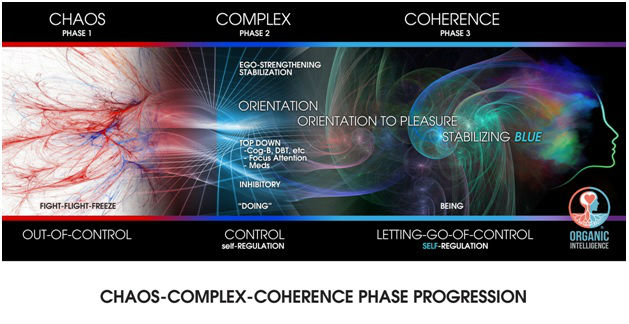
The main question, therefore, becomes attunement. For instance, an ego-strengthening comment, such as, “So you were able to set that boundary with your partner,” could be a helpful reflection when the system is in Phase II— it may support a more positive affective state appropriate to that Phase. In Phase I, such a reflection’s effect would be nullified in the system’s disorganization and tendency to associate things with negative affect or increased intensity. In Phase III, it would create a particular state extrinsically, when the system is intrinsically processing, and thus disrupt all-important intrinsic reorganization. As well as emotionally, interventions must thus be systemically attuned in order to be effective, and OI helps clinicians identify the recognizable signs of these phases in order to provide this deep, organismic attunement.
In particular, the above graphic suggests that ego-strengthening must go hand-in-hand with fundamental mindfulness: that of a basic orientation to reality. This certainly includes the capacity for affect regulation through various mental, physical, or psychological actions—like tools of helpful thinking, behaving, and attentional focus, such as is found with proven tools of cognitive behavioral therapy, dialectical behavior therapy, yoga, moderate exercise, medication, etc. However, the fundamental context for a person’s use of these proven tools is the fundamental awareness of oneself in the moment. On a practical level, OI promotes the particular aspect of mindfulness: attention to the environment through the senses—simply coming back to our senses!
In contemporary psychotherapy—with notable exceptions like those found here, positive psychology, and Ericksonian utilization approaches—the focus of attention most often lands in pathology or the preoccupation with “what’s wrong.”
In contemporary psychotherapy—with notable exceptions like those found here, positive psychology, and Ericksonian utilization approaches—the focus of attention most often lands in pathology or the preoccupation with “what’s wrong.” Elsewhere, I discuss this as a biological reflection of trauma—when the amygdala creates a self-stimulating loop of emergency alert and priming for what’s wrong: “the what’s wrong attention.” Organic Intelligence says: Trauma means unintegrated resource. In other words, what’s wrong is the priming of the attention toward what’s wrong—and this is what’s wrong. However, our neurophysiological system is actually making self-organizing efforts to bring us back to balance all the time. These obvious efforts are mostly missed due to the compulsion to see what’s wrong. Self-soothing remains conceptual until—with the right knowledge and accompaniment—one can change the concept into the lived experience of good feeling in the felt sense. This is the aim of many traditions, including the initial conditions of OI treatment protocols.
[fat_widget_trauma_ptsd_right]
The relationship to projection is clear: given enough here-and-now orientation, one can allow the projection process to occur. If one can allow the projection process to take place, freed from the “it’s wrong” association, then one has the possibility to see the material whose aim is integration. In other words, projection places one’s experience “out there”—at a safe distance, where it can actually help us recollect our relationship to it. Once there is sufficient ego-strength developed, and a sufficient degree of neutral awareness*—one can begin to experience aspects of oneself which are projected. Carl Jung knew this when he said, “Everything that irritates us about others can lead us to an understanding of ourselves.” However, it is of course not only that which irritates which reflects us back to ourselves; it can also be what inspires us, what is admirable, and what is numinous which we can reclaim via projection.
* The work of establishing this ego-strengthening, the stabilization of a relatively neutral, embodied awareness, is a task common to psychotherapy. We recognize that the more disoriented or fragmented the person in therapy, and the fewer the resources available, long-term support is increasingly necessary. Establishing these “initial conditions” may occur over months or years with those who are most disoriented.
Reference:
Vaillant, G.E. (1992). Ego mechanisms of defense: a guide for clinicians and researchers. Washington, DC: American Psychiatric Press.
 In light of the recent Supreme Court decision legalizing same-sex marriage across the nation, there has been a surge in the national dialogue about marriage in general. Although a range of opinions exist in response to the SCOTUS ruling, individuals on both sides of the debate are talking about the meaning and purpose of marriage with fervor and passion.
But why does marriage matter?
Marrying for love and happiness is a fairly recent phenomenon. Previous to democratization, which popularized the notion of individual rights and freedoms around the turn of the 14th century, individuals generally either participated in arranged marriages or married according to cultural norms for their social class, socio-economic status, gender, and/or birth order. Despite the fact individuals have not always prioritized attraction or emotions in marital decisions, modern Americans cherish the romance of marrying for love and happiness, as evidenced by just about every relationship narrative in the media today.
Marriage therapists often assist couples struggling with conflict, pain, or feelings of isolation in their marriage. If the purpose of marriage is to secure long-term personal and relational happiness, have these couples somehow failed?
[fat_widget_relationships_right]
In traditional marital vows from The Book of Common Prayer, couples commit “to have and to hold, from this day forward, for better, for worse, for richer, for poorer, in sickness and in health, until death do us part.” The weight of those words can feel far from romantic: they do not guarantee an image of blissful happiness that is typically associated with modern weddings. Could it be that marriage is not necessarily meant to make us happy?
Duke University ethics professor Stanley Hauerwas suggests that pursuit of marriage for the fulfillment of personal happiness “fails to appreciate the fact that we always marry the wrong person.” Hauwas writes, “We never know whom we marry; we just think we do. Or even if we first marry the right person, just give it a while and he or she will change. For marriage, being [the enormous thing it is] means we are not the same person after we have entered it. The primary challenge of marriage is learning how to love and care for the stranger to whom you find yourself married.”
Marriage is not merely a means to finding personal happiness; rather, it is an opportunity to demonstrate love to another person (and the family and community associated with that person) even in the midst of unhappiness. Let’s return once again to the traditional marriage vows: Are couples truly willing to embrace their words that marriage means to have and to hold … for worse … for poorer … and in sickness … until death do us part?
Are couples truly willing to embrace their words that marriage means to have and to hold … for worse … for poorer … and in sickness … until death do us part?
Today’s norm in American culture, which may be exacerbated through online dating, is to seek attractive partners with shared interests. It is reasonable to believe that engaging in a romantic relationship with someone who has these qualities will likely result in feelings of happiness, at least for a period of time. However, when inevitable stress or feelings of hurt impact the relationship, will the perceived value of the marriage decrease? Those who ascribe to the belief that the purpose of marriage is to seek happiness place themselves at risk of resentment, anger, or disappointment when their perceived personal needs for happiness in the relationship are not being fulfilled.
If, instead, the intent of marriage is to learn how to love one another and one’s community through sharing life together, happiness may be a welcomed benefit—but not the established primary goal.
Are one’s feelings in marriage irrelevant? Not at all. Spouses must tend to their own emotions and share them with their partners in order to increase intimacy and address relational problems. If one is suffering in marriage (e.g., if one is experiencing abuse, neglect, or addiction), feelings of distress may also be an important indicator that further action is needed.
Happiness is also important in marriage because it is a powerful motivator; couples who feel happy in their relationship will likely have more energy to work through relational challenges, learn relational skills, and seek opportunities to extend care in their marriages, families, and communities.
Individuals who marry tend to be happier than those who do not (Yap, Anusic, and Lucas, 2012). And yet, perhaps the point of marriage isn’t just to be “happily in love,” but rather to learn how to love through the act of continuously committing and extending care to one’s spouse even when circumstances are challenging.
References:
- Hauerwas, S. (1978, April 19). Sex and politics: Bertrand Russell and “human sexuality.” Christian Century, 417-2.
- Love — you’re doing it wrong [Motion picture]. (2012). France: TED.
- Yap, S. C. Y., Anusic, I., & Lucas, R. E. (2012). Does personality moderate reaction and adaptation to major life events? Evidence from the British Household Panel Survey. Journal of Research in Personality.
 Do you resist change?
Do you work hard to maintain the status quo, regardless of its effect on you?
Is it possible that you might better tolerate change if you approached it in small doses?
All too often, when we think of bringing about change in our lives, we consider making choices that have far-reaching effects, with sweeping consequences for ourselves and perhaps others. These seemingly super-sized changes beget long to-do lists of follow-ups and follow-throughs that can leave us overwhelmed and exhausted before we’ve even begun.
Change often ignites fear within us, so much so that we talk about making things happen but do nothing, or we initiate the first few steps only to abandon our goal because things get difficult or we meet with some resistance or it just requires too much of our energy and concentration. Sometimes we pin our hopes and dreams on big change only to discover that the results weren’t as we had imagined.
[fat_widget_right]
Have you ever initiated a big change and then stepped back from it, feeling the need to protect yourself, barricading yourself against the discomfort associated with it?
Have you felt shame or embarrassment at not being able to move forward in the way you had hoped?
This is why it’s so important for us to consider the impact that implementing subtle or small changes can have on us. They, too, can have far-reaching effects.
Some benefits of small change include:
- It is easier to implement.
- It is less difficult to get others to be supportive of small changes.
- Less fallout—subtle changes may not necessitate other changes to follow.
- It provides an opportunity to test the waters and course correct if need be.
- You’re more likely to stay motivated. With small changes, you’re more likely to experience a sense of accomplishment, promoting your next steps (“Since I was able to achieve THAT, why don’t I now try THIS?”).
Here are some examples of powerful yet subtle changes and what their immediate, noticeable impact might be (in italics):
- Take 10 minutes each night to plan tomorrow’s tasks/activities. This may enable you to go to bed more at ease than you would otherwise, feeling prepared and ready to face the next day.
- Set your clothes out the night before. No scrambling at the last minute to find your favorite shirt! You know what you’re wearing, and it is waiting for you to put it on. As a result, you leave the house on time and feel good about starting your day on the “right foot.”
- Begin your day with five minutes of gratitude, or choose to consciously set your positive intention for the day. Before facing the world, you orient yourself positively to it. You continue to notice the things that are going right and are aware of the things that support you in your mission.
- Acknowledge your partner for things you formerly took for granted. Your partner ends up feeling validated and may begin acknowledging YOU for the things you do. Your relationship strengthens as a result of this new attention.
- Wake 20 minutes prior to others in your household so you can peacefully drink your coffee with no distractions. You have a few minutes of quiet that can serve as the anchor to your day. You feel more equipped to handle the busyness that ensues thereafter.
- Take an honest lunch hour, instead of snacking at your desk while you continue working. You feel refreshed and more ready to tackle the afternoon’s work. You honor yourself by giving yourself some time to recharge.
- Delegate a task that can be done effectively by someone else. You may empower someone else by helping him or her discover what he/she is capable of handling. You free up your time and energy for more important or challenging items.
- Make your bed each morning. This can provide you with a sense of order. Also, crawling into bed at night can be like unwrapping a lovely gift, making the process more appreciated and special.
- Plan to meet up with friends twice a month. This gives you something to look forward to and ensures that you are devoting attention to the relationships that are important to you.
- Learn something new because you choose to. You will ignite your curiosity, exercise your brain, and challenge yourself to grow.
- Go to sleep a little earlier. Give yourself the opportunity to have more energy, more focus, less hostility, more patience, and improved overall well-being.
- Clean your desk. Feel like the master of your domain. Instead of feeling overwhelm, feel in control. Save time by knowing where things are. Experience the clarity that comes with clearing the surrounding clutter.
- Stretch, walk, or exercise for 15 minutes. Clear your head, release some stress, breathe fully, and become aware of the flexibility and strength of your body.
The majority of the above examples are relatively small behavioral changes that are within your power to execute.
If you have super-sized changes in mind, consider breaking them down into more manageable phases so you stay the course. You can make subtle shifts and adjustments along the way.
Choose what YOUR small change will be and then experience the impact it has. Share your results in the comments section below!
 Anxiety can show itself in many forms. Some can be very painful and impairing, and we may need professional help to deal with them. But anxiety is something that everyone experiences at different times, and there’s something you can do about it.
One powerful tool that can help you navigate anxiety is mindfulness. Being aware of the present moment without judging it, and allowing experience to happen without trying to change it, can free you from the pain of your anxiety as well as help you understand its underlying causes.
But how do you do this? Like anxiety itself, the answer to this question is multifaceted. Anxiety manifests through our moment-to-moment thoughts, emotions, and body sensations. We suffer a great deal when we reject what’s actually happening in our moment-to-moment experience; by recognizing our habits of trying to “get rid of” experience, we can ease unnecessary suffering. What’s more, we can begin to understand the deeper, underlying causes of our anxiety.
[fat_widget_anxiety_right]
Thinking Plays a Big Role
Our thinking patterns greatly influence how we see ourselves, others, and the world at large. As a consequence of our early interactions with caregivers, peers, and society, we create various thought patterns that continue to evolve throughout our lifetimes. Most of the time, we’re unaware of these patterns, so they can end up dictating a great deal of our lives.
For example, if as a child you were repeatedly told by your father that you weren’t good at something (or, conversely, that you were amazing at something), you likely internalized that message and it became part of your identity. You act accordingly and believe you aren’t good enough (or amazing) at that particular activity. And if you find yourself faced with the activity you believe you aren’t good at, you may experience anxiety, and doing the activity may be very difficult. In such situations, it’s as if we become that 6-year-old all over again.
Having a mindfulness practice can help us see our actual process of thinking, giving us some space from our thoughts. The next time you tell yourself that you can’t do something or that it’s too difficult, pay close attention to the tone of voice and words you’re using; you may recognize it as the voice of an influential person growing up. At this point, you may begin to appreciate that the thinking is not really “yours,” but an internalized voice.
With mindfulness, you can become aware of the thoughts without identifying with them. Again, this isn’t easy, and you may take a long time to get there—but it is absolutely possible. The more we practice mindfulness, the more this capacity develops.
What about Feelings?
Emotions are inevitable; we experience them all the time. Some are pleasant, and some are unpleasant. As humans, we tend to avoid the unpleasant ones and grasp for the pleasant ones. When we’re experiencing anxiety, our emotions can be especially difficult to tolerate, and we may try to suppress or get rid of them. The problem is, by doing this we perpetuate a rejection of ourselves, creating a negative feedback loop.
By developing a mindfulness practice, little by little you can begin to tolerate the emotional quality of anxiety, to the point that it becomes manageable. When you allow your experience to be what it is, it loses power over your sense of well-being. As with our thoughts, this skill takes time to learn, but it is very real. They key here is to practice.
Besides anxiety management, another important benefit that comes from emotional mindfulness is that we increase our capacity to know and understand our feelings. Many people experience anxiety because they lack a direct awareness of the emotions behind it. The more we became comfortable with our emotions, the deeper we see behind them and the less influence they have over us.
As you might sense, we miss out on a great sense of aliveness and dynamism when we live in our heads.
Everything Happens in the Body
Our bodies are our main vehicles for moving through life. They carry a tremendous amount of information, yet for the most part in modern society, we’ve lost touch with them. Emotions begin in the body, and so anxiety can show itself in the body, too, in ways such as contraction in the chest, heart palpitations, tightness in the stomach, and so on. As we develop the capacity to sense into our bodies, we can pick up on our different emotions earlier. We can also more easily see the impact others and the environment have on us.
At least in the West, most of us ignore our physical sensations and experience the world through thinking. Some of us take emotional life into account, but very few actually incorporate the body’s experience into our worldview. It makes a tremendous difference in our quality of life when we do. As you might sense, we miss out on a great sense of aliveness and dynamism when we live in our heads.
Ultimately, We Must Integrate All Three
Thoughts, emotions, and body sensations are not discrete, separate categories. The truth is, the three are complex and intertwined, affecting each other in many ways. Practicing mindfulness helps us to notice how our thoughts impact how we feel, how our feelings impact how tense our bodies are, and how our physical experience impacts our thoughts and feelings. The great news is that by becoming aware of any one of these processes, all of them begin to shift, harmonize, and flow.
As I’ve mentioned in previous articles, although it’s possible to practice mindfulness alone, it’s beneficial to have a coach, guide, teacher, or therapist who can help you track your progress and notice when you encounter one of the many pitfalls along the way. Sometimes anxiety can increase when we begin paying attention to our long-ignored experiences. Sometimes anxiety is masking psychological trauma, and opening this up without appropriate support can be counterproductive. If you want to reduce your anxiety and reap the full benefits of mindfulness, seeking guidance is crucial to your practice.
 In my psychotherapy practice, I work with many young adults who come into treatment as they recognize that they haven’t developed the necessary emotional tools to succeed as an adult in the world of work and relationships. In the media and in society, I believe that the emphasis on youth frequently leads us to overlook the experience of parents who become increasingly anxious and depressed as they watch their adult children struggle to create satisfying lives.
Parents often come to see me because they are uncomfortable with their feelings about their adult children. Typically, they worry that their children will never be successful or happy, and they are confused about whether they and/or their child are responsible.
Eric was suffering when he came to see me. He felt his 27-year-old daughter, Holly, was ruining her life and it was causing him great pain. In our first session, he seemed tormented as he told me that Holly “lived in a fantasy world.”
“She’s been in one rock band or another since middle school and through college,” Eric related. “She plays guitar and she’s good. But so are a lot of kids. She majored in education, and I thought she’d be a music teacher. But since she graduated college, she hasn’t pursued teaching and says she isn’t interested. She keeps auditioning for bands and sometimes gets a gig, but nothing permanent. My wife and I think she’s depressed. We agreed she could move back home after college, but that was more than four years ago. She makes very little money and barely seems to get by on what she makes playing music. I don’t think she is ever going to grow up. She doesn’t seem very happy. My wife and I keep arguing about whether we should give her an ultimatum that she has to get a real job or we won’t keep supporting her. I don’t know … I just don’t know what to do. I think I’ve become more depressed than Holly.”
[fat_widget_right]
Eric’s situation was familiar to me. Many parents are caught between their desires to love, nurture, and protect their children and their fear that their children don’t have the skills, drive, or emotional strength to enter the adult world and figure out who they are and what they want for themselves. More significantly, these parents frequently find it exceptionally difficult to make demands and behave in ways that evoke their own and their children’s bad feelings. Eric was angry with himself and with Holly. His ambitions and hopes for her were mixed with his feelings about himself and the kind of parent he was and had been.
“I always supported Holly’s musical aspirations,” he said. “I took her to lessons, went to her rock performances, let her bands practice in our garage. I loved every minute of it. I suppose I thought that maybe she’d become a professional, maybe even shared her wish that she’d become a rock star. Now I wonder if I lived in a fantasy world also and didn’t give Holly enough of a taste of reality. Maybe I didn’t help her with reality in other ways. She was always so busy with her music and her friends that my wife and I didn’t ask very much of her. We pretty much said yes to almost everything: music camp, expensive instruments, drove her everywhere. She never had to pay for anything, and we’re not rolling in money. We never even gave her chores, which drove my wife crazy and we fought about that. Maybe I just let her off too easy and now I don’t think she can take care of herself. The problem is, I don’t want to take care of my grown-up daughter as if she were still a child. I feel angry at her and I hate myself for feeling this way.
“No matter how I look at it, I’m a lousy father. If I cut her off, I’m not doing what I should and that makes me bad. But I’m already a bad father because It’s my fault that she doesn’t know how to be a grown-up in the world.”
Many parents are caught between their desires to love, nurture, and protect their children and their fear that their children don’t have the skills, drive, or emotional strength to enter the adult world and figure out who they are and what they want for themselves.
After many hours of talking with Eric about his relationship to Holly, we began to understand how he and his wife, Ella, had unwittingly undermined Holly’s ability to make her way in the adult world. As I learned about Eric and the early years with his daughter, a picture of two loving parents who were smitten with their daughter emerged. Both Eric and Ella had been raised in very strict, cold families. Eric told me that he and his wife were drawn to each other when they realized that neither of them was raised with feelings of recognition or appreciation from their parents. Eric remembered talking with Ella about how they would be different and give their children extra attention and make them feel special and perfect. In talking with me about this, Eric wondered aloud.
“Maybe we went too far in the other direction,” he said. “Everything that Holly did we delighted in. We oohed and aahed over everything. The smallest thing—a smile, a scribble, a sound—was enough to get us to be gleeful toward her. We were in love. I suppose we went overboard. We married late. When we realized that we would have only one child, we got even more enthusiastic and involved with Holly. We scheduled any activity she asked for; we tried to nurture all her interests and pretty much praised everything she did and made no demands. Now I’m always so irritable with her. I feel critical, but I don’t want her to know. I don’t want to upset her. It’s awful.”
It became clear that Eric and his wife had never set limits for Holly and that they hadn’t helped her develop a sense of herself that was realistic—i.e., that had both positive and negative aspects. I suggested a hypothesis to Eric: “I think it’s likely that if Holly only received praise, she knew, if only unconsciously, that she wasn’t so completely and totally fantastic. If she couldn’t believe that she was so terrific, it would have been difficult to develop a balanced view of her strengths and weaknesses. If Holly couldn’t trust the good stuff, she probably had a great deal of uncertainty about her abilities. She even might have leaned toward thinking more negatively about herself. I think it is very likely that she is quite anxious about whether she has what it takes to make it in the adult world.”
I asked Eric what he thought of my hypothesis. After some silence, he replied: “Yes, you have put into words what I haven’t been able to put together. It hurts, but it’s a relief to feel that this all makes sense and maybe now we can figure out how to make things better for all of us.”
While my hypothesis made sense to Eric and he wanted to find more productive ways to relate to Holly, he found it very difficult to change his behavior toward her. He agreed there would have to be limit setting, but he could not get comfortable with what limits and how to implement them. For example, he thought it would be a good idea to ask Holly to start paying some rent (his wife agreed). But he obsessed about how much, when to begin, and how to bring it up. As we explored his difficulties, some of his resistances became clear.
“I know I should ask for rent, but I’m sure Holly will think I’m mean. I hate that she’ll feel like I’m not supporting her musical aspirations. I don’t want to make it more difficult for her to pursue her music career.”
Eric and I spent many sessions exploring his conflicts. He had to come to terms with his feelings of meanness and get to a place where, even if it didn’t feel good to him, he could believe that setting limits was helping his daughter by giving her the opportunity to see that she could take care of herself and succeed in the world. Some of the questions I asked Eric to consider were: What is it like for you if Holly thinks you’re mean? Do you think you’re mean? What would you have to tolerate if Holly did think you were mean? Eric also had to reconsider what actually was and wasn’t supportive of Holly’s music career. I asked: “How do you conclude that asking for rent means you’re not supporting her career? Can you consider that (even if she didn’t like it) paying rent could help Holly see herself as able to take care of herself and might give her the confidence she needs to make it in the very competitive world of music?”
Eric is wrestling with these and many other questions. He and his wife decided to give Holly three months notice to begin to pay rent. As expected, Holly was angry and hurt. She cried and accused her father of not thinking she had what it takes to be a musician. Eric stood his ground (although he reported that he felt like a bad father). He is also working on being aware of his gushing about anything his daughter tells him. He is trying to be more honest with Holly when she acts entitled or does something irritating.
Eric and I continue to work on the difficult feelings that emerge as he asks Holly to be a responsible adult. He is increasingly able to appreciate that this is having a positive effect on Holly. She is paying rent and is talking about substitute teaching. At the same time, she has formed a new band and is writing more music. Without withdrawing all of his involvement, Eric is trying to let Holly become her own cheerleader. The more he sees her taking charge of her life, the better he feels about his limit setting and the more able he is to set limits. This should lay the groundwork for Holly to become more of an adult and for Eric to feel like a “good enough” father.
Note: To protect privacy, names in the preceding article have been changed and the dialogues described are a composite.
 Raising a child on the autism spectrum can be one of the most rewarding and yet taxing things some parents will ever experience.
I know.
In addition to being a therapist who works with families affected by autism spectrum issues, I, too, am a spectrum parent. Many of the people I help in my practice ask me how I am able to do it, as if I have some kind of secret or special ability they don’t. Honestly, it was my own journey in counseling—as a person in therapy—that helped me the most and gave me the skills I needed to navigate this challenge. It’s also why I decided to become a therapist.
As spectrum parents, we become adept at researching, finding, and financing all the right therapies for our kids, but we also have a tendency to neglect our own needs. In order to survive this parenting journey, seeking professional help may be necessary at some point.
Here are four ways counseling can help a parent of a child on the spectrum:
1. Adjusting to the Diagnosis
The autism diagnosis itself is often traumatic for parents. It can be a grueling process that may take up to a year or more, with multiple visits to several different professionals. During the process, parents are typically faced with myriad feelings, including anxiety, guilt, excessive worry, hope, and fear about the future. Oh, and a lot of waiting. Many parents end up being told that their child does not qualify for an autism diagnosis and are left at a dead end, with more questions than answers.
[fat_widget_right]
Diagnosis or not, the grief is very real. Often, an understanding of the grief stages, and the knowledge that grief is cyclical, helps parents adjust. Everyone reacts differently to grief, and how one reacts has a great deal to do with what happened and whether they’ve dealt with it appropriately. A person may need therapeutic interventions such as cognitive restructuring or EMDR therapy to help them get past the shock or pain of the initial diagnosis.
2. Parenting Skills
Parenting a child on the spectrum can be very different than parenting a neuro-typical child. There are sensory issues to consider, educational decisions to be made, medical interventions, safety concerns, and therapeutic decisions, to name just a few. More often than not, these children also have accompanying health conditions and self-regulation difficulties. Parents can become incredibly overwhelmed and confused when faced with it all.
A counselor who is well-versed in the needs of autism spectrum families is crucial. Such a professional can help parents prioritize needs and reduce the anxiety associated with overwhelm.
I often tell couples that a diagnosis of autism doesn’t ruin a relationship, but their response to it might.
3. Staying Connected to Your Partner
It has been reported that parents of children with autism have a slightly higher divorce and marital discord rate than parents of typical children. That certainly comes as no surprise, as the stressors are generally greater. I often tell couples that a diagnosis of autism doesn’t ruin a relationship, but their response to it might.
Autism tends to shine a bright light on whatever issues were already there. A counselor who understands the constant stress autism places on a family can help a couple navigate the difficulties while staying connected.
This doesn’t happen overnight. It’s process that takes time, patience, and perseverance. But the results are worth it. There is no doubt in my mind that counseling saved my own marriage.
4. Stress Management
Stress is a significant factor in the development of disease. It can literally make us sick.
In order to stay healthy, we need to learn to manage stress effectively. The daily stress of an autism parent is tremendous and constant. A counselor can help by offering a caring, supportive ear, validating parenting efforts and encouraging self-care skills. Counseling can help someone through a rough patch or be used on an ongoing basis throughout the parent’s journey. Some of the parents I help keep me on speed-dial for help during tough times, while others have attended therapy regularly for years as their child has grown.
It is said that we cannot give out of an empty cup, that we need to put on our own oxygen masks before helping others. If you are the parent of a child with autism spectrum, counseling can make a tremendous difference in how you play the cards you’ve been dealt. In the end, that’s a win-win for your entire family.
References:
- Cohen, S., Janicki-Deverts, D., Doyle, W. J., Miller, G. E., Frank, E., Rabin, B. S., & Turner, R. B. (2012). Chronic stress, glucocorticoid receptor resistance, inflammation and disease risk. Proceedings of the National Academy of Sciences, 109, 5995-5999.
- Hartley, S. L., Barker, E. T., Seltzer, M. M., Floyd, F., Greenberg, J., Orsmond, G., & Bolt, D. (2010). The relative risk and timing of divorce in families of children with an autism spectrum disorder. Journal of Family Psychology 24(4): 449-457.
- Naseef, R., & Freedman, B. (2012). A diagnosis of autism is not a prognosis of divorce. Autism Advocate. Fall: 9-12.
 Conversion therapy—which attempts to make LGBTQ people straight—is now illegal for minors in a handful of states, including New Jersey. Though proponents of this therapy argue that it supports sexual choice and religious freedom, it has been widely criticized for stigmatizing LGBTQ populations, using dangerous or abusive methods, and not working the way it promises it will.
Jews Offering New Alternatives for Healing (JONAH), a New Jersey organization that offered conversion therapy, was found guilty of consumer fraud late last month. In the first case to put conversion therapy on trial, jurors found that JONAH engaged in deceptive practices. The organization encouraged its clients to re-enact traumatic childhood memories, publicly undress, and attack effigies of their mothers. The civil jury agreed to award more than $20,000 to the plaintiffs.
Semicolon Tattoos Are a New Way to Talk About Mental Health
Project Semicolon hopes to add to the dialogue about mental health with a simple tattoo. Semicolons, the project explains, indicate a sentence that could have ended, symbolizing the decision to continue living. The project advocates drawing a semicolon or getting a semicolon tattoo somewhere on the body to draw attention to mental health issues while highlighting the power of continuing to live. [fat_widget_left]
Going on Nature Walks Is Good for Mental Health, Study Finds
If you’ve ever gotten lost contemplating everything that’s wrong with your life, you already know that rumination can cause depression. To test the ability of walking to reduce rumination, researchers recruited 38 participants, each with no history of mental health issues, and asked them to walk for 90 minutes. Questionnaires and brain scans before and after the walks suggested a reduction in rumination, but only among those who went hiking. Those who walked on busy streets did not reduce ruminative thoughts.
Most Antipsychotic Drugs Prescribed to Teens Without Mental Health Diagnosis, Study Finds
Antipsychotic drug use is on the rise among teens, according to a study published in JAMA Psychiatry. The study analyzed prescription trends between 2006 and 2010, and found that about 1.19% of teens used antipsychotics in 2010, compared to 1.1% in 2006. Though these powerful drugs are designed to treat mental health issues, no clinical diagnoses were made for 60% of antipsychotic users aged 1–6, 56.7% of those aged 7–12, 62% of those aged 13–18, and 67.1% of those aged 19–24.
Screen Addiction Is Taking a Toll on Children
In China, doctors now consider screen addiction a clinical problem. Children who spend too much time on technological gadgets may face draconian treatments, such as being confined without access to technology for months. Children addicted to technology may refuse to eat, sleep, or even break to use the bathroom. Screen addiction is also raising concerns in the United States, where organizations such as the American Academy of Pediatrics have recommended limiting children’s screen time.
Emotional Awareness Training ‘Reduces Severe Crime Reoffending Rates’
Some research suggests that young people who commit crimes have trouble reading social cues. This phenomenon is often written off as a permanent state, but a new study suggests that emotional awareness training could improve empathy and reduce recidivism rates. Twenty-four of 50 young people with a history of criminal behavior underwent training designed to improve emotional recognition. The other half of the group went through standard protocols recommended by their case managers. Both groups had a reduced recidivism rate, and those who underwent emotional awareness training engaged in less serious crimes when they did re-offend.
Suicide Attempts Most Common in Newer Soldiers, Study Found
New soldiers who have not been deployed are more likely to take their own lives, a new study suggests. Researchers found that 377 out of 100,000 enlisted soldiers attempted suicide, compared to 28 out of 100,000 officers. White soldiers were more likely to attempt suicide than blacks or Hispanics. Those with no college education and at early stages in their career also showed an increased propensity for suicide.
 There’s a reason you and your partner can’t agree. It’s because you started out as opposites. And opposites attract. So annoying, right? But you are in excellent company because opposites attracted long before the human species got here.
It turns out that Einstein’s theory of relativity is built on it, and if you remember your high school science, electrons and protons whoosh right into each other. In the animal kingdom, opposite-ness has the survival value of creating a diverse set of genes.
But among humans, the problem gets a bit complex when the very qualities that attracted us in the first place are the ones we now find highly irritating.
In the world of corporate America, it is well known that people work well together when they are similar in outlook and disposition. If we merely choose people we can get along with, we tend to choose similar ones. But if we choose those we are attracted to, then our unconscious tends to kick in and lead us down paths we probably wouldn’t take if only we knew (consciously) we were doing it. Often, those paths lead to our opposites.
[fat_widget_relationships_right]
Then again, attraction is hardwired into the animal kingdom, so it must have a positive purpose. What could that possibly be? Back in 1967, Henry V. Dicks had a theory about this (Whitehouse, 1981). According to his view, we are attracted to someone who has a quality we don’t have because that quality was a part of our personality when we were children. At some point, it was attacked or rejected by our parents. So we also rejected it, but at the same time missed it.
Because the quality was put down, we don’t care for it. But because the quality was a part of us at one time, it is still attractive. So, we now have ambivalence about that quality. In a 1981 study of 30 people, it turned out that the annoying quality was an exaggeration of the very quality the person was originally attracted to, supporting Dicks’ theory.
So, for example, if a person was attracted to someone who was outgoing, years later the complaint might be that the object of attraction socializes too much and doesn’t pay enough attention to the person.
What do you do? How do you resolve these sorts of things without giving up who you are?
This is an interesting psychoanalytic approach. Here’s mine: We are here on Earth to learn and grow. We reach for the stars. That is hardwired into us. That part of us that wants to expand our horizons naturally would be attracted to people who have qualities we don’t have. Yet, we of course get along best with people whose outlook and style are more similar to ours. We are pulled in both directions. I think it’s as simple as that.
What if you find yourself in exactly that situation right now? You are in a relationship with someone who seems to be your polar opposite. You are a saver; the other person is a spender. You like to travel; your soulmate likes to stay home. You feel that a comfortable home is a tidy one; your significant other feels home is where it’s most relaxed. You prefer time alone together; your mate wants to socialize. What do you do? How do you resolve these sorts of things without giving up who you are?
Step 1: Get the Magic Back
Without the magic you once had, all the discussions in the world may be of no avail. There was a time when you counted the minutes to being together. There was a time when the list of things above would have been petty in your eyes.
Do something fun, exciting, romantic, and then do something else that’s wild and happy.
The magic comes when you put the whole person into perspective. You used to love something deep and undefinable about that person; now it’s time to reach for that something again.
Step 2: Take a Look Inside
Use the ideas presented above to look at yourself. What is it that you wanted in this other person? What is it about you that is missing that thing? How did that happen? How did you come to find it attractive in your partner?
A little soul searching may help you remember that you had a reason—a good reason—to be attracted to this person. There was, indeed, something about him or her that completed you, even if you were not consciously aware of it at the time.
Step 3: Cherish That Quality
You were once attracted to that quality, so now is not the time to reject it. Cherish it.
True, it may need some refining. We were all put here to grow, and that includes not only you but your friends and relatives as well. By being in contact with one another, each of us can grow.
But the best possible climate for growth comes from acceptance, not rejection. If Dicks’ theory is correct, then plainly we see that rejection by our parents did not help us grow. Take responsibility for the fact you chose this partner.
Step 4: Say What You Need
If you have done all of this introspection and recognize where the attraction came from for this now-annoying quality, and it is still intolerable, speak up! But do it with love.
So many people think that being assertive is the same as being harsh, demanding, and autocratic. That’s the furthest thing from the truth. The reality is that an assertive response is one that doesn’t beat around the bush but doesn’t say it with anger, either. Although you may be annoyed, do some deep breathing and let go of the bad feelings.
Step 5: Figure Out a Solution Together
The beauty of relationships is that so much can be accomplished by putting your head together with someone else’s. Almost every problem really does have a solution. Enjoy the teamwork and the renewed sense of closeness it fosters.
And if you need a little nudge or guidance in the right direction, contact a qualified therapist.
Reference:
Whitehouse, J. (1981). The role of the initial attracting quality in marriage: Virtues and vices. Journal of Marital and Family Therapy, 7(1), 61-67.
 Amid or following divorce or separation, some families face the issue of one or more children refusing to be in contact with one of the parents. While the dynamics of any family experiencing this can be quite complicated, children may behave in this way for a variety of reasons.
Here are some examples (for the purposes of this article, one parent is referred to as the preferred parent, the other the resisted parent):
- There may be conflict between the parents, and the child does not want to remain caught in the middle.
- The child may have been closer to one parent than the other when everyone lived together.
- The child may be in a developmental phase where alignment with one parent over the other is age- and/or gender-related.
- One parent may be involved with a new partner before the child is ready and/or comfortable with the situation.
- The preferred parent is more financially secure or otherwise stable than the resisted parent.
- The child chooses who he or she believes most needs to be taken care of based on the circumstances.
- There is ongoing litigation (even if the children do not know the details, they often see the effects of the stress).
- Both the preferred parent and the child believe the resisted parent is not safe.
[fat_widget_right]
In these situations, it is often the favored parent’s belief that the resisted parent caused the resistance; meanwhile, the resisted parent often believes that the favored parent is responsible for the child’s refusal to see him or her. While either of these scenarios can certainly be the case, families are complicated systems in which many behaviors and relationships impact what everyone experiences.
There are two important options, which are not mutually exclusive, to consider here: (1) Improve both the favored and resisted parents’ relationships with the child, or (2) improve the co-parenting relationship. As complicated as the family system may be, individual relationships within the system can be addressed. Both parents have responsibility for their part in the family dynamic, including the favored parent.
When children can see their parents having civil and respectful interactions and making it a mutual priority to offer safety, this often leads to a relaxation of the need to push one parent away.
The favored parent may have a difficult time seeing or appreciating how he or she responded when the child did not want to see the other parent. When a child tells you about something negative that happened with the other parent, for example, it can feel natural to sympathize with the child and build a case against or undermine the connection between the child and the resisted parent. This isn’t fair to the other parent or the child. When a child provides negative information, contacting the other parent and asking what he or she knows about it is a good place to start. Secondly, it’s important to help your child understand that he or she can talk to the other parent about it and not have you be his or her voice.
The resisted parent, of course, has an important role to play in the relationship with the child and in behaving in a way that is inviting. Children who resist a parent sometimes feel the expression of affection, for example, as intrusive. It can be expressed, however, without the expectation of reciprocation. This gives the child room to make a choice. It sometimes happens, with time, that the child begins to respond. It is important that the resisted parent let the child know he or she is loved, without conditions.
There are many more ways for both the resisted parent and the preferred parent to alter their behaviors with the goal of improving the relationships between children and parents. The most important is to improve the co-parenting relationship. When children can see their parents having civil and respectful interactions and making it a mutual priority to offer safety, this often leads to a relaxation of the need to push one parent away.
If a child in your family is resistant toward one parent and your co-parenting strategies have been ineffective, contact a therapist in your area for help.