 Six simple screening questions can test for social media addiction, according to James Roberts, PhD, a marketing professor at Baylor University’s Hankamer School of Business. Roberts researches smartphone addiction and wrote the book Too Much of a Good Thing: Are You Addicted to Your Smartphone?
A recent poll from Common Sense Media shows about half of all teens feel they are addicted to their smartphones, and at least 59% of parents believe their kids are addicted. Nearly two-thirds of parents say their teenagers spend too much time using mobile devices, and 52% of teens feel the same way.
Are You Addicted to Social Media?
According to Roberts, social media addiction shares six key features with other behavioral addictions: building tolerance for the stimulus, symptoms of withdrawal, conflict about the source of the addiction, high salience of the addictive behavior, a sense of euphoria when indulging the addiction, and vulnerability to relapse.
Roberts suggests six questions can uncover these features and identify social media addiction. Those questions are:
- Salience: Is social media use heavily integrated into your daily routine?
- Tolerance: Do you find yourself spending progressively more time on social media to get the same satisfaction?
- Euphoria: Do you rely on social media as a source of excitement, or to cope with boredom or loneliness?
- Withdrawal: Do you feel a need to use social media, and feel edgy or anxious when you cannot?
- Relapse: Do attempts to quit or reduce social media use fail?
- Conflict: Does social media cause problems in your life or conflicts with loved ones?
Answering in the affirmative to three or more questions points toward a social media addiction.
Why Is Social Media Addiction a Problem?
[fat_widget_right]Previous research suggests excessive use of social media can affect mental health. For example, a 2015 study found a correlation between significant use of social media in teens and untreated mental health issues. Another 2016 study indicated an addiction to the internet may be associated with higher rates of anxiety and depression.
Roberts cautions that social media use can undermine in-person relationships by causing users to prioritize online relationships. Therapy can help effectively treat social media addiction, as well as other compulsive behaviors.
References:
- Are you addicted to social media? Expert offers six questions to ask yourself. (2016, October 20). Retrieved from http://www.baylor.edu/mediacommunications/news.php?action=story&story=174059&_buref=1172-91940
- Dallas, M. (2016, September 18). Internet addiction may be red flag for other mental health issues: Study. Retrieved from http://health.usnews.com/health-care/articles/2016-09-18/internet-addiction-may-be-red-flag-for-other-mental-health-issues-study
- Mozes, A. (2015, July 31). Too much Facebook, Twitter, tied to poor mental health in teens. Retrieved from http://www.nlm.nih.gov/medlineplus/news/fullstory_153889.html
- Wallace, K. (2016, July 29). Half of teens think they’re addicted to their smartphones. Retrieved from http://www.cnn.com/2016/05/03/health/teens-cell-phone-addiction-parents/
 Love is powerful. It can be reduced to chemical reactions in the brain or elevated to spiritual phenomenon. Love invites us to be brave and expose our deepest selves. Love can also feel like an unwelcome spotlight that reveals our dirtiest secrets.
We all have them—the parts of ourselves that are weak and afraid at best, disgusting and shameful at worst. We work hard to hide them away so no one ever sees them. We believe that these parts—and ultimately ourselves—don’t deserve compassion. Perhaps we don’t even feel worthy of love itself. What does that mean about our ability to be in a loving relationship with another person?
We often hear that you have to love yourself first to able to love or, worse, be loved. This is a toxic way to view yourself and only reinforces the very fears that keep you hidden in the first place. Your struggle to love yourself does not devalue the love you have to share, nor does it render you unlovable. Your ability to love yourself just changes the way you experience a loving relationship.
[fat_widget_right]
What Does It Mean to Love Yourself?
Loving yourself refers to accepting all parts of yourself, even the ones that bring you discomfort. It means taking care of yourself when despair instructs you to isolate and withhold. It means learning to believe in two seemingly opposing truths at the same time: you are good enough as you are and you have room to grow. Loving yourself is not an unchanging state that you either exist in or don’t. You will have days when you will revel in the chance to be kind and gentle with yourself, and there will be days it will feel like swimming upstream.
When you look at love as something dynamic, as a behavior, as a conscious effort, it becomes more accessible. Loving yourself is not set in stone, but a choice over which you have control. You have the freedom to offer love to yourself and to open yourself up to a new experience of being in love. Here are five ways loving yourself makes your relationships stronger:
1. When you love yourself, you can share yourself with your partner without fear.
When you love yourself, you can recognize your imperfections and refrain from judging them. You know all humans are in a constant state of flux, and that these imperfections are opportunities to evolve. You have nothing to hide and can be honest with your partner about your flaws and how you attend to them. And since you no longer allow shame to cloud your self-image, you can acknowledge your strengths and talents—the very attributes your partner has appreciated all along.
2. When you love yourself, you can trust your partner’s love for you.
When your partner tells you how kind, generous, and attractive you are, you can believe it. Self-doubt won’t prevent you from accepting your partner’s love. You will know that—while you’re not perfect—you have a lot to offer, and it is absolutely believable that someone would value you. You won’t have to be shocked that this person you hold in high esteem regards you as equally amazing. When you allow someone to love you, you reinforce that you are indeed lovable. Loving yourself becomes more than an option; it becomes your right.
3. When you love yourself, you can express your needs without guilt.
Recognizing your own value means recognizing that your needs are just as important as your partner’s. Rather than feeling like a burden or undeserving of attention, you will find the courage to ask for what feels good to you. The more you realize your own worth, the less you will accept others’ disrespect or lack of kindness. Loving yourself means setting healthy boundaries and requiring that others treat you in a way that makes you feel appreciated.
Without shame, doubt, and fear to blind you, you can work together to find a joint resolution that strengthens your commitment and deepens your bond to each other.
4. When you love yourself, you can fight fair.
That’s right. When you love yourself, you can have conflict in a relationship and it won’t feel like the end of the world. You won’t automatically take everything personally, which means less self-blame and anger. Rather than shaming yourself or lashing out at your partner, you’ll be able to take responsibility for your actions in a clear-headed and thoughtful manner. You’ll be able to express your concerns knowing you have the right to be happy and heard. You’ll encourage your partner to understand you, just as you will try to understand them. Without shame, doubt, and fear to blind you, you can work together to find a joint resolution that strengthens your commitment and deepens your bond to each other.
5. When you love yourself, you can be independent from your partner.
When you love yourself, you don’t have to feel insecure about your partner’s life outside of you. When your partner is away, you can still hold onto your own value. Your partner doesn’t exist for your validation and security; they are their own person. You can support the development of your partner’s personal story, and they can support yours. Your partner’s interests and friends won’t be threatening because you believe your partner has reason to come back to you. You recognize that your sphere of control extends only to your own behavior. You can allow for your partner to make their own choices, trusting they will remain mindful of the love you share. You may even find that when you and your partner explore life outside of each other, you reinvigorate the relationship. You get to be curious about each other’s separate experiences of the world and find new reasons to be excited about one another.
To practice loving yourself is to discover the kind of love you wish to receive. Explore what it means to love and to be loved. Understand your needs, your fears, and your strengths. Learn to develop the kind of relationship that suits you best. With a stronger sense of your value, you can offer yourself and your partner the open-hearted, limitless relationship you both deserve. No more hiding, no more shame. Just your authentic, imperfectly perfect self—to be seen, heard, and cherished, just like you’ve always wanted.
 More than 50 million students are enrolled in public schools across the United States. Of those, one in five meet the criteria for a mental health condition. About 70-80% of these students won’t receive any kind of treatment or therapy. Because children and adolescents spend most of their time at school, teachers, administrators, school nurses, and other staff are often in a unique position to be the first to identify any problems or issues in a child’s life. Here are some ways for public schools to better address this rising mental health crisis.
Mental Health Screening in Public Schools
Most schools do not have any type of mental health screening in place for students. The National Association on Mental Illness supports mental health screenings for several reasons. Half or more of chronic mental health issues begin at or before age 14. Early identification and treatment can help prevent more serious problems down the road.
Just as screenings are done for a variety of physical health problems, mental health screenings in public schools could greatly benefit vulnerable students. Conducting mental health screenings in schools allows teachers to recognize the warning signs of various mental health issues, allowing for earlier identification and quicker connections to the treatment resources students might need.
The Role of Public School Nurses in Mental Health
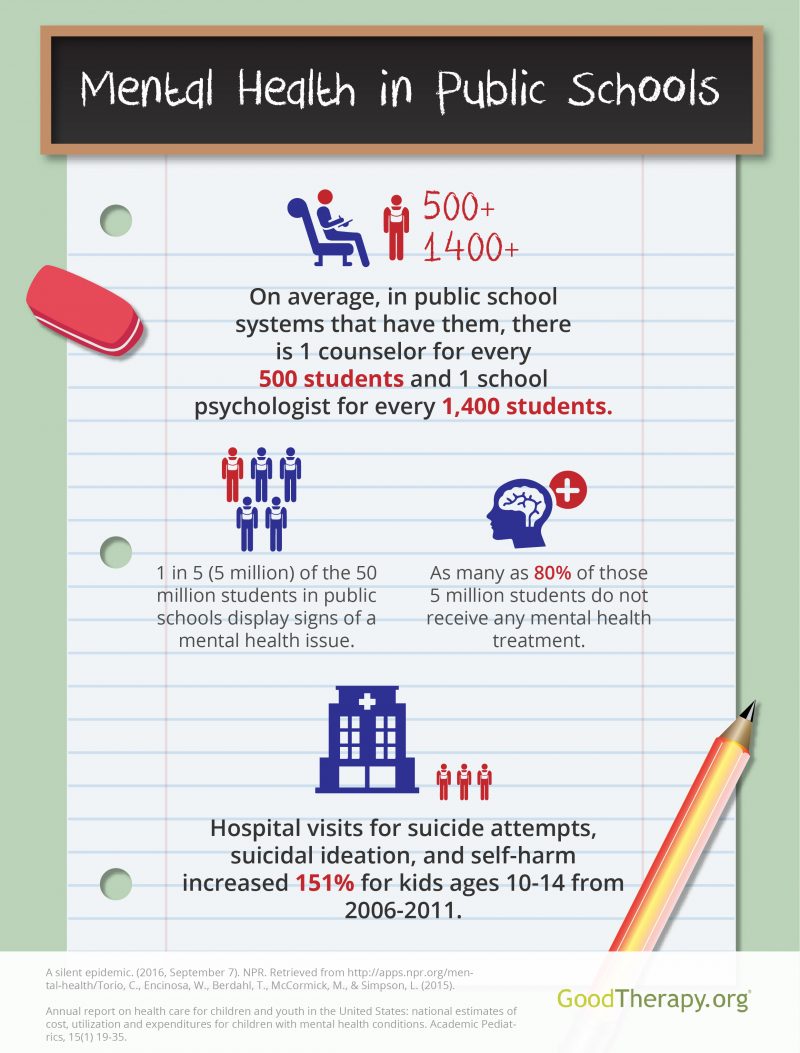
While school nurses are usually the most likely to catch any mental health issues early on, many schools only have one on-staff nurse, and many of these nurses only work part-time. It is not uncommon for entire school districts to share one nurse, meaning that one nurse may see hundreds or even thousands of students (depending upon the size of the district). This makes it more unlikely that a school nurse would be able to spot symptoms of mental health issues, as the nurse may not be available or have enough time with each student to address their needs.
According to the American Association of Pediatrics, schools function as the mental health system for approximately 80% of students. For this reason, school nurses play a critical role in identifying problems so they can be treated as soon as possible. Unfortunately, school nurses typically receive little to no training in mental health.
While nurses aren’t expected to be psychologists or therapists, they should be aware of emotional, physical, and behavioral warning signs for common mental health problems. Awareness and recognition of problems as soon as they arise could prevent a suicide.
Integrated Mental Health Strategy in Public Schools
Researchers suggest the best way to help students with mental health issues may be to have teachers, counselors, administrators, and school nurses work together to spot and handle mental health issues. Saddling this responsibility on one teacher or administrator is not likely to be effective because they typically do not have the necessary training or time. On average, school counselors see around 500 students. School nurses may see even more students, especially if they are the only nurse for an entire district. Teachers also see a significant amount of students, ranging from 20-30 in elementary schools to hundreds of students in middle schools and high schools where students change classes and teachers throughout the day.
[fat_widget_left]Integrating mental health care and strategies in public schools can help all staff who encounter students. They will likely be better able to recognize mental health problems and provide early intervention as well as prevention for many issues, including thoughts of suicide, drug and alcohol use, and relationship abuse. To recognize these potential problems, some degree of training in mental health will likely be necessary.
Some signs that a student may be experiencing a mental health condition include:
- Sudden changes in a student’s mood or behavior
- Frequent mood swings
- Behavioral problems such as aggression, temper tantrums, or lashing out in school
- Poor academic performance
- Poor hygiene
- Frequent absences
- No longer participating in extracurricular activities
- Isolation from peers
- Difficulty paying attention in class
- Excessive worrying or anxiety
- Hyperactivity
- Difficulty relating to others
- Somatic complaints (stomachaches, headaches) with no clear physiological cause
Providing Mental Health Services in Public Schools
According to the 2016 Children’s Mental Health Report, young people with access to mental health treatment and services in school are 10 times more likely to seek help for mental health and substance abuse concerns than those who do not have such programs available. Many schools are choosing to address the rising mental health crisis in the public-school system by hiring a professional psychotherapist, counselor, or psychologist on staff. Other schools have therapists come in from community mental health centers to see students who are struggling with mental health issues beyond the guidance counselor’s scope of expertise.
Congresswoman Grace Napolitano is currently working on implementing the Mental Health in Schools Act, which would provide $200 million in funding through competitive grants of $1 million each to 200 public schools across the country. This funding would help them provide on-site licensed mental health professionals in public schools. Napolitano has been executing these programs since 2001 in 14 public schools in her congressional district. This approach has proven successful and will be expanded nationwide through the funding provided by the Substance Abuse and Mental Health Services Administration.
References:
- Anderson, M. & Cardoza, K. (2016, September 7). A silent epidemic: Our public schools are struggling to handle millions of students with mental health problems. Retrieved from http://apps.npr.org/mental-health/
- Association for Children’s Mental Health. (n.d.). Problems at school. Retrieved from http://www.acmh-mi.org/get-help/navigating/problems-at-school/
- Cardoza, K. (2016, September 3). School nurses can be mental health ‘detectives’ but they need help. Retrieved from http://www.npr.org/sections/ed/2016/09/03/478835294/school-nurses-can-be-mental-health-detectives-but-they-need-help
- Child Mind Institute. (2016). 2016 children’s mental health report. Retrieved from http://childmind.org/report/2016-childrens-mental-health-report/
- Facts on the Mental Health in Schools Act. (n.d.). Retrieved from http://napolitano.house.gov/resources/additional-resources/mental-health-schools-act/facts-mental-health-schools-act
- Firth, S. (2015, February 20). Hospitals see alarming increase in suicidal children. Retrieved from http://www.medpagetoday.com/pediatrics/preventivecare/50117
- National Alliance on Mental Illness. (n.d.). Mental health screening. Retrieved from http://www.nami.org/Learn-More/Public-Policy/Mental-Health-Screening
- Shefall, A., Asti, L., et al. (2016, September). Suicide in elementary school-aged children and elderly adolescents. doi:10.1542/peds.2016-0436
Dear GoodTherapy.org,
First of all, my partner does not hit, abuse, or commit any acts of violence toward me. It’s the main reason I haven’t left yet. I’m writing because I’m curious whether addiction alone is a valid justification for leaving.
I’ve heard of the “three A’s” (abuse, addiction, and affairs) that are warning signs and signals a relationship is in trouble. And I know everyone probably thinks their case is special, or that their lover is different than anyone else who abuses, cheats, or develops an addiction. I am aware the cards are stacked against me. So how does an optimistic person weigh all of those “givens” and make a choice about the future of a relationship?
[fat_widget_addiction_right]
I have so much hope that my boyfriend will realize one day soon the strain his alcoholism puts on his health, our finances, and the plans we make. I catch glimpses of this realization occasionally when he sobers up (briefly). He has agreed to get help once or twice, but it never lasts. We’ve known each other for over a decade, and I loved the person I met all those years ago! I’m exhausted and sick of being the one person to try to remind him who he was.
Am I foolish for holding out hope that he will one day be that person again? Is there a chance I could get him the help he needs? —Hoping Against Hope
Submit Your Own Question to a Therapist
Dear Hoping,
Thank you for writing, and I’m sorry you’re in such a difficult situation.
The short answer to your first question (is addiction a valid reason for leaving?) is yes, with this caveat: it’s not so much the “addiction,†per se, but your boyfriend’s “straining†behavior (as you put it) while under the influence.
Your excellent question also signals one of the reasons living with an addicted partner is difficult: the dual nature of the person’s personality (sober versus not sober). It’s like living with two people, but only you know it. When something this distressing is unacknowledged, a person can start to feel like they’re losing their mind. This lack of acknowledgment of your experience creates a sense of isolation that is itself is a form of abuse, where “crazy†starts to feel normalized or we become numb to it—until it grabs our attention again and we ask ourselves, “Why the hell do I put up with this?â€
Except it’s hard to say “get lost†to the sober version of the person we care about. That version may show remorse, contrition, regret, etc., a stark contrast to the non-sober version’s selfish, mean, and spiteful behavior. Episodes of the latter are often forgotten or downplayed by the sober version, perhaps accompanied by an apology that rings rather hollow.
You have an extremely difficult decision to make, and for that you may need support. You can look for Al-Anon meetings—highly recommended—near you by doing an internet search. There are also online support groups, books on living with an addicted partner, and so on. There are also highly trained and skilled counselors and therapists who specialize in addiction and living with an addicted partner. I urge you to get support before you make any big decisions.
Some prefer meetings to therapy; with others it’s the other way around. I find that a combination of therapy and meetings can be most helpful. In meetings, we find others who can relate to us, to cut down on that soul-wrenching isolation, shame, and other pain.
Addiction puts everyone, including the addicted person, in a no-win situation. Just as someone with alcoholism can’t seem to live with or without the bottle, you love your boyfriend but can’t live with or without him. Leaving and staying are difficult.
Addiction puts everyone, including the addicted person, in a no-win situation. Just as someone with alcoholism can’t seem to live with or without the bottle, you love your boyfriend but can’t live with or without him. Leaving and staying are difficult. There is no “right thing to do,†necessarily. Even partners who are physically abused (men included) can find it terribly difficult to leave; it is hard to leave someone we love, especially if we have a history of tolerating emotional abuse, relational chaos, or trauma. (We often cannot help being attracted to what is familiar.)
You would not be shamefully “dumb†to stay, nor shamefully “selfish†to leave. In fact, sometimes it is such a gamble that jars the addicted person back to reality. It is usually action, not just talk, that gets a partner’s attention.
Some might suggest it’s important to have compassion for the addicted person, and I would agree—to a point. Have compassion, yes, but also set boundaries against hurtful behavior you have nothing to do with and cannot influence.
A good therapist can help you do the painful work of taking care of yourself. We can feel guilty or neglectful if we set boundaries and look after ourselves, especially when an addicted person under the influence lashes out at us for “ignoring†them. But as with a child in tantrum, consistent and firm limits are important.
My usual advice to people in your situation—barring anything life-threatening or physically injurious—is to take very small but manageable baby steps. For instance, telling your partner (while he’s sober), in as neutral a way as possible, what behaviors are hurtful to you, and what you can and cannot tolerate. Start small. Example: “I need to talk to you. Is this a good time?†If not, “When is good? Tonight at dinner?†Then, at the right time: “I don’t mean to criticize, and this is a little hard to say, but please stop lashing out at me late at night. It really hurts.†You might add, if the hint is not obvious enough, “You seem more angry and attacking when you drink.†Again, try to stay with a neutral tone with a focus on your own pain rather than your partner. Other-focused comments such as, “Boy, you’re one angry drunk,†or, “When are you going to stop drinking like a fish?†are unlikely to lead in a positive direction.
One can argue facts, but not feelings. If a partner is unwilling to listen to feelings, consistently stonewalls, or becomes defensive, then the relationship is in trouble—addictive behavior or no addictive behavior.
If your partner says, “Well, you hurt me too! Stop being so critical!†you can say, “Okay, I’m willing to hear feedback too. Can we both agree to do some work on this together?†If you are both struggling with this, relationship counseling can greatly help. The point is to work toward peace and productive communication, not the same old cycle over and over again. Some people reading this might say, “Why is it up to me? I’m not the addicted person here.†To which I would say, quoting Al-Anon, “Do you want to be right? Or do you want to feel safer and happier in your relationship?â€
If these conversations go nowhere, and if efforts to get outside help fail, then perhaps leaving becomes the only realistic option. Again, sending a firm message—I cannot tolerate such hurtful behavior—is crucial. Though difficult, making such a decision may do wonders for your self-esteem and sense of empowerment. It may also trigger sadness or grief.
I wish you the best of luck, and again reiterate that you are not alone. Please seek support. Admitting a need for help—for you or for a loved one you can’t seem to get through to—is often the bravest thing a person can do.
Kind regards,
Darren
 A common theme in my office lately has been difficulty with assertiveness. Whether it’s breaking off a relationship that’s no longer working, asking for a well-deserved raise, requesting an extension on a project, or setting healthy boundaries with others, many of the people I work with struggle with voicing their needs and advocating for their best interests.
The inability to speak up and ask for want we want often stems from a variety of subconscious fears and/or irrational belief systems. We may be afraid of making others mad or hurt, reluctant to put anyone else out, or terrified of appearing demanding or unreasonable. We tend to hold onto irrational belief systems that tell us we are responsible for the feelings of others. Thus, we avoid making requests that may create any form of discomfort or tension. Sometimes we hold deep-seated attitudes that the needs and wants of others are more important than our own. We ultimately wind up shutting down and remaining silent—in other words, being passive or non-assertive.
[fat_widget_right]
The problem with an inability to be assertive is that it often goes hand-in-hand with low self-esteem. When we are unable to be assertive, we may set into motion a vicious cycle where feelings of unworthiness are reinforced, leaving us even less empowered to stand up and take proper care of our needs. When we are unable to be assertive, we send ourselves a subtle yet powerful message that we are not good or worthy enough. It’s a form of self-belittling that becomes a destructive habit over time. The portrayal of weakness, indecisiveness, or inhibition is also conveyed to others, leaving us more vulnerable to being depreciated or taken advantage of.
As we remain silent in various situations, we may also begin harboring feelings of frustration and anger, leading to a buildup of resentment that results in assertiveness being all the more difficult. Many people find themselves initially unable to speak up, but ultimately reaching a boiling point, after which they cross the line and wind up engaging in aggressive communication or behavior.
When we are able to speak up for ourselves, we set a tone of equality, honesty, and mutual respect. Acting assertively allows us to establish healthy boundaries with others and to improve our chances of fulfilling our needs and meeting our goals.
I tend to view assertiveness on a continuum, with healthy assertion being the middle ground and goal, and non-assertion and aggression being the two opposite-end extremes. Assertiveness training is an important part of the work I do in helping individuals to build self-esteem. One of the most useful and encouraging things to know is that assertiveness is a skill that can be learned, practiced, and improved upon. It is not necessarily an inherent personality trait. Rather, it takes a concentrated effort to develop it.
[amazon_affiliate]
In Your Perfect Right: Assertiveness and Equality in Your Life and Relationships (9th edition), Robert Alberti and Michael Emmons define assertive communication as “direct, firm, positive—and when necessary persistent—action intended to promote equality in person-to-person relationships.†They say “assertiveness enables us to act in our own best interests to stand up for ourselves without undue anxiety, to exercise personal rights without denying the rights of others, and to express our feelings honestly and comfortably.â€
When we are able to speak up for ourselves, we set a tone of equality, honesty, and mutual respect. Acting assertively allows us to establish healthy boundaries with others and to improve our chances of fulfilling our needs and meeting our goals.
Most importantly, assertiveness helps us to build and maintain healthy self-esteem.
There are always going to be situations where certain assertive messages do not result in the end goal being achieved. You may not get the promotion, extension, appreciation, or respect you are asking for. There will always be challenging, difficult, or abusive people who refuse to embrace your assertiveness or fail to match your level of healthy communication. Don’t be discouraged. The fact you tried to advocate for your desires and needs sends a powerful message that you value and respect yourself enough to speak up.
Remember it does take effort and it may involve some work to challenge the irrational beliefs that stand in your way. But with practice and determination, you can become more assertive, build self-esteem, and experience a more rewarding quality of life.
Reference:
Alberti, R. & Emmons, M. (2008). Your perfect right: Assertiveness and equality in your life and relationships (9th ed.). Atascadero, CA: Impact Publishers.
 Do you ever wonder how happily married couples stay that way? As it turns out, happy couples are pretty much like every other couple. They have heated arguments. They have work stresses. They struggle to raise their kids. Difficult family situations pop up, and often partners don’t see eye to eye. So what sets happily married couples apart? What keeps them relatively happy and satisfied?
One important distinction that sets happily married couples apart from unhappily married couples is a greater capacity for emotional intelligence (EQ) in their relationship. What exactly is emotional intelligence, you ask? It can be defined as being skilled in awareness of your emotions, understanding your emotions and managing your emotions in a wise and empathetic way. Emotions are a powerful force that sets the tone for a marriage, good or bad.
Happy couples apply their emotional intelligence in their daily interactions with each other. They discuss issues in a courteous way. They listen. Their positive interactions outweigh their negative interactions. They tend to express admiration, understanding, and respect for each other.
[fat_widget_relationships_right]
There is a feeling that your partner is in your corner, has your back, and will support you no matter what. These characteristics create a positive emotional climate leading to feelings of closeness, intimacy, and greater overall satisfaction and happiness.
The way you feel about your feelings known as meta-emotions affects the way you interact with your partner. If you were taught as a child that negative feelings are bad and you were discouraged from expressing them, you may find yourself minimizing or avoiding conflict as much as possible or you may find yourself denying your feelings and working hard to please others. Uncomfortable negative feelings such as anger, fear, or hurt are useful signals letting you know something is wrong and needs to be attended to. Avoiding these powerful feelings only strengthens their negative impact on you and your relationship, thus making it more difficult to cope when they resurface over and over again.
Make a commitment to acknowledge, understand, and express your emotions without using criticism, blame, or judgment.
Here are a few ways you can raise your emotional intelligence in your relationship:
- Make friends with your feelings. Identify what you are feeling and what triggered this feeling. Take some time, away from your partner if necessary, to understand what is causing you to feel this way. Is there a history to this feeling? Give yourself permission to feel angry, hurt, or afraid. Your feelings do not define who you are as a person.
- Calm down. Negative feelings have a way of overwhelming us and clouding our judgment. When flooded with a negative perspective, it is difficult to be objective and look at things in a balanced way. You may find yourself being more critical or defensive than usual. Decrease your tension by taking a break from the problem. Relax your mind and body with activities you enjoy, such as listening to music, reading, walking, or meditating.
- Turn toward your partner. After you have identified your feelings and returned to a calmer state, you are ready to begin a more productive conversation. Express your needs in an assertive but non-aggressive way. Try to listen to your partner without interrupting. Acknowledge and validate your partner’s feelings. If negative feelings flare up again, take another break from the issue. Do not start a discussion again for anywhere from 20 minutes to 24 hours.
Make a commitment to acknowledge, understand, and express your emotions without using criticism, blame, or judgment. Negative emotions are not the enemy; it’s how they are expressed that can be problematic. When negative emotions come up, take a break, calm down, and then try turning again toward your partner to discuss. Doing so will most likely lead to greater connection and understanding between you, increasing your level of satisfaction and happiness in your relationship.
Reference:
Gottman, J. M., & Silver, N. (2000). The Seven Principles for Making Marriage Work: A Practical Guide from the Country’s Foremost Relationship Expert. New York, NY: Harmony.
 Often in my practice, I hear people in conflict about wanting to tell someone something that is true for them, but worrying about hurting the other person’s feelings. This arises regarding needs in romantic relationships, differing opinions with coworkers, and obligation-inducing invitations from acquaintances—from the most intimate to the most impersonal interactions.
We withhold relevant truths about ourselves and our preferences from people we are in relationship with for a litany of reasons: to shield them from pain, to avoid disappointing, to prevent angry reactions and conflict, out of fear of being vulnerable, or out of concern for other potential consequences. There are an infinite number of rationales as to why it may not be easy or enjoyable to speak your truth.
Considering the feelings and well-being of others is crucial. It is the foundation of a democratic, civil, and just society. However, humans can become overly concerned with the feelings of those around them to the detriment of their own welfare and experience. It is possible to be too considerate, too nice.
[fat_widget_right]
There is a difference between sincerely and mindfully attending to the experience of others and your impact on them, and over-functioning in a relationship by trying to remove the unavoidable pain that is part of life for all of us, pain we are all built for.
A psychologically balanced person is someone whose thoughts, feelings, and behaviors are aligned and mirror one another. In order to stay connected to your experience and act upon it, you must at times relay parts of who you are or what you want that may be painful for others to hear and digest. This may be difficult, but the alternative keeps you sheltered in a life that does not truly fit.
While being “nice†and “going along to get along†may keep your life stable and seemingly safe, you may also be imprisoning yourself and those around you. Anytime you block what you know to be true from expressing itself, you shut off key avenues to joy, authenticity, and freedom. This avoidance of the truth can have consequences in the form of addiction, hostility, decreased empathy, chronic stress, loneliness, and apathy, to name a few.
When you withhold important truths, you bar yourself from showing up authentically, from really being known. You prevent what needs to happen next in your life from coming to fruition. A significant byproduct of this is you also hinder others’ access to important information about themselves. When fear or resistance to saying something undesirable wins, you may protect people in the short term, but in the long run you keep them in the dark about things they would be better off knowing. This is because your truth directly impacts what is true for someone in relationship with you.
By finding and expressing what is genuine for you, you clear a path for someone to come closer to their truth. They have the opportunity to see you more fully, know where they stand, and decide how they want to live based on what is accurate and real. You offer them the gift of more information about their own lives. What they do with that information is up to them. Your work is yours; theirs is theirs.
Placing truth at a premium requires holding your own pain without medicating it, denying it, or projecting it onto someone else. You may find experiencing difficult feelings such as sadness, anger, and disappointment actually feels better than trying to fend off these feelings, which can lead to suffering.
To be clear, this is not permission to be mean. This is not a go-ahead to bully, to say nasty things, or to act upon an intention to be hurtful or cruel. This is taking a deep breath and conveying what is honest and accurate for you in a way that respects the experience of the other. It is permission to set yourself free and give others the key to their own freedom—the right to know what is happening in the other half of the relationship.
None of this is a walk in the park. This practice requires the ability to tolerate another’s pain without moving to fix it, own it, or run away from it. It also means dealing with possibly not being liked or not being seen as “good.†It requires having your own voice and self-love be enough. It means acknowledging that two conflicting truths can coexist, and honoring what is yours while respecting another’s.
Placing truth at a premium requires holding your own pain without medicating it, denying it, or projecting it onto someone else. You may find experiencing difficult feelings such as sadness, anger, and disappointment actually feels better than trying to fend off these feelings, which can lead to suffering. When emotions are accepted and felt for what they are, there may be a “clean†factor to the experience. It may be raw, intense, and painful, but afterward it can feel renewing and relieving. Tucking in your feelings and denying “what is†is a conduit to anxiety, shame, and guilt.
Is telling the truth scary as hell? Yes. Does it sometimes put important things in your life at risk? Definitely. Can the truth change everything? Bet on it.
Are there other options for operating in life? Absolutely. However, if you want to live an authentic life and have meaningful relationships, psychological health, and spiritual freedom, organize your life around what is true. With a little tact, telling the truth does not have to amount to being mean or bad; it is simply conveying what is and using your reality as your north star. The more your motives and actions parallel your authenticity, the more you are empowered to create the life you want. You must face pain or disappointment, allow truth to be the ground beneath your feet, and move forward not based upon what you should do, but what you want and need.
 A new longitudinal study strengthens previous evidence that parental sexual orientation has no notable impact on childhood development. While this is not the first investigation to find the sexual preferences of parents don’t affect children, it is the first to track childhood well-being in relation to parent sexual orientation over time.
About 65,000 adopted children in the United States have same-sex parents. This study’s results may help inform future policy decisions regarding same-sex parents.
Childhood Outcomes Not Linked to Parental Sexual Orientation
Published in the journal Developmental Psychology, the study followed 96 families with adopted school-age children as they moved through early and middle childhood. Parent combinations included a mix of heterosexual pairings and same-sex couples. The study tracked childhood behavior and adjustment along with family functioning and relationship variables.
The analysis found no significant differences between parent groups in any of the examined factors, including family characteristics and childhood outcomes. These findings are consistent with many previous studies that are similar in nature, but not longitudinal in design. According to the study, research has consistently found no differences between these parent types on several important measures, such as childhood stress levels and quality of mental health.
[fat_widget_right]It is possible that continuing academic concerns about same-sex adoptive parents are the result of an existing conflict in popular psychological theories. For example, family systems theory is in line with the observed results, as it contends family functioning is more important than family structure. In contrast, family stress theory generates predictions of differences between children of same-sex and opposite-sex couples.
Variables That Do Impact Childhood Outcomes
Several other variables were found to have a significant influence on childhood outcomes over time. Specifically, it was shown that child adjustment problems and high parental stress in earlier years can contribute to a child’s behavioral issues and problems in overall family functioning during middle school. These additional findings provide potential targets for future research.
References:
- Farr, R. H. (2016). Does parental sexual orientation matter? A longitudinal follow-up of adoptive families with school-age children. Developmental Psychology. doi:10.1037/dev0000228
- Farr, R. H., Forssell, S. L., & Patterson, C. J. (2010). Parenting and child development in adoptive families: Does parental sexual orientation matter? Applied Developmental Science, 14(3), 164-178. doi:10.1080/10888691.2010.500958
- University of Kentucky. (2016, October 24). No differences noted over time for children of gay, lesbian, adoptive parents. ScienceDaily. Retrieved from www.sciencedaily.com/releases/2016/10/161024104229.htm
 One of the most common types of questions I get as a therapist pertains to people wanting to know if they are “normal†in some way. Here’s an exchange I had with a person in therapy recently:
Person: “Well, you’re the expert, so please tell me. I think it’s normal that I’m angry at my husband for cheating. Am I right?â€
Me: “Yes, in a sense it is normal that you are angry at him. But we’ve been working through this for many months, and it seems the intensity of your anger has not decreased and you are not just angry at him, but you seem angry about a lot of things in general in your life. I’ve noticed that you get angry often.â€
I think people tend to ask if their emotions are “normal†when they suspect that the intensity of their reactions or the frequency of their negative feelings are problematic. I’m not a fan of the word “normal†because, to me, it is a statistical term. It also seems to imply that a large majority of people experience the same thing, and because of this, it must be “healthy.†It is entirely possible many people experience intense emotions on a frequent basis, but that does not mean this is healthy.
[fat_widget_right]
One benchmark of emotional and psychological health is the ability to regulate affect. In other words, if your emotions frequently impact you, or if you find it difficult to let go of negative emotions; reduce the intensity of your emotions; or shift from a negative emotional state (anger, anxiety, etc.) into a positive state (calm, joy, optimism, etc.), then your emotional regulation may not be entirely healthy.
What Causes Emotional Dysregulation?
There are many reasons a person’s emotions may not be well regulated. These can include growing up in a home where the adults did not have good emotion regulation skills, growing up in a family where there was substance abuse, not being taught emotion regulation skills as a child, being raised by parents who were afraid to hold appropriate boundaries, and experiencing trauma.
Research (Thompson & Calkins, 1996; Thompson, Flood, & Lundquist, 1995) shows that children raised in emotionally difficult environments have more difficulties with how they feel later in life. Trauma in either childhood or adulthood can lead to a dysregulation of affect (Seligowski, A. V. et al., 2015). Psychology researcher Allan Shore writes, “A large number of studies now demonstrate that alterations of brain development are associated with less than optimal early maternal care, especially with severe ‘relational trauma’ such as abuse and neglect†(Shore, A., 2011). (Author’s note: Although Shore uses the term “maternal,†it is generally accepted that this is taken to mean the child’s primary caretaker[s], male or female.)
What Does ‘Healthy’ Emotional Regulation Look Like?
Here are examples of emotional reactions I would consider within the range of “healthyâ€:
- You are frustrated by your toddler who is constantly pouring liquids in various places. You take a deep breath and let the realization set in that he is learning containment and volume. You lovingly direct him to a pouring station you set up on your patio.
- You feel angry, hurt, and betrayed that your husband cheated. After your initial anger subsides a bit, you begin to think about the situation more clearly and realize he has been expressing loneliness in the marriage and you have ignored that. In time, you are able to acknowledge your role in the marital dynamic and feel some empathy for the emptiness that led your husband to seek comfort elsewhere. You know people sometimes make errors in judgment, and you forgive him and work toward rebuilding your relationship. (Or you decide you prefer to part ways, but move past your anger and rebuild your life.)
- You are frustrated by both the person in front of you in the grocery store checkout line who has 50 coupons and the cashier who is much too slow. But you realize not everyone has the same abilities or the same life challenges, and you wait patiently.
- You are anxious about a family member being several hours late to an event, but you assume that more than likely everything is fine and they will call you as soon as they can.
- You are annoyed that your contractor didn’t return your call quickly, but you understand that sometimes people are busy and get overwhelmed. You give him a reasonable amount of time and follow up cordially.
- Your boyfriend breaks up with you. You are hurt and disappointed, but you practice good self-care and remind yourself that you will get over the pain and find a relationship partner who is a better match for you.
What Does ‘Unhealthy’ Emotion Regulation Look Like?
The reactions below indicate you may have trouble regulating your emotions:
- When your toddler pours liquids in various places, you yell at him, tell him he is being a “bad boy,†and punish him somehow.
- When your husband strays, you hold onto your anger for months or even years, unable to forgive. Many things trigger your anger: It comes back in full force when you hear of someone cheating on their spouse, when you see infidelity in a movie, or when your husband does something inconsiderate.
- Irritated, you tell the person in front of you in the checkout line that they are being inconsiderate and holding everyone else up. You tell the cashier to speed things up, too.
- When your family member is several hours late to an event, you call and text the person multiple times. When you do not hear from them, you begin to worry that something horrible has happened, or you become angry at them for being rude.
- When your contractor doesn’t return your call quickly, you leave a message telling him he’s unprofessional and the way he is treating you is unacceptable.
- You are devastated when your boyfriend breaks up with you. You call him several times and angrily insist he meet with you to talk things over. You ask for explanations and beg him to try again. When he refuses, your rage intensifies and you act out.
3 Ways to Improve Your Emotional Health
1. Find the right therapist. If you relate to any of the “unhealthy†reactions above, you may benefit from working with a therapist. In particular, a therapist trained in dialectical behavior therapy (DBT) and psychodynamic therapy would likely be able to help you reduce the intensity of your emotions and improve your emotion regulation skills.
2. Get a DBT workbook. Dialectical behavior therapy has an excellent track record for helping improve emotion regulation skills. Make a commitment to spending 30 minutes a week reading and doing exercises in the workbook for as long as it takes to feel your emotions have moved into the “healthy†range.
3. Practice good self-care. Self-care is immensely important to maintaining emotional wellness. Self-care includes:
- Positive self-talk. Practice self-compassion by talking to yourself in a supportive way—the way you would speak to a good friend experiencing the same issue.
- Getting the sleep you need. For most adults, this ranges between seven and nine hours of uninterrupted sleep each night. If you have difficulty sleeping, read some articles on good sleep habits, and make them part of your evening routine.
- Connecting with others. Good self-care includes spending time with supportive friends.
- Nutrition and exercise. Giving your body the nutrients and energy it needs will help the areas of your brain responsible for emotion regulation to function better.
- Leisure and recreation. Regularly spending time doing activities you find fun can help keep strong emotions at bay.
It’s perfectly normal to feel a range of emotions, and individuals vary in how strong or frequent their emotions are. But when negative feelings are too intense or linger too long, it may affect your health and relationships. By learning emotion regulation skills and practicing good self-care, you may begin to feel more joy and inner peace, and less anxiety, stress, sadness, and anger.
References:
- Schore, A. N. (2011). Bowlby’s “Environment of evolutionary adaptednessâ€: Recent studies on the interpersonal neurobiology of attachment and emotional development. Human nature, early experience and the environment of evolutionary adaptedness, ed. D. Narvaez, J. Panksepp, A. Schore, and T. Gleason. New York: Oxford University Press.
- Seligowski, A. V., Lee, D. J., Bardeen, J. R., & Orcutt, H. K. (2015). Emotion regulation and posttraumatic stress symptoms: A meta-analysis. Cognitive behaviour therapy, 44(2), 87-102.
- Thompson, R. A., & Calkins, S. D. (1996). The double-edged sword: Emotional regulation for children at risk. Development and Psychopathology, 8(01), 163. doi:10.1017/s0954579400007021
- Thompson, R. A., Flood, M. F., & Lundquist, L. (1995). Emotional regulation: Its relations to attachment and developmental psychopathology. In Rochester symposium on developmental psychopathology: Emotion, cognition, and representation (Vol. 6, pp. 261-299).
Dear GoodTherapy.org,
You have to help me—I feel like I’m living a terrible nightmare! I am not the type to snoop, but recently I’ve been seeing signs my husband might be gay. There’s what I think is evidence on his phone of random meetups with men, pictures … and even one lengthy text exchange with a man at his company. I didn’t read the whole conversation, but it seems to be a developing relationship. They were flirting and talking about feelings, “seeing where this goes.”
[fat_widget_right]
I’m devastated and confused, and unsure where to turn. My husband and I are rarely intimate, which is an issue we were trying to work on, since we’ve talked about starting a family. I still thought we cared about each other deeply. We get along well, laugh a lot, and typically have a policy of honesty with one another. Or I thought we did. We were good friends before getting together, and we always talked and shared everything. I do remember, years ago, him saying he’d had a fantasy about being with another guy, and I believe I responded supportively and nonjudgmentally. It wasn’t like I thought he was going to actually cheat on me, let alone with a man. I just thought it was a fantasy. I have fantasies of my own that I would never act out.
He doesn’t know I saw his phone, and I don’t know how to confront him about it all. I can’t imagine living with this information and just waiting for him to bring it up himself. Can we work through this? —Dazed and Confused
Submit Your Own Question to a Therapist
Dear Dazed,
It sounds like there are a couple of issues to tackle here. I hear your concerns about your husband’s sexual orientation, and I also hear some deep pain at the prospect of his cheating or being dishonest with you. Both sound like they are causing you significant distress.
I’d like to start first with the cheating issue. The loss of trust in a relationship can be devastating and hard to come back from. No matter the circumstances, if you fear your husband has been unfaithful, or is even considering being unfaithful, that is a painful feeling to sit with. Staying silent is not likely to bring peace of mind. Waiting for him to bring it up leaves you in a holding pattern that can make you feel powerless. Confronting him, however, brings its own set of fears. I strongly encourage you to find a therapist who can help you navigate through all of this with you as you decide what path to follow.
If you suspected your husband was having an affair with a woman, would your response be clearer? What if your husband is bisexual? How might that impact your view of your relationship with him and your future?
As to your original concern, wondering if your husband is gay, that lends an additional layer of complexity to your situation. If you suspected your husband was having an affair with a woman, would your response be clearer? What if your husband is bisexual? How might that impact your view of your relationship with him and your future?
Regardless, right now you are operating on suspicions, but without bringing your husband into the conversation there’s a huge missing piece. Perhaps he is, in fact, gay. Perhaps he wants to stay married and start a family, and also explore relationships with men. Without talking with him, you won’t know what he is thinking, which leaves you trying to respond to a situation with incomplete information.
You do have an opportunity to decide for yourself what your limits are and what you need in order to feel able to stay in a relationship with your husband. Talking with a therapist can help you gain clarity about what your needs and boundaries are. As for your final question—can you work through it?—that depends entirely on the two of you and whether your relationship can meet both of your needs. Figuring that out will require open and honest conversations, perhaps with a counselor who has worked with couples facing similar issues.
Best of luck,
Erika
 New research has strengthened the belief that the fear of missing out (FOMO) is a legitimate phenomenon with threatening implications for psychological well-being. The rapid pace of modern society may be facilitating the effect by overloading lives with continually evolving social circles that require frequent monitoring and maintenance.
Most of the social networks people have in their lives today are online. Even the more traditional networks (family, employment-based, etc.) likely have an online component. Keeping up with these different networks can be an anxiety-inducing experience that can interfere with daily life.
Even before the term was coined, many were familiar with the feeling of FOMO. Missing out on enjoyable activities can lead to anxiety, especially as social networks have grown. Today, it often seems like there is even more to miss out on than there was in the past. Before social media, a person usually only had to go outside or call a few phone numbers to alleviate the fear of missing out on something. Now, just scrolling through Facebook can make a person acutely aware of how many activities from which they may perceive being excluded.
FOMO, Social Networks, and Online Vulnerability
[fat_widget_right]The study, published in the journal Computers in Human Behavior, examines FOMO tied to online social networks and its potential effect on several psychological measures, including sense of support, sense of connectivity, and self-esteem. Collectively, these measures were considered to represent someone’s online vulnerability and psychosocial well-being. A collection of 506 United Kingdom Facebook users participated by responding to an extensive online survey.
To avoid the feeling of FOMO, study participants were likely to post more frequently online. More disclosure of personal activities and emotions makes social media users more likely targets of cyberbullying, which can then lead to decreased self-esteem. The researchers identified FOMO as a mediator of the relationship between increased social media use and decreased self-esteem. After surveying study participants again six months later, the researchers determined FOMO, increased social media usage, and low self-esteem were all repeating factors in an ongoing cycle.
Online Social Activities and Mental Health
The rise of online social networks, content, and media has gradually led to changes in human behavior, many of which appear to have negative consequences for mental health. However, there is also evidence that social media use can be a positive contributor to mental health by enabling the formation of new connections. The conflicting nature of these reports may be due to differences in usage motivation, including the presence or absence of FOMO. The study’s authors say the key is for people to limit their social media usage and try not to compare their lives to others, as a social media representation of someone’s life is generally not exhaustive.
References:
- Buglass, S. L., Binder, J. F., Betts, L. R., & Underwood, J. D. (2017). Motivators of online vulnerability: The impact of social network site use and FOMO. Computers in Human Behavior, 66, 248-255. doi:10.1016/j.chb.2016.09.055
- Dovey, D. (2016, October 14). The real cost of FOMO. Medical Daily. Retrieved from http://www.medicaldaily.com/fear-missing-out-fomo-real-and-it-could-be-detrimental-your-mental-health-401321
- Pantic, I. (2014). Online social networking and mental health. Cyberpsychology, Behavior, and Social Networking, 17(10), 652-657. doi:10.1089/cyber.2014.0070
 As therapists, we know the importance of addressing invisible issues such as stress, depression, and anxiety. But what about dyslexia? Let’s add this one to the list. Did you know that more than 40 million American adults have dyslexia—yet only 2 million know it? It’s likely that 1 in 10 of the people you work with in therapy will have it.
To illustrate why this matters, I’d like to share my story.
As I was growing up, my family never talked about my dyslexia. Although I got help in a public elementary school by means of a tutor named Mary, no one (including myself) understood how this was impacting my life and relationships.
While my school had a plan for me, home was a very different story. My parents separated when I was 6 months old and got a divorce when I was 6 years old. I lived with my mom and sister, who were very close and talked to each other about everything. I didn’t fit in well in our family of three. And unfortunately, no one took the time to try to understand my experience. As a result, I felt quite alone growing up.
[fat_widget_right]
My mother and sister were fast talkers, so their conversations flew right by me. With my unrecognized dyslexia, their joyful ritual of reading and discussing the newspaper each morning at breakfast felt like a tedious chore to me. I went off to school each morning already feeling disconnected. Family dinner conversations also felt strained and out of sync. I couldn’t remember many of the details of my day, so it was hard for me to participate and share entertaining stories the way my sister did. My mother seemed enraptured by everything my sister said. I sat silently at the table and let her do most of the talking. Each day was repetitive and lonely. Somehow my grades were always passable and I never got in trouble, so my mom seemed to think everything was fine with me. We lived in the house together like two ships passing in the night.

I had no real academic problems until I went away to Grinnell College in Iowa, far from where I grew up in Cambridge, Massachusetts. Over time, I began to feel like I was drowning … barely able to keep afloat under the pressure of my classes and sinking grades. Each semester became an endurance battle, an experience that left me feeling depleted and insecure. My mom would get my grades in the mail and immediately question my work ethic. Her mantra to me became, “Please just try, Sarah. For one semester, just try.†I was furious, seething with anger at her, because little did she know—I really was trying. It just wasn’t going very well.
And we still never talked about my dyslexia.
Even after those difficult college years were behind us, the tension persisted between my mother and me. We were not close. I felt angry and misunderstood. My mom wanted to feel connected and reassured. She needed reassurance in order to feel like everything was going to turn out all right in the end. I refused to give her any degree of satisfaction. We were stuck in the quagmire of our mutual misunderstanding.
Eventually, she suggested we see a therapist.
We met several times with an experienced counselor. We talked with him about our fights and frustrations, but we never really delved into the root of the problem. At the time, I still didn’t understand my dyslexia. While I received academic support throughout elementary school, no one ever talked to me about how this processing difference was playing out in my everyday life. In fact, to the best of my recollection the term “dyslexia†was never used. I knew I had a “learning disability†of some kind or other, but this sounded vague, and it wasn’t clear what this actually meant. Adding to that, I didn’t get any support in college, and nobody had ever suggested I needed any. I had this grave misunderstanding that whatever learning difficulty I had, maybe I had grown out of it.
So while we talked with this therapist about all sorts of topics that dealt with the stressors in our relationship, we missed the elephant in the room—namely, the legacy of dyslexia and attention-deficit hyperactivity (better known as ADHD) in our family. Here was this unique moment in time, where my mom and I chose to work on our relationship, and no one knew to talk about learning differences. What a lost opportunity!
My hope and intention is to bring more awareness and consciousness to the therapy community. Just as unrecognized addiction issues can make therapy less effective, I strongly believe that unrecognized learning differences can make therapy a superficial experience—or at the very least incomplete.
Eventually I ended up at the Simmons College School of Social Work in Boston. While I was getting my master’s degree, I visited one of the people I was helping at her home. It was like walking into my grandmother’s house. I saw total disorganization. Papers were strewn everywhere. She had trouble finding necessary everyday things—her purse, wallet, house keys. For me, that was a light-bulb moment. Whatever was troubling her was the same thing my grandmother had. It was ADHD.
Shortly thereafter, I ran into my elementary school tutor, Mary, and asked about our time together. I said to her, “I know I didn’t have dyslexia because I didn’t reverse my letters … so why did we meet?†She looked at me and said, “Oh, but Sarah, you do have dyslexia.†This was another watershed moment. I had dyslexia then, and I still have dyslexia now. It doesn’t go away. At 29 years old, I was finally beginning to understand my family and myself with clarity.
So why am I telling you this story? Realizing that many families must share multigenerational struggles with dyslexia, ADHD, and other learning challenges, I decided to make a film about my efforts to get my family to better understand dyslexia and to look at themselves as well. The result is my award-winning documentary, Read Me Differently. In addition to the film, I have put together a comprehensive viewing guide that provides detailed suggestions about how therapists can best use the film with the people they work with in therapy.
Unfortunately, for me, it wasn’t through therapy that I found insight, information, or relief. Instead, I figured it out though my own almost accidental detective work. Understanding dyslexia doesn’t have to be such an anonymous quest.
My hope and intention is to bring more awareness and consciousness to the therapy community. Just as unrecognized addiction issues can make therapy less effective, I strongly believe that unrecognized learning differences can make therapy a superficial experience—or at the very least incomplete. With more tools and information readily available, therapists can become better informed about addressing these invisible learning differences.
Dyslexia Awareness: Tips for Helping Professionals
Become more informed:
- Talk to your friends and colleagues to learn more about their experiences with dyslexia, ADHD, executive functioning, etc.
- Check out websites such as: understood.org, www.parentseducationnetwork.org, and www.eyetoeyenational.org.
- Watch films such as mine (Read Me Differently) or Being You
- Read books: too many to list!
Keep in mind that the people you work with in therapy may not know if they have learning and/or processing challenges. You may need to take the initiative to help them discover their learning difference.
Conduct a thorough intake of new clients, realizing that not all will be comfortable with filling out a written form. Note: this is a red flag! Go through a written history with the person. Ask questions:
- “Have you ever been identified with a learning difference (dyslexia, ADHD, executive function, etc.)?â€
- “Is there a family history of diagnosed or undiagnosed learning differences?†Follow-up questions: “Do you or anyone in your family have trouble with reading, spelling, written communication, tracking information (i.e., working memory … remembering details, sequencing information in the right order)?â€
- Ask about their school experience. “Did you ever receive extra assistance? Was school easy or hard? Did you get in trouble a lot or fly under the radar?†Explore these responses.
- “Did anyone in your family have trouble staying in school or drop out?â€
- “What can you tell me about your family’s expectations for performance? How did that play out in your family? How did you compare to your siblings or friends? Do you feel like you have met your own expectations (in school, work, family, etc.)?â€
- “Do you use or abuse drugs or alcohol? Is there a family history of drug use/abuse?†(This can be a coping mechanism.)
- “Is there a family history of anxiety, depression, or avoidance?â€
- “How would you rate your self-esteem on a scale of 1 to 10?†(Often, self-esteem is a significant issue for this population.)
- Ask about the person’s work history. “Has there been a lot of stability on the job or have you experienced employment disruptions? What type of work do you do? Is this your top choice or do you feel like an underachiever?†(These are all ways to determine if learning differences are impacting daily life.)
- “How would you rate your communication with friends, family, and coworkers?†(ADHD, working memory, and executive functioning can impact relationships.)
October is Dyslexia Awareness Month. Let’s #saydyslexia and bring visibility to this invisible difference.
Reference:
Conolly, A. (2015). Dyslexia facts and statistics. Retrieved from http://www.austinlearningsolutions.com/blog/38-dyslexia-facts-and-statistics.html