 I hardly dare to write or even think about suicide, a topic difficult enough to discuss when it is not outright painful. Suicide, attempted or completed, has touched the lives of many. You may know someone who has died by suicide or someone who has made an attempt. You may have experienced thoughts of suicide yourself.
There are people who consider the act of suicide to be a sin, an act tantamount to murder, and consider it unforgivable under any circumstances. My personal belief, though, is that some situations, such as long-term physical pain or terminal illness, may make suicide seem like a rational course of action. Of course, emotional pain can be intolerable too. Severe depression, for example, which may feel endless and can be a match for tormenting physical pain, can often play a part in the development of suicidal thoughts.
When someone we love dies by suicide, whatever the reason behind their choice, we are likely to feel unspeakable grief. We may feel angry or hurt; we may perhaps experience guilt. Along with these emotions, we might feel a desire for answers and explanations. We want to know why this happened, how it could have happened.
When A Loved One Dies By Suicide
People who complete suicide sometimes leave notes or discuss their plans with loved ones. Other people might say nothing. Even when we have some knowledge or understanding of a person’s reasons, suicide leaves us ungrounded. We need something to hold onto.
I myself know people who have died by suicide. My father’s cousin, who was fatally ill, asked to be removed from his respirator so he could die on his own terms. Another of my cousins who was incurably ill and in pain did something similar. They both said goodbye to close family members before passing on.
One lovely young man I knew who was battling addiction also chose to end his life. He was extraordinarily kind, funny and smart—a feeling soul. Before he died, he took his mother on a trip to the northwestern United States, a place they had both wanted to visit. I don’t know if they discussed his plans, but I do believe this was his way to say goodbye and tell her he loved her. I do feel he was, in some way, looking to be close to her and compensate, in a way, for his death. [fat_widget_left]
Some months after this young man’s death, I read a Facebook post from an older woman, a message that was unusually warm. Her wishes to her friends and her thoughts about life were so lovely—it took time and rereading to realize it had been a goodbye to those of us reading, a suicide note—that, in fact, she had already passed on by the time I read the post. Many of us wrote back, remembering her gifts and her compassion, expressing their love. I was not the only person who couldn’t believe she was dead.
A colleague with an incurable disease planned her suicide very carefully. She wanted to make sure she would succeed. She wanted to protect her husband and children. She wanted to live as long and as well as she could, and then she wanted to die.
Again, I hesitate to write about suicide. My intention is not to inflict pain, to challenge anyone’s beliefs, or to cause difficult feelings. I only want to help those left behind, the survivors, survive, but I’m not sure if I can.
The people I’ve written about just now had deep relationships with others. They took care of the people around them, both in their lives and in their deaths. Each of these people understood what they were doing and knew their choice would have an impact on the people close to them.
They said goodbye, either directly or metaphorically, to make sure those who survived them knew they were loved. And though their absence left a painful, unreal space, a hole, they are all still alive inside of me. There are always reminders that they are gone, as there should be. They were here, but now they are physically not, though they live in memories and as part of our emotions.
Some might consider love and suicide to be antithetical. But I believe death and love are both so big that they encompass their meanings and their opposites, their synonyms and their antonyms.
To me, the most touching death of all was that of the young man who traveled with his mother before he died. The enormity of his love, and of all that he left behind, is almost more than I can bear. I find his death so poignant because he was young—not yet thirty—and because he and his mother embodied the primal pair of mother and child. Birth and love. Ultimate connection, followed by the ultimate disconnection. But not. (The iconic image of the Pieta—the Virgin Mary holding the body of the dead Christ in her lap, appears before my eyes as I write this.)
When your life has been touched by suicide, working through the complicated feelings that develop can be a challenging process. The support of a qualified therapist or counselor can often be of benefit. If you are having thoughts of suicide, we urge you to reach out. The 988 Suicide & Crisis Lifeline (988) is available at any time, day or night. Additional crisis information and resources are available here.
If you would like to read further on this topic, I suggest Linda Phillips’ book A Beautiful Here: Emerging from the Overwhelming Darkness of My Son’s Suicide. [amazon_affiliate]
 Does your therapist agree with you all the time? Do they shower you with compliments and praise? Do they smile and nod a lot? Do they always let you lead the session? Have you noticed you invariably leave sessions in a good mood? These could be signs you have a supportive, caring, and empathetic helper—or they may be signs your therapist is too nice.
Therapists undergo years of training and are expected to be competent in counseling skills, including skill in confrontation and challenge. However, therapists are also people. Which means they, too, can struggle with disagreeing, being direct, and challenging others, including those with whom they work. Unfortunately, this can be to the detriment of people in therapy.
Consider the potential consequences of therapy with a too-nice therapist. If your therapist always agrees with and never challenges you, there is a good chance they’re not being objective. Objectivity is often a reason individuals seek counseling in the first place. Does “I want to talk to someone who doesn’t know me and won’t just tell me what they think I want to hear” sound familiar?
[fat_widget_right]
If your therapist is subjective, you could be missing out on valuable alternative perspectives. It could be refreshing to hear your therapist state, “Here is another way to consider what happened …” before you make a major decision or change. Or, depending on your personality, you might respond well to a therapist being as forward as stating, “I have to challenge what you just said. I think something completely different is happening.” In subjective or too-nice therapy, such challenges are less likely to occur.
A basic counseling approach many therapists follow is to let the individual lead the session. This is meant to make sure time is spent purposefully meeting the individual’s needs and to respect the expertise they hold regarding their own lived experiences. This is all fine and good, but have you ever gone into session and thought, “I have no idea what to talk about today”? This could lead to what feels like a wasted session (and maybe even wasted money). There are times it might be helpful for your therapist to be directive and actively lead the session.
Additionally, therapist directiveness can produce quicker results with some clinical issues. Take, for example, social anxiety. Getting practical steps for building social confidence, being provided with strategies for managing physical symptoms of anxiety, and practicing newly acquired skills in session demands a high level of involvement and direction from your therapist. A therapist can certainly ask you what you think you can do to improve your social skills, but it’s probably nice to also hear, “Here are some steps we will take to help you build relationships.”
If you find yourself in a relationship in which you feel as if your therapist is being too nice (or too directive, too nondirective, too laid back, too confrontational, or any other too …), a good first step is to communicate how you feel. Let your therapist know you wish for more direction or challenge.
There is no one-size-fits-all model when it comes to therapy. This is evident in the fact there are hundreds of different therapy approaches, with no one approach found to be superior to all others (American Psychological Association, 2013). What is important is your therapist is a good fit for you and vice versa. When the therapeutic relationship includes a strong bond, cultural understanding, and individualized treatment, therapeutic change is more likely to occur (Laska, Gurman, and Wampold, 2014).
If you find yourself in a relationship in which you feel as if your therapist is being too nice (or too directive, too nondirective, too laid back, too confrontational, or any other too …), a good first step is to communicate how you feel. Let your therapist know you wish for more direction or challenge. Express your desire to learn more about their views or perspectives on the issues brought up.
Maybe your therapist is intentionally being too nice. It may be a means to elicit a certain emotion from you or to move you to confront unsatisfying relationships. However, therapy tends to not work well if it is a mystery. If you feel confused or uncertain, ask your therapist to explain more about their approach and how they see therapy working. Such a conversation could give you the insight you need to tackle your presenting concerns.
After having an honest conversation about your needs, should you find your therapist’s style is still not a good fit for you, don’t give up on therapy; instead, find a new therapist. Wanting a therapist who may be a better fit for what you need is not a personal attack against your therapist. Therapists recognize they won’t be the best match for everyone who seeks their services. Additionally, having worked with you, your therapist might have suggestions for another therapist they feel will better suit your needs.
So if your relationship with your therapist is too nice, remember it is never too late to make a change in how you and your therapist work together—and it is never too late to change your therapist, either.
References:
- American Psychological Association (APA). (2013). Recognition of psychotherapy effectiveness. Psychotherapy, 50, 102–109.
- Laska, K. M., Gurman, A. S., & Wampold, B. E. (2014). Expanding the lens of evidence-based practice in psychotherapy: A common factors perspective. Psychotherapy, 51(4), 467–48.1
 Spiritual abuse, a type of abuse that results from a spiritual leader, system, or indoctrinated individual’s attempts to control and/or manipulate another individual, can be difficult to recognize, and many people are entirely unaware that this type of abuse even exists.
Those who are aware of spiritual abuse may understand this concept as the oppression or domination of individuals within a particular religious organization, leading these people to follow the leaders without dissent or question. While this is one manifestation, any abuse—committed intentionally or otherwise–that occurs in a religious context and negatively impacts a person’s spirituality, effectively diminishing or breaking their spirit, can be described as spiritual abuse.
Spiritual Abuse in Intimate Relationships
Spiritual abuse may occur in relationships, though some may not recognize they are experiencing abuse. A key feeling to look for, if you believe spiritual abuse may be present in your relationship, is shame. Shame, obvious at times but less apparent at others, can be experienced in many ways, all of which are likely to lead to hurt and pain.
Spiritual abuse can be recognized in many of the following situations but is not limited to these:
- Do you feel ashamed when you and your partner have different thoughts about religion? If your partner adheres to a particular religion and you feel it is not safe to challenge their ideas about religion, spiritual abuse may be present.
- Have you ever been silenced by your partner when challenging a common ideology in their religion? Have they called your thoughts and opinions silly, wrong, or stupid, leading you to feel ashamed of having the audacity to think differently?
- Has your partner ever forced you to attend religious gatherings? [fat_widget_right]
- Have you ever been shamed or punished by a partner for not obeying a particular religious rule or set of rules?
- Does your partner use scriptures, religious texts, or beliefs to justify harmful or abusive behaviors?
- Does your partner insist children be raised according to a certain faith, even if you do not follow that faith?
Many churches teach that in a heterosexual relationship, the male has supremacy over the female: the man is the head; the woman is the help-meet. This was true in the church I attended in my late teen years. I, and other young women, were given multiple reasons why God had arranged it thus. “Ladies, you should be so lucky to find a man to help and support!” we were told. As much as I hoped at the time to fit into this box, I—strong, opinionated, and stubborn as I was, and still am—simply didn’t. I push back. I make decisions. I desire to be involved in all aspects of a relationship, as an equal member, not a lesser part.
My partner, another member of the church, did not support these aspects of my nature. On more than one occasion we had disagreements in which he told me, jokingly at first, to “submit,” persisting until I stopped talking. His “joke” response continued, silencing me again and again until I lost the energy and willpower to defend myself further. To avoid that word, “submit,” I forfeited my voice and my opinions.
In this way, messages from religious organizations trickle down, affecting relationships, shattering the spirits of many, often leading to religious trauma syndrome or another lasting negative impact on mental health and well-being.
Spiritual Abuse in Parent-Child Relationships
Parent-child spiritual abuse, while common, may be tricky to recognize, as the line between abuse and influence can at times be blurry one. When does the attempt to influence and shape a child’s moral outlook through religious upbringing cross the line into abuse?
I imagine many individuals, when considering the topic of spiritual abuse, think of the movie Carrie. In this film, Carrie suffers extreme physical and spiritual abuse at the hands of her mother, all in the name of God.
Spiritual abuse perpetuated by parents, not always obvious or blatant, can be seen when parents:
- Encourage single-minded thinking. When parents discourage questions or shut a child down for challenging what they learn, they are teaching the child that critical thinking is not valuable.
- Use exclusive language or “us vs. them” mentality when referring to those who do not adhere to the same religious group. This language serves to give children a pointed message about the organization of social relationships and can encourage both an elitist mentality or a savior complex.
- Stifle a child’s interest in learning about other religious practices. This often furthers exclusive language by sending the message that others might be dangerous, evil, etc.
- Force a child to participate in certain rituals such as prayer, worship, communion, bowing, group participation, repentance, public displays of adherence, etc. A child who does not wish to participate likely has a reason, and parents who ignore the child’s choices send the message that children do not have the freedom to make their own choices.
- Force a child to remain in an environment where a traumatic event occurred. Children who have an extreme reaction to a religious environment typically do so for a reason. Parents may be unaware a traumatic event has taken place, but to ignore the child’s reaction instead of attempting to discover the reason for it is likely to teach the child they cannot expect to be protected from harm, even by their parents.
The parent-child dynamic of spiritual abuse should not be equated with a parent’s attempt to raise a child in a religious household. Parents who follow a particular faith may read their child stories from a religious text, explain why certain morals are important or why they hold certain beliefs, and bring their child to church events. These are not examples of abuse when they are not forced on a child.
Further, parents who encourage their child to ask questions and provide the child with explanations instead of simply saying, “Because God says so,” can help their child learn, grow, and think critically. It is often worth it for a parent to take the time to explain to a child why they chose to follow a particular faith, as this serves to introduce the child to that unique and important aspect of the parent’s life.
Abuse in Small Cults
Society as a whole has become more aware of cult practices in recent years. Cults might exist as small branches of major religions or are large organizations in their own right, and they may be difficult to recognize or define. People who have left them, however, often report abusive practices, though many share that they did not recognize these tactics as abuse until they had a chance to step away from them.
Some of the following may be questions to consider:
- Am I in danger? Physical danger? Danger of a destroyed reputation?
- Am I being forced to pay money in order to become spiritually enlightened?
- Have I been shamed for thinking differently?
- Have I been equipped with the tools to research my beliefs on my own, or are there only a chosen few individuals who are authorized to give me information?
- Is there a ranking system? Am I being taught that I am somehow lesser than other individuals?
- Is my individuality unappreciated or unwelcomed?
If you answered yes to any of these questions, you may wish to carefully consider the religious group to which you belong. It may be a good idea to seek the support of a trusted friend or family member along with professional help from a counselor, particularly one trained to provide help with spiritual and religious issues. A person should not have to worry that sharing their worries or opinions will lead to judgment or recrimination.
Abuse in Large Organizations
Spiritual abuse typically becomes more insidious as the size of the organization grows. In large organizations, however, the most common forms of abuse may be more difficult to identify.
One way of identifying whether you have been, or currently are, in a spiritually abusive relationship is to look at the leadership in your organization.
- Do the leaders hold all authority?
- Do they discourage free thinking or opinions about their messages?
- Do they inform followers they are less valuable because of things they cannot change (gender, sexuality, ethnicity, age, and so on)?
- Do they demonize other religions and belief systems?
- Do they catch you in the “loop”?
Spiritual abuse is sneaky. It hides in the fact that it is not commonly discussed and thus is often overlooked. But know that if you have experienced spiritual abuse or oppression, you are not alone, and compassionate help and support can help you overcome its effects.
The “loop” is an idea I have been developing as I continue my own spiritual exploration. Recently, the pastor giving a Christian church service I attended shared information I disagreed with. As I picked apart the message in my head, I experienced doubt about my own religious beliefs. As if the pastor had read my thoughts, he exclaimed, “And if you have doubt, that is because you are ensnared by sin.”
“Oh, that explains it,” I thought. “Now I need to do whatever he says I should to wipe out my sin, and that will ease my doubt. Wait. What?!”
This thought ran through my head as I processed what he told me. I was so quick to believe I was being manipulated by evil that my ability to think critically about his message was compromised by a loop he had created. He stated a “truth,” pinpointed doubt and critical thinking, and then he blamed it on outside forces like sin. My ability to deconstruct his message was inherently sinful, I interpreted.
Now, this was not a direct situation of spiritual abuse. That pastor was not intending to abuse his congregation. However, I can tell you that I did feel oppressed. My spirit felt crushed.
If you have felt similar oppression from this type of preaching, teaching, or reading, you may have felt abused. You may have experienced guilt, shame, or fear. Your emotional well-being may have been affected.
So what to do? How can you find an organization that affirms you and allows your spiritual self to thrive?
- Look for organizations with leadership that is horizontal, not vertical. True leaders pool the voices of those they represent. They do not stifle the voices of their congregation to remain in the role of “truth holder.”
- Find a community that celebrates your differences. It is oppressive to be told that because you are female, you cannot lead; because you are LGBTQ+, you cannot participate; because you are black, you belong in a black congregation. Avoid homogeneous congregations and find one that celebrates you and all aspects of your identity.
- Surround yourself with people who encourage you to form and process your own opinions about spirituality and your beliefs. Avoid communities, friends, and partners who confine you to one way of thinking and silence your opinions.
- Find a safe person/people to talk to and process, if necessary. This could be a counselor/therapist, friend, family member, or a support group.
Spiritual abuse is sneaky. It hides in the fact that it is not commonly discussed and thus is often overlooked. But know that if you have experienced spiritual abuse or oppression, you are not alone, and compassionate help and support can help you overcome its effects.
References:
- Kinsley, M. (2013, January 17). Eyes wide shut: ‘Going Clear,’ Lawrence Wright’s book on Scientology. The New York Times. Retrieved from http://www.nytimes.com/2013/01/20/books/review/going-clear-lawrence-wrights-book-on-scientology.html
- Tamm, J. (2011, April 14). What is a cult? Recognizing and avoiding unhealthy groups. The Huffington Post. Retrieved from http://www.huffingtonpost.com/jayanti-tamm/the-c-word_2_b_848340.html
 Enmeshment, a family dynamic that can be described as blurred boundaries between members, can make it difficult or impossible for a child to develop an individual sense of self because they are overly concerned about others. Family therapist Salvadore Minuchin brought this concept to light in the 1970s, and the topic has become common in psychological discussion of late. But what exactly constitutes enmeshment? How does it develop? And how can it be addressed?
Recognizing Enmeshment
Typically the roots of enmeshment can be traced back to parents who over-identify with a child, a dynamic often passed down through generations. Within this dynamic, boundaries are blurred—and may even be viewed as undesirable—and the parent may regard the child as an extension of the parent, rather than their own person, and treat them accordingly.
As a result, children of enmeshed family systems often develop emotional ties that elicit confusion, and they may fail to develop autonomy. An underdeveloped sense of autonomy may make it difficult for the child to act on desires that differ from the parent’s or lead a child to feel guilty when attempting to act on their own feelings. The enmeshed parent may also take it personally when a child attempts to demonstrate autonomy or independence, which can have a harmful impact on the child and the family dynamic overall. [fat_widget_right]
Enmeshment between a parent and child makes it difficult for the emotions of the child to be separated from the emotions of the parent. It can be said, then, that a child may take on emotional pain the parent carries from enmeshment in their own family of origin. This is not uncommon and is often done unconsciously—a child does not realize they are taking on the parent’s emotional pain or that it is not theirs to carry.
Another way of looking at it is to think in terms of “absorbing” the emotional pain of the parent. A parent who is projecting emotional pain is likely not consciously aware they are doing it but simply repeating the cycle that played out in their childhood.
Avoiding Enmeshment
To avoid becoming enmeshed with their children, parents must have their own sense of purpose in life, their own hobbies and passions separate from their children. A parent’s self-worth cannot rely a child’s behavior or accomplishments.
To avoid becoming enmeshed with their children, parents must have their own sense of purpose in life, their own hobbies and passions separate from their children. A parent’s self-worth cannot rely a child’s behavior or accomplishments. When one’s self-worth is defined by the actions or choices of one’s child, the pressure on the child to perform, to fulfill expectations, becomes heavy and burdensome. A parent’s self-worth is not the child’s responsibility, and children who take on this charge, consciously or unconsciously, often fail to develop self-esteem and/or a sense of personal identity.
Children generally rely on their parents for support. But before a child can expect to receive this support, they generally need to know the parent is emotionally strong and that the parent will support the child as they are, not only as who the parent wants them to be. When a child is secure in this knowledge, they will typically feel free to be themselves and to follow their own passions without feeling responsible for a parent’s emotional pain or disappointment.
In families affected by enmeshment, children may avoid seeking help when they experience difficulty or dilemma in life, fearing that the parent will impose their own agenda rather than offer guidance and support. When parents model good self-care habits, appropriate boundaries, and regulated emotions, on the other hand, children are more likely to desire to spend time with them, as opposed to when a child simply feels obligated to take care of their parent or manage their parent’s emotions. (Experiencing difficulty with dysregulated emotions? A therapist can help.)
Addressing Enmeshment
What can parents do to address enmeshment? Seek the help of a qualified family therapist or counselor if you recognize any of the following signs in your parent-child dynamic:
- Your child is your sole purpose in life.
- You take care of your children at the expense of taking care of yourself.
- Your self-worth is defined by your child’s behavior, accomplishments, or lack of accomplishments.
- Your child is the barometer for your happiness.
- Boundaries between you and your child are blurred or frequently crossed. For example, you find it necessary to know everything about your child’s daily life, such as what they say or do when not in your company.
What can an older child or adult child do to remedy the impact of an enmeshed relationship with a parent?
- Seek professional help from a family therapist who works from a family systems model, once the dynamic of enmeshment is recognized.
- Practice taking responsibility only for individual feelings instead of taking responsibility for the feelings of others.
- Further, practice taking responsibility for individual feelings instead of expecting others to do so.
- Those who recognize the dynamic of enmeshment being repeated in their relationships can work with a therapist who uses a family systems model and take steps to address this pattern and break the cycle.
Children in enmeshed families may view the parent-child relationship as an obligation or burden and, when they reach adulthood, seek out relationships that perpetuate this dynamic. Parents who take responsibility for their own self-worth and emotional pain, however, are likely to have healthier relationships with their children, where the children make the choice to be involved in their parents’ lives and are able to establish their own healthy, independent relationships.
Reference:
- Heru, A. M. (2015). Families in psychiatry: Unpacking enmeshment issues. Clinical Psychiatry News, 43(5). Retrieved from https://www.questia.com/magazine/1G1-417736319/families-in-psychiatry-unpacking-enmeshment-issues
- Lewis, C. (2013, July 8). The enmeshed family: What it is and how to “unmesh.” Retrieved from http://www.mariadroste.org/2013/07/the-enmeshed-family-what-it-is-and-how-to-unmesh
 I like to think of therapy as a place to try on emotions. I’m not implying there are emotions we don’t have yet; we’re given the capacity for the spectrum. But fully expressing how one feels in a healthy manner is not always easy to do.
It’s not easy because it gets socialized out of us early on. As children, we quickly learn what is “appropriate.” This may differ at home, at school, and maybe even with different caregivers. At some point, we settle into how we generally express ourselves, whether it’s with anger, sadness, happiness, amusement, or some combination of emotions. This is part of how we identify our personality. Feelings big or small, held in or let loose, comprise an unconscious, growing sense of how we emotionally exist in the world.
Sometimes people seek therapy to learn to express these feelings. Anger management, for example, is meant to shift how anger is expressed. Likewise, grief and bereavement counseling following a loss can help with those emotional expressions.
[fat_widget_right]
More often, though, people’s reasons for coming to therapy are different. Feelings and emotions more typically come up with respect to movement toward another goal, such as improving relationships, work advancement, or assertiveness. Still, cruelly, it’s often the unhealthy expression of feelings and emotions that gets in the way of these presenting goals.
In therapy, we travel back in time to see how the ways we emotionally express ourselves were taught to us and subsequently internalized. With these insights, we can make new decisions going forward about how we want to show our feelings.
Being Taught How to Have Emotions
In therapy work with parents, one major focus tends to be modeling. This looks at how you’d like your child to act in different situations, of course, but also at teaching your child how to express their feelings in a healthy way.
In therapy, we travel back in time to see how the ways we emotionally express ourselves were taught to us and subsequently internalized.
You don’t have to be a parent to know kids tantrum. It’s how they express anger, exhaustion, fear, disappointment, excitement, and other emotions. By labeling emotions—“That uncomfortable feeling when your face gets all hot and you want to crawl into a hole? That’s embarrassment”—we slowly learn we don’t need to throw ourselves on the floor anymore. We come to understand the emotion, how it feels in our body, how it feels in our heart. We can express it and not let it control us.
Children watch their moms and dads be angry or sad, and in so doing they learn how to “have” these feelings. Parents who hide their tears or never argue (in a healthy way) in front of their children rob them of amazing learning opportunities. When these opportunities arise, with their kids watching, parents can model, “This is how people settle differences. It’s uncomfortable, but these emotions don’t have to be scary.”
Experimenting with Emotions in Therapy
Emotions are layered. Sometimes we have to go through a lot of anger to get to sadness. Sometimes we need to locate that anger under strata of sarcasm.
And this is what often keeps people from achieving those presenting goals, from making their relationships and work lives better. We spend time and energy protecting the expression of these feelings. We don’t peel back the layers.
The therapeutic relationship allows for a safe space—and I don’t use that term loosely—to express feelings and emotions, to peel them back, to study them, to see how they work. In daily life, it’s rare we show how we authentically feel, even in our most trusted relationships. Sometimes we think we’ve expressed a feeling because we expressed it the way we were socialized to do. Then we realize how our stomach still hurts, how we’re still replaying that moment with our boss over and over in our head, how we can’t sleep, how we’re eating way more than we need to.
In the therapy room, we can look deeper. We can unpack our feelings and emotions and see if there is more to express. We can take a chance and get really angry or really sad—or even really, unabashedly happy, if that’s difficult for us.
Therapy is a place to experiment with emotions we’ve always had but either didn’t know how to express or felt inhibited in expressing. We can try it all on. Because it’s all inside us.
 People who are unhappy in their marriages may turn to mental health professionals for help, unaware therapy could in fact make things worse. I’m not talking about bad couples therapy, although therapists who lack training in effective couples therapy certainly can do more harm than good. What I’m referring to is bad individual therapy when the focus of treatment is an unhappy relationship.
There are some good reasons people in an unhappy relationship might seek individual therapy. Sometimes a partner may be unwilling to come to couples therapy, leaving individual therapy as the best available option. Some people may feel too frightened or unsafe to speak openly in front of a partner. By beginning with individual therapy, they may develop more self-confidence and feel better prepared for couples therapy. And for some people who are uncertain about whether to continue working on their relationship, individual therapy can provide a safe, private place to talk through their feelings and concerns.
[fat_widget_relationships_right]
However, while some therapists help unhappy partners gain a new perspective that can help both themselves and their relationship, others—especially therapists with no training in couples or family therapy—may further undermine shaky marriages. Many unhappy partners are influenced, either inadvertently or purposely, toward ending a marriage that could be improved with effective couples therapy.
How do you know if your therapist may be harming your marriage? Here are five warning signs:
- Your therapist allows you to focus almost exclusively on your partner’s flaws, with little attempt to help you understand your role in your unhappy relationship. Regardless of your partner’s shortcomings, every relationship is the result of a pattern created by two people reacting to one another. When the focus of therapy is only on what your partner does, you may feel increasingly hopeless about the relationship and powerless to change it. If you do decide to end your marriage, you will also have lost an important opportunity to learn from this experience and avoid repeating ineffective patterns in the future.
- Your therapist labels, diagnoses, or criticizes your partner without ever meeting them. Any well-trained couples therapist knows each partner has a unique perspective, and a full understanding of a relationship requires knowledge of both partners’ experiences and perspectives. Even objectively indefensible behavior such as name-calling, shaming, and threatening can usually be addressed much more effectively by understanding and addressing the underlying feelings and dynamics than by labeling the person who has behaved this way.
- Your therapist does not help you understand your partner’s “bad” behavior in context. There is a world of difference between a partner who purposely uses name-calling, shaming, and threatening to manipulate or control, and a partner who erupts in anger and then feels ashamed or remorseful for losing control. Sometimes the partner on the receiving end may have a difficult time distinguishing between these two very different patterns—another reason therapists should avoid judging or labeling people, especially those they haven’t met.
- Your therapist clearly prioritizes your individual needs over the marriage and family. While no one should tolerate a relationship in which their own needs are ignored or dismissed, neither should they expect to have a healthy marriage and family if they don’t also attend to the needs of others. An individual therapist who focuses only on the feelings and needs of the person in the room may implicitly discourage the kind of compromise and interdependence that characterize healthy families.
- Your therapist encourages you to end your relationship for any reason, other than to protect your physical safety, without an adequate trial of couples therapy. Many serious relationship problems can be addressed with the help of a well-trained couples therapist. Therapists who do not recognize this possibility do a disservice to couples and families who may never get the help available to them. It can even be helpful for you and your partner to discuss such “deal-breakers” as a serious, active addiction or an ongoing affair with the help of a skilled therapist before making a final decision to end a relationship.
How to Avoid These Pitfalls in Individual Therapy
If you are unhappy in your relationship and are seeking individual therapy, either because your partner is unwilling to come with you or you are not ready to talk with your partner, there are several steps you can take to minimize the chances of further damage to your relationship:
Many unhappy partners are influenced, either inadvertently or purposely, toward ending a marriage that could be improved with effective couples therapy.
- Choose an individual therapist who is also trained in an effective model of couples therapy, such as emotionally focused therapy. Most trained couples therapists also practice individual therapy, and they can use their understanding of couples dynamics to help you gain a clearer perspective on your marriage. If you have been unable to get your partner to come with you to therapy, a therapist who understands couples dynamics may also have suggestions for new ways to approach your partner without putting them on the defensive.
- Ask your therapist directly for help in understanding your partner’s perspective. Your therapist may feel a primary responsibility to be supportive of your feelings and needs, and thus may be reluctant to bring up your partner’s experience. By directly asking for this input, you give your therapist permission to help you understand your relationship from a broader perspective, including how you may unknowingly trigger unwanted reactions in your partner.
- Focus your individual therapy on your personal growth rather than on your partner’s shortcomings. Focusing on changes you want to make for yourself is the most constructive way to use your time in individual therapy. As it turns out, it is also often the most helpful thing one partner can do to improve a relationship. And if the relationship ends, your increased self-knowledge will help you move forward in healthier ways.
There are, of course, many other signs of questionable therapy, as well as indicators you’ve found a good therapist. If you decide to reach out to a therapist, be sure to ask plenty of questions based on what you’ve read to help you determine which side of the spectrum they fall on.
 For better or for worse, the holiday season is associated with the giving and receiving of gifts. Gifts are exchanged between those we are close with, including family members and friends. Gifts are exchanged between acquaintances, such as coworkers or local service providers (think mail carrier or hairdresser). Gifts may also be given or received among those with which we have no relationship, or anonymously (adopting a family, donating time or money to a charity).
With so many gifts being passed around in so many contexts, it’s an opportune time to talk about some of the potential issues one must be mindful of when considering gifting within the therapeutic relationship—be it during the holiday season or any other time of year.
It may seem only natural to exchange gifts in therapy. After all, in therapy, a close bond may be established, great care and concern are typically expressed, and when the rapport is strong, there may be a genuine like between the parties. The giving of gifts may also be thought of as a means to show appreciation or honor a special stage in therapy.
[fat_widget_right]
But not so fast. Although gifts may seem appropriate between a person in therapy and their therapist, receiving and giving gifts can be a source of stress for the therapeutic relationship. It can hurt therapeutic progress, and it can have serious consequences. Professional ethics codes typically caution therapists from giving or receiving gifts within a therapy relationship. For example, the American Counseling Association Code of Ethics (2014) advises counselors to consider the therapeutic relationship, monetary value of gifts, and the motivation for accepting or declining gifts from people they serve, and the American Psychological Association Code of Ethics (2010) requires that psychologists avoid personal and financial situations that could create a conflict of interest.
Such standards are meant to protect people in therapy from exploitative or manipulative therapy tactics and relationships. These standards are also meant to protect therapists. For example, if a therapist was presented with a gift of value, they may feel pressured to give preferential treatment or refrain from challenging the gift giver. Exchanging gifts may also suggest or invite a change in the nature of the therapeutic relationship—from a professional relationship to a relationship that is too casual, too friendly, or potentially provocative.
Where some mental health professionals might draw a hard line on gifting in either direction, others may see a sliver of gray area. While there are possible pitfalls and ethical complications to consider, there are also ways in which gifts might legitimately be argued to be potentially helpful and culturally appropriate. For example, if a child draws their therapist a picture, it may be hurtful to the child if the therapist rejects the drawing. Another example: After visiting their homeland, an individual brings their therapist a small gift of tea from their country. It might be unnecessarily complicated to explain why accepting the gift is a bad idea, particularly if giving gifts is a meaningful part of that person’s culture and rejecting it would be counterproductive to therapy goals.
Any licensed mental health professional should be keenly aware of potential ethical entanglements involved in gifting, and it is up to the therapist to determine whether gifting a person in therapy may risk or promote therapeutic growth. Where there is doubt, caution is always the wisest path.
It might also be argued that there are benefits of therapists providing some people, in some circumstances, with certain types of small, symbolic, therapeutic gifts. Such therapeutic gifts might be intended to represent growth and provide ongoing motivation. At the completion of therapy, a small memento may go a long way in maintaining positive change, or serve as a reminder to reach out for help in the future. Additionally, some individuals may have difficulty affording the therapeutic tools, such as journals or books, that are sometimes recommended or assigned as therapy “homework.” In these cases, within reason, a therapist might decide that gifting the individual with a homework tool is justified and appropriate.
Of course, some therapists might reasonably feel uncomfortable providing even therapeutic tools, no matter the circumstances. It’s a position few could fault them for. When therapists do choose to provide people in or completing therapy with these types of small gifts, they must consider the potential ethical issues. Therapists should never give gifts that impede the therapy relationship or promote a harmful or unsafe environment, and must be mindful of issues associated with power and control.
Below are some examples of free or low-value gifts and tools that therapists, in an informal survey, reported having given to people they worked with in the therapy room. The reasons the gifts were deemed to be therapeutically beneficial are also summarized. The general theme was this: in each case, the gift complemented the therapeutic relationship and the journey of the person in therapy.
- Cards. At the end of therapy, some therapists may provide a card highlighting therapy progress and reminding people of the changes they have made. During a termination session, sharing with a person the changes their therapist sees in them may be considered a special and caring way to end the relationship.
- Stones. Some therapists may keep small stones in their office. Stones may be representative of strength, resilience, hardiness, or other qualities. Stones that have flaws may be seen as beautifully imperfect. Allowing people to choose a stone may serve as a symbolic reminder of the person’s strength and imperfect beauty.
- Mandalas. These spiritual or ritual symbols in traditional Indian culture represent wholeness and one’s relationship with the universe. The therapeutic benefits of coloring mandalas may include expanding creativity, building spiritual connection, and enhancing relaxation.
- Journals. Therapists may request that people maintain a journal while in therapy. Journaling can help to organize thoughts, decrease anxiety, and serve as a means for tracking change. Some therapists may provide a simple journal or use time in therapy to create a journal.
- Books. Self-help books can be used separate from therapy or in conjunction with what is being explored in therapy. Therapists may provide a person with a book that is already in their office, one they believe the person would benefit from. Or, as routine practice, therapists may supply books associated with the specific form of therapy being used.
- Metaphors, quotes, or poems. Metaphors or inspirational quotes and poems can be symbolic of the unique qualities or strengths people possess.
- Candles. Candles can inspire relaxation, meditation, and focus. Use of a candle can help people reproduce a space of awareness and insightfulness outside of therapy.
- Music or meditation. Playing a song in session or giving a person a meditation recording may be a special way to acknowledge and maintain clinical progress.
Ultimately, the decision whether to give or accept a gift rests with the individuals involved. Some therapists might not want any part of gifting, while others might leave room for unusual considerations. Under no circumstances should a gift be expected or rewarded. Any licensed mental health professional should be keenly aware of potential ethical entanglements involved in gifting, and it is up to the therapist to determine whether gifting a person in therapy may risk or promote therapeutic growth. Where there is doubt, caution is always the wisest path.
References:
- American Counseling Association. (2014). Code of ethics. Washington, DC: Author.
- American Psychological Association. (2010). Ethical principles of psychologists and code of c Washington, DC: Author.
 The purpose of most therapies is to heal, or alleviate, symptoms of a concerning issue or condition. Medical professions create treatment plans that outline the professional’s approach and interventions used to achieve a certain goal. In mental health therapy, this is generally created collaboratively with input from both the person in therapy and the therapist. In some cases, it may be wise to include input from other professionals, such as a primary care physician, psychiatrist, or school counselor, perhaps even parents or caregivers.
When it comes to creating a treatment plan for a physical condition, it is often a bit more straightforward because such conditions tend to be visible or otherwise apparent. For example, the goal of a fractured wrist would be to heal the wrist. The treatment plan would perhaps consist of wearing a cast for several weeks, taking medication as prescribed, and resting.
[fat_widget_right]
I have found that some people have a difficult time setting goals for their counseling treatment plans because healing an emotional condition can be more complex. It can be hard to know where to start. It is even common for people to have difficulty explaining why they are seeking counseling in the first place.
Why Now?
Everyone has struggles in their lives, and everyone has the ability to cope with stress. You would not have made it to this point in life without some helpful strategies and problem-solving for difficult times.
Asking yourself what is happening now for you, or in your life, that is compelling you to seek counseling is an important first step. One common reason may be that your usual coping strategies aren’t working as well as they used to. Perhaps there is a lot of change occurring in your life, and things feel out of your control. You may be noticing an impact on your thinking, feeling, or relationships that you’re not satisfied with. Try to dig deep and describe what is happening that’s making you consider counseling at this specific time.
Get Behaviorally Specific
Contrary to some people’s perceptions, therapists can’t “fix” everything—and what does get resolved happens largely as a result of the work the person in therapy does outside of session, using tools and strategies learned in therapy.
Your therapist will ask you to describe your symptoms. It is helpful to use common language rather than “psychobabble” so both you and your therapist are clear on what you are describing. For example, you may self-describe as having depression, meaning you feel sad most of the time. However, your therapist may interpret this as you having been diagnosed in the past with a condition called major depression, which is used to describe a specific set of symptoms. However, your feeling sad most of the time may be related to a recent breakup, which may be normative and not a symptom of a depressive condition.
Through proper and thorough assessment, your therapist should be able to make an accurate diagnosis to describe your symptoms accurately. Being behaviorally specific also allows you and your therapist to be clear on what you actually want to address and change with the help of counseling.
Let Yourself Dream
Contrary to some people’s perceptions, therapists can’t “fix” everything—and what does get resolved happens largely as a result of the work the person in therapy does outside of session, using tools and strategies learned in therapy. Therapists don’t possess a magic wand.
However, as part of the goal-setting process, imagine a magic wand that could change your life overnight does exist. Allowing yourself to imagine using this wand, and noticing what would be different, can help you and your therapist clarify what areas of your life you’d like to change.
Be Realistic
When setting goals, make sure they are realistic. Setting a goal for feeling happy 100% of the time is unrealistic because we all experience a variety of moods throughout the day. It is reasonable to expect you will have difficult days that may be filled with uncomfortable emotions, as well as happier days. Rewording the idea of being happier into a more realistic goal may mean focusing on how you can create more happiness in your life—perhaps by learning how to manage or cope with difficult emotions, or making some other change.
Be Kind and Patient
Therapy is hard work! It can feel horribly uncomfortable and exhausting to go through the process of examining and talking about the difficult things we experience.
Much in the same way you need to feel fatigue in your muscles to build strength, the same is true for mental health therapy. Be sure to take care of yourself and be kind along the way. If you knew what to do already, you wouldn’t ask for help. And the truth is no therapist has all the answers. Simply showing up, making the effort, and being honest along the way are some of the key ingredients to successful therapy.
 What are your core values? Can you state them without thought?
A better place to begin might be, What are core values?
A core value can be considered a life direction, an internal compass that serves to guides us throughout our lifetime. Our values mold who we are and help point us in the direction we want to take in life. According to Russ Harris, therapist and author of The Happiness Trap: How to Stop Struggling and Start Living, values are what we want our lives to be about, deep in our hearts. Values—which vary from person to person and may change over time—include ideals like trust, love, success, wealth, freedom, health, and adventure.
Some of us may have identified our core values but experience challenges or barriers of some sort in moving forward with them. For many, chronic illness may be one of these barriers. Many of the people I work with in my practice who have a chronic illness experience an internal battle between their core values and what their bodies will allow as they attempt to work to establish these values in their lives. [fat_widget_right]
Allison,* for example, is in her early twenties. She recently married, and she and her husband had planned on having children soon after their wedding, but instead Allison received a cancer diagnosis. Without hesitation, she went through the necessary therapies to treat the cancer, but unfortunately these treatments left her unable to conceive. “I want to have children, but I can’t because of my illness,” she sobbed in one session.
Allison values family, but her plan to have children was waylaid by cancer treatment. “I’m so disappointed and sad,” she disclosed, tears streaming down her face. “This isn’t where I thought I would be at this point in my life.”
Allison and I began to address this by first paring down her value list to her top three—love, family, and health— in order to help her come up with some committed action steps to help move her forward. While she cannot become pregnant herself, she can adopt children to start her family. To this end, she and her husband have begun the adoption process by going to informational meetings, saving money, and interviewing different adoption agencies.
Sometimes Allison has to sit with the feelings of sadness and grief, accepting the temporary pain with the knowledge that the feelings will pass. But she also knows that if she continues to move toward her values through committed action, she will indeed find a life filled with love, family, and health.
Determining Our Core Values
How do we determine these values for ourselves? And once we have done so, how do we take action in our lives to implement them? It’s not all that easy to do, but it can be life-changing! There are lists of core values available online, but you can also make a list for yourself.
When you have a list, further whittling it down to the top three values is next. This process, which can be an interesting and insightful one, is important, because it may be too overwhelming to find direction if we have too many core values. Like the old adage says, “The hunter who chases two rabbits catches neither.”
Once we have identified three top core values, we can move forward. Proactive behavior moves us in the direction of our values. If we find we value adventure, making plans to travel someplace new could be a “moving toward” behavior. If health is one of our core values, eating more nutritious food, exercising regularly, and practicing self-care are some committed action steps we might take.
Along the way, we might notice certain distracting behaviors that move us away from our values, rather than moving us forward with them.
Learning to be observant of our behaviors can help us catch ourselves when we’re moving away from our values and get us back on track.
Behaviors that sidetrack us might include:
- Substance use
- Binge-watching television
- Isolating from others
- Sleeping too much
- Overworking
- Excessive spending
When we get caught up in these behaviors, our values are waylaid, and ultimately, we are left feeling unsatisfied. Learning to be observant of our behaviors can help us catch ourselves when we’re moving away from our values and get us back on track. (Any of these behaviors might also be indicative of an underlying concern, though this is not always the case. It can be helpful to raise these concerns, and others that may impact daily life and function, with a mental health professional.)
Sometimes even ordinary illness or fatigue can get in the way or slow down the process of moving toward our core values, and coping with a chronic illness can make a person’s quest to attain their values particularly challenging. However, because our values are ever-present in our lives, we can always commit to some kind of action steps, even if they are small.
What kinds of distracting behaviors are keeping you from moving toward your values? Acceptance and Commitment Therapy (ACT) is one approach that can help us identify our values and make a commitment to taking action steps. I believe that doing so can ultimately help bring meaning to life, even in the midst of chronic illness.
What’s stopping you from living a rich and meaningful life?
Editor’s note: Names in the preceding article were changed to protect confidentiality.
Reference:
Harris, R. (2008). The Happiness Trap: How to Stop Struggling and Start Living. Boulder, CO: Trumpeter.
 I’ve had the great fortune of being a therapist for the past 40 years. When I began this journey in grad school in 1974, I was told I would never make it in this field, nor should I, because I have cerebral palsy and use a wheelchair for mobility. This was my first real blast of bias and disrespect, encountered at age 22. Good that it happened then; I learned to navigate around such prejudice early and developed an informed emotional blueprint regarding that kind of experience that serves me to this day.
Over the past four decades I’ve had plenty of chances to put that blueprint to good use, both personally and professionally. Having worked with a wide variety of people with different life stories and sources of pain, I’ve come to realize that the experience of feeling deeply disrespected can lead to further disrespectful, if not abusive, patterns and be devastating for many.
[fat_widget_right]
In fact, the issue of feeling disrespected (or not) is the primary theme that has sifted to the top of what I see as most salient in psychotherapy. In my experience, people who have endured trauma, abuse, conflicted relationships, and/or struggles with addiction or mental health conditions have encountered their fair share of disrespect. Some people feel robbed of respect in significant and deep ways, if they ever felt like they experienced genuine respect at all.
Respect-focused therapy (RFT) aims to address this by utilizing the therapeutic relationship to set the stage for respectful interaction in a way that allows a person to feel genuinely respected, maybe for the first time. This experiential learning—of being respected by another human being in such a profound and holistic way—can lead the process of therapy toward a healing outcome.
As the process of illuminating and honoring pain as something separate from a person’s identity unfolds, it becomes easier to concentrate on wellness from the standpoint of self-respect. This can happen with the infusion of affirmation and sincere validation of one’s core strengths and values.
The first step is to become fully aware of the pain one holds. In effect, this involves the therapist and person in therapy holding a flashlight together in the dark, allowing the pain to be better seen and understood. In bringing the pain out of hiding, its intensity is often diminished. The idea from that point forward is to find a way of carrying what remains of the pain that is not quite as burdensome as it was in the beginning.
As the process of illuminating and honoring pain as something separate from a person’s identity unfolds, it becomes easier to concentrate on wellness from the standpoint of self-respect. This can happen with the infusion of affirmation and sincere validation of one’s core strengths and values. The restoration of identity and integrity comes out of reclaiming one’s uniqueness as goodness.
Interpersonal respect, or respect with and for others, then comes into play. Is the severity of the pain endured such that it creates a pattern of disrespectful interactions with others throughout a lifetime? Many people who have been abused or otherwise traumatized tend to learn to expect more trauma from others, perhaps feeling that is what they deserve. In some cases, people may become so angry at the world that they inadvertently create more conflicts. In respect-focused therapy, the therapist and person in therapy reflect upon how respect is about looking again, or reconsidering, and how that empowers more constructive communication. It’s also about feeling more valued in the relationship and how that creates a stronger bond.
Finally, respect-focused therapy is about instilling a universal or global sense of respect—for those with whom we don’t personally identify, people of different cultures, races, nationalities, sexual orientations, faiths, abilities, socioeconomic backgrounds, and so on. It is about embracing “otherness” rather than rejecting it. Respect, in its truest sense, is the active framework that allows for optimal human interaction and well-being.
Reference:
Slay-Westbrook, S. (2016). Respect-Focused Therapy: Honoring Clients Through the Therapeutic Relationship and Process. New York, NY: Routledge.
 Within the past several decades, a shift has been observed in the relationship patterns of many mothers and daughters. Many seem to have abandoned the traditional hierarchy of parent and child for a relationship of equals, identifying with each other more as “best friends.” BFF (“best friends forever”) mothers embrace their daughters’ lives, sharing them and, at times, walking in their footsteps.
A close, friendly mother-daughter relationship is not in itself a cause for concern. But when the boundaries of the relationship become blurred, this can lead to confusion regarding the distinct responsibilities and obligations, of both parent and child, over what behaviors are acceptable within the context of the relationship. This confusion may, in turn, may lead to behavior unrestricted by limits, on the part of either mother or daughter.
The New Mother-Daughter Relationship
Research has attempted to explain and explore the variables contributing to these mother-daughter best friend relationships. Authors Linda Perlman Gordon and Susan Morris Shaffer describe in their book, Too Close for Comfort: Questioning the Intimacy of Today’s New Mother-Daughter Relationship, what is referred to as a generation overlap, an intersection of lives that differs from anything seen in previous generations. Mothers and daughters today may shop at the same stores, utilize the same new technology, participate in the same social media apps (and possibly have some of the same friends or followers), and listen to the same music. [fat_widget_right]
Some believe this generation overlap, and mother-daughter relationships in general, are made easier by a youth-fixated culture. In the article “My Mom Is My BFF,” Paige Williams writes of a stay-young revolution, where women are enticed and encouraged—some might say pressured—to think, act, and look young. With the widespread availability and broad variety of technology and resources that promise to preserve youth, many mothers may find it fairly simple to recapture their years of young adulthood. And who better to morph with than a daughter, the one who likely most closely resembles their teenage selves?
Having their worlds so closely intertwined has made friendships between mothers and daughters more common than in generations past, something that is not necessarily harmful. After all, who doesn’t want a loving and caring relationship with their mother?
But these friendships may blur the distinctions between parent and child. If mother and daughter are best friends, what happens when the mother tries to parent, to speak out as a mother rather than a friend? Where do the lines get drawn? The danger of opting for the BFF route appears to lie in its potential to minimize, as well as distort, the parent-child relationship. When mothers and daughters are “besties” first and parent and child second, the maternal role—providing direction, support, and the tools needed to become a confident, self-sufficient adult—may be in jeopardy.
Mothers, Daughters, and Dating
Mothers and daughters who enjoy a close bond may share many details about their personal lives, dating details among them.
The dating world has always offered any number of challenges, among them the various rules, cultural norms, and aspects of etiquette often applied to dating individuals, particularly women. Some of these customs differ little from those of generations past, while others may be vastly different or newly established. In many cases, mothers may guide their daughters, using experience to navigate new challenges, as they also struggle with the unspoken rules of dating in a society that may encourage and expect them to balance a semblance of youth with the maternal role.
The current age of reality TV, smartphones, and social media give the term “being connected” a deeper level of meaning, in terms of dating. These technological advances have been shown to impact the development and progression of romantic relationships, but can they also contribute to the development of mother-daughter enmeshment?
Communication patterns between dating young adults today may in some cases differ significantly from those of the previous few decades, and parental involvement in teen and young adult relationships may be both more limited and more casual. Mothers who are friends with their daughters, or who want to be, may try to avoid setting strict rules, whether out of simple trust and support or in order to maintain their daughters’ good favor.
This may lead some mothers to work to become friends with their daughters’ dating partners. Some mothers may even come to act as “surrogate girlfriends,” displaying behavior that is friendly and supportive but may eventually cross the line into impropriety, even as it undermines the significance of their duties as a parent.
Mothers who assume a ‘surrogate girlfriend’ role may:
- Text their daughter’s significant other with random conversations (that go beyond asking for confirmation of whereabouts, etc.).
- Connect with their daughter’s partner on social media platforms regularly.
- Continue communicating with their daughter’s exes after breakups.
- Devote more attention to their daughter’s dating partner than to their adult relationships (their own partner or friends).
The Effects of an Enmeshed Relationship
When the roles of a mother and daughter become entangled, this is described as an enmeshed relationship. In an enmeshed relationship, a mother provides her daughter love and attention but tends to exploit the relationship, fortifying her own needs by living through her daughter. They both grow to depend on this type of arrangement, despite its dysfunction.
Susan Forward and Donna Frazier Glynn, authors of Mothers who Can’t Love: A Healing Guide for Daughters, explained this relationship as one where mothers depend on their daughters to fulfill all their needs for companionship, entertainment and a meaningful sense of identity. They call these mothers “mothers without borders,” as they tend to lack the ability to establish healthy boundaries. [amazon_affiliate]
Enmeshed relationships can have profound effects on daughters as they journey into adulthood. As Forward and Glynn explain, a daughter may not know “where she stops and her mom begins.” This may lead to developmental setbacks in the attempts of daughters to become independent, develop a sense of identity, and express themselves individually.
Enmeshed relationships can have profound effects on daughters as they journey into adulthood. As Forward and Glynn explain, a daughter may not know “where she stops and her mom begins.” This may lead to developmental setbacks in the attempts of daughters to become independent, develop a sense of identity, and express themselves individually. A daughter may also feel uncomfortable and sometimes resentful of her mother’s over-involvement in her dating life, but because the intrusion is often packaged as motherly love, they may give in to the familiar pattern of behavior.
Mothers who have unfulfilled needs, lack a romantic partner, and/or are affected be low self-esteem may look outside themselves to fill what feels empty inside. They may, thus, be more susceptible to the creation of these entangled relationships, especially with regard to the development of a “surrogate girlfriend” role, as connecting with a daughter’s partner may serve as somewhat of a replacement for what they feel is missing or lost.
I encourage daughters and mothers to consider the following:
Daughters, you may form hundreds of friendships and share your stories and life events with countless people. However, you will only have one mother. Enjoy the closeness that comes with this bond and the many ways you can be a part of each other’s worlds. Recognize that a large step for your growth into adulthood is developing the ability to think and respond as an individual. Part of this is having experiences of your own, separate from your mother. You will know your mother-daughter relationship is healthy when you feel safe venturing away from the nest.
Mothers, when you honor and value your role as a mother and demonstrate responsibility, respect, and healthy boundaries, you send the message to your daughter that you are willing to do this tough job because she is worth it. As you model for her not only the role of a mother, but that of a responsible adult, you are at the same time fortifying her self-esteem—and your own.
Gordon and Shaffer interviewed a mother who described it best: “We share best-friend moments, but she is not my best friend, that would rob her of what we really cherish – which is that I am and remain her mother.”
References:
- Forward, S., & Frazier, D. (2013). Mothers who can’t love: A healing guide for daughters. New York, NY: HarperCollins.
- Gordon, L. P., & Shaffer, S. M. (2009). Too close for comfort: Questioning the intimacy of today’s new mother-daughter relationship. New York, NY: Berkley Books.
- Lieberman, D. J., Ph.D. (2010). Setting boundaries with difficult people. Lakewood, NJ: Viter Press.
- Williams, P. (2012, April 22). My mom is my BFF. New York. Retrieved from http://nymag.com/news/features/mother-daughter-best-friends-2012-4
 More than 50 million students are enrolled in public schools across the United States. Of those, one in five meet the criteria for a mental health condition. About 70-80% of these students won’t receive any kind of treatment or therapy. Because children and adolescents spend most of their time at school, teachers, administrators, school nurses, and other staff are often in a unique position to be the first to identify any problems or issues in a child’s life. Here are some ways for public schools to better address this rising mental health crisis.
Mental Health Screening in Public Schools
Most schools do not have any type of mental health screening in place for students. The National Association on Mental Illness supports mental health screenings for several reasons. Half or more of chronic mental health issues begin at or before age 14. Early identification and treatment can help prevent more serious problems down the road.
Just as screenings are done for a variety of physical health problems, mental health screenings in public schools could greatly benefit vulnerable students. Conducting mental health screenings in schools allows teachers to recognize the warning signs of various mental health issues, allowing for earlier identification and quicker connections to the treatment resources students might need.
The Role of Public School Nurses in Mental Health
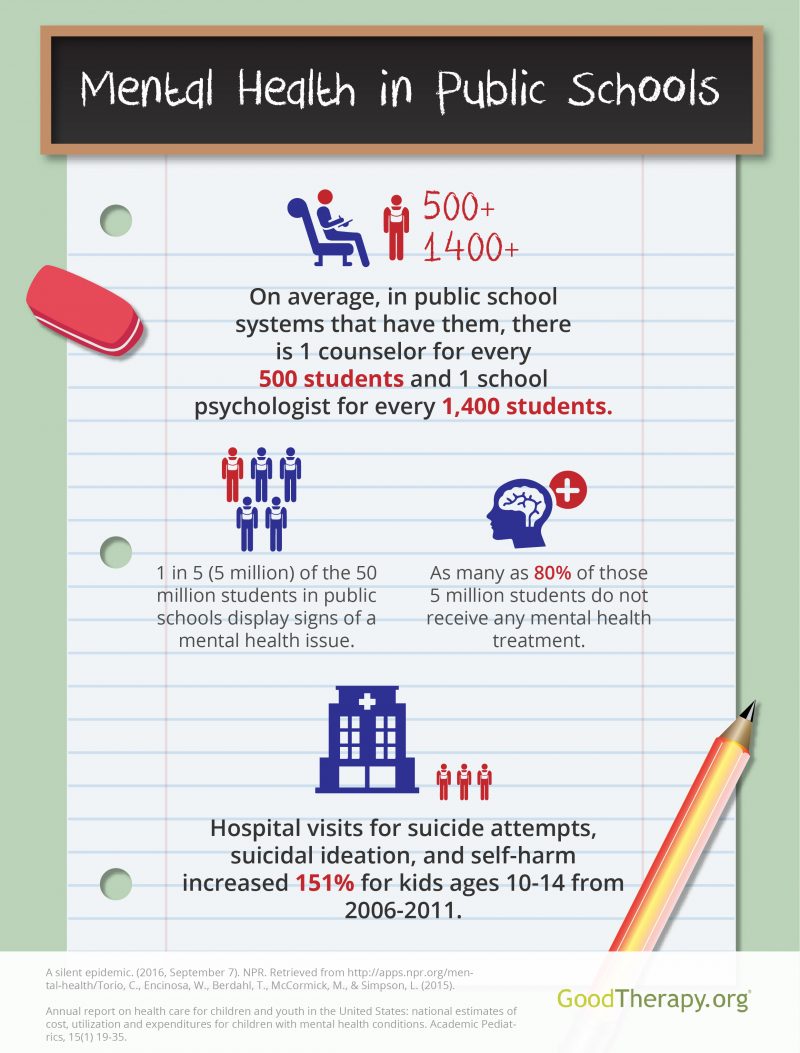
While school nurses are usually the most likely to catch any mental health issues early on, many schools only have one on-staff nurse, and many of these nurses only work part-time. It is not uncommon for entire school districts to share one nurse, meaning that one nurse may see hundreds or even thousands of students (depending upon the size of the district). This makes it more unlikely that a school nurse would be able to spot symptoms of mental health issues, as the nurse may not be available or have enough time with each student to address their needs.
According to the American Association of Pediatrics, schools function as the mental health system for approximately 80% of students. For this reason, school nurses play a critical role in identifying problems so they can be treated as soon as possible. Unfortunately, school nurses typically receive little to no training in mental health.
While nurses aren’t expected to be psychologists or therapists, they should be aware of emotional, physical, and behavioral warning signs for common mental health problems. Awareness and recognition of problems as soon as they arise could prevent a suicide.
Integrated Mental Health Strategy in Public Schools
Researchers suggest the best way to help students with mental health issues may be to have teachers, counselors, administrators, and school nurses work together to spot and handle mental health issues. Saddling this responsibility on one teacher or administrator is not likely to be effective because they typically do not have the necessary training or time. On average, school counselors see around 500 students. School nurses may see even more students, especially if they are the only nurse for an entire district. Teachers also see a significant amount of students, ranging from 20-30 in elementary schools to hundreds of students in middle schools and high schools where students change classes and teachers throughout the day.
[fat_widget_left]Integrating mental health care and strategies in public schools can help all staff who encounter students. They will likely be better able to recognize mental health problems and provide early intervention as well as prevention for many issues, including thoughts of suicide, drug and alcohol use, and relationship abuse. To recognize these potential problems, some degree of training in mental health will likely be necessary.
Some signs that a student may be experiencing a mental health condition include:
- Sudden changes in a student’s mood or behavior
- Frequent mood swings
- Behavioral problems such as aggression, temper tantrums, or lashing out in school
- Poor academic performance
- Poor hygiene
- Frequent absences
- No longer participating in extracurricular activities
- Isolation from peers
- Difficulty paying attention in class
- Excessive worrying or anxiety
- Hyperactivity
- Difficulty relating to others
- Somatic complaints (stomachaches, headaches) with no clear physiological cause
Providing Mental Health Services in Public Schools
According to the 2016 Children’s Mental Health Report, young people with access to mental health treatment and services in school are 10 times more likely to seek help for mental health and substance abuse concerns than those who do not have such programs available. Many schools are choosing to address the rising mental health crisis in the public-school system by hiring a professional psychotherapist, counselor, or psychologist on staff. Other schools have therapists come in from community mental health centers to see students who are struggling with mental health issues beyond the guidance counselor’s scope of expertise.
Congresswoman Grace Napolitano is currently working on implementing the Mental Health in Schools Act, which would provide $200 million in funding through competitive grants of $1 million each to 200 public schools across the country. This funding would help them provide on-site licensed mental health professionals in public schools. Napolitano has been executing these programs since 2001 in 14 public schools in her congressional district. This approach has proven successful and will be expanded nationwide through the funding provided by the Substance Abuse and Mental Health Services Administration.
References:
- Anderson, M. & Cardoza, K. (2016, September 7). A silent epidemic: Our public schools are struggling to handle millions of students with mental health problems. Retrieved from http://apps.npr.org/mental-health/
- Association for Children’s Mental Health. (n.d.). Problems at school. Retrieved from http://www.acmh-mi.org/get-help/navigating/problems-at-school/
- Cardoza, K. (2016, September 3). School nurses can be mental health ‘detectives’ but they need help. Retrieved from http://www.npr.org/sections/ed/2016/09/03/478835294/school-nurses-can-be-mental-health-detectives-but-they-need-help
- Child Mind Institute. (2016). 2016 children’s mental health report. Retrieved from http://childmind.org/report/2016-childrens-mental-health-report/
- Facts on the Mental Health in Schools Act. (n.d.). Retrieved from http://napolitano.house.gov/resources/additional-resources/mental-health-schools-act/facts-mental-health-schools-act
- Firth, S. (2015, February 20). Hospitals see alarming increase in suicidal children. Retrieved from http://www.medpagetoday.com/pediatrics/preventivecare/50117
- National Alliance on Mental Illness. (n.d.). Mental health screening. Retrieved from http://www.nami.org/Learn-More/Public-Policy/Mental-Health-Screening
- Shefall, A., Asti, L., et al. (2016, September). Suicide in elementary school-aged children and elderly adolescents. doi:10.1542/peds.2016-0436