 There have been countless articles—including some of my own—about the hazards of so-called “helicopter parenting,†the current trend of over-watchful, over-involved child rearing (also known as cosseting). By now, many people are familiar with stories of adult children who can’t leave home because they lack life skills, anxious teens whose schedules rival those of corporate CEOs, and parents who expect their toddlers to learn Mandarin and excel in five sports.
But in these times, when many of us feel alienated from our government, our neighbors, and sometimes our families, it’s worthwhile to rethink the benefits of kids being more connected to their parents. After all, parents started parenting this way for a reason. We were reacting against the free-form, unbounded childhoods we experienced, in which many of us faced daily dangers and years of floundering without oversight or steady guidance. We were the kids who came home to empty houses and wandered the neighborhood all afternoon, getting ourselves into physically and emotionally treacherous experiences. Because our parents were afraid to broach the subjects of sex, drugs, and violence, we got the information from our friends, who got all sorts of details wrong. As a result, many grew up feeling unseen, unsupported, and confused.
[fat_widget_right]
While helicoptering has its flaws—most notably how it often fails to teach kids how to think on their own and make bold decisions in the face of uncertainty—it also has many advantages, some of which have gone unheralded. Here are some of the reasons parents may choose to be very involved in their kids’ lives, and some of the benefits to both children and society.
1. These kids feel supported.
Children, from the millennial generation to the current one, typically know that their parents have their backs. They grow up with a sense of security, knowing a framework is around them. This might give them more freedom to fail and to experiment, because someone is there to provide a net. Yes, young adults these days move in with their parents more often and rely on their families for financial support more than ever before. But this also allows them time to grow without as much pressure and danger as previous generations experienced.
Research has shown recently how the brain does not fully mature until our mid- to late-20s. Knowing this, why aren’t we more accepting of the idea that a 21-year-old college graduate might still need more time to feel fully launched? The average age to get married and have children has increased over the past few decades, and many people accept the idea that it might help to be more mature before leaping into these commitments. Likewise, young adults are taking longer to enter the workforce or buy a home; although economic factors contribute to that reality, couldn’t it be argued that it’s not necessarily the worst thing to delay these moves until they’re adequately prepared?
2. These kids feel seen and known.
Alice Miller writes in The Drama of the Gifted Child how parents who are preoccupied with meeting their own needs first can create children who feel unseen. Today’s parenting, however, tends to be highly focused on the child instead of the parents’ needs. While a degree of balance would be ideal, the value of this imbalance is that children these days know they are fully understood by their families. These kids get therapy, school testing, vocational evaluations, extracurricular trainings, and more. And while they may be overscheduled and over-observed, they are also privy to a large amount of information about their temperaments, skills, and interests.
[amazon_affiliate]
The great thing about that is this generation of kids may not have as much of a struggle, or take as long, as previous generations did to know themselves. They may be able to make better partnerships and be better parents because they are not, as Miller writes, struggling to heal old wounds and blindly fighting the shadows of the past.
3. These kids have a sense of community and connectedness.
In the essay that spurred my thinking on this topic, Jennifer Trainor writes, “What if we are moving away from individualism and autonomy (with its requirements that we push away from our parents, rebel against the establishment and its institutions, like school) and entering a much more connected, inter-dependence?â€
There are real benefits to doing something you’re bad at. It increases resilience, teaches how to hold onto self-esteem, and reduces perfectionism.
Trainor is asking this: Are we looking for the kind of communalism that marked American life in the beginning of the last century, when families lived with or nearby each other, neighbors helped one another, and people intrinsically trusted the government to be benevolent and generous? And does that desire to be close to others both encourage today’s parents to dote on their children and allow the children to stay close and reliant on their parents? A century ago, there was nothing wrong with, say, expecting your parents to help raise your children or provide you with a job. This gave people a sense of kinship and lineage. It sounds much more pleasant than the current overarching sense of alienation and existential loneliness.
4. These kids benefit from doing stuff they’re not good at.
Yes, our kids tend to have too many activities, leaving them without enough unstructured play time. But it also pushes them to persevere at pursuits they might not have thought of on their own, even though they may not excel at them. Thirty years ago, kids tended to gravitate toward one pastime—usually something they had an affinity for—and stuck with it. We rarely tried our hands at many different sports or arts, and as as result we were less well-rounded.
There are real benefits to doing something you’re bad at. It increases resilience, teaches how to hold onto self-esteem, and reduces perfectionism. To be the slowest runner on the soccer field week after week demands a huge amount of persistence, which years later can give kids a major leg up in the business world.
5. These kids have tried a little of everything and thus are better equipped to make good career choices.
Speaking of the business world, trying their hand at so many recreational activities may also help this generation of children to pick job fields. Compared to teens of the past, they may have a higher awareness of themselves at a young age. The parents who have driven them to music lessons, football games, and chess club meetings have instilled in these kids the knowledge that they are good at organization, perhaps, or lousy at spatial relations. These pieces of information give them a sense of what they have to offer to employers and which fields might be best avoided.
6. These kids will take care of us (and pass on the same family values).
Finally, there’s an upside to parents as well as to kids. In addition to having children who like us and want to stay in touch, we may also be creating a community with an overall sense of family connectedness. As they grow, children who were parented closely often want to remain close. Perhaps this will diminish the fears we have about an aging society, where seniors become lonely and neglected. Perhaps, just perhaps, helicoptered children may someday hover over their parents and return the favor.
There’s a lot of fear in society about the ways technology creates distance and isolation. We look at the younger generations with their heads buried in their phones and wonder if they will know how to make conversation or form connections. But we forget that, even on those phones, they are in constant communication—not only with their friends, but with us. Through this lens, helicopter parenting might be considered an antidote to the loneliness of the digital age, a way to create snug, loving bonds with our children.
References:
- Miller, A. (1997). The Drama of the Gifted Child. New York, NY: Basic Books.
- Trainor, J. (2016, March 7). Does Helicopter Parenting Harm Kids’ Ability to Think for Themselves? Retrieved from https://medium.com/@jstrainor/lythcott-haims-book-led-me-to-terry-castle-s-2012-essay-about-helicopter-parenting-an-essay-that-5732281d6ce1#.sferakci8
Dear GoodTherapy.org,
My oldest child is 7, and many of his friends receive an allowance from their parents for doing chores around the house. I never gave the idea of an allowance much thought, as I didn’t receive an allowance for chores as a kid and don’t personally feel it’s necessary. But seeing his peers spend money and buy things for themselves (nothing major, just small toys or candy) makes my son want the same freedom. Plus, I’m facing a shocking amount of criticism from other parents in my son’s friend circle. I had no idea this was such a contentious issue! Those parents all say that giving an allowance teaches kids the importance of earning money through hard work, as well as the value of saving money, spending it wisely, etc.
[fat_widget_right]
Of course, like any parent, I do see the merit of providing an incentive for tasks, especially when so often it’s like pulling teeth to even get them to put a dish in the sink. But I also feel strongly that chores are not the type of labor that deserves a reward, since contributing to household duties is something they will have to do their whole lives without compensation. In many ways, I feel like offering an allowance is instilling in them the idea that they’re entitled to payment for doing chores that are not above and beyond the scope of expected responsibilities.
Is there an argument for or against an allowance from a long-term mental health standpoint? Or is there a certain age when it’s better to introduce an allowance system? I know in the grand scheme of parenting the issue of an allowance, either issued or withheld, probably will not “make or break” a kid. Just curious whether you have any insights about lasting lessons a child might learn one way or the other. Thanks! —Raincheck, Please
Dear Raincheck,
This is such a great parenting question!
The first part I’d like to address is the criticism you are getting from peers. You are entitled to make parenting choices that work for you and your family that are aligned with your family’s unique values. The judgment you are feeling from the other parents is unfortunate—and ultimately their issue, not yours.
I’d also like to separate the two issues of chores and allowance. Chores are great for kids, assuming they are age-appropriate. They teach competence, life skills, and the importance of contributing to the family (something that combats entitlement and enhances gratitude). It is absolutely okay to expect your children, even as young as 3 or 4, to contribute to the household by picking up, feeding animals, setting and clearing the table, and other achievable tasks.
You are also correct that combining allowance and chores can be problematic. It shifts the focus from contributing to the family as an expectation, or social relationship, to a fee for service, or business relationship. What happens if your child feels he doesn’t need the money? Does that excuse him from feeding the dog? Combining the two also runs the risk of fostering a sense of entitlement—I’ve heard many kids, when asked to do something for their parents, ask, “What will you give me?†If they have been trained to believe task equals payment, this reaction is to be expected.
The allowance does not have to be exorbitant. It does not need to match what your child’s peers are getting. There will be plenty of times over the course of your parenting life when your children will compare their treatment to that of their peers (today, allowance—soon, phones and cars). You are under no obligation to match what their peers or peers’ parents are doing.
An allowance, however, is also pretty terrific for children. It teaches them the value of money. It gives them some independence. It allows them to contribute financially to gifts for friends or family and feel some pride and ownership. It also encourages them to learn about decision-making and delayed gratification. If they want a toy that costs $15, do they want to spend their savings on trinkets that cost $2,if they know it will delay their ultimate goal?
Allowances also encourage conversations about values. Some parents set up a system by which kids put money in spend-save-share jars. The share part is for donating to a cause of their choice. If that is something you want to encourage, there’s no better way to teach that lesson than having them involved in deciding what to give and to whom.
The allowance does not have to be exorbitant. It does not need to match what your child’s peers are getting. There will be plenty of times over the course of your parenting life when your children will compare their treatment to that of their peers (today, allowance—soon, phones and cars). You are under no obligation to match what their peers or peers’ parents are doing. However, conversations with your children about why you are making the decisions you are making will help them develop a keener understanding of your family values and priorities.
[amazon_affiliate]
I hear your struggle with incentivizing chores. Some parents choose to make chores a basic expectation (this is what we do). Failing to meet those expectations results in losses of privileges (screen time, dessert, play dates, etc.). There are also ways to encourage chores by instilling in your children a sense of pride of accomplishment. Letting my son hear me brag to friends and family about how well he did his “jobs†without prompting has accomplished far more than any sticker chart or reward system ever did.
You are right that this is not a “make-or-break†kind of parenting decision. It is, however, a tremendous opportunity to intentionally foster the skills and values you hope your children will possess as adults. If you want to read more about this topic, there’s a fantastic book by Ron Lieber called The Opposite of Spoiled. It delves into all of this and more and is incredibly informative and accessible.
Best of luck,
Erika
 Parenting style can affect behavior in any child, but matters most for children with “difficult†temperaments, according to a study published in the journal Psychological Bulletin. Research suggests some portions of a child’s temperament—such as impulsivity and the tendency to experience negative emotions—might be influenced by genes. Environmental influences can act upon this nascent personality, affecting how children think and feel as adults.
The new study suggests parenting is a significant predictor of who a child will become. For children born with a tendency toward negative emotions and challenging behavior, parenting may be even more important.
How Parenting Shapes ‘Difficult’ Children’s Personalities
The study evaluated previous research on parenting style and child outcomes. Researchers analyzed data from 84 previous studies, half of which were conducted in 2010 or later.
Children identified as having a “difficult†temperament had higher levels of impulsivity and negative emotions, and lower levels of conscientiousness. Parents who practiced positive parenting provided children with more guidance and affection. They encouraged children to embrace empathy and think through their actions. Parents with a negative parenting style were more punitive and less affectionate. These parents attempted to control their children’s behavior with harsh discipline.
[fat_widget_right]The affectionate style of more positive parents produced better outcomes in their children, regardless of a child’s temperament. For children with a more difficult temperament, the effect was most pronounced, especially among children who were highly emotional. Negative parenting was more harmful to these children, while positive parenting offered significant benefits.
The study highlights how parenting style is both internalized and externalized. Positive parenting increased positive internal behaviors such as high self-esteem, as well as positive external behaviors such as community involvement. Negative parenting increased negative internal behaviors and mental health issues such as depression, as well as negative external behaviors such as aggression and substance abuse.
Understanding Parenting Style
Parents of challenging children may worry their child’s personality is hard-wired. Children who experience more negative emotions are more likely to experience mental health issues. For parents concerned about how a difficult child might think and behave in adulthood, this study points to the importance of effective parenting.
A number of studies point to the benefits of an authoritative parenting style. Authoritative parents, like the “positive†parents of this study, establish clear rules and are highly affectionate. They stand in contrast to authoritarian parents, who are controlling and unaffectionate, and permissive parents, who are affectionate but provide few boundaries.
References:
- Baer, D. (2016, October 17). The kids most affected by parenting share a personality trait. Retrieved from http://nymag.com/scienceofus/2016/10/how-parenting-affects-kids-depending-on-personality.html
- Dewar, G., PhD. (2013, April). Authoritarian parenting: What happens to the kids? Retrieved from http://www.parentingscience.com/authoritarian-parenting.html
- Slagt, M., Dubas, J. S., Dekovic, M., & Van Aken, M. A. (2016). Differences in sensitivity to parenting depending on child temperament: A meta-analysis. Psychological Bulletin. doi:10.1037/bul0000061
 More than 50 million students are enrolled in public schools across the United States. Of those, one in five meet the criteria for a mental health condition. About 70-80% of these students won’t receive any kind of treatment or therapy. Because children and adolescents spend most of their time at school, teachers, administrators, school nurses, and other staff are often in a unique position to be the first to identify any problems or issues in a child’s life. Here are some ways for public schools to better address this rising mental health crisis.
Mental Health Screening in Public Schools
Most schools do not have any type of mental health screening in place for students. The National Association on Mental Illness supports mental health screenings for several reasons. Half or more of chronic mental health issues begin at or before age 14. Early identification and treatment can help prevent more serious problems down the road.
Just as screenings are done for a variety of physical health problems, mental health screenings in public schools could greatly benefit vulnerable students. Conducting mental health screenings in schools allows teachers to recognize the warning signs of various mental health issues, allowing for earlier identification and quicker connections to the treatment resources students might need.
The Role of Public School Nurses in Mental Health
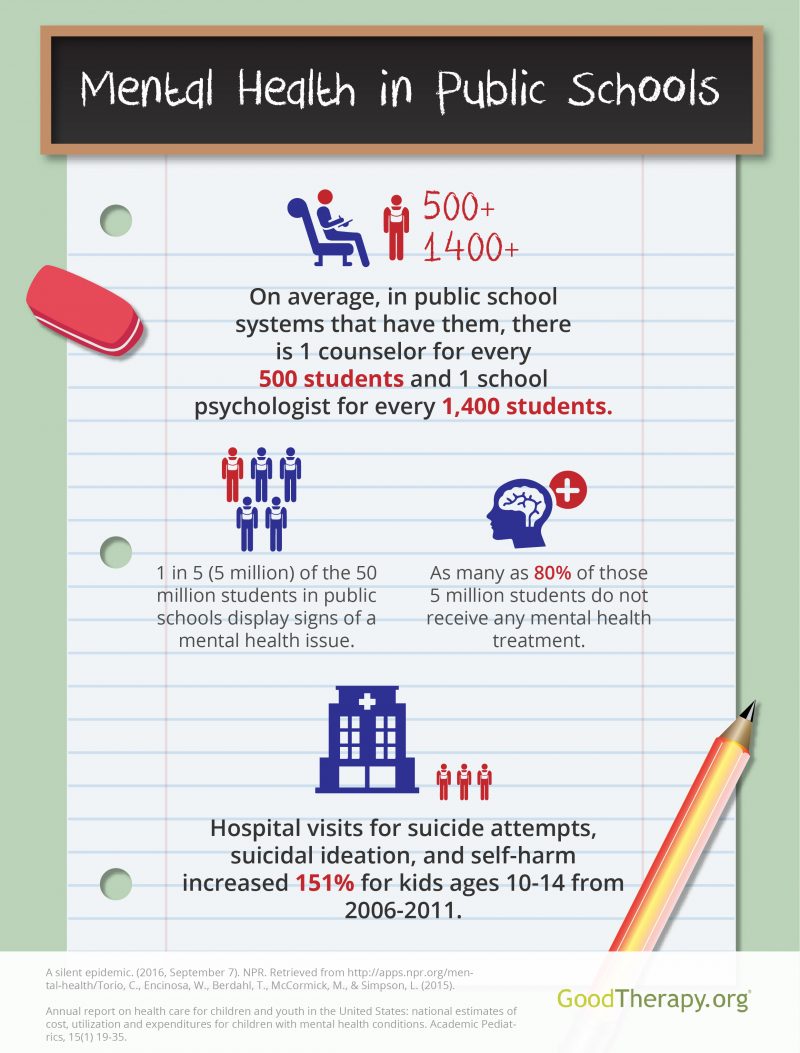
While school nurses are usually the most likely to catch any mental health issues early on, many schools only have one on-staff nurse, and many of these nurses only work part-time. It is not uncommon for entire school districts to share one nurse, meaning that one nurse may see hundreds or even thousands of students (depending upon the size of the district). This makes it more unlikely that a school nurse would be able to spot symptoms of mental health issues, as the nurse may not be available or have enough time with each student to address their needs.
According to the American Association of Pediatrics, schools function as the mental health system for approximately 80% of students. For this reason, school nurses play a critical role in identifying problems so they can be treated as soon as possible. Unfortunately, school nurses typically receive little to no training in mental health.
While nurses aren’t expected to be psychologists or therapists, they should be aware of emotional, physical, and behavioral warning signs for common mental health problems. Awareness and recognition of problems as soon as they arise could prevent a suicide.
Integrated Mental Health Strategy in Public Schools
Researchers suggest the best way to help students with mental health issues may be to have teachers, counselors, administrators, and school nurses work together to spot and handle mental health issues. Saddling this responsibility on one teacher or administrator is not likely to be effective because they typically do not have the necessary training or time. On average, school counselors see around 500 students. School nurses may see even more students, especially if they are the only nurse for an entire district. Teachers also see a significant amount of students, ranging from 20-30 in elementary schools to hundreds of students in middle schools and high schools where students change classes and teachers throughout the day.
[fat_widget_left]Integrating mental health care and strategies in public schools can help all staff who encounter students. They will likely be better able to recognize mental health problems and provide early intervention as well as prevention for many issues, including thoughts of suicide, drug and alcohol use, and relationship abuse. To recognize these potential problems, some degree of training in mental health will likely be necessary.
Some signs that a student may be experiencing a mental health condition include:
- Sudden changes in a student’s mood or behavior
- Frequent mood swings
- Behavioral problems such as aggression, temper tantrums, or lashing out in school
- Poor academic performance
- Poor hygiene
- Frequent absences
- No longer participating in extracurricular activities
- Isolation from peers
- Difficulty paying attention in class
- Excessive worrying or anxiety
- Hyperactivity
- Difficulty relating to others
- Somatic complaints (stomachaches, headaches) with no clear physiological cause
Providing Mental Health Services in Public Schools
According to the 2016 Children’s Mental Health Report, young people with access to mental health treatment and services in school are 10 times more likely to seek help for mental health and substance abuse concerns than those who do not have such programs available. Many schools are choosing to address the rising mental health crisis in the public-school system by hiring a professional psychotherapist, counselor, or psychologist on staff. Other schools have therapists come in from community mental health centers to see students who are struggling with mental health issues beyond the guidance counselor’s scope of expertise.
Congresswoman Grace Napolitano is currently working on implementing the Mental Health in Schools Act, which would provide $200 million in funding through competitive grants of $1 million each to 200 public schools across the country. This funding would help them provide on-site licensed mental health professionals in public schools. Napolitano has been executing these programs since 2001 in 14 public schools in her congressional district. This approach has proven successful and will be expanded nationwide through the funding provided by the Substance Abuse and Mental Health Services Administration.
References:
- Anderson, M. & Cardoza, K. (2016, September 7). A silent epidemic: Our public schools are struggling to handle millions of students with mental health problems. Retrieved from http://apps.npr.org/mental-health/
- Association for Children’s Mental Health. (n.d.). Problems at school. Retrieved from http://www.acmh-mi.org/get-help/navigating/problems-at-school/
- Cardoza, K. (2016, September 3). School nurses can be mental health ‘detectives’ but they need help. Retrieved from http://www.npr.org/sections/ed/2016/09/03/478835294/school-nurses-can-be-mental-health-detectives-but-they-need-help
- Child Mind Institute. (2016). 2016 children’s mental health report. Retrieved from http://childmind.org/report/2016-childrens-mental-health-report/
- Facts on the Mental Health in Schools Act. (n.d.). Retrieved from http://napolitano.house.gov/resources/additional-resources/mental-health-schools-act/facts-mental-health-schools-act
- Firth, S. (2015, February 20). Hospitals see alarming increase in suicidal children. Retrieved from http://www.medpagetoday.com/pediatrics/preventivecare/50117
- National Alliance on Mental Illness. (n.d.). Mental health screening. Retrieved from http://www.nami.org/Learn-More/Public-Policy/Mental-Health-Screening
- Shefall, A., Asti, L., et al. (2016, September). Suicide in elementary school-aged children and elderly adolescents. doi:10.1542/peds.2016-0436
 A new longitudinal study strengthens previous evidence that parental sexual orientation has no notable impact on childhood development. While this is not the first investigation to find the sexual preferences of parents don’t affect children, it is the first to track childhood well-being in relation to parent sexual orientation over time.
About 65,000 adopted children in the United States have same-sex parents. This study’s results may help inform future policy decisions regarding same-sex parents.
Childhood Outcomes Not Linked to Parental Sexual Orientation
Published in the journal Developmental Psychology, the study followed 96 families with adopted school-age children as they moved through early and middle childhood. Parent combinations included a mix of heterosexual pairings and same-sex couples. The study tracked childhood behavior and adjustment along with family functioning and relationship variables.
The analysis found no significant differences between parent groups in any of the examined factors, including family characteristics and childhood outcomes. These findings are consistent with many previous studies that are similar in nature, but not longitudinal in design. According to the study, research has consistently found no differences between these parent types on several important measures, such as childhood stress levels and quality of mental health.
[fat_widget_right]It is possible that continuing academic concerns about same-sex adoptive parents are the result of an existing conflict in popular psychological theories. For example, family systems theory is in line with the observed results, as it contends family functioning is more important than family structure. In contrast, family stress theory generates predictions of differences between children of same-sex and opposite-sex couples.
Variables That Do Impact Childhood Outcomes
Several other variables were found to have a significant influence on childhood outcomes over time. Specifically, it was shown that child adjustment problems and high parental stress in earlier years can contribute to a child’s behavioral issues and problems in overall family functioning during middle school. These additional findings provide potential targets for future research.
References:
- Farr, R. H. (2016). Does parental sexual orientation matter? A longitudinal follow-up of adoptive families with school-age children. Developmental Psychology. doi:10.1037/dev0000228
- Farr, R. H., Forssell, S. L., & Patterson, C. J. (2010). Parenting and child development in adoptive families: Does parental sexual orientation matter? Applied Developmental Science, 14(3), 164-178. doi:10.1080/10888691.2010.500958
- University of Kentucky. (2016, October 24). No differences noted over time for children of gay, lesbian, adoptive parents. ScienceDaily. Retrieved from www.sciencedaily.com/releases/2016/10/161024104229.htm
 The world is full of people who survived the experience of being bullied while growing up. The wounds bullying can inflict on one’s self-esteem can ooze throughout life. Sticks and stones may break your bones, but names can, in fact, hurt you. The good news is people can heal from bullying. Psychotherapy can help promote that healing.
Children and teens may be bullied for any number of reasons—weight, gender, sexuality, ethnicity, clothes, social difficulties, interests, and behaviors related to mental health conditions among them. The terms bullies use to label their victims, such as “fat,†“stupid,†“ugly,†etc., may be absorbed into the victim’s self-identity at a tender, vulnerable time in their development. If fully digested, the bully’s taunts may become the victim’s inner voice. The negative judgments may become distorted core beliefs.
Distorted beliefs can limit the choices survivors of bullying make in their social and professional lives. Children who start out as outwardly expressive may turn inward to protect themselves from further ridicule. They may gravitate toward compassionate adults for social interaction rather than peers. Many survivors continue to reenact their role of disempowered victims in the workplace and social spheres. It may be difficult to see themselves as adults rather than the defenseless children they once were.
[fat_widget_right]
Others may lack empathy for lovers and friends (“Nobody ever cared for my feelings, so why should I care about theirs?â€). Or they may become loners and/or disdainful of humanity in general. Some project their conditioned self-hatred onto people with whom they engage. When victims of bullying hear others whisper or giggle, they may become paranoid they are the brunt of malicious jokes. They may keep to themselves in the workplace and be regarded as cold or unfriendly by coworkers.
Children tend to benefit from parents who offer comfort and invalidate the bully’s actions. Kids who seek comfort from their parents but are ridiculed instead (“Don’t be a crybaby,†“Grow up,†etc.) may have deeper scars. Children who are bullied or abused at home have a greater risk of being bullied at school as well. They may conclude that if a majority of people in their life regard them negatively, they have it coming. Their wounds can be profound. A large number of male survivors do not report bullying to parents or school staff because they feel shame and emasculation from the abuse. Keeping the abuse a secret and receiving no comfort, support, or invalidation of the bully from others may leave them with hurt feelings, damaged egos, and severe emotional scars.
Many survivors of bullying have an abundance of empathy for others. They report that hearing about or observing others being bullied is triggering for them. Even as they are quick to comfort and support others, however, they may be strangers to the concept of self-empathy. The shame and self-hatred that resulted from being bullied may have arrested their development of this important life skill. Labeling themselves as “garbage†because they were treated as such can lead them to falsely believe there is something inherently lacking in their personhood. Consequently, they can feel like outcasts.
Cognitive therapy and strengths-focused counseling are essential components in therapy treatment for survivors of bullying. The goals include:
1. Adult Perspective to Replace the Traumatized Child Perspective
In treatment, the individual is encouraged to understand that their adult perspective on the bullying should be vastly different and more logical than their child perspective. The child’s perspective of the survivor (which deems the bully’s opinion as expert and still dominates the adult survivor’s beliefs) must be put to rest—just as other childhood beliefs such as Santa Claus, the Tooth Fairy, and the Easter Bunny have been.
Consider an individual who was teased about their weight and called unflattering names by their bullies. The child self could be convinced that people of a size that is larger or smaller than average deserve to be shunned by others. The grown-up self can see the ignorance and cruelty in such a claim. The survivor’s new perspective must be reality-based: the bullies did not have the right, life experience, empathy, or education to be valid evaluators of anything except whether ice cream is cold.
If the survivor was bullied by their parents, a new perspective would be that the parents’ judgments were verbally abusive and false. The individual must accept the painful fact their parents were profoundly limited in their ability to parent properly and were most likely perpetuating a pattern of abuse that their own parents had imposed upon them.
2. Empowerment
Personal power is an important therapeutic concept for a survivor of bullying: Each individual has personal power (feelings of well-being, self-worth) which can be kept or given to others. Bullies are thieves of others’ personal power. Therapy helps the survivor understand that they have given up enough of their personal power to those long-ago cruel kids in the schoolyard, many of whom had only recently learned to tie their shoes. The survivor will be mindful that others who cruelly judge people deserve no endorsement (agreeing with their opinion).
3. Self-Empathy and Self-Validation
Because the survivor internalized the bully’s words or hatred, they may have lost the ability to see their self-worth. With the therapist’s help, the survivor learns to love and validate themselves.
Bullies are thieves of others’ personal power. Therapy helps the survivor understand that they have given up enough of their personal power to those long-ago cruel kids in the schoolyard, many of whom had only recently learned to tie their shoes.
4. A New Relational Style
Many bullying survivors develop an interpersonal style that is submissive and passive. Others develop a hypervigilant and aggressive style to defend themselves from further attacks. The goal is to evolve to an assertive relational style which seeks reciprocity and respect from people in the survivor’s social orbit.
5. A Balanced View of People
Due to bullying, the survivor may have concluded at a young age that all people are cruel and cannot be trusted. In therapy, they may come to understand that this is black-and-white thinking. The survivor widens their perception by acknowledging that while there are people who hurt others, there are also people who extend kindness and trustworthiness. The survivor develops an ability to distinguish between these two types of people.
6. Recognition That Bullying Is About the Bully, Not the Victim
Many children do not have the wisdom or cognitive ability to understand the above statement. They tend to regard peers as valid critics. In reality, many bullies have been bullied themselves, either at school or within their own home. Bullying others allows them to reenact their experience from a position of power. Bullies detect a vulnerability in their victims and target that vulnerability. The victim is essentially the bully’s scapegoat.
7. Positive Core Belief and Improved Self-Esteem
In therapy, the survivor learns to let go of the distorted negative core belief (“I am ugly,†“I am stupid,†“I am a loserâ€) that the bully planted. The survivor comes to understand that defining themselves by others’ words and treatment is a losing plan that can fluctuate depending on the company we keep. The survivor develops a vigilance for correcting the automatic negative self-talk that they have carried since childhood. The result is an enduring positive and reality-based core belief and self-esteem derived from the survivor’s values, behaviors, and accomplishments.
There is a lot of work to be done in closing the wounds left by bullying, as the above goals indicate. Because “old habits die hard,†the survivor must be patient as they proceed through the healing process. Baby steps toward self-love may begin to occur from the start of therapy. In time, the self-confidence a survivor develops in therapy may provide new positive ways to navigate life. It may also afford the survivor new opportunities that were once falsely believed to be out of reach.
References:
- Lyness, D. (2013). Helping kids deal with bullies. Retrieved from http://kidshealth.org/en/parents/bullies.html#
- Support the kids involved. (n.d.). Retrieved from http://www.stopbullying.gov/respond/support-kids-involved
 Children with attention-deficit hyperactivity (ADHD) may have an impaired tolerance to being punished, according to a new study published in the Journal of Child Psychology and Psychiatry. The finding could have implications for several areas of study, including behavior modification and neuroscience.
Children with ADHD often run into problems with people in supervisory positions because of their symptoms. Distractibility, fidgeting, and apparent daydreaming are just a few of many potential behaviors associated with the condition that can be perceived as disruptive and result in punishment from authority figures. The research shows punishment-based behavior correction can have unexpected consequences for children with ADHD.
Measuring Punishment and Reward Sensitivity in Children
The study included 210 children, 145 of whom were diagnosed with ADHD (the rest participated as part of a comparable control group). Each child was placed in front of a computer with two game options visible on the screen at all times. They were then given time in which they could play either game as much (or as little) as they liked. The games were almost identical (the player could gain points as a reward for correct responses), except in one option there was a fourfold greater chance of being punished by having points taken away for giving incorrect answers.
[fat_widget_right]Both groups of children showed a tendency to play the less punishing game more often. This trend remained relatively stable until about 100 trials were completed by each child. At this point, there was a significant increase in the number of ADHD-diagnosed children choosing to play less of the game that had an increased rate of punishment, suggesting children with ADHD tend to avoid punishment more often than children not diagnosed with ADHD.
Motivational Systems in Children with ADHD
Some might say these findings validate persistent punishment as an effective means of behavior control in children with ADHD, but the study’s authors say there are some important caveats to consider. First, punishment is generally not advised as a form of behavior modification due to a high risk of causing more harm than good.
Additionally, the change in behavior (choosing the high-rate punishment game less often) occurred despite the rate of reward staying the same in both games. The researchers say this is not typical of developmentally sound decision-making processes and could indicate a wider problem with the brain’s motivational system in children with ADHD. They may be more sensitive to and focused on punishment, while other children are generally more focused on reward.
The study’s authors suggest frequent rewards and incentives may be an effective way to give children with ADHD what they need to seize opportunities for success, especially if they view a task as requiring a great amount of effort.
References:
- Doucette, J., Harris, B., & Jaffe, P. (2014). Educating Canadians on the health risks of corporal punishment and safe and effective alternatives. Health Tomorrow: Interdisciplinarity and Internationality, 2(1). Retrieved from http://ht.journals.yorku.ca/index.php/ht/article/download/40169/36356
- Furukawa, E., Alsop, B., Sowerby, P., Jensen, S., & Tripp, G. (2016). Evidence for increased behavioral control by punishment in children with attention-deficit hyperactivity disorder. Journal of Child Psychology and Psychiatry. doi:10.1111/jcpp.12635
- Hulst, B. M., Zeeuw, P. D., & Durston, S. (2014). Distinct neuropsychological profiles within ADHD: A latent class analysis of cognitive control, reward sensitivity and timing. Psychological Medicine, 45(04), 735-745. doi:10.1017/s0033291714001792
 Don’t let my youthful face fool you—I’m a few years older than Taylor Swift. (No, I’m not telling you how many years older. How rude of you to ask! We just met.) Nonetheless, the iconic pop star has several lessons those from every generation—millennials to boomers—could stand to learn, even if you are not a Swiftie or are repelled by the idea of becoming one. (I must confess, though, life on the Swiftie side really is delightful!)
Life Lesson No. 1
“Don’t let other people’s opinions of you define you, especially when they don’t know you.â€
I’m taking this quote directly from Taylor when she performed at the Staples Center in Los Angeles. Well said, Taylor.
How many times have you worried about other people’s opinions of you? How has that worry held you back? What might you have achieved or accomplished if you had been able to let go of that worry? Could you have felt better about yourself?
[fat_widget_right]
One thing I’ve learned in life is that, the majority of the time, people are focused on themselves—so much so they probably have no clue what you’re doing. And if they did, they would likely be more concerned about what you thought about what they thought of you! (Are you still with me?)
Life Lesson No. 2
Your 20s are both “miserable and magical†and a time to feel “happy, free, confused, and lonely at the same time.â€
As a psychologist, I provide therapy to adults of all ages, from every decade of life from the 20s to the 80s. Each decade has common challenges. Yet, for those in their 20s, it can be a landmine of obstacles. For many, the 20s are a time when nearly everything in life is up in the air, sometimes all at once.
Young adults often question what they should do for a living, who they should date (perhaps exploring or questioning their sexuality), where they should live, even who they feel they truly are. These concerns don’t magically or mysteriously resolve the day you turn 30. However, as people move through their 20s, they often find some grounding in these various areas that can be built upon in future decades. In the interim, the vast selection and possibilities can feel liberating, scary, or even isolating. Any unpleasant feelings can be exacerbated by people aged 30 and over who act dismissive, telling those in their 20s they have no problems because they are young. Maybe they had so much fun in their 20s they can’t remember the associated and occasional angst. For their sake, I hope that’s the case.
Life Lesson No. 3
When you drown, you can ironically begin to breathe.
It’s hard for me to imagine that concert-goers under age 10 could understand the lyrics, “When I was drowning/that’s when I could finally breathe.†For me, I associate this song (“Cleanâ€) and its lyrics with the occasional importance of hitting bottom, or at least getting close. It is often only when you hit bottom that you realize you can float, or essentially discover how resilient you really are.
As humans, we typically do all we can to avoid emotional pain. But people die, get divorced, get fired from jobs, and go through countless other forms of adversity. And the only option is to keep going forward, even if you take some time to grieve and retreat, because you must come out the other side. When you do, you will realize you are stronger than you think.
Life Lesson No. 4
Players gonna play, haters gonna hate, heartbreakers gonna break, and fakers gonna fake.
When you run into these characters, try to do like Taylor and “shake it off.†This is related to life lesson No. 1—not letting others define you. Believe people when they show you who they are. Don’t let others throw you off your game.
I often advise people in therapy to keep their eyes on their own lane. Just as when driving, if you focus on someone else’s life or drama, you may get hurt in a crash or start driving to someone else’s destination.
Life Lesson No. 5
Always take the high road, even when others don’t (ahem, Kanye).
This life lesson can be learned anytime Taylor must interact with Kanye West or his crew. Few of us will ever forget the infamous 2009 MTV Video Music Awards, when Kanye rudely interrupted Taylor’s acceptance speech for Best Female Video. And we won’t soon forget the recent lyrics Kanye wrote about Taylor, the video he made, and the subsequent reactions on social media.
It doesn’t seem to matter who throws shade her way; her responses, whether in an acceptance speech or in a tweet, always seem to reflect maturity and integrity. I don’t know how she maintains such composure, but it’s impressive. I know what I wanted to say to Kanye, but Taylor never went there. She rose above.
Life Lesson No. 6
Make art out of your pain.
Some of Taylor’s best work emerged from times of what seemed like significant pain. Figure out how you can work with your pain and sadness to create something amazing or healing. Such an approach could transform your life.
In my practice, I call this a “tragic gift.†This relates to life lesson No. 3—when you drown, you can ironically begin to breathe.
I could write about several more life lessons I’ve learned from Taylor Swift, including investing in and supporting your friends, standing up for what you feel is right, being able to laugh at yourself, and giving back to your community. But you get the idea. Despite Taylor’s relatively young age, there is much we can learn from her. One of my favorite lessons is you can be a woman and be powerful, beautiful, and intelligent. Thank you, Taylor!
 Emotional incest, also known as covert incest, is a dynamic that occurs in parenting where the parent seeks emotional support through their child that should be sought through an adult relationship. Although the effects of emotional incest can be similar to those resulting from physical incest, the term does not encompass sexual abuse.
Many times when I am working with people in therapy who are developmentally stuck, they end up sharing that, as children, they were the person their parent turned to as a confidant or for emotional support. Children put in this position may feel special or privileged because the parent is sharing adult information with them and/or is looking to them for support, creating a sense of closeness. However, given that the child’s needs are ignored in favor of the parent’s, there can be devastating long-term developmental consequences.
[fat_widget_right]
Clearly, it is desirable for parents and their children to be close. However, in healthy parent-child relationships, parents prioritize their children’s emotional needs as opposed to children taking care of the parent’s emotional needs. When children are put in the position of meeting the emotional needs of a parent, it creates an unhealthy dynamic in which children essentially become the parents. The children are emotionally abandoned, in effect robbing them of their childhood.
It is important to note that, in most cases, parents who foster a dynamic of emotional incest do not realize the impact of their behavior and do not intend to hurt their children. But the impact and the hurt are there all the same.
Most often, emotional incest occurs when an adult marriage or relationship is fragile, a parent is lonely, or there is a broken family dynamic such as infidelity, mental health conditions, or addiction. One or both parents may seek to get their emotional needs met through the child instead of seeking support from adults. Sometimes a parent will undermine the other parent during an argument or separation/divorce proceedings by putting children in the middle or colluding with a child, which increases the level of the parent’s dependency on the child. The child, in turn, may become concerned about having to take sides or protect a parent.
It is important to note that, in most cases, parents who foster a dynamic of emotional incest do not realize the impact of their behavior and do not intend to hurt their children. But the impact and the hurt are there all the same.
The Impact of Emotional Incest
Children who have experienced emotional incest may have great difficulty setting boundaries and getting their needs met as adults without feelings of excessive guilt. In addition, their relationship with their gender and sexuality can greatly inhibit their ability to maintain intimacy in adult partnerships.
Emotional incest can create an unhealthy sense of loyalty or obligation to a parent, which can result in a love/hate relationship between children and parents. Additionally, substance abuse, feelings of inadequacy, low self-esteem, and compulsivity around work, sex, and food are all potential outcomes.
Emotional incest also can impact the family dynamic as a whole. One partner typically experiences being shut out and may be denied opportunities for parent-child bonding. Additionally, other children may be neglected as the parent leans heavily on the “chosen child.â€
[amazon_affiliate]
Healing from Emotional Incest
For those who experienced emotional incest as a child, there are several ways to promote healing. They include the following:
- Therapy or counseling: Find a counselor who specializes in childhood abuse, enmeshment, or codependency, and who focuses on the needs of survivors.
- Self-help meetings: Prior to participating in self-help meetings, it is important through the process of individual counseling to gain an understanding of what you are facing as a survivor of emotional incest. Once that happens, self-help meetings can be a valuable adjunct in the recovery process and in sustaining recovery. Self-help meetings that follow the 12-step model can be especially helpful.
- Journaling: Writing about distressing issues and experiences can be especially cathartic while confronting the dynamics of obsessive-compulsive behaviors, which often exist as a result of defense mechanisms created for emotional survival when emotional incest has occurred.
- Psychoeducation: There is a wealth of information and resources available that help educate and increase understanding about emotional incest. Knowledge is power. Gaining an understanding of what has happened and the impact it has on your life and relationships can be healing. One valuable resource for understanding and healing from emotional incest is Silently Seduced: When Parents Make Their Children Partners and When He’s Married to Mom: How to Help Mother-Enmeshed Men Open Their Hearts to True Love and Commitment by Dr. Kenneth M. Adams.
References:
- Adams, K. M. (2011). Silently Seduced: When Parents Make Their Children Partners. Deerfield Beach, FL: HCI Books.
- Adams, K. M. (2007). When He’s Married to Mom: How to Help Mother-Enmeshed Men Open Their Hearts to True Love and Commitment. New York, NY: Touchstone Books.
 Most articles you read about helping children and teens with attention-deficit hyperactivity (ADHD) complete homework are likely to focus on having a structured plan. A structured plan—do homework in the same location, take breaks at specific times, etc.—can indeed be helpful, but often parents underestimate the importance of the actual environment in which the homework is done.
Here are five suggestions to help develop the ideal work environment for your child or teen:
[fat_widget_right]
- Make sure the work area is physically comfortable. This means having your child or teen sit in a comfortable chair. Ideally, they should be sitting at a desk or using a lap desk (as opposed to sitting on the floor or bed), but see what works best for them. Using a chair that reclines slightly or is padded may make it easier to sit and focus for longer periods.
- If your child or teen fidgets, harness the fidgeting. If they fidget with their legs, for example, provide your child or teen with something to keep their legs occupied. Try a bicycle or elliptical base that fits under a desk; exercise bands attached to the chair; tennis balls cut open and glued to the floor; or large, squishy shoe innersoles attached to the floor. For individuals who fidget with their hands, try something such as attaching a stress ball to a stretchy string that’s connected to the desk. Alternatively, attach something with different textures to the desk so your child or teen can rub their hand against something while working.
- Minimize shifting of attention. This can be achieved by decreasing the frequency with which your child or teen needs to switch between their book and the computer, documents on the computer, getting up to get materials, and so forth. To decrease shifting between materials, many individuals (adults included) do well with using a laptop and attaching an external monitor (or LCD television) to it. With two screens, they can keep documents they are referring to on one screen and write on the other. Using a laptop and a tablet for this purpose can also work well, especially if the tablet has a stand. To help with textbooks, using a kitchen book holder that props up the book and keeps it open to set pages can be useful. To avoid children and teens having to get up frequently, keep a few pens, pencils, highlighters, and basic school supplies within arm’s reach.
- Reduce visual and auditory distractions. Keep the walls within view fairly plain if possible, and if looking out a window is distracting, face the workspace away from the window. Auditory distractions can be minimized by being quiet around your child or teen, using a white noise machine, or using an app (with or without headphones). Some children and teens like noise while working. If they feel they need to listen to something while working, white noise or music without words might be best. While ideally music should be soft, if your child or teen insists on listening to popular music while working, have them listen to karaoke versions.
- Have different work stations for different types of tasks. Some teens may find it helpful to sit in a special chair just for reading, to use a desk for writing papers, and to use a reclining chair for proofreading. Sometimes a change in position or room between tasks can lead to increased focus and reduce fatigue. (For others, of course, it can lead to getting off task more easily.)
There are many things you can do to help your child or teen get their homework done. While a structured plan is key, so too is the setup of the actual workspace. Try the tips above to get the most out of your child’s study time.
 Gender-nonconforming children—including those who are agender, transgender, bigender, gender fluid, or have other identities—are often met with parental rejection. A new study presented at the annual meeting of the American Sociological Association explored the process through which parents may come to accept their gender-nonconforming children.
Exploring the Process of Parental Acceptance
Researchers from the University of California, Davis, followed 29 mothers and seven fathers with gender-nonconforming children. The study included 33 children between the ages of 5 and 16. Fourteen were trans girls, nine were trans boys, and 10 were gender-diverse boys.
Parental acceptance of transgender kids is often a slow process, the study found. Parents were quicker to notice gender nonconformance in children designated male at birth (DMAB) than children designated female at birth (DFAB). DFAB children were more typically labeled tomboys when they did not conform to gender stereotypes.
Parents of gender-nonconforming boys often attempted to set limits on when and where their children could present as girls, fearing discrimination and bullying. Parents often explained these guidelines in terms of practical rules, such as the weather being too cold to wear a dress. Parents were more likely to eventually relax these rules when they realized how unhappy their children were, researchers found.
[fat_widget_right]Researchers also found many mothers play a vital role in advocating for their gender-nonconforming children. They often will work to educate themselves on the subject, and many become experts on gender diversity to better identify resources for their children. Perhaps because more mothers than fathers participated in the study, researchers did not address whether fathers acted the same way.
The Effects of Parental Rejection on Transgender Children
Research consistently points to the damaging effects of rejection and stigma on gender-nonconforming kids. Half of transgender adolescents attempt suicide by their 20th birthdays, and 41% of transgender adults attempt suicide at some point in their lives. Harassment, isolation, and bullying all figure prominently in suicidal thoughts and actions.
Statistics show transgender children whose parents reject them or try to “fix†them are especially vulnerable to mental health conditions such as depression as well as at a higher risk for suicide.
References:
- Statistics about youth suicide. (n.d.). Retrieved from http://www.yspp.org/about_suicide/statistics.htm
- Study examines families’ journeys to accepting transgender children. (2016, August 23). Retrieved from http://www.eurekalert.org/pub_releases/2016-08/asa-sef081616.php
- Ungar, L. (2015, August 16). Transgender people face alarmingly high risk of suicide. Retrieved from http://www.usatoday.com/story/news/nation/2015/08/16/transgender-individuals-face-high-rates–suicide-attempts/31626633/
 Negative feedback from teachers can increase concentration issues, disruptions, and overall negative behavior in students, according to a new study published in Assessment for Effective Intervention. Teachers may use negative feedback in an attempt to curtail problematic behavior among children, but the study suggests this approach has the reverse effect.
How Negative Teacher Attention Harms Students
For the study, Wendy Reinke—an associate professor of educational, school, and counseling psychology at the University of Missouri College of Education—and her colleagues developed a tool for monitoring student-teacher interactions. The Brief Student-Teacher Classroom Interaction Observation (ST-CIO) tool requires a five-minute observation period to assess whether an interaction is negative or positive.
Using the ST-CIO, researchers observed 53 teachers’ interactions with 896 students in kindergarten through third grade. They found the tool was able to capture information similar to that captured by longer observations, suggesting the ST-CIO might be a good way for principals, researchers, and others to quickly assess student-teacher interactions.
[fat_widget_right]The researchers then observed a correlation between teacher-student interactions and student behavior. Students who received more negative than positive feedback from their teachers during the year had a significant increase in disruptive behavior, concentration difficulties, and problems with emotion regulation by the end of the school year. Students who received positive feedback saw no such increase and were more likely to engage in positive, prosocial behaviors in the future.
The Role of Teachers in Student Mental Health
The study notes that previous research has linked student-teacher interactions to both academic and behavioral outcomes. Most students spend six to nine hours each day with their teachers, which may be more time than some students spend with any other adult.
Particularly among students who come from struggling families, whose parents are uninvolved, or whose families are abusive, teachers may fill an important void. Teachers may also be the first to notice signs of learning difficulties and mental health diagnoses such as attention-deficit hyperactivity.
References:
- Negative attention from teachers can lead to more negative student behaviors. (2011, August 8). Retrieved from https://www.sciencedaily.com/releases/2016/08/160808150536.htm
- Reinke, W. M., Herman, K. C., & Newcomer, L. (2016). The brief student-teacher classroom interaction observation: Using dynamic indicators of behaviors in the classroom to predict outcomes and inform practice. Assessment for Effective Intervention. doi:10.1177/1534508416641605