 Do you have strong interpersonal skills and a passion for helping students navigate the world of education? If so, you could excel as a school counselor. School counselors provide resources for students who want to learn how to pursue their academic and professional futures, and they also work with students who have learning difficulties or mood issues that interfere with their success in school. Whether providing K-12 education support, helping undergraduates navigate the world of higher education, or getting students to the next step in graduate school, thousands of opportunities for school counselors exist.
Like many health-related fields, specific requirements for becoming a school counselor can vary from state to state, so check with the American School Counseling Association for details. Otherwise, read on to find out how you can get started.
1. Lay the Foundation with Undergraduate Studies
As with similar fields of study, people intending to become school counselors will need a substantial academic background. Your first step is to decide where you want to go to college and apply. Depending on your current level of education, this could mean applying for an undergraduate or graduate program. While your undergraduate degree is not typically required to be in education or counseling, it is often helpful to choose a major that reflects knowledge and understanding of the theories and practices required for counseling. Students who major in subjects such as psychology, sociology, or counseling may find they have acquired a feel for the work involved with becoming a school counselor, and as an extension, are well prepared for their graduate studies. [fat_widget_right]
2. Get Your Master’s Degree in School Counseling
Depending on your program, receiving a master’s degree means learning counseling and guidance techniques for multiple age groups and ability levels. During this process, which may take 1-2 years, you can explore areas of specialization, such as K-12 education, behavior issues, or education for children with developmental delays. According to US News & World Report, some of the top-rated counseling programs in the country are at University of Maryland, College Park, and University of North Carolina, Greensboro. However, there are many worthwhile programs across the country depending on your preferred home base.
 Infographic by Hannah Johnson
3. Work Under Supervision After Graduation
During or after your study program, you can intern or complete a practicum as part of your course requirements. Many programs set a certain number of these hours for you to complete, either as a graduation requirement or part of your future doctorate studies, if you decide to pursue that course. For example, one school counselor program might require 100 practicum hours, 40 of which are in direct contact with K-12 students. Additionally, to take the licensing exam to become a school counselor, you must have completed hundreds of hours of practicum or internship work.
Get familiar with the day-to-day workings of your site and don’t be afraid to ask your supervisor for any tips or important things to know while working there—it is better to ask more questions than less, especially when you are still in a learning environment.
During your school counseling internship or practicum, you will get hands-on experience in the field, generally at a school site you have chosen. You will perform most of the duties associated with your field under the direct supervision of both an on-site supervisor and your instructor or supervisor on campus. Get familiar with the day-to-day workings of your site, and don’t be afraid to ask your supervisor for any tips or important things to know while working there—it is better to ask more questions than not enough, especially when you are still in a learning environment.
4. Get Licensed as a School Counselor
After completing your educational and working hour requirements, it is time to become a board certified school counselor. First, you will need to know your state’s requirements, as they vary. The National Counselor Examination (NCE) is a 200-item exam you might sit for, as it is required to become licensed in most states. It may also be required for a national license or any potential military work you are interested in doing. The NCE website lists all the requirements for the exam and provides information on where to take it in your state. It’s a good idea to study and prepare for this exam like you would for other important, long-term tests. Find example questions from past exams and consider borrowing or ordering an NCE test prep book, which will contain helpful strategies and tips for passing your NCE successfully.
5. Optional Credentials for School Counselors
Before hiring you, most schools will prefer that you have one to two years of hands-on classroom experience. You may also need to get a teaching certificate or license. Research your state’s teaching certificate requirements, as these can differ depending on the education system. Additionally, you can pursue specializations such as career counseling or an emphasis in students experiencing addiction.
6. Get Hired as a School Counselor
The field of school counseling has many opportunities and benefits: more than 200,000 school counselors are employed every year as of 2014, and the profession has a median salary of $50,000 a year. Most educational institutions, whether K-12 schools or colleges, need counselors. Openings for these positions are generally posted through school districts or university careers sites for internal positions. You might begin your job search by researching where you would like to work and begin looking for school counseling postings in that location or ask your own college counselor for help finding a placement. Sometimes the connections you make during your internship or practicum hours can lead to future employment opportunities.
References:
- Danzinger, P. & Newman, H. (2011). School counseling concentration practicum/internship handbook. William Patterson University College of Education. Retrieved from https://www.wpunj.edu/dotAsset/315254.pdf
- National counselor examination for licensure and certification. (n.d.). National Board for Certified Counselors. Retrieved from http://www.nbcc.org/Exams/NCE
- School and career counselors: Summary. (2017, October 24). Bureau of Labor Statistics. Retrieved from http://www.bls.gov/ooh/community-and-social-service/school-and-career-counselors.htm#tab-1
- School counseling degree programs & schools. (n.d.). Retrieved from http://careersinpsychology.org/degree/school-counseling
- State certification requirements. (n.d.). American School Counselor Association. Retrieved from https://www.schoolcounselor.org/school-counselors-members/careers-roles/state-certification-requirements
 People who are unhappy in their marriages may turn to mental health professionals for help, unaware therapy could in fact make things worse. I’m not talking about bad couples therapy, although therapists who lack training in effective couples therapy certainly can do more harm than good. What I’m referring to is bad individual therapy when the focus of treatment is an unhappy relationship.
There are some good reasons people in an unhappy relationship might seek individual therapy. Sometimes a partner may be unwilling to come to couples therapy, leaving individual therapy as the best available option. Some people may feel too frightened or unsafe to speak openly in front of a partner. By beginning with individual therapy, they may develop more self-confidence and feel better prepared for couples therapy. And for some people who are uncertain about whether to continue working on their relationship, individual therapy can provide a safe, private place to talk through their feelings and concerns.
[fat_widget_relationships_right]
However, while some therapists help unhappy partners gain a new perspective that can help both themselves and their relationship, others—especially therapists with no training in couples or family therapy—may further undermine shaky marriages. Many unhappy partners are influenced, either inadvertently or purposely, toward ending a marriage that could be improved with effective couples therapy.
How do you know if your therapist may be harming your marriage? Here are five warning signs:
- Your therapist allows you to focus almost exclusively on your partner’s flaws, with little attempt to help you understand your role in your unhappy relationship. Regardless of your partner’s shortcomings, every relationship is the result of a pattern created by two people reacting to one another. When the focus of therapy is only on what your partner does, you may feel increasingly hopeless about the relationship and powerless to change it. If you do decide to end your marriage, you will also have lost an important opportunity to learn from this experience and avoid repeating ineffective patterns in the future.
- Your therapist labels, diagnoses, or criticizes your partner without ever meeting them. Any well-trained couples therapist knows each partner has a unique perspective, and a full understanding of a relationship requires knowledge of both partners’ experiences and perspectives. Even objectively indefensible behavior such as name-calling, shaming, and threatening can usually be addressed much more effectively by understanding and addressing the underlying feelings and dynamics than by labeling the person who has behaved this way.
- Your therapist does not help you understand your partner’s “bad†behavior in context. There is a world of difference between a partner who purposely uses name-calling, shaming, and threatening to manipulate or control, and a partner who erupts in anger and then feels ashamed or remorseful for losing control. Sometimes the partner on the receiving end may have a difficult time distinguishing between these two very different patterns—another reason therapists should avoid judging or labeling people, especially those they haven’t met.
- Your therapist clearly prioritizes your individual needs over the marriage and family. While no one should tolerate a relationship in which their own needs are ignored or dismissed, neither should they expect to have a healthy marriage and family if they don’t also attend to the needs of others. An individual therapist who focuses only on the feelings and needs of the person in the room may implicitly discourage the kind of compromise and interdependence that characterize healthy families.
- Your therapist encourages you to end your relationship for any reason, other than to protect your physical safety, without an adequate trial of couples therapy. Many serious relationship problems can be addressed with the help of a well-trained couples therapist. Therapists who do not recognize this possibility do a disservice to couples and families who may never get the help available to them. It can even be helpful for you and your partner to discuss such “deal-breakers†as a serious, active addiction or an ongoing affair with the help of a skilled therapist before making a final decision to end a relationship.
How to Avoid These Pitfalls in Individual Therapy
If you are unhappy in your relationship and are seeking individual therapy, either because your partner is unwilling to come with you or you are not ready to talk with your partner, there are several steps you can take to minimize the chances of further damage to your relationship:
Many unhappy partners are influenced, either inadvertently or purposely, toward ending a marriage that could be improved with effective couples therapy.
- Choose an individual therapist who is also trained in an effective model of couples therapy, such as emotionally focused therapy. Most trained couples therapists also practice individual therapy, and they can use their understanding of couples dynamics to help you gain a clearer perspective on your marriage. If you have been unable to get your partner to come with you to therapy, a therapist who understands couples dynamics may also have suggestions for new ways to approach your partner without putting them on the defensive.
- Ask your therapist directly for help in understanding your partner’s perspective. Your therapist may feel a primary responsibility to be supportive of your feelings and needs, and thus may be reluctant to bring up your partner’s experience. By directly asking for this input, you give your therapist permission to help you understand your relationship from a broader perspective, including how you may unknowingly trigger unwanted reactions in your partner.
- Focus your individual therapy on your personal growth rather than on your partner’s shortcomings. Focusing on changes you want to make for yourself is the most constructive way to use your time in individual therapy. As it turns out, it is also often the most helpful thing one partner can do to improve a relationship. And if the relationship ends, your increased self-knowledge will help you move forward in healthier ways.
There are, of course, many other signs of questionable therapy, as well as indicators you’ve found a good therapist. If you decide to reach out to a therapist, be sure to ask plenty of questions based on what you’ve read to help you determine which side of the spectrum they fall on.
 If infidelity has happened to you (emotional, physical, or both), you don’t have to go running to an attorney right away. Of course, separation or divorce is always an option, both now and in the future.
If you are like many people who have been betrayed, you may be in a state of shock and disbelief and feel as if your entire world has been turned upside down. Perhaps you have always told yourself you would never stay with someone who had an affair, that you don’t deserve to be treated this way and you shouldn’t have to put up with it. Perhaps you have always believed you would end your marriage in a heartbeat, simply out of self-respect.
And now the topic seems to be everywhere—on television, on the radio, or just among others who talk about “kicking a cheater to the curb.†If you have disclosed the infidelity to friends or family, it is not uncommon for well-meaning loved ones to advise leaving right away, or perhaps to offer a spare bedroom or the name of an excellent lawyer.
[fat_widget_relationships_right]
But you also don’t instantly stop loving this person, and the word “cheater†does not encompass the complexity or entirety of who your partner is.
As a couples therapist, I am often asked for my advice in these situations about whether to leave. My answer is always the same: “This is a highly personal decision that is not mine to make.†That said, I do recommend that people give themselves permission to slow down and gather information in order to make a grounded and thoughtful decision.
We know from Dr. John Gottman’s research that someone who has been betrayed by their primary romantic partner very often experiences symptoms consistent with posttraumatic stress (PTSD). We also know it is unwise to make major life decisions when in the midst of a crisis and not thinking clearly. Among other things, these PTSD symptoms may include intrusive thoughts of text or email exchanges, disturbing visual images of sexual acts, mood swings, irritability, and an inability to experience positive emotions.
These symptoms can make it nearly impossible to continue to function. Betrayed partners often find themselves doubting what is real and what is not, especially when there has been denial and defensiveness from the person who did the betraying. There can be a loss of trust in their partner, and even in their own perceptions, feeling as if they have failed in their ability to judge the character of their spouse.
As with any trauma, safety and self-care need to be the priorities. Step one is to normalize your full range of emotions and pain. It is normal to want to leave, and it is normal to feel a whole range of reactions including anger, anxiety, depression, suspiciousness, and general overwhelm. It is also normal to want to stay to work things out.
Although recovering from an affair can be very difficult work, there are many times couples find themselves in closer, more intimate partnerships as a result of healing together. Mental health professionals witness this on an ongoing basis. Perhaps neighbors, members of your community, or family have overcome this ordeal and are now happier together, unbeknownst to you.
It is important to recognize you are not alone. Although 90% of Americans say adultery is morally wrong, many families have secrets behind closed doors. One study found that approximately 23% of men and 19% of women in heterosexual marriages have had sexual affairs. These statistics are consistent with many other studies, although it is difficult to gather data about affairs because of the inherent secrecy and stigma of the issue. It may be more prevalent than studies show.
As unbearable as this pain is, and as difficult as it may be to see a way to get past it, a common mistake is a belief you have to “get out quick.†It is rarely this simple. You might still be in love, have children, or be living a life together that is integrally intertwined. Whatever your situation, there is often a confusing mix of strong emotions and feelings of ambivalence.
As you are weighing your options, you might only be looking at two extremes: (1) separation or (2) trying to forgive and move on. We have learned from relationship researchers that these extreme options are too difficult for most people in the immediate aftermath of such a traumatic event.
A third option is to make the decision together with your partner. A couples therapist or other professional trained in affair recovery can help the two of you process what happened, provide education, and give you a safe space to explore your options. You don’t have to know what you want before asking for help. Much of what we do is to guide couples in the decision-making process. You might benefit from learning what the journey would look like and hearing more about where your partner is emotionally. Your feelings might change as a result.
Although recovering from an affair can be very difficult work, there are many times couples find themselves in closer, more intimate partnerships as a result of healing together. Mental health professionals witness this on an ongoing basis. Perhaps neighbors, members of your community, or family have overcome this ordeal and are now happier together, unbeknownst to you.
There are, of course, other times couples decide to peacefully dissolve their union. This can be done respectfully and thoughtfully, especially if they wait until after the initial shock of the trauma. Energy can be placed into co-parenting—if there are children—or amicably separating property, thus reducing the risk of harm for all parties.
Ultimately, this decision lies with you and your partner. If you take your time to find clarity and make an informed and grounded decision, you may be more likely to feel the sense of peace you desperately seek.
References:
- Gottman, J. M., & Gottman, J. S. (2016). Healing a Relationship from an Affair-Research Training Manual. The Gottman Institute.
- Gottman, J., & Silver, N. (2012). What Makes Love Last? How to Build Trust and Avoid Betrayal. New York, NY: Simon & Schuster, Inc.
- Mark, K.P., Janssen, E., & Milhausen, R.R. (2011, October). Infidelity in heterosexual couples: demographic, interpersonal, and personality-related predictors of extradyadic sex. Archives of Sexual Behavior. Retrieved from https://www.ncbi.nlm.nih.gov/pubmed/21667234
 While it’s inevitable that couples experience ups and downs over the course of a long-term relationship, there are times when conflict can reach a critical point and the prospect of a breakup begins to feel more real. Deciding whether to stay or go can be tough. Often, the relationship can feel compromised due to a variety of concerns that have not been adequately addressed. While it can be challenging to identify the real issues and determine the best course of action, doing so may lead to clarity and confidence as you move toward a decision. It can also help you to honor the good in the relationship and amicably move forward in your separate lives.
As a licensed marriage and family therapist, I greatly appreciate the extensive body of research that Dr. John Gottman and his team contributed to the field of couples relationships. When couples enter therapy, I find it helpful to review some of his core findings about relationships in order to provide an overview of the qualities and attributes that will help them to be more effective with each other.
Here are some points to consider if you’ve been feeling conflicted about ending a long-term relationship:
[fat_widget_relationships_right]
1. Trust and Commitment
Perhaps there has been a rupture in the relationship and you find yourself wondering whether trust and commitment, two essentials, still exist in your relationship. Sometimes these two areas become so compromised that day-to-day life together starts to feel toxic. When this happens, it’s important to take inventory and understand each other’s perspective about what’s not working.
As a pro-relationship therapist, I believe there is value in working through relationship challenges. In exploring and sharing important feelings, individuals may begin to feel a sense of relief and a feeling of finally being understood—two important components involved in repairing damage and trust ruptures. When each person is able to identify their experience in their relationship, feel heard, and reach a mutual understanding about what needs to shift, couples are often able to move from feeling stuck to feeling more accepted by their partner. This shift in perspective often has a profound impact on a couple’s ability to nurture a more positive atmosphere with each other.
2. Friendship and Curiosity
Do you remember what it was like when you met your partner? Perhaps a thrilling sensation would pulse through your body when you knew you were getting together. You felt alive, curious, and desired at the same time! Everything was new and exciting—even a mundane afternoon together somehow felt like the most interesting day of the year. During the early stages of your relationship, you likely engaged your partner in a way that made them feel special, asking a lot of questions, eager to understand all the complexities that made up their unique way of navigating the world.
It is not uncommon for this level of curiosity to fade over the course of long-term relationships—you get into a routine, you know your person, so why bother asking questions anymore? This type of thinking can be detrimental to your friendship. A solid friendship allows couples to weather the inevitable ups and downs of their intimate relationship and to support each other as individuals separate from their partnership. When we stop being curious about our partner, the relationship may become stagnant.
3. Conflict Management
Do you find that you’re constantly at odds? If you’re able to repair arguments often, conflict might not be cause for concern. Research conducted by Dr. Gottman found that it’s not necessarily conflict or negative contact that is the issue in relationships, but rather that conflict in the absence of positivity and repair is predictive of instability. Gottman notes that when there is a 5-to-1 ratio of positive-to-negative interactions, the relationship is likely to be stable. Positive interactions include not only the obvious but also more subtle gestures, such as a glance in your partner’s direction when they are making a point or a follow-up question to an expressed need. Positive interactions demonstrate that your partner is present and responsive to you and your needs.
A solid friendship allows couples to weather the inevitable ups and downs of their intimate relationship and to support each other as individuals separate from their partnership.
In times of conflict, if you find that you are not able to repair and that any attempts to repair or make light of a situation are met with cold indifference, anger, or hostility, you and your partner may benefit from exploring your experience of each other more in-depth. The ability to repair can include the following: taking some responsibility for what went wrong, accepting your partner’s influence, and demonstrating a willingness to participate in a conversation about what happened and what could be better.
When thinking about resolving conflict in your relationship, how can you nurture an atmosphere of positivity? If it’s typically difficult for you and your partner to make repair attempts, you may need to work on the underlying dynamics that prevent you from being more effective with each other.
4. Solvable vs. Perpetual Problems
In his research, Dr. Gottman emphasizes the importance of understanding the critical difference between relationship problems that are solvable and the ones that will always be there. I find this distinction to be incredibly hopeful. Couples often enter therapy in order to gain the clarity, skills, and confidence necessary to negotiate, on an ongoing basis, the many different points of contention unique to their relationship. In identifying which problems are which (solvable vs. perpetual), couples can begin to more effectively negotiate and compromise. For example, perhaps you have a contentious relationship with your partner’s best friend or an in-law. These situations can pose a big challenge for any couple; however, they are quite common and need to be addressed on an ongoing basis. For perpetual problems, the solution typically involves reaching a compromise.
Although spending time and energy on working through a relationship challenge may sound simple, it can sometimes be complicated due to past hurts or a lack of trust in a particular area, making it quite difficult for many people. If this area has been problematic for you and your partner, you may benefit from couples counseling in order to gain awareness, insight, and the skills necessary to negotiate important topics with greater ease.
5. Honoring Each Other’s Life Dreams
Do you sometimes wonder whether you and your partner want different things in life? You and your partner may have significant differences in your life goals, and that’s okay. The important thing to consider is whether you’re willing to support each other in accomplishing your respective life dreams. In thinking about ambitions, it’s helpful to consider them in categories. For example, what are some of your personal and professional goals?
For some people, it might be easy to define personal and professional life dreams. For others, it might involve more thought and soul-searching. If you are having trouble identifying these areas, start by considering what makes you feel happy, inspired, and joyful. Then think about your partner’s goals. Is your list similar in some ways? Are there significant differences? If so, what do you anticipate might be some of the challenges? Honoring the life dreams of a partner may involve some compromise, so it’s important to consider what you’re willing to compromise and what you’re not. This is an area that is worthy of thoughtful discussion so you can be informed and on the same page about accomplishing your respective goals.
Over the life of any relationship, feeling disappointed and hurt at times is inevitable. And while a breakup is sometimes unavoidable, other times it’s possible to work through difficulties and achieve a closer connection. Whatever the situation, it can be helpful to spend time reflecting on the areas mentioned above to help you determine a thoughtful decision. If you are committed to your partner but are having difficulty engaging in these topics or moving through your unique relationship challenges, you may want to seek couples counseling to help you to improve the quality of your relationship.
Reference:
Gottman, J. M., & Silver, N. (1999). The Seven Principles for Making Marriage Work. New York, NY: Crown Publishers.
 I hear from so many men and women whose marriages and relationships are in crisis. “How did I get here?†they wonder. We all know it takes two to tango. What we may overlook is our ability to ignore warning signs. Upon further analysis of the relationship in counseling, we may wonder what messages we missed and what we can learn from them.
Take, for instance, the woman who is thinking of divorce because she found out her husband is having an affair, one of many she has recently discovered. While her husband’s behavior and choices lend evidence to his lack of respect for her, we can also find small clues along the way that she may have dismissed—red flags, if you will, signaling danger.
One night, a few years back, her husband was on the phone late at night. When she asked who he was talking to, he gave a general answer about work. She immediately felt the hairs on the back of her neck go up, and her stomach flip-flopped. She had an intuitive feeling he was not being truthful. In order to keep the peace, however, she said nothing further.
[fat_widget_right]
The next time she felt that same distressing sense, he did not call her for his nightly check-in when he was on a business trip. She had already been uneasy that he was going to dinner with both female and male colleagues and having after-dinner drinks. When he didn’t call her as usual, she called him but got no answer. She texted him but got no answer. She stayed up extra late to wait for his response, but it didn’t come. A nagging feeling told her something wasn’t right, but when he came home and minimized the missed calls and texts as her “overreacting,†she felt foolish for thinking anything could be wrong with their relationship.
Another time, she found a gift of female lingerie in her husband’s gym bag. She chose to say nothing, hoping the lingerie would wind up being a surprise for her. She waited. And waited. She eventually brought it up and received a strange answer that didn’t sit well with her, nor make any sense. Yet she ignored her feeling that danger was near.
When she eventually found out he was having affairs, she exclaimed, “I knew it!â€
So why do we ignore the red flags in our relationships? I think there are several answers, and all of them are complicated by love, devotion, and sacrifice.
Often, we don’t want to know the truth. We would have to change something—our lives, the place we live, our finances, perhaps even ourselves—if we found out the truth.
First, we ignore red flags because we are afraid they are telling the true, painful story. We may ask questions of our partner about their behavior and receive answers, but we leave the answers alone even if they don’t quite fit. Often, we don’t want to know the truth. We would have to change something—our lives, the place we live, our finances, perhaps even ourselves—if we found out the truth. That can simply be too exhausting to think about. Even if we are certain it’s happening, we don’t want our partner to say they are having an affair because of what that would mean for us, our families, and our lives.
Second, we ignore red flags because we think our intuition is wrong. It simply cannot be right. So we engage in denial and carry on as if nothing is wrong because it’s easier to deny than to go through the pain of conflict. Surely your beloved partner would NEVER do that to you, right? They vowed they wouldn’t. We ignore our gut feelings, signs of disconnection, inappropriate conversations, and foggy details. We assume, after hearing our partner’s explanation, that we must be “crazy†and their explanation is the complete truth. Challenging our intuition is a dangerous game because it blocks us from knowing primal truths.
Third, we ignore red flags because we have been indoctrinated to believe that marriage and committed relationships are hard work. As a couple, you are supposed to struggle and compromise, right? Marriage and relationships are indeed hard work, but they shouldn’t be so hard that you feel disrespected and at war with your own intuition.
When I ask people in counseling, “What red flags did you choose to ignore?†most often I get a puzzled expression that turns into a knowing look and then to acknowledgment. Upon reflection, most of us know what we ignored and allowed.
For a clearer picture of your relational distress, ask yourself what you are ignoring and denying. Are you brave enough to see the red flags? And finally, do you have the courage to do the arduous work of repair or healing?

Dissociation is a way people, to varying degrees, disconnect from their thoughts and feelings in order to avoid pain or traumatic memories. It represents a “lack of normal integration of thoughts, feelings, and experiences into the stream of consciousness and memory,” serving as an unconscious strategy the mind uses to protect from distress. It is a refuge of sorts into an altered state of mind that is often characterized by obsessive thoughts, fantasies, or even non-thinking states. It can be employed consciously or unconsciously as a defense mechanism and can range in intensity from mild daydreams to feeling separate from one’s body.
In our current digital age dissociating is easier than ever. You can simply turn on the television or, better yet, turn on your computer or mobile device and find yourself on a high-speed train through the internet highway, encountering all kinds of people, distracting yourself with all kinds of information, and stimulating yourself in all kinds of ways. Recent research indicates that digital environments and social media can contribute to dissociative experiences, particularly among adolescents and young adults. All the while, your body is there, in the chair or wherever it is, coping with the emotional unrest residing deep inside.
Although dissociation can be an effective short-term strategy for pain management, it often wreaks havoc on relationships.
The Impact of Dissociation on Relationships

Relationships flourish when the participants relate to each other, which requires mutual sharing of thoughts and feelings not just about each other but about their lives and the world around them, about their pasts, and about the future. Relating is the “food” of a relationship.
Dissociation can distress relationships because it undermines the ability to relate and thus starves the relationship over time. Recent research describes this as “dissociative collusion,” where split-off aspects of one or both partners are mutually dissociated in a complementary fashion that becomes destructive to the relationship. It is a bit of a catch-22: people often (unconsciously) choose partners who will bring up elements of their painful past in order to grow, heal, and develop. For those who dissociated during that original pain, however, employing the strategy now starves the relationship of the food of relating to each other.
Many people who frequently dissociate find that relationships can feel quite stifling. Inevitably, painful memories and feelings arise in the relationship and they (unconsciously) dissociate. At the same time, they see this other person there feeling hurt that they’ve disconnected or “left,” and feel trapped. They can’t leave, but they can’t stay, either. It can feel agonizing, lonely, and confusing to both partners when dissociation occurs.

How Couples Counseling Can Help
A good couples counselor can be an invaluable resource and guide to finding a new way forward, both for the individual who dissociates and for the distressed couple. Evidence-based guidelines from organizations like the International Society for the Study of Trauma and Dissociation support comprehensive treatment approaches that integrate multiple therapeutic modalities. Specifically, couples counseling can help by:
Identifying and naming the issue: It may be hard for a couple to recognize that dissociation is causing distress in the relationship because it often is an unconscious coping process and is easily confused for intentional emotional distancing. If there is something beyond dissociation going on—and there often is—a therapist should be able to help identify that, too.

Helping the couple understand what’s going on: Dissociation often leaves the other partner feeling abandoned, unheard, and unloved. A therapist can help both people recognize that this is not about a lack of interest or love but rather a deep survival mechanism. Research shows that dissociative defenses are particularly relevant for couples with histories of trauma. A dissociating person typically only wants to feel better, not make their partner feel bad.
Making space to slowly reduce dissociative symptoms: This is vital. A therapist can slow things down enough to help each person observe the dissociation and, over time, feel into the pain as a means of reducing symptoms. Individuals with chronic dissociation often struggle to feel safe, especially in relationships, making psychotherapy challenging but essential for healing.
Helping the couple find new skills: This is the creative aspect of therapy—helping the couple discover new ways to respond when painful feelings and memories arise. Individual or couples counseling can explore root causes of dissociation and develop coping strategies, offering stress-management techniques and enhanced communication skills.
If there is unresolved pain or trauma in the background of your relationship and you suspect dissociation may be hurting your ability to relate to your partner, contact a trained and compassionate couples counselor. You don’t have to suffer alone.
Please Note: This article is for informational purposes only and does not constitute medical or therapeutic advice. If you are experiencing severe dissociative symptoms or relationship distress, please consult with a qualified mental health professional for personalized treatment recommendations.
References:
- Robinson, M. A., Purcell, J. B., Ward, L., Winternitz, S., Kaufman, M. L., Baranowski, K. A., & Lebois, L. A. M. (2024). Advancing research on and treatment of dissociative identity disorder with people with lived experience. American Journal of Psychotherapy, 77(3), 141-150. https://doi.org/10.1176/appi.psychotherapy.20230028
- Černis, E., Chan, C., & Cooper, M. (2019). Identifying preliminary risk profiles for dissociation in 16‐ to 25‐year‐olds using machine learning. Early Intervention in Psychiatry, 25(2), 1-12. https://doi.org/10.1111/eip.13162
- Costa, R. M. (2020). Dissociation (Defense Mechanism). In V. Zeigler-Hill & T. K. Shackelford (Eds.), Encyclopedia of Personality and Individual Differences. Springer. https://doi.org/10.1007/978-3-319-24612-3_1375
- Bernstein, E. M., & Putnam, F. W. (1986). Development, reliability, and validity of a dissociation scale. Journal of Nervous and Mental Disease, 174, 727-735.
- D’Andrea, W., & Pole, N. (2012). A naturalistic study of the relation of psychotherapy process to changes in symptoms, information processing, and physiological activity in complex trauma. Traumatology, 18(2), 26-40.
- International Society for the Study of Trauma and Dissociation. (2011). Guidelines for treating dissociative identity disorder in adults, third revision. Journal of Trauma & Dissociation, 12(2), 115-187.
- Johnson, S. M., & Greenman, P. S. (2024). Emotionally focused couple therapy and attachment theory: Understanding emotion regulation in distressed couples. Journal of Couple & Relationship Therapy, 23(4), 295-312.
- Loewenstein, R. J., Brand, B. L., & Schielke, H. J. (2022). Trauma-related dissociation and the dissociative disorders: Neglected symptoms with severe public health consequences. Frontiers in Psychiatry, 13, 1-24.
- National Institute of Mental Health. (2024). Post-traumatic stress disorder. U.S. Department of Health and Human Services. https://www.nimh.nih.gov/health/publications/post-traumatic-stress-disorder-ptsd
 All close relationships have difficult moments, times when partners feel hurt, disappointed, or frustrated with one another. But some wounds are so deep they threaten the fabric of the relationship. At these times, the wounded partner’s experience can typically be summarized as either: “When I needed you most, you weren’t there for me,†or, “I trusted you and you betrayed me.†Either way, the spoken or implied reaction is, “I will never trust you and risk being so hurt and disappointed again.â€
Practitioners of emotionally focused therapy (EFT), a well-researched, effective model of couples therapy, call these destructive experiences attachment injuries. EFT encourages hurt partners to share not just the facts about their injury, but the deep pain and sadness they experienced. Offending partners are helped to listen non-defensively, fully understand the emotional impact of their behavior on the injured partner, and express sincere remorse and regret. Couples are then guided through the process of asking for and receiving the comfort and support that was missing at the time of the injury.
[fat_widget_right]
When partners complete this process, many find their bond is not just repaired but strengthened. They understand each other’s needs and experiences in new ways that allow them to be more responsive to each other in the future.
But for a number of couples, understanding their partner’s experience and offering heartfelt apologies is not enough. The wounded partner still has trouble moving on, and the remorseful partner feels stuck in purgatory, not knowing what more to do.
If you have ever been that remorseful partner, unable to regain your partner’s trust, chances are you have experienced your own emotional pain. You may have felt hurt your partner wouldn’t give you another chance, sad your thoughtless behavior had such monumental consequences, ashamed of what you did, scared you would never repair your relationship, or angry your partner was unwilling to move on.
Chances are, you felt confused and stuck. What more did your partner want from you? What more could you do?
At that moment, your confusion, fear, anger, hurt, or despair placed you at high risk of doing something to make things worse. Or, afraid to say or do the wrong thing, you might have done nothing at all. Either way, your good work in understanding and acknowledging past mistakes could easily be undone.
But for a number of couples, understanding their partner’s experience and offering heartfelt apologies is not enough. The wounded partner still has trouble moving on, and the remorseful partner feels stuck in purgatory, not knowing what more to do.
What you may not have understood is that you—your presence, comfort, and understanding—were the key to your partner’s recovery. Your partner felt alone and abandoned at a vulnerable time. The antidote to this painful memory is to experience your presence whenever they share their pain, for as long as it takes to believe they can count on you again.
Whether partners share pain for the first time or for the hundredth, they are asking, “Do you really care how I feel? Are you really there for me now?†If the answer is, “Yes, I’m here and I care, and I’ll be here for as long as it takes,†your relationship has taken at least a small step forward. If you grow impatient, if you get angry or defensive or hopeless, your partner may again feel dismissed or alone at a time of need. In other words, you will have replayed and reinforced the original hurt.
A couple I recently saw—I’ll call them Allison and Mark—exemplify how couples can continue to struggle after a heartfelt apology. After months of working on their relationship in therapy, Allison summoned the courage to tell Mark how deeply wounded she had been since a dismissive remark he made to her several years earlier, at a time she was depressed and overwhelmed.
Because of the good work they had already done on their relationship, Mark was able to take in Allison’s experience without defending himself or minimizing her pain. Understanding the magnitude of her wound, he was stricken. He expressed his heartfelt apology and sat with her in a moment of shared sorrow.
But the wall Allison had put up to protect her from ever feeling that vulnerable and hurt again did not immediately come down. “I wish I could just take the wall down and move on,†she told him sadly, “but I can’t yet. I don’t know why.â€
And then he panicked. What if Allison never recovered from this injury? What if there was no way to undo or repair the damage? What if she decided he couldn’t be the man she needs?
In his panic, Mark tried to convince her they couldn’t change the past and she needed to begin trusting him again. He understood what he did wrong, and he would try to be a better partner. But instead of feeling reassured, Allison felt he was telling her, “You shouldn’t be feeling hurt and alone anymore. You should be able to move on.â€
If the conversation stopped here, as it often did at home, Allison would have felt Mark was once again dismissing her feelings, leaving her to struggle alone. She would have felt less trust in him than before the apology and added a few more bricks to her self-protective wall.
But this time, I was able to explain that Allison needed a different kind of reassurance. Mark then turned to her and said, “I’ll wait as long as you need me to. I don’t care how long it takes for you to take the wall down. I’m here and I love you.â€
And with that, their relationship took a small but important step forward.
 Marriages are often perceived by those who aren’t in them or by those who have suffered in them to be a place of restriction, resentment, and lack of understanding. Many other people, meanwhile, consider marriage to be the holy grail, the fountain of youth, and the best thing since sliced bread.
So why are so many bad marriages bad? What do so many of them have in common?
Although it may be a gross overgeneralization, trauma is often a major culprit. It’s sneaky, hides in the darkest and deepest places within a person, and boy, is it persistent!
If you’re married, I want you to reflect on your life and your marriage. What experiences have you had that could be affecting your marriage today? If you are having trouble coming up with answers, let me cite a handful I have seen come into play: growing up in a single-parent home, economic struggles, parental infidelity or divorce/separation, physical abuse, emotional abuse, sexual abuse, neglect, lack of affection, trust breaches, deployment, illness, death of a loved one, miscarriage, even the birth of a child (yes, that can be traumatic, too!). I can list pages of experiences that might be considered traumautic.
For the purposes of explaining how trauma can undermine a marriage, I am going to use the example of childhood sexual abuse experienced by a female.
[fat_widget_right]
When Childhood Traumas Haunt Adult Relationships
Elliott and Briere (1992) confirmed their long-held belief that women who experience childhood sexual abuse were not only more likely to have symptoms of posttraumatic stress, but also to have increased negative outcomes across several areas, including their marriages. For example, women participating in the study who had been sexually abused were more likely to have reported divorces than their non-sexually abused counterparts.
The fact the extent of the abuse (whether it was an inappropriate lap-sit or a long-term incestuous relationship) did not correlate to better or worse outcomes is important to consider in the context of relationship issues. The presence of ANY sexual abuse, no matter its form or extent, may be detrimental to a person’s relationships in the long run.
So if someone wants to prevent sexual trauma from affecting their marriage, what should they do? Where should they go?
The Role of Therapy
Time and time again, couples counseling has paid off for people who worked through such trauma together. In a research study by Macintosh and Johnson (2008), dealing with the trauma of childhood sexual abuse helped more than half of participating couples achieve improved relationships.
My suggestion, however, is for couples in situations like this to go beyond couples counseling and for each partner to also pursue individual therapy. Many therapists will see both partners individually as well as together. If you choose this route, it is important to do your research on prospective therapists. Generally speaking, you want someone who specializes in or is highly experienced with trauma.
What to Expect During a Consultation
In my own practice, my routine is to meet with couples prior to beginning treatment for a consultation where I listen to general issues and history (I always assess for trauma), formulate a treatment plan, and give an estimation of therapy length. I talk about the risks, some of the difficulties, and the importance of the couple’s engagement and commitment to doing the needed work. Then I let the couple decide if they want to schedule a session.
No one gets the same treatment plan or approach. Some couples see me individually as well as in couples counseling, while in other cases I see the couple together only. For some, I may even suggest a different therapist to provide the individual or couples therapy.
Whatever you pursue and whoever you choose to pursue it with, please make sure it is a good fit.
References:
- Elliott, D. M., & Briere, J. (1992). Sexual abuse trauma among professional women: Validating the Trauma Symptom Checklist-40 (TSC-40). Child Abuse & Neglect, 16(3), 391-398. doi:10.1016/0145-2134(92)90048-v
- Macintosh, H. B., & Johnson, S. (2008). Emotionally Focused Therapy for Couples and Childhood Sexual Abuse Survivors. Journal of Marital and Family Therapy, 34(3), 298-315. doi:10.1111/j.1752-0606.2008.00074.x
 Couples who come to therapy typically hope for a renewed connection and deeper intimacy. Ideally, both partners are equally ready to be vulnerable and accountable. In the real world, though, one of you might be ready to dive deep into those emotional waters, while the other fears drowning. One of you is prepared to bear all, while the other feels dangerously exposed.
It’s common for partners to differ in their level of interest and openness to the therapy process. Depending on your presenting issues, your background, and any past therapy you’ve had, you and your partner may experience your therapy together very differently.
Maybe one of you has already done a great deal of internal work through individual therapy, spiritual exploration, or even self-help materials. Couples therapy seems like the logical next step because you want to use your personal healing to enrich your relationship. In some ways, the foundation you’ve built for yourself will be a great support to the work you and your partner will do together. Many times, you will enter into therapy with a great deal of patience and compassion to offer your partner as they try to meet you where you are. Perhaps your partner sees you as a model for where they want to be and uses that as motivation when therapy feels difficult or anxiety-provoking.
[fat_widget_relationships_right]
At the same time, however, your differing stages of healing can bring about unexpected obstacles. If you’ve spent months or even years developing self-awareness, you’ve become accustomed to the language of emotions and to the discomfort involved in exploring the deeper, lesser known parts of the self. Perhaps you’ve confronted shame, anger, and fear and have successfully come out on the other side. You learned facing your pain reveals a stronger, more resilient sense of self. You know the benefits of the work, and you’re ready to keep going!
Your desire to hit the ground running, however, might set you up for disappointment and resentment. You might feel impatient or frustrated if you use your personal healing as a measuring stick for how your partner’s progress should look. Expecting that your health will engender health in your partner places unreasonable pressure on both of you. Don’t make yourself solely responsible for lifting your partner up; allow them to develop the self-efficacy that comes from doing their own hard work. Feel free to maintain your own progress without feeling tethered to theirs. Act as a witness to your partner’s work and acknowledge their efforts. Remember the courage it took for you to get where you are today, and offer compassion to encourage your partner to keep moving at their own pace.
It’s important to note healing manifests in various ways. Assuming your partner’s journey toward health will resemble yours fails to take into account their personal history and unique way of being in the world. As you witness their journey, practice respect and acceptance for their individualized needs and development.
It’s important to note healing manifests in various ways. Assuming your partner’s journey toward health will resemble yours fails to take into account their personal history and unique way of being in the world. As you witness their journey, practice respect and acceptance for their individualized needs and development. Together, you can decide how to create a joint path to healing your relationship.
When you’re the one who has less experience with self-exploration, you face a different challenge. You might perceive your partner as soaring easily to newer heights of self-actualization, while you feel you are limping along, too far behind to catch up. Don’t judge yourself against your partner’s current experience of health. Your partner has been where you are right now. They have struggled to confront distressing emotions. They have felt discouraged when they couldn’t move forward with a new pattern of thought or behavior. And they have wanted to give up when fear or shame overwhelmed them.
Because self-improvement is an inside-out process, your partner’s growing pains might have been invisible to you. Imagine an iceberg; what we see on the surface of the water is nothing compared to the enormity of what exists underneath. Your partner’s comfort with introspection and emotional expression was hard-earned and the result of long-term, internal trial and error. Accept that you do need time, not necessarily to catch up to your partner, but to determine what the path to healing looks like for you.
If you’d like more time to prepare for the relational work, individual therapy is a great option. Sometimes it’s helpful to engage in both individual and couples therapy at the same time. Your couples therapist might even be able to offer a few individual sessions to acclimate you to the process and allow you to feel more comfortable.
At the end of the day, both of you need to feel you are working toward a common goal. Offer empathy and compassion to each other as you encounter deeper levels of intimacy. Give each other room to be vulnerable and authentic, offering acceptance and validation for uncomfortable thoughts and feelings. No matter how far apart your healing processes seem to be, you can join together in couples therapy to create profound change. Your relationship can become a sanctuary—the place you both go to feel safe, connected, and finally at home.
 Do you and your partner have arguments that go round and round and seem like they recycle the same information over and over?
Max: Didn’t I tell you the reason I told your mother …
Melinda: No, that is not the reason you said at the time. If you had said what you’re saying now, I would have handled it differently. I don’t understand how you could change things so much.
Max: Why do you keep insisting I said something I never said? What I said was …
And so on. Some of these back-and-forths can take weeks to stop recycling themselves.
Why does this happen? And more to the point, what can be done about it?
What’s Behind the Arguing?
Human beings were built to connect with one another. In being connected, we chase away a sense of being alone. Connection, of course, requires us to understand one another. Ironically and unfortunately, we can feel most alone when we are with someone who does not understand us.
[fat_widget_relationships_right]
Arguments such as the one Max and Melinda are having are attempts—however unsuccessful—to repair damage and connect, finally. The arguments are doomed to fail because of the way the participants go about it, but that is not what’s important to consider right now. What is important, I think, is these people desperately want to connect, as evidenced by the amount of energy they put into their conflict.
Another important piece here is that Max and Melinda want to connect on their own terms. This is not because they are selfish or controlling, but because they don’t know another way.
What Are They Doing Wrong?
Do you ever notice how, in a heated argument, no one involved is really listening? Each person is desperately trying to get a point across at the same time the other person is doing the exact same thing.
How can they possibly expect to meet somewhere in the middle? They don’t know what the other person is talking about, let alone how to reconnect and resolve the issue.
Why does it seem as if what they really want is to win? And where does winning get them, exactly?
People who have learned to argue like this have, like most of us, at one point or another been made to feel small or ashamed. As much as they want to connect, they don’t want to lower themselves—by “losing†the argument, by being “wrongâ€â€”in the process.
What Can They Do About It?
A necessary ingredient for a successful exchange in which two people may see things differently is to make sure the other person feels emotionally safe.
Think about it: if Max and Melinda are quite certain they will get bashed, blamed, or somehow made to feel small or stupid, they likely will continue in attack/defense mode. But if each makes clear, repeatedly, that no matter how difficult it becomes they will avoid hurting the other in any way, then the chances of a round-and-round thing decrease dramatically.
Here are some things they need to be careful of:
- Don’t try to psychoanalyze the other’s reasons for their behavior
- Don’t bring up old mistakes or errors in judgment; stick to the current issue
- Don’t talk about parents, siblings, or irrelevant others
- Avoid using “but” statements
- Never, ever be verbally abusive—including name-calling, put-downs, yelling, threats, or disrespectful gestures
Instead, it’s a good idea to:
- Inject compliments or gestures of respect into the conversation where possible
- Listen carefully and actively, acknowledging the validity of the other person’s perspective even as you disagree
- Ask clarifying questions about what the other person means
- Take a break or go for a walk, if needed, to let things cool off
- Accept responsibility for mistakes, and accept differences of opinion as natural and okay
Case Example
One couple I worked with argued about food. They both worked long hours. The wife, who took pride in her cooking skills, would make delicious meals and be insulted when her husband would snatch a cookie from the cupboard. She got angry at him and they argued.
What was going on?
First, the wife took her husband’s culinary preferences personally. Looking at the issue from another angle could help her relax. If she liked the food she cooked, great. If her husband enjoyed it, so much the better. If he wanted other food too, it wasn’t necessarily a rejection of her cooking, let alone her, and it wasn’t helpful to interpret it as such.
Why does it seem as if what they really want is to win? And where does winning get them, exactly?
Second, it was perfectly reasonable for her to be disappointed. Disappointments are a part of life—rain on a beach day, the movie was a bore, the new gadget didn’t meet expectations. We can acknowledge the feeling of disappointment, surmise that on a 1-to-10 scale it’s about a 3, and move on.
Third, it wouldn’t hurt to express her feelings to her husband provided she does it as a statement of her feelings and not an accusation. He, in turn, might acknowledge her feelings and be gentle but honest about his own. If he didn’t love the meal but wants to soothe her, he can mention that although it was good and he appreciated it, he prefers foods that are less salty (or whatever). He can also offer to do the cooking the next night (and she, of course, can feel free to not like it).
If you need help resolving communication problems in your relationship, seeking the help of a trained couples counselor can be greatly beneficial. A good relationship always has differences. Making an effort to truly understand each other, rather than reacting emotionally in the moment, is key. The goal isn’t to win or even to agree; it’s for both parties to feel heard, to feel like what they think matters. That’s what fosters intimacy and draws two people closer together.
References:
- Gau, J. (2011). Successful marriage. Pastoral Psychology, 60, 651-658.
- Schnarch, D. (2009). Intimacy & Desire: Awaken the Passion in Your Relationship. New York: Beaufort Books.

Many couples share their lives intimately—sleeping in the same bed, raising children together, managing daily routines side by side—yet still feel profoundly lonely and disconnected. Relationship satisfaction is a widely used indicator of treatment success and reflects core dimensions of relational functioning, such as emotional intimacy, communication, and commitment. Understanding the difference between simply being close to someone and truly sharing intimacy can transform how we approach our most important relationships.
Closeness vs. Intimacy: A Critical Distinction
While many people struggle to define intimacy precisely, they can definitely sense when something vital is missing from their relationships. The distinction between closeness and intimacy, though subtle, is fundamental to understanding relationship dynamics.
Closeness refers to the degree to which relationship partners are cognitively, emotionally, and behaviorally interdependent with one another. This means the extent to which partners’ lives are deeply intertwined—they influence each other’s outcomes and rely on one another for fulfilling important social, emotional, and physical needs.
Intimacy, however, represents a special class of social interactions in which one partner expresses self-relevant feelings and information and, as a result of the other partner’s responsiveness and positive regard, comes to feel understood, validated, and cared for. Intimacy as an interpersonal process: The importance of self-disclosure, partner disclosure, and perceived partner responsiveness in interpersonal exchanges. Intimacy includes verbal sharing, physical touch, and sexual engagement.
You may find yourselves managing life together effectively (closeness) but not necessarily diving into the deeper realm of emotional transparency, physical affection, and meaningful connection (intimacy).
For many couples, this disconnection happens gradually rather than suddenly. Partners may continue functioning well as a team, coordinating schedules, parenting, paying bills, and managing responsibilities, while quietly losing emotional curiosity, affection, and vulnerability with one another over time. Because the relationship still “works” on the surface, the loss of intimacy can go unnoticed until loneliness, resentment, or emotional distance becomes difficult to ignore.
The Science of Emotional Intimacy
Recent research reveals intimacy as far more than a subjective feeling—it’s a measurable psychological process with profound implications for mental and physical health. Emotional intimacy protects marital satisfaction from role conflict in dual-earner couples. Lee and Yoon demonstrated that disruptions in emotional and sexual functioning significantly undermine marital intimacy in medically stressed couples
Self-disclosure (especially in the sense of confiding) and social support are thought to be particularly important in mediating the positive effects of intimacy on health and well-being. Intimate interactions are also a vital source of social support, for instance, when one partner discloses personal feelings and the other provides understanding and reassurance.
Healthy intimacy is different from emotional dependence. Intimacy allows two people to remain emotionally connected while still maintaining a sense of self, individuality, and personal boundaries. Emotional dependence, by contrast, can involve relying on a partner for constant reassurance, emotional regulation, or self-worth. Secure intimacy supports connection without requiring emotional fusion.
Neurobiological Foundations
One of the immediate effects of self-disclosure is reduced autonomic nervous system activity, while the long-term benefits include enhanced immune function and improved physical and mental health. This research demonstrates that intimacy operates at both psychological and physiological levels, influencing stress response systems and overall well-being.

Attachment and Intimate Relationships
Attachment theory considers the “capacity to make intimate emotional bonds with other individuals… as a principal feature of effective personality functioning and mental health.” Confirming this, several studies underlined that successful romantic relationships could support well-being and happiness among university students.
Insecure attachment style is associated with anxiety and depression and difficulties with emotion regulation. Secure attachment on the other hand is associated with greater levels of wellbeing and resilience.
Building Intimate Connections
Genuine intimacy often requires tolerating vulnerability, uncertainty, and the possibility of rejection. For many people, especially those with histories of emotional inconsistency, betrayal, criticism, or attachment injuries, allowing themselves to be fully seen by a partner can feel emotionally risky. Yet intimacy grows when partners gradually create enough safety for honesty, openness, and emotional presence to feel possible. Consider these essential questions about your relationship:
- Do we regard each other as good people?
- Do we have each other’s best interests at heart?
- Do we trust each other with our innermost thoughts and feelings?
- Do we listen to each other attentively?
- Do we take care of each other emotionally, physically, and sexually?
If you answered “no” to any of these questions, you may not feel entirely safe and secure in your relationship. You may fear rejection, abandonment, or even a loss of identity or self. Many couples become discouraged when answering these questions honestly, particularly after trust has been damaged. The goal is not perfection or constant closeness. More often, intimacy is rebuilt by creating enough emotional safety, consistency, and responsiveness for vulnerability to slowly return over time.
Evidence-Based Intimacy Building
Research shows that the presence and quality of sexual communication had positive actor effects on relationship satisfaction, emotional intimacy, and daily affect. The presence of sexual communication also had a positive partner effect on emotional intimacy.
Emotional, intellectual, and recreational intimacy were the significant predictors of marital satisfaction for male and female participants. This suggests that intimacy operates across multiple dimensions, not just emotional or sexual connection.
Conflict itself does not necessarily damage intimacy. In many healthy relationships, disagreement can actually deepen understanding when both partners feel heard and respected. Intimacy tends to erode more through chronic defensiveness, emotional withdrawal, resentment, contempt, or the absence of repair after conflict. Small moments of accountability, reassurance, and reconnection often matter more than avoiding conflict altogether.
Challenges to Intimacy in Modern Relationships
Technology and Digital Disconnection

Intimacy quality, a critical component of romantic relationships, is eroded as digital distractions interfere with meaningful connection and attentiveness. Frequent interruptions due to smartphone use diminish emotional closeness and perceived partner availability, further reducing relational satisfaction.
In some relationships, technology also becomes a way to avoid vulnerability, discomfort, conflict, or emotional presence. Scrolling, texting, gaming, or retreating into digital spaces can create emotional distance when partners feel overwhelmed, disconnected, or unsure how to reconnect with one another directly.
Pphubbing negatively affects several relational outcomes, including relationship satisfaction, marital satisfaction, romantic relationship quality, intimacy, responsiveness, and overall emotional closeness.
The Challenge of Authentic Connection
In user testimonies and qualitative research, individuals often describe their AI companions using the language of intimacy. The illusion of emotional reciprocity creates a dangerous feedback loop. The more realistic the simulation, the more users project human attributes onto the machine. This projection fosters emotional dependence on a relational entity that cannot reciprocate, cannot change, and cannot truly grow
While this research focuses on AI relationships, it highlights a broader challenge: the risk of settling for pseudo-intimacy over genuine emotional connection with real partners. Part of the appeal of artificial companionship may be that it can feel emotionally safer than human intimacy. Real relationships require compromise, uncertainty, accountability, and the possibility of misunderstanding or rejection. AI interactions, by contrast, may offer the illusion of connection without the emotional risks that genuine intimacy demands.
Attachment and Intimacy Across the Lifespan
Research confirms that our adult romantic relationships are deeply connected to our early primary attachments as infants. According to attachment theory, interactions with inconsistent, unreliable, or insensitive attachment figures interfere with the development of a secure, stable mental foundation; reduce resilience in coping with stressful life events; and predispose a person to break down psychologically in times of crisis. Attachment insecurity can therefore be viewed as a general vulnerability to mental disorders.
In adult relationships, insecure attachment patterns may appear as over-pursuing reassurance, emotional shutdown, conflict avoidance, hypervigilance to rejection, difficulty trusting closeness, or withdrawing during moments of vulnerability. These responses are often protective adaptations rather than intentional attempts to harm a relationship. With greater awareness, emotional safety, and healthier relational experiences, these patterns can gradually shift over time.
When you consider the questions above about trust, responsiveness, and emotional care, how closely do your responses mirror relationships from your early childhood years? With your parents? With caregivers?
Bowlby claimed that meaningful relational interactions during adolescence and adulthood can move a person from one region to another of the two-dimensional conceptual space defined by attachment anxiety and avoidance. Moreover, a growing body of research shows that attachment style can change, subtly or dramatically, depending on current context, recent experiences, and recent relationships.
This means that regardless of your early experiences, you can develop more secure patterns of intimacy through conscious effort and healing relationships.
Creating Intimate Moments

When I help people develop healthy levels of intimacy, I remind them that intimacy is not an end goal. Intimacy is a shared moment. It will come and it will go.
Our work is not to hold a death grip on intimacy but simply to create an abundance of intimate moments. Many couples discover that intimacy is built less through grand romantic gestures and more through small moments of responsiveness and emotional consideration. Being attentive after a difficult day, repairing after conflict, listening without immediately trying to fix the problem, expressing affection consistently, or responding warmly to vulnerability can slowly strengthen emotional connection over time.
In fact, intimacy can feel so intense at times that stepping away from deeply intimate moments allows us to put our best attention toward other important life tasks.
Couples who regulate emotions effectively are better equipped to tolerate relational stress, navigate conflict productively, and remain emotionally connected during periods of adversity. Emotion regulation influences how partners express needs, respond to vulnerability, manage conflict, and maintain emotional safety. These processes, in turn, shape the quality of intimacy, which directly determines whether marital stress accumulates into burnout or is effectively absorbed within the relational system.
The Role of Responsiveness
A partner’s responsiveness and positive regard are essential elements of intimate dynamics. Lack of intimacy may directly connect to a history of poor responsiveness between partners.
Many people assume intimacy naturally follows love, but responsiveness is often what determines whether emotional closeness deepens or gradually weakens. Repeated experiences of feeling emotionally dismissed, ignored, criticized, or unseen, even in subtle everyday interactions, can slowly erode trust and emotional safety within a relationship.
Effective interventions to enhance trust within a relationship, be it online or offline, include transparency, open communication, explicit rules regarding appropriate behaviors within the relationship, and quality time with the romantic partner through shared activities.
Professional Support for Intimacy Issues
Building a solid, stable, loving, long-term, committed relationship takes intentional work. You are a complex human being, comprised of many dimensions that influence how you show up as a romantic partner.
For individuals with greater attachment anxiety, attachment‐focused interventions should explore insecurities around inadequacy of self and fears around loss of a romantic partner to another person on social media. Emotionally focused couple therapy (EFT) is a particularly helpful model given that EFT interventions target deep‐seated insecurities by helping individuals with greater attachment anxiety build more secure emotional connection with their romantic partners.
Emotional closeness rarely disappears overnight, and rebuilding intimacy usually takes time as well. Couples often need repeated experiences of honesty, responsiveness, repair, and emotional consistency before trust and connection begin to feel secure again. Know that with thoughtful, consistent effort, you can develop a richer, more connected relationship. Start with answering the questions above. Let them guide you into a deeper conversation with your partner.
If you’re struggling with intimacy in your relationships, consider working with a qualified therapist who specializes in couples therapy. Individual therapy can also help address attachment insecurities and emotional barriers to intimacy.
Find a therapist who specializes in relationships, intimacy, or sexual issues.
- Apostolou, M., Hadjiantoni, M., & Lajunen, T. J. (2025). Strategies for coping with the end of a desirable intimate relationship: An exploratory study. Evolutionary Psychology, 23(3), 14747049251368249. https://doi.org/10.1177/14747049251368249
- Banks, J. (2024). Emotional attachment and emerging psychological risks in human-AI relationships. Frontiers in Psychology, 15, 1679324.
- Carnelley, K. B., Hudson, M., Lewis, N., & Millings, A. (2023). Partner phubbing and relationship satisfaction: The mediating role of partner responsiveness. Computers in Human Behavior, 141, 107623.
- Chen, T., Dai, M., Calabrese, C., & Merrill Jr, K. (2025). Dyadic and longitudinal influences of sexual communication on relationship satisfaction, emotional intimacy, and daily affect among same-sex male couples. Health Communication, 40(7), 1352-1362. https://doi.org/10.1080/10410236.2024.2400813
- Kernová, L., & Halamová, J. (2025). Effectiveness of digital interventions on relationship satisfaction among couples: A systematic review and meta-analysis. BMC Psychology, 13, 1069. https://doi.org/10.1186/s40359-025-03444-y
- Kocyigit, M., & Uzun, M. (2024). Couple burnout and marital satisfaction: Serial mediation by mindfulness and emotion regulation. American Journal of Family Therapy, 1-19.
- Laurenceau, J., Feldman Barrett, L. F., & Pietromonaco, P. R. (1998). Intimacy as an interpersonal process: The importance of self-disclosure, partner disclosure, and perceived partner responsiveness in interpersonal exchanges. Journal of Personality and Social Psychology, 74, 1238–1251.
- Lee, H., & Yoon, H. G. (2023). Body change stress, sexual function, and marital intimacy in Korean patients with breast cancer receiving adjuvant chemotherapy: A cross-sectional study. Cancer Nursing, 46(4), E234-E242.
- Mikulincer, M., & Shaver, P. R. (2019). Attachment orientations and emotion regulation. Current Opinion in Psychology, 25, 6-10.
- Nugrahani, R., Smith, J. L., & Williams, K. (2025). Emotional intimacy as a protective factor against role conflict in dual-earner couples. Journal of Marriage and Family, 87(2), 445-462.
- Pennebaker, J. W. (1999). The effects of traumatic disclosure on physical and mental health: The values of writing and talking about upsetting events. International Journal of Emergency Mental Health, 1, 9-18.
- Prager, K. J. (1995). The psychology of intimacy. Guilford Press.
- Reis, H. T., & Franks, P. (1994). The role of intimacy and social support in health outcomes: Two processes or one? Personal Relationships, 1, 185-197.
- Reis, H. T., & Shaver, P. (1988). Intimacy as an interpersonal process. In S. Duck (Ed.), Handbook of personal relationships (pp. 367-389). Wiley.
- Ryff, C. D., & Singer, B. H. (2000). Interpersonal flourishing: A positive health agenda for the new millennium. Personality and Social Psychology Review, 4, 30-44.
- Sagone, E., Commodari, E., Indiana, M. L., & La Rosa, V. L. (2023). Exploring the association between attachment style, psychological well-being, and relationship status in young adults and adults—A cross-sectional study. European Journal of Investigation in Health, Psychology and Education, 13(3), 525–539. https://doi.org/10.3390/ejihpe13030040
- Tayebi, M., Rahman, S., & Johnson, L. (2025). The relationship between emotion regulation and marital burnout with the mediating role of intimacy. Applied Family Therapy Journal, 7(2), 1-10.
- Uchino, B. N., Cacioppo, J. T., & Kiecolt-Glaser, J. K. (1996). The relationship between social support and physiological processes: A review with emphasis on underlying mechanisms and implications for health. Psychological Bulletin, 119, 488-531.
- Wang, X., Li, Y., & Zhang, M. (2024). Partner phubbing and attachment anxiety: The role of emotional security in romantic relationships. Cyberpsychology, Behavior, and Social Networking, 27(8), 556-563.
- Yang, F., & Sari, K. (2025). Emotional intimacy and shared values as predictors of marital satisfaction in Indonesian couples. KMAN Counseling & Psychology Nexus, 3, 1-9.
References:
- Apostolou, M., Hadjiantoni, M., & Lajunen, T. J. (2025). Strategies for coping with the end of a desirable intimate relationship: An exploratory study. Evolutionary Psychology, 23(3), 14747049251368249. https://doi.org/10.1177/14747049251368249
- Banks, J. (2024). Emotional attachment and emerging psychological risks in human-AI relationships. Frontiers in Psychology, 15, 1679324.
- Carnelley, K. B., Hudson, M., Lewis, N., & Millings, A. (2023). Partner phubbing and relationship satisfaction: The mediating role of partner responsiveness. Computers in Human Behavior, 141, 107623.
- Chen, T., Dai, M., Calabrese, C., & Merrill Jr, K. (2025). Dyadic and longitudinal influences of sexual communication on relationship satisfaction, emotional intimacy, and daily affect among same-sex male couples. Health Communication, 40(7), 1352-1362. https://doi.org/10.1080/10410236.2024.2400813
- Kernová, L., & Halamová, J. (2025). Effectiveness of digital interventions on relationship satisfaction among couples: A systematic review and meta-analysis. BMC Psychology, 13, 1069. https://doi.org/10.1186/s40359-025-03444-y
- Kocyigit, M., & Uzun, M. (2024). Couple burnout and marital satisfaction: Serial mediation by mindfulness and emotion regulation. American Journal of Family Therapy, 1-19.
- Laurenceau, J., Feldman Barrett, L. F., & Pietromonaco, P. R. (1998). Intimacy as an interpersonal process: The importance of self-disclosure, partner disclosure, and perceived partner responsiveness in interpersonal exchanges. Journal of Personality and Social Psychology, 74, 1238–1251.
- Lee, H., & Yoon, H. G. (2023). Body change stress, sexual function, and marital intimacy in Korean patients with breast cancer receiving adjuvant chemotherapy: A cross-sectional study. Cancer Nursing, 46(4), E234-E242.
- Mikulincer, M., & Shaver, P. R. (2019). Attachment orientations and emotion regulation. Current Opinion in Psychology, 25, 6-10.
- Nugrahani, R., Smith, J. L., & Williams, K. (2025). Emotional intimacy as a protective factor against role conflict in dual-earner couples. Journal of Marriage and Family, 87(2), 445-462.
- Pennebaker, J. W. (1999). The effects of traumatic disclosure on physical and mental health: The values of writing and talking about upsetting events. International Journal of Emergency Mental Health, 1, 9-18.
- Prager, K. J. (1995). The psychology of intimacy. Guilford Press.
- Reis, H. T., & Franks, P. (1994). The role of intimacy and social support in health outcomes: Two processes or one? Personal Relationships, 1, 185-197.
- Reis, H. T., & Shaver, P. (1988). Intimacy as an interpersonal process. In S. Duck (Ed.), Handbook of personal relationships (pp. 367-389). Wiley.
- Ryff, C. D., & Singer, B. H. (2000). Interpersonal flourishing: A positive health agenda for the new millennium. Personality and Social Psychology Review, 4, 30-44.
- Sagone, E., Commodari, E., Indiana, M. L., & La Rosa, V. L. (2023). Exploring the association between attachment style, psychological well-being, and relationship status in young adults and adults—A cross-sectional study. European Journal of Investigation in Health, Psychology and Education, 13(3), 525–539. https://doi.org/10.3390/ejihpe13030040
- Tayebi, M., Rahman, S., & Johnson, L. (2025). The relationship between emotion regulation and marital burnout with the mediating role of intimacy. Applied Family Therapy Journal, 7(2), 1-10.
- Uchino, B. N., Cacioppo, J. T., & Kiecolt-Glaser, J. K. (1996). The relationship between social support and physiological processes: A review with emphasis on underlying mechanisms and implications for health. Psychological Bulletin, 119, 488-531.
- Wang, X., Li, Y., & Zhang, M. (2024). Partner phubbing and attachment anxiety: The role of emotional security in romantic relationships. Cyberpsychology, Behavior, and Social Networking, 27(8), 556-563.
- Yang, F., & Sari, K. (2025). Emotional intimacy and shared values as predictors of marital satisfaction in Indonesian couples. KMAN Counseling & Psychology Nexus, 3, 1-9.
 Most people drawn to a career in social work have a desire to help those in need. Social workers serve the community by helping people solve and cope with problems in daily life. Clinical social workers may also diagnose and treat mental health conditions, behavioral problems, and emotional issues, similar to therapists and counselors.
Just as social workers can take on many different roles in their field, there is no single route to a career as a social worker. If you are considering a career in social work, be sure to educate yourself in order to determine the best option for you.
1. Pave Your Path in Social Work
If you are considering becoming a social worker, you can start by learning everything you can about the field. Some ways to learn more about what social workers do include researching online, going to a local library, speaking with a college recruiter, or shadowing a licensed social worker for a day.
Next, examine your aptitude for the career. An effective social worker will typically have high levels of compassion and empathy, strong interpersonal and listening skills, well-developed organizational and problem-solving skills, and good time management.
Although it is not necessary to decide on an area of interest immediately, it may help to research different specialties within social work. Some of these include:An effective social worker will typically have high levels of compassion and empathy, strong interpersonal and listening skills, well-developed organizational and problem-solving skills, and good time management.
- Child and family social workers
- Clinical social workers
- School social workers
- Healthcare social workers
- Geriatric social workers
- Hospice and palliative care social workers
- Medical social workers
- Mental health and substance abuse social workers
2. Find the Right Program for You
When choosing a social work program, it may be helpful to envision a path for your career. Do you want to work in a hospital, public school, or at a non-profit? Do you see yourself more in advocacy or policy change, mental health care, private practice, or the military?
The right program for you will depend upon your chosen path. For example, if you’re interested in clinical work, a program with a clinical concentration may be the best fit.
Most entry-level positions will require a bachelor’s degree in social work, though some will accept a related field such as psychology or sociology. To work in the clinical field, a master’s degree is necessary.
In some states, baccalaureate social workers can obtain licensure, but most require a master’s degree. In addition to licensing requirements, there are other advantages of pursuing an advanced social work degree. Master’s level Social Workers (MSWs) often have higher salaries and more career opportunities.
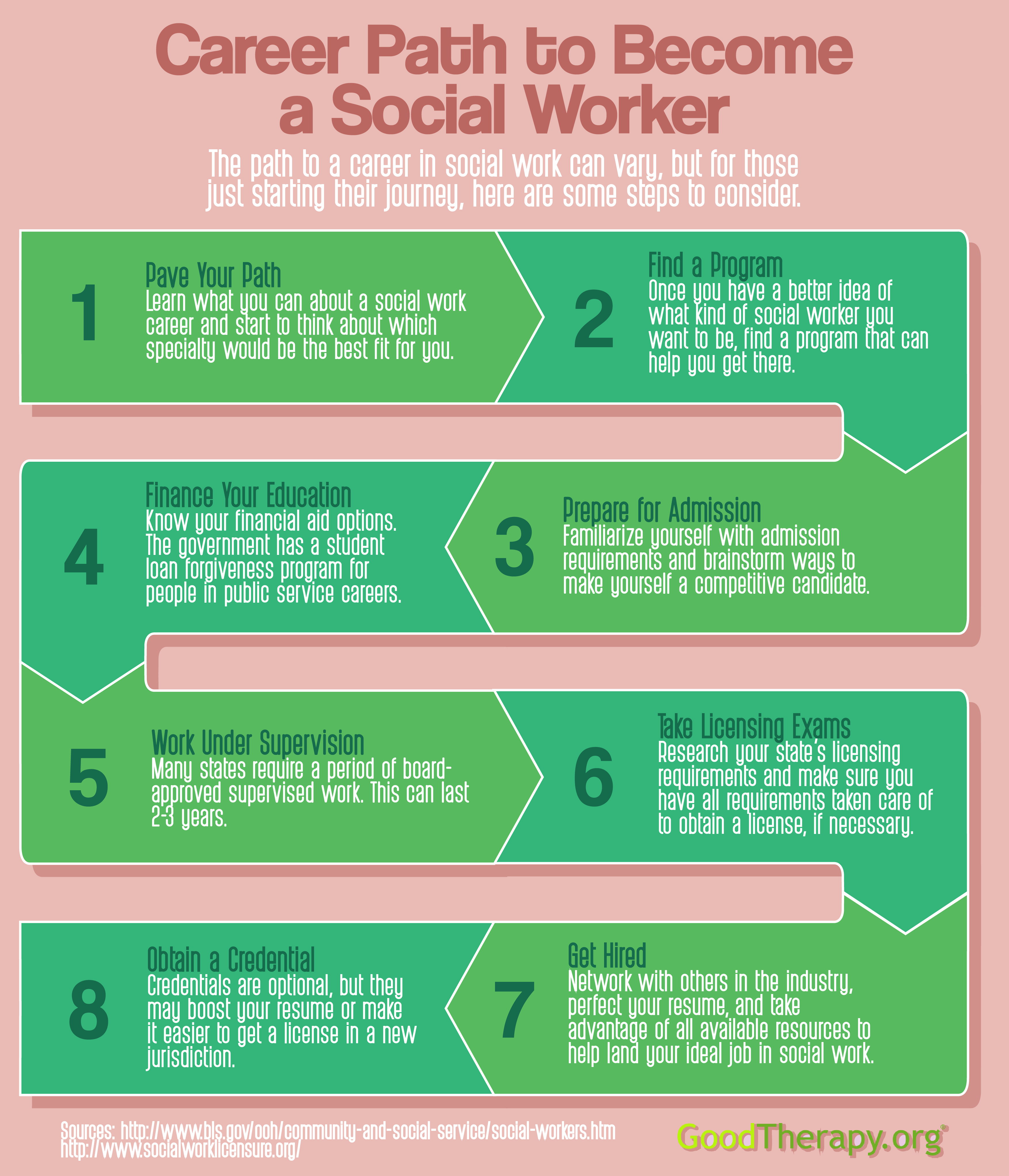 Infographic by Hannah Johnson
3. Prepare for Admission
Once you have decided on a program and a school, fully understanding and adhering to the admission requirements can make you a competitive candidate. You will need letters of recommendation from people who have known you for at least six months and can easily speak to your skills and attributes.
Volunteer work is an excellent way to show commitment and propensity for social work. Many human service agencies have volunteer opportunities to gain valuable experience. Some students interested in social work choose to volunteer for AmeriCorps, a national community service organization that provides small stipends and education awards in exchange for a service commitment.
[fat_widget_left]An accredited social work undergraduate degree is not necessary for admission to a graduate-level social work program. Any undergraduate degree can be sufficient, but a related field may be preferred.
You can view the directory of accredited social work programs from the Council on Social Work Education here.
4. Finance Your Education
Education can be an expensive investment. Considering financial aid options long before the start of a program can help you get your finances organized. You may qualify for grants, scholarships, or student loans, and some employers may even provide educational assistance. The government also has a student loan forgiveness program available to those who work in the public service field.
5. Work under Supervision after Graduation
In most cases, you will need to work under board-approved supervision for a period of two to three years or 3,000 hours after graduation before applying for state licensure. After receiving a master’s degree, all states require some form of practice for independent clinical licensing if you intend to eventually work in private practice.
Many states require a period of supervised work even for non-clinical positions such as administrative work. It may be necessary to check with your state licensing requirements and your admitted program to know for sure what your requirements will be.
6. Take State Licensing Exams
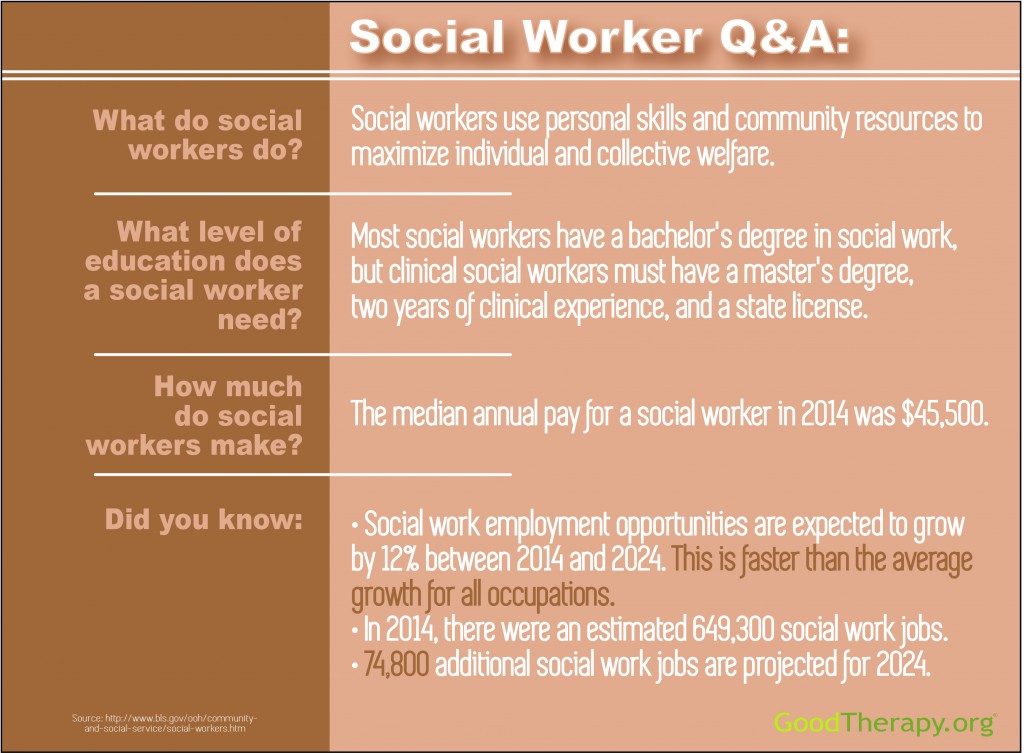
To become a licensed social worker, learning the licensure requirements in your state is a key step. In the past, many jurisdictions would accept bachelor’s degrees in related fields without accreditation, but most states are moving away from this and do require an accredited degree from the Council on Social Work Education (CSWE) or foreign equivalent for licensure. For those with bachelor’s degrees not CSWE accredited, a master’s degree in social work from an institution that is accredited may be necessary.
In addition to educational requirements, you will also need to work under supervision, take an exam, and possibly be fingerprinted in some states. You can check your state’s requirements here.
In several states, you will need to take the Association of Social Work Boards (ASWB) master’s exam before or after graduation. After completion of all other requirements, you will then take a clinical or advanced generalist exam if necessary.
7. Obtain an Optional Credential
The National Association of Social Workers offers an Academy of Certified Social Workers (ACSW) certification. It is not the same as licensing and does not give any legal authority to practice in any state, but it does provide an additional credential to add to a resume. In some cases, the certification may make it easier to receive a new license in a new jurisdiction.
8. Get Hired
Once you have completed your education and licensing requirements, you’re ready to look for social work jobs. Networking can be helpful for getting to know others in the industry, and spending time perfecting your resume and using all resources available to you can make it easier to land your first social work job or start your own clinical practice. For anyone in a therapist or social work career, staying involved in the community and keeping up with your continuing education requirements can help maintain your licensure and expand your knowledge.
References:
- Bureau of Labor Statistics. (2015, December 17). U.S. Department of Labor. Occupational Outlook Handbook, 2014-15 Edition. Social Workers. Retrieved from http://www.bls.gov/ooh/community-and-social-service/social-workers.htm
- Council on Social Work Education. (CSWE). (n.d.). Directory of Accredited Programs. Retrieved from http://www.cswe.org/Accreditation/Accredited-Programs.aspx
- Federal Student Aid. (2015, December). Public Service Loan Forgiveness Program. Questions and Answers for Federal Student Loan Borrowers. Retrieved from https://studentaid.ed.gov/sites/default/files/public-service-loan-forgiveness-common-questions.pdf
- National Association of Social Workers (NASW). (n.d.). Become a Social Worker: Starting out. Retrieved from http://www.socialworklicensure.org/articles/become-a-social-worker.html#context/api/listings/prefilter
- National Association of Social Workers (NASW). (n.d.). Social Work License Requirements. Retrieved from http://www.socialworklicensure.org/articles/social-work-license-requirements.html