 For anyone facing the demon of substance abuse, one of the most difficult challenges is understanding how their addiction is affecting the people around them, including family and friends. In a haze of drugs and alcohol, it is virtually impossible to understand the impact that substance use and addiction have on the people who are closest. This dynamic is especially prevalent when parents are the substance abusers and they are unable to conceptualize how their use is impairing the growth and development of their children.
When a parent drinks too much or is under the influence of a substance, legal or illegal, many kids are likely to find themselves overwhelmed and unable to deal with their emotional reality. Children may deal with feelings of anger, embarrassment, frustration, fear, and myriad other emotions that they may not know how to express.
If there is substance abuse occurring in the home, often the family will try to manage the fallout internally, leaving kids with the feeling they have to protect a family secret. Sometimes, addiction may be influencing one or both parents in a household, but no one in the family unit is willing or able to address the issue. Even a suggestion that there may be problems with addiction can bring anger and backlash from a parent who is not ready to face his or her own substance issues.
[fat_widget_right]
Substance use can also make home a dangerous place for kids. The addicted parent may not be able to maintain work or a steady income, rendering home life unstable. The potential for abuse also rises in households where one or more parents are under the influence. This lack of stability may adversely affect the emotional development of children, leaving them lost, lonely, and stressed.
The long-term effects of these experiences will influence kids in many aspects of their daily lives. Kids of addicted parents often take on responsibility for the household and become what is commonly called the “parentified” child. Such kids are forced into adult roles and responsibilities that are not being managed by the parents. They may become perfectionists in an effort to manage the emotional instability in the home.
These same kids often carry low self-esteem and face challenges when trying to create intimate relationships outside the home. They often have limited emotional awareness and may be conflict avoidant as a means of maintaining a steady emotional state. Holding the secrets of the addicted parent(s) makes it hard for them to build open, honest relationships, which in turn makes it challenging to develop close connections.
All of these are reasons to find help for kids in families with addiction issues. If one parent, family friend, or relative can step in and recognize the issues occurring in the household, there is a window of opportunity to get professional assistance.
It is vital for kids of alcohol- or drug-addicted parents to realize that they are not alone and that there are other people in their community facing the same challenges. It is also important, with the assistance of a professional counselor or support group, for kids to understand that they are not responsible for the addiction issues that their parents are going through. Having a place to share their story and make sense of the emotional turmoil in their home may help kids of addicted parents to process their feelings and begin to develop a stronger sense of self.
The development of self-esteem, independent of a parent’s addiction issues, can help children to regulate their emotional life and adapt to family needs. By providing a place of safety and understanding for kids of addicted parents, we can help children learn healthy coping skills and understand how addiction can affect any home, not just theirs.
 If you were to attend a professional training on trauma, the instructor would likely reference the nervous system and its window of tolerance. In recent years, trauma researchers and therapists have developed a deeper understanding of the nervous system’s role in regulating extreme stress, and have learned some techniques for regulating this system.
You have probably heard of the fight-or-flight response, which describes our impulse to defend ourselves or run until we reach safety. This is part of the window-of-tolerance model, but it’s not quite the whole picture. Let’s start with understanding a regulated nervous system.
A regulated nervous system experiences a stress and calming response throughout the course of a given day. Perhaps you are driving and someone brakes unexpectedly ahead of you; when your nervous system is regulated you will feel some stress, but once your body feels safe and you are able to act in a way to ensure your safety (i.e., press your own brakes), your system will calm back to baseline. Dr. Dan Siegel of UCLA coined the term “window of tolerance†to describe this space in which we can regulate ourselves without too much effort.
Make sense? You’ve probably felt some of these fluctuations in your system today—rushing to get somewhere and relaxing when you arrive on time, for example. Next we’ll explore what happens to the nervous system when a traumatic experience enters the picture.
[fat_widget_trauma_ptsd_right]
Trauma pushes the activation of the nervous system beyond its ability to self-regulate. When a stressful experience pushes the system beyond its limits, it can become stuck on “on.†When a system is overstimulated like this, we can experience anxiety, panic, anger, hyperactivity, and restlessness. This is the fight-or-flight mode; your body is activated and ready to move.
Some nervous systems will stay here, while others will dip below the normal range and become stuck on “off.†Below the window of tolerance we see symptoms of depression, fatigue, disconnection, and lethargy. Systems can get stuck above or below the line for prolonged periods of time, or they can vacillate between the two.
How can you discharge the traumatic stress and transition back into the window of the regulated nervous system? Here are a few tips:
- Seek safe relationships. Being with someone who is safe and soothing will help your nervous system settle and create a safe space for you to connect and share your experience. We are social beings and we heal in relationship, so if you find yourself isolating or pulling away from social contact, consider instead seeking out people who feel supportive.
- Practice mindful breathing. This trauma response is connected to the brain stem (basic physiological regulation) and the limbic (emotional) brain. Practicing mindful breathing helps connect a basic physiological process (breathing) with your prefrontal cortex (thinking brain), which helps integrate and shift our neurological state. To put that more simply: breathing has a HUGE capacity to calm the brain and regulate the nervous system.
- Find a therapist who understands trauma and can help you get to know the habits of your nervous system. Recognizing when you are outside of your own window of tolerance and building personal strategies to soothe or stimulate your system is key to regulating in an ongoing way. For some people, sitting still is calming; for others, movement brings more peace. Find someone who can support you as you explore what works best for you.
There are many unique and healthy ways you can learn to support your nervous system and bring it back into its window of tolerance when something stressful occurs. Creating a support network that includes a trained trauma therapist is a helpful way to build your ability to heal and recover from traumatic experiences. When you learn to work with your nervous system, you may even build up a wider window of tolerance, which can allow you to move about the world feeling more grounded and connected to others.
Have questions? Please post them in the comments section below!
 For many people, however, constant worry can become a serious problem, leading to both mental and physical health issues. Our causes of stress can include, among others, high demands at work, family problems, financial difficulties, traumatic events, divorce, illness, or the loss of a loved one. Unfortunately, many people deal with these types of issues in unhealthy ways by overeating, drinking or using drugs, excessive caffeine consumption, becoming a workaholic, or developing chronic anxiety or depression.
In order to deal with stress in a healthy manner, we need to implement some self-care strategies into our lives. The following are some effective ways of reducing the stress we face on a daily basis:
[fat_widget_right]
- Create a healthy work-life balance. If you are a workaholic constantly trying to complete the next project, learn to set some limits for yourself. Technology often allows us to continue to work even after we’ve gone home for the day. We need to learn to establish healthier boundaries, however, in order to avoid becoming burned out or getting sick. Determine a cutoff time for work so that you can decompress at the end of the day and enjoy some much-needed leisure time. Learning more effective time-management strategies can also be helpful.
- Establish your priorities. If you find yourself with too many commitments and not enough time to get them all done, take time out to consider which ones can be delegated or eliminated and keep only the ones that are most important for you.
- Include self-care practices in your daily routine. Make sure you incorporate some time in your schedule each day to nourish your body and soul. Even if you have only a few moments to spare, you can enjoy a warm bath, listen to relaxing music, or watch the sunset.
- Engage in a physical activity several times a week. Going for a jog or working out are great ways to get rid of excessive stress. If you don’t have time to go to the gym, take a walk around the block on your lunch hour. Moving our bodies can keep us physically fit and healthier, which can make us feel better emotionally as well.
- Spend some time in nature whenever possible. A change of scenery is always helpful for changing our viewpoint about whatever is troubling us. Enjoying a trip to the park, watching the waves at the beach, or gazing at the stars are all wonderful ways to commune with nature that can help us to put our problems into perspective.
- Avoid emotional eating. When we feel stressed out, we often have a tendency to try to comfort ourselves by eating unhealthy foods, which only leads to negative feelings about ourselves afterward. Become more mindful of your eating habits when you are dealing with pressure, and have some healthy snacks on hand to fall back on rather than reaching for another doughnut or cookie.
- Limit time spent on social media. When you have already spent a full day at work, try to avoid spending too much of your leisure time connected to yet another computer or device. Allow yourself to connect with your friends on social media for a limited amount of time each day and then unplug and unwind. Many people spend too much of their time online, which contributes to their already stressful days.
- Practice meditation or relaxation techniques. Start a meditation practice, which can lead to lowered stress levels and a sense of greater equanimity. If sitting in meditation feels too daunting for you, practicing relaxation for 10 minutes a day can bring about many healing benefits for your mind and body. Numerous relaxation CDs are available to help you get started.
- Be creative! Once a week, try to set aside some time to do a hobby or other activity that you enjoy. Exercising our creative muscles is enjoyable and can also help to generate new ideas and solutions to problems you may be dealing with.
Stress is an ongoing issue that we all have to deal with. If we do not find healthy ways in which to handle our daily pressures, they may end up taking a toll on our physical and mental health. If you have tried some or all of the suggestions listed above and are still having difficulties dealing with stress, you may want to consider talking to an empathic other, whether this be a friend, family member, or therapist, in order to obtain the help needed to start to experience a more peaceful frame of mind, even in the midst of an otherwise hectic life.
You are in a tough spot. You have been married for 16 years, and of course there’s a part of you that would love to see him change and spare all of you the challenges that come with restructuring your family. That makes total sense to me. I can’t tell you what to do, but I think one of the most telling parts of your question is the presence of apparent emotional manipulation in his pleas to give him a second chance. I say “apparent” because, although his pleas feel manipulative to you and might very well be strategic, we have to leave open the possibility that the guilt trips are unintentional manifestations of the pain your husband is experiencing. You would know better than me how authentic those pleas are.
Whatever the case, though, it’s clear that he has some work to do. There are plenty of other signals in your narrative—verbal and emotional abuse, controlling/limiting/tracking behaviors, denying social connections—that should alarm you. Those signals are not consistent with a healthy relationship.
The way I see it, here are the possible scenarios: he has or has not changed and you do or do not call off the divorce. Best case, he has changed and you call off the divorce and, with the help of a marriage counselor, develop a strong and healthy relationship. Worst case, you call off the divorce and it becomes clear in the following weeks/months/years that he has not changed and he reverts to abusive behaviors.
[fat_widget_relationships_left]
I can’t tell you the likelihood of either scenario in your specific situation, but in my experience, change like the kind your husband is talking about takes time and committed work. In the meantime, I would be concerned about your well-being and the well-being of your children. His intentions may be to change, but there is significant work to be done to implement those changes consistently. Has he started working with a counselor to address his behaviors? How does he react when you don’t give him answers he likes? Do you feel heard, accepted, and safe? If the answer is not a resounding “yes,†there is still work to be done.
Let’s look at some alternative scenarios. What if you continue with the divorce and he shows he is committed to changing? There is nothing to say you can’t let him back into your life in the future if you trust that his changes are real and you feel safe doing so.
If you continue with the divorce, however, and the negative behaviors continue or escalate, you will know that you made the right decision. It is not unusual for the angry party to try to place the blame for his or her reaction on the other person; if only you had taken him back, it would be different. Don’t buy into that. Either he will choose to operate in this world in a peaceful, kind manner, or he won’t. If his choice is dependent on getting what he wants, then that change is not likely to last.
Best of luck!
Erika
 The initial aftermath of affair exposure is a critical time in the life of an intimate relationship. What you say or don’t say can make a big difference in the outcome of your partnership.
Let’s start with what you shouldn’t say. You should not say your affair “didn’t mean anything.†Do not yell, get angry, raise your voice, play the victim, blame your partner, blame your affair partner, or blame your kids. The only person you should blame is yourself. The goal is to take responsibility and be accountable for your actions in a way that is genuine, respectful, and remorseful.
There is a story to your affair which your partner will very likely want to hear. She or he may want to know everything. If so, you should go slowly in the unfolding of the story. Watch for his or her reaction when you talk about the affair; every detail may not be necessary in order to communicate the key elements of the infidelity. Be considerate and watchful of providing details that will only hurt your partner more. Emotional sensitivity is required even if your partner claims he or she wants to hear everything. Use your best judgment. Remember, this is a person you love and hope to love in the future.
Even though you are feeling shocked, exposed, and ashamed, don’t shut down and go silent. You probably don’t know what to say to help soothe and calm your partner. But it is important that your partner not have to drag information out of you. Before you begin the process of telling your story, check with your partner to determine if it is a good time. You may need to postpone the discussion depending on her or his mood and emotional reactivity. Your partner’s world has come unraveled, and you need to begin the process of cleanup. Your need to be proactive cannot be overstated. Some assumptions you can make about the situation: your partner is very angry, hurt, and lost. In addition to some other questions he or she may want answered, your partner wants to know why, how, and for how long. He or she may ask questions such as,“How could you hurt me like this, where did you meet, who initiated the relationship, who else knew about it, when did it start, and is it still going on?â€
[fat_widget_relationships_right]
You need to be proactive and get this discussion going. You may not want to create an emotional storm and begin sharing all the information you went to great lengths to hide, but you must. Your partner is in pain, and the only one who can address the suffering is you. You should not answer any question with, “I don’t know.†Whenever I hear someone say this in response to a question about the affair, I push them to think harder about the reasons behind the betrayal. “I don’t know†is the intellectually dishonest and emotionally safe response. Of course you know why, but chances are you have never had to answer that question and are afraid telling your partner may hurt him or her. The thinking behind the “I don’t know†answer is really “I don’t want to tell you,†“I don’t want to think about it,†or “I’m afraid to tell you because I may incriminate myself further.†From your partner’s perspective, if you made a decision that put your relationship at risk, you had better have a good reason for doing so. Being drunk, bored, or angry is not a good reason to have an affair.
As the unfaithful partner, you will need to spend some time thinking hard about why you engaged in the hurtful behavior. The explanations and reasons for the affair are likely many, and will require serious reflection to determine how you strayed so badly off course. If your partner wants answers immediately and you don’t feel adequately prepared to provide them, give him or her a time and a place when you will be ready to tell the story. The sooner you are honest and forthright with your partner, the sooner you can begin the process of repair.
If you need help in putting your story together, contact a mental health professional for assistance.
 The other day I was supposed to meet a dear old friend. The last few times we had plans, she canceled last minute because her mother, now 86, needed something. I understood, of course. This time she didn’t cancel, but she did tell me we’d have to meet for breakfast and it would have to be a quick one because it was her weekend to have her mother at the house and she didn’t want to leave her alone for long. This time, I opened my mouth.
“It seems like you have put your life on hold a lot lately, and your siblings don’t seem to do that. When do you get to have a life?†I must have struck a chord because she burst into tears.
“There just isn’t time for me,†she said.
Sound familiar?
With a growing number of people living longer and more adult children caring for them, this has become an issue of epic proportion. For those who have assumed the major responsibility of caretaking for an elderly parent (or two), their overwhelming needs can become a full-time job. Women especially fall prey to the feeling that they must take care of those around them before tending to their own needs (though more and more men are also facing this dilemma).
[fat_widget_right]
The analogy I like to use—whether in relation to a child, partner, or dependent elder—is the following: when you are flying on a plane, they tell parents to put their oxygen masks on first, and afterward to put on their child’s. The idea being that, when we first take care of ourselves, we can be better caretakers—not negligent, as we may often feel ourselves to be. Sometimes we are so busy “giving†that we don’t even realize we’ve got nothing left to give!
So, what are some basic guidelines for self-care when you are a caretaker?
- Recognize that the more you give, the more you are expected to give. I observe this phenomenon in all aspects of daily life: the person who takes on the lion’s share will be expected to do more and more, while the absentee parties will be not only exempted from expectations, but often excused with understanding for their lack of participation. To combat this, maintain healthy boundaries. This means sometimes saying “no†to taking a loved one to an appointment and “forcing†them to call a less active sibling or friend who they never want to “bother†(though of course they think nothing of “bothering†you!). It also means scheduling your own activities and sometimes expecting that person to work around your schedule. This isn’t mean; it’s establishing that you have a life and your time and energy need to be honored and valued.
- Dependence creates dependence. Encourage your loved one to be engaged in something he or she enjoys. Ideally it would be great to have at least one activity outside the home (community transportation is often available, so you don’t necessarily have to drive). The person can join a community center, take a class, spend time at another sibling’s house for the weekend, etc. This not only frees up your time, but also helps foster your loved one’s independence and happiness, which makes for a much more harmonious interaction with you.
- Keep in mind that this person may live for a long time and you can’t put your life on hold forever. I have a friend who has been retired since age 62 and has postponed her plan to relocate until her mother passes away. She never dreamed her mother would live so long (she’s now 96!), and now she regrets not having relocated herself and her mother years ago. I’m not suggesting you dump your parent so you can go out partying, but rather that you figure in your own needs as much as his or hers as you plan for the long term as well as the minutiae of daily life.
- Get help! Don’t take on everything yourself. I often hear about parents who want only their adult child (usually a female) to deal with their daily needs. But sometimes it is too much. Get a helper, companion, home aide, or something to spread the care around. Many elderly (and chronically ill people) who are fortunate enough to live in their own homes or their children’s can take for granted what goes into this process. You can also find many useful websites and organizations that can support you in being a caretaker. A support group can be a wonderful addition to your self-care routine.
Many, many people are caring for elderly parents, whether in their own homes or supporting them so they can stay in their homes. Know that you are not alone, and that this can be both a wonderful, enriching experience as well as a deeply challenging one. The more you take care of yourself, the more rewarding—and less depleting—it will be.
 The world of children can seem like a foreign culture, featuring values and rules that may appear quite different from those that govern the adult world. Even from a young age, though, children observe adult behavior and incorporate what adults do into their own repertoires. Thus, children’s worlds are often simple reflections of what they’ve seen from the adults in their lives. According to a new study, the sponge-like ability of children to pick up on adult emotional cues, particularly those for anger, begins very early.
How Children Respond to Adult Emotions
Toddlers grow up quickly, morphing from babies who know little about their worlds to preschoolers with large vocabularies, strong manipulation skills, and a keen understanding of social norms. To evaluate what young toddlers know about adult emotions, researchers from the University of Washington studied 150 15-month-old toddlers. The children sat on their parents’ laps while watching an experimenter show them how to play with various toys. Each toy featured movable parts that made sounds when manipulated in specific ways, such as a box that buzzed when experimenters touched it with a wooden stick.
The children were enthusiastic observers, eagerly watching the experimenter show them how to use the toys. As the children’s interest increased, a second experimenter, known as the “emoter,†entered the room. The emoter loudly and angrily complained, calling the toys annoying, while the first experimenter continued to demonstrate the use of the toys. Thereafter, the children could play with the toys. In one group, the emoter either left the room or turned around. The other group of children had to play with the toys in the presence of the angry emoter.
The children who were allowed to play with the toys without being viewed by the emoter were enthusiastic participants, eagerly grabbing the toys and playing with them. Children who had to play with the toys in the presence of the emoter, though, were more hesitant, even though the emoter maintained a neutral expression and did not further comment on the toys. When these children did finally reach for the toys, they were less likely to repeat the steps the experimenter had demonstrated to them.
Emotion and Development
The study’s authors note that a number of factors could influence the children’s reactions. For example, children from high-conflict households might be less affected by anger, and therefore more likely to play even in the presence of an angry “emoter.†Children’s individual temperaments can also affect the way they react in the face of adult anger. Researchers, though, argue that their study shows that very young toddlers have sophisticated emotion-detection skills, and that these skills enable them to adjust their behaviors based on the reactions of adult observers. [fat_widget_child_counselor_left]
Researchers also found a link between impulsive behavior and reactions to anger. Children who rated high on measures of impulsivity on the Early Childhood Behavior Questionnaire were more likely to ignore angry adults, suggesting that impulsive behavior begins early and might inhibit the ability to read emotional cues.
For adults and parents who find themselves frustrated by the challenging behavior of toddlers, this study serves as a powerful message. Adult anger can inhibit children’s behavior, and even very young children want to avoid the disapproval of adults, including adult strangers.
References:
Toddlers regulate behavior to avoid making adults angry. (2014, October 7). Retrieved from http://www.sciencedaily.com/releases/2014/10/141007131422.htm
 Megan doesn’t want her daughter to be a theater major in college. Tim doesn’t think his son’s about-to-be fiancée is right for him. Samantha doesn’t want her son to join the Peace Corps. Each of these parents struggles with if and/or how to express their strongly felt feelings and opinions to their children. Each believes that there would be disastrous consequences if their child followed through with their choice.
Parents who are troubled and conflicted about what they see as the life choices their adult children are making describe experiencing a wide range of intolerable feelings. Typically feeling desperate, the initial question they present to me is, “How can I get my child to do what I know is best?†When I respond, I try to get them to consider my question: “Best for whom?†Surprised, they usually look at me as if there can only be the obvious answer: “best for my child.†But if I can help them consider how it is also best for them, they may ultimately have a fuller sense of what is driving their strong need to influence their child. It may also help them moderate their intense and frequently painful feelings. They will then be in a better position to choose how or if they should try and persuade their child to see it their way.
I am going to describe some work I did with Megan, who responded “best for my daughter†to my usual question.
Megan was open to exploring both why she thought it was best for her daughter and also why it might be best for her. She described how worried she was that her daughter, Annie, would never make it in theater: “She is going to suffer all the pain and humiliation of failure. I’m really frightened that she’ll never be able to make a living. She could end up living a terribly depressed and deprived life.â€
[fat_widget_right]
As Megan and I talked about her worries, she acknowledged that she would be relieved if Megan didn’t become a theater arts major. She recognized that she was very frightened. If she could influence Annie, her suffering would diminish and she would feel much less anxious and troubled.
As we explored Megan’s feelings, it was clear that while she understood that she wanted to get rid of her anxiety by persuading Annie to listen to her, she had complete certainty that her daughter’s life would be ruined: “She says she gets it, but I don’t really think she has thought about what it will be like to fail, to not be able to support herself after college.†This has created a serious conflict between mother and daughter. Megan was so sure it would be a disastrous decision that she wasn’t willing to pay Annie’s college tuition.
Megan and I did a lot of talking about her relationship with Annie. Megan was surprised at how much Annie was pushing back: “She’s always listened to me. She never fought with me about anything. We’ve had very few disagreements. I remember when I told her that I thought her friend Jordy, who I never liked, was a bad influence. She didn’t argue and just stopped hanging out with her. She took tennis lessons and talked about how much she liked the game. But I could see that she was pretty bad at it and she never objected when I suggested it wasn’t her thing. I don’t know, she’s always seemed fine with my ideas about what was good for her and what wasn’t.â€
The more I learned about Megan and Annie’s relationship, the more it seemed that historically there was a dynamic where Megan exerted a great deal of influence and Annie complied. I wondered if there was some significance in Annie turning 18 and planning to go away to school that created a shift in this pattern. Annie was behaving in a more separate way from Megan. She was expressing more of an individuated self. Perhaps Annie’s new attempt at separation and individuation was something Megan was finding difficult.
As we continued our work, Megan began to consider that she was having trouble separating from Annie. One day in our session she began to cry: “You know, I suppose it’s always been about separation. I thought if she did what I wanted, followed my life plan for her, didn’t have conflict with me, we would always be Mommy and Annie. But she is growing up and she isn’t just like me. Maybe she is tougher than me. I get scared about risks. I suppose it might not be so terrible if she was less scared, more able to risk failure. I don’t know. The thing is, I don’t like her choice. I think it’s wrong. I don’t want to help her to do it.â€
Megan’s tearful statement captures her intense conflict. Her strong need to stop Annie from becoming a theater arts major may not just be about her intense belief that it is a choice that would be harmful to Annie. The surprising pushback from Annie may have strengthened Megan’s feelings that the theatre choice is a bad one.
Megan has reported that Annie has become very angry with her and has told her that she is going to find a way to pay her own tuition. Megan, in disbelief, told me: “This is so not like her. She says I can’t stop her from doing what she wants for herself. She screamed at me, ‘I’m not going to let you make me doubt myself or make me feel guilty for choosing what I want instead of what you want.’ I can’t believe this is my daughter talking to me.â€
Megan is feeling hurt and rejected by Annie. Until now, Annie had not had her own voice in their relationship, and it is difficult for Megan to see Annie’s assertion of herself as a positive behavior in service of the developmental tasks of separation and individuation. As we have been exploring her conflict, I have asked Megan to think about her impact on Annie. Megan has been so angry and scared about Annie’s choice that she hadn’t stopped to think what it would feel like for Annie to be unsupported: “I guess she could feel like I don’t believe in her talent or that she doesn’t have what it takes to succeed. But maybe she’ll think she has a mother who is trying to make sure she doesn’t do something ruinous.â€
Megan and Annie’s struggles are representative of parent-child conflicts where parent and child feel strongly about influencing and being influenced. These conflicts are often not simply about the manifest issues at hand. Rather, both parent and child are responding to the indirect messages in the communications. To deal with these conflicts, it is important for parents and children to learn how to express the impact each is having on the other.
Parents may feel they are being protective parents who are taking good care of their children when they insist their adult child do it their way. They can feel angry, hurt, or confused by their child’s responses to their concerns. Adult children frequently report feeling intruded upon, infantilized, and/or controlled when parents attempt to have the final say in their life decisions. These children may begin to doubt themselves and can become anxious about failure. Or, they may become angry and recognize they are being deprived of learning how to become resilient and deal with failure. Many express that their self-confidence is being undermined.
When parents try to influence their children, it is important for everyone to decode what messages are being communicated and whether the intended communication is what is being heard. While parents may believe they are expressing “I love you and want to protect you,” or, “I am thinking about what is best for you,” their child may be hearing, “you don’t have what it takes to do that,” or, “you don’t know how to take care of yourself in risky situations,” or, “you are going to fail and not recover.” When the child rejects the parents’ influence, parents may hear the child’s response as, “I don’t love you”, “you don’t know me,” or, “I want to get away from you.”
Megan is working on taking Annie’s angry outbursts less personally and is trying to be more aware of the benefits for Annie in being supported by her. For now, Megan’s goal is to get comfortable with the idea of having a dialogue where she is open to hearing what Annie has to say about what she wants with the hope that Annie will be more willing to consider the risks and potential harm that could result from her choice of major. Megan also wants to try to have a conversation with Annie about their relationship and what it is like for both of them to deal with Annie’s separating and individuating.
As Megan has discovered, parents and their adult children who are struggling about whose version of the adult child’s life will prevail need to find a way to talk, listen, and hear each other. If they can accomplish this, they will be in a better position to benefit from the other’s views and have a better chance of accepting each other’s differing points of view without feeling dismissed and devalued. While this doesn’t mean they will agree, the unwanted and painful feelings that are generated in the struggle can become more tolerable, and the relationship will be stronger.
Note:Â To protect privacy, names in the preceding article have been changed and the dialogues described are a composite.
 The topic of domestic violence entered the media spotlight well ahead of Domestic Violence Awareness Month this year. October has been dubbed domestic violence awareness month since 1987, and each October, we see a flurry of media content dedicated to raising awareness about the alarming numbers of people who are affected by violence in the home. This year, widespread media coverage of a professional football star’s appalling abuse of his then fiancée, made more horrific through video footage, rallied forces to stand up and speak out against domestic violence several weeks ahead of October.
But domestic abuse, or intimate partner violence, is not limited to sports stars or to any particular month. Domestic violence occurs in millions of households every day, and a huge number of these incidents go unreported. Violence in the home affects everyone within the household, whether or not family members are victims of abuse themselves, and it extends well beyond the confines of the home, affecting neighbors, family, friends, coworkers, and the community at large.
The sources of domestic violence are many, and both the abuser’s and the victim’s backgrounds play a part. Over the years, GoodTherapy.org has published a number of articles addressing the complexity of intimate partner violence. This October, we’re highlighting our top five picks that help illuminate statistics, dispel myths, and illustrate the nature of violent relationships.
 Why Do Abuse Victims Stay with Their Abusers?
Our GoodTherapy.org correspondent, Zawn Villines, addresses the recent media coverage of the physical abuse Baltimore Ravens’ Ray Rice inflicted on his partner, Janay, and the popular response, or bafflement, as to why Janay chose to stay with her abuser. Villines outlines some of the reasons an abuse victim might choose to remain in an abusive relationship.
The Psychological Wounds of Domestic Violence Â [fat_widget_right]
 [fat_widget_right]
This comprehensive article takes a look at intimate partner violence in the United States today, examining the characteristics and complications associated with violent relationships. Statistics and data on prevalence, psychological outcomes, and resources are provided as well.
Seen, Heard, Felt, Hidden: Recognizing Domestic Violence Signs
A therapist provides a case example to highlight the ways that people in violent relationships can’t see or refuse to see the signs of abuse. Particularly in the absence of physical abuse, it may be difficult to identify controlling behaviors, put-downs, and emotional manipulation as ongoing abuse.
 Emotional Outcomes for Child Witnesses to Domestic Violence
The psychological ramifications for children who witness domestic violence in the home can be damaging and lasting. They may experience social or academic problems, anxiety, depression, behavioral issues, or somatic symptoms, such as stomachaches. Later in life, children who witness abuse may end up as abusers or victims themselves.
Domestic Violence in Same-Sex Couples
Therapist and LGBT issues Topic Expert Susan Leviton dispels the myth that domestic abuse is solely a heterosexual issue, and she addresses some of the misconceptions surrounding domestic violence in same-sex couples, such as the notion that violence between LGBT partners is always mutual. She also points out that internalized homophobia may account for some couples’ experiences and acceptance of abuse.
GoodTherapy.org also offers readers an opportunity to share their experiences with issues like intimate partner violence and the therapeutic interventions that helped them along the way through the Share Your Story section of the Good Therapy Blog. Several readers have shared their experiences with domestic abuse, including one woman who found she was brought back to life with therapy: ‘I Don’t Need Therapy:’ Why I Was Wrong.
 For many people, there are few things that evoke a more reassuring sense of warmth, comfort, stability, and safety than going home. Many people see their home as a personal stronghold—a bastion of unconditional love and support. At home we tend to have more freedom, more time for family, and for a few hours, at least, we are afforded an escape from the hustle of the day. For victims of domestic violence, however, the home is anything but a refuge.
According to the National Coalition Against Domestic Violence (NCADV), domestic violence is the intentional physical assault, intimidation, battery, sexual assault, and/or use of other threatening behavior by one member of a household against another. Other less obvious forms of abusive behavior include stalking, the use of threatening looks or gestures, attempts to control the reproductive health of an intimate partner (for example, refusing to use contraception during intercourse), and displays of psychological aggression such as putting down, humiliating, or isolating an intimate partner.
The Shocking Prevalence of Domestic Violence in America
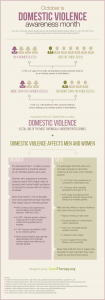
Intimate partner violence (IPV), a more narrowly defined term for domestic violence, affects both men and women, married (spousal abuse) or unmarried. The US Department of Justice estimates that 1.3 million women and 835,000 men are victims of physical violence by an intimate partner each year.
The NCADV also reports that among all domestic violence victims, 85% are women; on average, one in every four American women will experience domestic violence in her lifetime. Crime statistics also indicate that close to one-third of all female homicide victims were killed by an intimate partner.
Domestic Violence: The Psychological and Emotional Wounds
Broken, bruised, and battered features are the obvious signs of domestic abuse. However, just as physical injuries demand our care and attention, it is imperative that the psychological and emotional wounds suffered from these traumatic events also get addressed.
The American Psychological Association (APA) explains that psychological trauma is “an emotional response to a terrible event …” which interferes with an individual’s ability to function as he or she would under normal circumstances. While the psychological impact of a particular incident will vary from person to person, most individuals experience increased levels of emotional distress after going through traumatic events. Thankfully, these feelings of distress often subside if adequate support is received from family members, friends, mental health professionals, and other social networks.
For victims of spousal abuse and other types of intimate partner violence, however, the situation is not always so clear-cut. Fear of retaliation from the abusive partner might prevent victims from seeking needed assistance. Feelings of shame and embarrassment, especially among male victims, can also be a major hindrance to seeking out services or aid. This lack of emotional support can lead to heightened fear, anxiety, depression, anger, posttraumatic stress, social withdrawal, the use of illicit drugs, alcohol dependence, and even suicidal ideation.
It is clear that the psychological and emotional wounds of domestic violence are devastating. They can potentially haunt victims for many years and rob them of the ability to live a rich, full life. These wounds are completely undetectable by x-rays and too often go untreated.
The Social Impact of Domestic Violence
Domestic violence often has a ripple effect that tears through the fabric of the victim’s life. The psychological, emotional, and social impacts of domestic violence can linger long after the violence has subsided, and even after the victim has left the abusive partner.
The National Center for PTSD, a prominent research and education organization that studies the psychological effects of trauma, has identified several scenarios that indicate red flags in an unhealthy relationship. An unhealthy relationship may be indicated when one partner:
- Has complete control of all household finances.
- Limits or completely closes off the other partner’s social life. He or she may isolate the other partner from friends and family.
- Consistently threatens to ruin the reputation of the other partner, especially after he or she has expressed a desire to end the relationship.
- Repeatedly tries to scare the other by breaking things, punching holes in the wall, and hurting or threatening to hurt pets.
- Systematically evokes feelings of guilt or shame in the other partner.
These types of coercive and controlling behaviors are often present in cases of domestic violence, and can have a profound impact on how a victim of abuse is able to function socially, even after leaving an abusive relationship. If an individual is financially dependent on his or her abusive partner, any decision to escape the abuse carries with it the real possibility of homelessness. One study (2003) showed that among a sample of 110 women who had experienced domestic abuse, 38% reported homelessness.
Issues of poverty and homelessness are closely linked to the abusive act of isolating an intimate partner from family, friends, and other sources of social support. Under normal circumstances, a person with strong social connections will look to his or her relatives and/or peers when assistance is needed. However, isolation from these support groups may cause the connections to wither. In the end, people who experience domestic violence might reason that they are completely alone in their struggles and former resources are no longer available.[fat_widget_right]
Even if a survivor is successful in escaping from a violent relationship, the scars of past abuse can significantly influence future intimate relationships. The National Center for PTSD explains that some people who have endured IPV may not even believe that healthy relationships exist. Thus, they might enter new relationships with the same unhealthy expectations that they had previously. Other challenges could include intrusive memories of past abuse (for example, during intimate moments with a new partner), nightmares, communication challenges, and feelings of worthlessness.
The Effect of Domestic Violence on Children
Research shows that a child’s development can be adversely affected by domestic abuse. One study conducted by Appel and Holden (1998) even emphasizes a large overlap between households where there is IPV and child abuse. The National Center for PTSD estimates this overlap to be about 40-60%. According to statistics from the NCADV, boys who are exposed to domestic violence are twice as likely to abuse their intimate partners and children when they grow up.
Similarly revealing statistics from the American Bar Association show that girls with a history of physical or sexual abuse were more likely than non-abused girls to engage in risky behavior such as smoking (26% versus 10%), drinking (22% versus 12%), and substance abuse (30% versus 13%). Abused girls were also more likely to binge eat and purge than non-abused girls (32% versus 12%). In another study involving 2,245 children and teenagers, it was highlighted that recent exposure to domestic abuse was a primary factor in predicting future violent behavior. Even children are not directly abused, they are affected by witnessing domestic violence.
Where and How You Can Get Help
If you or a loved one is a victim of domestic abuse, please seek help. The longer abuse persists, the more damage it can cause physically and psychologically. There is support nationally and in your community to help you end the cycle of violence and move beyond it. Here are some resources if you are in trouble:
- If you are hurt or in immediate danger, please call 911 and do what you can to get in a safer situation.
- Contact the National Domestic Violence Hotline at 800-799-SAFE (7233) or 800-787-3224 (TDD). The national hotline can guide you to local shelters in your community and/or vital services.
- For local resources, visit this section of womenshealth.gov to find support and safe haven in your state.
- If you are searching online for help, be sure to clear your Internet browsing history so that your abusive partner cannot track your searches. Firefox, Internet Explorer, and Google Chrome all have options to clear browsing history located in the upper-right corner below the red X to close the window.
Even after the violence has subsided, the psychological effects of domestic violence can stick around. Seeking the help of a mental health professional such as a counselor or a therapist can be critical to helping a victim finding peace. If you or a loved one is a victim of domestic violence, consider talking to a professional with the experience and knowledge to help a person overcome the psychological wounds of domestic violence.
References:
- American Bar Association, Commission on Domestic and Sexual Violence. (n.d.). Domestic violence statistics. Retrieved September 26, 2014, from http://www.americanbar.org/groups/domestic_violence/resources/statistics.html
- American Psychological Association. (n.d.). Trauma. Retrieved September 26, 2014, from http://www.apa.org/topics/trauma/
- Appel, A. E., & Holden, G. W. (1998). The co-occurrence of spouse and physical child abuse: A review and appraisal. Journal of Family Psychology, 12, 578–599.
- Australian Psychological Society. (n.d.). Understanding and managing psychological trauma. Retrieved September 26, 2014, from http://www.psychology.org.au/publications/tip_sheets/trauma/
- Baker, C.K., Cook, S.L. & Norris, F.H. (2003). Domestic violence and housing problems. A contextual analysis of women’s help-seeking, received informal support, and formal system response [Abstract]. Violence Against Women, 9(7), 754-783. doi:10.1177/1077801203009007002
- Black, M.C., Basile, K.C., Breiding, M.J., Smith, S.G., Walters, M.L., Merrick, M.T., Chen, J., & Stevens, M.R. (2011). The National Intimate Partner and Sexual Violence Survey (NISVS): 2010 Summary Report. Atlanta, GA: National Center for Injury Prevention and Control, Centers for Disease Control and Prevention.
- Centers for Disease Control and Prevention. (2013). Intimate partner violence: Consequences. Retrieved September 26, 2014, from http://www.cdc.gov/violenceprevention/intimatepartnerviolence/consequences.html
- National Coalition Against Domestic Violence. (n.d.). Domestic violence facts. Retrieved from http://www.ncadv.org/files/DomesticViolenceFactSheet%28National%29.pdf
- National Coalition Against Domestic Violence. (n.d.). Male victims of violence. Retrieved from http://www.ncadv.org/files/MaleVictims.pdf
- S. Department of Veterans Affairs, National Center for PTSD. (2014). Intimate partner violence. Retrieved September 26, 2014, from http://www.ptsd.va.gov/public/types/violence/domestic-violence.asp
Thanks for the letter and your thoughtful questions. I am very pleased that you reached out, seeking advice on what to do.
You ask if it’s possible to become dependent on therapy, and as much as I would like to offer a simple answer, the honest answer is much more complex. Many people come to rely on the insight of their therapist and the relationship they foster in the safe confines of the therapy room. However, it is the responsibility of the ethical therapist to create conditions that do not foster or encourage dependence, and to do his or her part in helping a person in therapy learn to function and perhaps even thrive without the therapist.
The point of therapy is not to keep people in therapy indefinitely; if a person is not getting better or otherwise seeing desired results, the therapist has an ethical obligation to stop working with that person. Therapists are also bound by an ethics code that does not allow them to benefit financially if the person isn’t benefiting therapeutically. Additionally, you are always free to choose when you end therapy, unless you are court ordered to attend. On the other hand, many people maintain a relationship with a therapist long term and go in for “tune-ups†when needed—which, of course, is not the same as being “dependent.â€
[fat_widget_left]
Beyond any ethical obligations, please know that good therapists thrive off of people getting better. If it was about making money, most therapists would chose a different profession. Most therapists truly care about the well-being of the people they work with. That’s why they do what they do.
As for medication, yes, some meds can be addictive after long-term use. I am not a psychiatrist, so I can’t speak to which medications specifically. There is certainly a lot of fear about becoming dependent on medication, and I understand that fear. However, if you were to seek out therapy and/or medication, the clinician or physician you work with can discuss with you, at length, which medications might work best without being addictive. Also, you have a say in your treatment, so if you want to change or eliminate medication (should you decide to use it), that is always your choice. It is imperative to remember to only make changes under a doctor’s supervision, however.
You ask whether you can get better on your own. That is a question I can’t really answer. There are anecdotal accounts of people who defeated depression without the use of therapy and/or medication, but there are a lot more who did it with the assistance of a mental health professional and/or medication. I believe the best and fastest healing of the things that ail us comes through relationships. Research has consistently shown that people who go to therapy and use medication have better and long-term recovery from their mental health/emotional concerns.
I’m curious, though, whether your desire to avoid therapy has less to do with cost and more to do with stigma. There’s nothing wrong or bad about needing therapy; many people do, including therapists themselves. Even just a session or two of therapy often yields insight and healing that can help a person move forward. I challenge you to view the possibility of therapy in such a light.
I suggest that you interview some therapists; ask them about their methods, how they feel about the use of medication, and how long the people they see usually remain in therapy. The foundation of a good therapeutic relationship is trust, and trust is fostered through honest communication. You can begin building that bridge immediately simply by openly expressing your concerns and sharing your fears. You have every right to ask as many questions as you have, and a good therapist will do his or her best to address and alleviate your concerns. Even if you decide ultimately not to pursue therapy, at least you will have explored all your options.
Sincerely,
Lisa
 Have you ever been in a situation where you’re in a good mood, but then you talk to a friend who’s not doing so well and suddenly you feel conflicted? You want to support your friend, but you feel like you’re being pulled into the friend’s negative emotions, and you don’t want to give up your good mood. It seems like your only choice is to be pulled into the bad feelings or run away. Neither choice feels right.
This is one of the challenges that we navigate in order to have healthy relationships. But while it may seem like your only choice is between being pulled in or running away, there is a third choice: differentiation.
The psychological term for being “pulled in†is enmeshment. Enmeshment means losing our individuality and merging emotionally with others. We’re born enmeshed. As infants, we have no sense of where we end and others begin. When the brain is finally able to comprehend that we are separate beings, separation anxiety sets in, triggering existential isolation and creating a longing to merge with another.
Enmeshment can feel like love, connection, or empathy. It could be the only way you know how to be with someone else or the way you were taught you were supposed to feel. If a loved one has a feeling, you have a feeling, too. Feeling neutral can feel lonely, uncaring, or just plain wrong.
[fat_widget_relationships_right]
The fact is, though, enmeshment doesn’t really help either person in the relationship. If your partner is distressed and you join them in distress, then you’re both distressed! It’s much more helpful if one of you remains calm and supportive. When your child is anxious, being anxious yourself only increases the child’s anxiety and may even send a message that the child can’t handle their feelings alone. It’s unhealthy for your own mental well-being to be so affected by the moods of others. You have enough of your own feelings without also taking on everyone else’s. Enmeshment can stop both of you from reaching your full potential as individuals.
The psychological term for “running away†is emotional cutoff. Emotional cutoff occurs when enmeshment has gone too far, becoming emotionally dangerous for you, engulfing you in painful feelings. In order to protect yourself, you react by cutting yourself off emotionally from the other person. A woman notices her husband’s sadness, feelings of helplessness or fear flare up in her, and so she cuts off these feelings by ignoring and avoiding him. As a result, her husband is left alone with his feelings, he doesn’t receive love and support when he needs it, and a chasm grows between them.
In extreme cases, a person will permanently sever the relationship. It’s not always possible or even healthy to maintain toxic relationships, but in other cases, becoming differentiated can help you achieve a healthy relationship.
Differentiation is a person’s ability to maintain individuality while remaining emotionally connected to significant relationships. Differentiation is an innate part of human development, but the conflicting demands or desires for enmeshment can thwart its development. When you are differentiated, you can be with another person and listen to what that person is feeling without being emotionally pulled in one direction or another.
As with any problematic behavior, the first step in effecting change is to become aware that there is a problem. If this article rings true for you in any way, start by paying more attention to how you’re reacting in your relationships when you are confronted by someone else’s negative emotions. Do you remember the old suggestion, “Take a deep breath and count to 10?†Try it. It works!
The goal is to create a little window of opportunity to slow down your emotional reaction to the other person so that you can become aware of it, think about it, and hopefully choose to handle it differently. Ask yourself some questions: Are you becoming emotionally activated easily? Are you distancing yourself from the person? What is the person really trying to tell you? Does he or she want you to help, or just listen?
In order to separate your reactions from the other person’s emotions, you have to focus on yourself. This might require a heavy dose of acceptance: accepting your own thoughts and feelings, accepting the loneliness of individuality, and accepting the necessity of allowing other people to work through their feelings on their own.
If you ask yourself, “I’m OK, they’re not … is that OK?†The answer is yes.