
Compassion fatigue can be a serious occupational hazard for those in any kind of helping profession, with a majority of those in the field reporting experiencing at least some degree of it in their lives. This is no surprise, as it is typically those with the most empathy who are the most at risk.
Compassion fatigue is characterized by physical and emotional exhaustion and a profound decrease in the ability to empathize. It is a form of secondary traumatic stress, as the stress occurs as a result of helping or wanting to help those who are in need. It is often referred to as “the cost of caring†for others who are in physical or emotional pain. If left untreated, compassion fatigue not only can affect mental and physical health, but it can also have serious legal and ethical implications when providing therapeutic services to people.
While it is not uncommon to hear compassion fatigue referred to as burnout, the conditions are not the same. Compassion fatigue is more treatable than burnout, but it can be less predictable and may come on suddenly or without much warning, whereas burnout usually develops over time.
Because it can arise so abruptly, it can be important for therapists and others in the helping professions to protect themselves from this condition. Here are 11 ways to prevent compassion fatigue from happening to you:
1. Get Educated
If you know you are at risk for compassion fatigue, taking the time to learn the signs and symptoms can be a helpful means of prevention.
The most common signs and symptoms of compassion fatigue include:
- Chronic exhaustion (emotional, physical, or both)
- Reduced feelings of sympathy or empathy
- Dreading working for or taking care of another and feeling guilty as a result
- Feelings of irritability, anger, or anxiety
- Depersonalization
- Hypersensitivity or complete insensitivity to emotional material
- Feelings of inequity toward the therapeutic or caregiver relationship
- Headaches
- Trouble sleeping
- Weight loss
- Impaired decision-making
- Problems in personal relationships
- Poor work-life balance
- Diminished sense of career fulfillment
[fat_widget_right]Knowing the signs and symptoms and continuing to check in with yourself can help you better prevent and manage compassion fatigue if it arises. Many people find that ranking their level of compassion fatigue on a scale of 1-10 is an effective strategy. For example, a rank of 6 might mean you are declining social invitations due to feeling drained and a 7 might be difficulty sleeping due to excessive worry about someone else’s well-being.
Cultivating a high level of self-awareness and understanding of how your 6 differs from your 7 can help you gage where you are so you can implement necessary strategies to avoid the red zone that would likely be a 9 or 10.
It is not only the work itself that poses a risk, but the person’s life conditions as well. For example, someone who is not only taking care of people at work, but also caring for a child or adult family member at home may be even more susceptible to compassion fatigue. If you are currently experiencing increased life stressors at home as well as in the workplace, prevention strategies against compassion fatigue may be important.
If you think you may be experiencing compassion fatigue, you can take a compassion fatigue self-assessment developed by the Compassion Fatigue Awareness Project here.
2. Practice Self-Care
Practicing self-care can be a critical method of protecting yourself against compassion fatigue. It is not uncommon for those who are constantly concerned with the needs of others to wind up neglecting their own.
Those who practice good self-care are significantly less vulnerable to stress and compassion fatigue than those who fail to do so. A good self-care regimen will look different for each person, but it should generally include:
- Balanced, nutritious diet
- Regular exercise
- Routine schedule of restful sleep
- Balance between work and leisure
- Honoring emotional needs
Making time for these self-care activities leaves less room for overworking, which can lead to compassion fatigue, said Nicole Urdang, MS, NCC, DHM, a holistic psychotherapist based in New York.
“Overworking is often at the heart of compassion fatigue and its first cousin: vicarious trauma,†Urdang said. “Taking the very best care of yourself includes setting limits.â€
3. Set Emotional Boundaries
It can be especially important for therapists, social workers, nurses, and caregivers alike to set firm emotional boundaries to protect themselves. Empathy and compassion are generally at the forefront of a human services career.
If left untreated, compassion fatigue not only can affect mental and physical health, but it can also have serious legal and ethical implications when providing therapeutic services to people.The challenge is to remain compassionate, empathetic, and supportive of others without becoming overly involved and taking on another’s pain. Setting emotional boundaries helps maintain a connection while still remembering and honoring the fact that you are a separate person with your own needs.
If people in a human services career are exposed to too much trauma, they may begin to feel overwhelmed, and people may feel that overwhelm in different ways, Urdang said.
“It might manifest as insomnia, overeating, skipping meals, addictive behavior, isolating oneself, depression, anxiety, or anger. We might find ourselves fighting with partners or children, having no patience, feeling exhausted, noticing a lowered libido, unmotivated, and, paradoxically, being less interested in what our clients have to say,†she said. “Believe it or not, these are all helpful, as they quickly alert us to our depleted state. If we are paying attention and are committed to radical self-care, we can act on this awareness by rebalancing our life. If that is not possible, simply taking short breaks throughout the day to close your eyes, focus on your breath, or put your hands on your heart and send yourself some compassion can all make a big difference.â€
4. Engage in Outside Hobbies
Maintaining a solid work-life balance can help protect you from compassion fatigue. When all your time is spent working or thinking about work, it can be easy to burn out. Studies have shown work-life balance is becoming more important to workers, and making time for leisure activities and personal hobbies outside of work can help lower stress levels and improve overall life satisfaction.
5. Cultivate Healthy Friendships Outside of Work
While it is great to have strong relationships with your co-workers, it is equally important to cultivate and maintain healthy relationships outside of work. It can sometimes be difficult for co-workers to avoid talking about work even outside the workplace. Connecting with friends who are not aware of the ins and outs of your work situation can provide much needed emotional and professional relief.
6. Keep a Journal
Journaling is an excellent way to process and release emotions that may arise from your line of work. Taking the time to cultivate self-awareness and connect with your personal thoughts and feelings can help prevent suppression of emotions, which can lead to compassion fatigue over time.
7. Boost Your Resiliency
Resilience is our ability to bounce back from stress. While some people seem to naturally be more resilient than others, resilience is a skill that can be learned and cultivated.
“Resilience can be thought of as the ability to adapt to and become stronger through adversity,†said Marjie L. Roddick, MA, LMHC. “It can be a protective factor against compassion fatigue, so those with higher resiliency are better able to prevent compassion fatigue. Resilience is something that can be learned, and enhancing or boosting it can reduce the effects of compassion fatigue as new coping methods are learned.â€
8. Use Positive Coping Strategies
While it may be tempting to wash away the stress and emotional burdens of your job with alcohol or drugs, this can actually work in the reverse and compound stress in the long run. Consider making a list of positive coping strategies to use in times of stress. This might include deep breathing, meditation, taking a walk, talking with a friend, watching a funny movie, or relaxing in a hot bath.
9. Identify Workplace Strategies
Workplace strategies are often an important part of compassion fatigue prevention. If your employer does not currently have any in place, consider suggesting their implementation.
Some workplace strategies that have been proven to be beneficial are:
- Support groups and open discussions about compassion fatigue in the workplace
- Regular breaks
- Routine check-ins
- Mental health days
- Onsite counseling
- Relaxation rooms, massage, meditation classes, etc.
10. Seek Personal Therapy
If you find yourself feeling emotionally vulnerable, significantly stressed, or overwhelmed, consider seeing a therapist who can help you process your feelings and implement strategies to help you combat compassion fatigue and maintain a healthy work-life balance.
References:
- Badger, K. (2008). Preventing compassion fatigue: Caring for ourselves while caring for others. Phoenix Society’s Burn Support News. Retrieved from http://www.phoenix-society.org/resources/entry/preventing-compassion-fatigue
- Brooks, C. (2013, March 5). Career success means work-life balance, study finds. Retrieved from http://www.huffingtonpost.com/2013/03/05/career-success-means-work-life-balance_n_2812707.html
- Boyle, D. A. (2011, January). Countering compassion fatigue: A requisite nursing agenda. The Online Journal of Issues in Nursing, 16, (1). Retrieved from http://www.nursingworld.org/MainMenuCategories/ANAMarketplace/ANAPeriodicals/OJIN/TableofContents/Vol-16-2011/No1-Jan-2011/Countering-Compassion-Fatigue.html
- Mathieu, F. (2007). Running on empty: Compassion fatigue in health professionals. Rehab & Community Care Medicine. Retrieved from: http://www.compassionfatigue.org/pages/RunningOnEmpty.pdf

How important is the therapeutic relationship—the relationship between a person in therapy and his or her therapist—to the change process? Is the relationship itself the primary source of healing or are techniques the mechanisms for positive outcomes? And where does “love†fit in to all of this?
Out with the Old
My career in social work began with a full-time psychotherapy position in a rural town at a small mental health clinic. I was convinced my recent academic instruction had taught me everything under the sun, but also that I was clinically inept to practice as a therapist. Fortunately, the thoughtful, compassionate, and experienced supervisors at the clinic reined in my earnest energy.
I met with a clinical social worker on a weekly basis for supervision. She was a former nun with a wicked proclivity for curse words and an extreme disdain for computers. The topics that arose in the supervision hour varied. We talked about my personal issues, people who got under my skin in the therapy setting, and even her recollection of the days when people in therapy—as well as therapists—smoked cigarettes throughout sessions. What I remember most from our time together was her insistence that the beginning and end-all goal of psychotherapy was the same: you want the people you help in therapy to love you.
[fat_widget_right]
She did not mean love in the romantic sense, nor was she veering from any ethical boundaries. This was not a trick or gimmick. She believed that the person in therapy improved based on the degree of emotional connection, including shared trust and belief in the therapeutic relationship. I immediately dismissed the idea. My graduate school never talked about love, and I didn’t know of any research to back what my supervisor was saying.
I was trained to understand psychology as a series of universal principles. These principles are translated cross-culturally. I was clinically oriented and meticulously uniform with many of the therapeutic modalities I applied. The rigid stance I took on this disallowed vulnerable feelings from surfacing within the therapeutic relationship. It was easier for me to sit back and diagnostically judge than to truly join with people in therapy.
The Role of Therapeutic Alliance
My supervisor at the time was describing (and to some degree going beyond) the concept of the therapeutic alliance. Simon Goldberg of the University of Wisconsin-Madison has conducted research on this concept. It is an emotional bond between the therapist and the person in therapy, which includes a shared agreement regarding the goals to work on as well as the form of psychological intervention used (Goldberg et al., 2013).
Goldberg brought up a related construct—the real relationship (Gelso & Carter, 1994)—which involves the “actual, non-transferential relationship between a client and a therapist†which he feels most accurately reflects what we might call love in therapy. The real relationship is theorized to operate in tandem with the therapeutic alliance, combining the emotional bond of therapist and person in therapy with agreement on the tasks and the goals of where the therapy work is headed. “Love has something major to do with effective therapy,†he adds.
Part of the therapeutic alliance includes a positive attachment contracted around the mutually defined treatment plan for therapy. The role of the therapeutic alliance is central to psychotherapy, and the effect is independent of the type of therapy used. The quality of the therapeutic alliance accounts for approximately 30% of the clinical outcome, while the guiding theory or model used accounts for 15% (Walsh, 2013).
In other words, therapists are all different, but the methods or theories they use are far less important in terms of a person feeling better (Germer et al., 2005). This means that the alphabet soup of therapy acronyms (e.g., EMDR, CBT, DBT, ACT, etc.) are relatively minor ingredients to what really fills the therapeutic bowl: a person’s individual characteristics (participation, motivation, problems, background) and the therapeutic alliance (Walsh, 2013).
However, many therapists swear by their affiliated or credentialed techniques. So, what accounts for the change that occurs in therapy?
Phases of the Therapeutic Alliance
Goldberg states that the theory and technique offer a “rationale on some ritual that the client and therapist engage in.â€Â This collaborative partnership with mutual agreements as to the problem and solution is the predominant factor for change in psychotherapy.
For alliance to build, the therapist needs to be flexible and not hold tightly to an agenda. Priority is placed on collaborating with the person in therapy to establish and maintain the therapeutic relationship.
Past research looked at this alliance as developing from two phases. Phase one sees the person in therapy believing in the therapist as the desirable source of assistance. With warm regard and support from the therapist, the caring relationship commences. Therapy begins on this foundational level. In phase two, the alliance involves the person in therapy buying into the process of therapy via commitment to the procedure (i.e., shared understanding of the problem, value of the examination of the problem) as well as each person’s responsibility for the process (Horvath et al., 2011).
For alliance to build, the therapist needs to be flexible and not hold tightly to an agenda. Priority is placed on collaborating with the person in therapy to establish and maintain the therapeutic relationship (Horvath et al., 2011). The quality of the relationship can be assessed based on the “level of mutual and collaborative commitment to the ‘business of therapy’ by therapist and client†(Horvath et al., 2011; p. 15). This is the “collaborative enterprise†of psychotherapy. Essentially, the question and answer comes down to how well the person in therapy and the therapist work together in sessions.
Collusion Versus Confrontation
Specific variables and behaviors can be assessed for each role of the enterprise. The therapist’s non-reactivity to comments or overall antagonism of the person in therapy is reflected in the therapeutic alliance. My work centers on the conceptual space between collusion and confrontation. It is essential for the therapist to hear—not ignore—criticisms, but this must be done by threading the needle between colluding with the person in therapy or confronting his or her ideas. This perspective requires a dance between total agreement or affirmation and a scared-straight challenge or proverbial wrestling match.
For example, a person might say, “Am I a bad patient?†The therapist’s collusion with this statement might come across as, “Let’s talk about something else,†or, “You can be difficult at times.†The other end of the spectrum is confrontation. A therapist says, “No, no, no. You are not a ‘bad patient.’ †Or the therapist could say, “Where did you get that idea?†in direct opposition to the statement. A middle-ground response finds the therapist replying, “What would it mean to you to be a ‘bad patient’?†This is the essence of non-defensive but attuned responsiveness.
The therapist does not personalize or absorb any statements, but also does not ignore or avoid emotional comments (Horvath et al., 2011). This is the narrow window or divide between collusion and confrontation that fosters alliance. This is an attuned, appropriate, and nonjudgmental response. Isn’t that love?
References:
- Gelso, C. J., & Carter, J. A. (1994). Components of the psychotherapy relationship: Their interaction and unfolding during treatment. Journal of Counseling Psychology, 41, 296–306.
- Germer, C. K., Siegel, R. D., & Fulton, P. R. (2005). Mindfulness and psychotherapy. New York: Guilford Press.
- Goldberg, S. Personal communication, December 5, 2015.
- Goldberg, S.B., Davis, J.M., & Hoyt, W.T. (2013). The role of therapeutic alliance in mindfulness interventions: Therapeutic alliance in mindfulness training for smokers. Journal of Clinical Psychology, Vol. 69(9), 936–950.
- Horvath, A. O., Del Re., A. C., Fluckiger, C., & Symonds, D. (2011). Alliance in individual psychotherapy. Psychotherapy, 48(1), 9–16.
- Walsh, J. (2013). Theories for direct social work practice (2nd). Belmont, CA: Thompson Brooks/Cole.
 Intensive short-term dynamic psychotherapy (ISTDP), like all psychotherapy models, is a set of ideas and strategies used to form a healing relationship with another human being. Like therapists using other models of therapy, ISTDP therapists strive to create a relationship in which a person in therapy feels safe and secure. Experience shows that people need to feel safe in order to experience the emotions that their symptoms are designed to hide, and that experience of emotions within a secure bond will likely reduce their symptom burden (Davanloo, 1990; Frederickson, 2014; Abbass, 2015).
Sounds simple enough, no?
How ISTDP Therapists Use Attachment to Create Safety
[fat_widget_right]All psychotherapy models are ways of connecting and creating safety, but many assume a willing, motivated person will show up to the first session, which is not always the case. Some people arrive terrified of emotional contact with the therapist. They may come in and, intentionally or unintentionally, do things that interrupt their therapy goals without knowing why. Many therapists get stumped by these situations.
I love learning, teaching, and practicing ISTDP because the model offers an elegant system for reaching out to and supporting people to overcome the automatically deployed avoidance mechanisms that can defeat therapy. In ISTDP, we create safety by inviting a secure attachment, and then help people overcome the automatic thoughts, feelings, and behaviors that would otherwise create an insecure attachment.
Why People Create Walls and How We Can Invite Them Out to Play Again
Those of us who set out to create healing relationships, in therapy and elsewhere, quickly become aware of the many barriers people erect to keep love and concern from others out. We learn about the many rationalizations and self-recriminations that buttress people’s interpersonal walls. We understand that for many people the wall was once a survival mechanism, but we also see how it hurts them now. This presents a challenge: How do we create safety and security with someone who won’t let us in? How can we heal a heart if we can’t get close enough to see it?
We understand that for many people the wall was once a survival mechanism, but we also see how it hurts them now. This presents a challenge: How do we create safety and security with someone who won’t let us in? How can we heal a heart if we can’t get close enough to see it?When we reach out to meet a person and instead we meet a wall, therapists and non-therapists alike have a variety of reactions. We might feel angry toward the person we reached out to so lovingly. We might act out that anger and turn it into efforts to control or cajole. We might pretend the walls are not there and carry on a chronically disappointing pseudo-relationship with whatever parts of the person are not walled off. Often, we transiently forget our love, feel only our anger, and become harsh. We might even respond with our own walls.
In psychoanalytic thinking, we call the above reactions “enactments†(Sandler, 1976; Chused, 1991). In other words, we start acting out the relationship that the wall invites us to have, rather than the healing relationship that the person behind the wall needs from us. We end up relating to the character armor (Reich, 1945) or “resistance†rather than the wounded person who is stuck underneath. For therapists, the trick is learning how to step out of or around the enactment and reach out to the person behind the walls.
ISTDP therapists are trained to try to channel our mixed feelings of love and anger into communication. In this case, we talk about the wall with phrases like:
- “Do you notice how when I asked how you were feeling, you started to avoid my eyes and withdraw into your thoughts?â€
- “Do you notice how as I was inviting you to celebrate the successes you shared, you minimized your progress and started to put yourself down?â€
- “Do you notice that whereas just a minute ago you were fully on board to face these feelings, now you are digging in your heels and saying you can’t or won’t?â€
For ISTDP therapists, our first step in connecting with someone who is pushing us away is to describe the behaviors that make up the wall so they can be seen, considered, and discussed. Like any survival mechanism, our walls are built automatically and often unconsciously. To overcome these automatic barriers to connectedness, people often need help slowing down, self-reflecting, and noticing what is happening.
First, help the person see the wall. Let him or her know you see it too. Only then can you start talking about why it’s there and how it’s hurting the person, which may help him or her begin the work of overcoming the wall so you can create a safe, healing space together.
The wall, Davanloo’s (1990) vivid metaphor for the psychoanalyst’s “transference resistance,†will push many friends away, and often deflect any otherwise helpful therapeutic intervention. The wall is often a major driver of symptoms and presenting problems. By talking about the wall in ISTDP, we can sidestep the “enactment†and its destructive potential, and make a safe space where a new kind of relationship—a healing relationship—can take root.
References:
- Abbass, A. (2015). Reaching through resistance: Advanced psychotherapy techniques. Kansas City, MO: Seven Leaves Press.
- Chused, J. (1991). The evocative power of enactments. Journal of the American Psychoanalytic Association, 39, 615-640.
- Davanloo, H. (1990). Unlocking the unconscious: Selected papers of Habib Davanloo, M.D. Hoboken, NJ: Wiley.
- Frederickson, J. (2014). Co-creating change: Effective dynamic therapy techniques. Kansas City, MO: Seven Leaves Press.
- Reich, W. (1945). Character analysis. New York: Noonday Press.
- Sandler, J. (1976). Countertransference and role-responsiveness. International Review of Psycho-analysis, 3, 43-47.
“ I’m trying to imagine ethics without an awareness of power. That would be like trying not to step on anyone’s toes, without an awareness of one’s feet.†—Susan Mikesic
The power differential is the inherently greater power and influence that helping professionals have as compared to the people they help. Understanding both the value and the many impacts of the power differential is the core of ethical awareness. Written codes for ethical behavior are based on the strong positive and negative impacts of this power differential.
People seeking help are in a position in which they must trust in the knowledge and guidance of their caregiver. This results in a greater-than-ordinary vulnerability. Consequently, people are unusually susceptible to harm and confusion through misuses (either under- or overuse) of power and influence.
Examples of Power Inequality
“The impact of the role, control, and power difference between client and therapist is very strong and also very subtle, and thus demands a strong ethical stance. In brief, your role as the therapist [or any helping professional] is to create a safe space, empower your client, protect your client’s spirit, and to see a wider perspective.†—Hakomi Institute Code of Ethics preface
[fat_widget_right]
Stated another way, there is a power inequality whenever you take on a role that gives you authority over another or creates the perception that you have authority. Power differential roles include: supervisor, clergy, body worker, healer, lawyer, coach, group leader, therapist, counselor, doctor/nurse, mediator, teacher, social worker, massage therapist, guide, and social worker.
Personal Power and Role Power
In talking about the power differential, it is necessary to clearly describe and distinguish between two kinds of power. This distinction is important because it makes clear that the increased power that accompanies a position of authority is role-based and not the same as personal power.
- Personal power is our ability to have an effect and to have influence.
- Role power is the added-on power (and responsibility and opportunity) that accompanies a positional role.
I like to show the difference between these two powers with scarves. When I am a therapist, I have my personal power, of course, but I wear my added-on role power as if it were a scarf. When I leave my office, I take my role-power scarf off. My personal power stays with me. It’s like my scarf has access to and stores information related to the enhanced power that belongs to my role. With my scarf on, I can remember multiple details about my clients’ processes. When I take my scarf off, I can and need to leave those details and responsibilities behind.
This is not a purely black-and-white thing. Of course I continue to have concern about the people I work with in therapy, and I am known as a therapist or teacher even when I am not in these roles. But many misuses of power are a result of the person in the up-power role over-identifying with his or her role power, forgetting that this is a role-based add-on power.
My friend Nancy’s husband, Daniel, is a commercial airline pilot. Until they understood this dynamic, their marital relationship was quite compromised each time Daniel came home and acted as if he were still the airline pilot—a commanding position. Things changed when Daniel ritually took off his hat with the symbolic words, “I’m hanging the pilot on the hook now.”
Up-Power and Down-Power
I refer to those in positions of increased role power as having “up-power” and those in corresponding positions of lesser power as having “down-power.” These are simple and directional terms not intended to indicate disrespect, disempowerment, exploitation, manipulation, better, worse, power over, or power under. Instead, these terms are intended to denote role differences in responsibility and vulnerability.
Up-power and down-power positions have cognitive, emotional, and somatic differences. As an exercise, I ask my students to walk around the room imagining walking with someone up-power to them. My students notice a variety of things—feeling smaller, more cautious, protective, turned inward (or, for some, feeling relaxed, eager, relieved). Then, when imagining walking with someone they are up-power with, they notice feeling more spacious, focused on the other, taller, kind, caring, and alert. It is very clear to them that the two roles are experienced differently. For most, this is a surprise. A student described the difference in this way: “When I’m a practitioner, my personal needs and ‘stuff’ are behind me resting against my shoulders, and when I’m a client, my personal needs and ‘stuff’ are sitting right there in a huge ball on my lap, visible and available.â€
We move back and forth daily between being in up-power positions and down-power positions.
We move back and forth daily between being in up-power positions and down-power positions. (Like putting on a scarf or robe when in a role and taking it off when leaving the role, we move from up-power therapists to a down-power supervisee, or up-power doctor to down-power patient, for example.) We are usually unaware of the shift. This unconscious shifting of roles makes it more difficult to clearly understand the dynamics and impacts.
Some up-power roles carry a stronger differential—and, therefore, a stronger risk of harm—than others. For example, the president or a police officer or a therapist has a greater power difference than the chair of a committee or a clerk in a store. But all up-power roles have impacts and dynamics.
Value of the Power Differential
In the helping professions, the power differential has great value. Used wisely and appropriately, it creates a safe, well-boundaried, professional context for growth and healing. More specifically, when used ethically and effectively, the power differential offers people in therapy, students, supervisees, and patients some important assurances:
- Confidence in their caregiver’s knowledge, training, and expertise
- Security, safety, and protection
- Role boundary clarification and maintenance
- Assessments of progress
- Sensitivity, respect, fairness, and care
- Allocated responsibilities
- Provision of direction, focus, treatment, guidance, and support
- Overview and access to a bigger picture and wider view of persons and situations
- Chain of accountability
- Facilitated accomplishment of task and purpose
- Final decision-making authority
These values can be reduced to six categories:
- Safety, kindness, and boundaries
- Larger frame
- Expertise
- Assigned responsibilities
- Accountability
- Assessment and productivity
Think about it. When you go to a therapist, doctor, or teacher, you want to be in an environment where you can get what you need. You want the environment to be different than just talking to a friend. When you get on a plane, for example, you want and need the pilot to look and act competent. Wearing jeans and a T-shirt just won’t do. You need him or her to be skilled, to embrace his or her role, and treat you with respect.
Understanding and Owning Your Power and Influence
Because the power differential is role-dependent, it is easy to over-identify with (or get inflated by) this increased or enhanced power. However, it is just as easy to misuse this increased power by under-identifying with it. The central idea here is the necessity to understand and own your role power so that you can be conscious and informed.
Here are several misunderstandings that illustrate the multiplicity of the impact of the power differential for both helping professionals and people who seek help:
- Believing in equality, you may find it difficult to accept that your role creates a power inequality, and that this inequality is actually essential to your effectiveness.
- Rushed for time, you may underestimate the power differential and over-focus on technique or useful information. Effective use of your role power involves balancing technique with the essential need for relationship connection and repair when needed.
- In fear of manipulative and wounding abuses of power, you may find it difficult to understand that, to be able to use it for good, you must own the power you have. Under-use of power is also a misuse of power.
- Misunderstanding your elevated role power as confirmation of your wisdom and a mandate to take charge, you may inadvertently disempower, disregard, or disrespect the people who turn to you for help.
- Motivated by a desire to be of service, you may find it difficult to comprehend that your impact may be different from your intention, and that it may be experienced as confusing or harmful.
The power difference between therapist and person in therapy, or other similar pairs, is the dynamic that creates down-power vulnerability. Down-power vulnerability, based in a role, is what creates the need for ethical guidelines to protect people from harm.
 Editor’s note: Steven Hoskinson, MA, MAT (pictured at left) is a consultant and trainer who employs and teaches a mindfulness-based approach to trauma treatment called Organic Intelligence. His continuing education presentation for GoodTherapy.org, titled Organic Intelligence and Exposure Therapy: Implicit Memory Integration Without Flooding, is scheduled for 9 a.m. PDT on July 24, 2015. This event is available at no additional cost to GoodTherapy.org members and is good for two CE credits. For details, or to register, please click here.
I remember in grad school in clinical psych, there was a change in the way heated discussions took place. In particular, ways of winning such discussions became more psychologized. Like the spells cast at Hogwarts, the “You’re PROJECTING!†was one of the more common attacks. The pejorative nature of projection stems from the understanding from Freudian perspectives of projection as one of the more primitive defenses. In his authoritative review of the topic, Vaillant (1992) describes how:
… for Freud, the defenses of denial, distortion, and projection were the defenses of psychosis. At the opposite end of the continuum, sublimation, altruism, humor, and suppression were the defenses of maturity. Between these two groups of defense mechanisms were splitting, hypochondriasis, turning against the self, phantasy, dissociation, repression, isolation, undoing, displacement, and reaction formation—defenses that Freud believed to be the hallmarks of neurosis. (p. 9)

In the understanding of Organic Intelligence (OI), projection—rightly encountered—is instead a uniquely potent means toward reassociation. The protective value of projection from OI’s perspective is honored and respected. Instead of interpreting or unveiling the unconscious process, OI proposes to build state-specific ego-strength until the projection’s value becomes ego-syntonic, and integration becomes a matter of course. It’s the difference between a person feeling vulnerably exposed, and feeling supported and self-discovered.
Rather than providing insight, per se, OI aims to shepherd observable physio-emotional states according to a protocol which aligns with subtle but naturally occurring organismic trends toward increased coherence (a “shaping†paradigm of positive reinforcement). Toward this end, one of the most helpful aspects of Organic Intelligence (OI) as a clinical approach is that, as a systems approach, it clearly defines the three actual and distinct organizational phases of the nervous system: chaos, complexity, and coherence. (This will be discussed during the webinar, and is also covered at OrganicIntelligence.org.) This is important for clinicians because in-the-moment nervous system phase determines the intervention that’s needed. We can see the three phases in this diagram:
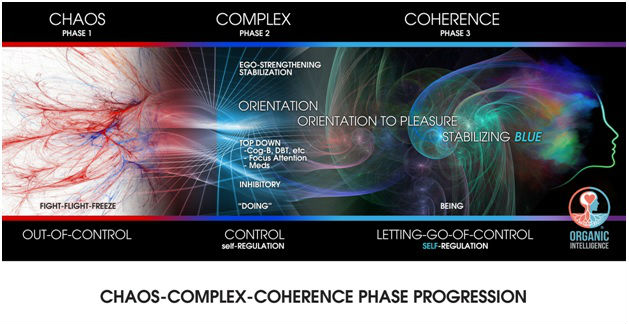
The main question, therefore, becomes attunement. For instance, an ego-strengthening comment, such as, “So you were able to set that boundary with your partner,†could be a helpful reflection when the system is in Phase II— it may support a more positive affective state appropriate to that Phase. In Phase I, such a reflection’s effect would be nullified in the system’s disorganization and tendency to associate things with negative affect or increased intensity. In Phase III, it would create a particular state extrinsically, when the system is intrinsically processing, and thus disrupt all-important intrinsic reorganization. As well as emotionally, interventions must thus be systemically attuned in order to be effective, and OI helps clinicians identify the recognizable signs of these phases in order to provide this deep, organismic attunement.
In particular, the above graphic suggests that ego-strengthening must go hand-in-hand with fundamental mindfulness: that of a basic orientation to reality. This certainly includes the capacity for affect regulation through various mental, physical, or psychological actions—like tools of helpful thinking, behaving, and attentional focus, such as is found with proven tools of cognitive behavioral therapy, dialectical behavior therapy, yoga, moderate exercise, medication, etc. However, the fundamental context for a person’s use of these proven tools is the fundamental awareness of oneself in the moment. On a practical level, OI promotes the particular aspect of mindfulness: attention to the environment through the senses—simply coming back to our senses!
In contemporary psychotherapy—with notable exceptions like those found here, positive psychology, and Ericksonian utilization approaches—the focus of attention most often lands in pathology or the preoccupation with “what’s wrong.â€
In contemporary psychotherapy—with notable exceptions like those found here, positive psychology, and Ericksonian utilization approaches—the focus of attention most often lands in pathology or the preoccupation with “what’s wrong.†Elsewhere, I discuss this as a biological reflection of trauma—when the amygdala creates a self-stimulating loop of emergency alert and priming for what’s wrong: “the what’s wrong attention.†Organic Intelligence says: Trauma means unintegrated resource. In other words, what’s wrong is the priming of the attention toward what’s wrong—and this is what’s wrong. However, our neurophysiological system is actually making self-organizing efforts to bring us back to balance all the time. These obvious efforts are mostly missed due to the compulsion to see what’s wrong. Self-soothing remains conceptual until—with the right knowledge and accompaniment—one can change the concept into the lived experience of good feeling in the felt sense. This is the aim of many traditions, including the initial conditions of OI treatment protocols.
[fat_widget_trauma_ptsd_right]
The relationship to projection is clear: given enough here-and-now orientation, one can allow the projection process to occur. If one can allow the projection process to take place, freed from the “it’s wrong†association, then one has the possibility to see the material whose aim is integration. In other words, projection places one’s experience “out thereâ€â€”at a safe distance, where it can actually help us recollect our relationship to it. Once there is sufficient ego-strength developed, and a sufficient degree of neutral awareness*—one can begin to experience aspects of oneself which are projected. Carl Jung knew this when he said, “Everything that irritates us about others can lead us to an understanding of ourselves.†However, it is of course not only that which irritates which reflects us back to ourselves; it can also be what inspires us, what is admirable, and what is numinous which we can reclaim via projection.
* The work of establishing this ego-strengthening, the stabilization of a relatively neutral, embodied awareness, is a task common to psychotherapy. We recognize that the more disoriented or fragmented the person in therapy, and the fewer the resources available, long-term support is increasingly necessary. Establishing these “initial conditions†may occur over months or years with those who are most disoriented.
Reference:
Vaillant, G.E. (1992). Ego mechanisms of defense: a guide for clinicians and researchers. Washington, DC: American Psychiatric Press.

Editor’s note: Ashley Davis Bush, LICSW is a psychotherapist in private practice with over twenty years experience. She is the author of six self-help books, including Simple Self-Care for Therapists: Restorative Practices to Weave Through Your Workday. Ashley’s continuing education presentation for GoodTherapy, titled “A New Approach to Self-Care: The Ethical Imperative of Daily Restoration“ is available as a homestudy course at no additional cost to Premium and Pro GoodTherapy Members (Basic Members and mental health professionals without membership can view this course for $14.95). This homestudy course is good for two CE credits. For details, or to register, please click here.
Sitting with a group of colleagues, having just finished our monthly consultation group, I blurted out the question, “How do you feel about self-care?†At the time, I was researching and writing a book about self-care for therapists, so this question was very much on my mind.
I fielded a range of responses from, “I know it’s important but I don’t have the time,†to “I’m in this field to take care of others, not myself!†Over the next few months, as I polled my colleagues, I heard these themes of conflict and time constraints repeated many times.
I began to realize and assert with increasing vigor that it’s time to change our approach to self-care. Not only do we have to address the practical roadblocks to self-care but also the ethical quandary that allows self-sacrifice to undermine good therapy.
Ethically speaking, it’s important to understand that taking care of yourself is taking care of your clients (and your family and friends.) I have been a lifelong singer, and I remember when a voice teacher told me, “You are the instrument. You have to take care of your body or otherwise you won’t have a voice to share.â€

Ashley Davis Bush, LICSW
Being a therapist is not unlike being a singer—you are the instrument of healing. Whether you employ CBT, DBT, EMDR, or EFT, it’s the therapeutic relationship itself, as we well know, that is the tool for healing. It’s your presence and your personal resonance that create the relational environment for healing. If we don’t take care of ourselves in mind, body, and spirit, we can’t take care of others.
Consider how we are compromised when we are overworked and burned out, depleted and compassionately fatigued, numbed and vicariously traumatized. If we don’t replenish and restore ourselves, if we don’t take self-care seriously, we’re not doing our best clinical work.
If we don’t take care of ourselves in mind, body, and spirit, we can’t take care of others. So given that self-care is not only vital but an ethical imperative, how do we realistically fit it into our busy, overworked schedules? It’s not like we can drop everything and book a monthly vacation or even a weekly massage. How can we practically engage in self-care and give it the priority it deserves in our lives and in our careers?
One answer is to microtize self-care. What does this mean? It means to engage in small habits in our daily lives that have a big impact on our well-being. Advances in neuroplasticity underscore this successful strategy: Small repetitive practices matter, both in creating new neural networks in our brains and in creating sustainable self-care.
Practically, it can be as simple as ‘shrinking down’ the macro–self-care activities and practices that you already love into their most powerful essences. For example, you might not be able to get to a yoga class today, but you can benefit from the stretch and relaxation of one power-pose between sessions. You might not be able to schedule a full body massage today, but you can realize the benefits of myofascial release by massaging your feet with a tennis ball before you go home.
[fat_widget_right]The idea is to create a personal toolbox of micro-habits—self-care activities that you can do in a few minutes or less which can then be woven through the workday. With this new approach, you can take care of yourself throughout the workday, before clients, between clients, and even in session.
Here are a few more ideas to get you started:
- You love to read but don’t have time to dive into a novel: Keep a book of poetry nearby that you can flip through between sessions.
- You love to take long walks in the woods but don’t have time for that right now: Do a march-in-place exercise and add 10 jumping jacks to get your blood flowing.
- You want to do long meditations but never seem to have the time: Set your timer for a one-minute. A brief moment of mindfully focusing on your breath is a powerful form of relaxation.
- You can’t wait to go on vacation, but don’t have anything scheduled for months: Spend a minute looking at photographs of places that you long to visit (look online or in a travel magazine).
- You’ve gotten triggered in a session and want to go outside for fresh air: Reengage your dual awareness with a deep belly breath and then lengthen your spine by imagining a string pulling your head upward.
Less really is more. Once you get into the habit of using micro–self-care practices throughout the day, every day, you’ll notice that you start to feel replenished on a regular basis. The process begins first with the realization that self-care is your ethical obligation, and second with the intention of making self-care a daily priority. With this approach, you honor the importance of self-care in your professional life and you make it happen.
 The power spiral is a guide to using role power wisely and well, and is of particular use to therapists. There are four aspects to the power spiral for use with ethical decision-making: gathering information, engaging compassion, resolving and repairing, and resourcing.
As a mental health professional, when you have any kind of ethical decision to make, consider the questions that guide you through the power spiral process. This process may also be helpful when you would like to harvest some learning by reflecting back on a decision or mistake you may have made.
Start by focusing your thoughts on the situation you want guidance on. Then imagine this situation in the center of a power spiral surrounded by the four aspects described next. Now imagine sitting in each of the directions of the spiral and consider questions such as the ones listed here. What insights emerge?
[fat_widget_right]
1. Gather Information: The Informed Use of Power
- What does your code of ethics say about this issue?
- What is the impact of the power differential?
- What other objective information is relevant?
2. Engage Compassion: The Conscious Use of Power
- How does this issue affect you personally?
- Is shame de-resourcing either you, the person you’re working with in therapy, or both?
- What kind of transference or countertransference may be operating?
3. Prevent or Repair Harm: The Caring Use of Power
Some ethical decisions are involved with how to be in service to the person you’re working with and prevent harm, while others are related to how to resolve difficulties and repair harm.
Questions for being of service and preventing harm:
- What are the response options?
- What will be the short- and long-term impact of each of these options?
- What additional factors might be important to consider? For example, you might take into account other family members, the life circumstances and abilities of the person in therapy, any risks to the person or therapist, or the spirit (versus the letter of the law, cultural norms, and spiritual beliefs).
Questions for resolving difficulties and repairing harm:
- Is there a difference between intention and impact?
- How do you feel toward the person you’re working with? Toward yourself?
- Because of your role, what are you responsible for?
- What is the best strategy for: (1) compassionately understanding the experience of the person in therapy and communicating this understanding along with genuine concern; (2) ascertaining what kind of repair is needed; and (3) following through in the most appropriate way?
4. Resource Yourself: The Skillful Use of Power
- How will you take care of yourself and use the resources and support available?
- How can you use this situation to self-correct and/or be more skillful in the future?
- When you have done all you can, how can you best let it go?
Example of the Power Spiral Process in Action
One of my students told me about an experience that usefully illustrates this process. Names and identifying information have been changed to protect confidentiality.
A colleague referred someone to Elena, who works for an agency. The written notes about this man, David, said he wanted to get disability payments. When Elena met with David, he said he didn’t want disability assistance. Hearing that and feeling some reticence from David, Elena began working with him on feeling less shame and personal failure at needing to apply for public assistance.
This process went nowhere. David stopped coming to appointments and even filed a complaint with Elena’s boss. He said he had quit his appointments because she wasn’t giving him any help with his communication skills and managing his anger. Elena was quite surprised to hear this.
Using the power spiral process, Elena got some insights:
- That the power differential might have been interfering with David’s ability to tell Elena the truth—that he wasn’t getting what he needed. Based on her notes, she had not actually asked David what he wanted help with, assuming his reticence was his discomfort with needing assistance.
- That she was likely projecting her sense of shame about needing public assistance onto David, and that she wasn’t checking in with her gut sense of what was going on.
- That she needed to take responsibility for being insensitive to David’s real needs and relying too much on the referral notes. She decided her best choice was to make an authentic apology to David and invite him back to work with her on anger and communication skills. Elena also understood that she needed to do some follow-up work with her boss to let him know how the complaint had been successfully handled.
- Elena took the action she decided on. David came back to work with Elena on communication and anger, and was satisfied with their work. Elena learned to focus on the relationship rather than the referral notes. She was glad she had taken responsibility for her mistake and reached out to David to resolve and repair the situation.
This is a fairly simple example of how to use this process and the many insights and guidance the focused questions can provide, and demonstrates how the process can be used in supervision or with a group of peers. It is also a humbling example of how quickly and innocently we can get off course. Further, it underscores how easy it is to be rule-bound (in this case, referral notes-bound) when we most need to be attuning to ourselves and being in right relationship with the people we serve—ethics from the inside out. Finally, it is an example of how simple and straightforward it can be to work out a problematic issue.
 In my practice, I see many mothers who have lost their only children during pregnancy or early infancy. They show up at my office struggling with grief and feelings of isolation. Some also grapple with infertility and the prospect of never being a mother to a living child.
Many of these mothers have been to multiple therapists or support groups, yet their search for adequate support continues. They report feeling like outsiders in support groups where other women talk about their living children or who are pregnant again after experiencing a loss. They talk about struggling to find a therapist who understands the unique experience of being a mother without living children.
Again and again, these mothers share feelings of invisibility and isolation and the intense grief of having empty arms with no children to fill them. More than anything, they want someone to acknowledge the pain of their loss.
Having an awareness of the unique experience of being a mother without living children is vital in supporting these women. Here are some things therapists should consider when supporting a mother without living children.
[fat_widget_grief_right]
There Is No Guarantee of a ‘Rainbow Baby’
It’s common in the world of pregnancy loss to hear talk about “rainbow babies†(babies born after loss). Often there’s an assumption that moms who have experienced loss will go on to have such babies. Many support groups include discussion of mothers desperately trying to get pregnant again.
I call the idea that another baby will fix a woman’s grief the “myth of the rainbow fix.†Even if a mother goes on to have a living child, it won’t replace the baby she lost or miraculously cure her grief.
More importantly, not all moms who have experienced loss have the option to have another child. Many moms are dealing with the knowledge that they physically or emotionally can’t have another baby. Others tried for years and are struggling with infertility. For many, the baby they lost was a “miracle baby†after years of apparent infertility and trying. Some have accepted that they may never have another pregnancy and have been on adoption waiting lists for years.
Not every mother who loses her child to stillbirth or miscarriage will have another child. Making the assumption that they can or will may be detrimental to the emotional health of these mothers.
Many Need Reassurance That They Are Indeed Mothers
Many mothers who have lost their only baby struggle with whether they are “allowed†to claim the title of mother. Their idea of what it means to be a mother has been suddenly and unexpectedly altered. Being able to claim the identity of mother even though their baby did not survive can be a valuable piece of the healing process.
It’s important to work with these women to redefine what “mother†and “mothering†means to them now that their baby is no longer physically here. In what tangible and intangible ways can they continue to mother their child?
Early Loss Does Not Mean a Lesser Loss
Far too often when a mother loses a baby early in pregnancy or has an ectopic pregnancy, her loss experience is minimized. Many women whose babies died in their first trimesters often feel that their grief is dismissed or invalidated through statements like, “It was so early,†“You didn’t really know it yet,†or, “You just found out you were pregnant, so try not to get too down.â€
However, for many women the love and attachment come the moment they know they are pregnant. For others, the attachment and love were formed long before the pregnancy occurred, through years of trying to get pregnant, fertility treatments, or planning to become a mother.
Depth of love has no basis in time.
Questions about Children May Be Difficult to Answer
Many intake assessments and initial sessions for any kind of medical or mental health provider include the question, “Do you have any children?†or “How many children do you have?â€Â For those who haven’t lost a child, this probably seems like a simple and straightforward question. For those who have lost one or more children, it’s often not so simple. Internal debate immediately comes up:
Do I say yes and explain?
Do I say yes, but then what if they ask how old he/she is?
Do I have the energy to go through the story all over again?
Maybe I should just say no, but I always feel so guilty when I do that.
What is his/her reaction going to be if I say I have a child but he/she is dead?
I want to acknowledge my child, but I don’t want to deal with discomfort and that awkward silence.
Gah, I hate this question!
For therapists, I don’t know that there is a good solution for the pain and uncertainty questions like this bring up. However, asking about living children and deceased children separately may make the situation more comfortable for mothers and help them feel more accepted.
Nothing therapists can say or do will completely take away the grief and pain a woman feels after the death of a baby. We can’t fix the ache of not having a living child to hold, raise, and love. As professionals and compassionate human beings, however, we can be more aware and sensitive to the unique experience of being a mother without a living child. Support without judgment or assumptions can go a long way toward healing, not just for these mothers but for anyone in pain.
 By the mid-20th century, family therapy pioneers were overturning conventions. Chief among them stirred Carl Whitaker—country boy-turned-OB/GYN-turned-psychotherapeutic provocateur who Rich Simon, editor of Psychotherapy Networker, once called “fearless and idiosyncratic.â€
In the vein of existentialist philosophers, Whitaker largely regarded his treatment paradigm as protest against the reduction of human existence to mere behaviors, cognitions, or even theories.
There were at least 10 integral elements of Whitaker’s richly evocative therapeutic ethic. These are explored below.
Psychopathology as Distraction
Whitaker saw “symptoms as mere signals of, or even noisome distractions from, the real existential problems faced by families—birth, growing up, separation, marriage, illness, and death†(Luepnitz, 2002).
Whitaker contended: “Psychopathology is proof of psychological health. The individual who is distorted in his thinking is essentially carrying on an open war in himself rather than capitulating to the social slavery. His delusion system and his hallucinations are a direct result of this war with his lifetime situation—the stresses of his living and his efforts to defeat those stresses rather than become a non-person and a social robot†(Whitaker and Ryan, 1989).
[fat_widget_right]
Responsibility of People in Therapy
Whitaker’s emphasis on personal freedom and responsibility derived from philosophers, such as Martin Heidegger and Edmund Husserl, who considered the psychological implications of existentialist thought. Ludwig Binswanger (1967) assimilated these ideas into psychotherapeutic formulation, emphasizing “freedom and the necessity to discover the essence of one’s individuality in the immediacy of experience.â€
Throughout Whitaker’s writings and therapeutic example, he conveyed existentialist presuppositions: anxiety and suffering can be growth inducing; people have power to choose to be responsible; elements of the human condition which exist in clients’ relationships with each other exist between clients and therapists.
Rousing awareness of change processes, Whitaker coaxed people toward ownership. He declared, “The integrity of the family must be respected. They must write their own destiny†(Neill and Kniskern, 1982).
Value of Courage
Whitaker regarded existential anxiety as an “irresolvable dialectic,†contending: “The effort to solve living as a problem is impossible. … The process of facing the dialectic life … is endless, irresolvable, and poorly understood. … Security alone equals slavery. Exploration alone equals danger and death. The flux is always exciting but never an answer, only a courage-inducing impetus to more of the individual’s right to decide on the next move and to discover more and dare more†(Whitaker and Ryan, 1989).
Transformative Nature of Vulnerable Encounter
By daring to be vulnerable with people in therapy, Whitaker exposed families to an existential encounter. When the family comes “face to face with part of your insides, they have to decide what to do. … They’re free to produce their own extrapolations, depending on how it reverberates inside of them†(Whitaker and Bumberry, 1988).
The concept of the “I-thou†relationship stems from the writings of Buber (1937), who philosophized that the nature of our interactions with others are often more “I-it†than “I-thou.â€
One of Whitaker’s common therapeutic goals was for family members to begin to experience themselves more openly and nondefensively with one another; that an existential shift occur on a systemic level.
Primacy of Affective Experiencing
During one session, Napier and Whitaker (1978) hypothesized, “They [are] most afraid of what many couples find the threatening aspect of their marriages: deadness.â€
Keith and Whitaker (1982) wrote, “We presume it is experience, not education that changes families.â€
Whitaker often redirected attentions from the content of conflict to the emotional process: “I would guess that almost anything you focused on together would bring out this disagreement. … It feels more like a fear of conflict that’s the problem, rather than some particular issue you are fighting over†(Napier and Whitaker, 1978).
Power of Artful Communication
Whitaker developed the notion of symbolic communication as interactional metaphor based largely on George Herbert Mead’s concept of symbolic interactionism. Whitaker stressed the importance creating and shaping meaning between people and, consequently, facilitating shifts within the family emotional system.
Whitaker saw his role as engaging a family by raising the intensity within its relationships and communicating symbolic meaning through experiential interaction in such a way as to catalyze the family toward intimacy.
Spontaneous Evocation as Healthy
Whitaker advocated a spontaneous and evocative presence with people in therapy as a means of engaging them at the hidden symbolic dimensions of awareness. Perhaps his most well-known display of spontaneity in therapy was when he wrestled with a teenage boy who had knocked Carl’s glasses off in a moment of rage: “As Don had struck out in panic and anger at Carl, Carl had tackled him, and the two of them went down onto the Oriental carpet, a tangle of limbs†(Napier and Whitaker, 1978).
This unplanned and, arguably, unprofessional encounter was certainly one of Whitaker’s more radical therapeutic moments. Yet it was also indicative of Whitaker’s view of therapy.
Whitaker went as far as to advocate “crazinessâ€â€”nonrational, right-brain experiencing—as a measure of health in both therapist and family (Whitaker and Keith, 1981). Whitaker explained, “My craziness [has given] other people the freedom to be more spontaneous, to be more intuitive, to be crazy in their own ways.â€
Necessity of Present-Centeredness
Whitaker was careful to observe and allow himself to react quickly and intuitively to interactions between family members, both to prevent unhelpful more-of-the-same dynamics and to highlight potential signals of underlying emotional patterns, often the very mire in which the family is stuck.
Whitaker saw the problems that families brought to therapy as failures to adapt together to common problems of life and the here-and-now as the necessary moment for creative intervention and change. He urged, “Life isn’t mind over matter, it’s present over past and present over future†(Keith and Whitaker, 1982).
Developmental Growth as Necessarily Relational
Every person must counterbalance needs for individual autonomy with needs for relational connection. Whitaker believed that therapy must stimulate the growth of the person alongside the growth of the system.
Whitaker worked to facilitate family cohesion, ensure family members were meeting each other’s needs in the process of their own individuation, and were developing increasing proclivities for spontaneity, creativity, and attunement within the family unit. For Whitaker, the individual cannot grow in a relational vacuum.
Need for Holistic Versus Reductionist Goals
Whitaker saw the trajectory of therapy moving toward, for example, a heightened sense of competence, well-being, the development of compassion, self-esteem, role flexibility, awareness, self-responsibility, greater sensitivity, learning to recognize and express emotions, achieving intimacy with a partner, and so on.
Carl Whitaker died in 1995, and this April will be the 20th anniversary of his death.
References:
- Binswanger, L. (1967). Being-in-the-world: Selected papers of Ludwig Binswanger.Needleman, J., translator. New York: Harper & Row.
- Buber, M. (1937). I and Thou (2nd), translated by Ronald Gregor Smith. Edinburgh: T. and T. Clark.
- Keith, D. V., and Whitaker, C. A. (1982). Experiential-symbolic family therapy. In A. M. Horne and M. M. Ohlsen (Eds.), Family counseling and therapy. Itasca, IL: Peacock.
- Luepnitz, D. A. (2002). The family interpreted: Psychoanalysis, feminism, and family therapy. United States: Basic Books.
- Napier, A. Y., and Whitaker, C. A. (1978). The family crucible. New York: Harper & Row.
- Neill, J. R., and Kniskern, D. P. (Eds.). (1982). From psyche to system: The evolving therapy of Carl Whitaker. New York: The Guilford Press.
- Whitaker, C. A., and Bumberry, W. M. (1988). Dancing with the family: A symbolic-experiential approach. Levittown: Brunner/Mazel.
- Whitaker, C. A., and Keith, D. V. (1981). Symbolic-experiential family therapy. In A. S. Gurman and D. P. Kniskern (Eds.), Handbook of family therapy. New York: Brunner/Mazel.
- Whitaker, C. A., and Ryan, M. O. (1989). Midnight musings of a family therapist. New York: Norton.
 Editor’s note: DeAnza Spaulding, MA, LMHCA is a trauma therapist who takes a holistic, client-centered approach to therapy. Her continuing education presentation for GoodTherapy.org, titled Ethics in Spirituality in Therapy, is scheduled for 9 a.m. PDT on November 14, 2014. This event is available at no additional cost to GoodTherapy.org members and is good for two CE credits. For details, or to register, please click here.
Right from the start, psychology taught us to be suspect of processes involving spirituality, and this led us to divide spirituality from psychological treatment. In fact, Freud once coined religion and spirituality as “obsessional neurosis.†In his 1927 book Future of an Illusion, Freud stated, “Religious views are illusions, fulfillments of the oldest, strongest, and most urgent wishes of mankind.â€
As therapeutic professionals, we’ve been trained to think that spirituality has no place within the tradition of psychotherapy and that there is no intersection between these two arenas. For decades we’ve been telling people that when addressing concerns about their psychological health, such as depression or anxiety, they should seek guidance from psychotherapists and counselors, and for questions regarding their spiritual health and faith, they should consult their priests, pastors, clergy, and imams.
This dichotomy fails to address how psychological well-being impacts spiritual health and spirituality, psychological health. People have been led to believe that spirituality is an inappropriate means to address their psychological health, so they are less likely to bring their spiritual selves to the counseling setting. Perhaps they internalized the message: leave the spirituality to your spiritual leaders and the psychological care to your therapists.Â

Today’s clients, however, more frequently inquire where their spiritual identities might fit in therapy. In part this has to do with how clients see themselves—many acknowledge that their spirituality is a core component of their identities. In a 2012 Pew Research Center survey, for example, 85% of Americans stated that their spirituality is an essential part of their identities.
The diverse needs and expressions of clients require therapists to reexamine the divide. Our clients are changing and assessing their personal needs, and some may be saying, “My spiritual identity is a vital part of who I am—is there any way to incorporate that in therapy?†The “leave your spirituality at the door†perspective is no longer sufficient in assessment and treatment, yet many of us find ourselves ill equipped to address the client’s spiritual needs.
Therapists fielding questions about spirituality and therapy may find themselves asking, “How do we bridge this great divide?†This question stems from concerns about how to utilize spirituality in helpful and meaningful ways in therapy. Some therapists may question their qualifications to merge these areas, as spirituality is a broad spectrum. It isn’t uncommon to think that in order to effectively utilize spirituality, one must be experienced in the various expressions. It is certainly a daunting prospect to consider learning every religion and tradition. What’s more, some therapists link spirituality to religiosity when those are two different aspects. [fat_widget_right]
Spirituality refers to transcendence—a state where one is connected to something beyond self and imminence. The word spirit is derived from the Latin word spiritus, which means breath. Spirituality is commonly referred to as a fundamental component of a human’s sense of being and purpose—the breath that is the essence of life. Spirituality is often viewed as a connection beyond self, to nature, for example, or a Deity or higher power, as well as the ability to access that connection within self. Thus, spirituality is not about belief systems, dogma, or doctrine. This broader understanding and language allows the practitioner to explore each client’s personal meaning to spirituality.
For thousands of years people have relied on spiritual coping strategies. Spirituality aids individuals in dealing with grief, loss, transition, and change. A pilot study was conducted in 2010 on the efficacy of a multi-faith spirituality-based intervention (SBI) for generalized anxiety disorder (GAD) and found that SBI significantly reduced the baseline psychic and somatic symptoms of GAD. Similarly, a 2007 meta-analysis on the efficacy of spiritually oriented psychotherapy revealed the positive health outcomes for depression, anxiety, stress, and disordered eating. And research shows that cognitive behavioral therapy (CBT) techniques that incorporate spirituality enhance psychological outcomes for individuals in alcohol treatment (Hodge, 2011).
Therapy is a healing practice that opens pathways to hope, inspiration, and relief, and a holistic approach is a bridge to incorporating the whole person in therapy. Holistic therapies take into consideration the body-mind-spirit of the individual and honor all aspects of an individual’s identity. This approach does not require therapists have experiential knowledge in all spiritual practices. Holistic therapy allows the therapist to build on language and meaning that is derived from an individual’s experience.
References:
- Crook-Lynn, R.E., O’Grady, K.A., Smith, T.B., Jensen, D.R., Golightly, T. and Potkar, K.A. (2012). Addressing religious and spiritual diversity in graduate training and multicultural education for professional psychologists. Psychology of Religion and Spirituality, 4(3), 169-181.
- Hodge, D. R. (2011). Alcohol treatment and cognitive-behavioral therapy: Enhancing effectiveness by incorporating spirituality and religion. Social Work, 56(1), 21-31.
- Koszycki, D., Raab, K., Aldosary, F., & Bradwejn, J. (2010). A multifaith spiritually based intervention for generalized anxiety disorder: A pilot randomized trial. Journal of Clinical Psychology, 66(4), 430-441.
- Pew Research Center. (2012). Religion and the unaffiliated. Retrieved from http://www.pewforum.org/2012/10/09/nones-on-the-rise-religion/
 Editor’s note: Susan Heitler, PhD is a clinical psychologist specializing in healthy conflict resolution and the author of The Power of Two, a workbook for couples. Her continuing education presentation for GoodTherapy.org, titled Narcissistic Habits: Couples Therapy Treatment Techniques, is scheduled for 9 a.m. Pacific Time on September 19, 2014. The event is available at no additional cost to GoodTherapy.org members and is good for two CE credits. For details, or to register, please click here.
Codependency as a personality diagnosis is a label with significant limitations. Having emerged initially from the world of alcohol and drug treatment, codependence neatly describes the husband who makes excuses to his wife’s friends to cover for his wife’s evening drinking binges. In that context, the husband is acting as a codependent in the sense of fostering his wife’s alcohol dependency. For use beyond the arena of alcohol and drug dependency treatment, however, the term needs an upgrade.
For instance, Jack who is married to a quick-to-anger woman with narcissism, strengthens his wife Julie’s narcissism when he self-smothers his inner voices lest he say something that might arouse Julie’s ire. Similarly, a corporate assistant, Brenda, fosters her boss Peter’s self-defeating workaholic tendencies when she consents to work late hours to help him tackle too many tasks. While Julie’s narcissism and Peter’s work excesses both create problems, the narcissism and workaholic patterns are not “dependencies†in the sense of a drug dependence. So describing Jack or Brenda’s enabling behaviors as codependent stretches the term excessively.
The term enabler—commonly used as a synonym for codependent—may be a more fitting alternative. Jack functions as an enabler when he smothers his own preferences, fostering his wife Julie’s narcissism. Brenda functions as an enabler when she too often works late to help her boss Peter complete the excessive number of work projects he has taken on.
The True Nature of Codependency
Although codependence may be better labeled as enabling, the phenomenon merits further clarification. To this end, I have coined four additional terms that clarify the internal experience of “codependent†enabling: excessive altruism, appendagitis, wishful thinking, and misplaced locus of focus.
While I speak these terms with my tongue somewhat in my cheek, diagnostic language is clinically useful to the extent that it guides therapeutic interventions. These terms, for me, pass that test.

What’s more, the new terminology brings an added bonus to treatment. Clients almost always chuckle when I tell them with exaggerated seriousness, “I’m afraid that you have a quite serious case of wishful thinking†(or either of the other three terms). Humor relaxes them so they are more open to accepting feedback on these self-defeating phenomena.
What Is Excessive Altruism?
Giving feels good. By contrast an excessive inclination to help others through giving—that is, giving more time, money, energy, or affection than feels do-able—incurs a sense of burden.
In healthy partnerships altruism is a two-way street. Hopefully each partner gives and receives ample affection and appreciation, the ultimate contributions of value in relationships. The contributions needn’t be identical: One partner may cook, the other may wash dishes and take out garbage, so long as the contributions are subjectively felt to be of similar value.
When the overall traffic of giving and receiving feels approximately equal from both sides, goodwill prevails. Excessive altruism and/or selfishness, by contrast, unbalance the giving and getting, inviting resentment.
What Is Appendagitis?
Appendagitis characterizes an attachment in which one person serves as another person’s additional appendage. This psychological diagnosis is not to be confused with Epiploic appendagitis, a self-limiting inflammatory process of the epiploic appendices which are small, fat-filled projections along the surface of the colon and rectum.
Psychological appendagitis occurs when individuals shed their own preferences, life goals, and voice, and instead devote all their energies to another, such as a spouse, boss, or friend with needy or narcissistic tendencies. This shift usually is motivated out of a mixture of love and fear that without this shift they may incur the other’s anger and/or lose the relationship.
What Is Wishful Thinking?
Wishful thinking is the cognitive habit of believing that others will change when there is no realistic basis for this hope.
Brenda wishes her boss would become more appreciative of her efforts. She devotes ever-increasing efforts to please him in misplaced hope that someday he will change into a person who expresses gratitude and praise.
[fat_widget_right]Jack likewise wishes that his wife Julie would become less self-centered, entitled to special treatment, and quick to anger, but when Jack tries to discuss these concerns with her, Julie immediately erupts in anger, turning on him with blame that the problems are in fact his fault. Julie’s blaming responses indicate that the likelihood of her making changes is very low.
What Is Misplaced Locus of Focus?
A locus is defined as a place—a center of activity—where something occurs. Misplaced locus of focus means that someone’s attention is riveted to reading another’s thoughts, feelings, and facial expressions, periferalizing their awareness of their own thoughts and feelings, and assuming or guessing what the other person is thinking instead of asking.
Brenda, for example, stayed late at work three nights in a row. When her boss, Peter, was surprised to find her still in the office, she explained, “I thought it would make you less stressed, more relaxed, if I could get this report out before the weekend. I’m here working late because I thought it would make you happy.â€
“Actually,†Peter responded, “I want to wait a month before sending the report out. I have more information coming in over the next few weeks that I’ll want to include in it.â€
Brenda was disappointed to discover that she not only failed to anticipate Peter’s needs, but also neglected the needs of herself and her friends with whom she had cancelled plans in order to fulfill her boss’s needs.   Â
When Is Helping Others a Good Thing? When Is It Excessive?
Codependent-like behaviors have their healthy variants. Infants and young children for instance depend upon the consistent attentions of parents to stay alive. Parents’ responsivity, attunement, and nurturance contribute positively to the survival and thriving of young children.
At the same time, even parents can go overboard on attending to their young, allowing attunement and nurturing to slip inadvertently into appendagitis. Jack, the devoted husband and dad of four young children, often gets overwhelmed at breakfast time when he asks his wife and each of their children, “What would each of you like for breakfast today?†Bacon for this one, scrambled eggs for that, a fried egg for another, sunny side up with pancakes for the fourth, and French toast for the next. What’s wrong with this picture?
In other large families, parents put cereal and bowls on an accessible shelf where even the younger children can reach the boxes and pour their own, adding fruit, nuts, and milk. Maybe Mom or Dad cooks toast and eggs, and sometimes even pancakes, but only one kind of food is on the menu for everyone.
By catering to each individual’s daily preference, Jack’s excessive altruism is training his children in unrealistic expectations. He is fostering dependence and narcissism instead of training his children to become increasingly independent, to adapt to living as part of a group, and to be considerate of their dad’s time and energies.
Behaviors like altruism become problematic when people dedicate their energies to another person (1) to their own detriment, (2) to the detriment of the receiver and (3) when the other does not want the help.
For instance, Brenda suffers unhealthy appendagitis to the extent to which she allows her contribution of extra work hours to be exploited. Does she get paid? Does she really want to devote these additional hours to work? Also, while she believes she is helping her boss Peter, Brenda may actually be harming him by encouraging his tendencies to take on more and more until he is ready to collapse from stress and fatigue.
What Causes Excessive Altruism, Appendagitis, Wishful Thinking, and Misplaced Locus of Focus?
The all-about you attachment stance of people with the four enabling tendencies described above inadvertently attracts individuals with narcissism who love being the focus of someone’s attention and adulation. A hallmark of narcissism attachment patterns is an all-about-me stance that allows the coupling of enabling and narcissistic habits to seem, initially at least, to dovetail beautifully.
In enabler-narcissist partnerships, all-about-you habits may then be sustained because they seem to attenuate the narcissistic partner’s quickness to criticism, controlling behaviors, and anger. For someone trying to live in relative harmony with a narcissistic partner, these seemingly self-defeating habits may in fact help.
Family of origin can also play a role in creating a template for enabler interactions. Most often, individuals who develop excessive altruism, appendagitis, wishful thinking, and misplaced locus of focus are repeating patterns they observed in their parents’ marriage relationship. A child learns to speak French by hearing French spoken at home. We learn interaction and survival habits the same way, by hearing and observing our parents.
Children also may become highly skilled at enabling habits in order to cope with a narcissistic parent. Parents with narcissism insist that their children ignore their own preferences and become instead what the parent wants them to do and be. The development of enabling habits, like appendagitis, offers children of narcissists less animosity and more positive attention than if they were to interact with the parent in a more emotionally healthy manner. Children learn to do whatever contortions they must to retain the necessary positive attentions of their caretakers. Survival of the bond with the attachment figure is a first priority.
Treatment Implications for Each of These Terms
Excessive altruism, appendagitis, wishful thinking, and misplaced locus of focus each exacerbate the other, creating a vicious downward cycle of circular causation with ever-increasing anger, depression, and relationship dissatisfaction. What can reverse this cycle so that the spin switches upward toward ever-more positive feelings?
Excessive altruism leads to feeling over-burdened and resentful toward those on the receiving end of the giving. Folks with excessive altruism therefore need to learn to balance their giving to others with self-care.
Similarly, people with appendagitis need to refocus their attention on themselves. They need to turn up the volume on their own thoughts and preferences so they can hear their inner drummer. They then need to learn to speak up tactfully and still effectively about what they feel and want. Lastly, they need to learn win-win ways of making decisions so that the partner with narcissisism is less likely to feel disempowered, wrong, or like a loser.
Wishful thinking creates a faulty personal guidance system. Therapy that clarifies the realities regarding the other person’s repeated motivations and behavior patterns enables the development of better life decisions. The narcissistic partner may someday change, but often only after the wishful thinking partner first has begun making decisions based on reality.
Misplaced locus of focus can be reversed with practice drills on utilization of new sentence starters. For example, each time clients use the sentence-starters such as “I feel … ,” “My concern is … ,” and “I would like to … ,” their locus of focus must switch to their own inner feelings and thoughts in order to complete the sentence.
A change of habits seldom comes with a “Get Out of Jail Free†card. As Jack ceases to foster Julie’s narcissism, it therefore is vitally important that Julie be included in the treatment process, preferably in a couples therapy treatment format, so that the two spouses can change and grow simultaneously. If so, Julie and Jack are likely to end up feeling increasingly loving toward each other and happier within themselves. If not, they are likely to end up divorced.
As to Brenda, if she embarks on therapeutic change Brenda may lose interest in continuing to work for Peter. On the other hand, Brenda’s growth could free Peter as well, so that he may enjoy a fuller life less clogged by work.
Words have power. Naming a phenomenon helps to clarify what a phenomenon is and does, and how to attenuate its negative impacts. Each of the playful terms introduced in this article can help therapists to guide their codependent/enabler clients to awareness and correction of the technical mistakes they have been making, leading them toward the more positive emotions and fulfilling relationships that they have come to therapy to discover.
 Editor’s note: Cory F. Newman, PhD, ABPP, is a psychology professor at the University of Pennsylvania and the author or co-author of several books. His continuing education presentation for GoodTherapy.org, titled Core Competencies in Cognitive Behavioral Therapy: Becoming an Effective and Competent Cognitive Behavioral Therapist, is scheduled for 9 a.m. PDT on May 16. This event, free to GoodTherapy.org members, is good for two CE credits. For details, or to register, please click here.
Much has been written about the methods that comprise cognitive behavioral therapy (CBT). There is an abundance of research supporting CBT’s efficacy in treating a range of psychological maladies across a variety of groups (age, gender, ethnicity, etc.). As such, CBT is more accurately described as an entire set of psychotherapies, with key features in common but also demonstrating differences depending on the problem and person being treated, that have been designed and tested to meet the highest standards of care.
Over the past few decades, great strides have been made in developing CBT so that it helps people even when they demonstrate psychological difficulties on the more serious side of the spectrum, such as chronic mood issues, suicidality, debilitating anxiety, addictions, posttraumatic stress, eating disorders, and many other areas of mental health concern. Furthermore, the field is always improving, owing to the CBT tradition of refining and researching new ways of delivering care. Although CBT is not a magic “cure,†it is a powerful psychological technology that is helping more and more people, providing ever-increasing hope for even better outcomes in the future.
[fat_widget_right]
It is easy to think of CBT as comprising a set of “techniques,†mainly because there is indeed a set of core methods that are most often associated with this modality that have been identified as being key components in helping people to cope and live more effectively. The list below is just a sample of such techniques, all of which have been described in great detail in CBT texts and CBT treatment research protocols:
- Rational responding or cognitive restructuring (e.g., via Socratic questioning)
- Behavioral activation and planning (including ratings of “mastery†and “pleasureâ€)
- Behavioral “experimentsâ€
- Problem solving
- Self-monitoring (moods, behaviors, cognitions, physiological responses)
- Graded tasks
- Graded exposures to feared experiences and prolonged exposure to trauma memories
- Relaxation responses (including breathing control)
- Mindfulness
- Imagery (guided, reconstructive, and prospective)
- Communication skills training
- Social skills training
These are just some of the CBT methods that can be used effectively, not only in the therapist’s office but also as part of homework assignments—another powerful part of treatment that improves people’s sense of self-efficacy, consolidating their memories for the interventions and their skills in performing them, and leading to good maintenance of therapeutic gains.
Additionally, the CBT literature is clear that the therapeutic relationship is an indispensible part of a positive, efficacious intervention, as is a well-conceived cognitive behavioral case formulation. This is where CBT begins to go beyond techniques and into the realm of the therapist’s personal qualities, thinking style, interpersonal manner, and skills in listening, understanding, and communicating. CBT is not delivered by machines, and it does not come in prepackaged “doses†that are passively “taken.†It is delivered by fellow humans called “therapists,†a rather diverse lot of individuals with varying years of clinical experience and training histories, as well as individual personality characteristics that naturally play a role in their competency and expertise in conducting CBT. What are the qualities of therapists who are most likely to be highly competent? What should people look for in a therapist so as to be confident that the CBT they are receiving is top-notch care?
Most people think of competency and expertise as being related to training and experience, and there is more than a kernel of truth to this assumption. When a therapist is licensed, board certified in cognitive behavioral therapy (e.g., via the American Board of Professional Psychology and/or the Academy of Cognitive Therapy), has a substantial history of treating people and supervising trainees, and has a track record of publishing and lecturing on CBT, there is a good chance that this therapist will be knowledgeable and effective in the clinical sphere. However, there is evidence that even novice practitioners can deliver CBT very competently if they are well-supervised. Therefore, there is more to competency than repetition of methods and recognition of patterns over time.
What are some of the habits, attitudes, and personal qualities of therapists that amplify their competency and help get the best clinical results, whether they practice CBT or any other evidence-based treatment? The following may seem obvious, but they warrant more discussion and attention than they typically get. If the information below simply validates and reinforces what you already do as a therapist, I will have accomplished my goal with this post. Here is a sample list of suggestions, with some accompanying commentary:
Show respect for a person’s time: Make a concerted effort to be on time for sessions, to stay focused on the person in the session (e.g., rarely attending to your incoming calls, messages, or other distractions), to give them their full allotment of session time, and to try to see them as soon as your schedule will allow. Return their phone calls as promptly as you can, and be understanding when their legitimate life demands make it difficult for them to attend sessions and/or to do their therapy homework as regularly as would be optimal.
Do your homework and be organized: Be a good role model for taking care of business, being prepared, and being up to date on a person’s situation. This includes taking good therapy session notes, reviewing those notes so you are aware of and conversant in the matters that are on the person’s agenda, following through with extra-session tasks such as consulting with the person’s other practitioners and releasing records when requested, and being willing to review the person’s homework assignments as part of your own homework. Anything you can do to facilitate your memory of the details of the person’s current life and history (including the names of family members, important events in their lives, and noteworthy things they said in previous sessions) is very powerful in conveying the message, “I value you as an individual and I am providing a treatment that is focused on you, not just your diagnosis.â€
Be professional, ethical, and respect cross-cultural issues: This covers a broad area, including speaking to people in a caring, supportive, confident tone, maintaining professional boundaries while still being friendly, attentive, and personable, going over the details of informed consent, explaining both your role and the person’s role in treatment, handling uncomfortable requests in a calm way that is not sanctimonious, speaking in a way that shows self-respect and respect for the other person, and being sensitive and responsive to his or her cultural identity and related issues.
Don’t just provide instructions; provide hope and inspiration: In thinking back to our school days, most of us can remember at least one teacher who was particularly adept at inspiring us to learn and to get the best out of ourselves as students. Be like that teacher when you treat people. Many people feel lethargic, distracted, helpless, and hopeless. It is not enough for us simply to provide instructions in a neutral tone. We need to “lean in†and speak in a way that gets their attention, promotes hope, and that expresses confidence in them. Express a commitment to help the person even when he or she has difficulty making a commitment to treatment. Give positive feedback even when people can’t believe it themselves. Be a role model for persevering in the face of obstacles and adversity, and for not giving up. Share some appropriate humor at the right time to make people smile and laugh, and to add some positive energy to the therapeutic dialogue.
Be open and eager to learning: One of the most rewarding aspects of being a therapist is meeting so many people who have so much to teach us. We can provide people with an education about using CBT effectively in their lives, but they provide us with lessons about life itself. Don’t just be aware of and open to the idea that people are often our teachers, embrace the idea. It is very empowering for people when their therapists thank them for sharing their knowledge and wisdom, and it enriches the therapist—both in his or her personal life, but also in terms of being that much more aware and sensitive toward a diversity of people in the future. It also demonstrates a respectful humility that amplifies the validity and meaningfulness of what therapists communicate when they do show confidence and authority in teaching CBT methods to people.
Find the “picture that is worth a thousand wordsâ€: A little bit of creativity can go a long way in therapy, especially if it makes a positive impression on people and helps them remember important concepts for the long term. Using metaphors, analogies, images, hypothetical questions, and stories with which people can personally relate are powerful learning vehicles. When therapists make it a point to pay attention to the things that matter to people most (and that define them as individuals), such as their hobbies, their profession, their cultural practices and beliefs, their most important relationships and memories, and their views about life and the world, the therapists are in a position to give feedback that deeply resonates. Brief examples include:
- The person is a judge who is chronically depressed and who states that she cannot use rational responding as a homework technique because she does not believe anything hopeful. The therapist encourages this judge to craft well-written rational responses as “dissenting opinions†in response to the “majority decisions.†Within this legal format, the person then becomes very interested in utilizing rational responding effectively to expand her thinking.
- The person is a middle-aged man who is under-employed, estranged from his family, fighting addictions, and who believes that he has ruined his life and that “there is no point going on.†He also loves football. Therefore the therapist notes that teams always come out for the second half of the game, no matter how badly the first half went. They discuss how this person can come out for the “second half†of his life and play like he is capable of playing, giving the fans something to cheer about, playing for pride, and at least trying to “win the second half.†From that point forward, the person reminds himself that “I have to play a better second half†whenever he feels discouraged about his past.
- A person who is a musician has a problematic habit with overwhelming others with her emotions and need for attention. When others do not respond favorably, she feels rejected and crushed, and then tries even harder to get the attention of others in dramatic ways, which only serves to make things worse. She winds up believing that nobody loves her, and that she is horribly flawed. The therapist then discusses the person’s favorite music, asks her to imagine it, and then asks her what would happen if the volume were increased to 200 decibels. The person says that she would need to cover her ears and leave the room immediately, whereupon the therapist asks, “Does that mean that the music was flawed and should be rejected?†The person responds, “No, the music is beautiful, but we have to lower the volume, for crying out loud,†and she laughs. The therapist then offers that the person is like that music. Others could potentially love and appreciate her for who she is, but she has to lower the volume. This one analogy served to motivate this woman to monitor herself and “dial back the intensity†more than any other intervention.
In sum, CBT is a powerful technology for psychological change, but the human element is part and parcel of CBT methods. Competent CBT practitioners know how to use the core techniques that have been demonstrated to be efficacious, but they magnify the positive impact of these methods via their personal qualities, habits, and attitudes that communicate care, convey accurate understanding and respect, and inspire people to remember and use the most important aspects of treatment for the long run.
References:
- Beck, J. S. (2011). Cognitive behavior therapy: Basics and beyond (2nd ed.). New York: Guilford.
- Butler, A. C., Chapman, J. E., Forman, E. M., and Beck, A. T. (2006). The empirical status of cognitive behavioral therapy: A review of meta-analyses. Clinical Psychology Review, 26, 17-31.
- Dobson, D., and Dobson, K. S. (2009). Evidence-based practice of cognitive behavioral therapy. New York: Guilford.
- Gilbert, P., and Leahy, R. L. (Eds.). (2007). The therapeutic relationship in the cognitive behavioral therapies (pp. 106-142). New York, NY: Routledge. Â
- Greenberger, D., and Padesky, C. A. (1995). Mind over mood. New York, NY: Guilford.
- Hays, P. A., and Iwamasa, G. Y. (Eds.). (2006). Culturally responsive cognitive behavioral therapy: Assessment, practice, and supervision. Washington, D.C.: American Psychological Association.
- Kazantzis, N., Whittington, C., and Dattilio, F. (2010). Meta-analysis of homework effects in cognitive and behavior therapy: A replication and extension. Clinical Psychology: Science and Practice, 17, 144-156.
- Knapp, S. J., and VandeCreek, L. D. (2006). Practical ethics for psychologists: A positive approach. Washington, D.C.: American Psychological Association.
- Kuyken, W., Padesky, C. A., and Dudley, R. (2009). Collaborative case conceptualization: Working effectively with clients in cognitive-behavioral therapy. New York: Guilford.
- Newman, C. F. (2012). Core competencies in cognitive-behavioral therapy: Becoming a highly effective and competent cognitive-behavioral therapist. London: Routledge.
- Newman, C. F. (2011). Cognitive behavior therapy for depressed adults. In D. W. Springer, A. Rubin, and C. G. Beevers (Eds.), Clinician’s guide to evidence-based practice: Treatment of depression in adolescents and adults (pp. 69-111). Hoboken, NJ: Wiley.
- Nezu, A. M., Nezu, C. M., and D’Zurilla, T. J. (2013). Problem-solving therapy: A treatment manual. New York: Springer.
- O’Donohue, W. T., and Fisher, J. E. (Eds.). (2009). General principles and empirically supported techniques of cognitive behavior therapy. Hoboken, NJ: Wiley.