 A death, divorce, illness, sudden unemployment, or any major loss can create chaos in your life. This emotional fracturing, as well as the practical aftershocks of dealing with estates, lawyers, housing, finances, and doctors often yields intense feelings that can be overwhelming.
When you can’t assimilate another thing, it is crucial to just stop. Even if you have never meditated, simply sitting or lying down and paying attention to your breath can calm your nervous system and give you the literal breather you need.
If it is too hard to stay still, take a walk. It is imperative you give yourself a break from the internal chatter and incessant activity that may be consuming every waking moment. When you think you do not have a minute to sit, lie down, or walk, that is when you need the break the most. Take it, and watch the world continue to spin on its axis.
Practice Beginner’s Mind, Witness Consciousness, and Self-Compassion
[fat_widget_grief_right]A big part of healing through grief is connecting with yourself while putting all the parts back together in a new way that makes you feel safe and whole. This process of reconnecting all the emotional, physical, and spiritual dots can be an exhausting and chaotic ride. One minute, there is a sense of control and growing mastery; the next, you are surfing a sea of feelings.
Part of the immediate task is showing up with what yogis call beginner’s mind and witness consciousness. Beginner’s mind refers to an attitude of openness when approaching something new—without preconceived notions—just as a beginner would. This particular grief experience is terra incognita; you haven’t had it before. By abandoning all your ideas about how you “should” feel or behave, you allow yourself to safely feel what is true in the moment. That cosmic permission slip, coupled with open awareness, allows you to fully experience the moment and all it entails emotionally. While you may want to run from it, the only way out is through it. Avoidance may provide short-term relief, but it often brings long-term pain.
Achieving witness consciousness means retraining your mind to detach enough for objectivity. It is practicing watching something with a neutral perspective and not identifying with it. Both of these yogic techniques encourage you to leave your ego outside. You might never succeed in completely detaching from your ego, but these practices can allow you to experience the freedom and joy of not taking everything personally, while enhancing your chances for greater inner peace.
Beginner’s mind, witness consciousness, and self-compassion can be the trifecta for healing from almost anything. They shore you up, increase your perspective, and allow for enough detachment to see things more clearly.
Simple Routines Can Help Ease the Chaos
Just as in yoga, where each visit to the mat reveals something new, the process of unraveling the threads of grief is fresh every minute. Whether it’s a crying spell, a fit of anger, guilt, or deep sadness, recognizing how each one is unique can keep you open to change and transformation.
The chaos of grief is sometimes caused, in part, by the old issues it triggers, such as abandonment and posttraumatic stress. During times of acute emotional turmoil, being gentle with yourself can ease the pain. Recognizing unhelpful thought patterns and challenging them as much as possible may help you to feel better and more in control.
The chaotic emotional fallout of grief can also be assuaged by establishing simple routines, such as:
- Taking a tea break at the same time every day
- Getting some exercise
- Listening to soothing music
- Meditating
- Talking on the phone with someone supportive
- Eating at regular intervals
- Watching the sky
- Spending time with your pet
Simple and readily available tasks can have a greater chance of providing you with an enjoyable way to calm the chaos.
Related articles:
Learn to Sit with Discomfort in Your Life
Surviving Suffering
How to Be With Someone Who Is Grieving
 Psychotherapy is the first form of treatment for depression or anxiety and involves a variety of treatment techniques. During psychotherapy, the person experiencing depression or anxiety speaks with a licensed psychologist or therapist who helps him or her to identify and work on the causative factors. These factors trigger depression or anxiety by working in combination with chemical imbalances in the brain or heredity factors.
Psychotherapy helps people with depression or anxiety in the following ways:
- Understanding the behaviors, ideas, and emotions that contribute to depression or anxiety
- Identifying the problems or events that contribute to depression or anxiety and understanding which aspects of the problem they can solve
- Helping to regain a sense of control and pleasure in their lives
- Teaching them problem solving skills and coping techniques
Although psychotherapy can be performed in different ways, such as individual, family, and group therapy, there are also different approaches that psychotherapists can use to provide therapy. After having a brief talk with the client, the therapist will decide on the approach to use based on the underlying factors that contribute to the person’s depression. Many therapists specialize in one or more specific techniques or approaches. These different approaches to psychotherapy include psychodynamic therapy, interpersonal therapy, cognitive behavioral therapy, and solution focused therapy.
Psychodynamic Therapy
This therapy assumes that the person is depressed due to unresolved, unconscious conflicts that often stem from childhood. The goal of this therapy is for the person to understand and cope better with these feelings by talking about such experiences. Psychodynamic therapy usually takes place over several months and can produce excellent results.
Interpersonal Therapy
Interpersonal therapy mainly focuses on the person’s behaviors and interactions with family and friends. The goal of this therapy is to enhance self-esteem and improve communication skills during a short period of time. This therapy usually lasts for 3 to 4 months and works well for depression caused by social isolation, mourning, major life events, and relationship conflicts.
Psychodynamic therapy and interpersonal therapy help people resolve depression or anxiety caused by loss or grief, role transitions (like becoming a parent or caregiver), and relationship conflicts.
Cognitive Behavioral Therapy
Cognitive behavioral therapy helps people experiencing depression or anxiety to identify and change inaccurate perceptions they have about themselves and the world around them. The psychotherapist helps the client to think differently by directing attention to both the accurate and inaccurate assumptions they have about themselves and others.
This therapy is recommended for the following types of persons:
- People who think and behave in ways that trigger and perpetuate depression
- People who experience disability or interpersonal problems due to depression
Solution Focused Therapy
Solution focused therapy is a symptom-specific approach, which means it targets one or two stressors that are causing problems. The result might be helping the person find a better way to handle the boss at work or children at home. A person may simply learn techniques to handle anxiety. One therapist commented that solution focused therapy is like getting new tools in your toolbox to use immediately in your life, therefore helping you feel better quicker.
For an individual living with depression or anxiety, psychotherapy can promote better understanding of the condition and associated symptoms. For a person with depression, being able to talk with a psychologist or therapist who is there to listen, inquire, and help can be comforting as well as rewarding. After just a few sessions of psychotherapy, clients may feel a difference. Research suggests that three to five sessions often cause significant change. Talking through the issues can help identify behaviors and detrimental reactions or circumstances. Coping techniques can also be investigated during therapy sessions, and progress reports can be used to keep track of how these techniques work. For individuals experiencing anxiety or depression, being surrounded by loved ones or being encouraged to attend therapy sessions can provide immense support.
 What would you do? An important romantic figure from your past finds you on an internet social media site. Perhaps this was your first love. This renewed connection brings to mind the passion and enthusiasm of youth—before children, financial problems, and middle age. In your mind, you travel back to a time before career worries, mortgage problems, and thinning hair to a time of anticipation, optimism, and more energy. What would you do? Is it a wrong choice to maintain contact on-line? Is it wrong to have a texting relationship? Where do you draw the line? What is the line that would determine that this is an inappropriate relationship?
Infidelity is high on the list of issues that prompt couples to seek relationship therapy. As a therapist who has worked with couples for over 25 years, I see couples struggle with the aftermath of affairs. Typically, both partners are in considerable pain as they work to heal their marriage and build the trust back. Most couples are able to navigate the storm with the help of therapy, good intentions, and motivation to save the marriage.
Recently, social media has been a player in the triangle when individuals find the old flame or school love that has been out of their lives for the last 15 years. The story has become well known. At first, the reunited lovers are happy to find each other on line and enjoy the new “friendship” and reconnection. There is no threat to the marriage. The new spouse is told about the on-line relationship and nothing seems amiss. But slowly over time, the relationship returns to romance. The now married partner struggles with the old emotions getting stirred up again and begins to feel guilt. They try to work it out on their own by not telling their current spouse about the feelings only to find the appeal of the former romance growing stronger. They decide to meet for coffee. They don’t tell their current spouse because they don’t want to worry them. The secrets continue to grow until they become lies. They kiss and an affair begins. It ends when their current mate stumbles upon text messages or email. A few more lies follow when the wrongdoer is confronted and tries to limit the marital damages. At this time, the current spouse is hurt by the infidelity as well as the lies and denial. The lies become worse than the offense. When they come to my office for therapy, they work on repairing the damages and fixing the elements of the marriage that weren’t working before the affair. It is a lot of work to do.
When I review the choices that the wrongdoer made along to way, it is clear to me how the situation could have turned out better. Here is my advice on choice points. As soon as you begin to have feelings for another person, tell your partner, even if this disclosure causes you pain, embarrassment, or discomfort. Have long conversations with your spouse. Expect the conversations to be difficult. Expect to talk about any unhappiness that may be seeping into your relationship. Dissatisfaction that didn’t have words previously will now have names.
The names of these dissatisfactions are stress, money problems, job troubles, parenting issues, or other family concerns. These difficulties are some of the things that send partners into the arms of someone else. They are looking for an escape from the demands of life, and the old flame takes on the bright shining light of deliverance. The deliverance is short lived. The once bright light that looked like a beacon of hope in the storm was more like a kraken leading you towards the rocky shores of a shipwreck.
My advised choice point looks quite logical in hindsight, but if you are in this situation now, it does not look so simple. If there is something going on in your life that you can’t tell your partner, then the relationship is in trouble already. Talk over your choices with a trusted friend or counselor. There is more at stake here that finding relief from stress. You may be making a choice that will change your life forever. Most people who cheated on their spouses say, afterwards, that they wish they could take it back. Choose wisely.
 Expressive arts therapy bridges the gap between the conscious and the unconscious mind. It can bring light to areas of therapy that are blocked, inhibited, and stuck, as well as bringing greater focus to those areas of concern. The primary focus is on the process, which allows a person to discover new insight and meaning that might not be achieved with traditional talk therapy. Appropriate for all ages, it can enhance a person’s emotional, spiritual, cognitive, and physical well-being. While no talent in the use of expressive arts is required, several modalities available within expressive arts therapy magnify and deepen the process.
This article will explore five common benefits associated with the use of expressive arts therapy:
- Expressive arts therapy encourages the unfolding unconscious. When working with expressive media, people often benefit from the unconscious bubbling to the surface of their awareness. Various media like painting, psychodrama, dance, and sculpting draw forth unearthed material that may not have been seen, felt, observed, or accessed in some way via talk therapy. Through letting go and getting into the creative flow, a portal is created to the process, enabling listening, watching, and observing what might not be explained through words. An example of this would be a person viewing an image and recalling a buried memory shaping their current experience. Another example would be a therapist suggesting to a person that mask-making might deepen the process of a new sub-personality. Whether the choice is a specific media (i.e. paint or sculpture) or the person’s own media (i.e. voice and movement), the process of unfolding to the unconscious material is supported as the person allows the new material to emerge.
- It informs communication between a person and their therapist. Another benefit that makes expressive arts therapy inviting is the increased depth of spoken and unspoken communication which results from the expression process and the product itself. [fat_widget_left]The process makes way for additional communication to be made known, which may inform the person and his/her therapist of new insights. An example of this might be when the process of creating an authentic movement piece stirs additional emotion within a person’s experience, resulting in a dialogue about the new feelings that have emerged. The product can also increase or enhance the meaning, infuse additional unseen material, and provide an externalized venue for further discussion. An example of this would be a therapist supporting a person in expressing his or her grief by tapping into his or her talent as a watercolor artist and creating an abstract of his or her grief. The therapist could inquire about the use of color, line, and symbols present in the art.
- Expressive arts therapy externalizes and gives form to unfolding material. Giving process a physical form allows a person to feel in control of their process. It can bring depth and life to feelings and images. It shines light on ambivalent feelings by externalizing them and giving them shape and color. One example is having a person draw an image of how they are currently feeling. Doing this might elicit additional information that wasn’t available to the person cognitively. Additionally, one of the benefits is externalizing the process so that a person can witness and be an observer of their own process. This is especially helpful for painful and difficult images and memories by allowing the a person to observe things from a distance. An example of this would be to have the person talk and explain their experience as if they are watching a movie. This allows them to psychically remove him or herself from the painful somatic response that might be risky in the moment.
- It awakens and sparks process. Probably the most obvious benefit of expressive arts therapy is the spark created in the imagination. This awakening process allows the person to experience something new. It’s like an a-ha moment, a new discovery. It can lead to new things, bring light to something stuck, open a new doorway to unarticulated feelings, and shed light on the past. It can provide a new language and foster existing language when current circumstances and words cannot describe the unfolding process.
- Expressive arts therapy supports integrative learning. It encourages the undiscovered places of knowledge within each person. The opportunity for a person to experience a different way of knowing is enhanced by different sensory experiences. Each experience is enhanced by the other and forms new experiences, thoughts, sensations, and images not normally experienced in the person’s normal one-dimensional experience. As a result, a rich tapestry takes form. An example of this might be asking a person to explore sounds representative of their current experience, which then deepens into the depth of pain that had gone unnoticed.
As you can see, there are many deepening and enriching experiences that expressive arts therapy supports to create a richer, more vibrant therapeutic experience. Each modality is unique, as is each therapist’s use of the modality and the client’s comfort with the material. The beauty is in the process and not the product, which is at the heart of all therapy.
 We all, at one time or another, use food for soothing. Eating is a pleasurable experience. The problem lies in using food for comfort rather than dealing with our emotions because food only provides a temporary escape only to have emotions resurface again and again. For may people, they are taught from a young age that emotions are not meant to be expressed, but just dealt with on their own and to move on with a brave face. This is, in most cases, not done in malice, but for the sheer fact that we are uncomfortable with emotion. We are uncomfortable with our own emotions and certainly more uncomfortable with that of others. This begins a dangerous cycle, especially if you are trying to manage your weight. When we eat to soothe feelings while trying to lose weight, it begins a cycle of shame, guilt and self-loathing that pushes us further into the emotional abyss. So, let’s HALT the BS!
H- Hungry. If you are hungry, by all means eat. Choosing a balanced meal or snack rather than something high in fat or sugar, will be more satisfying.
A- Angry. Deal with the anger directly, if at all possible. Otherwise resentment will build and become overwhelming. If it isn’t possible to deal with the anger in a direct or healthy way, find a physical outlet like a walk.
L- Lonely. Engage in social activities. When we are lonely, some people have the tendency to withdraw, which just makes the loneliness worse. Call someone or get out of the house even if you don’t have anyone to go with you.
T- Tired or Thirsty.
- Tired- Get plenty of sleep on a regular basis. If you are tired and aren’t able to nap, get moving. The more physical activity you have, the more energetic you will feel.
- Thirsty. I add another T here because dehydration often masks itself as hunger. Make sure you are getting plenty of water; yes, plain water every day.
B- Bored. If you are bored, try the distraction technique. Find something, anything to occupy you for 15 minutes and get you away from food. The likelihood that you will still want to eat after 15 minutes greatly diminishes. If at that point, you still want to eat, go ahead, but make it a snack, not a treat.
S- Stressed or Sad.
- Stressed- So often, the stress and anxiety that accompany stress are soothed greatly by food. The problem is, when you stop eating, the stress comes back. Find something soothing to cope with stress that does not involve food like reading, a bath, talking to a friend, etc.
- Sad- I add another S here because this is a big one. It is more difficult to cope with sadness than some of the other emotions. Try any of the other coping skills discussed like spending time with others and engaging in self-nurturing activities. In winter months, make sure you get enough sun exposure. Incorporating exercise and laughter can also be helpful. If the sadness continues, seek out a counselor in your area.
While this can seem like an overwhelming pattern to change, take it one step at a time. Even the smallest changes can add up. Just remember that unless you address each of these issues directly, you will continue the same cycle. The more you practice the new skills, the more successful you will be in changing your patterns. It is about progress, not perfection!
Related Articles:
Eating Disorders and the Internet
The Role of Self-Acceptance in Eating Recovery
Vulnerability and Eating Disorders
 Everyone seems to be talking about the Bs lately. Specifically, B12 and folic acid (or folate) are making headlines for their roles in mental health and illness. Both of these vitamins play an essential role in a number of key bodily processes.
Symptoms of a Deficiency
A deficiency in B12 or folate may take months or years to become evident, and may lead to symptoms such as fatigue, muscle weakness, diarrhea, difficulty concentrating, forgetfulness, sleeplessness, irritability, and mood swings. In more severe cases, deficiency can result in seizures, dementia, or parathesia (burning, prickling, tingling, numbness, or a crawling sensation in the extremities or elsewhere in the body).
Low levels of B12 and folate are associated with having higher levels of homocysteine, an amino acid found in the blood; when levels are too high, the risk of cardiovascular disease and cognitive problems increase. What is particularly interesting about this relationship is that over the past several years, more research has emerged showing a link between depression, and to lesser extents, anxiety, hostility, and increased likelihood of cardiovascular problems. Additionally, people who have heart disease have higher rates of depression than what is seen in the general population. It is unclear if the sole or definitive link between heart disease and B-vitamins is homocysteine levels, but the relationship is intriguing.
Who is at Risk?
Risk factors for B12 or folate deficiencies include following a vegan diet ( B12 is only found in animal products), being elderly, having an inflammatory bowel disease, being malnourished, having liver problems, being pregnant, using proton pump inhibitors regularly (medications that reduce stomach acid), and alcoholism. In addition, certain medications may interfere with the absorption of B12 or folate.
What’s the Evidence?
Recent research has investigated whether supplementation with B12 or folate could yield observable improvements in cognitive functioning or mood. A 2012 study examined the effects of supplementation on cognitive functioning in 700 elderly adults who had symptoms of depression but did not meet full criteria for a depressive disorder. Improvements in some aspects of memory (immediate and delayed recall) were significant, if not modest, but were only seen after two years of daily use. Supplementation did result in significantly higher blood levels of B12 and folate, and significantly lower increases in levels of homocysteine over time, as compared to taking a placebo.
Other research has found that approximately one third of depressed patients have low levels of folate and elevated levels of homocysteine. Treatment with antidepressants may be less effective in those with low levels of B12. Adequate levels of folate and B12 are also important for those taking the supplement SAM-e (S-adenosyl-methionine). SAM-e is a popular over-the-counter supplement typically used to treat depressive symptoms or pain due to osteoarthritis or fibromyalgia. SAM-e is sometimes used in conjunction with conventional antidepressants to boost their effectiveness in those who don’t respond sufficiently to antidepressants alone.
Finally, a 2010 paper discussed two case reports in which depressed patients had failed to respond to three different trials of antidepressant therapies. In each case, the patient was a male vegetarian with low levels of B12. One of the men had sleep difficulties that progressed to complete insomnia, as well as cognitive symptoms (slowness in thinking, difficulty performing calculations, and forgetting names of objects and people). The other experienced problems with attention-concentration, learning new information, and immediate and visual recall of information. In both cases, supplementation resulted in an improved response to medication and reduction in depressive, sleep, and other cognitive symptoms.
Although recent headlines and some of the study findings suggest a link, it is important to note that more research needs to be done to definitively state whether B-vitamin supplementation can reduce, prevent, or reverse cognitive or mood problems in healthy or ill people.
Recommendations
- Strive for a healthy diet comprised of adequate amounts of high-quality food. This should include whole grains, vegetables and fruits, beans/legumes, as well as fish, dairy, and other lean proteins if you eat animal foods.
- B12 and folic acid supplements are water soluble and tend to be safe in moderate doses. If you do choose to take supplements, be aware that when taken without B12, folate can mask a B12 deficiency. Thus, it is typically recommended to add B12 if you are already taking a folic acid supplement.
- If you fall into one or more of the higher-risk categories mentioned above, it is worth consulting with your physician and/or a registered dietician regarding whether supplementation is warranted or to adjust your diet appropriately.
- If you have any of the cognitive, psychological, or physical symptoms mentioned above, consult a health care provider immediately.
- Learn more about dietary supplements at the National Institutes of Health’s Office of Dietary Supplement’s page
References:
- Kate, N, Grover, S, and Agarwal, M. (2010). Does B12 deficiency lead to lack of treatment response to conventional antidepressants? Psychiatry, 7(11), 42-44.
- Stanger O, Fowler B, Piertzik K, Huemer M, Haschke-Becher E, Semmler A, Lorenzl S, & Linnebank M (2009). Homocysteine, folate and vitamin B12 in neuropsychiatric diseases: review and treatment recommendations. Expert Rev Neurother, 9(9), 1393-412.
- Walker, JG, Batterham, PJ, Mackinnon, AJ, Jorm, AF, Hickie, I, Fenech, M, et al. (2012). Oral folic acid and vitamin B-12 supplementation to prevent cognitive decline in community-dwelling older adults with depressive symptoms—the Beyond Ageing Project: a randomized controlled trial. American Journal of Clinical Nutrition, 95(1), 194-203.
 Hypnotism can be a useful and versatile tool for addressing sexual concerns, including several types of sexual problems (such as non-medically caused erectile dysfunction and low desire) and negative body image, shame, and sexual inhibitions. Hypnotism can help discover and correct inner obstacles to sexual health and pleasure. As a skill set, hypnotism is used in a complementary way by many types of helping professionals. Hypnotism also provides the foundation for a growing group of professional practitioners variously known as consulting hypnotists and hypnotherapists.
I spent a good portion of 2011 working on a doctoral project related to this topic. The literature search was extensive, fascinating, and deeply frustrating. Part of my frustration had to do with the strange history and frequently tarnished reputation of hypnotism, which has created a number of public and professional myths and misconceptions. Another complication had to do with the diversity of practitioners who use hypnosis to address sexual problems; licensed therapists (and sex therapists in particular), clinical sexologists and sex coaches, professional hypnotists and hypnotherapists, and a wide variety of erotic hypnotists (professional and amateur) have all found human sexuality to be fertile and often lucrative terrain. This meant that my literature search ranged from peer-reviewed articles in journals, to popular “how to” erotic hypnosis books, and everything in between. While I labored on my project, I found myself thinking that one lifetime would not suffice to understand it all. The history and use of hypnotism for sexual concerns is that broad, that deep.
What does stand out is the efficacy and promise of hypnosis in this area. This is supported by numerous peer-reviewed articles, as well as books by authors and practitioners such as Dr. Daniel Aroaz, who has became a tremendous guiding light to me.
Another thing that stands out is the almost universal lack of training in the specialty I’ve come to call “sexological hypnosis” – the application of hypnotism to sexual and gender concerns. My concept of sexological hypnotism is based on the triple-pronged idea that:
- (1) more therapists, counselors, and other licensed professionals should be trained in sexology (a multi-disciplinary study of human sexuality, which includes but is not limited to clinical considerations)
- (2) more therapists, counselors, other licensed professionals, and sexologists should be trained in hypnotism
- (3) more consulting hypnotists and hypnotherapists should be trained in sexology, human sexuality, and gender studies – particularly those who want to offer hypnosis for sexual problems.
However, there are no comprehensive programs which specifically address the application of hypnotism to sexual and gender concerns. The one hypnotism school I found which includes sexuality courses in its curriculum was founded by a man (now deceased) who believed that most women don’t have an orgasm – they have a “climax” – and that “ethnic sexuals” are distinctly different than non-ethnic sexuals (whatever that means!). In other words, discredited ideas and inaccurate information is likely still a part of this school’s curriculum, as the books are still published and sold without revision. (Incidentally, none of these books cite even a morsel of research or contain a bibliography or list of sources – however dated!) Hypnotists trained in this school get something worse than no sexuality education at all – they are sold an old “clunker” when they rightfully deserve a Ferrari. Clients may suffer as a result.
Up-to-date, comprehensive training in human sexuality is crucial because people whose understanding of human sexuality is limited to their own experience (or a few books or workshops or outdated programs) may have a skewed perspective on the bigger picture of adult, consensual diversity. Such practitioners may pathologize or misinterpret any behavior or expression that seems out of the ordinary to them. This is a disservice to clients who seek assistance with sexual or gender concerns. Issues of erotic or gender authenticity – so crucial to sexual health and well being – may not be acknowledged, let alone addressed, respected, and supported.
I would like to see more real training and expertise in this area. In my doctoral project, I designed a 150-hour certificate course capable of delivering the triple-pronged training that I wish already existed. In 2012, I hope to teach the entire program, in addition to the partial courses I now offer online through Creative Sexuality and Sex Coach U. As a dual practitioner, I’ve experienced the value of combining clinical sexology with hypnosis and believe that my clients are generally well-served as a result.
Related Articles:
What Do Your Sexual Fantasies Mean?
An Introduction to Clinical Sexology
An Introduction to Holistic Psychotherapy

Individuals who are “symptomatic” of post-traumatic stress disorder (PTSD) may seem sick, crazy, or irrational. They might appear dissociative, clinically depressed, anxious, highly reactive, or rageful (or all of the above). In addition, it’s common for an individual to cultivate a sense of self-loathing for displaying these characteristics. During treatment, both therapist and survivor may agree that these symptoms are a mark of disease, making it their goal to alleviate the symptoms. Alternatively, both may choose to believe that these symptoms are an expression of health versus illness. This could enable more directed treatment, internal compassion, decreasing fear of symptoms, and a relationship between survivor, therapist, and trauma.
According to the DSM IV (American Psychiatric Association, 1994) criteria for diagnosing PTSD includes intrusive memories, thoughts, or dreams of an event, a sense of reliving the event, and intense distress in response to both internal and external cues that resemble an event(s). Individuals may thus avoid triggers or cues, increase isolation or have a sense of ‘waiting for the other shoe to drop’ (a foreshortened future), and detachment. Sleep difficulties are common; mood liabiality, and hyper vigilance are also common (American Psychiatric Association[DSM-IV], 1994). When a survivor feels hopeless, confused, and self-loathing because of the manifestations of their trauma, the initial layer of treatment is frequently the unraveling of self-loathing for the expression of symptoms themselves.
To begin to evaluate trauma and develop a relationship with its influence on survivors, we can draw from the practice of narrative therapy and the concept of externalizing a problem, which recognizes that the person is not the problem; the problem is the problem (Playful approaches to serious problems: Narrative therapy with children and their families. Freeman, Jennifer C.; Epston, David; Lobovits, Dean New York, NY, US: W W Norton & Co. (1997). xvii, 321 pp.). PTSD, as a character in a survivor’s life, uses symptoms as tools to protect us, remind us of our core values, and ensure that what happened before won’t happen again. The trauma response could even correspond to the level of violation on self and values; from this perspective, a profoundly disturbing event calls for a profoundly disturbing response. Flashbacks, dreams, invasive thoughts, and triggers provide specific information about the violation the client’s event(s) infringed upon them. These also exemplify the concept of “stuck points” in Trauma-Focused Cognitive Behavior Therapy (Akin-Little, Angeleque (Ed); Little, Steven G. (Ed); Bray, Melissa A. (Ed); Kehle, Thomas J. (Ed), (2009). Behavioral interventions in schools: Evidence-based positive strategies, School Psychology (pp. 325-333). Washington, DC, US: American Psychological Association, xi, 350 pp.)
The aspect of a survivor’s past that is troublesome can be quite specific and idiosyncratic. Groups of people exposed to the same event often are disturbed by different parts of it. Interpersonal trauma such as child abuse, domestic violence, or sexual assault may render someone feeling responsible for what happened to them, feeling dirty or shameful, betrayed, foolish, unimportant, or completely exposed. Trauma might be conveying to someone that they are at fault for an assault because it wants the individual to have a sense of mastery or agency. Helplessness is too passive, so self-blame is an acceptable tone to assume. An individual might also begin to associate a traumatic feeling of betrayal with a feeling of foolishness, ensuring s/he does not trust people too easily and maintaining inner safety.
The way in which a survivor expresses their PTSD can vary widely and presentations can be very complex and oppressive. It is common for survivors to blame themselves for their past experiences, and they often enter into treatment with a great deal of shame because they feel they should have “gotten over it” without help. A therapist can offer some relief from shame by viewing survivors’ symptoms as useful, even critical to their treatment.
Through the process of healing, a survivor can learn to establish trust in self to clearly identify his/her core values, to reflect his/her significance in the world, and to maintain personal safety. The character of trauma will refrain from presenting images (flashbacks and dreams) when the stuck point has been identified, and will cease making statements that the individual is culpable for what happened once there is a demonstration of mastery over the event. It will hold back on invasive, persistent thoughts once the survivor is able to look at the event rather than avoiding it. PTSD symptoms reflect individual values and provide explicit guidance for healing; if therapist and client are willing to work with trauma, and absorb the information it has to offer, it will not invade with such rigor.
Depression among older adults is an often-overlooked health crisis. Studies show that more than half of all people older than 60 diagnosed with depression fail to respond to initial treatment programs. In general, a psychotropic medication such as Lexapro (escitalopram) is one option of many as a first treatment. A variety of factors, however, complicate the successful treatment of elderly depression. Comorbid conditions, such as anxiety or poor physical health, may exacerbate the symptoms of depression. For reasons not fully understood, elderly patients respond more slowly to psychotropic medications in general. The patient’s level of independence likewise contributes to the success or failure of standard treatments. Despite the well-documented difficulty of treating depression in the elderly, relatively little work has been done to find more age-appropriate solutions to the problem.
In the case of elderly adults with depression, behavioral therapy may be at least as important as medication. One form of therapy known as depression care management (DCM) focuses on educating the patient about depression, their treatment, and practical measures for improving mood and daily functioning. Another therapy, known as interpersonal psychotherapy (IPT), is more intense and individually targeted. IPT resembles traditional cognitive-behavioral therapy, whereas DCM is more akin to routine counseling.
In a study of elderly adults, researchers tested whether DCM alone or coupled with IPT is more beneficial for those with a history of poor response to antidepressant medication. Study participants were administered standard prescriptions for Lexapro, which was increased as needed after an initial 6 weeks. People who experienced remission with medication alone were dropped from the study. Poor responders were divided into a DCM group and a DCM plus IPT group. Eighty percent of these individuals saw some improvement, while half experienced full remission of symptoms. Interestingly, there were no significant differences between the groups. Researchers theorized that “quantity” of therapeutic attention was less important than the existence of the attention at all. Therefore, the addition of DCM alone produced benefits; adding IPT did not produce more benefits.
The study was somewhat limited because researchers did not control for external variables, other than medical conditions that might argue against the use of Lexapro. In addition, some patients might have improved simply because of increased dosages and not behavioral interventions. More investigation is necessary to answer such questions.
References
Reynolds III, C. F., Dew, M. A., Martire, L. M., Miller, M. D., Cyranowski, J. M., Lenze, E., et al. (2010). Treating depression to remission in older adults: a controlled evaluation of combined escitalopram with interpersonal psychotherapy versus escitalopram with depression care management. International Journal of Geriatric Psychiatry, 25(11), 1134-1141.
 “Life will give you whatever experience is most helpful for the evolution of your consciousness. How do you know this is the experience you need? Because this is the experience you are having at this moment.” – Eckhart Tolle
If you are reading this, the demons haven’t won. Facing your demons is part of life. From the earliest moments when you might have been hungry and the breast or bottle wasn’t immediately available, to later life crises like divorce, death, job loss, financial hardship, illness, and other challenges, everyone is beset with demons. When things are particularly rough, it may seem as if the demons are winning. But as long as you’re still living and breathing, you are the victor.
[fat_widget_right]
It’s important to remember just how resilient you are, especially in the midst of an invasion. When I say invasion, I mean those times when you feel so overwhelmed by life you think you simply can not stand another minute; when the emotional pain, grief, or hopelessness is all you can see. At those moments, it is crucial to remember how time-limited everything really is, including you.
Demons are excellent shape-shifters and can morph from one torturous form to another in the blink of an eye. A few of the guises they assume include:
- Fear of rejection
- Worthlessness
- False pride
- Anxiety
- Failure
- Pain
- Jealousy
- Anger
- Depression
- Giving up on oneself
Even if you live a long life, it will still be a relatively short span in the body. Being incarnate is fraught with all sorts of experiences. When the less appealing ones visit, it’s best to welcome them with open arms, as counter-intuitive as that may seem. By denying what is really happening for you, or repressing your feelings with addictions or unhealthy habits, you forgo the opportunity to grow. You miss the chance to spar with scary thoughts, ugly impulses, or overwhelming grief, all of which move you into a more evolved and compassionate place.
There are still many people out there, and I don’t mean drug dealers, who will offer you a way around your misery. Advertisers will tell you life can be rosy if only you buy X, Y, or Z. Some New-Agers will claim a quick way to nirvana, and there are myriad options for dulling one’s pain with obsessive-compulsive behaviors of all kinds. Don’t be beguiled by their dog and pony show. Who would turn away an easy way out from pain? Sign me up! I’d love to think there was some quick panacea. Although, after 40 years of studying psychology, religion, and philosophy, I truly believe the only way out is through.
That does not mean you have to weather every storm alone. This is the time to ask for and graciously accept help. Whether it is from a friend, relative, therapist, hotline, clergy-person, or 12-step group, please avail yourself of any support you can. That many of us were brought up with that old Calvinist ethic of independence and self-sufficiency does not mean we are limited in our healing options. If you were traveling west in a covered wagon then you definitely needed to be one tough cookie. But most modern folks are not braving a physical, material wilderness.
In some accounts, when the Buddha was under the Bodhi tree seeking enlightenment, the demons came. He tried to fight them off for days. Finally, realizing that, at best, they would reach an impasse, he invited them to sit with him. I like to think of this as the Buddha inviting his demons to tea. Take a page from the Buddha’s book and befriend your demons. Undoubtedly, you will learn something, and develop more resilience in the process.
Jung, Sigmund Freud‘s disciple, believed each of us has a shadow side and we need to embrace it to be fully human, alive, and whole. By inviting your demons to tea, you establish ownership of your shadow. You bravely go where many fear to tread. You have the guts to face your anger, fear, jealousy, lack of self-acceptance, guilt, and anything else you deem unacceptable.
By dancing with the demons you reclaim your power. If you keep trying to bury them, you unconsciously feed each one and it comes out in projection, attributing all your own issues to others. Everyone does this to some degree, but being unaware of doing it is problematic.
It takes guts to face your demons. Luckily, everyone has the innate capacity to tread this rocky path, and already has. Have you been ill? Divorced? Child of divorced parents? Child of an alcoholic or addict? Moved to a place where you knew no one? Weathered a financial storm? Been estranged from family? Experienced the death of a loved one? If so, you faced your demons.
You courageously soldiered on. It was not easy or fun, but you persevered, even when you thought the pain would never stop. Slowly but surely, it abated. At first, you may not have even noticed the subtle lessening of your anger, anxiety, or grief, but as the weeks and months wore on you started to feel more alive and open. That resiliency supports you through every challenge, allowing you to stretch beyond what you thought your limits were, and finding more capacity to bear what you thought was unbearable.
You are here for the whole enchilada, not just the kittens and rainbows. The sooner you embrace the totality of life with its highs, lows, and everything in between, the sooner you will find some measure of peace. Practicing affirmations, self-soothing thoughts, or a comforting prayer or mantra, will ease you through those trying times everyone has.
No one is exempt, no matter what their life looks like, or what story they tell you. Every life is mix of treasures and traumas. By persevering, speaking lovingly to yourself when the going gets rough, and assuming the best, you will make it to the other side.
Just like all the molecules in you and around you, things are constantly moving and shifting. Whatever you feel at this moment won’t last. It can’t. That’s what makes life so interesting and bittersweet. By embracing the vicissitudes of life with compassion for yourself and others, you allow yourself to fully experience whatever is happening to you right now. Yes, this is also known as mindfulness, acceptance, and liberation.
 The loss of a child before it is born naturally stirs intense and conflicting emotions. Women might feel an intense physical bonding and grief for a being with whom they have already grown attached. Whereas men might feel more ephemerally connected and cheated from the opportunity to begin their bond. When miscarriage affects couples, it may stimulate growth or, conversely, unearth an inability to support each other through troubling times. The confusion surrounding one’s own feelings as well as how to be of real support to one’s partner after the loss tends to disrupt the balance of our relationships. This is especially true if some of that balance lay in the shared anticipation of parenthood. The inability to share and understand each other’s grief can be an isolating experience.
One week after the loss, most women report feeling closer interpersonally with their partner while feeling more distant sexually. As time progresses and different coping strategies for grief kick in, the feelings of closeness fade even when their sexual relationship recovers. Partners with significantly different grieving patterns may be at particularly high risk for subsequent marital conflict or emotional withdrawal.
A recent study on women’s perceptions on their relationship after a miscarriage (1) shows a dramatic decrease in interpersonal and sexual intimacy for most couples up to one year after a miscarriage. At that point only about half of women interviewed report a return to normalcy in their relationship (there is no data available on men’s perceptions).
Percentage of Women Claiming Their Interpersonal and Sexual Relationships Were Closer, As It Was, or More Distant
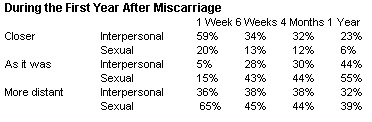
Results of the study showed that women who perceived their partners engaged in mutual sharing of feelings and experiences claimed to grow closer interpersonally and sexually. When partners failed to do things that showed they cared, women felt abandoned. These results combined with the findings of others (2) that men tend to keep to themselves after miscarriage deny their own loss, engage in avoidance, distract themselves through work and, if highly self-critical, experience greater despair and difficulty suggest that couples may need coaching in how best to care for each other after miscarriage.
Should you find that your partner experiences feelings of grief at the same intensity and duration as you, count yourself fortunate. Grief, by definition an extremely uncomfortable emotion, when shared and reflected accurately by another, tends to wane and can actually strengthen us over time. Creating supportive rituals to acknowledge and soothe one another’s pain are tremendously helpful for those who have experienced a miscarriage. Funerals, wakes, and birthday and anniversary routines all serve to give parents healing time; honoring the role that the “child to be” continues to play in their family and restoring a sense of meaning to the loss.
It is important to normalize the fact, however, that men and women tend to experience the impact of miscarriage differently. Coping with loss is a unique experience for each of us and there is no “right way” to go about it. Women, in general, do not need to learn to toughen up and let go. Nor do men need to soften up and express themselves more deeply. Often we choose our partners precisely because of these differences. The health of our long term commitment to one another depends on remaining curious and respectful of how those differences evolve over time.
Should weeks of estrangement from your partner’s grief become months (or years), it would be a good practice to explore new pathways for connection. The topic of miscarriage may seem still terribly hurtful to one, and all but forgotten to the other. Remember that getting outside help is appropriate at any stage of grief. Couples counseling provides neutral territory for safely acknowledging the new terrain of your marriage and what new shared coping strategies might still be available.
References:
(1) Miscarriage Effects on Couples’ Interpersonal and Sexual Relationships During the First Year After Loss: Women’s Perceptions
(2) Kristen M. Swanson, RN, PhD, FAAN, Zahra A. Karmali, BA, Suzanne H. Powell, BS, BA and Faina Pulvermakher, BS, MT (ASCP)
Psychosomatic Medicine 65:902-910 (2003)
© 2003 American Psychosomatic Society
 While there are a multitude of distractions and amusements available to anyone with a library card, it is not unusual to go through periods of boredom when not even the most scintillating book, movie, or conversation will sate the crankiness demon. At those times, it is best to stop whatever you are doing and simply sit with what is. Are you feeling annoyed, frustrated, agitated, sad, or self-critical? Welcome whatever comes up. Investigate it. Do something paradoxical and try to increase the feeling. This may sound counter-productive, but it will actually help you figure out what is going on. If you let yourself go deeply into your boredom the underlying issue will surface. Once it does, ask yourself how you want to handle it. Consciously choose to explore your thoughts and feelings though journaling, talking with someone (friend, relative, clergy, or therapist), or simply breathing, meditating, and allowing them.
Boredom is uncomfortable, and it is natural to want to banish it immediately. By exploring what is going on right this minute, you allow yourself to relax with what’s coming up. It is only a feeling. You have probably felt every emotion before, whether fear, joy, anger, love, anxiety, sadness, or grief, and you’re still alive.
Boredom is often a code word for something else. It seems to appear when your internal state is so strong that anything external loses its power to divert you. The irritability comes from wanting relief from those simmering uncomfortable feelings and knowing the only way out is through. When nothing feels right or good, just breathing can be a refuge.
No one likes feeling irritable, bored, or restless. Nor should you. Perhaps, the purpose of these annoying feelings is to wake you out of a funk. Sometimes, an unpleasant state of mind is necessary when routine ways of being and doing have sucked the novelty out of life. Variety does spice things up, and without it living can lose its luster. Whether it’s trying different foods, listening to new music, taking a drive to an unknown locale, or going to an art opening, mixing things up helps you thrive. In addition to creating new neural pathways, unpredictability and spontaneity create a sense of surprise and delight. Of course, it has to be the right amount. Too much novelty and you feel groundless; too little and you’re bored.
Maintaining emotional balance is not easy. Life, with all its demands, intrudes on the best laid plans. So, boredom, restlessness, and groundlessness appear. Re-grounding yourself can be as easy as feeling your body sitting, standing, or moving, eating something mindfully, looking out a window and really seeing what meets your gaze, taking a walk, calling a friend, listening to music, writing in your journal, or anything else that uses some of that irritable energy. Even meditation, not an easy feat when you are feeling crabby, is helpful, since it reminds you this is merely a passing state you can label and release. Actually, you are not really releasing the state as much as your attachment to it.
Boredom, restlessness, and groundlessness are simply different terms for feeling temporarily stuck and uncomfortable. You will not stay in this state of mind. Everything changes, and that is what makes life so interesting. You never know what’s next. By sitting with what is, or actively shaking things up a bit, you practice mindfulness or self-determination. Sometimes, one will work better than the other. It’s always good to have a few arrows in your quiver since one day sitting with your feelings will be the right choice, and another day doing something proactively will work.
The following grounding techniques utilize your ability to actively focus attention on something external to distract you from whatever thoughts and feelings seem unpleasant, overwhelming, or boring:
- 5-4-3-2-1 meditation. Wherever you are, notice 5 things you can see, then 5 things you can hear, and then 5 things you can physically feel. Continue with four things in each category, then 3 things in each category, then 2 and, finally, 1. Allow about 15 minutes to complete one full cycle. It is preferable to find new things, but not necessary.
- Another 5-4-3-2-1 meditation. Wherever you are, notice 5 objects, 5 colors, 5 shapes, and 5 textures, then 4 in each category, then 3, then 2, and 1.
- Think of all the vocabulary words you can remember from another language you studied.
- Recall your favorite foods, places you have visited, movies, books, or music.
- Recite a poem you memorized as a child.
- Describe in minute detail a mundane activity you do every day, like brushing your teeth: I pick up the toothbrush, I turn on the water, I wet the toothbrush, I put toothpaste on the toothbrush, etc.
- Imagine a time when you felt very safe and describe it in great detail, using all five senses.
- Sing a song.
- Build a sanctuary in your head. Add as much detail as possible.
- Focus on where your body is contacting the floor, a chair, or bed. Breathe into that place.
- Widen and stretch your fingers and toes. Relax them and repeat.
- Repeat a prayer, affirmation, or mantra. Use a rosary or mala beads to help anchor the repetitions.
- Count backwards by threes from one hundred.
- List how many things you can do, from the mundane to the most sophisticated.
- Play old car games in your head, like Geography (where you say the name of a place and use the last letter of that place as the first letter of your next one) or I Packed My Trunk and In It I Put an A (apple), a B (beta endorphin), a C (color wheel), to Z, going through the whole alphabet, starting from A each time you add another letter.
- Look out the window and notice subtle color differences in the sky, cloud configurations, trees and branches, or the various shapes and sizes of leaves.
Feel your breath. Remind yourself that you are alive, and whatever you are feeling is part of life. You are here to feel it all.
Related articles:
How to Use Curiosity as a Cure for Relationship Boredom
Boredom and the Longing for Connection
Learn to Sit with Discomfort in Your Life