 In many ways, it would appear that breaking up is similar to falling in love. I know what you are thinking, and you are right – it’s not quite the same thing. However, in terms of the physiological effects that it has on your mind, psyche, and body, it would appear to have quite a significant effect as it can potentially turn your world upside down.
Breakups can throw our worlds into a chaos, similar to falling in love, I would suggest. Dr. Helen Fisher wrote a book called Why We Love, and in her book, she discussed the chemical changes that actually take place in the human brain and body when one ‘falls in love,’ which she surmised was similar to being on cocaine. In the early stages of, what she describes as lust and romantic love, the brain goes through a series of changes, which can be best described as exciting, but chaotic. The third stage is the attachment phase, or long-term love, which is basically biology’s way of allowing couples to raise children together; not as chaotic, and not as exciting, but with deep trust and love. In breakups, we experience a similar chaos, though perhaps not quite as exciting, and sometimes perhaps downright tumultuous. Now, most of us hope that we won’t have to get to this stage of “breaking up,†but sometimes it’s actually bound to happen and is in fact a blessing, perhaps in disguise, as it will undoubtedly force us to grow and heal. Like ripping a band-aid off, breakups do allow for new cell growth, if given the proper time and patience.
Breakups are not only a chaotic time, but are also a vulnerable time for most. The early stages of breakup periods, if not dealt with consciously, with allowance for grieving, and sadness, can lead to a slew of other problems. Many people turn to other sources for solace in the early stages of a breakup: alcohol, drugs, food, one-night stands, dating, and sex, to name a few. Some people do this, but not all. Some people turn inwards, decide to eat healthy, exercise, spend some quality time alone, and balance it with friends, work and family. Others may jump head first into some other relationship, without a break from their current life, and start over anew. The point is that jumping head first into something new, whether it be a new relationship, or even just work, or random one-night stands, though they may feel good in the moment, during this time of new vulnerability can lead to bigger and greater problems down the road.
Let’s talk about sex for just a brief moment. After a long-term relationship, some people may find that their sexual drives are at an all time high. People respond to this increase in arousal in several different ways. Finding another long-term partner to focus your affections on is one way, and finding a series of anonymous or one-night stand hook-ups might be yet another way. Either way may be fine for you; however, it is very important to take care, as jumping head first into either of these options could halt the healing process, and in many cases adds on a whole other series or problems to the fold. Sex addiction is amongst those possibilities. Addictions often develop as a result of anxieties which require soothing. Acting out sexually could, in the moment, alleviate one’s anxiety, but in the long run can turn into an escape from dealing with one’s problems in the present, which could eventually turn into an addiction.
The main thing to remember during a breakup is what to not do. Avoid jumping into something new right away, and avoid patterns that alleviate pain, temporarily. Do allow yourself to sit and feel the pain, as difficult as that may seem. Allow yourself to be alone, to sit alone. Give yourself time to think, breathe and exist in your own pain. Pain and suffering are a part of life. Avoiding the inevitable strips us of growth, as it doesn’t allow us to utilize our own coping skills, which in the end are akin to survival. Develop those survival skills now, not later. In addition, allowing our own healing to occur now can prevent a slew of maladies later on. Sometimes a breakup can seem like the end of the world, and it’s hard to hear these words, but trust me when I say time heals all wounds.
Related Articles:
Phases of Healing
3 Things You Can Do in Overcoming Sex Addiction
Why Does Mr. Wrong Feel Like Mr. Right?
Individuals who have avoidant attachment personalities struggle with intimacy and closeness. In romantic relationships, this type of personality can cause a partner to distance themselves from their loved one, and avoid physical closeness. “Because avoidantly-attached people feel most comfortable with distance and detachment from their partner, they may have less of the commitment-inspired inhibition that normally prevents people from showing interest in alternatives and from engaging in infidelity,†said C. Nathan DeWall of the Department of Psychology at the University of Kentucky. “Therefore, avoidant attachment may relate to a broad pattern of responses indicative of interest in alternatives and propensity to engage in infidelity, associations that should be mediated by a lack of commitment to one’s partner.†DeWall and his colleagues conducted a study to find out how avoidant attachment affected commitment in romantic relationships, and if the level of commitment would influence the desire to cheat. He said, “We focus on commitment because prior evidence suggests that commitment is the most direct mediator when predicting behaviors that relate to the persistence of one’s relationship and engagement of behaviors meant to strengthen one’s relationship, accounting for variance beyond relationship satisfaction and investment in one’s relationship.â€
DeWall enlisted 42 college students in romantic relationships for his study. He conducted eight separate studies designed to evaluate both attachment style and commitment, and found that in all the studies, attachment style was directly linked to commitment and infidelity. “The first four studies showed that avoidant attachment was related to more positive attitudes toward cheating on a current relationship partner, having an attentional bias toward alternatives, and engaging in more infidelity,†said DeWall. “The final four studies showed that lower levels of commitment mediated the relationship between avoidant attachment and interest in alternatives and infidelity. He added, “Our findings suggest that chronic discomfort with closeness and intimacy, as indicated by relatively high levels of an avoidant attachment style, has direct consequences for how interested people are in alternatives to their relationship partner, their attitudes toward cheating on their partner, how committed they are, and hence how much they engage in infidelity.â€
Reference:
DeWall, C. Nathan, Nathaniel M. Lambert, Erica B. Slotter, Richard S. Pond, Jr., Timothy Deckman, Eli J. Finkel, Laura B. Luchies, and Frank D. Finchman. “So Far Away From One’s Partner, Yet So Close to Romantic Alternatives: Avoidant Attachment, Interest in Alternatives, and Infidelity.” Journal of Personality and Social Psychology 101.6 (2011): 1302-316. Print.
 In my neck of the woods the majority of therapists see mainly women (probably about 80% of their clients). Not so for me – more than half my clients are male, and when I work with a couple it is more often the men who initiate conjoint therapy. I think this is because many guys tend to become very uptight about their penis, what Paul Joannides (author of The Guide to Getting It On) calls “deadwood – the bummer in your pants”. Many of the men I work with are concerned about their system crashing when their pants are off!
I’m not comfortable diagnosing erection problems as “erectile dysfunction.â€Â I hate labeling, and the “dys†implies failure and the overwhelming shame that goes along with it. I never click on the links that come with the numerous ads in my spam folder offering “your instant cure for impotence†(why are they sending these to ME?). Viagra can make a huge difference but masks the issues that cause the tissues to stay soft.
It’s not just men over 50 who have erection problems. They happen to men of all ages, from teens on up. Often erectile challenges crop up quite early in a sexual relationship when folks are just beginning to find their sexual rhythms together. Many guys are nervous that their performance is not up to par – they may require a few weeks or even months to find their groove. Especially when the couple moves from dating to mating in domesticity!
So gals, remember that expecting a guy to get it up straight away could be a big mistake – especially if you truly feel that he’s the man for you.
It can make for a big opportunity to look beyond sexual performance to deep bonding with each another. The danger is not the lack of an erection, but what each of you makes of it. When a woman needs her partner’s erection to validate that she’s desirable, a short term problem can quickly become long term.
Recently a 23 year old client described a typical scenario with his fiancée, with whom he has a long distance relationship. “So it’s Friday evening and we’re coming home from a romantic dinner. She says, ‘Wanna have sex when we get home?’ and I panic! I feel like all the blood is draining from my body. It’s this deep seated fear that I won’t be able to get an erection 30 minutes from now and it becomes self-fulfilling and self-defeating. How do I get control over my own body?â€
He was extremely surprised when I suggested that trying to “get control†was precisely the problem. Viagra did indeed help with his attempts to stave off what he called “hydraulic failure.†But the blue pills were only part of the picture for this couple. In this kind of situation I usually sit down with both people separately as well as seeing them together. I call this my three-legged stool approach. When you eliminate one leg the stool often topples.
His fiancée had been blaming herself, “He obviously doesn’t find me attractive any more. I’ve gained some weight…†etc. Once I helped her to realize that his erection problems had nothing to do with her, it turned out that she wasn’t nearly as attached to a hard penis as he had imagined.
Viagra produced the requisite hard-ons but was no help at all when this couple couldn’t laugh together or let go of their attachment to having things go a certain way between the sheets. They needed to learn more about intimacy. Many couples require some help deepening their intimacy, and therapy can provide the tools.
Joannides again: “When it comes to making love, relationship issues trump d*** issues.â€
 I’m struck by the fact that people with addiction issues, when confronted with the destructive effects of their behaviors, often find it harder to stop. This is especially true, in my clinical experience, when it comes to compulsive sexual behavior, aka sex addiction. Why is that?
Therapy clients who struggle with drinking or substance abuse tend on the whole to accept – eventually, and with my ongoing support – that they do have a problem with drinking or using, and that these behaviors are an obstacle to happier living. Once “the cat is out of the bagâ€, they usually attempt to reduce or quit using, over time, or else quit therapy altogether.
Those struggling with compulsive sexual behaviors, however, may remain ambivalent for years, while remaining in therapy – aware of their dependence on these behaviors and the destructive effects of same, while wrestling with whether or not they want to stop. It’s a matter of two steps forward, two steps back, over and over again, with no change in sight.
Additionally, it is often reported to me that there appear to be more people in Alcoholics Anonymous with long-term sobriety compared to those in Sex Addicts Anonymous or Sex and Love Addicts Anonymous or other 12-step programs for healthier sexuality. Those with long-term sexual sobriety – or “abstinence†– tend to be fewer in number. Again – how come?
I know there is a lot of controversy in the mental health field about whether sexual compulsivity is truly an “addiction.†It is not my intent here to address that complex question. Suffice it to say that the suffering of those who can’t stop, in the face of heartbreaking damage and loss, is staggering to behold. If one of the key criteria for an addiction is an inability to stop in spite of negative consequences, then compulsive sexual behavior more than qualifies as an addiction.
So, if one assumes we are in fact dealing with two actual addictions, we are still left with the aforementioned disparity between drug/alcohol vs. sexual sobriety. Is it because one can live without drugs or alcohol, but cannot “remove†sexuality from one’s being? We are, organically speaking, sexual creatures, and the goal of treating sexual addiction is not to remove one’s sexuality but to create healthier, more intimate and less self-destructive behaviors.
I suspect that, because we are dealing with sex after all, the issue goes even deeper. Sexual desires and fantasies often emanate from the very core and are difficult to interpret. Heterosexual men with compulsive sexual issues, for instance, may desire sex with other men while staying married to a woman; some pursue sex with transvestite prostitutes, in ways that put themselves at legal and medical risk. I know of high-functioning women who are compelled to conduct serial affairs, virtual or real, with men whose only apparent goal is to sexually “use†them in sadistic or degrading ways. These are people who have little to gain, it would seem, and everything to lose.
Another complication is that sexuality is a relational activity. It always implies another person, either real or fantasized. One can use heroin or drink alone, as many do. But it always “takes two to tangoâ€, even if one of those people is a fantasy or “virtual†person. Even when one uses online pornography, for instance, another person is “presentâ€, at least onscreen.
Close readings of sexual fantasies and compulsive behaviors can be revealing of one’s buried self-concepts and unexpressed needs; an S&M fantasy may represent a way of coping with an overbearing or shame-inducing caregiver, by sexualizing the pain and staying in control of the fantasy/scenario (even if one is the “Mâ€). Those struggling with scenarios of dominance over others may be trying to compensate for intolerably low self-worth, an attempt to control chaotic emotions leftover from a traumatic upbringing.
My experience with straight men who compulsively watch porn often reveals a desire for a woman who can offer everything but demand nothing, and disappear when the encounter is over, before she decides he’s “too much†for her, or “gross,†or perverted, etc. It’s a sort of mini-relationship, easily controlled by someone who usually has a desire for and deep fear of intimacy, who gets his needs met quickly and then signs off.
It’s almost as if these fantasies provide a window into the psyche, revealing unmet needs.  Like the need to feel in control, to express repressed desires, to sexualize (i.e. numb or self-medicate) hurtful or shameful feelings or other emotions that are unconscious or too difficult to articulate.
These are feelings and needs that cannot be expressed in their actual relationships – usually because they are perceived as “disgusting†or “too much†for their partner. Of course, their partner very often has her own “stuff†and tends to be closed off, angry, controlling, etc. It’s an extremely painful dynamic that I see with many of my male clients – straight and gay – who struggle with sexual compulsivity.
Why would a man, or anyone really, seek an “emotionally unavailable†partner? Because we tend to gravitate toward the familiar, even if what is familiar is dissatisfying or even abusive.
Very often the person chooses an emotionally closed off, or overly aggressive (or withdrawn) partner because, in reality, the alternative is too scary. It may sound strange, but what’s even scarier than not finding love – especially in cases of a traumatized upbringing, which includes just about everyone I work with – is actually finding it! Why is that? Because love can be lost or taken away, leaving the person abandoned and traumatized (again) – even more painful than being mistreated or ignored. In the latter case, at least you know someone is there.
Thus the person suffering from core interpersonal trauma – the result of a faulty caregiver, another human being – who ends up sexualizing their needs via the behaviors described above, hovers between a desperate yearning for and deep aversion to intimate connection. The sort of “mini-relationship†described above is often a substitute. It satisfies…for a while. One connects, finds relief via sex and affection (what’s actually virtual feels real at the moment) – then detaches before becoming too invested or emotionally “at risk†for abandonment.
That emotional risk, believe it or not, is usually more frightening than the prospect of the legal or health risks that accompany these behaviors. Abuse and emotional distance is familiar, even if painful, while the possibility of genuine love is new and terrifying.
Thus the compulsive behaviors are a temporary solution to the very real and shameful problem of a confusing inability to connect with others. I say “shameful†because very often the feeling is something like, “I’m an idiot because I don’t know how to stop. Why do I do such disgusting things. What a piece of garbage I truly am.† (Even if the person is outwardly successful, wealthy, etc. As they say in recovery, it’s always an inside job.)
One of my clients once said in my office, with a smile on his face, “I have no love in my life. I’d only ruin it if I didâ€. This was a successful, married attorney with a compulsion to see prostitutes.
It took me a few moments to realize the smile was an awkward attempt to conceal shame, not any sort of bemusement. That smile was one of the saddest things I’ve ever seen.
What I want to stress here is the pain that needs soothing is, in part, not the result of an unrequited hunger for love, nor a fear of finding it, but rather an impossible non-reconciliation between the two.
Here are two opposing, powerful forces at work, with radically different agendas – one to connect, the other to protect. Without help, this internal conflict results in unmanageable emotional turmoil and frustration. The cycle never ends, until the person says “enough,†and seeks help.
I’ll talk next time about how therapy can, when effective, provide a slow but steady path towards healthier intimacy and a chance to escape the suffocating shame and loneliness that so many of my clients describe as a slow-moving poison — leading them to behaviors they so desperately want to stop, but can’t.
Related Articles:
Super-sizing Sex
The Good and Bad Sides of Porn
Three Ways to Avoid Sex Addiction Relapse
 If Hollywood is an indicator of our most common fantasies, modern Americans want to sleep with their therapists. I am horrified that so many television shows and movies depict romantic relationships between therapists and clients as though they were perfectly normal! The truth is, romance within a therapeutic relationship is as far from normal, acceptable, healthy, and sane as you can possibly get.
The writers of How I Met Your Mother currently have the character Robin dating her previous therapist. The relationship has been rationalized through a series of cutesy excuses: “Well, we only had a handful of therapy sessions … it hardly counted!†and, “Well, if we have a session where the previous client now becomes the therapist, it will all balance out!†ICK! In no way, shape, or form is dating a current or previous therapist healthy, ethical, or socially acceptable.
In California, there is a legal clause that states that a personal relationship between a previous therapist and client may be pursued two years after the termination of services. However, research tells us that the power imbalance remains strong, even after time has passed, and that romance in this situation is usually still emotionally damaging to the one who was the client. Hormones, brain chemistry, and emotional issues often inadvertently conspire to lead us toward unhealthy romantic choices, which is why therapists are clearly instructed that “Professional Therapy Never Includes Sex” (this is the name of a pamphlet that every single therapist-in-training in California receives on several occasions). Although specifics vary from state to state, 19 states have sexual exploitation laws forbidding therapists from engaging in sexual contact with clients.
Even though in the movie 50/50, Joseph Gordon-Levitt appears to find care, comfort, and I-don’t-know-what-else in the arms of his intern therapist (I don’t know because I walked out of the movie), your therapist is neither your caretaker nor your best friend. Your therapist can help you develop the skills you need to go out and make friends and find someone to help you through the difficulties of life. But if your therapist tries to convince you that his or her role is to love and protect you, run away! That is NOT appropriate therapy! And if he or she makes any sexually suggestive advances (verbal or physical), you know you are not working with an ethical therapist.
Extensive worldwide research and anecdotal evidence dating back to the origins of formalized therapy indicate that romantic relationships between therapists and their clients, regardless of which role is the initiator, are criminally damaging to the client in the majority of situations. The client is typically left with extreme emotional disruption, feelings of emptiness, isolation and guilt, and a tragically impaired ability to trust.
Certainly the therapeutic relationship is a unique situation wherein two human beings share space in a room while playing particular roles that ask them to maintain strict discipline of their human instincts, but to share the greatest level of openness and honesty imaginable. When deconstructed, the therapeutic hour shows itself to be a very bizarre social construct that is quite challenging to enact in a productive and healthy way. When properly delivered, the benefits of appropriate psychotherapy can be powerfully life-changing. However, there are many ways to get off track throughout the process, which is why therapists need to be well-trained, licensed, ethically and emotionally stable, grounded in common sense, and masters of self-discipline and self-care.
The boundaries around the therapeutic relationship are essential to the success and integrity of our profession, and I find it inexcusable for our entertainment industry to treat the subject matter so lightly and irresponsibly. We know that the mass public derives their sense of “normal†and desirable from the information presented on the screens in front of them. If this were an isolated incident of poor judgment, I could write it off as such. But the theme has become so ubiquitous as to appear in highly rated productions reaching tens of millions impressionable minds worldwide.
I started enjoying the recently cancelled sitcom, Free Agents, until the female character’s therapist asked her out during a session and they started dating. What? After a few therapy sessions, in which he did nothing of therapeutic value, he declared her problem-free and decided to hit on her. My concern is that the writers of these shows may actually be typical, regular people who truly believe that relationships with therapists are normal. If this storyline is depicted in other regular people’s everyday media consumption, a very serious misconception about the purpose and practice of psychotherapy may occur.
Of course, romantic, sexual, and loving feelings can arise between two people who sit close together and speak of personal and intimate issues on a regular basis. A well-trained and ethical therapist will seek professional consultation if romantic or lustful feelings arise and will follow wise counsel as to the most ethical way to proceed. Often these feelings can be worked through and resolved without any negative effect on the therapy. If the feelings persist, the responsible and legitimate therapist will control his or her impulses and refer the client to another professional. With the help of an esteemed consultant, they can determine how best to implement the transition with the client.
The therapist portrayed by Gabriel Byrne in In Treatment struggled with sexual feelings toward a client in the first season of the series. I have not seen these episodes, but I know the series is highly revered and often seen by the general public as an accurate representation of therapy. It was very disheartening for me to hear that this character acted on his sexual impulses, even though he apparently understood the harm that physical intimacy could do to his client. I think these representations are misguided and ill-advised, as they imply that the psychotherapeutic setting is always imbued with sexual energy and tension.
It is not uncommon for strong feelings to arise in a psychotherapy client. For many schools of thought, this is actually an important part of the therapeutic process. However, if the feelings become strong enough to breach the integrity of the therapy, they must be addressed. In the healthiest of situations, the client would admit these feelings to the therapist—the best therapeutic alliances are built on trust and acceptance, communicating to the client that no judgment or disgust will befall them in that room, under any circumstances. If a client shares the feelings he or she is having, the issue can be discussed openly and often can be resolved, bringing greater insight and personal power to the client. If the feelings cannot be redirected and resolved, it is best to help the client find a new therapist to continue the growth work in a nonsexualized setting.
Looking at current blog posts, I see many people justifying their seductions, romances, and friendships with their therapists. Most of these bloggers are writing at the beginning of their relationships and seem not to believe that they may not get a Hollywood ending. I am very concerned that media representations of our profession are casting a skewed and uninformed light on this very complex issue. The general public is clearly buying into the idea that dating their therapists may be legitimate.
Perhaps we therapists can take this challenge as an opportunity for greater enlightenment and education with our clients. It will keep us on our toes (even more) so that we may identify and address misplaced emotional feelings that arise in therapy. This aspect of the profession is difficult enough without added pressures from the mass media. However, our awareness of the issue can serve to reinforce our ethical stance and prepare us for any type of challenge that may walk through our consultation door.

Many couples I work with come in with a large amount of stress and difficulty. The causes vary, but the behaviors people use to respond to the upset are often predictable. People who start out loving each other sometimes find themselves so burdened by stress and difficulty that they end up feeling frustrated in the relationship.
Research suggests that up to a third of married individuals report low marital satisfaction, and approximately 20% of all married couples experience marital distress at any given time. These numbers reflect what therapists see daily in their practices.
No one starts out being frustrated. Frustration comes after being unhappy, sometimes for a long time. Often, couples with the best intentions end up not being able to explain themselves to each other, or they won’t say what they really want to say, and as a result they feel tense, stressed and oftentimes frustrated.
The most frequent problem reported by unhappy couples is poor communication. Frustration can appear in many ways. It may come out as a curt answer to a question. Maybe it’s a rolling of the eyes, or a “whatever” response to a partner, or no response at all. Frustration can also be felt when one person ignores the other altogether.
Sometimes frustration is a slammed door, or a sigh. It’s a sign of exasperation from the frustrated person to the other telling them something is very wrong. It also broadcasts unhappiness and discontent. And it’s a problem. It keeps the frustrated person trapped in difficulty and leaves the other partner in the dark regarding the source of the problem.
What would be helpful is to discover how to talk about what doesn’t feel good in the relationship. Unfortunately, this is often difficult for couples who have not communicated with each other for a while. Over time, the breakdown in communication evolves into increased arguing, stonewalling, defensiveness, and contempt. Distressed couples tend to engage in these negative patterns of communication often and are unable to successfully repair the relationship after an argument.
If you find yourself answering your mate with frustrated gestures, you might want to think about what is happening to you. I am pretty sure you used to have very soft, loving responses in the early days. Maybe as time passed you found yourself unable to express your thoughts and feelings to your partner without worrying how he or she might react. It’s possible you may even have started keeping your thoughts and feelings to yourself, not wanting to bother your mate. But the more you kept your thoughts and feelings inside without speaking them, the more you might have felt yourself becoming stressed and uncomfortable.

This is the body’s natural response to too much tension. Marital stress can alter endocrine, cardiovascular, and immune function—key pathways from troubled relationships to poor health. This tension is a clear message about what it feels like when you can’t express yourself and you keep your feelings inside. You might have a sensation of all your feelings being trapped inside your own body and you can’t let them out, like you are frozen. You keep yourself suppressed and you suffer. At first you might be able to manage your increased stress. Maybe you exercise more or take up an activity. Maybe you yell at the kids instead or a co-worker. Perhaps you overindulge; too much alcohol, drugs, or food.
The more you figure out how to manage your challenges, the more you might be looking at your partner with disdain. You may start to believe that he or she just doesn’t care about what you think and feel. Individual and couple responses vary greatly; That’s when people start with the one word answers, or the disinterest, or the shaking of the head. These behaviors tell the other person you are not interested in them. These reactions indicate that you are unhappy.
If you are unhappy in your relationship, take stock of how you are feeling right now. Ask yourself, “Am I stressed and unable to talk to my partner about what is bothering me?” If you answer yes, start looking at the ways you do talk to your mate. Are you short and abrasive? Do you dismiss him or her? Do you just not bother because you don’t think anything will change?
If you answered yes to any of these questions, you
So how do you change your situation? You just took the first step; you recognized it. From here you might want to talk to someone: a friend, family member, religious mentor, or counselor. Get your long held feelings from inside yourself outside of your head by communicating them. Try to understand what is preventing you from talking to your mate about these feelings. Learn why you stay silent.
There are effective treatments for marital distress. No one begins as a perfect partner and a successful marriage depends on a number of skills, such as the ability to understand one’s own behavior and motives, to understand one’s partner, to argue and problem-solve productively, and to effectively negotiate differences—all of which can be enhanced by working with a marriage and family therapist.
You will likely feel better even after just a few sessions. You could also learn different ways to communicate your feelings that may give you confidence. When you leave your old behaviors – the eye rolling, sarcastic responses, non answers – and replace them with true expressions of your feelings, a number of things might also happen. Your stress and tension may decrease, and it’s possible you might even begin to experience some happiness, and that might feel pretty great.

When to Seek Professional Help
Over 98 percent of clients of marriage and family therapists report therapy services as good or excellent. After receiving treatment, almost 90% of clients report an improvement in their emotional health, and nearly two-thirds report an improvement in their overall physical health. A majority of clients report an improvement in their functioning at work, and over three-fourths of those receiving marital/couples or family therapy report an improvement in the couple relationship.
If you’re experiencing persistent relationship frustration, consider reaching out to a qualified couples therapist or marriage and family therapist. They can help you and your partner develop better communication skills and work through underlying issues contributing to your frustration.
For immediate support, you can:
Contact the Find a therapist directory
Call the SAMHSA National Helpline: 1-800-662-4357 for mental health resources
Reach out to your healthcare provider for referrals
References:
- Regan, P., Walsh, S., Horton, R., Rodriguez, G., & Kaufman, L. (2025). Contextualizing marital dissatisfaction: Examining profiles of discordant spouses across life domains. Frontiers in Psychology, Collection date 2025. https://pmc.ncbi.nlm.nih.gov/articles/PMC11961942/
- Association for Behavioral and Cognitive Therapies. (2021). Marital distress fact sheet. https://www.abct.org/fact-sheets/marital-distress/
- American Association for Marriage and Family Therapy. (n.d.). Marital distress. https://www.aamft.org/AAMFT/Consumer_Updates/Marital_Distress.aspx
- Heim, C., & Heim, C. (2025). How long-term couples cope with chronic stressors and adverse life course events in marriage: A qualitative study. The American Journal of Family Therapy, Published online: 18 Feb 2025. https://www.tandfonline.com/doi/full/10.1080/01926187.2025.2459688
- Shrout, M. R. (2021). The health consequences of stress in couples: A review and new integrated Dyadic Biobehavioral Stress Model. PMC, PMC8474672. https://pmc.ncbi.nlm.nih.gov/articles/PMC8474672/
- American Association for Marriage and Family Therapy. (n.d.). About marriage and family therapists. https://www.aamft.org/AAMFT/About_AAMFT/About_Marriage_and_Family_Therapists.aspx
 Every so often I will be treating a couple, one of whom says that the other doesn’t care about religion or spiritual matters. The complainant may cite a lack of support for his or her spiritual or religious activities. Sometimes the partner resents the time devoted to religious/spiritual pursuits. Sometimes one or the other person feels alone when it comes to events that are more couple or family oriented (such as holiday celebrations). In my religion, the Yoruba/Lucumi faith, the activities, initiations, drumming, etc. are so labor-intensive, it is hard to imagine being with someone who isn’t in some way in the faith.
When working with these couples, I explore if there is really some other issue lurking beneath the surface of the presenting complaint. Sometimes there is something not readily apparent; for example, feelings of neglect in general, sexual problems, addictions, abuse, and so on. Ultimately, these “hidden†are the issues that must be worked on in the treatment.
However, if most of the relationship is working well and this is the real complaint, I tend to explore the feelings on both sides rather than the issue of why someone is or isn’t religious/spiritual. The feelings that typically surface are those of abandonment: sometimes there is a feeling of scorn and contempt on the part of the religious/spiritual one, loneliness on both sides, a lack of joint purpose/values/goals, or a drastically different world view and outlook on life, just to cite a few examples.
I also explore why it is so difficult for one or the other to allow the partner to be on his or her own path. Is perhaps this some form of codependence that requires homogeneity in thought and belief? Is it perhaps threatening to one or the other to be different? Are there fears that unless the two are the same, they can’t survive as a couple?
While it is important in a relationship to have shared interests and values and to some extent goals, each person in a couple does not have to be a carbon copy of the other. After all, it is different points of view that make a relationship interesting.
As long as the other person is not critical, contemptuous or belligerent as far as the other’s religious/spiritual beliefs, it is important for each person in the couple to follow his or her heart when it comes to religion and spirituality. Too many people have been pressured by parents, extended families, social groups, communities and other such entities to follow along with a certain religious/spiritual example. Ideally, this is one area where there should be freedom of choice (even though that is often not the case). So, to perpetuate that lack of choice in a relationship makes it even worse for both parties.
I do appreciate that the issue becomes more complex when it comes to raising children. If this hasn’t been discussed prior to making a commitment to the other, then it needs to be worked out with mutual respect. Often compromise is the only way to resolve something like a conflict in this area, knowing full well that the children will probably decide what they want to do in the long run anyway.
Ultimately, what couples should strive to avoid is using religion/spirituality as a tool for manipulation of one another. That goes against the very purpose of belief, and in the long run is divisive and destructive to the relationship. Respecting another’s differences is really the only choice to make.
Related Articles:
Five Domains of a Healthy Relationship
What is “This”? An Exercise in Contemplation
Appropriate Conversations about Spirituality in Counseling
 The loss of a child before it is born naturally stirs intense and conflicting emotions. Women might feel an intense physical bonding and grief for a being with whom they have already grown attached. Whereas men might feel more ephemerally connected and cheated from the opportunity to begin their bond. When miscarriage affects couples, it may stimulate growth or, conversely, unearth an inability to support each other through troubling times. The confusion surrounding one’s own feelings as well as how to be of real support to one’s partner after the loss tends to disrupt the balance of our relationships. This is especially true if some of that balance lay in the shared anticipation of parenthood. The inability to share and understand each other’s grief can be an isolating experience.
One week after the loss, most women report feeling closer interpersonally with their partner while feeling more distant sexually. As time progresses and different coping strategies for grief kick in, the feelings of closeness fade even when their sexual relationship recovers. Partners with significantly different grieving patterns may be at particularly high risk for subsequent marital conflict or emotional withdrawal.
A recent study on women’s perceptions on their relationship after a miscarriage (1) shows a dramatic decrease in interpersonal and sexual intimacy for most couples up to one year after a miscarriage. At that point only about half of women interviewed report a return to normalcy in their relationship (there is no data available on men’s perceptions).
Percentage of Women Claiming Their Interpersonal and Sexual Relationships Were Closer, As It Was, or More Distant
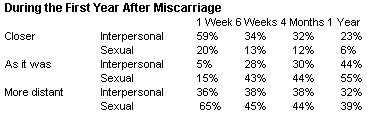
Results of the study showed that women who perceived their partners engaged in mutual sharing of feelings and experiences claimed to grow closer interpersonally and sexually. When partners failed to do things that showed they cared, women felt abandoned. These results combined with the findings of others (2) that men tend to keep to themselves after miscarriage deny their own loss, engage in avoidance, distract themselves through work and, if highly self-critical, experience greater despair and difficulty suggest that couples may need coaching in how best to care for each other after miscarriage.
Should you find that your partner experiences feelings of grief at the same intensity and duration as you, count yourself fortunate. Grief, by definition an extremely uncomfortable emotion, when shared and reflected accurately by another, tends to wane and can actually strengthen us over time. Creating supportive rituals to acknowledge and soothe one another’s pain are tremendously helpful for those who have experienced a miscarriage. Funerals, wakes, and birthday and anniversary routines all serve to give parents healing time; honoring the role that the “child to be†continues to play in their family and restoring a sense of meaning to the loss.
It is important to normalize the fact, however, that men and women tend to experience the impact of miscarriage differently. Coping with loss is a unique experience for each of us and there is no “right way†to go about it. Women, in general, do not need to learn to toughen up and let go. Nor do men need to soften up and express themselves more deeply. Often we choose our partners precisely because of these differences. The health of our long term commitment to one another depends on remaining curious and respectful of how those differences evolve over time.
Should weeks of estrangement from your partner’s grief become months (or years), it would be a good practice to explore new pathways for connection. The topic of miscarriage may seem still terribly hurtful to one, and all but forgotten to the other. Remember that getting outside help is appropriate at any stage of grief. Couples counseling provides neutral territory for safely acknowledging the new terrain of your marriage and what new shared coping strategies might still be available.
References:
(1) Miscarriage Effects on Couples’ Interpersonal and Sexual Relationships During the First Year After Loss: Women’s Perceptions
(2) Kristen M. Swanson, RN, PhD, FAAN, Zahra A. Karmali, BA, Suzanne H. Powell, BS, BA and Faina Pulvermakher, BS, MT (ASCP)
Psychosomatic Medicine 65:902-910 (2003)
© 2003 American Psychosomatic Society
 Perhaps youʼve come across one of the many articles or videos with titles like, “In Love with the Eiffel Towerâ€, or a recent National Geographic Taboo program called “Forbidden Love?†The topic is Objectum Sexuality (OS), a rare sexual orientation which includes affectionate, romantic, and sometimes erotic attraction and relationships with objects. The beloved objects can range from transport to landmarks, from sporting equipment to fisheye buttons.
Such stories may make us shake our heads and mutter, “How can this be?†Are these people delusional, or worse – dangerous? How seriously should we take these stories, and the people who are featured in them?
In April 2009, my interest in autism and Aspergerʼs Syndrome (AS) sexuality led me to contact OS-Internationale, an organization of people who have relationships with objects. I had read on their website that a number of the organizationʼs members reported diagnoses of AS, or showed significant autism traits (while other members simply identified as animists). After some correspondence with Erika Eiffel, one of the most influential and well-known OS activists, I volunteered to do a sexological survey of the membership, so that they could have data to offer other interested professionals, as well as journalists.
I didnʼt know it at the time, but the accumulated information kindly provided by the 21 English-speaking members of OS-Internationale granted me a perspective unique among sexologists and mental health professionals. I suddenly became “the†expert in Objectum Sexuality – though obviously OS people are themselves the true experts on what it is like to live and love in this manner.
The most startling finding, from my perspective, is how natural object relationships feel to those who have this orientation. Most of the people I surveyed rejected the idea of human-to-human romance, and many have never had a desire to experience it. Only two people reported having a sexual human relationship in addition to object loves.
Other findings: A history of sexual trauma does not seem to cause OS – only a couple of respondents reported abuse. And aside from Aspergerʼs Syndrome and autism diagnoses, one case of Tourettes, and two cases of PTSD – object lovers are a fairly balanced bunch. Though some respondents mentioned feeling anxiety and depression due to social ostracism, all but one person said they were happy with their orientation toward object relationships.
And itʼs not because object relationships are simple, either. These relationships include jealousy, breakups, and the heartbreak of unrequited love (especially when the object is an inaccessible public landmark or large piece of public transportation) as well as blissful love. Some people who love objects are monogamous, and others are not.
And when two or more people love the same public object, this too requires a complex negotiation within the human community. You can read more about this research in “Love Among the Objectum Sexuals†in the Electronic Journal of Human Sexuality (vol. 13).
At first I saw autism as containing the most likely explanation for Objectum Sexuality – but this didnʼt account for the people who were adamant that they were not autistic! I knew there had to be some other explanation, or collection of explanations, to account for the feelings of “this is whatʼs natural for me!†held by so many OS people.
Then I happened across an article about object personification synesthesia and realized that if a person senses a pleasing personality in, say, a teapot – it is logical that a person may develop warm feelings for that object, and warm feelings may grow even warmer over time. Humans, being what they are, are capable of eroticizing nearly anything.
Interestingly, synesthesia is also known to be more prevalent among people with autism.
Voila! Object personification synesthesia emerged for me as an area of exploration! About a year later I followed up the first OS survey with a second, shorter one. Many respondents did report various synesthesia-like experiences, including sensing personalities in objects. I am convinced that this area merits more research. My modest (self-funded) efforts can only offer an intriguing glimpse into this mystery of love and brain function. A clever group of well-funded researchers could do so much more.
In the meantime, people who identify as OS have the same needs as the rest of us, and share much in common with other sexual and gender minorities. They need acceptance and understanding from informed helping professionals. They need help dealing with social discrimination, grieving, and all the usual developmental challenges we face in life. OS people ask for the same right to live and love as human-loving humans do, and for access to help as they need it.
OS people, and their lovers, may seem improbable to many of us. But it is my belief that they are not part of a circus side-show, far down the midway, but that they too are in the big tent of trying to make sense of it all. Their erotic and emotional preferences may be rare, but they are real.
As a sexologist, I see the need for professional training in understanding OS, and will begin to offer online classes on this topic next week. While you may never have an OS client yourself, I guarantee that making the effort to understand this group will pay off in expanding your concepts of love and intimacy.
So, is it love? Or is it object personification synesthesia? My answer is: it’s most likely both.
Related Articles:
What Do Your Sexual Fantasies Mean?
An Introduction to Clinical Sexology
Writing Your Personal Manifesto
 In couples and sex therapy, one of the common themes that come up is that of acceptance. I strongly encourage people to accept their partner, and accept each other. I believe that acceptance is at the core of a successful intimate relationship. I discourage long lists of expectations and/or changes that people often bring into their relationships, which may be ideals of who their partner should or should not be, perhaps based on how a previous partner may have been or how the perfect partner should be. These ‘ideals’ or ‘shoulds’ can be quite detrimental not just to the relationship as a whole, but affect other areas of the relationship along the way, such as a couple’s sex life. Ideals and ‘shoulds’ can sound like judgments and criticisms, and there is just no room for hostility in the bedroom (well, in most cases). So limiting our lists to two very specific items is something I recommend; simply accept the rest. Acceptance conveys the message that we love our partner just the way he/she is, and that quite possibly we even admire them, look up to them, and still love and/or are in love with the same person when we met, and who we fell in love with. If we find we cannot accept our partner much of the time, and that we get angry too much, then taking a look at ourselves is the next step.
But there is another side of acceptance I want to talk about. There is a detrimental aspect of acceptance, and that is when it allows for things like abuse, manipulation, and control to take over the relationship. Being too accepting of all things, especially when they risk harming someone, is where learning to draw the line becomes important. Having boundaries is key, and knowing what one’s boundaries are is a good place to start. Some examples of behaviors that should be at least questioned and looked at include drug and alcohol use and abuse, violence of any kind (this includes physical abuse), sexual abuse towards anyone, including spouse, pets, and children in particular. Yes, there are some things we should not blindly accept. Accepting these often become like shoving things under the rug — a giant pink elephant in the room that everyone knows is there, but no one acknowledges or talks about. This is also sometimes known as denial (a concept that Sigmund Freud suggested was one of our coping mechanisms). Denying that there is a problem may often lead to trying to cover up the problem or fix the problem by accepting our partners behavior. I call this covering-up behavior enabling.
Enabling is simply trying to smooth things over, to keep things in peace and harmony, to keep the relationship together and intact, and while enablers definitely have their personal roots and reasons, enabling may have severe and detrimental costs. In the case of violence, physical abuse, and drug or alcohol abuse, the worst case scenario is death, but along the way there are many other costs. The enabling individual (or, enabler) may have to work harder and harder to make up for the addict or abuser’s behaviors to keep the relationship and family running smoothly. There may be financial hardships. There may be accidents or legal battles, and there may be a lot of physical or emotional suffering. Establishing boundaries for what is acceptable and unacceptable behavior is absolutely key. No, we cannot accept everything, for we risk becoming an enabler. The person who accepts too much must also take a look at him/herself.
Below is a link to some questions from TellingItLikeItIs.Net for you to ask yourself, to help you determine if you might be enabling some sort of otherwise unacceptable behavior. If you answer yes, I strongly suggest making some changes, determining and developing your boundaries and seeking out the help of a mental health professional.
Identifying Early Warning Signs of Enabling Behavior
Related Articles:
How Co-Dependents Come Into Therapy
The Quest for Wisdom
Saying No to the “Disease”
 When the chips are down and your back is to the wall, can you look to your spouse or relationship partner for backup? Do you have assurance that you can count on this person—no matter what?
Our romantic relationships have a high value and we want to trust our partner. Neuroscience tells us we are hardwired to want that close bond with another human.
But how do we know that we can count on our partner? The couples I have seen in my therapy practice all want to know: “Are you there for me?” As a relationship therapist for over 25 years, I have discovered three important factors that let us know, “My partner has my back.â€
How does your partner treat other people?
Are they a loyal friend or dependable family member? Do they show respect and look for ways to support or encourage friends or family? Do they go back on their word in these other relationships? Do they talk badly about them when they are not around? How do they treat past relationship partners? Do they blame past relationship partners for all of the problems in old past relationships? These attitudes and behaviors towards other important people are good indicators of how you will be treated in your relationship.
[fat_widget_relationships_right]
What is your partner’s track record with you?
Do they have a habit of letting you down, then apologizing by saying it won’t happen again? Even if they promise to improve, if you aren’t seeing a reliable track record, then you may have doubts. People make mistakes. It is not a good idea to keep a score card for every transgression—it is better to keep track of the times your partner supported you. However, if you see a pattern, apologies tend to be less meaningful.
It is realistic to assume that our partner won’t be “there for us†100% of the time.
Sometimes they are tired, hungry, sick, or just into their own thing. If your partner hits 80% to 90%, that’s pretty good. But here is the most important aspect to attend to:of those things you can count on with your partner, how valuable or important are they?
For example, maybe your partner never remembers to put her shoes in the closet when she gets home, even though you have thoughtfully and uncritically reminded her on numerous occasions. Maybe she leaves her shoes out three times a week. On one level, that behavior could imply a lack of follow through, or maybe worse, that she doesn’t care about your concerns.
On the other hand, if your partner gets up with you in the middle of the night because you are sick or in pain, isn’t that really more important? The former case is an incidental, while the latter is more meaningful. Chances are, this is a person you can count on.
Another way to think about this is to consider the breadth, depth, and value that your partner exhibits. Breadth includes other important people and your partner’s attitude towards them. Depth involves treatment of you over time. Value implies the importance or meaningfulness of your partner’s actions.
Knowing that your partner is committed to your happiness is part of a solid, loving relationship. We long for that comfort and security. As you think about whether or not you can count on your partner, turn your eyes to yourself. Can your partner count on you? How well are you living up to the test areas listed above?
 I have been in practice long enough to see many couples and families develop over the past thirty years. While there are countless stories over a full range of topics, one that greatly interests me involves divorce.
Many couples and individuals have come to counseling after divorcing 15, 20, or 25 years earlier. Most are quite happy in their current lives and marriages. Many, however, have looked back on their previous marriage with one very powerful observation:Â Their original divorce did not need to happen!
What an astounding realization! Not only was I impressed by their honesty, but I was also amazed they could look back on their divorces and understand them in a completely new light.
So, what is this all about? As I spoke with these couples it became clear to me that they were looking at how they previously managed emotional reactivity, and how that dovetailed with divorce. Every couple has to manage conflict, but the business of managing emotional reactivity, which is part of managing conflict, is not easy. Knowledge of how the brain works and how to use the brain to one’s advantage is critical to managing reactivity, especially intense reactivity.
Specifically, there are two brains that come into play when managing reactivity. Those two brains are the prefrontal cortex, and the limbic system. The prefrontal cortex and the limbic system are often referred to as the logical and emotional brains, respectively.
Here is a quick overview: the prefrontal cortex is the brain that allows us to make decisions, reductions, inductions, calculations, etc. The prefrontal cortex is the CEO of the brain. The limbic system, otherwise known as the mammalian brain, is the center of all emotions. The limbic system possesses all the pain centers, the pleasure centers, and is the part of the brain that has a very unique connection to the prefrontal cortex. It is the fight-or-flight-brain, among many other things.
Here is how the two brains work in concert: when the limbic brain is activated, it sends an amount of adrenaline up to the pre-frontal cortex commensurate with the degree it wants to inhibit pre-frontal cortex functioning. In short, adrenaline inhibits the pre-frontal cortex from thinking.
Those two brains, in effect, operate in opposition to one another. It is a survival function that allows us to take action without having to think first. Another way to think about these two brains is that they often function inversely. When limbic activity is up, pre-frontal cortex activity is down, and vice versa.
In practical terms this means that the limbic system will inhibit an individual from thinking clearly when they are feeling intense emotions. That is why, in the middle of a heated argument, people may say and do things they wish they could take back—things which sometimes lead to divorce. The one thing that is very important to understand about the brain and conflict is that the limbic brain always wants relief. And the fact that it wants relief is not enough: it wants relief NOW! The lengths to which an individual will go to get relief can include divorce.
An unfortunate artifact of those couples who are in constant conflict is that they become so tired of chronic conflict, and the intense emotional reactivity that comes with it, that they will do anything to reduce their emotional reactivity. When the high emotional reactivity has persisted for many months, or in some cases for many years, couples will often decide to get a divorce. They just can’t stand “it†anymore: they want relief.
After a rear-view look in the mirror several years post-divorce, some couples have realized that had they known how to reduce their reactivity as a way to get relief, they may have been able to avoid a painful divorce.
The Catch-22 that comes with divorce as relief is that the divorce process, rather than decreasing reactivity, actually increases it. That is one of the reasons depression often accompanies the divorce process, especially a protracted one. Ironically, a couple may not experience the emotional relief they went down the divorce road looking for until many years later.
That is why it is very important when seeking couples counseling that the couple and the therapist both understand how the brain works. In addition, the therapist must know how to teach a couple to manage emotional reactivity. Once emotional reactivity is managed consistently, then a couple is able to determine whether or not divorce makes sense.
Divorce as an emotional reactivity reduction strategy is not the best way to achieve emotional equilibrium. In fact, is possibly one of the worst ways to reduce reactivity, while couples who have a smooth divorce process tend to be very effective at managing emotional reactivity.
My purpose in cautioning against “relief divorce†is not to moralize against divorce. Clearly there are many couples for whom divorce is the viable alternative, and it may have little to do with reducing emotional reactivity.
Overall, it is important to understand the distinction between divorce as relief from intense emotional reactivity, and divorce that is not about relief of that sort. Remember: reducing emotional reactivity will allow you to think more clearly about the marriage, and also about divorce, because the pre-frontal cortex will not be inhibited by limbic activity.
Reduce emotional reactivity before you choose divorce. You won’t regret it.