

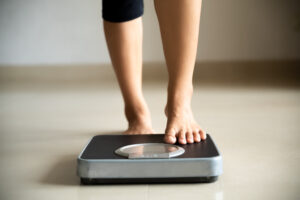
 Long after eating patterns and weight have stabilized, many women with an eating-disorder continue to struggle with issues of body image. In fact, body dissatisfaction has become so prevalent, many authors propose it has sadly become simply part of the female experience. Body dissatisfaction is believed to be one of the highest predictors in adolescent girls who go on to develop an eating disorder.
The National Eating Disorders Association (NEDA) defines negative body image as:
- A distorted perception of your shape—you perceive parts of your body unlike they really are
- You are convinced that only other people are attractive and that your body size or shape is a sign of personal failure
- You feel ashamed, self-conscious, and anxious about your body
- You feel uncomfortable or awkward in your body
I am a psychotherapist who specializes in the treatment of adolescents and women with eating disorders. For several years I have been leading body-image therapy groups in my outpatient practice. What follows are some of the group topics we cover as well as resources and activities I have found useful for helping people with their body image.
Generally, the group therapy series is focused on improving body image and runs for eight to ten sessions, as outlined below:
Session 1: My Body Relationship.
How do I feel about my body? To introduce this topic, group members participate in an art activity exploring how they feel about different parts of their bodies—from head to toenails. When asked to voice to the group the body part they like most, frequently the women will speak about a part that allows them to pleasantly experience some aspect of life, for example: “My hands—because I love to play the piano.” This activity allows members to recognize that some parts of their body are just fine, in their eyes. It’s not all body hatred. Great! We can build on this.
Leslea Newman’s book SomeBody to Love: A Guide to Loving the Body You Have (1991) has journaling exercises to help people creatively work toward repairing a broken relationship with the body. She recommends writing love letters, having dialogues with body parts, speaking compliments into the mirror, and more.
Session 2: Create a Vision.
How do I want to feel inside this body? If I felt this way, how would I move differently, how would I interact with others differently, what would this free me to do and experience? Using guided visualization, to step into and experience this vision, allows each person to plant and hold in their awareness a goal to guide them in the work ahead.
Session 3: Contributing Factors.
How did I come to define beauty? What experiences and messages contributed to my personal body opinions? Using a time-line, each group member looks at significant life events and paralleling patterns of weight and feelings about the body. The women in group often speak of having felt “different” from their peers. They feel dissimilar in their relationships with one another and with food. They also feel ambivalence about their developing bodies. We take a critical look at the media and the conflicting messages received from advertising. NEDA offers a number of handouts useful in facilitating this discussion.
Session 4: Body Talk.
What’s being said inside my head? How we talk to ourselves and what is said has a powerful effect on how we feel. Thomas Cash, PhD, in The Body Image Workbook: An eight-Step Program for Learning to Like Your Looks (2008) tells us this talk is often self-defeating, derogatory, and distorted rather than realistic. His book and audio program provide people with specific steps and tools to help them become aware of their negative body talk and begin to transform these messages.
Session 5: Body as Camouflage.
What do I hide with my body? To explore this dynamic, each group member creates a collage with magazine clippings portraying the “inside me/outside me.” People have used this activity to explore their beliefs about what others assume and expect of them, the image they try to portray, and then what they really feel like on the inside. We explore how they have used their bodies to protect or distract them from certain feelings and what it has been like to live with such a dichotomy.
Session 6: Body as a Vehicle.
What can I do and experience, thanks to my body? Sondra Kronberg, RD, writes, “True body power is the power of the body to accomplish tasks and be the vehicle through which to experience life” (Fall, 2002). As a group, we meet for a nature walk, adapted from the chapter called “Sensual Walk,” in Working with Groups to Explore Food & Body Connections: Eating Issues, Body Image, Size Acceptance, Self-Care (1996). In silence, we mindfully pay attention to the titillation of all of the senses: “Notice the smell of air, the feel of the elements, the textures beneath your feet, the views along your route, the taste on your lips, the ever-changing sounds in the background or foreground” (1996). In processing the experience, we talk about beginning a new relationship with our bodies by celebrating all the amazing things our bodies do for us and allow us to experience. Using Thomas Cash’s chapter called “Adult Pleasant Activities List” (1996), members are asked to mindfully and joyfully experience something from the list each day for the next week.
Session 7: Body as Container.
What is this spirit, this essence-of-me that lives inside my body? Kronberg goes on to write about the importance of helping our clients find their “real beauty,” that is the beauty “stored inside of them” (2002, Fall). During this session, group members create a word and picture collage of favorite things, causes they passionately believe in, relationships that matter most, compliments received, qualities of character they admire in themselves. This activity is often a favorite and reminds participants that they are so much more than the size of their clothes.
Session 8: Body as a Rich Source of Wisdom.
What can I learn if I slow down and listen to my body? This session opens with a deep-breathing exercise to practice being still, quiet, and focused. We then explore “gut instinct”—where and how we experience it in our bodies and how we have used this information to reliably guide us. Members are also invited to explore feeling states in the same way. Using a body outline on paper, members draw where in their bodies they feel anger, sadness, or loneliness, noting the size, color, and shape of each, and what distinguishes one from the other.
Session 9: Body Respect.
I can honor and take care of my body. This is a brainstorming session of all the things we can do to take care of and nurture our physical selves. Belleruth Naparestek’s affirmations are used from A Meditation for Relaxation and Wellness.
The following is excerpted from her beautiful work:
- I thank my body for all it has done for me in the past and all it will do for me in the future.
- I am learning to trust my body and to make good use of the information it offers me.
- More and more I will save my energy for what truly matters to me.
- I am aware that with each breath in I am sending precious oxygen and rich nutrients to the places in my body that need them.
- I welcome my ability to listen to the wisdom of my body and sense what it needs—telling me to rest, pace my energy, and take gentle good care of myself.
- More and more I can understand that my body is my ally, my oldest friend, and steadiest companion.
Body image work is a critical step in full recovery from an eating disorder.
Recommended Reading:
- The Body Image Workbook by Thomas Cash, PhD
- The Body Myth by Margo Maine, PhD & Joe Kelly
- Eating in the Light of the Moon by Anita Johnston, PhD
- A Meditation for Relaxation & Wellness (CD) by Belleruth Naparstek
- SomeBody to Love by Leslea Newman
- Transforming Body Image: Learning to Love the Body You Have by Marcia G. Hutchinson, EdD
- Working with Groups to Explore Food & Body Connections by S. Christian, Editor
References:
- Kronberg, Sondra. (2002, Fall). Nourishing a Healthy Body Image: A Nutritionist’s Perspective. Perspective.
- Levine, Paula. (1993). The Meaning of the 3D’s, Eating Disorders & Awareness Prevention. Perspective.
- Naparstek, Belleruth. (2002). A Meditation for Relaxation & Wellness. Akron, OH: Health Journeys.
- Ressler, Adrienne. (2006, May) A Body to Die For: Advanced Training in the Treatment of Eating Disorders & Body Image Disturbance in Women. Perspective.
- Hawkins, Nicole. (2009). Battling Our Bodies: Understanding and Overcoming Negative Body Images. Center for Change. Retrieved from: http://centerforchange.com/content/battling-our-bodies-understanding-and-overcoming-negative-body-images

The preceding article was solely written by the author named above. Any views and opinions expressed are not necessarily shared by GoodTherapy.org. Questions or concerns about the preceding article can be directed to the author or posted as a comment below.
 How Advertisements Targeting Women Undermine Body Image
 Body Image Issues and Healthy Boundaries
 The Vanity Myth: Eating Disorders and Beauty
Please fill out all required fields to submit your message.
Invalid Email Address.
Please confirm that you are human.
Leave a Comment
By commenting you acknowledge acceptance of GoodTherapy.org's Terms and Conditions of Use.