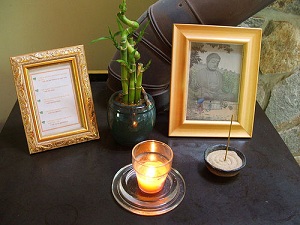
 Altars and Shrines: What Are They?
Archeologists have found evidence of altars and shrines in nearly all places where there is evidence that humans have lived. The predisposition to construct these kinds of sacred creations seems almost to be part of our DNA. Traditionally, shrines are memorials or monuments to the dead. We have made shrines for thousands of years throughout the world’s cultures.
Some well-known shrines include the Taj Mahal and the Egyptian pyramids. Public monuments such as the Vietnam Veterans’ Memorial, the Mount Rushmore carvings, the Lincoln Memorial, and the Martin Luther King, Jr., Memorial are all examples of secular shrines that honor the memories of individuals whose lives and deaths have influenced our history as well as countless individual lives.
We create shrines in public spaces, in our communities, in places of worship, and in our own private spaces. We create them after long preparation and fundraising, with thoughtful planning, through elaborate installations, as well as with less expense and fanfare. We may place them in our own private spaces, in a community gathering place, or at specific sites where a death or tragedy occurred.
Shrines may evolve as spontaneous collaborations, such as those created by students, faculty and families at Virginia Tech or Columbine after those tragic shootings. Those types of shrines are usually added to throughout the days following the shootings and provide a community gathering space. They become places where the shocked and grieving may seek comfort and support from others. Shared, spontaneous shrines often evolve into more permanent community memorials where the lives of those who died can be remembered. Street memorials, where family and friends lay flowers, trinkets, card, balloons, or works of art where loved ones died, can be found in cities all over our country.
In New York City, throughout the five boroughs, one can see the hundreds of Street Memorial plaques placed at spots where pedestrians were killed on the city streets. That movement arose from the St. Louis, Missouri’s Ghost Bike Memorial project where bicycles are painted white and locked to street signs near crash sites to memorialize bikers who died there. Think also of the highway memorials and shrines that can be seen along our nation’s roadways at the sites where someone’s family member or partner was killed in a crash.
Shrines may be created outside the homes or at the burial sites of well loved public figures or artists who have died, such as those created in honor of John Lennon, Princess Diana, Jim Morrison, and Edgar Allen Poe. Shrines can serve as places for solitude, reflection, and remembering but they can also be whimsical and celebratory like the brightly colored Day of the Dead shrines in Mexico’s annual festivities which celebrate and honor the lives and memories of loved ones who have died with parades, games, picnics and family gatherings. Shrines connect us to our past, to each other, and to something greater than ourselves. They serve to help us remember and to heal.
Sometimes there may be confusion about the differences between shrines and altars. Often, the words altar and shrine are used interchangeably. For the purposes of personal healing from grief, or your own personal spiritual expression, you can use which ever term you like. If religious connotations make you uncomfortable, you may prefer thinking of a personally created altar or shrine as a memorial, memory box, memory space, honoring space, remembering space, meditation space, etc. Your space can be called whatever you choose to call it.
Shrines are typically dedicated to a specific person, or in religious traditions, to a specific deity or saint. In the case of shrines dedicated to people who have died, those can also be considered as memorials. An altar is usually thought of as a sacred space used for specific functions that may be associated with religious and spiritual purposes, such as worship, prayer, rituals or offerings. In religious traditions, the altar is usually the centerpiece of the worship space, such as in a church, synagogue, temple, mosque or sacred circle.
Many people create home altars as a personal sacred space for prayer, reflection, meditation or other specific spiritual and religious pursuits. Home altars can help us focus our minds on our chosen spiritual path and serve as daily reminders of a spiritual focus or our connection to Spirit. Altars may also be created and dedicated to specific deities or saints.
Altars can also be created with people as a focus. In my own home, I have little altars everywhere, with photos of my son, elements of nature (such as stones, shells or flowers), candles, or incense, place with other objects that help me to focus on peace and comfort, such as a lovely little Jizo statue or a statue of Ganesha. Shrines and altars can be as small or elaborate as you like. You may have many different shrines or altars for different things.
Why Create Shrines and Altars?
As the instructors at Life Path Center for Learning and Healing beautifully put it, “altars and shrines are external representations of interior mysteries.â€Â Shrines and altars are ways of showing in tangible form what might be happening in our hearts and spirits. Creating shrines and altars gives us opportunities to remember, to reflect and to honor, as well as to help heal the pain of loss through the act of creating. The creation of a personal shrine can establish a private place to which you can return to reflect, meditate, grieve, engage in a personal ritual, remember, and honor the one who has died.
Small, portable shrines can be carried with you where ever you go. These might be as small as a matchbook that can fit in your pocket or something a bit larger, like the size of a book, perhaps, that might be slipped into a purse or briefcase. A take-along shrine can allow you to maintain a needed connection with your loved one, or to create a sacred space for remembering or engaging in any type of personal ritual any time or place you may need or want to do so. Or you might prefer to create a more permanent shrine or altar that can be set up in your home or on your property using heavier more substantial elements, or a smaller semi-permanent type whose elements can be taken apart and used in other places or spaces. The choices are yours.
Creating Your Shrine
There are no rules or guidelines for creating shrines. The beauty of creating a shrine is that the ideas and materials are seemingly endless and the process, like the grieving process itself, is completely individual. A few guidelines might be helpful as you engage in the creation your own personal shrine.
Before you plan the look of your shrine, spend some time thinking about your loved one without thoughts or preconceived ideas of what you think your shrine might look like. Here are some ideas that may help the process:
- Make a list of words that come to mind when you think of your loved one.
- Make a list of objects or things that you associate with your loved one.
- Write down any words of wisdom, favorite expressions, funny or loving things your loved might have said. If your loved one never spoke, write down memories that have stuck with you, specific times that you continue to return to, that seem to bring some peace and comfort and to remind you of their love.
- Write down nicknames or pet names you might have used for each other and any associations those words may bring up .
- Write down his or her favorite colors, flowers, foods, hobbies, talents, etc.
- Research and find images that correspond to some of the things you have listed. You may find lots of interesting images on the internet that you can print and cut out for use in your creation or seeing the images may spark other thoughts or ideas that you may wish to incorporate in your memorial shrine.
To Create a Take-Along Shrine
Some artists suggest that a container be decided upon first before proceeding. The container may help guide the process or selection of items used in creating your shrine. Some suggestions for containers which can be re-purposed as your moveable shrine:
- Altoid tins (or other candy or gum tins)
- Sliding matchboxes (these can be the very small sized matchboxes or the large kitchen match boxes)
- Jewelry boxes
- Gift boxes
- Cigar boxes
- Shoe boxes
- Deep frames or shadow boxes
- Drawers
- Books (you can make a book into a box by cutting a rectangular shape into the pages and then gluing the pages together to create a container inside the book)
Gather basic craft supplies:
- Scissors
- Glues
- Paints (acrylic craft paint is inexpensive and works well for this purpose)
- Decorative and colored papers
- Photographs, personal objects or other items related to your loved one
- Anything else that you wish to add to your creation, such as
Ribbons, wires, sticks, dried flowers, string, yarn, decorative paper, wrapping paper, rhinestones, shells, small mirrors, glitter, charms, and beads, as well as anything that you like, that speaks to you, and that can be glued down.
Then, begin your process:
- Prepare your surface by painting or covering the outside and then the inside of your container, allow it to dry completely.
- Add background papers or images on the prepared surface if you wish.
- Place the photo(s) of your loved one where you think it should go. Add your embellishments as desired inside and out: beads, glass pebbles, words, charms, etc., until you feel you have completed your shrine.
To Create a Semi-Permanent or Permanent Shrine
To create a semi-permanent shrine, decide on your location or designate a particular space, such as a table top or a special shelf. You may want to visit thrift and antique shops to find the perfect small table or shelf that will serve as the base for your home altar/shrine. Of course, you can re-finish, paint, and decorate these items as you wish, or you may choose to forgo the paints, glues and embellishments.
Your shrine is yours to create as you see fit. Once you’ve found your base, begin the assembling of your sacred space. Gather together meaningful items that will help you focus on your intentions of memorializing, remembering, honoring, and healing. You might want to cover your altar with a special cloth or decorative mat. Next, you may want to place a picture of your loved one in a special frame as the centerpiece of your shrine. Add to this basic memorial anything you wish.
Some Suggestions:
- Personal objects that remind you of, or which are connected to, your loved one. These might include other photos, jewelry, letters or cards he or she gave you, awards, trophies, caps, hats, and other items of clothing, favorite books, or items he or she used on a regular basis such as sewing scissors, razor, comb or brush. The list here could be nearly endless.
- Natural objects such as flowers, fruits, rocks, crystals, shells, sticks or branches from your back yard, pinecones, leaves, abandoned birds’ nests, etc. You may wish to change the natural objects weekly (such as fresh flowers or fruits) or monthly, changing out stones and shells or other things you may find in nature.
- Candles, oil lamps, or incense
- Small strings of lights
- Chimes or bells
- Religious or spiritual objects that speak to you, such as statues or photos of deities or saints, or other religious or spiritual symbols
You may add to or change the objects on your shrine as often as you wish. Many people like to add seasonal items, such as a small Christmas tree or a Menorah during the holidays, various ornaments and items representing special times of the year such as your loved one’s birthday or other special days.
You can use your shrine or altar space simply as a reminder of your loved one or as an active part of creating and conducting your personal grief rituals. The planning, making, building and “adding to,†of your shrine can itself be a healing ritual. What you do with and how you use your creation is entirely your choice. Your creation is as individual as your personal journey through grief toward healing.
Please feel free to share your experiences with your own shrines and altars. If you do not have your own shrine or altar, whether or not you are grieving, consider creating one. Shrines and altars can bring a great deal of peace and comfort, as well as serve as a reminder for us to slow down and focus on those things that are important in our lives—our loved ones, our hearts, and our souls.
 No one can prepare us for the experience of providing care for a seriously ill family member or friend. When sickness strikes someone close to us, there may be a sense of chaos, urgency, and confusion. Details must be agreed upon, phone calls made, and appointments kept. You’d like to sit and catch your breath, but chances are there is a list of tasks and you’re already running behind.
Illness has a way of sweeping the rug right out from under us. Some illnesses are chronic, part of our loved one’s day-to-day existence – and ours as well. Others may first appear in the form of a suspicious lump, a questionable lab result, or an accident. Whether chronic or acute, you’ve got a lot on your mind, heart, and plate. This article is written for you – a few ideas to help you so that you can better help your loved one.
Get centered – Stop, for just a moment, and look at your daily routine. Are you getting enough nutritious food? Enough sleep? Are you able to go for a walk, even around the grounds of the hospital? You can’t drive a car on an empty gas tank. Take a minute to make sure you include some element of self-care. If this feels overwhelming, keep reading.
Get connected – Meet the doctors and caregivers involved in your loved one’s treatment. Explore resources for support in your community.  Hospitals usually have a Social Services office, oftentimes with social workers and others who can talk with you, offer ideas and resources, and help you navigate this experience.
Get answers – Got a question about your loved one’s treatment? Ask. Noticing a new symptom or a side effect of medication? Tell someone. Clinicians are often bound by confidentiality, which may or may not apply depending on your circumstances. It doesn’t hurt to ask or to speak up. Knowledge is power. While we are on the topic of answers, is this the time to become aware of your loved one’s treatment wishes, legal matters, preferences about his or her personal paperwork? These can be some of the most difficult decisions we ever have to make, but they are important to consider in the case of serious illness.
Get support – It can be easy to isolate and lose touch with your friends and family, however, having concerned others who can be there for you is vital. Allow others in. If you can, remain involved in school, work, and activities you enjoy. Some days you may need to share how you are feeling with a friend. Other days you may not be able to give one more status report and just want someone to go to a movie with you. Friends and family can be a vital part of your wellness team.
Get control – “Control?? You’ve got to be kidding!â€Â It may feel right now like nothing is within your control. Serious illness or injury can sweep through your life like a force of nature. But hear me out. What can you control right now? Making decisions about mundane tasks like what to wear or what to have for dinner can add a tiny spot of normalcy. You can prioritize your day in any way available to you: “I will spend an hour at the hospital this morning, then when Mom goes down for x-rays, I will go down to the coffee shop and call a friend.†Getting control may also mean knowing your limitations and saying “No†when you need to.
Finally, get hope. When someone is diagnosed with serious illness, it may be hard to know what the future holds. There is a fine line between facing a significant medical diagnosis realistically, and holding onto hope for recovery. You may find yourself wavering between hoping for the best and yet fearing the worst. You are not alone in this state of confusion. Finding peace and balance can come as you work through the barrage of feelings, thoughts, and fears that are an inherent part of serious medical crises. Reach out to your support system, and allow others to help. If you have a spiritual path, this is a good time to spend some time connecting with your faith. Most of all, take the best care of yourself that you can during this stressful time.
Life holds no guarantees, but knowing this doesn’t make it any easier when we face a medical crisis. You are not alone. Allow others to help, find quiet moments for reflection alone as well as connection with your loved one who is ill, and if you begin to feel your level of distress is overwhelming, reach out and talk to someone you trust.
 Are you a person who takes care of everyone else before yourself? Do you believe you should put yourself last? If you routinely take care of others’ needs before your own, then you may have codependent tendencies. In a relationship, codependent behaviors can potentially sabotage your relationship success. If you neglect your personal needs and wishes and care for others instead, then you may begin to feel resentful and empty. Taking care of yourself enables you to then be available to take care of others.
Codependent Behaviors
Let’s explore some codependent behaviors. Ask yourself the following questions:
- When you are criticized, do you become defensive and angry because your behavior was questioned?
- Do you feel better about yourself when you are helping (and only when you are helping) others?
- Do you settle for being needed when you really want to be truly loved?
- If you are a caretaker, do you anticipate others’ needs?
- Do you feel responsible for others’ feelings, thoughts, actions, choices, wants, needs, well-being or their lack of the aforementioned topics?
- Do you find it easy to change your plans for another person’s needs?
- Do you often feel angry and used even though you choose to ignore yourself?
- Do you always say “yes” even when you want to say “no?”
- Do you say “yes” even when it is not in your best interest?
- Do you feel you do more than your fair share?
If you tell yourself that your circumstance will improve later, get depressed or sick without understanding the reason why, over-eat, feel overextended, or if you stay busy to keep from addressing the issues you need to address, you may be in a state of denial.
[fat_widget_right]
Do you find it difficult to feel joy, to have fun, or to do something at the spur of the moment? Do you find it hard to enjoy sex? Do you have sex when you really don’t want to have sex? Do you make up reasons to avoid having sex? Do you have sex when you really just want to be held and loved? Do you look for happiness in others and not within yourself? Do you choose partners who are not available (physically or emotionally) to love you? Do you stay in a relationship long after it is clear it is not working? Do you think you are not loveable? Is your communication poor? Do you blame, threaten, or beg for your needs to be met? Do you ask for your needs and wants indirectly, thinking people will just know what your needs are because they love you enough? Do you think what you have to say is unimportant? Do you avoid talking about yourself, thoughts, or dreams? Do you ignore your thoughts without voicing them? Do you fail to voice your opinions for fear of being rejected or put down?
From an early age, women are usually taught about the importance of nurturing and taking care of others. Mothers generally focus on meeting the needs of the children, husband, and household before addressing their own needs. Simultaneously, society and the media send women the message that they must be perfect. They are given the message they need to be thin, beautiful, young, perfectly dressed, and in all ways flawless. Men are taught to be outwardly strong. They are taught it is acceptable to be angry, but not sad, vulnerable, or outwardly emotional. These incorrect, constant messages will destroy us if we allow them to.
Do you often feel overwhelmed, depressed, or anxious? Are there times where you feel like an empty shell wanting to isolate yourself from the world? Do you also find it difficult to connect with others? If so, it may indicate that certain needs aren’t being addressed. Addressing neglected aspects of your inner and outer world is related to self-care.
What is “Self-Care?”
Self-care can have a different meaning for each of us. Essentially, self-care is associated with taking care of your needs, asserting yourself to increase the possibility of those needs being met, and monitoring your time and energy given to others. To feel balanced in today’s world, we must address both our inner and outer needs. Taking care of yourself will allow you to be there for your relationship. It will allow you to feel the Goddess or God you truly are inside. Your partner will respond to you in a more positive manner, and emotional intimacy will be more easily deepened when your needs are satisfied.
As parents, we get caught up in the family fast track. We are consumed by school, homework, little league, karate, dance class, and on and on. There is little time left to focus on self-care. Parents get caught in this cycle, leaving little to no energy left to meet their own physical, emotional, mental, or spiritual needs. There is no time left for themselves, much less their intimate relationships.
When we neglect self-care by focusing on trying to meet the needs of others before taking care of ourselves, we can lose our identity and power. We also harvest a great amount of resentment and self-hatred when we neglect ourselves. Ultimately, it is when we connect and address our needs that we can find balance and happiness. When this happens, we can give to others from a full heart. In other words, we can enhance our relationships by taking care of ourselves.
The list of things you can do to develop a self-care practice is endless! Learning to respond to your needs with acceptance, compassion, and a willingness to make healthy changes can begin to bring balance into your life and allow you to connect with joy. Self-care does not mean spending money. A spa day or week is great, but self-care can mean much more than having services performed.
Make a list of your needs: spiritual, emotional, physical, intellectual, and relationship intimacy needs. Under each heading, record activities that will support self-care in that area. Keep space for additions as you think of them.
Here are some suggestions:
- Journaling, meditating, yoga class, moving to your favorite music, taking time to enjoy your favorite music, lunch with the girls/guys, overnight romantic time with your honey, walk in the rain, bubble bath with candles and music, taking a lunch to the river, reading a book, or anything you enjoy. Search your soul for those things that really nurture you.
- Make a list of things that nourish your spirit and make you come alive. Is it music, art, writing, cooking, or dancing? If you’re not sure what would be on this list, then explore new activities or hobbies.
- Connecting with nature can be extremely nurturing. Take a walk on the beach or in a park and really listen to the surrounding sounds and sights. Allow your senses to open and let yourself be nourished by nature. “Taking time to smell the roses” is good advice after all.
- Laughter can be the best medicine. Play. Play with your partner. Find ways to put humor and playfulness into your everyday living. Let that “inner child” out often. Allow yourself to be silly. Allow yourself to enjoy. Allow yourself JOY.When you are filled with joy, even part of the time, all of your relationships will benefit, not just your romantic relationship.
Accept the fact that the road of life will have bumps. Instead of resisting or personalizing these bumps, accept that there are things you cannot change. Realize that the only thing you truly have control over is yourself. Be present in what is happening in your life. Reflect on whether you’re responding to your emotional, mental, spiritual, or physical needs. Are you taking good care of both outer and inner needs? Are you listening to your inner voice when it tells you to slow down, set boundaries, take care of your body, rest, or exercise?
Take care of yourself. Have fun. Life is short, so enjoy every moment. May your day be interspersed with joy.
 We humans like things to stay the same. Even if we are open to change, change can be very difficult. There is nothing more disruptive than the death of someone you love, someone whose existence is part and parcel to your own. When those people die, we are left floundering. That person may be your child, your husband or wife, your companion, your friend, your sister, or your brother. The depth and breadth of your grief depends on the connectedness you feel to the person who has died—your spiritual, emotional, or physical connectedness, and often, your perception of your very existence. The more intertwined your life with a person, the more affected you are by your experience of grief when that person dies.
When someone you love dies, you experience deep, soul-wrenching pain. Your life changes. You change. Everything changes. Things are very different than you thought they would be. Yes, it hurts terribly. But there is nothing wrong with you. Grief is not pathological. Grief is normal. It totally sucks, but it is normal. Grief is a part of life—a very painful, difficult part of life. And it flat out just sometimes sucks, but it is normal. There are things you can do to help grief along its way; one thing I believe can be the most helpful is to engage in ritual.
[fat_widget_grief_right]
What Is a Ritual?
Rituals are actions done in purposeful ways that symbolize something much more than the acts themselves. Rituals are made up of actions that represent ideas, thoughts, myths, or beliefs about a particular thing. Rituals give purpose to action and always serve to connect us to something else, generally something greater than our own solitary selves. We may engage in ritual as we seek peace, clarity of mind, or to become more grounded. We may seek connectedness to family, a particular person, our culture, society, traditions, ancestors, or even to our own selves.
We perform mini-rituals daily. Most of us have a specific routine associated with preparing for bed each night; we may wear a particular piece of jewelry or clothing for specific occasions; or we may make our beds each morning. We might repeat a particular phrase when we make a toast, or perhaps we close our texts or emails in a certain way. Whether small or elaborate, the rituals we engage in tell stories about who we are, who we want to be, and what is important to us in our lives. Your own rituals may be derived from your family, culture, ethnicity, or a particular religious or spiritual tradition. No matter what stories they tell, rituals always provide structure, meaning, and connectedness.
Perhaps the most significant thing that rituals provide is a certain order to an existence that otherwise might be full of confusion and chaos. Human life is full of confusion and uncertainty and, undoubtedly, the most chaotic times in our lives are the times when we are grieving. Grief is chaos. Times of grief are when we need ritual most. Unfortunately, in our society, there are few rituals that are specifically designed for grieving people, aside from the funeral or memorial service. These are necessary and helpful, but grieving people need more than a couple of rituals to help quell the deep chaos the death of a loved one can bring.
Create Your Own Rituals
Creating your own personal rituals to remember your loved ones allows you to access and work through your grief in a safe and constructive way. Some people plan rituals in honor of a loved one’s birthday or an anniversary. Others choose to express their grief through small daily or weekly rituals. A ritual can be as elaborate as a public memorial service or as small as a quiet moment alone with your loved one’s picture. Some examples of small rituals include:
- Lighting a candle at certain, special times of the day or week to remind you of your loved one (for example, at dinnertime to represent sharing meals with him or her)
- Creating a memory scrapbook and filling it with photographs, letters, postcards, notes, or other significant memorabilia from your life together
- Spending time listening to your loved one’s favorite music or creating a special mix of music that reminds you of that person
- Watching his or her favorite movie
- Planting a tree or flowers in your loved one’s memory
- Making a donation to a charity that your loved one supported
- Visiting your loved one’s burial site
- Carrying something special that reminds you of your loved one that you can take out and hold when you feel the need
- Creating a work of art in your loved one’s memory
- Preparing and eating a special meal in honor of your loved one
- Developing a memorial ritual for your loved one on special days or whenever you wish
Some people engage in the smaller, spontaneous rituals listed above on a regular basis. You may do something similar, or you might choose to create a more structured ritual. You may decide to create a special ritual only one time, or you might decide to hold your ritual (or some version of it) on a regular basis—daily, weekly, monthly, or on special days like birthdays, anniversaries, holidays, or other special occasions.
When selecting activities for a more structured grief ritual, choose specific things to mark the opening and the closing of your ritual:
- Light a special candle used only for your ritual purposes
- Light some incense
- Read or say aloud an inspirational verse, poem, or prayer
- Sing a song
- Chant
- Play a particular selection of music
- Ring a chime or a bell
Clearly marking the beginning and the end of the ritual will help you transition into a different frame of mind at the opening, and it will signal that it is time to shift consciousness back to the mundane at the closing.
Remain Open: Do What Feels Comfortable to You
Before starting the ceremony, take a few deep breaths to center yourself. Remember that it is okay if you cry. This is your space and time to express your grief in whatever ways you need to do so. If all you can do is cry during your planned ritual time, most likely, that is what you need to do. Whatever happens in between the opening and closing of the ritual is completely up to you. You can have an activity planned, or you may be the sort of person who feels more comfortable planning nothing at all. Perhaps you’ll choose to do whatever you are moved to do once you are in the ritual space—you might wish to simply sit quietly for as long as you need to, listen to music, spend time crying, look through photos of your loved one, meditate, pray, or read some healing literature or a sacred text. It is okay to remain open and do whatever comes to you in the moment.
Sometimes you may feel the need to communicate something to your loved one. The sacred, safe space of a ritual is an ideal place to do this. When you need to communicate, you may choose to speak aloud, meditate on your thoughts silently, or write your thoughts in a letter. Consider incorporating the burning, burying, or floating of the letter that you write in a future ritual.
You may simply feel the need to release energy in your ritual space. Yell, scream, or cry as much as you need to. If you’re working through feelings of anger in your grief, keep pillows nearby that you can hit, punch, or throw. Tearing and ripping paper or stomping cardboard boxes can also help release anger. You may wish to include some movement, dance, or vocal expression such as singing, chanting, or yelling. You might want to beat on a drum or play some other instrument to release energy and emotion through sound.
Consider Inviting Others
You can conduct your grief rituals alone or with others. Your ritual could be an ideal time to share your grief with friends and family members grieving the same loss. If you invite others to join your ritual, you may wish to ask each person to share something about your lost loved one—a memory, story, or thought. Ask guests to bring something to read or share as part of the ritual, and invite them to participate in any ritual activity you develop, such as chanting, drumming, or letter-writing.
Continue Your Ritual as Needed
Conduct your grief rituals for as long and as often as you need to. As you heal, you may find that your need to engage in ritual for your grief will wane. Continuing to maintain some of your small rituals, such as continuing to carry your loved one’s photograph or wearing a particular sentimental piece of jewelry may serve you. Your more elaborate rituals may change over time, or you may feel the need to hold them only on special occasions, such as birthdays or anniversaries. If you have created a shrine or altar that you have used in your rituals or kept in your home, you may find that you wish to make changes to it over time. This is okay, too. The changes mean that your personal process through grief is progressing, and your rituals have helped you move from chaos and pain to wholeness and stability.
I hope that this has helped you think about ritual and how you might use it as you move through your own grief process. Please feel free to comment about how ritual has helped you, what kinds of ritual activity has helped you—large or small—and what your thoughts are on engaging in ritual to help us move toward healing.
 Manifesto: a public declaration of intentions, opinions, objectives, or motives.
As a long-time yogi, I have been setting an intention before my daily practice for more than 10 years. Perhaps it was this habit that prompted me to write my first manifesto in 2004. Gathering healing thoughts and wishes into one short document was enlightening, centering, and deeply positive. Since others have found this process helpful, I wanted to share the method and some suggestions for possible inclusion in your own manifesto.
Guidelines for Writing Your Manifesto
Let it flow. In my opinion, the best thing you can do when you start to write anything is let it flow. As you allow thoughts, feelings, and ideas to take shape on the page, give yourself the gift of writing without interruption. That means both carving out a little time for yourself and not stopping to edit your words. You can revise and rewrite later on.
Brainstorm. Write the word “manifesto†in the middle of a blank page and let your mind wander. When an idea pops into your head write it in a circle around that central word. Then, focus on each word and write what comes to mind in a line branching out from it. That may be enough for one day. If you feel like continuing, focus on any word or concept that speaks to you, and think of your wish for your own growth, development, or peace as it relates to that idea.
[fat_widget_right]Daydream. Recent studies show that encouraging your mind to wander in what appears to be an aimless manner actually generates creative solutions to problems and is just as valid as any other kind of “work.†If you regularly keep a journal, or a dream journal, you may find rereading entries gives you plenty of fodder for your manifesto.
Let go. If you have a health issue, you might explore ways to be more comfortable with your body. Think of phrases that help you let go of preconceived notions about your health, and accept things as they are because you can be sure they will change. In situations you can’t control, it is often best to find power in letting go, and allowing what is to be exactly as it is.
Build resilience. During a particularly difficult transitioning period, you may want to focus your intentions on building resilience. Certain life events—such as becoming a parent, taking a job, or moving—naturally inspire new thoughts and wishes. Let your mind wander, and imagine ways you would like to be in this stage of your life. If you are working with a therapist, there may be recurring themes you want to address.
Whether you try some of these suggestions, read the examples below, or just start writing, it is best to remember your manifesto is an ever-changing, fluid document meant to support you on your journey to your truest self. It is not a rigid set of rules or “shoulds†to encourage negative self-talk or critical self-evaluations. Let your imagination run wild. Think of how you would like to live your life, and write what comes from that deep, all-knowing place.
Here are some ideas to stoke your creative process:
- I embrace my humanity and fallibility.
- I appreciate every goodness and kindness in my life by practicing gratitude.
- I allow my body, mind, and spirit the time and space to heal.
- Every day, I make time for self-reflection.
- I am exactly where I am supposed to be in this moment.
- I get outside and let nature work its magic.
- All I seek is already within me.
- I tenderly acknowledge the small, vulnerable child in myself and others.
- I surround myself with beauty.
- I give my body the movement or stillness it seeks.
- When I feel hopeless, I let myself take another breath until despair departs.
- I regularly tune in to nourish any areas I have neglected, whether social, creative, physical, spiritual, or intellectual.
- I acknowledge my losses and grieve, letting go when the time is right.
- I cultivate patience during the fallow times, for they nourish and prepare me for a bountiful harvest I may not be able to see in those dormant, but fertile, moments.
- Every day, my heart opens a little more with compassion for myself and others.
- I allow myself to feel and express all emotions.
- I carefully and authentically share my truth.
- When I say or do something insensitive or thoughtless, I apologize.
- I take all the time I need to be with grief, hurt, and anger, knowing they will pass.
- Appreciating my unique gifts comes easily and naturally to me.
- I rise to the joys and challenges of each day, knowing I have made it through every one, so far.
- I allow life to unfold and surprise me.
- I welcome the rhythms of my body, mind, and spirit as they continually evolve.
Play is serious business!
–Caitlin ‘Cake’ Gateaux
I was asked by the US Play Coalition research committee to collect personal statements about ideas and beliefs that are connected to the question, what is play?
How we define play and its value is shaped by many personal, historical, and cultural influences. Darell Hammond, in his recently published book, KaBOOM! How One Man Built a Movement to Save Play, writes about the reality of a play deficit in our communities. He calls on those of us who recognize the value of play (and there aren’t enough of us out there, he says) to take action steps that will lead to a greater recognition of play’s value while brightening each child’s life and create playful communities for all ages no matter where we live. (more…)
 Experiencing a traumatic life event is horrific and terrifying, but this experience does not have to become your defining moment.
It is possible to grow through a traumatic event, or series of events, and there are loosely-structured phases of healing for that growth to follow. For a moment, stop and reflect on what it means for experts to have identified these patterns of healing: it means that you are not alone in having experienced trauma, and you are not alone on the healing journey.
The healing journey follows three loosely linear stages or phases. The rate of growth through each of the phases, as well as the details of what that growth looks like, will be unique to you. You will develop your own unique pattern of healing, which means that you will enter, exit, and revisit phases at various times in your life.
Always keep in mind that revisiting is not backwards movement. It is like the outer layers of a spiral: you pass by the same issues, but are in a different, deeper state of healing. As you near the end of your healing journey, you will be able to look back and notice an overarching progressive nature to your growth and healing.
[fat_widget_trauma_ptsd_left]This article will look at the first phase of healing, while future articles will address the second and third phases.
Understanding the Safety Phase
As you begin the first phase of healing, safety is both your main concern and the hardest task to achieve. Establishing safety—both within yourself and within your environment—can take days, weeks, or even years. The length of time required to develop genuine safety depends on your unique attributes, such as past life experiences, personality, and pretrauma baseline. The length of this phase also depends on how chronic the trauma. In general, the longer you were exposed to the trauma, the longer it will take to develop a sense of safety.
This is not an easy stage. Establishing safety requires a lot of hard work and may require that you, the survivor, dramatically change your life or lifestyle. While this is a difficult part of the healing journey, absolutely no survivor can skip this stage.
Safety Within
In order to truly have safety, you must establish safety within yourself. Focusing on your physical health lays the foundation for internal safety. Establishing internal safety requires you to tend to any ailments, as well as to eat healthy foods, exercise regularly, and sleep sufficiently. Self-harming behaviors preclude genuine safety, so cutting, burning, or addictions to drugs, alcohol, food, or sex, must be grown through and terminated.
Many self-harming behaviors are efforts at managing emotions or thoughts. Learning how to manage your thoughts and emotional world, including your trauma reactions (especially hyperarousal and intrusive reactions), is fundamental to being safe within yourself. Many people find it difficult to engage in this healing without the assistance, support, and guidance of a trained professional. Do not feel ashamed or hesitant to reach out for help.
Safety in the World
Safety within oneself is only half of the equation. No one can be fully safe unless the environment they live and interact in is also safe. Creating safety within your environment requires safety within your physical and relational spheres.
- Attaining a safe physical space includes your ability to move physically in society with a sense of safety and security. It may help to work on your ability to identify dangerous situations or individuals and, to the best of your ability, to get out of a dangerous situation if at all possible. Consider developing safety plans or learning self defense.
- Assess the physical and emotional safety of your social support network. It may be necessary to remove people from your life who are a potential source of physical or emotional danger, or to increase the number of people who can and do provide emotional support, protection, or practical help.
- For those who experienced trauma at the hands of other people, assess the degree of continuing threat and the potential for re-victimization or revenge, and develop appropriate precautions. Ensuring your safety is not 100% within your authority, since to live means to be vulnerable. But that does not mean it is 0% within your authority either.
Moving Through the First Phase
This phase of growth is gradual. It can have a sometimes halting stop-and-go pattern, and it can take a long time. However, if you continue to work on developing safety, and allow trustworthy others to help you, you will be able to grow through this phase.
Some indicators that you have grown through this phase include no longer feeling utterly vulnerable; having a degree of confidence in your ability to protect yourself physically and emotionally; knowing who to count on for safety and support, and being able to effectively manage most of your trauma reactions, including emotions, thoughts, and behaviors.
If learning about the tasks involved in this first phase of healing feels daunting, don’t give up. Reach out to a trained therapist and harness their skills and abilities in order to engage in this healing work. You have a right to reclaim the quality of life you deserve.
If this first phase of healing sounds like a review of work you have already completed, take a deep breath of congratulations and gratitude. You are on your way to continued and ever-deeper healing and growth.

What do you do when you feel bad? You may clean your house, take a walk, or binge on sweet or salty foods depending on who you are and what habits you’ve developed. Does whatever you do make those bad feelings go away? If so, for how long?
Your feelings – good, bad, or ugly – represent your reactions to experiences. When you disown feelings, you disown yourself. This hurts your self-esteem. Let’s take a closer look at why.
By definition, you can not esteem someone who you are unfamiliar with. Self-esteem requires some knowledge of who you are and what you’re about. In other words, to have healthy self-esteem, you need a measure of self-knowledge. The more aspects of yourself you are aware of, the better you know yourself.
When we try to avoid to feeling the way we actually do,we are performing a kind of psychological gymnastics. We are maneuvering around inside ourselves in an attempt to distance ourselves from the pain. Cutting ourselves off from the pain rejects the part of us that is feeling pain. It’s a sacrifice similar to cutting off a leg caught in a trap in order to save the rest of our body.
Nobody wants to feel badly, which is why we try so hard to feel happy most of the time. When we can’t avoid feeling unhappy, we often try to contain any damage by “getting over it†quickly, or trying to talk ourselves out of an underlying feeling of loss. Some common examples are:
- “He was no good for me anyway.â€
- “I should be glad I still have my health.â€
- “She’s in a better place now.â€
This is adaptive behavior that attempts to minimize emotional pain. Unfortunately, such attempts sometimes succeed too well in the long term. We isolate our hurt selves. We become fragmented in the process and keep ourselves from the healing we need.
At a deep level, we are aware of this banishment of our hurting selves. We know that we’re keeping something from ourselves. This knowledge itself must be hidden. Losing connection with the pain worsens as we lose trust in ourselves. There are too many secrets. We might even have lost self-respect because of what we dimly perceive as a lack of courage. We are afraid to repair the rift and invite all those suppressed feelings back into our awareness.
Feeling separated from ourselves erodes self-esteem, just as a collection of “No Trespassing†and “Keep Out†signs might erode the goodwill of one’s neighbors. Self-esteem requires that we embrace every aspect of ourselves. We need self-awareness and self-acceptance to feel whole. What many call “wallowing†is an opportunity for both awareness and acceptance of ourselves. Constructive wallowing is not for the weak or the idle. It takes courage and fortitude.
True wallowing is not like sinking into a warm bath; it’s more like getting a bikini wax. If you want the smooth results, you’ve got to endure the uncomfortable process. Just as it’s said that there’s a price for beauty, there is also a price for self-esteem. If it were easy to come by, more of us would have it. The price of self-esteem is full awareness and a willing embrace of our emotional pain.
Only by fully experiencing our pain can we reunite with the cut-off parts of ourselves that carry our deepest hurts. Through allowing ourselves to have our true feelings without self-criticism, we can know our whole selves and experience the courage of our intent to be who we are. This is the essence of self-esteem.
 Unemployment is a downright monster. Most often, we see a lot of support for the unemployed person who is building his or her resume, interviewing, networking, staying busy, and being positive. I certainly hope and pray that our economy improves soon and each unemployed person finds work that is fulfilling in both meaning and income.
But how about support for the partners of unemployed people?
Ms. Y (not her real name) came in the other day and said, “My husband has been unemployed for over two years. Over two years. Over—two—years! I say it, dumbfounded, because at some point every day, I realize that I can’t believe how long it’s been. First it was an industry crisis. Then came his depression. Then there was his second wind, his revival. Then the revival turned into stagnation again. There were a number of short-term freelance gigs. There were rejections, interviews, and even jobs-in-hand that folded at the last minute thanks to the tanking economy.
“During every rise and fall of this god-forsaken unemployment phase, I have been there to support my partner every step of the way. I’m exhausted. I’m tired of being the sole breadwinner. I’m especially tired of all those people who tell me what they think about my husband’s lack-of-work situation. During these years, I can’t tell you how many times I’ve been at some function where after a few drinks someone said to me, ‘I feel so bad for your partner. Your partner really needs support. Be patient, be supportive.’
“I think to myself, ‘Me, be patient? Me, be supportive? When haven’t I been?!’ I want to jump out of my skin and slap that person silly. Instead, I stuff my pride, and in my most polite tone, I tell the preacher-man to stick it. I want to hear what they have to say after they’ve supported their unemployed partner for over two years. I doubt it’ll be the same thing, I swear. Jerk.â€
My heart goes out to Ms. Y and people like her. It is tough to be unemployed, but it is equally tough to be the partner watching and supporting the unemployed person. It is a terribly helpless position. Some have become involuntary breadwinners, straining to care for everyone and everything with one lone paycheck. All are forced to be passengers on the emotional roller coaster ride of a loved one’s bout with unemployment.
Some are the only people their unemployed partners will talk to about their suffering. Often, their emotional needs involuntarily get thrown aside because of the attitude that “unemployment isn’t happening to you, it’s happening to the unemployed.†Both the unemployed and partners of unemployed vacillate on the spectrum between the hope for the day of the “Great News” (“I start a new, real job on Monday and can help pay the bills now!â€) and fear that their savings will be sucked dry and they’ll be forced to live in a shelter—or worse, their parents’ house.
I say unto you, dear partners: It is time.
Partners, it is indeed time to take care of you. You deserve it. You have done an amazing job of standing by your unemployed person’s side despite the mental, physical, and spiritual turmoil that unemployment puts everyone through. So first of all, do yourself a favor and give yourself—your mind, body, and soul—a break.
How can you possibly give yourself a break at a time like this? Well, if you don’t, you’re going to keel over, for one. The truth of the matter is that unemployment is not what defines you or your partner completely. In other words, each of you is a complex, multifaceted human being who remains healthy as long as your mental, physical, spiritual, and relationship states are receiving attention. At this moment, unemployment is taking a toll on these four realms; however, the trick to lessening unemployment’s severe control is self-care.
Self-care means honoring the other facets of your personality and life, thereby diminishing the attention given to the unemployment monster. Take a look at the following short lists of self-care ideas that honor these other parts of who you are. You’ll find that many ideas can cross multiple realms:
Mental: Attend individual and/or group therapy. Meditate, listen to music, take a vacation alone or with a friend or partner, spend time with loved ones, take a class, or escape through watching movies or reading.
Spiritual: Pray alone or with others. Choose to be silent, join a group on a spiritual practice that you enjoy, light a candle and reflect, journal your thoughts and feelings, or attend spiritual events and retreats.
Physical: Get a massage, exercise, go for a walk, take a hot bath, get regular sleep, dance, play sports, do yoga, paint, draw, sing, arrange flowers, color mandalas, play music, use relaxation techniques, or cook.
Relationship: Attend couples counseling. Create creative dates, like cooking from scratch together; do an activity together on a regular basis, like volunteering; take a week-long vacation from talking and thinking about unemployment; have sex.
Try any or all of these ideas, and keep adding to these lists. Find what works for you. You’ll see that given enough respite, you will have more energy to carry on your daily tasks until the “Great News†arrives. No one will be able to do this for you. You have to take care of yourself just as much as you take care of everyone and everything else. So, dear partners, be good to yourself and feed your mind, body, and soul. It is long overdue.
The human shadow carries with it the potential for global annihilation and the potential to regenerate and evolve our species. At the crossroads, which road shall we choose?
I shall be telling this with a sigh
Somewhere ages and ages hence:
Two roads diverged in a wood, and I–
I took the one less traveled by,
And that has made all the difference ~ Robert Frost
Down the path less traveled you meet the mysterious, unfamiliar, and at times horrifying parts of yourself. Long ago, for good reasons, you rejected and exiled specific behaviors, emotions, beliefs, memories, and capabilities. For example: If you were raised in a home where being the Good Child, the Pleaser was rewarded, and being more Selfish or Outspoken was punished, you may have determined that being the Pleaser was the wiser path. The Pleaser then became one of your many Primary Selves. (more…)
 I enjoy writing to myself. Sound strange? I initially chose not to share this information with anyone else because I thought people would be confused by this statement. However, writing to myself is helpful to work, relationships, and self-evolvement. I hope this technique is beneficial to you as well.
Writing to myself is like having a conversation with my true self. Intimately revealing and increasing present moment awareness, it is just as helpful as meditation, visualization, or yoga in relieving stress. Writing to oneself can also help one work through depression or deepening intimacy with a partner.
So, how can you learn to write to yourself?
All you need is fifteen minutes a day, a pen, pencil, or a crayon (whichever works best for you), and an intention to be honest, true, and nonjudgmental to the writing that emerges from within. This method of journal therapy is most beneficial when you are feeling overwhelmed and/or when you are making an important decision. Begin by gathering a pen and paper to have on hand; try opening a window to let in fresh air; make sure you feel calm and ready as you start this activity.
Evaluate your goals, which may include:
- Managing stress.
- Reducing symptoms of depression.
- Losing weight
- Starting a new business.
The first step in this activity is to realize that although you may hear several different voices in your head (the critic, the people-pleaser, etc.), another voice exists that you can call your true self, your guardian angel, or your higher self. This inner voice knows peace and joy and guides you in making choices that feel right for you, without fear.
The second step is to write a question on a piece of paper. Try to find a question that concerns you deeply and affects your current mental health:
- Should I stay in this relationship?
- What do I really want from this job?
- What is my life’s purpose?
- What is bothering me?
- How can I forgive myself?
Once you have determined your question, sit in silence. Close your eyes. Breathe deeply. Notice the thoughts ebb and flow in your mind. Continue to focus on your breath for five minutes. As you calm, notice how your thoughts slow down.
Then write as if you’re having a conversation with your true self. A conversation might ensue as follows.
Q: What is bothering me?
A: I don’t know. What do you think is bothering you?
Q: I don’t know; that’s why I am asking you.
A: Well, sit still for a moment.
Q: How is that going to help?
A: Well, try it and see what happens.
Q: I am not here to sit still. Solve my problem.
A: Sitting still is the answer.
Q: How long do I have to sit still?
A: A couple minutes.
Q: Okay. I’m still. Now what?
A: Well, how do you feel?
Q: Not as bothered as before.
A: Great. Do you have another question?
The first time you attempt this activity you may not hear your inner voice, but don’t give up. Keep writing. It takes time and patience to hear your true self speak to you. The more you intend on finding that voice, the more easily you will hear it. With practice, you will learn to speak from your true self, and all the other voices (the whiny child, the people-pleaser etc) will take a back seat.
Good luck!