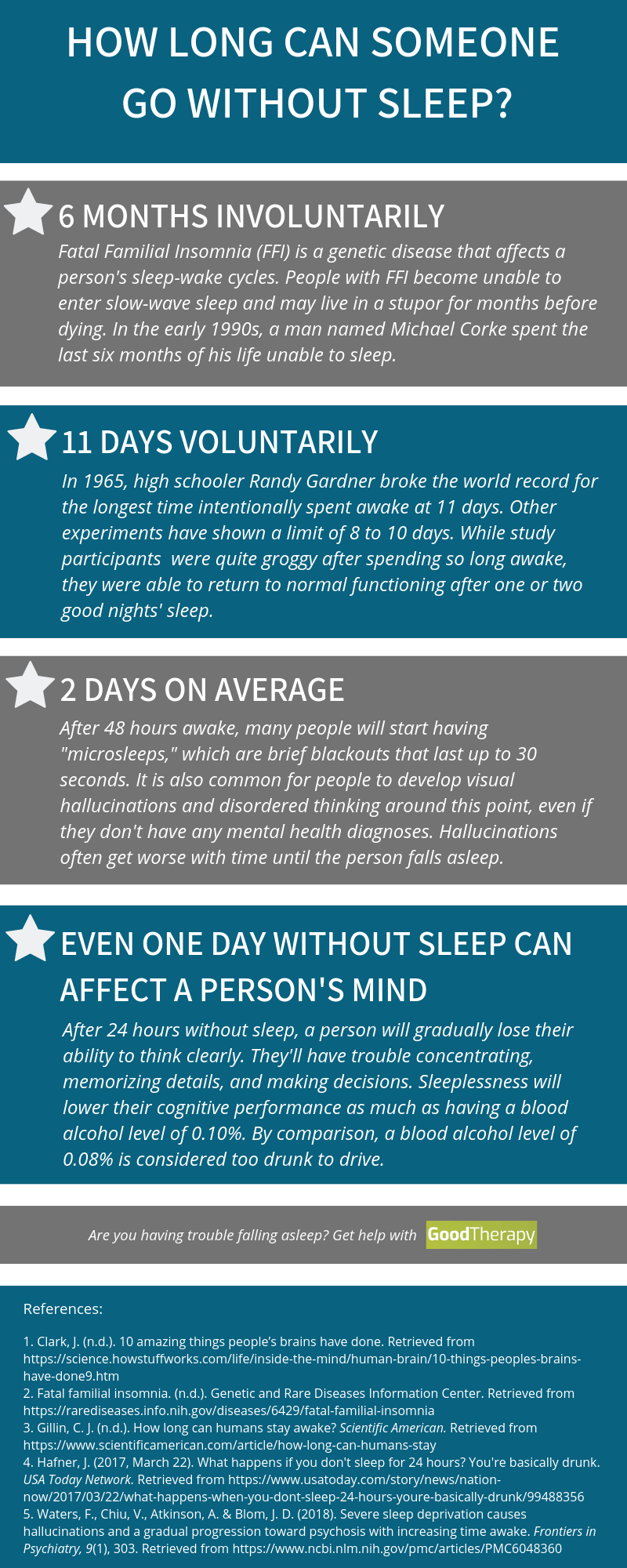
Infographic Text: How Long Can Someone Go Without Sleep?
6 MONTHS INVOLUNTARILY
Fatal Familial Insomnia (FFI) is a genetic disease that affects a person’s sleep-wake cycles. People with FFI become unable to enter slow-wave sleep and may live in a stupor for months before dying. In the early 1990s, a man named Michael Corke spent the last six months of his life unable to sleep.
11 DAYS VOLUNTARILY
In 1965, high schooler Randy Gardner broke the world record for the longest time intentionally spent awake at 11 days. Other experiments have shown a limit of 8 to 10 days. While study participants were quite groggy after spending so long awake, they were able to return to normal functioning after one or two good nights’ sleep.
2 DAYS ON AVERAGE
After 48 hours awake, many people will start having “microsleeps,” which are brief blackouts that last up to 30 seconds. It is also common for people to develop visual hallucinations and disordered thinking around this point, even if they don’t have any mental health diagnoses. Hallucinations often get worse with time until the person falls asleep.
EVEN ONE DAY WITHOUT SLEEP CAN AFFECT A PERSON’S MIND
After 24 hours without sleep, a person will gradually lose their ability to think clearly. They’ll have trouble concentrating, memorizing details, and making decisions. Sleeplessness will lower their cognitive performance as much as having a blood alcohol level of 0.10%. By comparison, a blood alcohol level of 0.08% is considered too drunk to drive.
References:
- Clark, J. (n.d.). 10 amazing things people’s brains have done. Retrieved from https://science.howstuffworks.com/life/inside-the-mind/human-brain/10-things-peoples-brains-have-done9.htm
- Fatal familial insomnia. (n.d.). Genetic and Rare Diseases Information Center. Retrieved from https://rarediseases.info.nih.gov/diseases/6429/fatal-familial-insomnia
- Gillin, C. J. (n.d.). How long can humans stay awake? Scientific American. Retrieved from https://www.scientificamerican.com/article/how-long-can-humans-stay
- Hafner, J. (2017, March 22). What happens if you don’t sleep for 24 hours? You’re basically drunk. USA Today Network. Retrieved from https://www.usatoday.com/story/news/nation-now/2017/03/22/what-happens-when-you-dont-sleep-24-hours-youre-basically-drunk/99488356
- Waters, F., Chiu, V., Atkinson, A. & Blom, J. D. (2018). Severe sleep deprivation causes hallucinations and a gradual progression toward psychosis with increasing time awake. Frontiers in Psychiatry, 9(1), 303. Retrieved from https://www.ncbi.nlm.nih.gov/pmc/articles/PMC6048360
 Sleepwalking and sleeptalking both belong to a group of behaviors called parasomnias—unusual or harmful behaviors that occur during sleep. Sleep talking is one of the most common parasomnias. A 2010 study found that 68.8% of people talk during their sleep at some point during their lives. According to the same study, 22.4% of people have sleepwalked at least once.
Both sleepwalking and sleeptalking can happen for many reasons. Sometimes they are symptoms of a mental health condition, and both may cause psychological distress and interfere with relationships, work, and even overall life satisfaction.
What Causes Sleepwalking?
Sleepwalking, known sometimes as somnabulism, happens in deep sleep when a person is very difficult to wake up. Normally, when a person sleeps, the body paralyzes skeletal muscles—the muscles responsible for walking and other complex behaviors. GABA, a neurotransmitter, is one of the primary chemicals involved in preventing sleepwalking. When GABA doesn’t work to paralyze the skeletal muscles, a person may walk, make food, or even try to drive during their sleep.
Sleepwalking is more common in children. Some research suggests this might be because the neurons that release GABA are still developing in children. Sleepwalking in children tends to peak between 8 and 12 years old. Children who sleepwalk may also have a condition called confusional arousal, which occurs when a person appears to be awake but is confused or unaware.
Though it’s difficult to wake a sleepwalking person, it’s a myth that doing so is dangerous. However, a person who is woken up from a sleepwalking episode may be confused or alarmed.
What Causes Sleep Talking?
Sleep talking, which used to be called somniloquy, is more common in children than adults. It typically happens during rapid eye movement (REM) sleep. Adults are more likely to talk in their sleep if they have depression, are experiencing a nightmare, or are under the influence of drugs or alcohol.
Is Walking or Talking in Your Sleep a Sleep Disorder?
Sleepwalking and sleeptalking are both considered sleep disorders. They are more common in people who have other sleep disorders, such as sleep apnea, insomnia, or sleep behavioral issues. Both sleepwalking and sleeptalking tend to run in families.
Sleepwalking and sleeptalking are more common in boys than in girls, though researchers don’t know why. Both tend to decrease or disappear by the age of 12, but when they don’t, a person may be diagnosed with a sleep disorder.
Sleep behavioral disorders, which cause people to do unusual things when they are asleep, are closely related to sleepwalking. For instance, a person might drive their car or attempt to have sex with their partner while sleeping. Rarely, do people even become violent in their sleep. A handful of rape defendants have successfully used a “sexsomnia” defense, arguing they did not intend to rape someone and instead were sleepwalking. The Diagnostic and Statistical Manual of Mental Disorders (DSM-5) recognizes sexsomnia as a mental health diagnosis.
Therapy can help with sleepwalking or sleep talking when these issues are due to a mental health condition or stress.
Mental Health Issues Associated with Sleepwalking and Sleep Talking
A number of mental health issues can cause sleepwalking and sleeptalking. When sleep issues are related to a mental health issue, seeking treatment for the underlying mental health condition is usually the fastest way to resolve the sleep problem.
Any mental health condition can interfere with sleep and lead to unusual behavior at night. Sleep issues are especially prevalent in people who have:
- Nightmares, night terrors, and other nighttime sleep issues
- Depression
- Anxiety
- Posttraumatic stress (PTSD)
- Neurological injuries such as a traumatic brain injury (TBI)
- Schizophrenia
Drugs and alcohol can cause some people to talk or walk in their sleep. Due to this, people with substance abuse issues, as well as those going through drug or alcohol withdrawal, may experience sleepwalking or sleeptalking.
Medical Issues Linked to Sleepwalking and Sleep Talking
Certain medical issues have been linked to sleepwalking and sleeptalking. Those include:
- Sleep apnea, a disorder that causes frequent nighttime wakings due to breathing issues.
- Breathing disorders such as asthma and chronic obstructive pulmonary disorder (COPD).
- Cardiovascular health issues such as heart arrhythmias.
- Infections and illnesses, especially when they cause a high fever.
- Brain health issues such as tumors or a brain injury. This is a rare cause of sleep issues but is more likely if sleep issues appear suddenly or are severe.
Certain medications have also been linked to sleepwalking and sleeptalking. Some sleeping medications, such as Ambien and Lunesta, can cause unusual nighttime behavior. Sleep eating is one of the most common medication-related behaviors, but driving and other unusual behaviors have also been reported.
Therapy can help with sleepwalking or sleep talking when these issues are due to a mental health condition or stress. Many people also find therapy helps them deal with the challenges of parasomnias, such as sleep deprivation or conflicts with a partner oversleep. The right therapist can help you craft a healthy sleep environment, set healthy sleep goals, and get better sleep.
According to the National Sleep Foundation, therapy can help with many sleep issues. Cognitive behavioral therapy (CBT) has proven especially effective.
Sleep issues can affect an entire family. When a child sleepwalks, parents may struggle to get a good night’s sleep, and siblings may feel anxious. A spouse who sleepwalks or sleep talks can trigger sleep issues in their partner. Nighttime sleep issues, such as sexsomnia or nighttime eating, can even be a source of marriage or relationship problems. Family or couples therapy can help families manage and understand these issues.
References:
- Bjorvatn, B., Grønli, J., & Pallesen, S. (2010). Prevalence of different parasomnias in the general population. Sleep Medicine, 10(11), 1031-1034. doi: 10.1016/j.sleep.2010.07.011
- Cognitive behavioral therapy for insomnia. (n.d.). Retrieved from https://www.sleepfoundation.org/sleep-news/cognitive-behavioral-therapy-insomnia
- Mohebbi, A., Holoyda, B. J., & Newman, W. J. (2018). Sexsomnia as a defense in repeated sex crimes. The Journal of the American Academy of Psychiatry and the Law, 46(1), 78-85. Retrieved from http://jaapl.org/content/46/1/78.long
- Oliviero, A. (2008, February 1). Why do some people sleepwalk? Retrieved from https://www.scientificamerican.com/article/why-do-some-people-sleepwalk
- Pediatric parasomnias. (n.d.). Retrieved from https://www.childrens.com/specialties-services/specialty-centers-and-programs/sleep/programs-and-services/sleep-medicine/nightmares-sleepwalking-sleep-talking-sleep-terror
- Post-traumatic stress disorder (PTSD) and sleep. (n.d.). National Sleep Foundation. Retrieved from https://www.sleephealthfoundation.org.au/pdfs/Post-Traumatic-Stress-Disorder.pdf
- Sexsomnia: A new DSM-5 diagnosis. (2014, October 28). Retrieved from https://www.psychiatryadvisor.com/sleep-wake-disorders/sexsomnia-a-new-dsm-5-diagnosis/article/379644
- Sleep talking: Causes. (n.d.). Retrieved from https://www.sleepfoundation.org/sleep-disorders-problems/sleep-talking/causes
- Sleep talking: What is it? (n.d.). Retrieved from https://www.sleep.org/articles/sleep-talking
- Sleepwalking. (n.d.). Retrieved from https://www.sleepfoundation.org/sleep-disorders-problems/abnormal-sleep-behaviors/sleepwalking
 It’s that time of year when the kids have gone back to school and we are approaching daylights savings. I know in my family, it’s been an adjustment to get everyone on a better sleep schedule after the late nights of summer fun.
Simultaneously, I’ve noticed in my practice that several of the people I work with have mentioned difficulties getting to bed at decent times, struggles maintaining an ideal sleep schedule, and a lack of feeling rested upon awakening in the mornings. Given this common trend around issues related to sleep, I thought before we head into the dark nights of winter, now would be a good time for us all to think about our own sleep hygiene.
What Is Sleep Hygiene?
I find the phrase “sleep hygiene” a little odd. For me, it conjures up images of bubble baths, toothpaste, and soap in the bedroom. While brushing your teeth before bed is a good habit and one that may help signal an end to your day, sleep hygiene isn’t just about cleanliness. Rather, it’s about all of the habits and agendas you maintain around your bedtime routine and night of sleep.
The definition of hygiene according to Dictionary.com is “conditions or practices conducive to maintaining health and preventing disease, especially through cleanliness.” As cleanliness is only one aspect, it makes sense to think about all of the other conditions and practices surrounding sleep. Sleep may seem like a trivial thing. We all do it; it’s a natural process that should be easy. But easy isn’t always the case.
The Challenge of Maintaining Good Sleep Hygiene
Getting good sleep can be a challenge for many, yet sleep is truly a vital component to life. It’s fairly common knowledge that research confirms getting enough restful sleep is an important part of staying healthy and operating at your best. Unfortunately, some adults find it difficult to sleep well, and many have fallen into patterns that are counterproductive to obtaining the best rest possible. If this rings true for you, stop to think about your own bedtime routine and the conditions you maintain for sleep.
Many parents of young kids are familiar with the importance of a bedtime routine—they’ve likely established one to help their babies and toddlers learn to easily go to bed each night. Whether it’s bath, story, milk, and a song, or some other type of tuck-in ritual, we know that a good routine helps kids get to bed, and we know how important it is for them to sleep. Sleep helps children to grow, develop, function well, be attentive in school, and avoid crankiness.
While adults may not need as many hours of sleep as kids, rest is still important. Yet as we get older, have more free will, and are inundated with modern technologies and daily stressors, we often neglect good sleep habits and can consequently wind up facing things like chronic insomnia, poor health, irritability, lack of concentration, and even impaired judgment from neglecting to give our bodies the sleep they require.
Tips for Better Sleep Hygiene
Below is a list of some of the most common recommendations involved in developing and maintaining good sleep hygiene:
- Establish regular and consistent times for going to bed and waking up. This helps regulate your internal clock.
- Determine how many hours of sleep your body needs. Each person requires a certain amount of sleep to feel rested and to achieve optimal functioning while awake. Figure out through trial and error what your optimal amount of sleep seems to be, then strive to get this amount of sleep every night by adjusting your going-to-bed and wake-up times accordingly.
- Develop rituals before bedtime. Routine things like locking up the house, drinking a cup of tea, putting on pajamas, washing your face, and brushing your teeth can become rituals when performed regularly and consistently before bed. Your brain eventually associates these things with winding down and going to sleep. Having a regular routine can make it easier for you to feel tired and ready for sleep at bedtime.
- Pair bedtime with something that engages one of your senses. Smelling the same scent or listening to the same sound every night at bedtime can help your brain learn when it’s time to feel tired and fall asleep. Try spraying fragrant pillow spray on your sheets, lighting a scented candle, or using a scented eye pillow. Lavender is an especially relaxing scent. A sound machine with calm sounds such as the ocean, rain, or white noise may also be helpful.
- Use the bedroom only for sleep and sex. Using your bedroom to work or perform other activities will cause your mind to associate the space with activities that may conflict with the ability to sleep.
- Make your bedroom a sanctuary for sleep. Make sure your bedroom is a calm space with a comfortable bed. Determine what type of pillows, sheets, and blankets are the most comfortable for you. Some people like to sleep with little weight on them; others like heavier blankets. Keep the thermostat at a comfortable level. Block out any bright or distracting lights.
- Get sunlight in the morning or during the day. Circadian rhythms are regulated by light and darkness and are closely related to our sleep-wake cycles. Sensing natural light through your retina signals the brain to be awake and alert. In contrast, the absence of light signals our bodies to produce melatonin, a hormone that aids in sleep. The contrast between light during the day and darkness in your bedroom at night helps regulate the sleep-wake cycle.
- Put away your iPad and/or smart phone before getting ready for and into bed. Don’t check email before bed. Electronics can pose a threat to sleep, not only because they keep your brain activated, but also because their light can disrupt melatonin production and impede your ability to feel tired. It’s best to avoid electronics at least half an hour to an hour before bedtime. That said, many people unwind before bed by reading. If you read on your electronic device, be sure to dim the backlight or turn on “Night Shift.”
- Use relaxation techniques to release stress and tension. It is very difficult to fall and stay asleep if you are very anxious, ruminate on stressful things that happened in the day, or fixate on things happening in the future. Practicing mindfulness techniques, meditation, progressive muscle relaxation, and other techniques can help slow down your mind and create a sense of calm that will be more conducive to sleeping peacefully.
Routine things like locking up the house, drinking a cup of tea, putting on pajamas, washing your face, and brushing your teeth can become rituals when performed regularly and consistently before bed.
How to Wind Down Before Bed
Remember that it’s hard to benefit from these tools unless you practice and become familiar with them during times when you are not already feeling stressed, overly anxious, or experiencing insomnia. Try them often and as you become more comfortable with various techniques, they can be tools to help you get to sleep faster.
- Try warm baths or showers before bedtime. Bathing or showering can raise your core body temperature, which naturally induces drowsiness and can help you fall asleep faster.
- Eat a good meal a few hours before bedtime. Going to bed hungry or feeling too full can impact your ability to fall asleep, so be mindful of what and when you are eating in the evenings.
- Exercise regularly. Research shows that exercise decreases stress and contributes to better and more restful sleep. However, avoid rigorous exercise too close to bedtime if you find that it impacts your ability to fall asleep.
- Avoid physical and mental stimulation before bedtime. Stimulation, including suspenseful books, action shows/movies, and video games, can increase brain activity and heart rate, making it difficult to fall asleep. If you get into bed too soon after engaging in these activities, you may face frustration regarding your inability to quickly fall asleep, which perpetuates sleep disturbances. Your body needs time to unwind and slow down after engaging in these activities and before getting into bed.
- Avoid naps if possible. For some people, short naps can be energizing and rejuvenating. But naps, especially long ones, can interfere with sleep-wake cycles and sabotage the ability to maintain a regular bedtime.
- Avoid caffeine in the afternoon/evenings. The effects of caffeine can last for several hours, often creating a feeling of being wired or on edge, which can impact some people’s ability to fall asleep.
- Keep a glass of water by your bed. Having a glass of water nearby can help you stay hydrated and allow you to quickly reach for a sip of water when you wake up thirsty in the night. Keep anything else you may need to stay comfortable (chapstick, a sweatshirt if you tend to get cold, etc.) nearby and avoid getting out of bed for anything but using the bathroom.
- Hide the clock or get a projection clock. If you are someone who constantly looks at the clock, becoming frustrated with how long it is taking you to fall asleep and fixating on how little sleep you will be able to get, hide the clock or resist looking at the time. A projection clock that shows the time on the ceiling could be helpful if you feel you have to know the time. Constantly rolling over and moving to look at the clock interferes with your ability to relax and can create feelings of anxiety and stress that make it even harder to fall asleep.
- Try not to stress about or fixate on sleep difficulties. Fixating on sleep difficulties only increases the problem. Know that it takes some time, practice, and trial and error to develop optimal sleep habits and ultimately create better sleep. Be patient with yourself and know that good sleep hygiene doesn’t happen overnight.
If you struggle with sleeping well or maintaining a healthy sleep schedule, consider implementing these tips to see what might help. Be patient with yourself. It may take time to break bad habits and establish healthier ones, but with time and persistence, you can discover better sleep hygiene and ultimately train your body to get better rest.
Working with a therapist may help you find sleep strategies that work for you if you have a difficult time maintaining good sleep hygiene.
Reference:
Hygiene. (2018.) Retrieved from https://www.dictionary.com/browse/hygiene?s=t
 Nearly 7% of Americans will be diagnosed with posttraumatic stress (PTSD) at some point during their lives. In any given year, 3.5% of Americans have PTSD. Many struggle with sleep problems such as insomnia, sleeping too much, and nightmares. For people struggling with trauma during the day, nighttime can feel like a battleground that offers little respite from traumatic memories and intrusive thoughts.
Are Sleep Problems a Symptom of PTSD?
Trauma changes the brain, and these changes can also affect sleep. The Diagnostic and Statistical Manual (DSM) lists sleep disturbances—such as insomnia, frequent waking, or nightmares—as one of many potential symptoms of PTSD. Specifically, to be diagnosed with PTSD, a person must show at least two of six “alterations in arousal and activity.” Those changes include:
- A heightened startle response
- Trouble concentrating
- Sleep disturbances
- Hypervigilance
- Self-destructive or reckless behavior
- Irritability or aggression
For some people, other symptoms of arousal play a role in sleep problems. For instance, a person who is anxious and hypervigilant may be too afraid to fall asleep, while a person with a heightened startle response may startle awake at every sound as they drift off to sleep. This change in sleep can also exacerbate other PTSD symptoms. A chronically exhausted person may be more irritable or have greater difficulty concentrating.
Some research suggests that sleep problems are more than just a symptom of PTSD. Instead, they may be a core component of the diagnosis. Research published in 1989 suggests that disturbances in rapid eye movement (REM) sleep are a PTSD hallmark that play a key role in other PTSD symptoms. Subsequent research has yielded mixed results. While some studies, including of animals, find a pattern of REM disturbances associated with PTSD, others do not.
A 2013 review of the literature argues that disturbances in sleep, especially REM sleep, may increase the risk of PTSD. Sleep issues may also worsen outcomes in people with PTSD. The study further argues that sleep issues can decrease the effectiveness of many PTSD treatments and that targeted treatments for sleep issues may speed recovery.
How Does PTSD Affect Sleep?
People with PTSD often find that their traumatic memories intrude on their ability to sleep. Some common PTSD-related sleep symptoms include:
- Being unable to fall asleep because of anxiety or agitation.
- Difficulty staying asleep because of frequent nightmares.
- Poor quality sleep because of nightmares. Some people report waking up many times each night and struggling to fall back asleep each time. This is called maintenance insomnia.
- Sleep problems related to drugs or alcohol. Some people with PTSD use alcohol or drugs to cope, which can cause sleep problems. Some medications for PTSD and anxiety may also cause sleep problems. For example, benzodiazepines may make it difficult to wake up in the morning.
A study that compared people with insomnia who did not have PTSD to those with combat-related PTSD and insomnia found important differences in the two groups. Those included:
- More repetitive nightmares in people with PTSD. People with PTSD were more likely to say their nightmares made it difficult to go back to sleep.
- More anxiety during the day in people with PTSD.
- More fatigue during the day among people with PTSD.
This suggests a feedback loop between sleep issues and other PTSD symptoms. Sleep problems can intensify daytime PTSD symptoms, which may make it even more difficult to sleep at night. People who feel anxious or fatigued during the day may ruminate more on their traumatic memories, increasing the risk of nightmares and other issues when they try to sleep.
Sleep problems can intensify daytime PTSD symptoms, which may make it even more difficult to sleep at night. People who feel anxious or fatigued during the day may ruminate more on their traumatic memories, increasing the risk of nightmares and other issues when they try to sleep.
Other Sleep Problems and PTSD
Sleep issues are common, even in people without PTSD. A 2009 study found that about 30% of people experience insomnia in a given year. Some people also struggle with sleeping too much or with not feeling rested after sleeping. This may be due to:
- Shift work sleep disorder, a condition that alters the “internal clock” of people who work nights or unusual hours.
- Sleep apnea, a disorder that affects breathing during sleep, causing people to briefly wake many times during the night.
- Sleep behavior disorder, which causes people to do unusual things while sleeping, such as sleepwalking, driving, or eating.
People with PTSD who have a pre-existing sleep disorder may find their symptoms get worse following a traumatic experience. Conditions that affect sleep can also compound the effects of PTSD, leading to depression, anger, difficulty concentrating, and more trouble coping with PTSD symptoms.
Even when the symptoms of a sleep disorder are not directly related to PTSD, it’s important to get help. Getting quality sleep is an important component of PTSD self-care.
Strategies for Coping with PTSD-Related Sleep Problems
Lifestyle changes can help some people with PTSD sleep more soundly. The National Sleep Foundation emphasizes that sleep is a habit, so the right changes can help the body adopt healthy sleep habits that offer better sleep. Try the following:
- Design a comfortable sleeping area, with a firm and supportive mattress and comfortable pillow.
- Develop a relaxing bedtime ritual.
- Stick to the same sleep schedule every day, even on weekends or vacations.
- Avoid napping during the day if you have trouble sleeping at night.
- Exercise every day, but not right before bed.
- Keep your bedroom cool, between 60-67 degrees Fahrenheit.
- Keep your bedroom quiet. Some people find that a white noise machine helps.
- If you can’t fall asleep, get up and do something else.
- Use your bed only for sleeping—not to play, read, or do work.
- Eat a light snack 45 minutes before bed if you tend to wake up hungry.
- Avoid heavy meals, alcohol, caffeine, and cigarettes before bed. Some people find drinking caffeine in the afternoon makes it harder to sleep.
Stress and anxiety management strategies can be especially helpful for managing PTSD-related sleep problems. Some people find relief from meditation or yoga. Others find that guided imagery or positive mantras as they try to sleep can help.
Medications, including anti-anxiety and sleeping medications, may help some people. However, when the underlying PTSD symptoms remain, sleep problems will likely return when you stop using medication.
Therapy can help with both sleep issues and PTSD. A compassionate therapist will help you work through your trauma in a safe space, free of judgment. Your therapist can help you set goals, cultivate new tools for managing stress, help you understand how trauma changes the brain, and work with your doctor to decide which, if any, medications are appropriate.
PTSD can feel overwhelming. Some people become depressed because they think things will never change. Others are too exhausted to work or enjoy time with their family. It doesn’t have to be this way. Reach out to a therapist who is highly skilled at treating PTSD.
References:
- Germain, A. (2013). Sleep disturbances as the hallmark of PTSD: Where are we now? American Journal of Psychiatry, 4(170), 372-382. doi: 10.1176/appi.ajp.2012.12040432
- Gradus, J. L. (2007, January 31). Epidemiology of PTSD. Retrieved from https://www.ptsd.va.gov/professional/PTSD-overview/epidemiological-facts-ptsd.asp
- Healthy sleep tips. (n.d.). Retrieved from https://sleepfoundation.org/sleep-tools-tips/healthy-sleep-tips
- Inman, D. J., Silver, S. M., & Doghramji, K. (1990). Sleep disturbance in post-traumatic stress disorder: A comparison with non-PTSD insomnia. Journal of Traumatic Stress, 3(3), 429-437. doi: 10.1007/BF00974782
- Phillips, K. (2015, February 4). What are the types of sleep disorders? A full list of sleep disorders. Retrieved from http://www.alaskasleep.com/blog/types-of-sleep-disorders-list-of-sleep-disorders
- Sleep and PTSD. (2015, August 13). Retrieved from https://www.ptsd.va.gov/public/problems/sleep-and-ptsd.asp
- Yehuda, R., Hoge, C. W., Mcfarlane, A. C., Vermetten, E., Lanius, R. A., Nievergelt, C. M., . . . Hyman, S. E. (2015). Post-traumatic stress disorder. Nature Reviews Disease Primers, 15057. Retrieved from https://www.nature.com/articles/nrdp201557#t1
 George felt weighed down as he checked into yet another motel room. This was his ninth business trip in one month. He didn’t used to mind the traveling so much. Sure, it gets tiring, but he was also feeling irritable, disheartened, and down. He loosened his tie and collapsed on the bed.
Lifting his head, he noticed a notepad and pen on the bedside table. He sat there and started scribbling away, writing about everything and anything – whatever came to mind with no analysis or self-censorship. He just let words flow on to the page. After about 20 mins or so, he sat back with a sense of satisfaction. He felt lighter in his body and more clear-headed in his mind.
He decided to repeat this activity the next day before his first meeting. He even spent a few minutes in the end reflecting on some of the things that were going well in his life. As he left his room to go to work, he was pleased to feel the bounce in his step return.
Whether in movement, song, dance, art, music, or words, there is something natural and liberating about self-expression. Not surprisingly, it can be a useful medium for processing challenging moments and accumulated stress. It can also promote self-empowerment and acceptance.
I often invite my clients to try journaling. They usually ask me if there is a specific way to start. As it turns out, researchers have been studying expressive writing for a while now, seeking to determine what format works best for different issues. The following are some of the results.
Unstructured Expressive Writing
The classical writing instruction as a therapeutic practice was introduced by Pennebaker and colleagues in the 1980s. It goes as follows:
- Write “your very deepest thoughts and feelings about an extremely difficult or emotional event that has affected you and your life…” (Baum & Rude, 2013, p.37).
- Keep the flow of writing going for 20 minutes nonstop.
- Don’t worry about spelling or grammar.
Gratitude Writing
Researchers also found keeping a gratitude journal can have a significant positive effect on mental health. It can create a greater sense of optimism and life satisfaction (Froh, Sefick, & Emmons 2008). A simple daily or weekly gratitude journal involves taking a few minutes to bring to mind things you are currently grateful for. Items on the list can be grand or mundane: “I am grateful that my kid is healthy” and “I am grateful for my toothpaste” are both acceptable.
Then there are gratitude letters. Researchers compared the difference between psychotherapy on its own, psychotherapy with expressive writing, and psychotherapy with gratitude letters. They discovered the option involving gratitude had the greatest beneficial impact. Here’s the gist of their approach (Wong, Owen, Gabana, Brown, McInnis, Toth, & Gilman (2018)):
- Choose a specific person to address your gratitude letter to. The purpose is not to send the letter, though you can if you want to.
- Reflect on and write about what it is you are grateful for in this person.
- Repeat this exercise over an extended period. You can choose the same person as your addressee or a different person.
Expressive Writing for Depression
In 2013, Baum & Rude incorporated the benefits of mindfulness and self-compassion into the classical expressive writing practice. They discovered “expressive writing plus emotional acceptance” made a better impact on alleviating mild symptoms of depression than the classical approach to expressive writing. Both kinds of expressive writing helped mild depression more than regular writing. However, expressive writing was found not to be helpful for those with severe depression symptoms.
So if your depression symptoms are on the milder side, consider the following tips (Baum & Rude, 2013):
- Be mindful as you write, taking an observer’s stance. Witness whatever difficult emotions that come out without judging them.
- Include a paragraph that normalizes distressed responses in the face of difficulty and stops self-blame.
Expressive Writing for PTSD
This year, researchers published findings that expressive writing could help reduce the severity of posttraumatic stress (PTSD) symptoms. Consider the following structure (Sloan & Marx, 2018):
- Write for 30 minutes every day and commit for at least 5 days.
- Write from the present moment looking back, as opposed to imagining the trauma as if it were happening now; write while feeling anchored in the here-and-now, present and safe.
- Go into the details of the events as you remember them, including thoughts and emotions.
- Be a nonjudgmental observer of the writing.
- Revisit the same event in your subsequent writing sessions instead of moving on to other incidents.
If you find yourself getting stuck, consider asking yourself some of these questions I adopted from different somatic psychotherapy approaches – including Somatic Experiencing and EMDR – that work with trauma:
- “What happened next?”
- “Who was there to help you?”
- “When did you know you were safe?”
Expressive Writing for Test Anxiety
Studies have found expressive writing helps students with high test anxiety perform better. So if you are a teacher, consider adopting the following activity for your students (Doherty & Wenderoth, 2017; Ramirez & Beilock, 2011):
- Set aside 10 minutes for writing prior to the exam. (If time does not allow, 5 minutes can also be effective).
- Let your students know the purpose of this writing activity.
- Keep the writing anonymous.
- Let it be an optional activity.
- Instruct your students to write “as openly as possible” about their thoughts and feelings regarding the exam they are about to take.
- When they’re done, or when time is up, instruct them to crumple the paper and throw it away.
If you are a student with test anxiety, see if your teacher will give you time to do this before the exam. You can also try it yourself. Find a quiet place near the exam room about 15 minutes before the exam. Use 10 minutes to do the expressive writing exercise and the remaining 5 to get to your exam on time and get settled.
Writing for Sleep Disturbance
In some cases, writing exercises can also help with sleep issues. Spending 5 minutes writing a simple to-do list for tomorrow can help you fall asleep faster. Conversely, writing about tasks you already completed can delay your ability to fall asleep (Scullin, Krueger, Ballard, Pruett, & Bliwise, 2018). So if you want to fall asleep quickly, you can use pre-sleep writing to clarify tomorrow’s activities and de-clutter your head.
Designing Your Own Writing Practice
If you decide to try writing your way to mental health, let yourself be curious and discover what is the best approach for you. If you already have a writing practice, great! If modifying based on the tips above, consider a combined power punch that incorporates a gratitude section into whatever writing practice you have.
If you are thinking of using expressive writing to process a traumatic incident or to manage depression, it might be helpful and even recommended that you do so with the added support of a trained mental health professional.
References:
- Baum, E. S. & Rude, S. S. (2013). Acceptance-enhanced expressive writing prevents symptoms in participants with low initial depression. Cognitive Therapy and Research, 37(1), 35-42. doi:10.1007/s10608-012-9435-x
- Doherty, J. H. & Wenderoth, M. P. (2017, August 11). Implementing an expressive writing intervention for test anxiety in a large college course. Journal of Microbiology & Biology Education, 18(2), 39. doi: 1128/jmbe.v18i2.1307
- Froh, J. J., Sefick, W. J., & Emmons, R. A. (2008). Counting blessings in early adolescents: An experimental study of gratitude and subjective well-being. Journal of School Psychology, 46(2), 213-233. doi:10.1016/j.jsp.2007.03.005
- Ramirez, G., & Beilock, S. L. (2011). Writing about testing worries boosts exam performance in the classroom. Science, 331(6014), 211-213. doi:1126/science.1199427
- Rude, S. S. & Haner, M. L. (2018, February 13). Individual differences matter: Commentary on “Effects of expressive writing on depressive symptoms—A meta‐analysis”. Clinical Psychology: Science and Practice, 25(1), e12230. Retrieved from https://onlinelibrary.wiley.com/doi/abs/10.1111/cpsp.12230
- Scullin, M. K., Krueger, M. L., Ballard, H. K., Pruett, N., & Bliwise, D. L. (2018). The effects of bedtime writing on difficulty falling asleep: A polysomnographic study comparing to-do lists and completed activity lists. Journal of Experimental Psychology: General, 147(1), 139-146. doi:1037/xge0000374
- Sloan, D. M. & Marx, B. P. (2018). Maximizing outcomes associated with expressive writing. Clinical Psychology: Science and Practice, 25(1), e12231. Retrieved from https://onlinelibrary.wiley.com/doi/full/10.1111/cpsp.12231
- Wong, Y. J., Owen, J., Gabana, N. T., Brown, J. W., McInnis, S., Toth, P., & Gilman, L. (2018). Does gratitude writing improve the mental health of psychotherapy clients? Evidence from a randomized controlled trial. Psychotherapy Research: Journal of the Society for Psychotherapy Research, 28(2), 192-202. doi:10.1080/10503307.2016.1169332
 It’s 3 a.m. You see the clock and realize you have four hours left before your alarm sounds. You think about everything you must do the next day and how miserable it will feel doing it exhausted. You toss and turn. You try counting sheep. You’re awake, and it feels like the entire world is sleeping.
You’re not suffering alone. Nearly 60% of adults lack sufficient sleep (Jacobs, 2009). How did this happen? Let’s start by looking at root causes of sleep problems and then identify ways to address them.
Root Causes of Sleep Problems
Behavioral
Bad habits breed many of our sleep problems. Staying up too late doing projects. Playing on the phone or computer. Responding to text messages or emails at all hours of the night. Engrossing oneself in a television show, particularly one with disturbing content, can negatively impact sleep. All these behaviors teach the brain that nighttime is a great time to be awake. The fear of missing out (i.e., FOMO) on an important post or text can keep our brains combing through social media or emails for hours.
[fat_widget_right]
Environmental
Having a dark, quiet, and comfortable place to sleep promotes rest. The glow of an energy-efficient light bulb, computer screen, TV, or phone can stimulate the wake center of the brain (“Blue Light Dark Side,” 2017). Environmental disturbances including noisy neighbors, a snoring partner, or a playful pet in bed can make it challenging to catch some Z’s. Having a bed that is too firm or provides inadequate support can leave you tossing and turning. Sleep can also feel elusive when the temperature is too hot or cold.
Emotional Distress
Stress, anxiety, and depression can adversely impact sleep (Jacobs, 2009, van Mill et al., 2013). When our brains perceive some type of threat (e.g., a meeting with a difficult coworker tomorrow, loss of a loved one), it activates the limbic system. This system controls the brain’s emergency response signal. It sends chemicals into our bodies which prepare us to fight or flee danger. We cannot fight of flee if we’re asleep, so the limbic system shouts, “Stay awake!” This response is wonderful if we’re being chased by a bear, but it creates problems when we need to rest. The limbic system can become particularly sensitive and activated when one has experienced a traumatic event.
Beliefs About Sleep
Negative thoughts about sleep, such as, “I’ll never sleep well again … I am not going to sleep tonight … If I don’t sleep, I am going to fail my test/perform poorly at work,” can perpetuate sleep problems (Jacobs, 2009). Additionally, beliefs that one must have sleep medication to sleep can interfere with the body’s ability to sleep on its own.
Substance Use
Caffeine, nicotine, and alcohol can negatively affect sleep (Lichstein, 2000). In addition to the common sources of caffeine (e.g., coffee, soda, and energy drinks), we also need to consider hidden sources. Certain protein bars, decaf coffee, chocolate, and some over-the-counter medications contain caffeine. A review of major sleep studies suggests alcohol users may fall asleep faster, but the second half of sleep will be poorer compared to those who don’t drink (Ebrahim, Shapiro, Williams, & Fenwick, 2013). Both prescribed and illegal substances can leave one feeling wound up, depending on amount and frequency of use. Common contributors include stimulating antidepressants, anti-hypertensives, bronchodilators, diuretics, beta blockers, and corticosteroids (Litchstein, Gellis, Stone, & Nau, 2006).
Health Conditions
Individuals with the following physical conditions commonly experience sleep problems: heart disease, asthma, lung disease, gastrointestinal disorders (e.g., heart burn), kidney disorders, endocrine disorders (e.g., hypothyroidism), diabetes, HIV infection, fibromyalgia, menopause, and cancer (Parish, 2009).
Ways to Address Root Causes
Behavioral
Creating a bedtime routine can play a vital role in getting good sleep. My grandmother followed the same routine every night. She would take a bath, put on her pajamas, feed her cat, turn down her bed, make a cup of tea, read for an hour, and then go to bed. She did this every night and never complained of poor sleep. Bedtime routines teach our brains it is time to go to sleep. Tips for a good bedtime routine include:
- Avoid blue light (e.g., TV, smartphone, computer) approximately one hour before you want to fall asleep.
- If you shower or bathe at night, do so at least one hour prior to bedtime. You could have trouble falling asleep if your body temperature is too warm.
- Cover the clock once your bedtime routine starts. Go to bed when your body feels tired (e.g., eyelids are heavy, head is drooping) as opposed to when a certain time shows on the clock. If you lay in bed awake more than 30 minutes, your brain could associate your bed with wakefulness instead of sleeping.
- Wake up at the same time every day, even on weekends. You may feel groggy the first several days. However, sticking with this wake time teaches the body to go to sleep earlier and faster.
- Do something relaxing and enjoyable before bedtime, such as reading a light-hearted book, knitting, or coloring. If you can’t think of something relaxing to do, consider listening to a guided relaxation recording. You can find many free ones online.
It may seem like you’ll never have a good night’s sleep again, but there is hope. Addressing the root causes of sleep problems and enlisting support can lead to better sleep.
Environmental
Create a comfortable sleep space. If possible, keep electronics such as TVs, computers, and smartphones out of the bedroom. Consider room-darkening shades or curtains if your room is exposed to bright light. A sleep mask is also an inexpensive alternative. If your bed is uncomfortable, explore options for supportive bedding. A new mattress can be expensive, but mattress toppers can be found for a fraction of the cost and make a positive difference in the coziness of one’s bed. A supportive pillow can also provide great comfort. If intermittent noise keeps you awake at night, consider a white noise machine, fan, and/or earplugs. If your partner is snoring, consider sleeping in a separate location (if possible) until your sleep is back on track.
Emotional Distress
Consider establishing care with a therapist if emotional distress is playing a role in poor sleep. Often, sleep improves over the course of therapy. Enlisting the support of caring others, such a friends and family members, can be helpful when you’re trying to regulate your sleep. For example, it could be helpful to ask for support with implementing some of the strategies discussed in this article. It can be frustrating when well-intentioned others ask, “How did you sleep last night?” when you’re having sleep problems. It may be beneficial to ask them to support you in ways which feel more helpful—for example, having them ask, “How can I support you right now?” or sending a funny meme or encouraging quote.
Beliefs About Sleep
Reframing our thoughts about sleep problems can help reduce the of suffering of sleeplessness. Some helpful sleep thoughts include:
- “I am taking positive steps to get my sleep back on track.”
- “I will likely sleep better tomorrow night.”
- “I have lived through sleepless nights before.”
- “My sleep will improve as I work through some of these stressful events/health issues.”
Substance Use
Stopping caffeine use can help if you’re having trouble sleeping. If giving it up completely feels too intimidating, try limiting use to the morning or decreasing the amount (e.g., half-caffeinated coffee). Scrutinizing labels on food and over-the-counter medicines can help you make informed choices about the amount of caffeine you consume. Talk to your primary care physician or a therapist if you are using illegal/nonprescribed drugs to learn how they impact sleep and to obtain support with stopping use. If insomnia is a side effect of a prescribed medication, talk with your prescriber about ways to manage this.
Health Conditions
Consider scheduling a checkup with your doctor, particularly if you have not had a physical within the past year. Your doctor can determine if lab work or other testing would be helpful in ruling out physical causes for sleep problems. If you have a preexisting condition but continue to experience sleep problems, scheduling an appointment with your provider to discuss concerns could help.
Conclusion
Most importantly, be kind to yourself. Talk to yourself as you would a friend who can’t sleep: “I know this is tough. You’re taking steps to sleep better, and it will improve in time.” It may seem like you’ll never have a good night’s sleep again, but there is hope. Addressing the root causes of sleep problems and enlisting support can lead to better sleep.
References:
- Blue light has a dark side. (2017, December). Harvard Health Letter. Retrieved from https://www.health.harvard.edu/staying-healthy/blue-light-has-a-dark-side
- Ebrahim, I. O., Shapiro, C. M., Williams, A. J., & Fenwick, P. B. (2013). Alcohol and sleep I: Effects on normal sleep. Alcohol Clinical and Experimental Research, 37, 539–549. doi:10.1111/acer.12006
- Jacobs, G. D. (2009). Say good night to insomnia. The 6-week program proven more effective than sleeping pills. New York, NY: St. Martin’s Press.
- Lichstein K. L. (2000). Secondary sleep problems. In K.L. Lichstein & C.M. Morin (Eds.), Treatment of late-life sleep problems (297-319). Thousand Oaks, CA: Sage.
- Lichstein, K. L., Gellis, L. A., Stone, K. C., & Nau, S. D. (2006). Primary and secondary insomnia. In S. R. Pandi-Perumal & J. M. Monti (Eds.), Clinical pharmacology of sleep (133-152). Basel, Switzerland: Birkhauser Verlag.
- Parish, James M. (2009). Sleep-related problems in common medical conditions. Chest, 135(2), 563–572. doi:001: lO.1378/chest.08-0934
- van Mill J. G., Hoogendijk W. J., Vogelzangs N., van Dyck R. & Penninx, B. W. (2010). Sleep problems and sleep duration in a large cohort of patients with major depressive disorder and anxiety disorders. The Journal of Clinical Psychiatry,71, 239–46. doi: 10.4088/JCP.09m05218gry