 Disclaimer: If you are strongly opposed to the killing of animals for the purpose of food or may be turned off to discussion about spiritual or religious traditions that include offering animals to the spirits/divinities, read no further. This article is sure to enrage you at worst and irritate you at best.
Now let’s get down to business. As a starting point, I’ll present a quote from William Kent Krueger’s latest book in a series about a law enforcement officer in a town in the Minnesota wilds named Corcoran (Cork) who’s part Native American. He has a close connection with a local shaman named Sam who taught him to “hunt in the old wayâ€:
“The next fall, he and Sam hunted white-tail deer. It was challenging in a way that rifle hunting with his father had never been. To kill a deer required that he be almost close enough to hear it breathing. It was a shockingly intimate experience, and after he’d brought down his first buck, he understood why it was necessary for his own spirit that he sing to the spirit of the animal he’d killed, that he explain the violence and promise the beautiful creature that his body would feed The People and they would be grateful.†—Trickster’s Point (p. 60, Atria Books, New York, 2012)
Most people who eat meat of any sort or fish rarely think about the animal or creature it once was. They may say a prayer at mealtime, but that’s usually about giving thanks for the food.
Part of the Native American tradition includes offering animals to the spirits. It is also part of the Yoruba tradition; deities are “fed†on a regular basis. It does not always involve a blood sacrifice, but sometimes it does. The premise is that what Orisa and Egun want, they get.
I can identify with Cork’s awareness of the true meaning of the killing. I wasn’t always so closely connected to similar sacrifices in my own Yoruba faith, though I never had a problem with it. For me, it was always about doing what I was expected to do.
That changed for me when my 5-month-old Irish setter puppy was hit by a speeding van up the road from my house. In truth, he saved my life (and in that way, he was an offering). He was still alive, and the men who hit him were responsible enough to drive me to the vet in town. Holding him in my arms on the way there, connecting to a spirit that was in so much pain, and knowing it very easily could have been me who was being rushed to medical care touched me in a way that still brings tears to my eyes. In those moments, he and I were one. He didn’t survive, and I grieved the loss of him long afterward.
Since that time, whenever I am called upon to offer a live creature to Orisa or the ancestors, part of the process is to make sure I am fully present and to thank the animal for offering his life on my behalf. In this way, I am always deeply moved by the sacrificial act—and grateful.
In this season of Easter, it may help to think of the crucifixion of Jesus as a human offering (which was more common in those days). Perhaps Jesus’ death was required in the same way other religions make their offerings. We can be grateful to him even if we are not Catholic (or Christian) because when one sentient being is offered, us who survive are the beneficiaries of that sacrifice.
 Church attendance in the United States has been dwindling over the past several decades, with people who regularly attend church now accounting for a minority of the population. More than 90% of Americans, however, report that they believe in God, with many harboring faith but not participating in formal religion. More than 30% of Americans report that they are spiritual but not religious.
Spiritual people don’t subscribe to a single set of beliefs. They may simply believe in God but dislike formal religion, or they may combine practices from a variety of religions. Spirituality is frequently associated with new-age and alternative religious practices. A new study published in the The British Journal of Psychiatry finds that people who identify as spiritual are more likely to experience a wide variety of mental health issues than both nonreligious and traditionally religious people.
The Study
The study, which was conducted by researchers at University College of London, involved surveys of 7,403 randomly selected participants. Each participant was asked about his or her religious beliefs, emotional state, history of drug use, history of addiction, and history of mental health issues. Thirty-five percent reported that they were religious. Nineteen percent reported that they were spiritual, and 43% reported no religious affiliation.
The Results
On nearly every measure of psychological well-being, people who described themselves as “spiritual but not religious†fared more poorly than other study participants. Notable findings:
- Spiritual people were more likely to have used drugs than nonreligious and traditionally religious people. They were also more likely to report drug dependence. Thirty percent of spiritual people had used drugs, compared to 16% of religious respondents. Five percent of spiritual people reported drug dependence, but only 2% of religious respondents reported addiction issues.
- Spiritual people were more likely to experience mental health issues such as depression, generalized anxiety, and phobias.
- Spiritual people were more likely to take psychoactive medications.
What Does It Mean?
While the study shows that spiritual people may be more vulnerable to mental health issues, it provides little information about why. It could be that people are more likely to identify as spiritual when they have a mental health issue; it could also be that something about spirituality makes people more vulnerable to mental health issues.
Religion provides significant social support, as well as an explanation for life’s suffering. It could be that, absent this support, people are more vulnerable to mental struggles. But even the nonreligious people in the study had better mental health than the marginally religious spiritual people, so the psychological benefits of religion don’t tell the whole story. While more research needs to be done, some possible explanations include:
- People who identify as spiritual are more likely to admit to mental health conditions or more likely to diagnose themselves with mental health issues.
- People who identify as spiritual may receive lower-quality treatment or be less likely to seek treatment, which can lead to more severe mental health issues.
- People may become spiritual because they’re searching for answers, and this search could be spurred by drug addiction or mental issues.
- The study could be a fluke; future research will need to duplicate the results before mental health professionals can state with certainty that spiritual people are more vulnerable to mental health issues.
References:
- Castella, T. D. (2013, March 01). Spiritual, but not religious. BBC News. Retrieved from http://www.bbc.co.uk/news/magazine-20888141
- Corner, D. (2006). The impact of spirituality on mental health: A review of the literature[PDF]. London: The Mental Health Foundation.
- Gallup, G. H., Jr. (2003, February 11). Americans’ spiritual searches turn inward. Gallup. Retrieved from http://www.gallup.com/poll/7759/americans-spiritual-searches-turn-inward.aspx
- Merica, D. (2013, January 9). The spiritual but not religious likely to face mental health issues, drug use, study says. CNN Belief Blog RSS. Retrieved from http://religion.blogs.cnn.com/2013/01/09/the-spiritual-but-not-religious-likely-to-face-mental-health-issues-drug-use-study-says/
- Newport, F. (2011, June 3). More than 9 in 10 Americans continue to believe in God. Gallup. Retrieved from http://www.gallup.com/poll/147887/americans-continue-believe-god.aspx
- Spirituality ‘link’ to mental illness. (2013, January 2). PubMed Health. Retrieved from http://www.ncbi.nlm.nih.gov/pubmedhealth/behindtheheadlines/news/2013-01-02-spirituality-link-to-mental-illness-/
 Exorcisms occupy a hallowed place in horror movies, with some claiming to be “based on a true storyâ€â€”attracting mass audiences, rampant skepticism, and much discussion. But the ancient practice of expelling demons or other entities from a person isn’t merely fodder for fright flicks or some relic of a less enlightened time. Exorcisms are very much a part of cultural mythology, and occupy an important place in some religions. The Catholic Church has 10 exorcists in the United States. Even Mother Teresa underwent an exorcism at the direction of the archbishop of Calcutta.
No one can say with absolute certainty whether demons walk among us and occasionally take control of living beings, but science can offer a helpful window into exorcisms and what might cause a person to appear “demonically possessed.†The Diagnostic and Statistical Manual of Mental Disorders does not recognize demonic possession as a psychiatric issue. There is little doubt, however, about the influence of issues that are recognized by the DSM, and no one questions the power of suggestion.
What Causes the Appearance of Possession?
Historically, exorcisms have been used to treat a wide variety of symptoms that are now associated with mental issues. People with schizophrenia, personality issues, delusions, hallucinations, or severe depression might all have been considered candidates for exorcisms in generations past. Each of these issues can, in some cases, cause unusual or frightening behavior.
In a culture where many believe certain behaviors may be caused by demonic possession, the manifestations of mental health issues may conform to popular mythology. A person with schizophrenia might, for example, believe he or she hears the voice of Satan, or that he or she is in fact Satan, because he or she grew up amid culturally ingrained messages that this is possible.
Even in contemporary times, people with mental issues may be subject to exorcisms, particularly in devoutly religious communities and developing countries. Epilepsy, which can cause severe seizures, may lead to exorcism being performed. Substance abuse, head injuries, and brain tumors can also dramatically alter behavior, leading someone to appear possessed.
What Happens During an Exorcism?
Exorcisms tend to follow a predictable path. The apparent victim of possession’s behavior becomes increasingly erratic, perhaps even violent, until the exorcist casts the demonic spirit out. “Possessed†people may speak in tongues, vomit, become violently ill, or harm themselves. And while these behaviors might seem shocking, they can be easily explained.
Mental issues can cause strange behavior, and people tend to conform to expectations. This means a person experiencing an exorcism is more likely to act in ways he or she has heard of others behaving during exorcisms. Exorcisms sometimes also involve the use of potions, drugs, or fasting, each of which can induce violent illness and strange behavior. Starvation can affect brain function, and the stress of an exorcism may radically alter behavior.
Some exorcism advocates insist that exorcism works. And it very well may. People undergoing exorcisms may enter hypnotic trances, during which time they may be much more suggestible, which means their behavior may later change. The dramatic ritual of an exorcism can also be cathartic for some deeply religious people, and may inspire a change in behavior or personality.
Exorcisms As Abuse
Although every person has the right to practice his or her own religious beliefs, exorcisms sometimes become a form of abuse, and some mental health experts are concerned that they may replace competent psychiatric treatment for people with mental health issues.
Over the past decade, several people have died during exorcisms. A woman in Fort Wayne, Indiana, attempted to exorcise her son by forcing him to drink vinegar and olive oil, then held him down during an exorcism. The boy suffocated, and his mother was convicted of murder in 2011. A 3-year-old in Arizona was nearly choked to death by her grandfather, who was attempting to exorcise her; the grandfather was shot and killed by police.
References:
- Attempted exorcism ends in man’s death. (2007, July 29). MSNBC.com. Retrieved from http://www.nbcnews.com/id/20027027/
- Batty, D. (2001, May 02). Exorcism: Abuse or cure? The Guardian. Retrieved from http://www.guardian.co.uk/society/2001/may/02/socialcare.mentalhealth1
- Interview with the exorcist. (2000, September 21). The Daily Beast. Retrieved from http://www.thedailybeast.com/newsweek/2000/09/21/interview-with-the-exorcist.html
- Libaw, O. (2012, September 11). Exorcism thriving in the U.S., say experts. ABC News. Retrieved from http://abcnews.go.com/US/story?id=92541
- Mom convicted in son’s exorcism death. (2011, May 29). WISH TV. Retrieved from http://www.wishtv.com/dpp/news/local/north_central/boy-dead-after-attempted-exorcism
- Peter, B. (2005). Gassner’s Exorcism—not Mesmer’s Magnetism—is the Real Predecessor of Modern Hypnosis. International Journal of Clinical and Experimental Hypnosis, 53(1), 1-12. doi: 10.1080/00207140490914207
 Unconditional love is a concept that is bandied about frequently in religious/spiritual and secular contexts. I’ve been thinking of it more frequently as a result of some premarital counseling I recently provided to a young couple. The opinion (and keep in mind it was my opinion) I expressed was that unconditional love was not possible between adults; that all adult love was, in fact, based on certain expectations and requirements. Because adult love comes with expectations and requirements, it is therefore conditional. I also said that the time we are supposed to receive unconditional love is when we are born and are infants. (Hopefully this occurs, but it is not always the case.) Unconditional love occurs between mother and infant, as well as between human and dog and human and God.
I started to reflect on what I had said about God’s love being unconditional and read a few online articles on the subject. The opinions seem split between those who believe it is unconditional and those who don’t.
What I’ve concluded is that it’s a paradox, intentionally so. God’s love is unconditional, but God also has expectations and requirements. If we don’t meet those expectations and strive to fulfill those requirements, God doesn’t stop loving us—but is not happy, and expects us to continue to strive to do better next time. God is also extremely patient and appreciates effort. God does not expect perfection (unlike some humans, who expect it of themselves and thus think they know better than God) because only God is perfect. From that perspective, perfectionism takes on the qualities of narcissism, doesn’t it? (That’s a whole other article.)
So what are God’s expectations and requirements? I suppose that depends on one’s spiritual/religious orientation. As a Yoruba priest, according to God (Olodumare) and the Orisas (the divinities who interact with humans), I am expected and required to: develop good character (Iwa Pele); honor my ancestors; respect the earth; honor and practice the traditions of the faith; and live in gratitude. (There are others, but hopefully you get the point.)
If I don’t do those things, it’s not as if Olodumare and the Orisas will no longer love me, but my life will not turn out well. Things will not happen as expected or hoped for, and there may be unforeseen reversals of finances, health, and relationships. It’s not that I will be punished (as in the concept of being punished for sins), but rather that I will have blocked my own blessings.
Therefore, it makes sense to do what Olodumare and the Orisas want me to do. I know what they want through divination, which takes some of the pressure off me to figure it out alone. Once I have the information, it is my choice to do it or not, but given the consequences, there’s really no other healthy choice.
I have found that since I became a Yoruba priest almost 12 years ago, when I did what I was told to do by the divinities that guide me, my life either improved, changed in a significant way, or took a direction that might have been scary initially but ultimately worked out for the best. When I did not do what I was instructed to do (which wasn’t very often) or dragged my feet, I felt like I had abandoned not only my strongest supporters but myself as well. In a word, I started to become depressed.
Even though my belief system is specific, I believe we are all looking for that unconditional love we may or may not have experienced as infants from our mothers. Unconditional love (even with requirements and expectations) brings with it feelings of serenity and calm, a sense of completeness and wholeness and a hopeful attitude toward life. For those who have found it on a spiritual path, it is the only love that can fill the space left by not getting that love from other humans.
 As I sat to write my end-of-the-year complementary and alternative medicine blog post, I questioned the wisdom of discussing prayer for healing, as prayer remains one of the most hotly debated CAM therapies. For many people, prayer is a meaningful part of their daily lives; for others, it may be engaged in more out of duty than beliefs. And for some, prayer is simply a practice in which other people engage.
Regardless, according to a large-scale survey by the National Institutes of Health, approximately 43% of Americans say they pray to improve their health, and about 24% indicated asking others to pray on their behalf. In the scientific community, however, the topic of prayer can be as polarizing as many of the other issues and events that marked 2012.
What’s the Evidence?
The research evidence for whether intercessory prayer (prayer on behalf of another for the purpose of healing) can improve mood, heal wounds, or enhance other health-related outcomes has been subject to much scrutiny and harsh debate. The quality of the research has been variable, as have the results. There are also many who believe it is inappropriate to test whether prayer can affect change. Yet prayer for healing, specifically, remains one of the most commonly used CAM “techniques.â€
Several prayer studies have found positive effects, whereas others have found prayer to make no difference with regard to health (or even be associated with slightly poorer outcomes). Many have pointed out, not incorrectly, the tendency for the prayer research to create more questions than it answers. Researchers in both the “pro†and “against†camps regarding prayer agree that one challenge in evaluating this type of intervention is that it is not possible to completely rule out whether those in the control or “no prayer†group have in fact also received prayers from loved ones or clergy during the study period. If those in the “no-intervention†group are prayed for, and prayer does have an effect, theoretically this would make it difficult or impossible to tell the difference between one group and another. Thus, even if prayer for others could help them heal, we would be unlikely to detect this effect in a research situation described above.
Of course, no study can answer whether there is, in fact, a God or other divine organizing principle; if He or She answers study-related or other prayers; or whether religious affiliation of the one praying has any impact on the outcome.
Why Pray, Then?
The question of whether prayer should be studied, or if it has any efficacy as a tool for healing, will not be answered here. Regardless of the scientific evidence available, people who pray will likely continue to do so for themselves and others. Prayer brings millions of people comfort, and helps them feel connected to others as well as to something greater than themselves. Thus, given the time of year, and especially in light of the events of recent months, it seems relevant and important to mention it here.
As someone who has engaged in research, I know that my questions may never be adequately answered by the data, and yet, as a human being, I admit that when I or someone I care about has been ill or experienced significant difficulty, I have very much appreciated and at times solicited prayers, healing intentions, and “good vibes.†Over the years, I have also worked with many medically ill children and adults, and I can say that prayer is very common in the hospital setting and elsewhere, even when it is not obvious.
Perhaps there is a difference between private prayer for oneself, a loved one, or for one’s community, as compared to prayer for a stranger identified only by a study ID number, at least with regard to the meaning it has for us. Although I am not a religious person, on occasion I have prayed for my clients, although I have never prayed with any of them. At these times, when I have prayed for or hoped on someone’s behalf, or tried to visualize a positive outcome, I have often felt a sense of connection with something greater than myself—whether this is evidence of the divine or simply a sense of knowing I am part of a caring community, or a benefit I receive simply from striving to do good in some way, I cannot say for certain. And at those times, I am not really sure that finding “proof†matters all that much anyway.
Whatever your beliefs, my wish for us all in the coming year is to treat each other with respect, kindness, and compassion. If you do pray, among other things, pray for peace.
Goodwill to all!
References:
- Davis, J. L. (2006). Can prayer heal? http://www.webmd.com/balance/features/can-prayer-heal
- Mind and body: Do music, imagery, touch, or prayer improve cardiac care? (2006). Harvard Men’s Health Watch; 11, 6-7. http://www.health.harvard.edu/newsletters/Harvard_Mens_Health_Watch/2006/December/Mind_and_body_Do_music_imagery_touch_or_prayer_improve_cardiac_care
- More than one-third of U.S. adults use complementary and alternative medicine, according to new government survey(2004). http://nccam.nih.gov/news/2004/052704.htm

Marriages aren’t like fine wines. They are not harvested in vineyards and they do not always get better with age. However, many marriages far exceed any expiration date. According to a recent article by Matt Richtel, Pulitzer Prize-winning writer and columnist, modern marriages—which divorce at rates upward of 50%—may benefit from an exit strategy after, say, five, 10, or 20 years. Richtel said that many marriage contracts already exist. Prenuptial agreements are rampant among the wealthy, some couples who live together make paperless commitments to each other, and many celebrities and politicians have legalized business/marriage agreements. In fact, the idea of contractual marriage has been picked up in Mexico, where lawmakers recently introduced the idea of renewable marriages. Good idea or bad, the law didn’t pass.
But should it have? Should the institution of marriage be updated to keep pace with other cultural advances in areas such as medicine and technology? This was the question that Richtel asked several marriage therapists, psychologists, and divorce attorneys. The responses were varied. Author and professor Pepper Schwartz commented that marriage has been getting picked apart for decades and needs to be fully examined. Today’s marriages have less connection to religion and family, which creates a weaker support system, and modern technology encourages people to expect instant gratification from marriage. Schwartz said something like a 20-year marriage contract is an option, and that nuptial contracts including dowries and financial arrangements are not new.
Dr. Robert E. Emery, a professor of psychology at the University of Virginia, says the problem with marriage is the expectation of longevity that it comes with. Children of divorced parents bear the immediate emotional devastation of losing one parent, or having their family rhythm disrupted. If the possibility of divorce was anticipated, and marriages were not supposed to last past a certain point, it would be more culturally acceptable and emotionally tolerable. Emery says the best way to approach marriage is to understand that it is not a union filled with unlimited sex with someone who is beyond perfect, but rather an investment of every available resource that can reap emotional, sexual, and physical rewards. “There are good reasons to be romantic about marriage,†Emery said. “The big benefit of marriage is precisely the commitment over the long term.â€
Reference:
Richtel, Matt. Till death, or 20 years, do us part. (n.d.): n. pag. The New York Times. 28 Sept. 2012. Web. 1 Oct. 2012. http://www.nytimes.com/2012/09/30/fashion/marriage-seen-through-a-contract-lens.html?pagewanted=all&_r=0
Religion has been shown to be a stabilizing factor for mental well-being. Research has demonstrated that people who have religious beliefs tend to have better mental health, physical health, and more satisfying relationships than those who do not have any religious beliefs. Religious individuals who seek therapy may look specifically for a therapist who is of their religious affiliation; however, many choose to work with secular therapists in order to receive an unbiased assessment of their psychological state. Because of this, it is important to understand how religious clients view the treatment they receive from secular therapists. Carrie L. Cragun of the Department of Educational and Counseling Psychology at the University of Albany in New York was curious to find out if religious individuals held negative or positive opinions of secular therapists and the treatment they provided.
Cragun recently reviewed assessments from 11 Christian individuals who had received therapy from secular therapists. She evaluated whether the clients reported their experiences as positive or negative and how religion influenced their reports. Cragun found that the majority of the clients reported positive experiences from the secular therapists. This was most often the result of working with a therapist who was open and willing to discuss religious beliefs. The therapists who were judgmental and less inclusive with respect to faith were seen as providing a negative therapeutic experience. However, when therapists explained that they were unqualified to discuss their client’s religion, the clients respected that response and still rated the overall experience as positive.
Religious beliefs play a significant role in the lives of many clients. This study demonstrates that many individuals do not feel comfortable initiating discussions about this important topic to therapists. “Results suggest that creating safety for clients to discuss their religious identity and beliefs could begin on intake,†Cragun said. “Therapists could ask about clients’ coping methods or specifically about religion and spirituality.†Providing an environment in which a client feels fully accepted regardless of religious devotion or ambiguity will set the stage for full disclosure in other areas. Cragun believes that the best place for this to start is when students are studying to become therapists. Learning about the importance of multicultural issues and how to integrate these issues into therapy will allow therapists to be more inclusive of clients from every ethnic and religious background.
Reference:
Cragun, C. L., Friedlander, M. L. (2012). Experiences of Christian clients in secular psychotherapy: A mixed-methods investigation. Journal of Counseling Psychology. Advance online publication. doi: 10.1037/a0028283
 A dear friend was telling me the other day about a bumper sticker that had symbols of some of the world’s religions and writing that said “coexist.†What a shame that as we approach the start of the Easter/Passover season, in which many of the world’s believers participate, people are far from accepting the right of others to worship as they see fit without judgment or condemnation. Why is it that many people feel that their religion is the one true way to believe in and connect to God?
I can only speculate from my perspective as psychotherapist and Yoruba/Lucumi priest. Here are some random guesses.
- This attitude is a hedge against feeling inferior or less than. If someone follows the “superior†faith, then that means that they are superior and everyone else is beneath them.
- It is a means of wielding control or having power over others. In other words, only the truly enlightened are capable of ruling, decision-making, or governing. This entitles them to natural resources, land, livestock, workers and so on.
- It satisfies a sense of entitlement—to more wealth, power, prestige, position, material things, and opportunity. In reality, a sense of entitlement is just a defense against feeling shame, unworthiness, and powerlessness.
- It is a way of fighting fear—of annihilation, conquest, enslavement.
- It represents an urgent demand for respect and reverence. However, in reality, one cannot demand respect; it must be earned. And reverence should be reserved for the divine.
- It justifies conquest and oppression of others—nations, individuals, a particular gender (in most cases, women).
- It serves as a substitute for good parenting and can be used to threaten children with punishment on a divine level if they don’t behave.
- It is a statement that people feel threatened by anyone who is different than themselves. Perhaps that goes back to instinct—the hardwired flight or fight response.
So what can we as individuals do to combat this worldwide pathologic response of religious fundamentalists who are ironically supposed to have a love of God and God’s children?
- For one, we can be aware of our own biases and judgments. This can be a challenge, especially in extremist situations, such as in some parts of the world where women are treated so badly. We can try to all be New Yorkers as described on a New York City subway poster: NYC: where we accept your personal beliefs; where we are judgmental about your shoes. (That’s a joke.)
- We can challenge others who claim religious moral superiority when we are in their company, pointing out the weaknesses of their positions (of course, only if it is safe to do so).
- We can support individuals, groups, and others who promote tolerance and acceptance of religious differences (and other differences).
- By the same token, we can boycott, whenever possible, those who/that promote intolerance. This statement is ironic in view of a recent news item I heard about the Christian right wanting people to boycott Starbucks, which was supporting acceptance of choice in relationships. (Asking New Yorkers to boycott Starbucks is totally unrealistic, I might add.) Probably goes for other parts of the country as well.
I’m sure my readers will have something to say about what I have written in this article. Please feel free to offer your own list of examples of reasons why it is so hard for many to coexist and what solutions are possible.
And if you’re a practitioner, have a joyful Easter-Passover holiday.
 This years 2012 contenders in the GOP election process are presenting themselves as devoutly religious people. But what lies within these candidates beneath their religious presentation? Often in life we don’t get to see what lies beneath a person’s “good self†presentation, also called a mask. We don’t get to find out if that person really is religious, kind, caring, or not. The discrepancy is often hidden.
How does this occur? Children responding to trauma or abuse experience mean-spiritedness and destructiveness. It may even start out as simple anger, but anger that gets buried or distorted and twisted into something destructive. Many of us know not to act it out, for fear that we will be punished, made bad, abandoned. So, instead, we create a mask self to hide our destructive self. And we hold onto our mask for dear life, defending against discovery. In the meantime, our buried mean-spiritedness does have an effect on us and those around us, if only unconsciously.
Eventually, though, what we’ve hidden beneath our mask does manage to find its way into the open. It may slip through the mask in words we mean, but didn’t mean to say; in actions we’d like to take, but didn’t mean to act out; in actions we don’t take, but want to.
Lately many masks have been falling off—and the abuses of power and other dangers beneath the masks have been revealed. Numerous government leaders, corporate executives, and others have been exposed or have exposed themselves for their abuses of power: some sexual (Anthony Weiner); some financial (Bernie Madoff); some legal (Idaho Senate Republican Caucus Chairman John McGee, arrested June 2011 for DUI and vehicle theft); some ethical (Michael Jackson’s doctor, Conrad Murray); and some spiritual (among evangelical leaders, Richard Roberts, son of Oral Roberts, arrested January 2012 for DUI; among yogic leaders, Gurudev of Kripalu, who required celibacy of unmarried students while at the same time having sexual relations with some of his students; and among New Age leader, James A. Ray, who misused the Native American sweat lodge, causing several people to die, then fleeing the scene).
But it is a rare thing in a presidential election for candidates to tout their religious connection and the next day, or even the next sentence, to expose their mean-spirited, destructive side.
One candidate presents himself as a religious man, but creates ads that are lies, isn’t concerned about the poor, makes $10,000 bets in the middle of a debate, runs a very ugly, negative campaign in Florida, and repeatedly says he misspoke—things that he actually meant and came through his mask.
Another contender, claiming to be a reformed religious person, forgiven for his sins, revealed how arrogant, grandiose, and dishonest he is, not to mention unfaithful to two wives.
A third candidate, a state governor of, actively used his religious beliefs both as a basis for his policy and in his campaign ads and debates; but in his eyes his religious beliefs provide justification for imposing his will and his religion’s will upon the state and the nation. His state executes more prisoners than any other state in our nation, while he claims to be pro-life; makes it legally mandatory for girls to receive a vaccine even if their parents object; and makes it compulsory for any woman seeking an abortion to be given a vaginal ultrasound—even if it’s against her will and her doctor’s will.
Yet another challenger would like to use whether or not an individual follows “God’s law,†as the candidate defines it, to determine who can claim equality under the law; he doesn’t want to “make black people’s lives better by giving them somebody else’s moneyâ€; he claims the right to privacy doesn’t exist in the constitution; and he maintains it’s dangerous to use contraception in this country.
And still another contender quotes the golden rule, but only for foreign policy, not regarding race relations at home, and it turns out he’s revealed himself as racist.
What used to be hidden beneath the mask, especially the mask of “religiousness,†is coming out into awareness in the election process these days. But, most religious and spiritual traditions don’t teach about this truth, at least as far as common knowledge reveals: Identifying with our spiritual self cannot safely occur without also identifying and resolving the destructive aspects of ourselves (even if we don’t act them out). Since this is not taught, most of us don’t know what we’re seeing and experiencing. Most of us don’t realize that we’re witnessing the religious/spiritual mask falling off and the destructive, mean-spirited aspects of people coming out into the open from beneath it.
It may be coming out blatantly, obviously, and undeniably. It may be coming out vicariously, or second-hand. Like the people who cheered, “Yeah!†when a candidate was asked if he was saying society should just let an uninsured man die.
What lives within us beneath our mask is coming out, allowing us to see it, know it, and utilize what we see to help heal it. First, in our individual candidates and leaders, by our insisting that they do their own work with their destructiveness before they can run for office and lead us. Second, in our society and our world, by seeing it, naming it, talking about it, and not settling for it. And third, but probably the most important, in ourselves. We need to see beneath our own masks, what is destructive and mean-spirited in ourselves, however hidden it may be. We need to commit to and actively work to heal those parts of ourselves, for the sake of the life within us, for the sake of the life immediately around us, and for the sake of the life all over our world.
 Every so often I will be treating a couple, one of whom says that the other doesn’t care about religion or spiritual matters. The complainant may cite a lack of support for his or her spiritual or religious activities. Sometimes the partner resents the time devoted to religious/spiritual pursuits. Sometimes one or the other person feels alone when it comes to events that are more couple or family oriented (such as holiday celebrations). In my religion, the Yoruba/Lucumi faith, the activities, initiations, drumming, etc. are so labor-intensive, it is hard to imagine being with someone who isn’t in some way in the faith.
When working with these couples, I explore if there is really some other issue lurking beneath the surface of the presenting complaint. Sometimes there is something not readily apparent; for example, feelings of neglect in general, sexual problems, addictions, abuse, and so on. Ultimately, these “hidden†are the issues that must be worked on in the treatment.
However, if most of the relationship is working well and this is the real complaint, I tend to explore the feelings on both sides rather than the issue of why someone is or isn’t religious/spiritual. The feelings that typically surface are those of abandonment: sometimes there is a feeling of scorn and contempt on the part of the religious/spiritual one, loneliness on both sides, a lack of joint purpose/values/goals, or a drastically different world view and outlook on life, just to cite a few examples.
I also explore why it is so difficult for one or the other to allow the partner to be on his or her own path. Is perhaps this some form of codependence that requires homogeneity in thought and belief? Is it perhaps threatening to one or the other to be different? Are there fears that unless the two are the same, they can’t survive as a couple?
While it is important in a relationship to have shared interests and values and to some extent goals, each person in a couple does not have to be a carbon copy of the other. After all, it is different points of view that make a relationship interesting.
As long as the other person is not critical, contemptuous or belligerent as far as the other’s religious/spiritual beliefs, it is important for each person in the couple to follow his or her heart when it comes to religion and spirituality. Too many people have been pressured by parents, extended families, social groups, communities and other such entities to follow along with a certain religious/spiritual example. Ideally, this is one area where there should be freedom of choice (even though that is often not the case). So, to perpetuate that lack of choice in a relationship makes it even worse for both parties.
I do appreciate that the issue becomes more complex when it comes to raising children. If this hasn’t been discussed prior to making a commitment to the other, then it needs to be worked out with mutual respect. Often compromise is the only way to resolve something like a conflict in this area, knowing full well that the children will probably decide what they want to do in the long run anyway.
Ultimately, what couples should strive to avoid is using religion/spirituality as a tool for manipulation of one another. That goes against the very purpose of belief, and in the long run is divisive and destructive to the relationship. Respecting another’s differences is really the only choice to make.
Related Articles:
Five Domains of a Healthy Relationship
What is “This”? An Exercise in Contemplation
Appropriate Conversations about Spirituality in Counseling
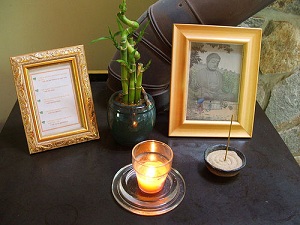 Altars and Shrines: What Are They?
Archeologists have found evidence of altars and shrines in nearly all places where there is evidence that humans have lived. The predisposition to construct these kinds of sacred creations seems almost to be part of our DNA. Traditionally, shrines are memorials or monuments to the dead. We have made shrines for thousands of years throughout the world’s cultures.
Some well-known shrines include the Taj Mahal and the Egyptian pyramids. Public monuments such as the Vietnam Veterans’ Memorial, the Mount Rushmore carvings, the Lincoln Memorial, and the Martin Luther King, Jr., Memorial are all examples of secular shrines that honor the memories of individuals whose lives and deaths have influenced our history as well as countless individual lives.
We create shrines in public spaces, in our communities, in places of worship, and in our own private spaces. We create them after long preparation and fundraising, with thoughtful planning, through elaborate installations, as well as with less expense and fanfare. We may place them in our own private spaces, in a community gathering place, or at specific sites where a death or tragedy occurred.
Shrines may evolve as spontaneous collaborations, such as those created by students, faculty and families at Virginia Tech or Columbine after those tragic shootings. Those types of shrines are usually added to throughout the days following the shootings and provide a community gathering space. They become places where the shocked and grieving may seek comfort and support from others. Shared, spontaneous shrines often evolve into more permanent community memorials where the lives of those who died can be remembered. Street memorials, where family and friends lay flowers, trinkets, card, balloons, or works of art where loved ones died, can be found in cities all over our country.
In New York City, throughout the five boroughs, one can see the hundreds of Street Memorial plaques placed at spots where pedestrians were killed on the city streets. That movement arose from the St. Louis, Missouri’s Ghost Bike Memorial project where bicycles are painted white and locked to street signs near crash sites to memorialize bikers who died there. Think also of the highway memorials and shrines that can be seen along our nation’s roadways at the sites where someone’s family member or partner was killed in a crash.
Shrines may be created outside the homes or at the burial sites of well loved public figures or artists who have died, such as those created in honor of John Lennon, Princess Diana, Jim Morrison, and Edgar Allen Poe. Shrines can serve as places for solitude, reflection, and remembering but they can also be whimsical and celebratory like the brightly colored Day of the Dead shrines in Mexico’s annual festivities which celebrate and honor the lives and memories of loved ones who have died with parades, games, picnics and family gatherings. Shrines connect us to our past, to each other, and to something greater than ourselves. They serve to help us remember and to heal.
Sometimes there may be confusion about the differences between shrines and altars. Often, the words altar and shrine are used interchangeably. For the purposes of personal healing from grief, or your own personal spiritual expression, you can use which ever term you like. If religious connotations make you uncomfortable, you may prefer thinking of a personally created altar or shrine as a memorial, memory box, memory space, honoring space, remembering space, meditation space, etc. Your space can be called whatever you choose to call it.
Shrines are typically dedicated to a specific person, or in religious traditions, to a specific deity or saint. In the case of shrines dedicated to people who have died, those can also be considered as memorials. An altar is usually thought of as a sacred space used for specific functions that may be associated with religious and spiritual purposes, such as worship, prayer, rituals or offerings. In religious traditions, the altar is usually the centerpiece of the worship space, such as in a church, synagogue, temple, mosque or sacred circle.
Many people create home altars as a personal sacred space for prayer, reflection, meditation or other specific spiritual and religious pursuits. Home altars can help us focus our minds on our chosen spiritual path and serve as daily reminders of a spiritual focus or our connection to Spirit. Altars may also be created and dedicated to specific deities or saints.
Altars can also be created with people as a focus. In my own home, I have little altars everywhere, with photos of my son, elements of nature (such as stones, shells or flowers), candles, or incense, place with other objects that help me to focus on peace and comfort, such as a lovely little Jizo statue or a statue of Ganesha. Shrines and altars can be as small or elaborate as you like. You may have many different shrines or altars for different things.
Why Create Shrines and Altars?
As the instructors at Life Path Center for Learning and Healing beautifully put it, “altars and shrines are external representations of interior mysteries.â€Â Shrines and altars are ways of showing in tangible form what might be happening in our hearts and spirits. Creating shrines and altars gives us opportunities to remember, to reflect and to honor, as well as to help heal the pain of loss through the act of creating. The creation of a personal shrine can establish a private place to which you can return to reflect, meditate, grieve, engage in a personal ritual, remember, and honor the one who has died.
Small, portable shrines can be carried with you where ever you go. These might be as small as a matchbook that can fit in your pocket or something a bit larger, like the size of a book, perhaps, that might be slipped into a purse or briefcase. A take-along shrine can allow you to maintain a needed connection with your loved one, or to create a sacred space for remembering or engaging in any type of personal ritual any time or place you may need or want to do so. Or you might prefer to create a more permanent shrine or altar that can be set up in your home or on your property using heavier more substantial elements, or a smaller semi-permanent type whose elements can be taken apart and used in other places or spaces. The choices are yours.
Creating Your Shrine
There are no rules or guidelines for creating shrines. The beauty of creating a shrine is that the ideas and materials are seemingly endless and the process, like the grieving process itself, is completely individual. A few guidelines might be helpful as you engage in the creation your own personal shrine.
Before you plan the look of your shrine, spend some time thinking about your loved one without thoughts or preconceived ideas of what you think your shrine might look like. Here are some ideas that may help the process:
- Make a list of words that come to mind when you think of your loved one.
- Make a list of objects or things that you associate with your loved one.
- Write down any words of wisdom, favorite expressions, funny or loving things your loved might have said. If your loved one never spoke, write down memories that have stuck with you, specific times that you continue to return to, that seem to bring some peace and comfort and to remind you of their love.
- Write down nicknames or pet names you might have used for each other and any associations those words may bring up .
- Write down his or her favorite colors, flowers, foods, hobbies, talents, etc.
- Research and find images that correspond to some of the things you have listed. You may find lots of interesting images on the internet that you can print and cut out for use in your creation or seeing the images may spark other thoughts or ideas that you may wish to incorporate in your memorial shrine.
To Create a Take-Along Shrine
Some artists suggest that a container be decided upon first before proceeding. The container may help guide the process or selection of items used in creating your shrine. Some suggestions for containers which can be re-purposed as your moveable shrine:
- Altoid tins (or other candy or gum tins)
- Sliding matchboxes (these can be the very small sized matchboxes or the large kitchen match boxes)
- Jewelry boxes
- Gift boxes
- Cigar boxes
- Shoe boxes
- Deep frames or shadow boxes
- Drawers
- Books (you can make a book into a box by cutting a rectangular shape into the pages and then gluing the pages together to create a container inside the book)
Gather basic craft supplies:
- Scissors
- Glues
- Paints (acrylic craft paint is inexpensive and works well for this purpose)
- Decorative and colored papers
- Photographs, personal objects or other items related to your loved one
- Anything else that you wish to add to your creation, such as
Ribbons, wires, sticks, dried flowers, string, yarn, decorative paper, wrapping paper, rhinestones, shells, small mirrors, glitter, charms, and beads, as well as anything that you like, that speaks to you, and that can be glued down.
Then, begin your process:
- Prepare your surface by painting or covering the outside and then the inside of your container, allow it to dry completely.
- Add background papers or images on the prepared surface if you wish.
- Place the photo(s) of your loved one where you think it should go. Add your embellishments as desired inside and out: beads, glass pebbles, words, charms, etc., until you feel you have completed your shrine.
To Create a Semi-Permanent or Permanent Shrine
To create a semi-permanent shrine, decide on your location or designate a particular space, such as a table top or a special shelf. You may want to visit thrift and antique shops to find the perfect small table or shelf that will serve as the base for your home altar/shrine. Of course, you can re-finish, paint, and decorate these items as you wish, or you may choose to forgo the paints, glues and embellishments.
Your shrine is yours to create as you see fit. Once you’ve found your base, begin the assembling of your sacred space. Gather together meaningful items that will help you focus on your intentions of memorializing, remembering, honoring, and healing. You might want to cover your altar with a special cloth or decorative mat. Next, you may want to place a picture of your loved one in a special frame as the centerpiece of your shrine. Add to this basic memorial anything you wish.
Some Suggestions:
- Personal objects that remind you of, or which are connected to, your loved one. These might include other photos, jewelry, letters or cards he or she gave you, awards, trophies, caps, hats, and other items of clothing, favorite books, or items he or she used on a regular basis such as sewing scissors, razor, comb or brush. The list here could be nearly endless.
- Natural objects such as flowers, fruits, rocks, crystals, shells, sticks or branches from your back yard, pinecones, leaves, abandoned birds’ nests, etc. You may wish to change the natural objects weekly (such as fresh flowers or fruits) or monthly, changing out stones and shells or other things you may find in nature.
- Candles, oil lamps, or incense
- Small strings of lights
- Chimes or bells
- Religious or spiritual objects that speak to you, such as statues or photos of deities or saints, or other religious or spiritual symbols
You may add to or change the objects on your shrine as often as you wish. Many people like to add seasonal items, such as a small Christmas tree or a Menorah during the holidays, various ornaments and items representing special times of the year such as your loved one’s birthday or other special days.
You can use your shrine or altar space simply as a reminder of your loved one or as an active part of creating and conducting your personal grief rituals. The planning, making, building and “adding to,†of your shrine can itself be a healing ritual. What you do with and how you use your creation is entirely your choice. Your creation is as individual as your personal journey through grief toward healing.
Please feel free to share your experiences with your own shrines and altars. If you do not have your own shrine or altar, whether or not you are grieving, consider creating one. Shrines and altars can bring a great deal of peace and comfort, as well as serve as a reminder for us to slow down and focus on those things that are important in our lives—our loved ones, our hearts, and our souls.
 The term “spiritual bankruptcy†is a word used in the rooms of 12-step programs to characterize addicts who have lost their connection to “higher power.†One dictionary definition describes spiritual bankruptcy as “a state of complete lack of some abstract property.†Recently, I’ve been pondering what I believe “spiritual bankruptcy†means and how it appears in the people I know personally and treat in my practice.
If I were to think of the personal qualities of someone who seems to be spiritually bankrupt, what comes to mind is despair. The spiritually bankrupt person cannot envision a future different from the present. The spiritually bankrupt person has lost his/her moral compass and makes poor choices. The spiritually bankrupt person is self-absorbed and often oblivious of the effects of his/her actions on others.
As I write this, these qualities are sounding an awful lot like how I would describe someone who is deeply depressed. And I also wonder, what’s chicken and what’s egg. Does someone become depressed because he/she is spiritually bankrupt or is it the other way around?
People become depressed for many reasons including genetics, life circumstances and temperament (sensitivity). Can we say that a person who has faith and is deeply spiritual will never become depressed? That faith and being spiritually grounded will always be the antidote to depression?
I’m not so sure. But what I do know is that those who have faith, who are connected to the God of their understanding, who have a relationship with a higher power do recover from bouts of depression faster and more completely.
The reasons for this I believe are that a spiritually connected person knows somewhere in the depths of his/her being that the depression is temporary, an aberration as opposed to a constant and permanent state of being. The spiritually connected person can look at the depression as holding value for him/her, perhaps in the form of some opportunity for deeper understanding of self and life.
In other words, the spiritually grounded person may not succumb to the same level of despair or lack of hope that someone without a spiritual connection might.
In my particular faith (Yoruba), we believe each individual has a destiny and it is his/her obligation to fulfill that destiny. Everything is part of it, including sadness, pain and even depression. Depression is not viewed as punishment for wrong doing or as some moral failure. Knowing that can be a strong hedge against losing that connection to higher power. It is a hedge against the sort of spiritual bankruptcy I started out describing in paragraph one.
We must each find our own spiritual path. Our beliefs can take many forms. We can be a part of many different spiritual and religious communities. But one thing all religions and spiritual paths have in common is the presence of the divine. A spiritual connection can help people feel a greater sense of fulfillment in life. The emphasis is on the “fill†in the word fulfillment. It is one of the best remedies for that deep-seated emptiness that many people feel. We as humans, by connecting to our spiritual selves, have the opportunity to compensate for what we never received in our families of origin and perhaps from society.