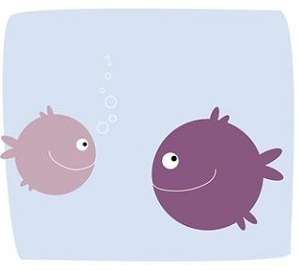
 Have you seen the movie? There are a lot of parenting situations in it that we can relate to. The main one that I see is with Marlin and Nemo. Nemo has a short fin and his dad is very protective of him, which is natural. Nemo wants to show his dad what he can do in spite of his short fin, but this is a scary situation for Marlin (the dad), because he does not know how to protect Nemo.
Nemo is reacting in an age-appropriate way: He wants to show his dad what he can do; Dad won’t let him, and then Nemo does it anyway. Sound familiar? This pattern happens a lot and at different ages and stages with parents and kids. As the kids get older, we may become more comfortable with letting go, but it will still be hard.
The question is this: How do we allow our children to do more things on their own when our own fears get in the way?
At a young age, kids begin to pull away and search for independence, and as parents, we encourage that, support them, and cheer them on. When they stumble, we help pick them up and tell them to try again. When they succeed, we feel great! When they “fail,†we get discouraged and/or keep cheering them on. The latter is a healthier response: to keep cheering for and encouraging them and to allow kids to keep striving.
The challenge is when they are hurt or held back by a physical or mental challenge that as parents we want to protect them from. We may also want to protect them because of our own fears or beliefs that someone is going to hurt them even more. When a child is showing the desire to try again or to show you that he can do something, that is when it can be okay to allow it.
With Nemo, he wanted to show his father he could swim far (out to the boat) and come back. Yes, he was being oppositional and was not listening or following directions, but that is not really the point.
Marlin was afraid that Nemo would not be able to swim to the boat, and from my perspective, Marlin was afraid that he would have to go get Nemo, and Marlin was more afraid of that than anything else. So here is something to think about: we need to be aware of where our fears come from as parents. Do our fears arise from our own insecurities or doubts that we will not be able to swim to the boat? Or maybe the fear is that when our child does well, he will need us less.
Wherever Marlin’s fears were coming from, Nemo did what he believed he could do. Yes, he got caught, and his dad searched and found him; and then Nemo was able to show Dad that in spite of his short fin, he was still able to do great things. Maybe if Marlin had allowed Nemo to show him earlier, then the situation would not have had to go that far, but then the movie would not have been made.
It took Dori to point out to Marlin that maybe it was time for him to let go. Yes, they were in the whale, but Marlin got the message: Allow Nemo to show what he can do, even if Marlin has some fears.
But let’s look again at the question posed earlier: When is it okay to allow your child to have more freedom? How can parents manage their fears when a child is insisting on what he can do?
- Identify your fears. Be aware of them. When we look at our fears, we can do something about them. Are the fears more about your child or that you may not be able to protect him from getting hurt? You are not always going to be able to protect your child; he may get hurt, but he probably will also be okay.
- Focus on what your child is able to do. Look at where improvements have been made, and see how you can help encourage him. Look at how you can support him to try something new or a little more challenging.
- Is your child asking to try something new? Is he wanting to try more? If he is, then believe in him, and try to understand that he believes he is able to try it. You can share with him your thoughts and concerns. He may disagree and still want to try, and if so, then trust him. Yes, he may not fully succeed, and that’s okay. He will learn more about himself and become more confident in himself. When he does succeed, it will feel wonderful and he will be very proud to show you.
- If you have conveyed your thoughts/fears to your child and he’s still insistent that he can do whatever it is, then support him. Encourage him and be there for him.
- If he “failsâ€, do NOT say, “I TOLD YOU SO†because that would be your fears talking. Encourage him to try again; failure means not trying at all.
Back to Marlin and Nemo: Marlin learned that Nemo was able to do a lot of things, even with a short fin. He succeeded, and Marlin also succeeded: He learned that letting go is not only scary at times but also very rewarding. Nemo told him that he loved him and was thankful, and the letting go helped their relationship become more fun. Marlin also became better at telling jokes!
One last thought: When Marlin allowed Nemo to show what he could do, I think Marlin found his own “Nemo,†which I guess opens the door for another article on this topic: Finding “Nemo†Part II.
Related articles:
Increasing Children’s Self-Esteem
Importance of Coping Skills, Part 2: Building Resilience
When Not to Say “No†to Your Child
 Healthy conflict resolution is essential to maintaining positive and constructive adult relationships. Individuals usually learn how to handle conflict in childhood. Children watch the way adults work through disagreements and model those patterns of behavior as they develop into adults and begin to form relationships with others. The bonds that children have with their caregivers also influence the way in which they address conflicts. People who have secure attachments with their parents and caregivers are often able to work through challenges with other people in respectful, affectionate, and loving ways. They are capable of recognizing when they need to ask for forgiveness and are willing to compromise to achieve a resolution that is mutually satisfying to all involved. Individuals who have insecure attachments, however, are often unable to handle situations as amicably. Insecure attachment can be expressed through avoidant or anxious behaviors. People who are avoidant in nature tend to withdraw and shut down when faced with conflict. Anxious individuals may demand attention, even negative attention, and use aggressive and hostile tactics to engage someone in a conflict dispute.
For children who have grown up witnessing dysfunctional conflict resolution strategies, having a secure attachment with others could help them avoid making the same mistakes of their parents. Rather than continuing the negative behaviors they have seen displayed by their own parents, these secure, self-reliant, and confident people may choose to use healthier mechanisms to maintain harmony in their adult relationships. Joyce A. Baptist of the School of Family Studies and Human Services at Kansas State University wanted to better understand how attachment style affected emotional processing learned in families of origin. She enlisted 203 young adults who had been raised in families with various emotional functioning styles for a study that evaluated how the adult children managed conflict.
Baptist found that the participants who had witnessed extreme disengagement in childhood were more likely to use aggressive and antagonistic disagreement strategies in adulthood. The most anxiously attached individuals in this group were the most apt to engage in hostile behaviors as their anxiety escalated. Those with minimally avoidant styles worked through disagreements in a more civil way. Baptist believes these results suggest that secure attachments can help protect individuals from dysfunctional and destructive conflict resolution patterns. These findings could impact how professionals assist people who have communication and compromise problems in their adult relationships. She added, “Considering the interrelations between emotional processing in families of origin and insecurities in attachment will allow therapists to better identify and treat the root of the destructive conflict behavior.â€
Reference:
Baptist, J. A., Thompson, D. E., Norton, A. M., Hardy, N. R., Link, C. D. (2012). The effects of the intergenerational transmission of family emotional processes on conflict styles: The moderating role of attachment. American Journal of Family Therapy 40.1, 56-73.
People who have suffered childhood trauma are at increased risk for psychological problems resulting from extreme stress. Borderline personality disorder (BPD) is one such condition that has been linked to severe childhood trauma. When the trauma is inflicted by a caregiver, the child’s ability to cope is significantly impaired. The effects of unhealthy coping, attachment dysfunction, and emotional regulation can affect many areas of the child’s life as they continue into adulthood. Affect dysregulation is the inability to control one’s moods and emotions and has been linked to BPD and other mental illnesses. Underregulation of emotions is expressed by lack of control, extreme emotional overwhelm; while overregulation is the result of numbing and is exhibited by an inability to express emotions. To determine which of these factors is more indicative of BPD in adults who suffered trauma during childhood by their primary caregiver (TPC), Annemiek van Dijke of the Delta Psychiatric Hospital in the Netherlands conducted a study of 472 clients with a diagnosis of BPD.
The participants’ levels of affect regulation were documented and they were evaluated for various forms of TPC, including sexual abuse, physical abuse, and emotional trauma. Van Dijke found that 63% of the participants had experienced some form of TPC and that those with underregulation had more symptoms of BPD than the participants with overregulated affect. Although the study did not consider other factors that could influence BPD, such as family history, other traumas, and the mental health of the caregivers, the results clearly emphasize the importance of examining emotional regulation, and specifically underregulation, in clients with a history of TPC.
The findings also showed that the participants with TPC were at increased risk for posttraumatic stress (PTSD). But Van Dijke noted that no research has been conducted to determine exactly how specific forms of TPC affect the severity of PTSD symptoms or how they are indirectly affected through affect regulation as a result of TPC. In sum, Van Dijke believes that these results can benefit clients who have suffered TPC by educating clinicians on the importance of helping clients build more secure relationships and develop healthier emotional expressions.
Reference:
Van Dijke, A., Ford, J. D., van Son, M., Frank, L., & van der Hart, O. (2012). Association of childhood-trauma-by-primary caregiver and affect dysregulation with borderline personality disorder symptoms in adulthood. Psychological Trauma: Theory, Research, Practice, and Policy. Advance online publication. doi: 10.1037/a0027256
 Families need to be together. After all, the family as a group exists to provide support, nurturance, food, shelter, resources, and a stable future to each member. While most families have their ups and downs, even stressed, impoverished, chaotic families want to live with one another. When is it in the family’s best interest for members to separate from one another? Can leaving the family home for a short while ever bring healing to the relationships in the long run?
Family separations occur in American culture in formal and informal ways. Formally, families can legally be ordered to separate by the courts because of domestic violence, child sexual, emotional, or physical abuse or neglect, chronic drug or alcohol abuse, and/or failure to educate and when there is a threat to the life, health, and well-being of one or more family members. Typically, less-intrusive assistance has been attempted at many levels before a court order occurs, including weeks or months of child-centered school counseling, family therapy, marriage counseling, social work support, addiction treatment, spiritual community support, or elder advocacy.
All of these actions occur at local, county, and state levels because we as a society believe that we have a stake in supporting and sustaining healthy families. State laws vary but generally have been written with family reunification as the end goal of this intervention process, wherever possible. Violent fathers, neglectful or addicted mothers, and abusive siblings can and often do change and grow into healthier, happier parents, spouses, siblings, and grandparents. We want families to get along well and have what they need to contribute to the world. No one benefits when families are so chaotic and dysfunctional that it takes dozens of people and thousands of hours and dollars to try to help.
[fat_widget_right]More informal separations occur every day, particularly among highly distressed married couples. Unable to live in the same home without physical or emotional pain, one member of the couple leaves the home temporarily and lives elsewhere. Unlike a formal, legal intervention of family separation, this kind of separation is less likely to change the marital interactions at all. What it usually does is create less fighting and conflict in the home, while increasing the stress of the separating spouse and any children in the family. The only person who may feel any relief is the remaining spouse, and this relief is generally temporary. The focus is shifted to the dozens of life details that, once shared, have to be renegotiated, from grocery shopping and bill paying to getting a child to baseball practice.
Unless a separated couple gets professional support and assistance immediately, the family begins to reshape around the absence of the separated parent. Children feel neglected and forgotten, no matter how diligent the separated parent is in spending time with the children. There is just no adequate substitute for living together, and the children’s behavior often suffers. The couples will simply shift their conflict away from one another in the short term and have no real plan of action for getting everyone back together. Because separation only tones down conflict and doesn’t solve it, I almost always suggest that separated couples who want to remain married work at getting back together as soon as possible, and always with professional family or marital therapy. If this is not the chosen path, statistics predict this couple will end up divorcing.
Separation is often a necessary choice when family behaviors become violent, abusive, or dangerous. But in nearly all cases, families should be helped to heal and reunify as soon as possible. Separation is not the best course of action unless it is the only course left for health, safety, or stability’s sake. Every one of us needs to feel like we belong and to be part of a group of people who know, appreciate, sacrifice for, and value us most of all. At our best, these are our families. It’s worth the effort to make them as healthy, whole, and loving as possible.
Related articles:
Three Truths Every Couple Needs to Know About Marriage
Want Family Therapy? These 4 Problems Should Be Treated First
Harness the Power of the Marriage Bond
 I was talking to one of my colleagues about our children; his are much older than mine. He had some great experience to pass along. The wisdom was that “friendship, with kids, comes later.â€
What I gather from that is when a child is younger, what they need is to be parented. Parenting is teaching, guiding, and leading the child to know how to make wise choices, to be disciplined when he/she is not making a wise choice, to be shown how to love self and others, to make friends, and to evolve into a wise young person.
There are parents out there who are concerned about being their child’s friend. What is challenging is that if you are, first, a friend, then when the child is a preteen or teenager, the child will not need you as a friend. By then, he or she will have friends their own age to listen to. As teens, they need you as a parent, but they are not going to tell you that. When you become their friend first, parenting becomes difficult to establish. The child may not see you as an authority figure, and when you try to establish authority, the child will most likely question you even more. That’s not what you want.
When you are a friend first, it sends a message that you want your child to like you, to share with you, and to help you feel connected. If that’s the case, that puts a lot more pressure on the child. It is not your child’s job to help you feel good about yourself. If that is why you are your child’s friend, rather than being his/her parent, then you may need to get some counseling for yourself. You and your spouse (if married) will need to focus on a healthy relationship so the lines of parenting and friendship, even with your child, can be reassessed and altered, if need be.
When you, the parent, behave as a parent, you are laying a solid foundation for a healthy friendship with your future adult child. There will be many challenging times, and parenting is going to be difficult. Yes, you are developing a friendship with your child based on how you respond to, love, guide, lead, and, of course, have fun with him/her. But, in the beginning stages of childhood, you need to be the parent, always. Over time, the parenting will change because the child will need different amounts of parenting.
Here is an example: My son, who will be 1 year old, needs a lot of parenting. He’s mobile and will get into everything. I need to be there to make sure that he is not getting into anything that will hurt him.
As he gets older, I will still parent him to make sure he learns and makes wise choices, but as he gets older, I will have him make more decisions on his own. When he can dress himself, I will still help him but will allow him to make decisions on what he wants to wear. If he does not want to wear a seatbelt, I will of course enforce that he wears one because that is the law. Parenting changes when the child is able to make his own decisions; but you will still need to be there to see that he is making healthy decisions. If he does not make the best decision, then he also needs to learn that he will have a consequence for that decision.
As you parent, you are laying a foundation for a friendship later on with your adult child. You are still his or her parent, but when the child is 18+, it is more of a friendship with your adult child, and adult children will seek out parenting advice when they need it. At that stage, you can ask if they want you to speak as a parent or as a friend.
Think on this: Your child will have plenty of friends, but only one parent (two, of course, if you are married).
 There are many ways one parent can influence how children perceive their other parent. This is often a positive experience for children, as they learn to appreciate both of their parents as individuals. Other times—especially during a divorce—this is a negative experience, making it difficult for children to manage their feelings of loyalty and have loving relationships with both parents.
It is sometimes the case that one parent is truly a danger and should not have access to the children as determined by a court of law. However, alienating behaviors often occur not because of fear of danger to children, but because of conflict between parents due to hurt feelings, imagined offenses, actual offenses, infidelities, feelings of abandonment, and more. There are various levels of alienating behaviors, all of which impact children, but some of these behaviors are more damaging than others.
Sometimes one parent might say something negative to other other parent in front of the children. Usually, they will quickly regret the statement and will try to mitigate the inappropriateness in an effort to minimize damage to the child and their relationship to the other parent. When a child already has a difficult relationship with the other parent, this effort to talk to the child about it is very important.
Behaviors can step up from there, from parents who, while they might regret their outbursts, do not believe it is their job to make sure there is a good relationship between the children and the other parent; to parents who are determined that there is no relationship possible. Parents may see this as a battle, thinking they are protecting their children, when in fact children tend to be the “casualties of war†between the warring parties.
Here are some examples of alienating behaviors, from more benign to more egregious:
- When it is time for children to go to the other parent and they refuse to go, the delivering parent does not encourage them to go to the other parent, stating they do not want to force them to go against their will.
- When one parent calls to talk to the children, the parent who answers stages a loud conversation about responsibilities for financial difficulties, while the children wait to “have to†get on the phone.
- Unwillingness of one parent to attend events where the other parent will be in attendance, letting the children know their unwillingness and the reasons for it.
- Letting the children know that he or she will feel badly if the child goes to the other parent when he or she feels ill, there is a relative visiting from out of town, etc.
- Telling the children he or she does not want to hear about what they do when they are with the other parent.
- Ripping up photographs or letters from the other parent with no regard for children’s awareness of the activity.
- Telling the children information about the other parent, such as issues regarding finances or infidelities—sometimes admitting that they should not have said anything.
- Telling lies about the other parent, like “Your father had an affair” or “Your mother is an alcoholic” when statements cannot be supported with evidence.
- Telling the children they can’t repeat things to the other parent about who they spend time with, how they’re doing in school, trips they have taken, or other information.
- Threatening to stop loving the children if they continue to have a relationship with the offending parent.
- Creating an environment that is so toxic to the children that they find it easier to believe the lies and innuendos and choose one parent to align with—usually the parent exhibiting the alienating behaviors, effectively ending the relationship with the other parent.
This is clearly not an exhaustive list. Hopefully, you will not find yourself represented in any of them.
Shyness is a behavior that can cause problems for children and adults. But adolescents, who experience elevated emotional turmoil, are more vulnerable to the symptoms of extreme shyness. “Although they might be easy to overlook, they probably experience much private unhappiness, as adolescent shy behavior is linked to loneliness, having fewer friends, and other internalizing problems such as anxiety, low self-worth, depression, social phobia, and eating disorders among women,†said Neira van Zalk of the Center for Developmental Research at Orebro University in Sweden. Shyness has also been shown to cause stress in social situations, leading to social anxiety that can result in negative thoughts, impaired job performance and general dysfunction. These symptoms can be caused by a number of factors, but recently, researchers have begun to examine how parenting styles influence the development of shyness in children. “As a number of reviews show, different forms of socially fearful behaviors, such as shyness, behavioral inhibition, social anxiety, social withdrawal, and reticence, are associated in young children with two forms of parental psychological control: intrusive control and criticism or rejection,†said van Zalk. Parents who are over-controlling, although their intentions are good, may shield their children from stressful life situations, thus prohibiting their ability to develop coping skills and self-regulation. Another factor linked to childhood shyness is the amount of warmth exhibited by parents. Studies suggest that children who receive praise and warmth experience less anxiety, stress and loneliness than children who receive little parental warmth.
Van Zalk and a team of researchers analyzed data collected from several waves of a larger study conducted on Swedish adolescents. The teens were interviewed for symptoms of anxiety and shyness, and reported how they perceived the parenting they received. “In this study,†said van Zalk, “We found that the more shy adolescents were, the more intrusively controlling, rejecting, and less emotionally warm they perceived their parents to be over time. There was also some evidence that the more youths perceived parents as intrusively controlling, the more their shyness increased over time.†Van Zalk added that the teens with the most severe shyness received the least parental warmth. “Why would shyness elicit these behaviors from parents? One possible explanation is that parents mistakenly see the adolescent’s social isolation as intentional and that they tend to do this more as youths age,†said van Zalk. “Their lack of warmth and rejection might reflect frustration or concern that is not expressed properly. Another possibility is that some correlate of shyness helps to explain parents’ critical, rejecting reactions.†Van Zalk added, “Maybe parents whose children show shy behavior can help by being aware of their children’s oversensitivity and their own responses to their children.â€
Reference:
Van Zalk, Nejra, and Margaret Kerr. “Shy Adolescents’ Perceptions of Parents’ Psychological Control and Emotional Warmth: Examining Bidirectional Links.” Merill-Palmer Quarterly 57.4 (2011): 375-401. Print.
 We know that when a marriage ends it is the parents who are divorcing. But do we think about the fact that our children aren’t getting a divorce, they are getting two households in which to continue living with their family. Their parents relationship is changing to something different than they have yet experienced. What do you need to think about so that your children are taken care of as well as possible? For some, the question is what rights do children have in a divorce? Here’s a list that is a good place to start.
1. Children have the right to live in a conflict-free zone. Your children should not have to go back and forth between two homes feeling the anger and tension between their parents. The best way to deal with this is to take care of the issues you are in conflict over. Find a way to work out your disagreements. Work with a third party if necessary, but keep the conflict out of the co-parenting relationship so it is out of the lives of your children. When children do not do well after their parent’s divorce, this is the number one reason why that is the case.
2. Children have the right to love each of their parents. Your children should be able to feel and express that love without interference from anyone. You may have an opinion of your ex that you feel your child needs to be taught about so they can be better protected. Unless your ex is truly dangerous and a court has found this to be true, do not subject your children to your beliefs that make it difficult for them to be in your presence and also feel love for their other parent. The other parent has also had a part in creating your children. Children will sometimes become safe-hating if they perceive that they have traits that are similar to the other parent. This may play out differently depending on the age of the child. It is important to consider it no matter the age.
[fat_widget_left]3. Children have the right to not be the emotional support for their parents during the divorce. When your child is growing up, your relationship with them changes. They are more able to have heartfelt conversations with you and can understand more complex emotions. When you are going through a divorce and you have a developing relationship with your teenage child, it is very tempting to tell them about what is going on for you in the way they have started to tell you what is going on for them and how they are thinking about the world. It is not the time to start telling them about your divorce and your feelings and your concerns. You are talking with them about their other parent, not your boss or friend with whom they do not have their own relationship. Protect them from the information that will be a burden for them to know. Do not ask your child to take care of you by listening and being your support. It is true you are in an emotionally difficult time in your life and you may need more care taking than usual. You should get taken care of in an appropriate place so you are best able to take care of your children while their world is changing as well. Keep in mind that children often like it when they are treated like adults. They will not tell you it is not what they want because they might like the newfound intimacy they are having in their children while their world is changing as well. Keep in mind that children often like it when they are treated like adults. They will not tell you it is not what they want because they might like the newfound intimacy they are having in their relationship with you.
4. Children have the right to not feel responsible for their parent’s divorce. It sometimes happens that children believe their parents are getting divorced because of something they did. They can feel responsible for the fights you have because of something they asked for that you may have disagreed on. They may think their behaviors when told they had done something wrong could contribute to their family changing in this very big way. Children believe their actions have more far-reaching effects than is actually the case. Feelings of guilt and shame often accompany these thoughts and they are not always shared with anyone. When telling your children you are divorcing it is helpful to make sure they know that there was nothing they did to bring this about and it is most helpful if you can tell them together.
5. Children have the right to not be the messenger for their parents. Because it seems logistically easier, backpacks, suitcases, notebooks, etc. that belong to your children are often thought to be appropriate conduits for material that needs to go back and forth between households. This is very often problematic. Children should not be the messengers for support checks, important papers, etc. It sometimes happens that the material that is brought with them in the transition is upsetting to the receiving parent. Perhaps the amount of the check is not what they had expected or the paperwork is inflammatory. This has the impact of your child feeling as though they are the reason you are not happy and they are somehow at fault. It is very important that your children not take part in any exchanges between you. They deserve to be protected from the information you are sending to the other parent.
These are just a few of many things to be aware of as you go through this process. It helps to try to look through the world periodically through the eyes of your child.
 Last week, I had the honor of attending and speaking at Postpartum Support International’s 25th Annual Conference in Seattle, WA. I was moved and inspired by the amazing work gestating and being born in the perinatal world by so many compassionate professionals. (Refresher: “perinatal†refers to the time from conception, through pregnancy, on through the first year after having a baby.)
My dear colleague Gabrielle Kaufman, BC-DMT, NCC and I presented a workshop on special needs parenting as relates to the family experiencing perinatal challenges. Both Gabrielle and I have found in our practices a large number of women and families who are impacted by the double whammy of a perinatal mood/anxiety disorder (PMAD), coupled with parenting a special needs child. We felt it was important to highlight this population of folks who are in great need of resources and support. Although this subject could be an entire week-long conference, we discussed the following highlights that are pertinent for special needs families and the people that support them.
It’s hard to define special needs, as we all are special and we all have challenges. We choose to define special needs as a child in a family system who is experiencing the challenge of a neurological, emotional, behavioral, developmental, or physical disability. This challenge affects the entire family system on several levels.
- One in 10 children have a disability (neurological, emotional, behavioral, developmental, physical)
- Parents of special needs children are more at risk for depression and anxiety
- Couples (parents) of special needs children benefit from support such as psychotherapy and regular date nights (50% or more of all special needs couples divorce)
- “Neurotypical” siblings benefit from support in the form of sibling support groups, one-on-one attention from parents, and open-ended discussion of feelings/solutions to concerns associated with being a special needs family (i.e., role-playing how to handle being in public with special needs sibling, preventing parentification, etc.)
- Stigma is real and exists, even in the 21st century. Therefore, family discussions need to happen to address this concern and to build social support networks.
- Family/couple/individual therapy and support groups were found to be helpful in buffering the effects of stress and lowering depression/anxiety in these family systems in several studies
- The special needs family is exposed to chronic stress and therefore requires an ongoing stress management program that will lower the effects of cortisol and adrenaline (the fight or flight response) that develop. For example, self-care, yoga, psychotherapy, respite care, support groups.
Below are some helpful resources we found to be beneficial.
Resources
- Americans with Disabilities Act Home Page – Extensive information about the Americans with Disabilities Act
- The Arc of the United States – Chapters across U.S. offer information, support, and advocacy for people with developmental disabilities
- The Arc’s Information for Siblings – Provides information and training to start sibling support groups
- ARCH National Respite Network
- Easter Seals Southern California – After-school activities for children with disabilities using public school sites and community settings
- Family Voices, Inc. – Offers information, support, advocacy, and workplace information for families of children with special health care needs; many publications available to download for free
- Fussy Baby Network – Resources for families with fussy babies
- National Alliance for the Mentally Ill (NAMI) – Offers interactive “Special Needs Estate Planning Guidance Systemâ€
- National Autism Association – Clearinghouse of resources on autism spectrum disorders
- National Dissemination Center for Children with Disabilities – Online clearinghouse providing information and links on all matters related to childhood disabilities, resources, laws, research
- Sensory Planet – Clearinghouse of information for sensory processing disorders
- Sensory Processing Disorder Foundation – Information on sensory processing disorders
Organizational Aids:
- Children’s Hospital and Regional Medical Center/Center for Children with Special Needs – Offers “CARE Organizer†(forms to document child’s activities, therapies, medical bills, etc.) and the “CARE Notebook†(an expanding file folder to organize forms)
- Children’s Medical Organizer – Online organizer to keep track of family’s medical information, from immunization records to doctor appointments
- The National Center of Medical Home Initiatives for Children with Special Needs – Provides links to various types of organizers and health care notebooks
- Â Think College – Has information and searchable database on special college training, courses, and assistance for young adults with disabilities
Books:
- Baskin, A., & Fawcett, H. (2006). More than a mom: Living a full and balanced life when your child has special needs. Bethesda, MD: Woodbine House.
- Celebi, J. (2008). Overwhelmed no more!: The complete system for balanced living for parents of children with special needs. Joan Celebi.
- Domar, A. (2001). Self-nurture: Learning to care for yourself as effectively as you care for everyone else. New York, NY: Penguin Books.
- Fogel Schneider, E. (2006). Massaging your baby. New York, NY: Square One.
- Gil, B. (1998). Changed by a child: Companion notes for parents of a child with a disability. Pella, IA: Main Street Books.
- Meyer, D. (1997). Views from our shoes. Bethesda, MD: Woodbine House.
- Seligman, M. (2004). Authentic happiness: Using the new positive psychology to realize your potential for lasting fulfillment. New York, NY: Free Press.
- Seligman, M. (2006). Learned optimism: How to change your mind and your life. New York, NY: Vintage.
Parental Self-Care:
- America On the Move Foundation – Information about healthy-eating and fitness; can register to work toward achieving health goals
- American Trails – State-by-state list of trails and greenways, groups, and hiking agencies
- Special Olympics – Opportunities for adults and children with intellectual disabilities for sports training and competition
- World Laughter Tour – Lists laughter clubs around the U.S. and Canada
- Global Family Yoga – Yoga resources for special needs families
Other Materials:
- Children with Special Needs and the Workplace: A Guide for Employers by the Center for Child and Adolescent Health Policy at the MassGeneral Hospital for Children
- Commonly Asked Questions About Child Care Centers and the Americans with Disabilities Act
- A Family Handbook on Future Planning edited by Sharon Davis, PhD
- Open Arms: Embracing a Bright Financial Future for You and Your Child with Disabilities and Other Special Needs by Easter Seals Disability Services and the National Endowment for Financial Education
This list of resources is far from comprehensive, as every day the Web has new sites on the special needs family. We chose to highlight a few websites and books which we found to be helpful for our clients and our practice, as perinatal psychotherapists.
 “I don’t know.†Is it the stock answer teens give their parents for every question? Does it mean more than just a lack of an answer? How do we get them to speak to us and to have a conversation? There are ways to talk to teens, develop relationships through communication and not feel like an interrogator.
To get around the “I don’t knowâ€, start by changing your attitude, mood, and how you start the conversation. Connect with them with a high energy greeting showing your good disposition. The frame of mind that you display sets the tone for the conversation. A high energy, happy greeting and smile goes a long way towards setting the mood and showing your child that you are happy and that they have nothing to fear by being open and honest with you. Teens, unless they prove to you otherwise, want their parents to be proud of, and accepting of, them. Set the stage of your conversation so that they are comfortable; help them by making it as easy as possible for them to talk to you. Ask questions that cannot be answered with just a simple ‘yes’ or ‘no’ response.
“I don’t know†is a response with many different meanings; it can be “no one has asked me that before†and “I genuinely have no idea how to answerâ€. This is your chance to be silent and let them mull it over for a few moments. When you are silent, it puts the emphasis back on to the adolescent to come up with an answer. Show them that you are interested and receptive to what they are going to say. Your body language conveys your curiosity – lean forward, face them, make good eye contact without being overbearing, and be aware of the voice you use when you talk. After a few moments of quiet, change the question subtly but ask them the same basic question; continue to show them interest. You can give them an idea by rephrasing your question to help spark their response.
At times, the response “I don’t know†means, “I have thought about it and I really do not have an idea or opinion one way or anotherâ€. If you think their response means this, clarify it with them. This is a valuable time to teach them and to share yourself openly to increase trust and amplify the quality of your relationship. Kindly ask questions and have a conversation about their thought process, find out where they were stuck in searching out an answer. You can share your experience in how you would answer the question that you had asked. When you share about yourself, keep it simple, brief and to the point. Remember that the conversation is about your child and their concerns; they have to grow and learn to live their own way.
Occasionally “I do not know†can mean, “the question you asked me is a poor oneâ€, or “I do not understand what you are asking meâ€. After you have given your teen a few moments to come up with a better answer and they appear not to understand, clarify your question by asking it in a different way. Remember to avoid asking “why†questions. These questions start with “whyâ€, or include only the word “whyâ€. Often people do not understand why they did something, but just went through an action without a lot of consideration. When you ask someone “why”, they are often put onto the spot and have to come up with a reason for their act instead of working with you to increase understanding. A teenager put on the spot is frequently going to say anything that pops into their mind instead of really thinking through what they are being asked; hence, parents often are told, “I don’t knowâ€.
Lastly, “I don’t know†can signify “I do not want to talk to youâ€, or “I do not want to talk about that subjectâ€. There are many ways to defuse this situation, including silence with receptive body language, clarifying that you need an answer, and giving an example answer. An additional way to communicate when told “I don’t know†includes explaining to your teen that you understand that it is a sensitive subject and that you respect that they may not want to talk about it. You can respect and understand that it is sensitive to them and you will treat them with respect, and offer to talk to them about the subject later or when they are ready, or after you both take a break from the conversation.
As your child uses “I don’t know†to push you away and tell you they do not want to talk to you, explain that your conversation is important and that you want to understand what is happening or are seeking an explanation. Offer to help them help you, and seek out ways to understand what is happening when they push you away with their words. Avoid creating a confrontation and an argument because you cannot make them talk to you; getting into an argument works to their advantage to avoid discussing what you are asking. Recognize when you are getting upset or your teen is trying to get away from the conversation. Be receptive to letting the conversation wait for a better time in order to avoid a fight. As they keep using “I don’t know†time and again, recover the conversation by explaining to them that you know what it means and that you are trying hard to communicate, respect them, and their opinions.
Talking to your children does not have to feel like a cross-examination, but can instead be satisfying banter. Remember, “I don’t know†means: “no one has asked that before”; “I really do not know”; “I do not have an answer”; or, “I do not want to talk to you”. You can try different means to get past the dismay that “I don’t know†causes parents and adults. Keep your body language receptive and encourage communication with your silence, clarify your question, relate about yourself and explain that you understand them. Following these steps can help you increase communication and fortify the relationship you have with your child.
Researchers from several universities recently collaborated on a study to determine how genetic, environmental, and interpersonal factors influence the development of psychopathy. Psychopathy is characterized by lack of emotion, dysfunctional attachments, lack of remorse or guilt, and often antisocial tendencies, thought to be caused by genetic factors. The researchers sought to determine how environmental factors, such as peer influence, parenting, neglect, or abuse, affected two specific traits of psychopathy—fearless dominance (FD) and impulsive antisociality (IA).
Using the Psychopathy Checklist-Revised (PCL-R) and the Multidimensional Personality Questionnaire (MPQ), the researchers assessed 2,604 twins, all 17 years old, for several factors. They evaluated the parent-child relationship and social environment, including peer interactions. They assessed levels of antisociality and prosocial behaviors and also gauged academic performance in school. Additionally, the team looked at external events including legal issues, school problems, and other stressful life experiences.
They found that the male twins exhibited more psychopathic behaviors overall. “There was a moderate to large gender difference on MPQ-FD and MPQ-IA, with boys scoring higher on both,†said the researchers. “Boys also scored higher on antisocial peers, mother-child relationship problems, and school and legal problems. Girls scored higher on academic achievement and engagement and family level problems.†They believe these findings regarding relationship problems are significant. “This pattern of disrupted parent-child relationships and antisocial tendencies then initiates a sequence of developmental processes leading to academic failure, peer rejection, deviant peer afï¬liation, drug use, and delinquency.†They added, “Less discussed are factors that underlie the initial disrupted parent-child relationship, such as a child’s undercontrolled temperament or the parent’s own antisocial traits that then influence his or her parenting practices. We propose that genetic factors are a likely source of such individual differences that then influence other putatively environmental variables such as parent-child relationship problems.â€
Reference:
Hicks, B. M., Carlson, M. D., Blonigen, D. M., Patrick, C. J., Iacono, W. G., and MGue, M. (2011, August 29). Psychopathic Personality Traits and Environmental Contexts: Differential Correlates, Gender Differences, and Genetic Mediation. Personality Disorders: Theory, Research, and Treatment. Advance online publication. doi: 10.1037/a0025084
Personality influences nearly every area of an individual’s life. From relationship satisfaction, career stability and even mortality, the five leading personality traits, known as the Big Five, agreeableness, openness, extraversion, conscientiousness and neuroticism, have been shown to have a direct impact throughout. But a new study suggests that an individual’s personality also influences another important role. “Given the importance of personality for the ways in which people live and experience their lives, it is hardly surprising that personality has been proposed to be related to one of the most central, challenging, and affectively charged tasks that many adults are faced with: namely, parenting,†said  Amaranta D. de Haan, Maja Dekovic´, and Peter Prinzie of Utrecht University, who conducted a study to determine exactly how the personalities of parents and adolescents affect the parenting dynamic. They theorized that outgoing and social parents, high in extraversion, would most likely exhibit positive and highly motivating behaviors with their children, while introverted parents would act more withdrawn and unavailable. Additionally, the team noted that children with difficult temperament who are impulsive and distractible may elicit stricter discipline and negative reactions from their parents.
The researchers interviewed nearly 1500 individuals, including mothers, fathers and adolescents, and assessed their personalities using the Five-Factor Personality Inventory and the Hierarchical Personality Inventory for Children respectively. They looked specifically at warmth and overreactive discipline when they assessed them two years later. They found that overreactivity was influenced more by the personality of the parent rather than the adolescent. But the personality traits of both children and parents impacted the level of warmth. “Associations between parental personality and parenting were similarly related to parents of easy versus difficult adolescents, and for mothers and fathers parenting daughters or sons,†said the team. “Together, results show that parent characteristics as well as adolescent characteristics importantly affect dysfunctional and adaptive parenting.â€
Reference:
de Haan, A. D., Deković, M., & Prinzie, P. (2011, August 29). Longitudinal Impact of Parental and Adolescent Personality on Parenting. Journal of Personality and Social Psychology. Advance online publication. doi: 10.1037/a0025254