 With the advent of easy plane travel, many larger businesses have grown to include regional, national, and even international customers and work sites. People who work at the higher levels of industries often find their jobs are not done just at their desks, no matter how well connected they are electronically. Business relationships, decisions, and inspections can’t all be done without physically being on-site, and long-distance and extended travel are part of the job.
You may look upon that lifestyle with envy. Well, don’t. Having worked with dozens of families and couples who have held jobs like this, I can tell you, from their experience, that these jobs can take a very heavy toll on satisfying family relationships. Before you make that big job your goal, I hope you’ll first consider what it can demand from your life.
- Physical toll: Traveling is exhausting no matter what class of seat you have on a plane. When you travel, your body is in a constant state of adjustment to different food, water, accommodations, climate, work expectations, and time zones. Any kind of steady, healthy patterns of sleep, exercise, nutrition, and relationships are interrupted, and it’s rough to try to keep up with good health habits somewhere else.
- Exit/reentry transitions: Life keeps moving on in your home, despite the traveler’s schedule. When you’re trying to pack, with your mind on the journey ahead, the family may feel your absence even while you are still home. Arriving home can be worse, as you’d love to be welcomed home with excitement, while the one who has been at home may want nothing more than to be relieved of the additional responsibilities he or she has been shouldering.
- Parenting patterns: When one parent in a family travels for work, the remaining parent has to temporarily become a single parent. Leadership around finances, yard work, car repairs, play dates, and school assignments have to shift to the parent who is home. Children can get accustomed to the traveling parent being the “fun†one who comes home with gifts and days off, leaving the at-home parent as the disciplinarian and enforcer, who becomes used to making parenting decisions solo.
- Emotional isolation: After spending enough days of the month away from home, it becomes very easy to live two lives: one on the road and the other at home. Even with regular phone, text, email, and Skype connections to those at home, the relationships that develop with those who share the travel with you can become more real to you than the ones you leave behind. Isolation, prestige, repetition, or intensity of the shared work adds to that other-worldliness. It’s at this level of isolation that I have seen long-term affairs, addictions, mood disorders, and health issues surface. These issues are not easily or often repaired.
Human relationships need physical proximity, regular conversation, shared patterns of caregiving, humor, health, and equality to thrive. Trying to have all these while traveling for a job is like trying to juggle three balls when all you’ve ever managed were two. If you are struggling with any or all of these issues as a family or couple, I encourage you to reach out to a family therapist in your area, who can help you manage the human challenges of traveling this much. While it’s not impossible to thrive, it is tough. Best buckle up. The captain has turned on the fasten seat belt sign.
 Have you seen the movie? There are a lot of parenting situations in it that we can relate to. The main one that I see is with Marlin and Nemo. Nemo has a short fin and his dad is very protective of him, which is natural. Nemo wants to show his dad what he can do in spite of his short fin, but this is a scary situation for Marlin (the dad), because he does not know how to protect Nemo.
Nemo is reacting in an age-appropriate way: He wants to show his dad what he can do; Dad won’t let him, and then Nemo does it anyway. Sound familiar? This pattern happens a lot and at different ages and stages with parents and kids. As the kids get older, we may become more comfortable with letting go, but it will still be hard.
The question is this: How do we allow our children to do more things on their own when our own fears get in the way?
At a young age, kids begin to pull away and search for independence, and as parents, we encourage that, support them, and cheer them on. When they stumble, we help pick them up and tell them to try again. When they succeed, we feel great! When they “fail,†we get discouraged and/or keep cheering them on. The latter is a healthier response: to keep cheering for and encouraging them and to allow kids to keep striving.
The challenge is when they are hurt or held back by a physical or mental challenge that as parents we want to protect them from. We may also want to protect them because of our own fears or beliefs that someone is going to hurt them even more. When a child is showing the desire to try again or to show you that he can do something, that is when it can be okay to allow it.
With Nemo, he wanted to show his father he could swim far (out to the boat) and come back. Yes, he was being oppositional and was not listening or following directions, but that is not really the point.
Marlin was afraid that Nemo would not be able to swim to the boat, and from my perspective, Marlin was afraid that he would have to go get Nemo, and Marlin was more afraid of that than anything else. So here is something to think about: we need to be aware of where our fears come from as parents. Do our fears arise from our own insecurities or doubts that we will not be able to swim to the boat? Or maybe the fear is that when our child does well, he will need us less.
Wherever Marlin’s fears were coming from, Nemo did what he believed he could do. Yes, he got caught, and his dad searched and found him; and then Nemo was able to show Dad that in spite of his short fin, he was still able to do great things. Maybe if Marlin had allowed Nemo to show him earlier, then the situation would not have had to go that far, but then the movie would not have been made.
It took Dori to point out to Marlin that maybe it was time for him to let go. Yes, they were in the whale, but Marlin got the message: Allow Nemo to show what he can do, even if Marlin has some fears.
But let’s look again at the question posed earlier: When is it okay to allow your child to have more freedom? How can parents manage their fears when a child is insisting on what he can do?
- Identify your fears. Be aware of them. When we look at our fears, we can do something about them. Are the fears more about your child or that you may not be able to protect him from getting hurt? You are not always going to be able to protect your child; he may get hurt, but he probably will also be okay.
- Focus on what your child is able to do. Look at where improvements have been made, and see how you can help encourage him. Look at how you can support him to try something new or a little more challenging.
- Is your child asking to try something new? Is he wanting to try more? If he is, then believe in him, and try to understand that he believes he is able to try it. You can share with him your thoughts and concerns. He may disagree and still want to try, and if so, then trust him. Yes, he may not fully succeed, and that’s okay. He will learn more about himself and become more confident in himself. When he does succeed, it will feel wonderful and he will be very proud to show you.
- If you have conveyed your thoughts/fears to your child and he’s still insistent that he can do whatever it is, then support him. Encourage him and be there for him.
- If he “failsâ€, do NOT say, “I TOLD YOU SO†because that would be your fears talking. Encourage him to try again; failure means not trying at all.
Back to Marlin and Nemo: Marlin learned that Nemo was able to do a lot of things, even with a short fin. He succeeded, and Marlin also succeeded: He learned that letting go is not only scary at times but also very rewarding. Nemo told him that he loved him and was thankful, and the letting go helped their relationship become more fun. Marlin also became better at telling jokes!
One last thought: When Marlin allowed Nemo to show what he could do, I think Marlin found his own “Nemo,†which I guess opens the door for another article on this topic: Finding “Nemo†Part II.
Related articles:
Increasing Children’s Self-Esteem
Importance of Coping Skills, Part 2: Building Resilience
When Not to Say “No†to Your Child
 Your social life, the quality of it, was wired into your gray matter by the age of 3, according to current thinking on child development. After a minute of contemplating that statement, the immense impact of early childhood caregivers becomes clear. This subject comes to mind after reading a recent news story about Artyom Saleviev.
Artyom was first in the news in 2010. He is the Russian boy who was adopted by a U.S. couple, the Hansens, 3 years ago. After being part of the Hansen family for 5 months, Artyom was put on a plane bound for Russia by his adoptive mother. Artyom carried a letter which stated the Hansen’s no longer wanted him because of his disruptive behavior related to psychological problems. The recent news article states that Artyom is now living in a foster home (in Russia) and his behavior there is not disruptive.
In the United States, the number of children in the foster care system is close to 500,000. One-quarter of them are infants when they enter the system; 15% are age 3 or younger, some only infants. The most common reasons for removing them from a parent or relative’s home are an absence of supervision (36%) and a failure to provide (31%). What affect does this have on a baby or toddler? Are they so young they will not remember neglect or abuse by early caregivers? If only that were true.
Caregiver Influence
To understand the effect early caregivers have on infants and toddlers, we can look at the implications of attachment theory. This theory, which has been substantiated by research, states that interactions with our initial caretakers determine our future capacity to build emotional bonds with others.
By the age of 3 years, children are either secure in their attachments to their caregivers or insecure. Children who are secure have the benefit of responsive caregivers that consistently meet their needs for food, safety, and affection. In adulthood, they can form lasting emotional connections with others.
There are three types of insecure attachment: avoidant, ambivalent, and disorganized.
When caregivers discourage expressions of a child’s distress or affection, an avoidant style of attachment develops. The child learns to discourage his or her own feelings, which damps down the child’s capacity to feel loved by others. Avoidant children typically withdraw from social interaction and grow into adults who are extremely uncomfortable with feelings and intimacy.
Ambivalent attachment occurs when early caregivers give comfort inconsistently. They sometimes respond to the child’s needs and sometimes do not. With this kind of care, children become unsure whether their needs will be met. As adults, they are slow to trust and at risk for mood and eating disorders.
When a child’s needs are not responded to, or the child is abused, a disorganized pattern of attachment can lead to delayed development, social withdrawal, and aggressive or disruptive behavior. Adults with disorganized attachment are susceptible to personality disorders and chronic mental health problems. Their relationships are often chaotic or short-lived.
Our attachment style sticks with us for life, although alternative behaviors and ways of thinking can be learned to improve relationships.
Not All Memory Is Conscious
When Artyom Saleviev arrived in the United States, was he secure, avoidant, ambivalent, or disorganized in relation to others? The Hansens painted a picture of a very disorganized child, although his current foster mother in Russia does not. Regardless, his experience with the Hansens, and the ill-conceived way he was sent back to Russia, are not stand-alone events. They rest on the foundation of interactions he had, or did not have, very early in life.
Even if a school-age child like Artyom is adopted or finds his way to a nurturing foster caregiver, a pattern of connection with others is already established. It begins before the child enters foster care, as a result of the child’s experience with his first caregivers, and the pattern continues after he leaves the system.
Around one-third of those 18 to 24 who age out of foster care are homeless within 18 months (in the U.S.). Up to one-half are unemployed within 4 years of leaving, and approximately 30% to 40% have a mental disorder and likely no health insurance. More than three-fourths will become parents.
Perspective
To keep these sobering numbers in perspective, we can consider that people with less than stellar starts in life can, and do, lead productive lives and find a share of happiness. Humans are highly adaptable and resourceful. It is also a fact that people from “good†homes enter adulthood with mild to severe attachment issues, usually the avoidant or ambivalent type.
Difficulty trusting and connecting with others is not just a single family issue. It is part of the human condition and drives the drama we call history.
The foster care system is imperfect, but it is a nested problem. Looked at as a whole, the problem begins with the child’s experience of insufficient early caregiving and is later aggravated by the lack of support for these children during the transition to adulthood. The system is situated in a disorganized world where, unfortunately, such institutions are necessary. The best we can do is to strive to keep making improvements based on what we continue to learn about the special needs of these children.
References:
- Child Welfare Information Gateway. Available from: http://www.childwelfare.gov
- U.S. Department of Health and Human Services, Administration for Children and Families. Abuse, Neglect, Adoption & Foster Care Research: National Survey of Child and Adolescent Well-Being (NSCAW), 1997-2010. Available from: https://acf.gov/opre/project/national-survey-child-and-adolescent-well-being-nscaw-1997-2014-and-2015-2024
- Radia, K. Adopted Russian boy rejected by U.S. mother adjusts in foster care. Available from: http://gma.yahoo.com/blogs/abc-blogs/adopted-russian-boy-rejected-u-mother-adjusts-foster-110037054–abc-news-topstories.html
Related articles:
Patterns of Attachment in Adults
Understanding Difficult Behavior – For Foster and Adoptive Parents
 If you have completed Codependency Workbook Exercise One, congratulations to you. Please take a moment to pat yourself on the back. You deserve it, because it must have taken a great deal of courage to write about your family history. Most people shed some tears in our therapy session when they share it with me. Then they feel very relieved.
Many people are not ready to share the letter with their family of origin right away. If you have a therapist available or a sponsor, discuss it with that person. If not, review it with a supportive, nonjudgmental friend. Before sharing this with your family, it is important that you be ready to deal with their reactions. Unless they are in recovery, most families will not be able to validate your experience. However, it is very therapeutic to put your family history on paper and share it with another person.
[fat_widget_right]
Now we are ready to begin the next workbook exercise, which concerns relationships. Please make a list of the most important people in your life. This may include friends, lovers, a spouse, family members, coworkers, or a boss. Spend a few minutes thinking about each relationship. How many people on your list do you believe are dysfunctional? How many are addicts, have untreated mental illness, refuse to work, even if they are able, or have other major issues? Are you taking care of some of the people on your list? Are some of the relationships lopsided, where you do most of the giving?
You may wonder why some of your relationships are lopsided. Dysfunctional people can sense that you are a caretaker and are drawn to you. It is almost as though they can smell you. You may find yourself drawn to them as well.
Last night, I saw a married couple where the wife was unsuccessfully trying to stop her alcoholic husband from drinking. She was anxious, frustrated, and very angry. Of course she would be frustrated. She was trying to control something that she had no control over. The facts are that we are powerless over other people, places, and things. Realizing this is helpful to codependents because they can learn to let go and relax. Trying to fix others is impossible, and just upsets the fixer. It also is not helpful to the dysfunctional person. Normally addicts only get help because of the consequences of their using. If the caretaker undoes the consequences, they caretaker unknowingly helps enable the dysfunctional person to remain sick.
Since caretaking may make you miserable and help your loved one stay sick, maybe we can work on not doing it. How? You can begin to learn to set boundaries. For example, you might tell the loved one that you will no longer bail him or her out if he is arrested. You may tell him that you will no longer call in sick if he is too hung over to work. You may tell her that you will only talk with her when she is sober.
I suggest that you put your list away for at least 24 hours. Then pick the relationship that causes you the most stress. Think about a boundary that you may set and write it down. Practice telling your loved one about the boundary. He or she will probably not like it, but in the long run it will be good for both of you. Be sure that you are prepared to maintain the boundary before you set it. The first time you do this, you are taking a major step in your recovery. Be sure to spend some time with someone who will support you setting a boundary.
 Families need to be together. After all, the family as a group exists to provide support, nurturance, food, shelter, resources, and a stable future to each member. While most families have their ups and downs, even stressed, impoverished, chaotic families want to live with one another. When is it in the family’s best interest for members to separate from one another? Can leaving the family home for a short while ever bring healing to the relationships in the long run?
Family separations occur in American culture in formal and informal ways. Formally, families can legally be ordered to separate by the courts because of domestic violence, child sexual, emotional, or physical abuse or neglect, chronic drug or alcohol abuse, and/or failure to educate and when there is a threat to the life, health, and well-being of one or more family members. Typically, less-intrusive assistance has been attempted at many levels before a court order occurs, including weeks or months of child-centered school counseling, family therapy, marriage counseling, social work support, addiction treatment, spiritual community support, or elder advocacy.
All of these actions occur at local, county, and state levels because we as a society believe that we have a stake in supporting and sustaining healthy families. State laws vary but generally have been written with family reunification as the end goal of this intervention process, wherever possible. Violent fathers, neglectful or addicted mothers, and abusive siblings can and often do change and grow into healthier, happier parents, spouses, siblings, and grandparents. We want families to get along well and have what they need to contribute to the world. No one benefits when families are so chaotic and dysfunctional that it takes dozens of people and thousands of hours and dollars to try to help.
[fat_widget_right]More informal separations occur every day, particularly among highly distressed married couples. Unable to live in the same home without physical or emotional pain, one member of the couple leaves the home temporarily and lives elsewhere. Unlike a formal, legal intervention of family separation, this kind of separation is less likely to change the marital interactions at all. What it usually does is create less fighting and conflict in the home, while increasing the stress of the separating spouse and any children in the family. The only person who may feel any relief is the remaining spouse, and this relief is generally temporary. The focus is shifted to the dozens of life details that, once shared, have to be renegotiated, from grocery shopping and bill paying to getting a child to baseball practice.
Unless a separated couple gets professional support and assistance immediately, the family begins to reshape around the absence of the separated parent. Children feel neglected and forgotten, no matter how diligent the separated parent is in spending time with the children. There is just no adequate substitute for living together, and the children’s behavior often suffers. The couples will simply shift their conflict away from one another in the short term and have no real plan of action for getting everyone back together. Because separation only tones down conflict and doesn’t solve it, I almost always suggest that separated couples who want to remain married work at getting back together as soon as possible, and always with professional family or marital therapy. If this is not the chosen path, statistics predict this couple will end up divorcing.
Separation is often a necessary choice when family behaviors become violent, abusive, or dangerous. But in nearly all cases, families should be helped to heal and reunify as soon as possible. Separation is not the best course of action unless it is the only course left for health, safety, or stability’s sake. Every one of us needs to feel like we belong and to be part of a group of people who know, appreciate, sacrifice for, and value us most of all. At our best, these are our families. It’s worth the effort to make them as healthy, whole, and loving as possible.
Related articles:
Three Truths Every Couple Needs to Know About Marriage
Want Family Therapy? These 4 Problems Should Be Treated First
Harness the Power of the Marriage Bond
 “Like father, like son.”
“Like mother, like daughter.”
These sentiments are often expressed with great joy and pride. Many parents are delighted and honored when their children seek to emulate them. As children grow older and think about what they want to be when they grow up, some choose to be in the same occupation as the parent.
When children opt for the same work roles as their parents, they may have the advantage of a role model who can show them the ropes, provide connections for school or jobs, and set the stage for what it is like to be in the parent’s job. Often, sharing the same job with a parent can increase the attachment between parent and child and make the relationship closer. Sometimes, though, when parent and child have differing ideas about how the work role should be performed or conceptualized, conflicts might undermine the relationship. Under these circumstances, it may be difficult for the parent to accept that, while their child is drawn to the parent’s work, they have their own ideas about how that work should be done.
Alan and His Father
Alan came to see me about the conflict he was experiencing working in his father’s business, a chain of sporting goods stores. At the time he sought therapy, he had been working for his father for five months. It was especially important to Alan that I understood that he felt like he was working for, not with, his father. He admitted that he was surprised how much he liked the work. It was a fun environment to work in and he could even envision himself taking over the store someday. But he was concerned that he would never be given enough authority or autonomy to feel like he could implement his ideas. For now, he didn’t feel he could really make the business into his vision of what he wanted it to be. His father had a completely different way of thinking about the stores.
Growing up, Alan had loved going to work with his father. He would help his father stock the shelves and talk about the latest equipment. They would go over every detail of the most recent sports game they had watched together; they were both intense fans of the same teams and this helped to create a profound bond between them.
But as Alan and I talked, some of the underlying issues connected to his conflict about continuing to work for his father began to emerge. Alan began to realize how difficult it was for him to let his father know that he wanted something that was different from what his father wished for. He recalled that, growing up, he didn’t like to get into arguments with his father, so he either just went along or never voiced his own wishes if he thought they would result in conflict.
He remembered how, on the rare occasions that he had tried to assert his own desires against his father’s ideas, his father had become very cold toward him. In middle school he became interested in hard rock music and wanted to learn to play the guitar. His father derided the music as having no value and refused to buy the instrument or pay for lessons. It wasn’t until Alan stopped expressing his wish to learn to play the music that his father resumed his friendly, jovial relationship with him.
After high school graduation, Alan went to an out-of-state college to study business administration. His parents were very supportive and paid his tuition and board. Overall, Alan described his home life as satisfying. Toward the end of Alan’s college, his father began to ask him about his future plans. Although one of Alan’s professors was encouraging him to apply to a company he had some connections with, Alan’s dad began to push his idea that Alan could put his business skills to good use in the sporting goods business. He invited Alan to come and work for him.
Alan’s first thought was, “How am I going to be able to tell him that I don’t want to do this?†Feeling anxious, Alan told his father he would think about it. But his father kept trying to convince him, and Alan began to waiver. Feeling pressured and worried about his relationship with his father, Alan’s agreed to give the sporting goods business a try for a year and then decide if he wanted to stay on or get into the corporate world.
Alan Learns to Assert His Ideas
I asked Alan when the last time was that he and his father had a disagreement, other than this recent conflict about his work. Alan told me that he couldn’t think of one. After their differences about music, Alan didn’t engage his father when they were in disagreement, so Alan’s father didn’t know that Alan had different points of view. Now, Alan believed his father thought that everything was okay and assumed that Alan would stay on in the business even though the agreement was to see what happened after one year.
When Alan realized that it had been a very long time since he tried to assert his own desires against his father’s wishes, he wondered if it was worth a try to speak with his father and address his concerns about his role in the business. He was anxious about how his father would respond to his need to have more authority and to be a partner, not an employee. He worried that if he brought it up, his father would become cold and rejecting as he had in the past. In spite of his worry, Alan decided to risk his father’s reaction. He hoped that if he could convey how much he shared his father’s love for the store, perhaps their differing ideas about the business would be more acceptable.
All Alan wanted was for his father to be able to listen and take his thoughts seriously. He told me, “I have to remember that I’m not eleven years old anymore. If my father gets cold and rejecting, I don’t have to give up what I want to please him. I know that he still loves me. I have to remind myself that I am not doing anything bad to him by being different.â€
Self-Assertion is Not an Attack
Alan’s realization captures what a child needs to come to understand about their self-assertion: it is not bad to assert one’s unique, separate self to a parent. While a parent may feel hurt or disrespected, those are feelings, not facts. The child’s challenge is to tolerate the parent’s feeling by being respectful, understanding, and empathic. The child should recognize, “I understand that my parent feels like my differing ideas are an attack on him, but I know that is not how I feel. They are just my ideas.â€
Some parents can find it in themselves to understand that their child’s difference from them is not a statement that there is something wrong with the parent. Rather, the child has developed into a separate person who may disagree with the parent. Hopefully, they can both respect the other person’s thoughts and feelings. Unfortunately, there are some parents who find it impossible to consider a child’s individuated, separate self as anything but an attack on their own way of seeing the world. In such cases, there may be nothing a child can do but understand that this is just how the parent feels, and that they can’t take responsibility for the parent’s wounded feelings.
Alan did speak with his father. After much discussion, he was able to help his father understand how he felt when his father treated him like an employee. He began to understand Alan’s wish to work with him, not for him. Alan and his father continue to talk about their work relationship and Alan is much less afraid to speak his mind. He is much happier at work and with himself. It is a work in progress.
 There are many ways one parent can influence how children perceive their other parent. This is often a positive experience for children, as they learn to appreciate both of their parents as individuals. Other times—especially during a divorce—this is a negative experience, making it difficult for children to manage their feelings of loyalty and have loving relationships with both parents.
It is sometimes the case that one parent is truly a danger and should not have access to the children as determined by a court of law. However, alienating behaviors often occur not because of fear of danger to children, but because of conflict between parents due to hurt feelings, imagined offenses, actual offenses, infidelities, feelings of abandonment, and more. There are various levels of alienating behaviors, all of which impact children, but some of these behaviors are more damaging than others.
Sometimes one parent might say something negative to other other parent in front of the children. Usually, they will quickly regret the statement and will try to mitigate the inappropriateness in an effort to minimize damage to the child and their relationship to the other parent. When a child already has a difficult relationship with the other parent, this effort to talk to the child about it is very important.
Behaviors can step up from there, from parents who, while they might regret their outbursts, do not believe it is their job to make sure there is a good relationship between the children and the other parent; to parents who are determined that there is no relationship possible. Parents may see this as a battle, thinking they are protecting their children, when in fact children tend to be the “casualties of war†between the warring parties.
Here are some examples of alienating behaviors, from more benign to more egregious:
- When it is time for children to go to the other parent and they refuse to go, the delivering parent does not encourage them to go to the other parent, stating they do not want to force them to go against their will.
- When one parent calls to talk to the children, the parent who answers stages a loud conversation about responsibilities for financial difficulties, while the children wait to “have to†get on the phone.
- Unwillingness of one parent to attend events where the other parent will be in attendance, letting the children know their unwillingness and the reasons for it.
- Letting the children know that he or she will feel badly if the child goes to the other parent when he or she feels ill, there is a relative visiting from out of town, etc.
- Telling the children he or she does not want to hear about what they do when they are with the other parent.
- Ripping up photographs or letters from the other parent with no regard for children’s awareness of the activity.
- Telling the children information about the other parent, such as issues regarding finances or infidelities—sometimes admitting that they should not have said anything.
- Telling lies about the other parent, like “Your father had an affair” or “Your mother is an alcoholic” when statements cannot be supported with evidence.
- Telling the children they can’t repeat things to the other parent about who they spend time with, how they’re doing in school, trips they have taken, or other information.
- Threatening to stop loving the children if they continue to have a relationship with the offending parent.
- Creating an environment that is so toxic to the children that they find it easier to believe the lies and innuendos and choose one parent to align with—usually the parent exhibiting the alienating behaviors, effectively ending the relationship with the other parent.
This is clearly not an exhaustive list. Hopefully, you will not find yourself represented in any of them.
 The loss of a child before it is born naturally stirs intense and conflicting emotions. Women might feel an intense physical bonding and grief for a being with whom they have already grown attached. Whereas men might feel more ephemerally connected and cheated from the opportunity to begin their bond. When miscarriage affects couples, it may stimulate growth or, conversely, unearth an inability to support each other through troubling times. The confusion surrounding one’s own feelings as well as how to be of real support to one’s partner after the loss tends to disrupt the balance of our relationships. This is especially true if some of that balance lay in the shared anticipation of parenthood. The inability to share and understand each other’s grief can be an isolating experience.
One week after the loss, most women report feeling closer interpersonally with their partner while feeling more distant sexually. As time progresses and different coping strategies for grief kick in, the feelings of closeness fade even when their sexual relationship recovers. Partners with significantly different grieving patterns may be at particularly high risk for subsequent marital conflict or emotional withdrawal.
A recent study on women’s perceptions on their relationship after a miscarriage (1) shows a dramatic decrease in interpersonal and sexual intimacy for most couples up to one year after a miscarriage. At that point only about half of women interviewed report a return to normalcy in their relationship (there is no data available on men’s perceptions).
Percentage of Women Claiming Their Interpersonal and Sexual Relationships Were Closer, As It Was, or More Distant
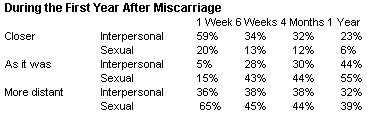
Results of the study showed that women who perceived their partners engaged in mutual sharing of feelings and experiences claimed to grow closer interpersonally and sexually. When partners failed to do things that showed they cared, women felt abandoned. These results combined with the findings of others (2) that men tend to keep to themselves after miscarriage deny their own loss, engage in avoidance, distract themselves through work and, if highly self-critical, experience greater despair and difficulty suggest that couples may need coaching in how best to care for each other after miscarriage.
Should you find that your partner experiences feelings of grief at the same intensity and duration as you, count yourself fortunate. Grief, by definition an extremely uncomfortable emotion, when shared and reflected accurately by another, tends to wane and can actually strengthen us over time. Creating supportive rituals to acknowledge and soothe one another’s pain are tremendously helpful for those who have experienced a miscarriage. Funerals, wakes, and birthday and anniversary routines all serve to give parents healing time; honoring the role that the “child to be†continues to play in their family and restoring a sense of meaning to the loss.
It is important to normalize the fact, however, that men and women tend to experience the impact of miscarriage differently. Coping with loss is a unique experience for each of us and there is no “right way†to go about it. Women, in general, do not need to learn to toughen up and let go. Nor do men need to soften up and express themselves more deeply. Often we choose our partners precisely because of these differences. The health of our long term commitment to one another depends on remaining curious and respectful of how those differences evolve over time.
Should weeks of estrangement from your partner’s grief become months (or years), it would be a good practice to explore new pathways for connection. The topic of miscarriage may seem still terribly hurtful to one, and all but forgotten to the other. Remember that getting outside help is appropriate at any stage of grief. Couples counseling provides neutral territory for safely acknowledging the new terrain of your marriage and what new shared coping strategies might still be available.
References:
(1) Miscarriage Effects on Couples’ Interpersonal and Sexual Relationships During the First Year After Loss: Women’s Perceptions
(2) Kristen M. Swanson, RN, PhD, FAAN, Zahra A. Karmali, BA, Suzanne H. Powell, BS, BA and Faina Pulvermakher, BS, MT (ASCP)
Psychosomatic Medicine 65:902-910 (2003)
© 2003 American Psychosomatic Society
 I have been in practice long enough to see many couples and families develop over the past thirty years. While there are countless stories over a full range of topics, one that greatly interests me involves divorce.
Many couples and individuals have come to counseling after divorcing 15, 20, or 25 years earlier. Most are quite happy in their current lives and marriages. Many, however, have looked back on their previous marriage with one very powerful observation:Â Their original divorce did not need to happen!
What an astounding realization! Not only was I impressed by their honesty, but I was also amazed they could look back on their divorces and understand them in a completely new light.
So, what is this all about? As I spoke with these couples it became clear to me that they were looking at how they previously managed emotional reactivity, and how that dovetailed with divorce. Every couple has to manage conflict, but the business of managing emotional reactivity, which is part of managing conflict, is not easy. Knowledge of how the brain works and how to use the brain to one’s advantage is critical to managing reactivity, especially intense reactivity.
Specifically, there are two brains that come into play when managing reactivity. Those two brains are the prefrontal cortex, and the limbic system. The prefrontal cortex and the limbic system are often referred to as the logical and emotional brains, respectively.
Here is a quick overview: the prefrontal cortex is the brain that allows us to make decisions, reductions, inductions, calculations, etc. The prefrontal cortex is the CEO of the brain. The limbic system, otherwise known as the mammalian brain, is the center of all emotions. The limbic system possesses all the pain centers, the pleasure centers, and is the part of the brain that has a very unique connection to the prefrontal cortex. It is the fight-or-flight-brain, among many other things.
Here is how the two brains work in concert: when the limbic brain is activated, it sends an amount of adrenaline up to the pre-frontal cortex commensurate with the degree it wants to inhibit pre-frontal cortex functioning. In short, adrenaline inhibits the pre-frontal cortex from thinking.
Those two brains, in effect, operate in opposition to one another. It is a survival function that allows us to take action without having to think first. Another way to think about these two brains is that they often function inversely. When limbic activity is up, pre-frontal cortex activity is down, and vice versa.
In practical terms this means that the limbic system will inhibit an individual from thinking clearly when they are feeling intense emotions. That is why, in the middle of a heated argument, people may say and do things they wish they could take back—things which sometimes lead to divorce. The one thing that is very important to understand about the brain and conflict is that the limbic brain always wants relief. And the fact that it wants relief is not enough: it wants relief NOW! The lengths to which an individual will go to get relief can include divorce.
An unfortunate artifact of those couples who are in constant conflict is that they become so tired of chronic conflict, and the intense emotional reactivity that comes with it, that they will do anything to reduce their emotional reactivity. When the high emotional reactivity has persisted for many months, or in some cases for many years, couples will often decide to get a divorce. They just can’t stand “it†anymore: they want relief.
After a rear-view look in the mirror several years post-divorce, some couples have realized that had they known how to reduce their reactivity as a way to get relief, they may have been able to avoid a painful divorce.
The Catch-22 that comes with divorce as relief is that the divorce process, rather than decreasing reactivity, actually increases it. That is one of the reasons depression often accompanies the divorce process, especially a protracted one. Ironically, a couple may not experience the emotional relief they went down the divorce road looking for until many years later.
That is why it is very important when seeking couples counseling that the couple and the therapist both understand how the brain works. In addition, the therapist must know how to teach a couple to manage emotional reactivity. Once emotional reactivity is managed consistently, then a couple is able to determine whether or not divorce makes sense.
Divorce as an emotional reactivity reduction strategy is not the best way to achieve emotional equilibrium. In fact, is possibly one of the worst ways to reduce reactivity, while couples who have a smooth divorce process tend to be very effective at managing emotional reactivity.
My purpose in cautioning against “relief divorce†is not to moralize against divorce. Clearly there are many couples for whom divorce is the viable alternative, and it may have little to do with reducing emotional reactivity.
Overall, it is important to understand the distinction between divorce as relief from intense emotional reactivity, and divorce that is not about relief of that sort. Remember: reducing emotional reactivity will allow you to think more clearly about the marriage, and also about divorce, because the pre-frontal cortex will not be inhibited by limbic activity.
Reduce emotional reactivity before you choose divorce. You won’t regret it.
 We know that when a marriage ends it is the parents who are divorcing. But do we think about the fact that our children aren’t getting a divorce, they are getting two households in which to continue living with their family. Their parents relationship is changing to something different than they have yet experienced. What do you need to think about so that your children are taken care of as well as possible? For some, the question is what rights do children have in a divorce? Here’s a list that is a good place to start.
1. Children have the right to live in a conflict-free zone. Your children should not have to go back and forth between two homes feeling the anger and tension between their parents. The best way to deal with this is to take care of the issues you are in conflict over. Find a way to work out your disagreements. Work with a third party if necessary, but keep the conflict out of the co-parenting relationship so it is out of the lives of your children. When children do not do well after their parent’s divorce, this is the number one reason why that is the case.
2. Children have the right to love each of their parents. Your children should be able to feel and express that love without interference from anyone. You may have an opinion of your ex that you feel your child needs to be taught about so they can be better protected. Unless your ex is truly dangerous and a court has found this to be true, do not subject your children to your beliefs that make it difficult for them to be in your presence and also feel love for their other parent. The other parent has also had a part in creating your children. Children will sometimes become safe-hating if they perceive that they have traits that are similar to the other parent. This may play out differently depending on the age of the child. It is important to consider it no matter the age.
[fat_widget_left]3. Children have the right to not be the emotional support for their parents during the divorce. When your child is growing up, your relationship with them changes. They are more able to have heartfelt conversations with you and can understand more complex emotions. When you are going through a divorce and you have a developing relationship with your teenage child, it is very tempting to tell them about what is going on for you in the way they have started to tell you what is going on for them and how they are thinking about the world. It is not the time to start telling them about your divorce and your feelings and your concerns. You are talking with them about their other parent, not your boss or friend with whom they do not have their own relationship. Protect them from the information that will be a burden for them to know. Do not ask your child to take care of you by listening and being your support. It is true you are in an emotionally difficult time in your life and you may need more care taking than usual. You should get taken care of in an appropriate place so you are best able to take care of your children while their world is changing as well. Keep in mind that children often like it when they are treated like adults. They will not tell you it is not what they want because they might like the newfound intimacy they are having in their children while their world is changing as well. Keep in mind that children often like it when they are treated like adults. They will not tell you it is not what they want because they might like the newfound intimacy they are having in their relationship with you.
4. Children have the right to not feel responsible for their parent’s divorce. It sometimes happens that children believe their parents are getting divorced because of something they did. They can feel responsible for the fights you have because of something they asked for that you may have disagreed on. They may think their behaviors when told they had done something wrong could contribute to their family changing in this very big way. Children believe their actions have more far-reaching effects than is actually the case. Feelings of guilt and shame often accompany these thoughts and they are not always shared with anyone. When telling your children you are divorcing it is helpful to make sure they know that there was nothing they did to bring this about and it is most helpful if you can tell them together.
5. Children have the right to not be the messenger for their parents. Because it seems logistically easier, backpacks, suitcases, notebooks, etc. that belong to your children are often thought to be appropriate conduits for material that needs to go back and forth between households. This is very often problematic. Children should not be the messengers for support checks, important papers, etc. It sometimes happens that the material that is brought with them in the transition is upsetting to the receiving parent. Perhaps the amount of the check is not what they had expected or the paperwork is inflammatory. This has the impact of your child feeling as though they are the reason you are not happy and they are somehow at fault. It is very important that your children not take part in any exchanges between you. They deserve to be protected from the information you are sending to the other parent.
These are just a few of many things to be aware of as you go through this process. It helps to try to look through the world periodically through the eyes of your child.
Personality influences nearly every area of an individual’s life. From relationship satisfaction, career stability and even mortality, the five leading personality traits, known as the Big Five, agreeableness, openness, extraversion, conscientiousness and neuroticism, have been shown to have a direct impact throughout. But a new study suggests that an individual’s personality also influences another important role. “Given the importance of personality for the ways in which people live and experience their lives, it is hardly surprising that personality has been proposed to be related to one of the most central, challenging, and affectively charged tasks that many adults are faced with: namely, parenting,†said  Amaranta D. de Haan, Maja Dekovic´, and Peter Prinzie of Utrecht University, who conducted a study to determine exactly how the personalities of parents and adolescents affect the parenting dynamic. They theorized that outgoing and social parents, high in extraversion, would most likely exhibit positive and highly motivating behaviors with their children, while introverted parents would act more withdrawn and unavailable. Additionally, the team noted that children with difficult temperament who are impulsive and distractible may elicit stricter discipline and negative reactions from their parents.
The researchers interviewed nearly 1500 individuals, including mothers, fathers and adolescents, and assessed their personalities using the Five-Factor Personality Inventory and the Hierarchical Personality Inventory for Children respectively. They looked specifically at warmth and overreactive discipline when they assessed them two years later. They found that overreactivity was influenced more by the personality of the parent rather than the adolescent. But the personality traits of both children and parents impacted the level of warmth. “Associations between parental personality and parenting were similarly related to parents of easy versus difficult adolescents, and for mothers and fathers parenting daughters or sons,†said the team. “Together, results show that parent characteristics as well as adolescent characteristics importantly affect dysfunctional and adaptive parenting.â€
Reference:
de Haan, A. D., Deković, M., & Prinzie, P. (2011, August 29). Longitudinal Impact of Parental and Adolescent Personality on Parenting. Journal of Personality and Social Psychology. Advance online publication. doi: 10.1037/a0025254
 “Which is harder – mourning an actual loss or mourning the ‘ideal’ of something you never had?â€
This question was recently posted to the wall of my professional services page on a popular social networking site. I thought this was an intriguing question and one you yourself may have pondered in one version or another.
Grief is a natural feeling we have in response to a loss. Many people immediately associate grief with the deaths of those we love, but there are many kinds of loss that can plunge us into the deep well of grief. Loss comes in seemingly endless varieties. Loss of a relationship, loss of your job, loss of your home or a treasured object. Loss of the feeling of safety after a trauma. Loss of functioning after an accident or a medical crisis. Loss of your sense of security or self-assurance. Loss of freedom or independence. Loss of property or material goods. We can feel grief in response to the loss of anything we love and cherish. Being bereaved is the state of having lost something precious to us. I feel grief, I am bereaved. Mourning is a verb. Mourning is the outward expression of the feeling of grief. Mourning, in a broad sense, includes whatever acts we engage in to help us express our grief. Crying, wailing, wearing particular items of clothing or jewelry, building altars or shrines, creating art that reflects our feelings, engaging in grief rituals, writing, whatever it is that we do with the purpose of expressing our grief. Alan Wolfelt, internationally noted author, educator and grief counselor, said, (and I completely agree with him), “Everybody grieves…but only people who mourn really heal and move on to live and fully love again.”
[fat_widget_right]
So, can we mourn something we never had? At first, the answer may seem to be no. If we must lose something in order to feel grief and the something was never a real thing that actually existed, it can’t really be lost, right? As so many seemingly straightforward questions are, the question of whether we can mourn the loss of an ideal is more complex than it first appears. I don’t know what the “ideal†was that the questioner lost, but I can imagine many kinds of “ideals” that can be lost. We often find ourselves in the position of having to face the realization that what we once thought was ours was never really ours to begin with. I believe there can absolutely be grief and mourning over those kinds of losses. Let’s imagine that her loss was what she once thought was her ideal relationship. If the person she had pinned all her dreams on turned out not to be the person they seemed to be, and the relationship seems now a sham, that kind of loss can be heartbreaking. Perhaps you have experienced such a loss. There may have been painful betrayals, realizations that the person you loved, and who you thought loved you, did not really share your values, or feel the same way you felt. You may have trusted and believed that you had found your soul mate, your ideal, and then when the relationship ended, the realization that it was never the beautiful dream you had believed in, came crashing down. So, was it real? I think the answer is yes. And so is the loss and the grief that comes with it. Therefore it can be mourned.
Another example of mourning the loss of an ideal is the very real grief caused by the loss of hopes and dreams of the future. Families whose children are diagnosed with disabilities such as Down Syndrome, or who receive a diagnosis on the Autism Spectrum, understand this kind of grief and mourning for the loss of an ideal all too well. When a beloved child is diagnosed with a disorder that will absolutely impact his or her future, quality of life, learning, or functioning ability, parents can feel a multitude of losses. Most of us imagine what our “perfect” child will be like before he or she is born. We imagine the wonderful things she will accomplish, the goals he will achieve. Our hopes and dreams for our children’s lives do not include hardships or pain that they may have to endure. Many families’ hopes and dreams for their children can seem all but destroyed when a diagnosis of a life-altering condition is given. Many families eventually learn to move forward and discover that their children possess amazing gifts. Eventually, they can come to celebrate their children’s unique qualities and see them as treasured testaments to the beauty and diversity of the human condition. This doesn’t mean that they don’t grieve and mourn the loss of the ideal life they imagined, a typical existence for their family, or an uncomplicated, usual course of development for their child.
The questioner on my page also asked though, “which is harder?”–mourning an “actual” loss or the ideal? I think in looking at what loss is, and the huge spectrum therein, we can conclude that “actual”, doesn’t necessarily mean something tangible. The loss of  hopes, dreams, or an envisioned future, is definitely included in the arena of genuine losses. No, those are not concrete things that we can touch or see, but they are very real nonetheless. Grief comes in many packages. Whether one kind of loss, and the grief felt as a result, is harder to grieve or to mourn than another, is not a question that I can answer. There are many who feel that the death of a child is the “worst” kind of grief imaginable. In my personal experience, I can say that for me, in my life, based on my own experience of the death of my own child, I cannot imagine that any other loss I will experience will ever compare to that. The death of my son and my subsequent grief, I don’t think could ever be rivaled by any other loss in my life. This is true for sure of losses past, and I think I can accurately predict that it will remain true for losses future. The only other loss I could ever conceive in my own life that could bring the same kind of pain is if I ever have to endure the loss of my now living child. Hope is not a big enough word to describe my wish to never, ever have to live through that kind of pain again. However, that is only my experience.
Each person’s unique experiences of loss and grief cannot be held to another’s for comparison. Every one of us is different and responds in different ways to loss and to grief. I used to try to compare my own loss following the death of my son to that of a mother whose child had died of murder or violence, whose last moments were spent in fear or pain, and think, my loss is not as terrible as hers. I was trying to somehow make myself feel better, to help myself come to a place where I could stop feeling sorry for myself. But I came to realize that I was being terribly unfair to myself in thinking those kinds of things. I deserved to feel sorry, and to feel sorrow, for myself. Sometimes, I still feel sorry for myself. And that’s ok. My son will not be here with me, or any other member of our family, for the rest of our lives. I am sorry for all of us who don’t get to experience his physical presence, and all that would entail, for the rest of our lives. I know that things can almost always be worse, and I am grateful beyond words that my child died peacefully, surrounded by love, but to live in those kinds of comparison based thoughts is to diminish my experience as well as his. So, I stopped trying to make comparisons and I feel better for it. The same would apply for someone who tries on a regular basis to compare his or her loss to those of others in order to prove somehow that his or her loss is worse than others. That sort of comparing of grief never really works.
How an individual reacts to loss is very individual. Generally, the more we identify with, and the closer our emotional lives are entwined with the person, object or state of being that is lost, the more intense our feelings of grief. How entwined are your emotions and your identity with your home and all of your possessions? With your spouse or partner and all that relationship represents in your life? What about with your career? Your place of worship? Your friends? Your pets? Your investments? Your family? Various places and things and distinctive aspects of all that makes you who you are and which you hold dear? What if by some tragic turn of events any of those things were gone tomorrow?
The most important thing in getting through grief and loss, coming through to the other side, is having hope and having support. Research has shown that grieving people, no matter how acute the loss, who are able to identify some aspect of hopefulness, are able to move through grief with a better outcome. What is a “better outcome”? I think that means with the ability to feel functional, to feel as though you can contribute to the world, that you can feel happiness again, that you can begin new endeavors, and even though you may be left with a scar, you can move forward and not only survive, but thrive, in your life after loss. You may be in a place where hope seems hard to reach. But sometimes just hoping that you can get out of the bed today may be enough. You may hope to get out of the grocery store without crying, or hope that tomorrow will be a little bit better than today, or hope that you can get through the next five minutes. Honestly, having that little remnant of hope may get you through it. Without hope, you’d likely find yourself breaking down in the cereal aisle.
Find someone you can talk to who will not tell you what you should or shouldn’t be doing. Non-judgmental support that will allow you to express and explore your feelings. Look for a support group in your area. Finding others who have experienced similar losses can be very encouraging and empowering. If you feel that you need some extra help, seek out a counselor or therapist experienced in working with people dealing with grief and loss. Above all, do mourn your loss. Find a way to express your feelings, do something, create something, engage in some activity that allows you express your grief, even if only for yourself. While you are hurting, remember to be gentle with and take care of yourself.