 In part 1 of this series, we touched upon the blissful and frightening states that can occur when we feel merged with a partner whom we love. These states are drawn from our earliest experiences outside the womb and tend to awaken parallel states of extreme helplessness. As exciting as these experiences of full absorption can be, humans are not designed to remain helplessly dependent. We are designed to learn to love autonomously.
One of the primary feats of early development is the forging of a self separate from mother. Out of the cacophony of fleeting images, sensations, drives, and demands swirling within our infant experience of the world, we somehow identify enough patterns within the chaos from which to propel our very own imprint of that world. The acorn cracks and the sapling lifts its first tendrils toward the sky. As our distinct character emerges, we begin the long craft of personalizing our experience. We learn to abide by a singular rhythm that makes sense only to ourselves while somehow maintaining the approval of mother.
[fat_widget_right]
The journey toward becoming a “me†continues from the first year of life well into our 20th. Then, just as we’ve gained some mastery at selfhood, we attempt to reverse the journey. We long for experiences of merging with another: adult intimacy. Our self-will, though still active, takes a back seat to the more instinctual parts of our brain. One day we are content to greet the object of our desire from a distance; the next there seems to be no distance at all. Before we know it, the fragile “me†we’ve carefully constructed over the years has merged into a “we.â€
Just how we experience adult intimacy depends as much on our inborn character as it does on how we differentiated our self from our primary caregiver. Below, I refer to four of the later separation-individuation stages, as defined by classic psychologist Dr. Margaret Mahler, for clues as to how we first managed the capacity to hold on to—while separating from—our merged existence with mother. The marks of these infant/toddler achievements make a dramatic reappearance in the work of adults attempting to navigate bonding—while maintaining autonomy—with their life partners.
Hatching: (5-9 months old)
Julie has felt hopelessly in love with Brian for a few weeks now. They’ve consecrated their affections during long weekends together, and the melding seems to have lifted Julie beyond time itself. With Brian, she feels solid and truly herself. During the intervening weeks without Brian, however, Julie feels she has lost any capacity to go through the motions of ordinary life. She doesn’t miss Brian or recall their time together. Instead, she finds herself unable to function at all. Having identified her true self as that which is beyond her grasp, she has no self left with which to even dream of reunification with Brian.
We might pity Julie, but we all remember at a visceral level the trouble she’s in. Waking hungry in our crib at night, we cry out and are met with no immediate response. No sound of approaching comfort. It takes but a few minutes before our cries threaten to steal our breath from us. We are inconsolable. We learn the dark contours of an unmerciful absence and we don’t forget it. How do we survive these early stages of helplessness?
We learn the dark contours of an unmerciful absence and we don’t forget it. How do we survive these early stages of helplessness?
We start, during what’s called “hatching,†by learning to hold on to imagery of our caregivers. Babies at this stage become obsessively interested in the sights and smells associated with mother. Mothers report there being a dramatic increase in the intensity of their child’s attachment at this stage. Fathers report feeling far less replaceable. During the hatching stage, babies are ingesting the image of their mother into their minds. The eventual result: the arising of an internal representation of the mother’s life-giving forces.
Revisiting the primal instinct for this transition in her adult life, Julie might ask Brian if she can keep his jacket so she can wear it during the week or update her profile with photos of the two of them, training herself to identify with the accessories and imagery of their partnership. To friends and family, Julie may appear more helpless than ever as she begins to fixate on her phone, always anticipating Brian’s next text or rereading old threads. But in terms of how we are designed to love autonomously, this is a necessary and critical part of her process. Internalizing the sights and smells of our beloved sets the stage for a sense of wholeness while living apart.
Practicing: (9-14 months old)
Children in the “practicing†stage are exchanging notions of symbiosis with mother for ones of possession. Instead of needing direct physical touch to feel connected, children practice feeling it at a distance. A child notices his mother leave to the kitchen while he is temporarily absorbed with his toys. His interest wanes and, instead of crying out for her to come comfort him, he calls out instead for her acknowledgment. “Juice?†“Sure, honey, I’ll get you some.†These interactions establish a sense of safety within a proximal distance. The more reliable these exchanges, the more distance opened up for exploration. In this way, the organic parameters of loving connection are found to reach far throughout the house and eventually throughout the neighborhood.
Sam and Phil are fully hatched as a couple. They are both enthralled with how important they are to each other and have begun regaling their friends with stories of their latest romantic triumphs. Their Instagram feeds contain large volumes of them holding, hugging, and having each other. Time apart is tolerable only insofar as they fill those empty hours with memories and plans for their next rendezvous.
Though their mutual world feels established, all is not always harmonious in the land of honeymoon. If Sam doesn’t hear from Phil for a day, he notices he starts to get cranky. Phil learns to oblige Sam’s moods by using a lot of soothing, reassuring tones when arriving after an extended absence. For his part, Phil gets anxious when Sam is given attention by others. Sam has learned to accommodate Phil’s jealousy by referring to Phil often when speaking to others. Phil relaxes each time he hears Sam describe himself as happily partnered. Some might judge Sam and Phil’s doting accommodations to each other’s insecurities as setting a poor precedent for their future. However, at the practicing stage, there can never be “too much†attention to sensitivity. It’s only closely wired couples whose love can span the distance as both partners venture a return to their autonomous lives.
Rapprochement: (14-24 months old)
Children in the “rapprochement†stage are confounded by two separate needs: the drive to individuate and the impulse to stay safe. Classically, this stage is depicted as a 2-year-old on her first day of preschool, clinging to her mother’s dress with one hand and reaching out toward the block room with the other. The job of the mother is to find grace as a selfless launchpad while the girl vacillates between hiding within the folds of mother’s dress and throwing her recklessly aside. The mother’s tolerance of this continual flip-flopping between extremes transmits to the child an ability to tolerate her own ambivalence.
The features of the fight give insight into the core rapprochement patterns established in their childhoods. This, in turn, gives insight into what’s in store for them as they attempt to resolve the current crisis.
When working with couples in crisis about their relationship, I’ll often ask them about their first serious fight with each other when they were just getting to know each other. As people recall the incidents, I listen for clues as to how they resolved the fight. Some scream and yell. Others are quick to kiss and make up. Some brood and punish indirectly for weeks before addressing the problem. Others discuss it ad infinitum until they slowly lose interest and move on.
The features of the fight give insight into the core rapprochement patterns established in their childhoods. This, in turn, gives insight into what’s in store for them as they attempt to resolve the current crisis. The need to shore up safety with a partner while also standing strong in one’s differences is a tense operation that doesn’t always resolve with the couple remaining intact. No matter the wedding vows, some partnerships can withstand an individual’s thrust toward self-growth, while others are shattered by the process. This period of rapprochement offers no promises, only an ability to tolerate the process.
Object Constancy: (24-plus months old)
Anyone who has witnessed a child progress through the early stages of attachment knows parenting is not for the faint of heart. Autistic merging, hatching, practicing, and rapprochement bring out the neediest and most demanding aspects of the human experience. Parents are asked not only to find a matching response to the child’s level of need but to express a reassurance that can somehow normalize the painful process of growing up. “It’s okay to be sad because I know you miss Mommy. I promise you, she’ll be right back.†With enough reassurance, children indeed arrive at the place where they can take comfort in imagining their mother’s goodness even while she is out for the day. “Object constancy†refers to a child’s capacity to feel the good qualities of their mother’s love inside of themselves.
As adults, we learn to return to and expand this childlike sense of object constancy to include:
- An ability to recognize and tolerate loving and hostile feelings toward the same person
- An ability to keep feelings of need centered on one person
- An ability to value that person for attributes other than their capacity to satisfy needs
There is no way to develop these abilities except by weathering the storms of disagreement, misattunement, and conflict with those we love. It’s never easy to be in opposition with the one you want to trust to take care of you. When tensions are high and the risk of separation appears imminent, some amount of “faking it ’til we make it†can be helpful.
“I can disagree deeply with you and know you will not leave me.â€
“I can see your point of view, even come to agree with you, without losing my self-respect.â€
“I trust us to negotiate solutions that will take care of both of us.â€
[amazon_affiliate]
Couples might reach toward such statements with the hope their very utterance will somehow make them true. Lo and behold, with enough patience, time, and reassurance, it can work. The good of the relationship is instilled within the hearts of each as a reliable constant. Arguments can come and go, leaving the underlying love undisturbed. With each round, a chance to grow up all over again.
Reference:
Mahler, M., Pine, F., & Bergman, A. (2000). The psychological birth of the human infant symbiosis and individuation. New York, NY: Basic Books.
 “NO, that’s NOT what I mean.â€
“How could you say that?â€
“I wasn’t finished. Where are you going?â€
At first glance, sudden and intense misattunement between partners may indicate a need for a more disciplined approach to conflict. Perhaps both need a class to practice nonviolent communication strategies, a workshop to enhance empathy, or a therapist to work on anger management.
But what if the problem isn’t interpersonal? What if the deeper conflicts at stake are going on within—each person struggling to maintain two versions of self simultaneously, their personal self and their relational self? Look again at the arguments that confound couples and we can see they are frequently frustrated not at each other but at the delicate trapeze work required of each person to keep their own identity from crashing.
[fat_widget_right]
I practice as both an individual counselor and a couples counselor. A core task in both practices involves helping folks navigate the space between their personal and relational selves. The personal self is busy with the task of differentiation: remaining autonomous and whole while with others. The relational self, meanwhile, is occupied with the task of merging: deepening intimate availability for connection.
As I talk with one person, I get a direct experience of their unique worldview. Speaking again on the same topic while that person is in the presence of a loved other, I often observe that worldview collapse. Here, the simplest facts, the clearest agreements, and the most bedrock values slip like disentangled particles through their grasp. Little that is true to the identity of a person necessarily remains true to their identity while in relationship.
Differentiation: Being Oneself in the Company of Another
Pay attention to couples as they slip into a casual disagreement and you’ll see any number of well-honed techniques to salvage dignity and equilibrium. It’s a supremely complex task. Not only must each preserve a sense of entitlement to their own opinion, they must simultaneously preserve a sense that the person to whom they are attached is worthy of respect. Most complex of all, they each need to handle a temporary rupture of relational attunement.
Differentiated couples have gained some measure of confidence that their relationship will survive its everyday ruptures. Such confidence is hard-won.
Differentiated couples have gained some measure of confidence that their relationship will survive its everyday ruptures. Such confidence is hard-won. It takes no small amount of faith and a whole lot of practice to establish a capacity to be caring while experiencing a sudden collapse of attunement (“How can I be right when the one I love doesn’t get me?â€).
Over time, a belief in constancy ensues and stays intact even through argument. Nevertheless, beneath the light ribbing (“There you go again, honâ€), the humor (“That’s okay, you don’t have to make sense for me to love youâ€), and the subtle redirection (“Remember that one time we weren’t fighting?â€), the remnants of early wounding remain. To understand how to love, we have little choice but to understand how we managed those first wounds.
Merging: The Urge to Return to Unity
During the first month of life, children lead a non-differentiated existence. Blissful or frightening, there is no sense of self separating them from the outside world. The attunement taking place in the touch and eye contact between mother and babe renders both in a fused state. Mothers describe being transported to a regressed world in service of the baby. Both are engulfed in feelings of oneness and a mutual sensitivity to each other’s moods and states. It takes six to nine months for babies to emerge from this fused existence and prepare to “hatch†a separate personality from their primary caregiver.
During that time, their experience of oneness vacillates between two phases of merging: autistic and symbiotic. In the autistic phase, mother is viewed as an intrinsic part of the infant, devoid of a separate existence. When deprived of their mother, babes will feel themselves to be literally nothing, empty, nonexistent. In the symbiotic phase, mother is viewed vaguely as separate but only in terms of need fulfillment. It is in this phase that babes develop their reactive capacities to cry out, push away, and demand a return to unity. Even if the child has yet to develop a sense of self, their self-preservation instinct is active and they will not kindly receive anyone or anything keeping them from attunement.
Regression Happens
The quality of these two phases of merging constitutes the felt landscape of the longing for adult intimacy. Once the desire for intimacy is awakened in mature adults, so too awaken recollections of their primal urge for unity. The body remembers the fused state of those first months outside the womb, even if the mind holds no actual memory of it. Like a moth drawn to a flame, we are compelled to reexperience the ineffable sense of oneness that transpired there.
The quality of these two phases of merging constitutes the felt landscape of the longing for adult intimacy. Once the desire for intimacy is awakened in mature adults, so too awaken recollections of their primal urge for unity.
Spiritually, as adults, we might seek it through prayers for atonement. Sexually, it may be sought in the lust toward orgasm. Interpersonally, this urge for unity is evident when we tap into states of unbridled attraction that go beyond seeing the other as merely attractive. We don’t actually see them at all, captured in the moment solely by our own sense of selfless longing for connection.
For those anticipating the prospects of a deep merging experience, there comes a necessary softening of their power to self-regulate. Differentiation pauses as an opening occurs for fusion. When the merged state arises, we are engulfed by a return to those first blissful/frightening months of life. And when it is taken from us, we either collapse or rage.
Confronting everyday conflicts with partners soon after experiencing hopes for intimacy naturally provokes autistic and symbiotic memories of detachment from mother. (“What was once my world has been torn asunder.â€) Regression into the autistic phase is marked by absolutisms: “I am nothing if you don’t see my point of view.†“I might as well kill myself if you see it that way.†Regression to the symbiotic phase is marked more by violent rejection: “How dare you!†“I want mommy. Go away!†These infantile responses get stirred in the middle of our grown-up lives, yet healthy adulthood never leaves these core feelings behind.
Do We Ever Truly Grow Up?
Our emotional development occurred not in a straight line but as an outward flowering spiral. If we could look at the core stages we passed through from ages 0 to 9 months, we would likely find origins of the most-repeated habits we employ to attain intimacy as adults. Those automatic habits constitute our “unknown knownsâ€â€”the unconscious strategies that control our most sophisticated adult interactions.
Even though we never truly graduate from the feelings associated with our core identity development, we learn to recognize them better as they arise. With practice, we also learn to soothe and express those feelings with more finesse.
Fortunately for most of us, our emotional development did not end at 9 months. Collapse and rage are not the only tools at our disposal to deal with the temporary ruptures in our intimate lives. We can look at a blueprint of the separation-individuation stages as defined by classic psychologist Margaret Mahler for clues as to how we developed the capacity to leave our merged existence with mother, eventually to carry that sense of safety within our individuated selves. In part 2 of this series, we will look at how these stages are installed over the first two years of life and how we subconsciously reexperience them as we attempt to build trust with those we love as adults.
[amazon_affiliate]
- Differentiation/hatching (5-9 months): The infant becomes increasingly interested in discovering mother (e.g., how she looks or smells) rather than trying to become symbiotically unified with her.
- Practicing (9-14 months): Although able to explore freely, the child still regards mother as unified with child and thus explores surroundings while keeping within an optimal distance.
- Rapprochement (14-24 months): The child’s desire to be all-powerful and self-sufficient is marred by a fear of abandonment. The child reaches a healthy medium between the two extremes due to language and superego development.
- Object constancy (24-plus months): Successful completion of this phase marks the development of an internalized mental model of the mother, which unconsciously accompanies and supports the child even when they are physically separated.
Reference:
Mahler, M., Pine, F., & Bergman, A. (2000). The psychological birth of the human infant symbiosis and individuation. New York, NY: Basic Books.
 Feeling sad does not build bridges, nor will it win a war that needs fighting. Dedicating time to dwell on past hurts also rarely brings home a paycheck (unless you’re a therapist). In a consumer, growth-oriented society, sadness seems a luxury we can ill afford in our restless race for more goods, more happiness, more distraction. We grow quickly uncomfortable in the presence of others’ sorrow. Rightly or wrongly, we all learn to keep feelings of genuine sadness to ourselves.
Yet the truth is we are hardwired for a depth and complexity that can be found nowhere more clearly than in sadness. Ask the great comedians where they discovered the roots of their humor. Almost universally, their answer is in sorrow. It is the volume of our sadness that gives dimension to our sense of joy, peace, love, as well as the full palette of human emotion.
[fat_widget_right]
Honoring That Which Transcends
Sadness is unique in its capacity to draw the outside world to our side. Even if our friends and family haven’t the capacity to cue in when we are deeply grieved, the environment itself leans in. Unashamed by our social ranking, dogs will tend to approach us when we have dropped our guard. Wild animals grow curious as our manic productivity ceases and we bend our heads earthward. If the sky has been dark, it may be our very tears that signal the start of a summer squall. We look up from soul-drenched misery to find a dove murmuring at her perch, watching and harmonizing with our pain. Never too direct. The dove quickly averts her gaze and takes flight, the arc of her wings nodding her approval. We see a remarkable law of call and response at play here. Nature responds well to fully expressed sorrow.
Sadness, when fully expressed, connects us even beyond the animal realm. Our small travails reflect greater laments—to the injustices, the brutal losses, and the painful ephemeral facts that constrain all life. Watch a small child howl uncontrollably after she is denied a friend’s toy. No amount of explaining can remedy such injustice. Our scolding and attempts to redirect fall on deaf ears. As we detect the absence of ploy or force in her screams, our parental instincts grow respectfully mute. We give pause before the depth of her feeling. Pure anguish. We shudder at the timelessness of her state and take side with awe at the purity of her misery. Helpless, we wait for the deep emotion to subside on its own. In her sobbing, we hear the horrifying music of galaxies clashing and collapsing into nothingness, the despair of lonely asteroids, the careless weight of entropy triumphing over all creation. If the universe needs a heart and voice to expel its pain, she is its instrument.
Sometimes we just don’t get to play with other friends’ toys! But we do get to feel sad about it.
When you attend to the depths of your sorrow, you partake in a profound transmigration of feeling. The quantum spin of one electron is entangled—via observation—with the spin of other electrons regardless of locality. Similarly, our sadness entangles with the sadness of others we have never met.
Feel It Fully to Let It Pass
Among our fellow humans, the attempt to console is fraught with mishap. Have mercy for those wishing to respond well to the tears within you. Try as they might, their brains are too advanced for the archaic wisdom that sadness requires. Aid, when it arrives too soon, interrupts the needed revelation. Arriving too late, it loses all value. The chance for misattunements are legion, and too often we are obliged to console the consoler and thus lose the true message of our sadness.
Instead, when powerful sadness wells up from within, take a meandering walk. Trust nature’s way with you as you traverse the barriers between you and your deeper self. Here are some of the barriers and passageways you may find familiar in your hunt for real sadness.
- Anger: After misfortune and before your honest response, your imagination first compels you to repeat the details of the affront. Eons of self-preservation dictate that you can’t feel sad until you have first rehearsed the problem and invested in your own safety. Go ahead then. Blame the universe for your condition (if there’s no human perpetrator to pin it on). Compound your defeat with memories of any and all related past hurts. Recount the underlying patterns that hold you forever confined. And, of course, plan your perfect revenge. People call anger a secondary emotion, but what better avenue to divest from the rational mind and unleash your primal self?
- Indignation: Eventually, your vision widens. All on its own, attention lifts above anger’s narrow hold and exposes you to a shakier view. At the edge of perception, you sense the arrival of another emotion entirely—something anger can’t capture or express. It is soft, undefined, and appears to lack power. Indignation is your felt experience of resistance as you begin to slide into this unknown feeling. You sigh. Small moans want to escape as you breathe. But not yet. Anger is still here and keeps you resolute. The dance between anger and indignation is its own world—a tug-of-war that hints to deeper forces but keeps the battle on the front lines of self-protection and blame. Not until you get close to the edge do you realize how difficult it is to take the plunge.
- Vulnerability: It begins with a shudder. Then a gentling ache beneath the sternum. Then a sinking. The ground is not as stable as you hoped. Instinct will have you looking left and right for predators. When vulnerability arrives, there is no mistaking your defenselessness. Some danger girds you for fighting. But in this surrender to sadness, you recognize that you have been rendered weaponless.
- Immersion: As the plummet commences, all energy turns to the necessary movements arising. Muscle structures in the face can be the first to melt, followed by collapses in the shoulder area and chest. Tears fill the eyes, the brow furrows, and all focus goes inward and down, down, down. The pit of the stomach is where sadness lives. There is a strength there capable of ruling all things. It is a rule that is readying for self-annihilation while simultaneously inviting mercy. Thoughts at this stage, if there are any, have given up assessing the world (“that was so meanâ€) in exchange for pure internal discernment (“I am just … so … tiredâ€). If there is truth to be told, this is the place from which truth is spoken.
When you look up again, it’s hard to tell how long you have been crying.
As intersubjective beings, each of our moods connects us to larger fields. The field of sadness just happens to run deeper than the rest. When you attend to the depths of your sorrow, you partake in a profound transmigration of feeling. The quantum spin of one electron is entangled—via observation—with the spin of other electrons regardless of locality. Similarly, our sadness entangles with the sadness of others we have never met. What you sense as yours alone calls your belonging to a larger whole.
 Think of the stories you tell about the endings in your life. Line these stories one against the other. What do they tell you about your relationship with endings in general? For many of us, goodbyes have a bad rap, associated with some of our worst memories. At best, we consider them gratifying conclusions to periods of prolonged misery. At worst, we construct them as traumatic punchlines to stories where we felt powerless and victimized, perhaps by the person who left us or by a harsh world which has taken a loved one. Conversely, as we see ourselves through the eyes of those we have left, we can experience complicated spirals of guilt, as unresolved today as the day we decided to depart. Whether voluntary or forced, the impressions left upon us are fraught with misgivings.
When therapy is successful, we are faced with the prospect of a new kind of ending. By the time it has come to say goodbye, a genuine mutual attachment between two presumed strangers has taken place. This kind of relationship, rare as it is in this world, certainly seems worth keeping. At the same time, it remains a professional relationship designed to conclude naturally as treatment goals are achieved. As therapy concludes, both therapists and the people they serve struggle with some of the same feelings prompted by other losses. We are faced, perhaps for the first time, with an opportunity to construct a mutual and intentional ending to a caring relationship.
[fat_widget_right]
Carrying out an honest and healthy farewell reverberates on many levels. Within the safe field of therapy, there is a full spectrum of meaning we might put to the experience of saying goodbye. I offer the following brief scenarios of therapeutic closure with the expectation that we can see in each some basic elements of the human condition and of our own wish to find peace with the act of parting.
Saying Goodbye in an Incomplete World
Timothy’s goals in therapy had grown less specific over time. As he gained footing with the initial bouts of social anxiety that prompted his first visit to my office, he chose new goals for himself every few months. Overall, it had become a year of great personal growth for Tim. Moving into our second year of weekly sessions, he and I spent less time examining particular life challenges and more time exploring previously unexpressed aspects of his personality. “Expanding self-awareness†was a very appropriate goal for our time together yet brought with it a sense of endless expanse. A few months later, we agreed our work had plateaued. It was coming time to say goodbye.
The ease and companionship afforded by our extended time together gave Tim a broad view of himself. He had grown to expect the unexpected to surface. Thus, as the time of our departure arrived, there was no sense he had reached any set destination. Unlike graduating from school, he had no final test to measure mastery of a predesigned curriculum. Instead, similar to how it is to end relationships outside the office door, our ending point was inconclusive. “I feel like there is so much left uncovered, so many parts of me that have barely broken through,†he told me. “That hurts a little. Still, it just feels right to put this chapter of my life behind me. I’m grateful for it.â€
Leaving therapy, for Tim, called upon a newfound experience of self-acceptance. We said our goodbyes with a bittersweet appreciation for what had transpired—both purposefully and unexpectedly—between us. As we shook hands at the door for the last time, we shared a final moment of accord: “This was enough.â€
Saying Goodbye in a Solitary World
Julie felt trapped in her relationships and looked to therapy for help in setting better boundaries. “I am sick of being so afraid to make my own decisions when they inconvenience those who care about me,†she said. We spent three months together as she focused on establishing more independence as a daughter, wife, and mother. Julie was practical about her goals and diligent in applying new coping skills when confronted with others’ unease. I played what seemed a supplementary role in her personal transformation as I encouraged her latent sense of power, praised her intelligence, and offered assurance to the legitimacy of her quest. Over the course of these 12 sessions, she achieved a more outspoken and balanced role with her family members and felt “almost ready†to terminate therapy.
I was propelled into my career by a high regard for building deep connections. It wasn’t clear to me during my training as a therapist that I would become a master at relinquishing them as well.
“Maybe I should plan on seeing you monthly,†she said. “You’ve become a bit of a father figure to me and I just don’t want to give this up.†This statement, shared at our “final†session, was uncharacteristic for Julie. She seemed surprised, though not embarrassed, by her tears as she spoke. I felt touched by the depth of her affection but also recognized that her tears were not about her and me. There was the ghost of another father in the room with us, one whom she had never had the chance to show those tears. “He left me way before I was ready to let him go. I’m still so afraid to be on my own.â€
Julie and I settled on a four-week extension of therapy to look a little deeper at the fears associated with the early loss of her father. It was a volatile and vulnerable set of sessions. In one, Julie gave herself brief permission to rage and sob over being abandoned in a lonely world; a side of herself so rarely expressed but situated at the center of her long-held habits of dependency. Then, just as quickly as they surfaced, the intense feelings subsided. The following week, we took another try at having a final session. Julie’s voice was steady and her hands lay still at her side as she thanked me for our work together. Our goodbye was that of two grown-up adults—solitary, intact, prepared.
Saying Goodbye in an Impermanent World
Death and dying had become a preoccupation for Matthew. He had good reasons to fear death—as do we all—but for Matthew these fears tended to permeate his every waking hour. His apartment had begun to reflect his inner state (“Why bother washing dishes if I might die tomorrow?â€), making it a difficult place for casual entertaining or dating. In therapy, he sought the space to expound on the bleak thoughts he knew his friends would find too morose.
With time, as we formed our own retreat for his darker visions (both real and imagined), Matthew learned to compartmentalize his fears and address them more fully with me. As our sessions focused on giving air to his compulsive morbid thoughts, the rest of his life opened up. He took more interest in others and incidentally began to adopt more of their interests as his own. His apartment began to express more of a genuine investment in life.
Anticipating his eventual departure from treatment, Matthew grew nervous. He had no intention of painting the end of therapy as a point of progress or new possibility. Endings, for him, would always carry an air of intense calamity. Ending his relationship to me meant also ending his relationship to the history of thoughts expressed between us. “Without you as my witness, it’s like all those parts of me will be taken from me as well,†he said. I immediately understood the truth of his words.
When we end relationships, we are forced to say goodbye to parts of ourselves as well. Terminating therapy brought a conclusion not only to Matthew’s past dysfunction, but also to the kindness, integrity, and intelligence we showed each other along the way. We decided to treat this closure much like a funeral. We took turns honoring the sadness entailed in letting go of this significant yet transitory connection. Our bonds with others on this planet are always tinged with melancholy for their brevity. Each goodbye is a small death to those grand pieces of ourselves that we can only find in one another.
I was propelled into my career by a high regard for building deep connections. It wasn’t clear to me during my training as a therapist that I would become a master at relinquishing them as well. Of course, the door to those connections never fully closes. Most people are invited to return as the need arises or to schedule additional sessions to revisit their long-term goals. But the act of ending therapy is always a crucial piece of the process and a strong reflection on the nature of the person seeking help. Financial limits, scheduling conflicts, and abrupt changes at home usually provide the pragmatic reasons for sudden terminations. These are genuine, but they often also mask an underlying distrust that a meaningful ending is possible in a fragmented and fragile world.
I’ve learned to hold out that an intentional goodbye is the most instructive. A true companion deserves nothing less.
Note:Â To protect privacy, names in the preceding article have been changed and the dialogues described are a composite.
 The loss of a child before it is born naturally stirs intense and conflicting emotions. Women might feel an intense physical bonding and grief for a being with whom they have already grown attached. Whereas men might feel more ephemerally connected and cheated from the opportunity to begin their bond. When miscarriage affects couples, it may stimulate growth or, conversely, unearth an inability to support each other through troubling times. The confusion surrounding one’s own feelings as well as how to be of real support to one’s partner after the loss tends to disrupt the balance of our relationships. This is especially true if some of that balance lay in the shared anticipation of parenthood. The inability to share and understand each other’s grief can be an isolating experience.
One week after the loss, most women report feeling closer interpersonally with their partner while feeling more distant sexually. As time progresses and different coping strategies for grief kick in, the feelings of closeness fade even when their sexual relationship recovers. Partners with significantly different grieving patterns may be at particularly high risk for subsequent marital conflict or emotional withdrawal.
A recent study on women’s perceptions on their relationship after a miscarriage (1) shows a dramatic decrease in interpersonal and sexual intimacy for most couples up to one year after a miscarriage. At that point only about half of women interviewed report a return to normalcy in their relationship (there is no data available on men’s perceptions).
Percentage of Women Claiming Their Interpersonal and Sexual Relationships Were Closer, As It Was, or More Distant
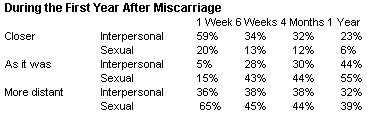
Results of the study showed that women who perceived their partners engaged in mutual sharing of feelings and experiences claimed to grow closer interpersonally and sexually. When partners failed to do things that showed they cared, women felt abandoned. These results combined with the findings of others (2) that men tend to keep to themselves after miscarriage deny their own loss, engage in avoidance, distract themselves through work and, if highly self-critical, experience greater despair and difficulty suggest that couples may need coaching in how best to care for each other after miscarriage.
Should you find that your partner experiences feelings of grief at the same intensity and duration as you, count yourself fortunate. Grief, by definition an extremely uncomfortable emotion, when shared and reflected accurately by another, tends to wane and can actually strengthen us over time. Creating supportive rituals to acknowledge and soothe one another’s pain are tremendously helpful for those who have experienced a miscarriage. Funerals, wakes, and birthday and anniversary routines all serve to give parents healing time; honoring the role that the “child to be†continues to play in their family and restoring a sense of meaning to the loss.
It is important to normalize the fact, however, that men and women tend to experience the impact of miscarriage differently. Coping with loss is a unique experience for each of us and there is no “right way†to go about it. Women, in general, do not need to learn to toughen up and let go. Nor do men need to soften up and express themselves more deeply. Often we choose our partners precisely because of these differences. The health of our long term commitment to one another depends on remaining curious and respectful of how those differences evolve over time.
Should weeks of estrangement from your partner’s grief become months (or years), it would be a good practice to explore new pathways for connection. The topic of miscarriage may seem still terribly hurtful to one, and all but forgotten to the other. Remember that getting outside help is appropriate at any stage of grief. Couples counseling provides neutral territory for safely acknowledging the new terrain of your marriage and what new shared coping strategies might still be available.
References:
(1) Miscarriage Effects on Couples’ Interpersonal and Sexual Relationships During the First Year After Loss: Women’s Perceptions
(2) Kristen M. Swanson, RN, PhD, FAAN, Zahra A. Karmali, BA, Suzanne H. Powell, BS, BA and Faina Pulvermakher, BS, MT (ASCP)
Psychosomatic Medicine 65:902-910 (2003)
© 2003 American Psychosomatic Society
 Lois has five minutes left to her fifth session and is now having a flash of insight. “I’m bored to death with therapy,†she thinks. “This is getting me nowhere.†She feels close to her therapist and decides that he deserves more than a false excuse. “Look,†she says, “I think we can both agree that we’re nearing the end here.†Unsure about how to respond to his neutral facial reactions, Lois plunges forward. “Believe me, I’m as bored of myself as you probably are. There’s no reason to pretend that we’re making progress here when I’m just going over the same issues, again and again. You’ve been trying. I know you have. But I’ve got nothing else to discover about myself. I’m done. That’s all there is. I’m just done.â€
There is nothing wrong with gaining the sense of well-being that comes with having a professional provide reflection and insight on one’s life. Lois is pleased with her therapist’s support and feels the first four sessions were a success. Brief therapy may have provided her the supportive boost she needs as she continues to apply new coping skills on her own. If, on the other hand, there are uncomfortable symptoms plaguing her (sleeplessness, worry, loss of interest in pleasurable activities, intense relational conflicts, etc), it will be worth her while to take a second look at the boredom that is blocking her way.
Lois and her therapist are at a common juncture in treatment. Research into the phases of therapy conducted by Kenneth Howard of Northwestern University outlines a progressive, three-stage sequence of change. In the first phase, the client experiences a restoration of subjectively experienced well-being. The second phase focuses on the resolution of the client’s symptoms. This phase occupies a greater number of sessions—generally, between the 5th and the 15th session of therapy. Curiously, over one-half of his clients had discontinued therapy by session four.
The Problematic Skill of Emotional Insulation
As children, most of us learn to create emotional boundaries around ourselves to keep us safe. Trapped with a negative or mean-spirited crowd, our emotional insulation kicks in and we can feel somewhat removed from harm. Dropping layers of emotional insulation while with a nurturing friend allows us to take in the nutrients of their care. By the time we become adults, this unconscious defense mechanism regulates our relationships automatically.
For those impacted by big or small experiences of neglect or harm from others, it follows that they would be prone toward a self-sufficient stance. This insulation might be felt in the emotional brain as apathy and irritability when the “threat†of an ongoing relationship is apparent. The cognitive messages associated with these feelings may be something like, “I’m fine not caring about this person. I’m waiting for them to leave so I can feel more safe.†Such feelings and thoughts get activated without permission from the conscious mind. Sometimes, as in the case with Lois, the realization of boredom can occur quite suddenly and emphatically.
Repairing Flaws in the Insulation
One does not need to be engaged in long-term psychoanalytic care to see the importance of the therapeutic bond. Even in brief, solution-focused therapy, progress results in large part from the trust established between those two people sitting in that room, taking time together to see what surfaces. Boredom is simply one of the body’s natural resistances to this process. Touching into that boredom gives one the opportunity to test and perhaps readjust one’s automatic reactions. Similar to removing an unnecessary layer on a hot day, the act of staying in a relationship even when bored can yield surprisingly pleasant results.
“So you’re feeling annoyed. I see that. Care to look at that feeling a little bit further?â€
Lois laughs. Another minute or two, she thinks, and this will be over. “Oh, great. So now I’m going to pay you for the chance to look at my boredom.†She rolls her eyes and opens her pocketbook.
“Only if you want to,†he answers. She hands her check to him. The two stand as she makes her way to the door. Lois takes one last moment to collect herself before reaching for the doorknob.
“You know,†she says, “I’ve never done this before. I don’t know what comes next.â€
She watches her therapist nod and smile. “I can be here if you want to find out.â€
Navigating Boredom and Longing
Taking a look at the automatic effort to prevent intimacy is just as important as putting effort into stepping past the resistance. Examining the body’s reactions to closeness and distance can be an unasked for but enlightening part of therapy. As Lois drives home, she is no doubt reexamining that nod and smile from her therapist as she stood at the door. The boredom that prompted their last interaction has now been unmasked to reveal an underlying uncertainty and frustration. Beneath that lies an unanswered longing for connection.
There is no quick answer to Lois’s dilemma of whether to return for another session. There’s neither certainty that therapy is the ideal site for her to place that longing, nor an assurance that it’s better to listen to the call of her boredom and move on. She has her own mind to make up and her own body to tend to as she manages the ebb and flow of her tolerance for relationships. She is not alone in her struggle, though. Boredom and longing carry their unspoken and magnetic influences on our interpersonal behaviors, driving each of us to our own true north. Effective therapy simply offers us a safe place to unmask the process.
While managing the ebb and flow of your capacity for intimacy, remember that every moment offers an opportunity for healing. I find this piece of wisdom encapsulated within the following excerpt:
Empty yourself,
So that you may be filled.
Learn not to love
so that you may learn how to love.
Draw back,
so that you may be approached.-St. Augustine Narration on Psalm 30:30
References:
Howard, K. I.; Lueger, R. J.; Maling, M. S.; & Martinovich, Z. (1993). A phase model of psychotherapy outcome: Causal mediation of change. Journal of Consulting and Clinical Psychology, 61(4), 678-685.