 Some people differentiate “counseling” from “therapy.” I have practiced in Washington and Texas and have found no clear differentiation in state law, the language of credentialing regulation, or the definitions provided by major national accrediting bodies for the respective professional licenses.
I am currently in Washington state, so I speak from a perspective within these borders. Here, there is no legal protection for the use of the terms “counselor”/”counseling” or “therapist”/”therapy” in and of themselves. Meanwhile, terms such as “social work”/”social worker” (see RCW 18.320), “psychologist,” and related titles and terms are protected by law (see RCW 18.83.020). Because of this, no explicit distinction has been made in law or regulation, that I am aware of, distinguishing “counseling” or “therapy.”
Rather, the scope of practice for particular credentials is deferred by states to the national bodies that accredit graduate counseling programs and provide guidance for standards of professional practice for mental health professionals with specific credentials (LCSW, LPC, LMHC, LMFT, LCPC, etc.). Examples of these accrediting entities include CACREP, COAMFTE, and the APA. Examples of organizations providing guidance for standards of professional practice include NBCC, NASW, AAMFT, AMHCA, and, again, the APA.
[fat_widget_right]
Beyond that, states treat these varying master’s-level clinical practitioners with legal parity, or equivalence, in scope of practice and legal protection.
In Washington state’s new credentialing law, passed in 2008 and rolled out in 2009, “psychotherapist” and “psychotherapy” were more clearly defined, but let’s be clear that the kind of regulatory accountability provided by these defined uses in the law does not apply to the terms “therapy” or “therapists.” I should note that the law also restricts the use of the term “private practice counseling” to sole use by two new categories of unlicensed providers, certified advisors (CA) and certified counselors (CC) (see RCW 18.19.020 and WAC 246-810-010). Can you imagine a law reserving such a term for unlicensed practitioners and placing licensed practitioners in legal limbo for using it?
Further, that 2009 law in and of itself did not explicitly regulate beyond providing new credentialing categories. It did result in executive recommendations in 2011 for scopes of practice, disclosure statements to be provided to people receiving services, and continuing education standards, but these recommendations still have not been translated into regulation (or even a great deal of clarity).
For instance, agency-affiliated counselors (AAC) are credentialed to provide counseling (see RCW 18.19, WAC 246-810), but Washington State Department of Health regulation does not require any academic degree as a minimum educational requirement for this particular credential, so the term “counseling” remains loosely defined and diluted (though not nearly as much as it was in the era of the state’s “registered counselor” credential).
And, whereas some regulatory bodies and insurance companies associate “counseling” with such services as skill-building, coaching, and varying forms of behavioral modification, all I have seen in the language of regulatory code and most insurance coding language are terms such as “skills training,” “psychoeducation,” “rehabilitation,” and the like, and a steering clear of the word “counseling” by itself whenever possible, due to its multitude of uses rendering it nearly descriptively meaningless.
One might think it best, then, to limit the words “counseling” and “counselor” to referring to non-degreed or bachelor’s-level mental health practitioners. Keep in mind, though, that the nature and scope of clinical practice for those credentialed as LPCs (licensed professional counselors), LMHCs (licensed mental health counselors), and LCPCs (licensed clinical professional counselors) has legal parity with master’s-level professions that prefer the terms “therapy” and “therapist” (such as LMFTs, or licensed marriage and family therapists). So while I think it’s fair to say the use of the term “therapy” is more limited, I’d bet LPC, LMHC, and LCPC boards would contend it is unfair to elevate it to a higher educational or professional plane in usage, which may result in viewing such clinicians as less qualified or as providing a less specialized treatment service than, for instance, LMFTs.
While it’s true that there are not, similarly, examples of bachelor’s-level clinicians who are credentialed under the terms “therapy” or “therapist,” it seems to me the terms are used so interchangeably as to be nearly synonymous from a regulatory perspective. Ultimately, I think calling a treatment service “psychotherapy” or “therapy” versus “counseling” has less to do with the methodology used or, in most cases, diagnoses rendered and more to do with permissions related to an as-yet-insufficiently defined scope of practice.
The terms “therapist” and “counselor” are often used interchangeably but are also sometimes used to highlight level of education or credentialing. A credentialed therapist may have had more extensive training and be more broadly credentialed. A counselor may not be credentialed, and may have a bachelor’s degree but no master’s. Of course, a counselor may indeed have a graduate degree and independent license yet simply prefer the words “counselor” and “counseling” to “therapist” and “therapy.”
For these reasons, I do not think there is a necessary distinction between “counseling” and “therapy” unless clear direction is provided for their usage by a local governing entity or other regulatory body that makes it so. Still, some are adamant that “therapy” is the realm of clinicians with a master’s-level education and above, while “counseling” is the realm of clinicians with a bachelor’s or below.
In many places, authorization to diagnose sets apart master’s- and doctoral-level clinicians from bachelor’s-level clinicians, although within the community mental health system in Washington, a master’s degree alone is insufficient for diagnosis. According to Washington state’s Access to Care Standards (2015) for Medicaid enrollees, one must also meet the state’s legal definition of MHP, or mental health professional (WAC 388-865-0150). Nearly every linguistic distinction and practice limitation has been forged into regulation in order to provide consumer protections requiring that practitioners practice reasonably within their scope of education and training.
The terms “therapist” and “counselor” are often used interchangeably but are also sometimes used to highlight level of education or credentialing. A credentialed therapist may have had more extensive training and be more broadly credentialed. A counselor may not be credentialed, and may have a bachelor’s degree but no master’s. Of course, a counselor may indeed have a graduate degree and independent license yet simply prefer the words “counselor” and “counseling” to “therapist” and “therapy.”
If you have any questions about a practitioner’s level of education, credentials, or experience, ask them. When I was in private practice, I periodically received phone calls to consult about the nature of the services I provided as well as to inquire about my background and qualifications. I was grateful for these opportunities to provide people with helpful information ensuring that if they did choose to see me, for counseling or for therapy, they would do so with eyes wide open.
A few questions: Do you differentiate between “counseling” and “therapy”? Does your state? Especially if you’re a master’s-level practitioner, do you value one term over the other? Please share your thoughts below.
References:
- Revised Code of Washington 18.19.
- Revised Code of Washington 18.83.
- Revised Code of Washington 18.320.
- Second Substitute House Bill 2674, 2008. 60th Legislature, State of Washington.
- State of Washington (January 2015, revised September 2015). State of Washington access to care standards for regional support networks/behavioral health organizations.
- Washington Administrative Code 246-810.
- Washington Administrative Code 388-865.
 Do you often dread parties, anxiously fearing awkward conversations that expose the contents of your mind for all to see?
Do you cringe at the thought of meeting people?
Around others, do you find yourself spinning with worry about what they think of you or how you measure up?
These are just a few of the manifestations of social anxiety.
Social anxiety can be a paralyzing, frustrating, and chaotic experience. It’s a very out-of-control feeling that can leave you very torn: torn between the human need to be social and connected to others and the feeling of wanting to run away and hide from what feels like an oppressive, all-consuming monster. It can feel as though you have no clothes and no skin—as if people can see right inside you.
[fat_widget_right]
And when you’re alone again, away from the social scene, you may notice your immediate relief being slowly replaced by feelings of isolation, disappointment with yourself, and hopelessness.
Social anxiety can derive from many sources: early traumatic experiences, generalized anxiety expressing itself in particular ways, and a more sensitive disposition interacting with a highly stimulating world, among others.
In the paragraphs that follow, I want to address one aspect of social anxiety and offer some tips for how to think about and work with it. Specifically, I want to discuss how social anxiety can be a reflection of what is happening for you on the inside.
Social Anxiety as an Internal Mirror Image
If you struggle with social anxiety, you may be projecting onto the outside world what you feel inside, perhaps partially or entirely unconsciously. Inside, you may feel the (self-fulfilling) constellation of thoughts and feelings you notice in social settings:
Social anxiety can derive from many sources: early traumatic experiences, generalized anxiety expressing itself in particular ways, and a more sensitive disposition interacting with a highly stimulating world, among others.
- Anxious anticipation of socializing or being with people, about being judged or exposed, or just having to deal with awkward conversations.
- Heightened anxiety (maybe manifesting in sweaty palms, pale skin, or rapid heartbeat) in a social setting, particularly if you feel what you anticipated you’d feel: anxiety, feeling judged, awkwardness, and the feeling you don’t belong.
- Often what goes along with this, even when things are going OK, is a running inner commentary of comparison: how everyone else is NOT anxious, just you. How everyone else is able to connect and has so much to say and is so articulate, just not you.
- Depending on how difficult it gets, you may want to run, but first have to devise the best escape route in order to not attract attention.
These thoughts and feelings may echo how you felt as a child in your family of origin. If so, you may have internalized them, and now replay them in social settings of one type or another.
Specifically, as a child, you may have felt alone, anxious, and not quite adequate in relation to your family. Especially if there was anxiety, insecurity, or self-criticism in the family system, and no one was really aware of or dealing with it, you may have internalized it and made it your own.
Attending to Your Inner World
In order to reduce social anxiety, especially if the family scene I described resonates for you, it’s important to attend to your inner world in a consistent way. Here are five steps you can take:
- In a journal, draw a line down the center. On the left, write “Family Environment” and on the right, “Social Anxiety.”
- Spend some time thinking about your family environment. Look for any similarities you experience in your social anxiety and your childhood. Specifically, was there a lot of criticism? Anxiety? Did you feel judged? Insecure? Write your observations down in the left-hand column.
- Track the thoughts and feelings you notice in social settings. (This is a great exercise because it distracts from your anxious thoughts and gives you an immediate tool to work with your anxiety.) Write down any repetitive thoughts and feelings you experience in the right-hand column.
- Take some time and compare and contrast. You might be surprised how much you learn about how your past affects your present experience. Write down any insights and, especially, feel whatever feelings arise.
- When feeling social anxiety, breathe into your belly consistently. Reassure yourself. Tell yourself that, most likely, everyone in the room is anxious in one way or another.
These are some great initial steps that may open your eyes to how your inner world, especially memories and emotion, affects your present-day experience. For more in-depth work and permanent change, psychotherapy is an excellent way to work with social anxiety because you can, in real time, observe and share your anxious thoughts with a trained professional who can help you navigate the memories and hurts that keep you from having a more satisfying social life.
 Schizophrenia is a chronic, severe mental health condition thought to result from some combination of genetic and environmental factors. Imbalances in brain chemicals, such as dopamine and glutamate, also seem to play a role in schizophrenia.
Schizophrenia is diagnosed both by “positive” symptoms—among them hallucinations, delusions, and other disordered thinking—as well as “negative” symptoms such as reduced expression of emotion and speaking less. People who have this condition also may experience difficulties with cognitive functions such as decision making, planning, paying attention, and working memory.
There has been a great deal of talk about the role of gut flora, also known as the “microbiome,” and mental health. It may sound surprising, but severity of symptoms in depression, anxiety, autism, and now schizophrenia have been linked to imbalances in the gastrointestinal (GI) tract. More recent research has suggested a relationship between activity of the immune system, increased inflammation, the presence of food sensitivities, and imbalances in the GI tract in the presentation of schizophrenia.
[fat_widget_right]
What’s the Gut Got to Do with It?
During the normal birth process, our GI tracts are populated with “good” bacteria (by moving down the mother’s vaginal canal). This, our diets, stress levels, and other factors subsequently affect our gut bacteria and our overall health, as well as our brain development.
Gut bacteria help regulate proteins and other substances that influence the brain’s development. One substance, “brain-derived neurotrophic factor” or BDNF, impacts the brain’s ability to develop new neurons and remain adaptable (referred to as neuroplasticity).
Our gut environment also appears to affect receptors in our brains. Receptors may be thought of as the equivalent of a keyhole on the surface of a neuron. Brain chemicals are like the “keys” that are designed to fit in a specific type of receptor. Once such type of receptor, the NMDA, is a type of glutamate receptor involved in, among other things, plasticity (or adaptability) of neurons related to memory and other functions. An unbalanced microbiome (gut bacteria, or flora) can lead to under-functioning NMDA receptors and variations in BDNF that may contribute to the production of schizophrenia symptoms.
Structural damage to the GI tract in people with schizophrenia has been linked to developing antibodies to brain cells in the hippocampus, amygdala, and frontal cortex. These brain areas are involved in working memory, emotion, motivation, decision making, and logical thinking—all of which may be impaired in people with schizophrenia.
Dr. Kaitlyn Nemani and colleagues reviewed the literature on the role of the gut in schizophrenia. Their review found that imbalances in the microbiome may be linked to structural damage in the gut, inflammation, and the development of autoimmune disorders. People who have schizophrenia, as well as their relatives, have been found to have a greater incidence of autoimmune disorders than people who either do not have or are not related to someone with schizophrenia.
In addition, structural damage to the GI tract in people with schizophrenia has been linked to developing antibodies to brain cells in the hippocampus, amygdala, and prefrontal cortex. These brain areas are involved in working memory, emotion, motivation, decision making, and logical thinking—all of which may be impaired in people with schizophrenia.
Gut flora imbalances may also play a role in increased sensitivity to gluten (a protein found in grains) and casein, which is the main protein found in milk and milk products. A growing body of research has found a relationship between gluten sensitivity that is not due to celiac disease and symptoms of both schizophrenia and autism.
Finally, imbalances in gut flora are linked to obesity and insulin resistance, both of which are linked to diabetes. People who have schizophrenia have an increased risk for these types of metabolic imbalances, and antipsychotic medication can further induce weight gain that can lead to metabolic problems and diabetes.
Novel Therapies to Balance the Gut
Dr. Nemani and colleagues suggest some nontraditional therapies that may complement existing medication and psychotherapy approaches for treating schizophrenia. These include:
- Dietary changes. Although the evidence has been mixed, there is some data and also anecdotal reports suggesting that a subset of people who have schizophrenia benefit from avoiding gluten-containing foods (i.e., wheat, rye, barley, and other grains). Data regarding the impact of a casein-free diet on schizophrenia symptoms are lacking, but if your current treatment regimen provides insufficient relief, or you have GI symptoms that appear to worsen after consuming dairy, it may be worth going dairy-free for a few weeks to see if this improves your symptoms.
- Antimicrobials. Minocycline (a form of tetracycline) is under investigation as an adjunct treatment in people with schizophrenia. It is thought to reduce inflammation and enhance glutamate neurotransmission.
- Probiotics. Probiotics, or supplements containing “good bacteria,” may help balance gut flora and have been shown to positively impact mood, digestion, immunity, and weight. There does not appear to be risk associated with taking probiotics.
The last type of novel therapy discussed by the authors is fecal transplantation, or transplanting the fecal bacteria from someone with a healthy microbiome to a person who has a gut imbalance. Although this is considered a cutting-edge GI treatment for those who have inflammatory bowel disease, the authors conclude that a better understanding of the microbiome in those with schizophrenia is needed to know if this therapy is warranted.
As always, consult with your medical team when considering new therapies, conventional or complementary, such as those described above.
References:
- Celiac Disease Foundation. (n.d.). Sources of Gluten. Retrieved from https://celiac.org/live-gluten-free/glutenfreediet/sources-of-gluten/
- National Institute of Mental Health. (2016). Schizophrenia. Retrieved from http://www.nimh.nih.gov/health/topics/schizophrenia/index.shtml
- Nemani, K., Ghomi, R. H., McCormick, B., & Fan, X. (2015). Schizophrenia and the gut-brain axis. Progress in Neuro-Psychopharmacology & Biological Psychiatry, 56, 155-160.

Many couples share their lives intimately—sleeping in the same bed, raising children together, managing daily routines side by side—yet still feel profoundly lonely and disconnected. Relationship satisfaction is a widely used indicator of treatment success and reflects core dimensions of relational functioning, such as emotional intimacy, communication, and commitment. Understanding the difference between simply being close to someone and truly sharing intimacy can transform how we approach our most important relationships.
Closeness vs. Intimacy: A Critical Distinction
While many people struggle to define intimacy precisely, they can definitely sense when something vital is missing from their relationships. The distinction between closeness and intimacy, though subtle, is fundamental to understanding relationship dynamics.
Closeness refers to the degree to which relationship partners are cognitively, emotionally, and behaviorally interdependent with one another. This means the extent to which partners’ lives are deeply intertwined—they influence each other’s outcomes and rely on one another for fulfilling important social, emotional, and physical needs.
Intimacy, however, represents a special class of social interactions in which one partner expresses self-relevant feelings and information and, as a result of the other partner’s responsiveness and positive regard, comes to feel understood, validated, and cared for. Intimacy as an interpersonal process: The importance of self-disclosure, partner disclosure, and perceived partner responsiveness in interpersonal exchanges. Intimacy includes verbal sharing, physical touch, and sexual engagement.
You may find yourselves managing life together effectively (closeness) but not necessarily diving into the deeper realm of emotional transparency, physical affection, and meaningful connection (intimacy).
For many couples, this disconnection happens gradually rather than suddenly. Partners may continue functioning well as a team, coordinating schedules, parenting, paying bills, and managing responsibilities, while quietly losing emotional curiosity, affection, and vulnerability with one another over time. Because the relationship still “works” on the surface, the loss of intimacy can go unnoticed until loneliness, resentment, or emotional distance becomes difficult to ignore.
The Science of Emotional Intimacy
Recent research reveals intimacy as far more than a subjective feeling—it’s a measurable psychological process with profound implications for mental and physical health. Emotional intimacy protects marital satisfaction from role conflict in dual-earner couples. Lee and Yoon demonstrated that disruptions in emotional and sexual functioning significantly undermine marital intimacy in medically stressed couples
Self-disclosure (especially in the sense of confiding) and social support are thought to be particularly important in mediating the positive effects of intimacy on health and well-being. Intimate interactions are also a vital source of social support, for instance, when one partner discloses personal feelings and the other provides understanding and reassurance.
Healthy intimacy is different from emotional dependence. Intimacy allows two people to remain emotionally connected while still maintaining a sense of self, individuality, and personal boundaries. Emotional dependence, by contrast, can involve relying on a partner for constant reassurance, emotional regulation, or self-worth. Secure intimacy supports connection without requiring emotional fusion.
Neurobiological Foundations
One of the immediate effects of self-disclosure is reduced autonomic nervous system activity, while the long-term benefits include enhanced immune function and improved physical and mental health. This research demonstrates that intimacy operates at both psychological and physiological levels, influencing stress response systems and overall well-being.

Attachment and Intimate Relationships
Attachment theory considers the “capacity to make intimate emotional bonds with other individuals… as a principal feature of effective personality functioning and mental health.” Confirming this, several studies underlined that successful romantic relationships could support well-being and happiness among university students.
Insecure attachment style is associated with anxiety and depression and difficulties with emotion regulation. Secure attachment on the other hand is associated with greater levels of wellbeing and resilience.
Building Intimate Connections
Genuine intimacy often requires tolerating vulnerability, uncertainty, and the possibility of rejection. For many people, especially those with histories of emotional inconsistency, betrayal, criticism, or attachment injuries, allowing themselves to be fully seen by a partner can feel emotionally risky. Yet intimacy grows when partners gradually create enough safety for honesty, openness, and emotional presence to feel possible. Consider these essential questions about your relationship:
- Do we regard each other as good people?
- Do we have each other’s best interests at heart?
- Do we trust each other with our innermost thoughts and feelings?
- Do we listen to each other attentively?
- Do we take care of each other emotionally, physically, and sexually?
If you answered “no” to any of these questions, you may not feel entirely safe and secure in your relationship. You may fear rejection, abandonment, or even a loss of identity or self. Many couples become discouraged when answering these questions honestly, particularly after trust has been damaged. The goal is not perfection or constant closeness. More often, intimacy is rebuilt by creating enough emotional safety, consistency, and responsiveness for vulnerability to slowly return over time.
Evidence-Based Intimacy Building
Research shows that the presence and quality of sexual communication had positive actor effects on relationship satisfaction, emotional intimacy, and daily affect. The presence of sexual communication also had a positive partner effect on emotional intimacy.
Emotional, intellectual, and recreational intimacy were the significant predictors of marital satisfaction for male and female participants. This suggests that intimacy operates across multiple dimensions, not just emotional or sexual connection.
Conflict itself does not necessarily damage intimacy. In many healthy relationships, disagreement can actually deepen understanding when both partners feel heard and respected. Intimacy tends to erode more through chronic defensiveness, emotional withdrawal, resentment, contempt, or the absence of repair after conflict. Small moments of accountability, reassurance, and reconnection often matter more than avoiding conflict altogether.
Challenges to Intimacy in Modern Relationships
Technology and Digital Disconnection

Intimacy quality, a critical component of romantic relationships, is eroded as digital distractions interfere with meaningful connection and attentiveness. Frequent interruptions due to smartphone use diminish emotional closeness and perceived partner availability, further reducing relational satisfaction.
In some relationships, technology also becomes a way to avoid vulnerability, discomfort, conflict, or emotional presence. Scrolling, texting, gaming, or retreating into digital spaces can create emotional distance when partners feel overwhelmed, disconnected, or unsure how to reconnect with one another directly.
Pphubbing negatively affects several relational outcomes, including relationship satisfaction, marital satisfaction, romantic relationship quality, intimacy, responsiveness, and overall emotional closeness.
The Challenge of Authentic Connection
In user testimonies and qualitative research, individuals often describe their AI companions using the language of intimacy. The illusion of emotional reciprocity creates a dangerous feedback loop. The more realistic the simulation, the more users project human attributes onto the machine. This projection fosters emotional dependence on a relational entity that cannot reciprocate, cannot change, and cannot truly grow
While this research focuses on AI relationships, it highlights a broader challenge: the risk of settling for pseudo-intimacy over genuine emotional connection with real partners. Part of the appeal of artificial companionship may be that it can feel emotionally safer than human intimacy. Real relationships require compromise, uncertainty, accountability, and the possibility of misunderstanding or rejection. AI interactions, by contrast, may offer the illusion of connection without the emotional risks that genuine intimacy demands.
Attachment and Intimacy Across the Lifespan
Research confirms that our adult romantic relationships are deeply connected to our early primary attachments as infants. According to attachment theory, interactions with inconsistent, unreliable, or insensitive attachment figures interfere with the development of a secure, stable mental foundation; reduce resilience in coping with stressful life events; and predispose a person to break down psychologically in times of crisis. Attachment insecurity can therefore be viewed as a general vulnerability to mental disorders.
In adult relationships, insecure attachment patterns may appear as over-pursuing reassurance, emotional shutdown, conflict avoidance, hypervigilance to rejection, difficulty trusting closeness, or withdrawing during moments of vulnerability. These responses are often protective adaptations rather than intentional attempts to harm a relationship. With greater awareness, emotional safety, and healthier relational experiences, these patterns can gradually shift over time.
When you consider the questions above about trust, responsiveness, and emotional care, how closely do your responses mirror relationships from your early childhood years? With your parents? With caregivers?
Bowlby claimed that meaningful relational interactions during adolescence and adulthood can move a person from one region to another of the two-dimensional conceptual space defined by attachment anxiety and avoidance. Moreover, a growing body of research shows that attachment style can change, subtly or dramatically, depending on current context, recent experiences, and recent relationships.
This means that regardless of your early experiences, you can develop more secure patterns of intimacy through conscious effort and healing relationships.
Creating Intimate Moments

When I help people develop healthy levels of intimacy, I remind them that intimacy is not an end goal. Intimacy is a shared moment. It will come and it will go.
Our work is not to hold a death grip on intimacy but simply to create an abundance of intimate moments. Many couples discover that intimacy is built less through grand romantic gestures and more through small moments of responsiveness and emotional consideration. Being attentive after a difficult day, repairing after conflict, listening without immediately trying to fix the problem, expressing affection consistently, or responding warmly to vulnerability can slowly strengthen emotional connection over time.
In fact, intimacy can feel so intense at times that stepping away from deeply intimate moments allows us to put our best attention toward other important life tasks.
Couples who regulate emotions effectively are better equipped to tolerate relational stress, navigate conflict productively, and remain emotionally connected during periods of adversity. Emotion regulation influences how partners express needs, respond to vulnerability, manage conflict, and maintain emotional safety. These processes, in turn, shape the quality of intimacy, which directly determines whether marital stress accumulates into burnout or is effectively absorbed within the relational system.
The Role of Responsiveness
A partner’s responsiveness and positive regard are essential elements of intimate dynamics. Lack of intimacy may directly connect to a history of poor responsiveness between partners.
Many people assume intimacy naturally follows love, but responsiveness is often what determines whether emotional closeness deepens or gradually weakens. Repeated experiences of feeling emotionally dismissed, ignored, criticized, or unseen, even in subtle everyday interactions, can slowly erode trust and emotional safety within a relationship.
Effective interventions to enhance trust within a relationship, be it online or offline, include transparency, open communication, explicit rules regarding appropriate behaviors within the relationship, and quality time with the romantic partner through shared activities.
Professional Support for Intimacy Issues
Building a solid, stable, loving, long-term, committed relationship takes intentional work. You are a complex human being, comprised of many dimensions that influence how you show up as a romantic partner.
For individuals with greater attachment anxiety, attachment‐focused interventions should explore insecurities around inadequacy of self and fears around loss of a romantic partner to another person on social media. Emotionally focused couple therapy (EFT) is a particularly helpful model given that EFT interventions target deep‐seated insecurities by helping individuals with greater attachment anxiety build more secure emotional connection with their romantic partners.
Emotional closeness rarely disappears overnight, and rebuilding intimacy usually takes time as well. Couples often need repeated experiences of honesty, responsiveness, repair, and emotional consistency before trust and connection begin to feel secure again. Know that with thoughtful, consistent effort, you can develop a richer, more connected relationship. Start with answering the questions above. Let them guide you into a deeper conversation with your partner.
If you’re struggling with intimacy in your relationships, consider working with a qualified therapist who specializes in couples therapy. Individual therapy can also help address attachment insecurities and emotional barriers to intimacy.
Find a therapist who specializes in relationships, intimacy, or sexual issues.
- Apostolou, M., Hadjiantoni, M., & Lajunen, T. J. (2025). Strategies for coping with the end of a desirable intimate relationship: An exploratory study. Evolutionary Psychology, 23(3), 14747049251368249. https://doi.org/10.1177/14747049251368249
- Banks, J. (2024). Emotional attachment and emerging psychological risks in human-AI relationships. Frontiers in Psychology, 15, 1679324.
- Carnelley, K. B., Hudson, M., Lewis, N., & Millings, A. (2023). Partner phubbing and relationship satisfaction: The mediating role of partner responsiveness. Computers in Human Behavior, 141, 107623.
- Chen, T., Dai, M., Calabrese, C., & Merrill Jr, K. (2025). Dyadic and longitudinal influences of sexual communication on relationship satisfaction, emotional intimacy, and daily affect among same-sex male couples. Health Communication, 40(7), 1352-1362. https://doi.org/10.1080/10410236.2024.2400813
- Kernová, L., & Halamová, J. (2025). Effectiveness of digital interventions on relationship satisfaction among couples: A systematic review and meta-analysis. BMC Psychology, 13, 1069. https://doi.org/10.1186/s40359-025-03444-y
- Kocyigit, M., & Uzun, M. (2024). Couple burnout and marital satisfaction: Serial mediation by mindfulness and emotion regulation. American Journal of Family Therapy, 1-19.
- Laurenceau, J., Feldman Barrett, L. F., & Pietromonaco, P. R. (1998). Intimacy as an interpersonal process: The importance of self-disclosure, partner disclosure, and perceived partner responsiveness in interpersonal exchanges. Journal of Personality and Social Psychology, 74, 1238–1251.
- Lee, H., & Yoon, H. G. (2023). Body change stress, sexual function, and marital intimacy in Korean patients with breast cancer receiving adjuvant chemotherapy: A cross-sectional study. Cancer Nursing, 46(4), E234-E242.
- Mikulincer, M., & Shaver, P. R. (2019). Attachment orientations and emotion regulation. Current Opinion in Psychology, 25, 6-10.
- Nugrahani, R., Smith, J. L., & Williams, K. (2025). Emotional intimacy as a protective factor against role conflict in dual-earner couples. Journal of Marriage and Family, 87(2), 445-462.
- Pennebaker, J. W. (1999). The effects of traumatic disclosure on physical and mental health: The values of writing and talking about upsetting events. International Journal of Emergency Mental Health, 1, 9-18.
- Prager, K. J. (1995). The psychology of intimacy. Guilford Press.
- Reis, H. T., & Franks, P. (1994). The role of intimacy and social support in health outcomes: Two processes or one? Personal Relationships, 1, 185-197.
- Reis, H. T., & Shaver, P. (1988). Intimacy as an interpersonal process. In S. Duck (Ed.), Handbook of personal relationships (pp. 367-389). Wiley.
- Ryff, C. D., & Singer, B. H. (2000). Interpersonal flourishing: A positive health agenda for the new millennium. Personality and Social Psychology Review, 4, 30-44.
- Sagone, E., Commodari, E., Indiana, M. L., & La Rosa, V. L. (2023). Exploring the association between attachment style, psychological well-being, and relationship status in young adults and adults—A cross-sectional study. European Journal of Investigation in Health, Psychology and Education, 13(3), 525–539. https://doi.org/10.3390/ejihpe13030040
- Tayebi, M., Rahman, S., & Johnson, L. (2025). The relationship between emotion regulation and marital burnout with the mediating role of intimacy. Applied Family Therapy Journal, 7(2), 1-10.
- Uchino, B. N., Cacioppo, J. T., & Kiecolt-Glaser, J. K. (1996). The relationship between social support and physiological processes: A review with emphasis on underlying mechanisms and implications for health. Psychological Bulletin, 119, 488-531.
- Wang, X., Li, Y., & Zhang, M. (2024). Partner phubbing and attachment anxiety: The role of emotional security in romantic relationships. Cyberpsychology, Behavior, and Social Networking, 27(8), 556-563.
- Yang, F., & Sari, K. (2025). Emotional intimacy and shared values as predictors of marital satisfaction in Indonesian couples. KMAN Counseling & Psychology Nexus, 3, 1-9.
References:
- Apostolou, M., Hadjiantoni, M., & Lajunen, T. J. (2025). Strategies for coping with the end of a desirable intimate relationship: An exploratory study. Evolutionary Psychology, 23(3), 14747049251368249. https://doi.org/10.1177/14747049251368249
- Banks, J. (2024). Emotional attachment and emerging psychological risks in human-AI relationships. Frontiers in Psychology, 15, 1679324.
- Carnelley, K. B., Hudson, M., Lewis, N., & Millings, A. (2023). Partner phubbing and relationship satisfaction: The mediating role of partner responsiveness. Computers in Human Behavior, 141, 107623.
- Chen, T., Dai, M., Calabrese, C., & Merrill Jr, K. (2025). Dyadic and longitudinal influences of sexual communication on relationship satisfaction, emotional intimacy, and daily affect among same-sex male couples. Health Communication, 40(7), 1352-1362. https://doi.org/10.1080/10410236.2024.2400813
- Kernová, L., & Halamová, J. (2025). Effectiveness of digital interventions on relationship satisfaction among couples: A systematic review and meta-analysis. BMC Psychology, 13, 1069. https://doi.org/10.1186/s40359-025-03444-y
- Kocyigit, M., & Uzun, M. (2024). Couple burnout and marital satisfaction: Serial mediation by mindfulness and emotion regulation. American Journal of Family Therapy, 1-19.
- Laurenceau, J., Feldman Barrett, L. F., & Pietromonaco, P. R. (1998). Intimacy as an interpersonal process: The importance of self-disclosure, partner disclosure, and perceived partner responsiveness in interpersonal exchanges. Journal of Personality and Social Psychology, 74, 1238–1251.
- Lee, H., & Yoon, H. G. (2023). Body change stress, sexual function, and marital intimacy in Korean patients with breast cancer receiving adjuvant chemotherapy: A cross-sectional study. Cancer Nursing, 46(4), E234-E242.
- Mikulincer, M., & Shaver, P. R. (2019). Attachment orientations and emotion regulation. Current Opinion in Psychology, 25, 6-10.
- Nugrahani, R., Smith, J. L., & Williams, K. (2025). Emotional intimacy as a protective factor against role conflict in dual-earner couples. Journal of Marriage and Family, 87(2), 445-462.
- Pennebaker, J. W. (1999). The effects of traumatic disclosure on physical and mental health: The values of writing and talking about upsetting events. International Journal of Emergency Mental Health, 1, 9-18.
- Prager, K. J. (1995). The psychology of intimacy. Guilford Press.
- Reis, H. T., & Franks, P. (1994). The role of intimacy and social support in health outcomes: Two processes or one? Personal Relationships, 1, 185-197.
- Reis, H. T., & Shaver, P. (1988). Intimacy as an interpersonal process. In S. Duck (Ed.), Handbook of personal relationships (pp. 367-389). Wiley.
- Ryff, C. D., & Singer, B. H. (2000). Interpersonal flourishing: A positive health agenda for the new millennium. Personality and Social Psychology Review, 4, 30-44.
- Sagone, E., Commodari, E., Indiana, M. L., & La Rosa, V. L. (2023). Exploring the association between attachment style, psychological well-being, and relationship status in young adults and adults—A cross-sectional study. European Journal of Investigation in Health, Psychology and Education, 13(3), 525–539. https://doi.org/10.3390/ejihpe13030040
- Tayebi, M., Rahman, S., & Johnson, L. (2025). The relationship between emotion regulation and marital burnout with the mediating role of intimacy. Applied Family Therapy Journal, 7(2), 1-10.
- Uchino, B. N., Cacioppo, J. T., & Kiecolt-Glaser, J. K. (1996). The relationship between social support and physiological processes: A review with emphasis on underlying mechanisms and implications for health. Psychological Bulletin, 119, 488-531.
- Wang, X., Li, Y., & Zhang, M. (2024). Partner phubbing and attachment anxiety: The role of emotional security in romantic relationships. Cyberpsychology, Behavior, and Social Networking, 27(8), 556-563.
- Yang, F., & Sari, K. (2025). Emotional intimacy and shared values as predictors of marital satisfaction in Indonesian couples. KMAN Counseling & Psychology Nexus, 3, 1-9.
 Most people drawn to a career in social work have a desire to help those in need. Social workers serve the community by helping people solve and cope with problems in daily life. Clinical social workers may also diagnose and treat mental health conditions, behavioral problems, and emotional issues, similar to therapists and counselors.
Just as social workers can take on many different roles in their field, there is no single route to a career as a social worker. If you are considering a career in social work, be sure to educate yourself in order to determine the best option for you.
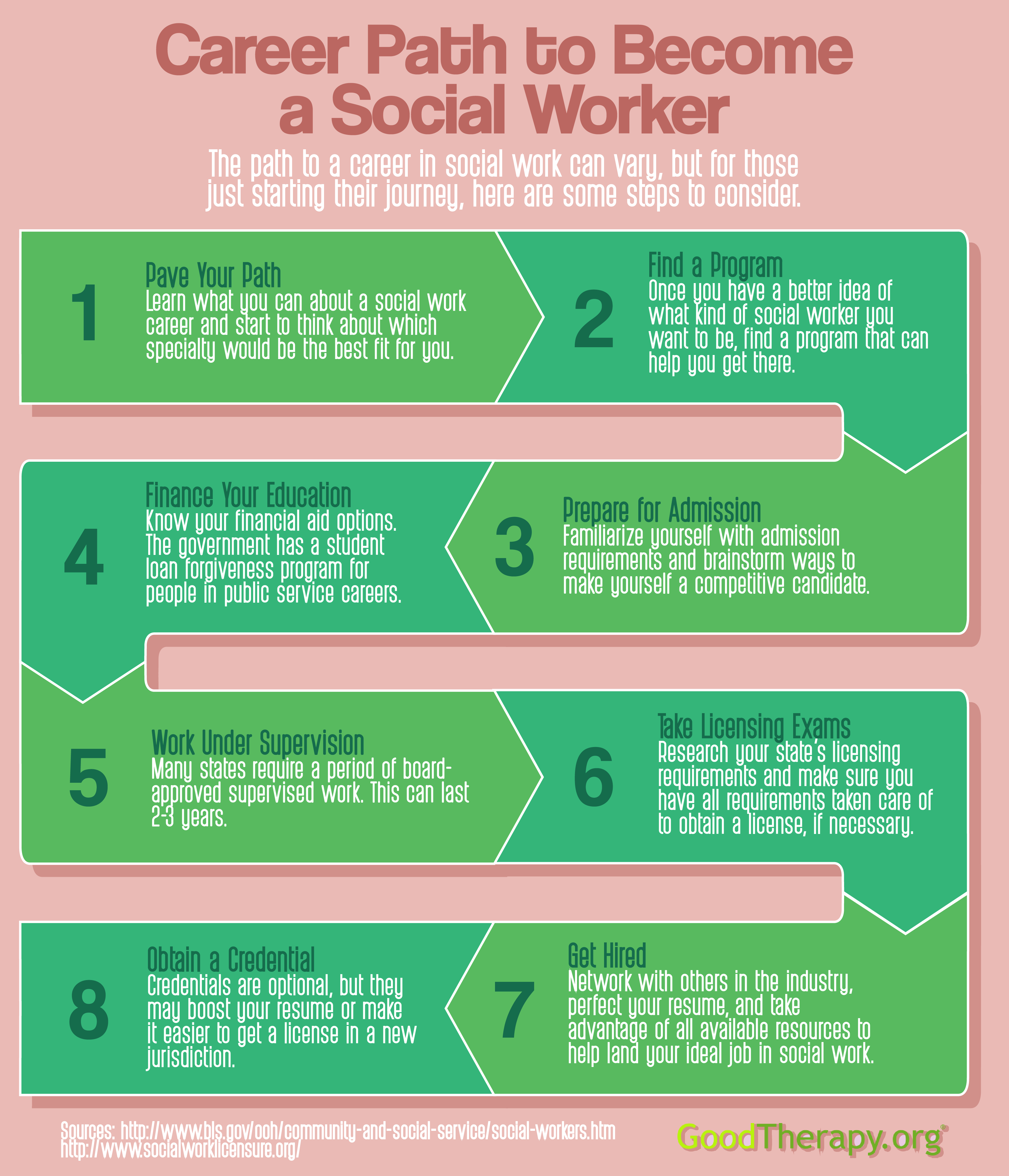
1. Pave Your Path in Social Work
If you are considering becoming a social worker, you can start by learning everything you can about the field. Some ways to learn more about what social workers do include researching online, going to a local library, speaking with a college recruiter, or shadowing a licensed social worker for a day.
Next, examine your aptitude for the career. An effective social worker will typically have high levels of compassion and empathy, strong interpersonal and listening skills, well-developed organizational and problem-solving skills, and good time management.
Although it is not necessary to decide on an area of interest immediately, it may help to research different specialties within social work. Some of these include:An effective social worker will typically have high levels of compassion and empathy, strong interpersonal and listening skills, well-developed organizational and problem-solving skills, and good time management.
- Child and family social workers
- Clinical social workers
- School social workers
- Healthcare social workers
- Geriatric social workers
- Hospice and palliative care social workers
- Medical social workers
- Mental health and substance abuse social workers
2. Find the Right Program for You
When choosing a social work program, it may be helpful to envision a path for your career. Do you want to work in a hospital, public school, or at a non-profit? Do you see yourself more in advocacy or policy change, mental health care, private practice, or the military?
The right program for you will depend upon your chosen path. For example, if you’re interested in clinical work, a program with a clinical concentration may be the best fit.
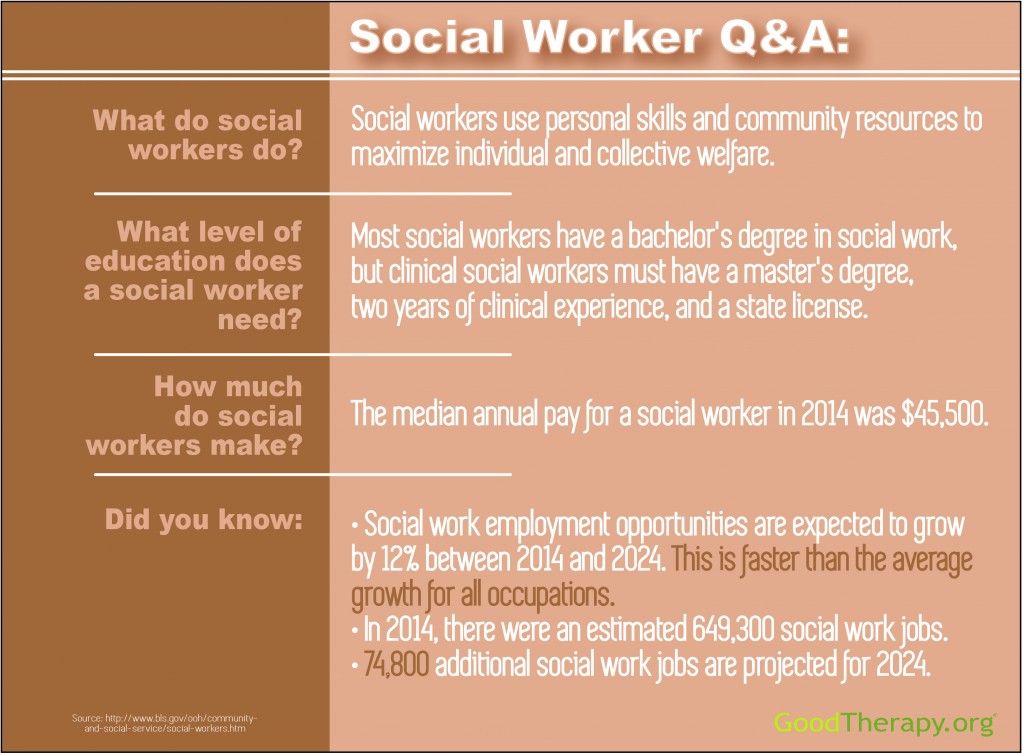
Most entry-level positions will require a bachelor’s degree in social work, though some will accept a related field such as psychology or sociology. To work in the clinical field, a master’s degree is necessary.
In some states, baccalaureate social workers can obtain licensure, but most require a master’s degree. In addition to licensing requirements, there are other advantages of pursuing an advanced social work degree. Master’s level Social Workers (MSWs) often have higher salaries and more career opportunities.
 Infographic by Hannah Johnson
3. Prepare for Admission
Once you have decided on a program and a school, fully understanding and adhering to the admission requirements can make you a competitive candidate. You will need letters of recommendation from people who have known you for at least six months and can easily speak to your skills and attributes.
Volunteer work is an excellent way to show commitment and propensity for social work. Many human service agencies have volunteer opportunities to gain valuable experience. Some students interested in social work choose to volunteer for AmeriCorps, a national community service organization that provides small stipends and education awards in exchange for a service commitment.
[fat_widget_left]An accredited social work undergraduate degree is not necessary for admission to a graduate-level social work program. Any undergraduate degree can be sufficient, but a related field may be preferred.
You can view the directory of accredited social work programs from the Council on Social Work Education here.
4. Finance Your Education
Education can be an expensive investment. Considering financial aid options long before the start of a program can help you get your finances organized. You may qualify for grants, scholarships, or student loans, and some employers may even provide educational assistance. The government also has a student loan forgiveness program available to those who work in the public service field.
5. Work under Supervision after Graduation
In most cases, you will need to work under board-approved supervision for a period of two to three years or 3,000 hours after graduation before applying for state licensure. After receiving a master’s degree, all states require some form of practice for independent clinical licensing if you intend to eventually work in private practice.
Many states require a period of supervised work even for non-clinical positions such as administrative work. It may be necessary to check with your state licensing requirements and your admitted program to know for sure what your requirements will be.
6. Take State Licensing Exams
To become a licensed social worker, learning the licensure requirements in your state is a key step. In the past, many jurisdictions would accept bachelor’s degrees in related fields without accreditation, but most states are moving away from this and do require an accredited degree from the Council on Social Work Education (CSWE) or foreign equivalent for licensure. For those with bachelor’s degrees not CSWE accredited, a master’s degree in social work from an institution that is accredited may be necessary.
In addition to educational requirements, you will also need to work under supervision, take an exam, and possibly be fingerprinted in some states. You can check your state’s requirements here.
In several states, you will need to take the Association of Social Work Boards (ASWB) master’s exam before or after graduation. After completion of all other requirements, you will then take a clinical or advanced generalist exam if necessary.
7. Obtain an Optional Credential
The National Association of Social Workers offers an Academy of Certified Social Workers (ACSW) certification. It is not the same as licensing and does not give any legal authority to practice in any state, but it does provide an additional credential to add to a resume. In some cases, the certification may make it easier to receive a new license in a new jurisdiction.
8. Get Hired
Once you have completed your education and licensing requirements, you’re ready to look for social work jobs. Networking can be helpful for getting to know others in the industry, and spending time perfecting your resume and using all resources available to you can make it easier to land your first social work job or start your own clinical practice. For anyone in a therapist or social work career, staying involved in the community and keeping up with your continuing education requirements can help maintain your licensure and expand your knowledge.
References:
- Bureau of Labor Statistics. (2015, December 17). U.S. Department of Labor. Occupational Outlook Handbook, 2014-15 Edition. Social Workers. Retrieved from http://www.bls.gov/ooh/community-and-social-service/social-workers.htm
- Council on Social Work Education. (CSWE). (n.d.). Directory of Accredited Programs. Retrieved from http://www.cswe.org/Accreditation/Accredited-Programs.aspx
- Federal Student Aid. (2015, December). Public Service Loan Forgiveness Program. Questions and Answers for Federal Student Loan Borrowers. Retrieved from https://studentaid.ed.gov/sites/default/files/public-service-loan-forgiveness-common-questions.pdf
- National Association of Social Workers (NASW). (n.d.). Become a Social Worker: Starting out. Retrieved from http://www.socialworklicensure.org/articles/become-a-social-worker.html#context/api/listings/prefilter
- National Association of Social Workers (NASW). (n.d.). Social Work License Requirements. Retrieved from http://www.socialworklicensure.org/articles/social-work-license-requirements.html
 What’s sacred for you? Where is it found? For many of us, the idea of sacred space brings up images of cathedrals or mosques, Stonehenge, Angkor Wat, or the pyramids. These can be places separated from us by great distances and steeped in centuries of tradition, so getting to them is a journey. “Next year in Jerusalem,” we tell one another. Or we dream of making the Hajj to Mecca, or going on pilgrimage to Santiago or Lourdes. Such spaces can also be the houses of worship we go to once a week, for which we dress in special clothes, covering or uncovering our heads, possibly leaving our shoes at the door.
For others of us, the sacred is hard to find, or is something we feel we once had access to but no longer do. We get caught up—sometimes for years at a time—in the business of daily life. Technology provides us with increasingly sophisticated means to keep ourselves distracted. Or the practices that once offered access to the sacred may no longer do so.
In the following discussion, names have been changed and personal material has been screened out.
[fat_widget_right]
Sacred space can mean what we set the space aside for, what we do while within it. Jim creates a memorial altar in his home. On top of a bookcase, he puts photos of people he loves who have died—his grandmother, his partner, his best friend. He keeps a candle burning there, and on their birthdays he sets out flowers or a cup of coffee.
Sacred can refer to what we feel when we enter the space. Benjamin, disillusioned with his church, goes into nature in order to feel he’s contained in something larger than he is, that will accept him no matter what. Janice writes her dreams down in a journal. When she sits down in front of her journal and opens it, she experiences feelings of calm and increased focus. Cathy goes on vacation to Istanbul and enters the Blue Mosque. Although a practicing Lutheran, she finds that looking up into the ornately tiled, domed ceilings produces a sense of weightlessness and freedom from worry.
Bob belongs to a writers’ group. Every two weeks, the group gets together at a different member’s home. They read and critique each other’s work. Although “sacred” isn’t the way he describes this (and, in fact, is a term he objects to), Bob says writing is the most important thing in the world to him—“what he was born to do.”
Kyle meditates before coming to therapy. He sees his therapist’s office as the place where he meets what is most true in his life, sometimes for the first time.
For Alice, it’s her mother’s house. For Karen, it’s wherever her 10-year-old daughter is. Both women struggle with recovery, but don’t use in the spaces where they locate the sacred.
If we give the sacred its own space, do we increase the chances we will recognize it when it greets us?
The sacred is what grounds us in meaning. It can include us, as when we recognize that we are part of or one with the universe. And it can gently put us in our place, as when we slowly realize our ego is not the most important content of that universe. It can be deeply personal, as in meeting rooms where we establish or affirm our relationship to a higher power. And it can be an experience of merger, as when we look up and out into the stars at night. Sharon Olds, in her poem Wilderness, describes sleeping in the desert and looking up at the stars. She feels suddenly “… as if/not only the earth while I am here, but space/and death and existence without me, are my home.”
Sometimes we know it for the first time by responses that surprise us. Fran, hiking, comes into a grove of California oaks in the hills over the ocean. She says, “I suddenly heard the silence for the first time. It seemed to go on forever.” For Steve, the experience came as he was driving through Death Valley. “I was going to meet some friends,” he says. “But I drove more and more slowly, until I just had to pull over and stop. I’d never seen anything like it—white sand dunes, colored cliffs that looked like sculptures, and no one else around anywhere. I felt connected to the earth for the first time since I was a kid.”
Our own bodies can provide such a space. Tom describes an experience late one Christmas Eve that the manger where the Christ child was about to be born was his own body. This original intensity faded, but he was left with a lingering and resonant awareness of what he put into his body in terms of food and recreational substances, and of how he took care of his health.
Sacred space can mean leaving room in our lives for something to be sacred—if not now, then someday. Perhaps as simply as by acknowledging we don’t know all the answers. Or that our answers might not be the ultimate answer, might merely be rest stops along the way.
Sacred space can as well act as a holding place in times of uncertainty or transition. It can be a system of meaning, rather than a literal place.
According to Erik Erikson, in the first stages of life we’re engaged in developmental tasks related to basic psychological functions, such as establishing trust and self-efficacy, and in developing a stable sense of identity. Another way of saying this is that we’re involved in consolidating the ego, the sense of “me” present in experience that makes it “my experience.” This time of life is a little like the Ptolemaic view of the universe, where everything—sun, moon, and stars—seemed to revolve around the earth. That’s us at the center of everything, and whatever happens is about us.
Often around the midpoint of life, we start picking up hints that we’re not going to increase and live forever. In Once Upon a Midlife, Allan Chinen describes how shocking this realization can be, accompanied by anxiety and grief. Especially at such a point, a sense of the sacred can act to ground us. As the fact of “me” begins to lose its apparent guarantee of continuance as well as its centrality (because how central to the universe can I be if I’m not going to be around?), the universe is less and less about me. But perhaps I become more and more about something else, something larger than me.
Carl Jung notes that, in this way, the ego becomes relativized and the process of individualization—becoming wholly who we were meant to be—is accomplished. We begin to live in a system of meaning where the earth revolves around the sun, the sun rotates through the galaxy, and the galaxy itself follows its own great attractor. Our experience then seems to participate in larger movements, whether those are our family or a cause in which we believe or humanity in general, a spiritual pathway or the life of the universe.
Ray tells me that if you go to the mosque to pray 40 mornings in a row, you will be able to meet Khid’r, a mystic figure in Islam, anywhere—in the market, on the street. Barbara tells me she sets a place at the Seder table every year for Elijah, who will someday return from his sojourn in heaven, so why not here, why not now? Beth tells me that when you practice Zen meditation, anything—even a drop of water falling into a bucket—can suddenly herald a glimpse into the nature of reality.
Here, we have the idea of ordinary daily space—and that includes the freeway where we’re caught in traffic, or the area where we keep our trash cans—suddenly converting to sacred.
A related idea is that all space is sacred already. Connie tells me a quotation from the Gospel of Thomas, where the figure of Jesus tells his disciples, “The kingdom of the father is spread out on the earth, and nobody recognizes it.”
If I’m already in a sacred space, what happens to my anxiety that is sometimes so intense? My craving for alcohol? The anger I feel at my partner when we disagree over small matters?
Sacred space can mean leaving room in our lives for something to be sacred—if not now, then someday. Perhaps as simply as by acknowledging we don’t know all the answers. Or that our answers might not be the ultimate answer, might merely be rest stops along the way. The possibility that even though something doesn’t seem to make sense to me, it still might make sense. That I am included in a great web of meaning, at home, wherever I am, with no chance of getting lost.
References:
- Chinen, A. (1992). Once Upon a Midlife: Classic Stories and Mythic Tales to Illuminate the Middle Years. New York: Putnam Publishing Group.
- Erikson, E. (1980). Identity and the Life Cycle. New York: Norton.
- Jung, C. (1969). The Structure and Dynamics of the Psyche, Second Edition. Princeton, NJ: Princeton University Press.
- Olds, S. (2002). The Unswept Room. New York: Alfred A. Knopf.
- Robinson, J., Editor. (1978). The Nag Hammadi Library. New York: Harper and Row.
 Memory is an integral part of being human. Remembering past experiences can help predict what will happen in the future if you alter your behavior accordingly. Some philosophers have actually gone as far as to say memory is the mark of being human. Memories not only serve to shape identity and define who a person is, but they are also a key factor in the ability to learn and process new information.
The nature of human memory has puzzled philosophers for a long time, and its function remained mostly a mystery until the past century. With new breakthroughs in neuroscience and psychiatry, scientists continue to learn more and more about how memories are formed, consolidated, and recalled. However, many questions still remain unanswered.
For humans, memories can be incredibly valuable. Many people may want to remember certain moments for the rest of their lives. Unfortunately, forgetting seems to be the common fate of most memories, and with incidences of Alzheimer’s on the rise, memories seem all the more vulnerable to forgetfulness. As we learn more about the nature and loss of memory, a question arises. Can we purposely make memories last forever?
Unfortunately, most things cannot last forever. Everything is subject to change and decay over time. Memories are destined to fade, and the brains we use to recall them will eventually shut down completely.
Although you cannot make memories last forever, there are many things you can do to improve memory storage and recollection, and hopefully your most important memories will last a lifetime.
Here are nine ways to create and hold onto vivid, long-lasting memories:
1. Get in Touch with Emotions
If you want to remember something, get emotional. Scientific evidence shows emotional arousal is directly connected to memory consolidation and endurance. The adrenal hormones released during emotional arousal regulate the consolidation of memory. Both human and animal studies have revealed that stress-induced activation of the amygdala (the brain’s emotional processing center) and its interactions with other regions of the brain involved in processing memory play an important role in guaranteeing emotionally significant experiences are remembered.

An excellent example of how this process works is the phenomenon referred to as flashbulb memory. Flashbulb memories are extremely detailed and vivid memories that are typically retained for a lifetime. These memories are usually of important historical events or personal life events.
For example, most Americans who were alive in the 1960s can still recall exactly where they were when they heard the news of the John F. Kennedy and Martin Luther King Jr. assassinations, although they likely have little or no recollection of what they were doing the day before or after those events.
Flashbulb memories reveal how the emotional content of an event can improve both the strength and endurance of the memory of it. Unpleasant experiences such as car accidents, the death of a loved one, acts of violence, and other traumas are generally remembered better than the events of a routine day. However, research indicates unpleasant memories do fade faster than positive memories, meaning strong and positive emotional experiences are the most likely to become embedded in long-term memory.
Still, studies have shown even mild emotions are associated with more vivid and long-lasting memories than those of neutral experiences. Research has also revealed having an emotionally arousing experience after learning something new helps to consolidate the memory of what was learned prior to the experience.
2. Pay Attention and Engage All Senses
The quality of memories is directly dependent on how attentive you were at the time they were formed. Be as alert as possible when experiencing something you want to remember with great clarity, vividness, and detail. Memory is a sensory experience, so engage all five senses both during the event and afterward when you recall it. The more attentive and engaged you are, the more you are likely to remember later.
3. Make as Many Associations as Possible
Memory is not confined to any particular place in the brain, but is instead a brain-wide process. Every memory is the result of a changed set of neural connections in the brain. It is a re-creation of past experiences through a synchronous firing of neurons that were involved in the original experience.
Because memories are both formed and recalled through associations, the more associations you make, the better your recall ability is likely to be. This is why many people use mnemonic devices and mental maps when studying information.
4. Recall the Experience and Share with Others
A lasting memory is not simply created at the time of the experience. Memories are actually formed after the experience and continue to be consolidated and changed each time an event is remembered. Therefore, the more you recall it, the more likely you are to remember it.
[fat_widget_left]An article published in Parents in May 2009 provided information and suggestions on how to make memories last for preschoolers. The article explained how language plays an important role in memory and how our memories are stored and accessed through words. As kids learn to verbalize, they are able to form more lasting memories, which is why older children and adults are typically unable to recall events that occurred during infancy.
You can use this awareness to your advantage and choose to verbally recall your memories by sharing them with others. Storytelling helps to reconsolidate memories. The more repetition the better, so don’t pass up a chance to reminisce with your loved ones.
5. Use Sensory Cues
Cues can be an effective method of evoking memories. Have you ever noticed how certain smells can immediately take you back years, often even as far as childhood? Perhaps the smell of cinnamon reminds you of your grandmother’s house or a chalk scent reminds you of your third grade classroom.
Music also tends to be a strong cue for people. Hearing an old song on the radio can immediately send someone into a nostalgic daydream. Be mindful of potential cues and associations during the experience you wish to remember and use those later to help improve your recall.
6. Exercise and Eat Healthfully
Having a strong memory is directly dependent on the health and vitality of your brain. Exercise increases oxygen to the brain and helps release stress. Chronic stress can destroy brain cells and damage the hippocampus, a region of the brain that helps form new memories and retrieve old ones.
Eating a balanced diet with healthy foods known to aid the brain can also protect your memory. Choose foods high in Omega 3 fatty acids such as salmon or flaxseed. Berries are also known to improve memory function as well as green leafy vegetables such as kale and spinach. Green tea and Ginkgo Biloba may also boost memory power.
7. Meditate
Meditation can help increase the ability to concentrate, focus, learn, store, and retain memories. Meditation has been shown to increase the thickness of the cerebral cortex and encourages more connections between brain cells, which ultimately helps increase memory. Positive results can often be seen with a simple 5-10 minute daily meditation regimen.
8. Sleep on It
The quality of memories is directly dependent on how attentive you were at the time they were formed. Be as alert as possible when experiencing something you want to remember with great clarity, vividness, and detail.Memory processing and consolidation occur during sleep. Both human and animal studies have shown sleeping after learning helps improve memory recall and is vital for memory consolidation. Cognitive impairments in both declarative and non-declarative memories have been found after sleep loss, fragmented sleep, and disturbed sleep.
Practicing good sleep hygiene may be able to improve the endurance of memories. Getting routine restful sleep each night can be an effortless way to improve memory storage and recall.
9. Keep a Record
Because memories are so vulnerable, if you truly want to remember something, it may be best to keep a record.
Journaling can be an excellent way to record experiences and help consolidate and reconsolidate memories. Keeping a diary not only provides you with the details of the experience, but it also gives you a chance to reflect on your emotional reactions to the event you are recalling.
Photos can also be a quick way to capture memories and induce vivid recall when viewing them. Videos can provide the closest possible recurrence of the event. With smartphones in most pockets, recording memories has never been easier.
But if you find yourself—in the absence of a recording device—experiencing something you don’t want to forget, try to engage your senses and pay attention to what you already have in the environment to grasp onto that memory.
References:
- Farooqui, T. & Farooqui, A. (2015) Diet and Exercise in Cognitive Function and Neurological Diseases. Wiley Blackwell. John Wiley & Sons, Hoboken, NJ.
- McGaugh, J. L. (2013, June 18). Making lasting memories: Remembering the significant. S. National Library of Medicine: National Institutes of Health. Neuroscience. Retrieved from http://www.ncbi.nlm.nih.gov/pmc/articles/PMC3690616/
- McGrath, P. (2014, May 4). Why good memories are less likely to fade. BBC News: Health. Retrieved from http://www.bbc.com/news/health-27193607
- Myers, C. (2006). Glossary: Flashbulb Memory. Memory Loss and the Brain: The Newsletter of the Memory Disorders Project at Rutgers University. Retrieved from http://www.memorylossonline.com/glossary/flashbulbmemory.html
- O’Brien, M. & Kellen, A. (2013, January 14). The Connection Between Memory and Sleep. National Science Foundation: Science Nation. Retrieved from http://www.nsf.gov/news/special_reports/science_nation/sleepmemory.jsp
- Rabbit, M. (2009, May). How to Make Memories Last for Your Preschooler. Parents Magazine. Retrieved from http://www.parents.com/toddlers-preschoolers/development/intellectual/make-memories/
- Ranpura, A. (2013, March 12). How we remember and why we forget. Brain Connection. Retrieved from http://brainconnection.brainhq.com/2013/03/12/how-we-remember-and-why-we-forget/
- Smith, M. & Robinson, L. (April 2015). How to Improve Your Memory: Tips and Exercises to Sharpen Your Mind and Boost Brain Power. org: Adapted from Harvard Health Letter: July 2014. Retrieved from http://www.helpguide.org/articles/memory/how-to-improve-your-memory.htm
 People generally want to be accepted. For many, this means fitting in with the crowd. In order to do that, you may feel pressure to think and behave a certain way. The trouble is that when you try so hard to be what someone else considers normal, you may lose a part of yourself in the process.
Here are seven reasons why you should stop trying to be normal and start being yourself instead:
1. Normal May Mean Playing it Safe
It takes courage to stand out from the crowd and follow your own path. It may be easier to simply do what everyone else is doing, but it probably won’t be nearly as fulfilling.
It can take a huge amount of energy to try to be normal. When you choose normality, you may inadvertently be giving up some of your own strength. You can empower yourself by choosing to honor your authenticity and staying true to who you are.
The choice is yours. You can either choose to potentially be limited by concepts of normality, or you can choose to free yourself and live your life in a way that feels natural to you. You may never know what you can achieve until you try. So rather than trying to be normal, use that energy to discover your own unique potential.
2. Normal Is a Subjective Ideal
The concept of normality is more of a subjective opinion than an objective reality. Each culture develops its own consensus of what is normal. What one culture may consider commonplace another may find unusual.
“The world ‘normal’ suggests there is a right and wrong way to be a person,” said Pandora L. MacLean-Hoover, LICSW. “There isn’t. There is a spectrum of acceptable behavior in lawful societies like ours. It’s vast and varies greatly.”
[fat_widget_right]There is no cookie cutter definition of how a human is supposed to behave. The idea that there is some ideal standard all humans should conform to is likely unrealistic and can be psychologically limiting. All you can do is trust in yourself, honor your values, and do what makes you happy.
3. Normal Is Not Easily Defined
It is often easier for people to define abnormal than it is to nail down a definition of normal. The reason for this is there is no clear definition of what normal is. It is only when someone deviates from what is generally conceived as ordinary that people become concerned with such labels.
“People widely embrace the notion they can always do better,” MacLean-Hoover said. “In doing so, they frequently deny themselves opportunities to validate their efforts. I suggest people become acquainted with the phrase, ‘I did my best.’”
4. Perfection Does Not Exist
Often, when people are trying to be normal, what they’re really trying to achieve is perfection. Perfection is unattainable, and when you strive for it, you may end up focusing too much on perceived flaws and not enough on strengths.
According to Andrew Archer, LCSW, a major drawback of trying to achieve perfection is that it is generally driven by a feeling of not being “good enough.”
“The self-fulfilling prophecy of perfectionism leads to perpetual cycles of dissatisfaction because the person gives 110% all the time, but never believes that they themselves are worthy or deserving in some way,” Archer said. “The negative belief gets in the way of ostensible achievement.”
Humans are not perfect. Mistakes happen and that is how we learn. Choose to find the beauty in the imperfections. If everything was already perfect, there wouldn’t be any room for growth.
5. People May Miss Out on Your Uniqueness
When you identify yourself as normal, you may be giving up your personal identity. We all have our differences. Embrace yours, and respect those of others.
Everyone possesses unique characteristics and qualities. When you deny yourself the right to be uniquely you, the entire world could be missing out.Can you imagine how boring life would be if everyone was the same? Everyone possesses unique characteristics and qualities. When you deny yourself the right to be uniquely you, the entire world could be missing out. Do yourself and the rest of us a favor: be yourself and be proud of who you are.
“If being ‘normal’ means being the same as others, then the benefits for being different are enjoyed in the form of recognition. This is especially true for creative people,” MacLean-Hoover said. “Striving for normality may magnify fear of failing while it diminishes creativity. Being curious and creative requires taking risk. Worrying about living up to a nonexistent standard puts a person’s emphasis on the outcome instead of the process.”
Emphasizing the outcome and seeking external acceptance is not likely to help you feel fulfilled. You are more likely to find genuine happiness through self-acceptance. Rather than trying to get other people to love you, try to simply love yourself.
6. Labels Are for Soup Cans, Not People
Labels are useful for some things, but they often don’t fit in well with the messy world of human emotions and personality traits. Even psychological diagnoses can be challenging to make, as no two people diagnosed with a single condition are exactly alike.
If normal is equated with the status quo, then abnormality becomes equal to nonconformity, Archer said.
“The American Psychological Association and the Diagnostic and Statistical Manual are good examples of a process that is implicitly defining normality through a diagnostic classification system of ‘disorders,’” Archer said. “There is a sense of abnormality created when a person is diagnosed with a ‘mental illness.’ The injustices of this system are both the eradication of culture within the process and the lack of definition for ‘normal.’”
People are not easily categorized, and perhaps this is for the best. Human life is too organic to be rigidly classified. Normal might be more of an abstraction than a human experience.
7. Normal May Not Change the World
Normal may be similar to usual, average, typical, or expected. Normal implies conforming to a preconceived standard, which can limit your potential. You might never achieve the extraordinary as long you choose to remain ordinary. Normal generally doesn’t mean stretching limits. Normal doesn’t commonly mean thinking outside the box. Normal usually doesn’t mean achieving greatness.
“Typically, we get caught up in comparison of what we think was normal or should be ideal when we reflect on the past or daydream on potential future understandings of who we think we are,” Archer said.
Don’t be normal. Be you.
 The feeling-state addiction protocol is a modified form of eye movement desensitization and reprocessing, referred to as EMDR in mental health. EMDR is a trauma treatment modality recognized as one of the main treatments for posttraumatic stress (PTSD) and other forms of trauma.
In EMDR therapy, therapists desensitize a traumatic memory by having the person in therapy use eye movements (or other back-and-forth stimulation) while holding the memory in mind along with the feelings, images, and belief about self in that situation. This causes the brain to process the memory in a way that takes the charge off the memory, so it no longer feels disturbing. In feeling-state addiction protocol, we desensitize the pleasant memory causing the addiction by removing the charge from that memory.
Tom and the Feeling-State Theory of Addictions
The feeling-state theory of addictions assumes that the feeling underlying the behavior, not the apparent object or behavior, is the real goal of unwanted compulsive behavior. In alcohol or drug addiction, the substance creates the [fat_widget_addiction_right]“feeling-state” that causes the compulsive behavior. In behavioral addictions, however, any feeling-state can be linked to any behavior. Feeling-states are state-dependent memories created during an intensely experienced event. With gambling addiction, we look for the positive feeling-state linked to the gambling behavior.
I worked with a person in therapy, who I will call Tom, who came to me because he had “reached bottom with the consequences of his gambling,” as he put it. Tom is a 37-year-old man who started therapy saying that he wanted to overcome two addictions: a very destructive woman and gambling.
The precipitating incident that brought Tom to therapy was having just lost his last $12,000 in a poker game, the final straw that caused him to lose his house. He had recently moved in with his parents, and they insisted he deal with the gambling addiction.
Both of the addictions Tom wished to treat are known as process addictions or behavioral addictions because they are not addictions to a substance. When he first came to see me, Tom was dealing with an intense sadness from losing his relationship and shame from losing his house and moving in with his parents. Tom’s parents agreed to pay for his therapy and insisted he make measured progress, lest they throw him out of the house.
Although addiction to a person and addiction to gambling seem different, like all behavioral addictions, they both involve an addiction to a feeling-state. According to Dr. Robert Miller, who developed the feeling-state addiction protocol in 2011:
“The feeling-state theory of behavioral and substance addictions postulates that addictions are created when positive feelings become rigidly linked with specific objects or behaviors. This linkage between feelings and behaviors is called a feeling-state. When a feeling-state is triggered, the whole psycho-physiological pattern is activated. The activation of the pattern then triggers the out-of-control behavior.”
The first step in eliminating a compulsion, according to Dr. Miller’s feeling-state protocol, is to figure out the feeling-state that drives the compulsion.
Identifying the Real Addictive Behavior
In therapy, we determined that the feeling-state Tom was addicted to with gambling was bonding with his father, which had provided both a sense of belonging and mastery.
Tom had one brother who was five years older. He described his brother as the favorite and the one his dad often Tom was very shy and described himself as someone who had never excelled at anything. He had few friends and participated in few social activities. In fact, the first time he said he felt any positive attention from his father was when he would watch his father’s poker games every week.praised for his intellectual ability and athletic success. Tom was very shy and described himself as someone who had never excelled at anything. He had few friends and participated in few social activities. In fact, the first time he said he felt any positive attention from his father was when he would watch his father’s poker games every week.
By the age of 18, Tom became a good observer and was playing cards with his dad’s poker group. He was skilled and was often the winner. It was this feeling-state of bonding with his father and the feeling of belonging to a group that drove his gambling compulsion.
We processed these strong feeling-states with EMDR, and his craving for gambling started to subside. We then discovered other feeling-states linked to his gambling. They were the feeling-state of freedom and mastery. Once we unlinked or disconnected these feeling-states with gambling, his desire for gambling waned and we could then address the psychological dynamics underlying the “need” for the gambling, such as his relationship with his dad, his feelings of being a “loser,” and the belief he is not smart and can’t succeed at anything.
We also desensitized his attraction to the destructive woman who had recently come back into his life. When he realized how easy it was to remove that attraction for her, it gave his self-esteem a huge boost. This helped him see other dynamics in his life with more clarity and confidence.
I have used this model with many process addictions, including:
- Shopping addiction
- Shoplifting
- Addiction to a person
- Internet addiction
I find it to be effective and relatively easy for the person in therapy because the person largely avoids the pain of going through withdrawal.
References:
- EMDR International Association. (2014). What is the actual EMDR session like? Retrieved from http://www.emdria.org/?120
- Miller. R. (2011). The feeling-state theory of behavioral and substance addictions and the feeling-state addiction protocol. Retrieved from http://www.psychinnovations.com/EMDRSD/Miller_Feeling_State_Addiction.pdf
 When Mommy’s little girl grows up and goes off into the world to have her own life, struggles with issues of separation and difference may occur. Eye rolls, hugs, tugs-of-war, and tears are familiar to those who have witnessed or participated in mother-daughter relationships. Frequently, in this new phase of their relationship, mother and daughter are unprepared to deal with their differing needs for the amount, form, and content of contact. Moreover, the impact of physical separation between mother and daughter is affected by the degree to which each needs to feel connected, or to not feel rejected or disconnected.
When adult children desire to individuate and develop autonomy, they may struggle to trust their choices and may fear being unable to withstand mom’s influence. Often, to avoid feelings of criticism or incompetence, the daughter will pull away. (These may be the daughter’s feelings and may not reflect the reality that mom feels critical or entitled to continue her earlier, authoritative role.)
From early childhood, mothers and daughters tend to identify with each other. As the daughter moves into adulthood, both may have difficulty with the daughter’s developing an identity that differs from a past shared view of being alike. For some mothers, this can be experienced as a rejection of the mother’s character, worldview, values, opinions, etc. Daughters may have a similar experience. Although we typically think of the daughter needing to pull away from mom to individuate, some daughters who are ambivalent about developing a separate life and sense of self may find they are being pushed by a worried mom to do so. These mothers may try to influence what they see as necessary individuation by reducing the amount and nature of contact with their daughters.
[fat_widget_right]
When Daughter Wants More Contact
Maggie began therapy at the age of 26 when her mother told her she didn’t think it was good for them to speak every day. She said Maggie should talk to someone to help her feel more confident and self-assured. Maggie sounded irritated when she told me she didn’t really want to be in therapy:
“I don’t see why I need a therapist. My mother has always been the one in my life who’s made me feel good about myself. She reassures me. I know my biggest issue is I wish I had a boyfriend. I know mom thinks I’m smart and cute and there is no reason for me not to find a man. I’m not so optimistic. There’s something about me that I can’t seem to find a relationship that works. It’s true; I don’t feel so good about myself. But if Mom hasn’t succeeded in helping me, I don’t know what you can do.”
I asked Maggie why she thought her mother wanted her in therapy. Maggie began to cry and barely managed to speak:
“This has never happened before. I guess I’m upset with Mom. How can she do this to me? I tell Mom everything. I rely on her for everything. She’s always there for me. Lately, she’s been pulling back. I feel so rejected. I don’t know what’s going on. She tells me I need to learn to rely on myself and trust myself. How can I do that if she rejects me? Doesn’t she know I need her input? I feel so abandoned. How can therapy help me? I just need my mother back.”
When you are the same or one, the relationship is symbiotic, with no space between the two. When you are two separate, distinct people, there is a space within which each can attach to the other. That may be the best contact of all.
Maggie and her mother had rarely experienced conflict:
“I always felt we were on the same page about things. She had great ideas and I was happy to do what she suggested. I took up piano, which we both love, and went to her alma mater when I decided on a college. I enjoy making her happy. I always feel safe that she knows what’s right for me. Now she seems to be telling me that what’s right is to be more on my own, have my own ideas. I do have ideas. They just happen to be the same as her ideas. How would I know what other ideas to have?”
Maggie decided to work with me and see if I could help her sort out her feelings about being more separate from her mother. She is beginning to realize she felt good as long as she was living the life her mother valued. She hadn’t recognized that she was so used to looking to her mother for guidelines for living, she paid little or no attention to her own wishes and desires. In fact, when we started working together, Maggie had no concept of her own unique needs, separate from what her mother believed would be good for her. The notion of differences between them was not part of her thinking or feeling.
Maggie has begun to think about how her reliance on her mother has limited her by preventing her from developing herself through her relationship to the world. She is considering that her mother may believe she had interfered with Maggie’s ability to individuate and was pushing Maggie away not to reject her, but so she could develop her sense of self. The challenge for Maggie is to move beyond her mother’s wish for her to individuate, and choose to grow her own desires and develop the capacity to feel self-confident and derive self-esteem from a variety of experiences.
When Mother Wants More Contact
Susan was beside herself. Her 34-year-old daughter, Isabel, who lived in another state, just had her first baby and wanted Susan and her husband to wait a month before visiting their new grandson. Susan had been seeing me for three years when she came into her session overwhelmed with feelings:
“I can’t believe this. You know how I’ve been so excited about going to visit Isabel and the baby and helping out. I assumed she would need me as soon as the baby arrived. I know she can bristle when I give her my opinions or suggestions about things. But I figured she doesn’t know anything about babies, so this was going to be different. Finally, she would let me be a mother.”
I asked Susan why she thought Isabel wanted her to wait. Susan let out a huge sigh and responded:
“I guess I should have anticipated this. Since she left home for college, she’s been keeping me at a distance. When I worried about her in college, she would take forever to respond to my contacts. I remember explaining that it’s a mother’s job to be concerned and she told me it made her feel like I don’t think she can take care of herself and I need to stop. She was partly right. I still don’t think she knows how to be a mother to a newborn and should welcome my input. But I fooled myself about this. I suppose I need to feel like I’m valued as a mother, and I do get worried that she is too independent and will get herself into trouble.”
I reminded Susan that she has been talking with me for some time about how distressed she is about Isabel. When she first came to see me, she was overwhelmed with anxiety that Isabel was about to make a mistake and marry Jake. She was hurt and angry that she had been given no clue that the relationship had progressed to the point of engagement. I recalled that early in our work she had told me she didn’t know why Isabel kept her out of the loop on everything, and I reminded her that we have been looking at that question in our work. Then I asked, “What have you come to understand about this?”
Susan shook her head sadly. “I know, I know. Isabel has to live her own life. Jake turned out to be great. I have to remember that my anxiety about Isabel’s life is about my own needs to feel like a good mother. When she was younger, I felt we were two peas in a pod and I always knew exactly what was right for her. That made me feel like a good mom. Now, she has such a different life from mine that I don’t always know who she is or how to be her mom.”
I recognized how painful this was for Susan, who wanted to feel like a good mother and desirable grandmother. I thought it important to remind her that lately she has been doing a good job thinking about what Isabel wants and being less intrusive. I told her I knew it was difficult to wait for Isabel to ask her on rare occasions for advice. I also hypothesized that perhaps becoming a grandmother triggered her feelings of wanting to be a good mother/grandmother and she was reverting to old patterns of wanting to be involved on her terms, not Isabel’s.
Hopefully, Susan will have an opportunity when she visits Isabel to practice what is so difficult to do: not attempt to influence Isabel’s thoughts and feelings. She knows the more she can admire and recognize Isabel’s differences, the more likely Isabel will learn to see her as uncritical and not controlling. Susan is working on this.
When mom and her little girl spend their early years thinking of each other as the same, the daughter’s seeking to separate can become a painful process for both. If the daughter wants to remain the child and not venture into the grown-up world, the mother who sees this as problematic faces the dilemma of how to help launch her daughter without creating feelings of abandonment and rejection. When the mother finds separation painful, she has to learn how to give her daughter space so they can attach in a new way.
Mother and daughter ultimately have to understand that being separate and different, rather than the same and enmeshed, facilitates a stronger experience of attachment: When you are the same or one, the relationship is symbiotic, with no space between the two. When you are two separate, distinct people, there is a space within which each can attach to the other. That may be the best contact of all.
Note: To protect privacy, names in the preceding article have been changed and the dialogues described are a composite.
 “We waste time looking for the perfect lover, instead of creating the perfect love.”
—Tom Robbins, American novelist
Are you still “in love” with your partner?
Do you feel deep affection?
Are you best friends?
Do you connect daily?
Is sexual attraction present?
Keeping love alive in a relationship is a challenge—especially when we’re perpetually busy and distracted by our gadgets and social media. Attending to and consistently nurturing bonds over time is key to making relationships last.
Love will fade if we don’t actively do the work to deepen and cultivate our connections. Just as exercise builds muscles and keeps us physically in shape, we must work out our emotional muscles to keep our relationships fit. Consciously loving our partners is what sustains and grows the strength and depth of intimacy over a lifetime.
Often, in the therapy room, individuals and couples disclose they’ve lost their connection. Among other things, therapists hear:
[fat_widget_relationships_right]
- “It feels like we’re just roommates.”
- “I feel detached.”
- “I love my partner, but I’m not ‘in love.’ ”
- “I care about my partner, but the attraction is gone.”
- “We don’t have fun anymore.”
With apprehension, people ask, “Is there a way to get love and attraction back?”
The answer is a resounding yes! And doing so doesn’t always require heavy lifting. Often, it’s more about creating a new habit of going to the “relationship gym” several times a week and lifting smaller weights. Consistency and perseverance are crucial to building relationship muscles. With repetition, loving feelings of warmth and attraction can return.
Here are 10 easy ways to build your relationship and actively create deeper love and connection:
1. Stay in Close Contact
With all our handy electronics, staying in touch during the day should be easy … if we don’t get so focused on work that we forget or fail to connect with our loved ones. Taking a few minutes to text or give a midday call is a great way to keep your relationship in mind and let your partner know you are thinking about them.
2. Be Present
One of the biggest roadblocks occurs when couples are together physically, yet one or both are on (or shall we say “in”) their computers or cellphones. For many couples, it is the only time they have to connect, catch up on the day, and share each other’s lives. To truly be present, you must put the electronics away and make a point of talking, touching, and sharing.
3. Learn More About Your Partner
Think you know everything about your partner? There is almost surely more you can learn. Here are some great resources to get you talking to each other. You might be surprised to discover things you never knew. [amazon_affiliate]
4. Reminisce
Sometimes my husband and I sit down and try to recall our best memories. We ask each other, “Do you remember …?” It is always fun going back down memory lane and thinking about how far we have come, how much history we share, and how much we have accomplished together over the years. Not just the good times, but the difficult ones, too. Here is a great journal where you can record your story, a place where you and your partner (and, someday, your kids) can remember the way it was.
5. Create a Relationship ‘Bucket List’
Stop and think about all the things you would like to do together but never get to. Chances are you tend to fly by the seat of your pants and don’t pause to think about the fun activities you could do together; the days just pass by. If you write it down, the chances are better you will actually do it.
6. Do Something New Together
Try something you haven’t done before. Go to a bed-and-breakfast for a night, find a new restaurant, have a picnic at a park, go on a ghost tour, do a casino night, visit a museum or art gallery, take a wine tasting tour, or go roller skating. Shared experiences create memories and stimulate connection.
7. Learn Something New Together
Finding a hobby you both enjoy can be exciting. Plus, it’s a bonding experience. Dancing, photography, yoga, couples massage, acting, cooking, painting, home improvement, and fitness are just a few ideas. Think outside the box here.
8. Play Games
Have you ever played a game (without the kids)? Try card games, board games, video games. Here is one from our favorite expert on marriage, John Gottman.
9. Laugh
Many people “forget” to laugh as the serious responsibilities of marriage, family, and career take over and get in the way. Get your laugh on—watch a romantic comedy, turn on Comedy Central, or go out to a comedy club. Spend time with people who make you laugh. I recently discovered something new: laughter yoga. Check out their YouTube video below.
10. Have Sex
Sexual intimacy may be what makes your relationship different from any other kind of loving relationship in your life. We often find in practice that couples neglect their sexual bonds. New research has found heterosexual couples who have sex at least once a week are happiest.
The key to success is to start small and be consistent. Ask your partner to read this article. Then, together, pick one or two ideas from above to start with. Add your own. Build your relationship. Feel closer. Create lasting love.
Reference:
Society for Personality and Social Psychology. (2015, November 18). Couples who have sex weekly are happiest: More sex may not always make you happier, according to new research. ScienceDaily. Retrieved from www.sciencedaily.com/releases/2015/11/151118101718.htm
 Anyone who has lost somebody they love will likely agree the death of someone close usually causes a deep and painful grieving process.
The people you care about typically validate these losses, understand they cause pain, and offer comfort and support. They don’t always give you what you need, but many at least try.
But what about a loss in which nobody died? Does it count as grief?
There are many examples of loss that don’t necessarily involve death, such as:
- Loss of a career you cherished
- Loss of a role you played in your community or church
- Loss of health
- A loss of closeness to a family member or friend
- A decline in financial status
- Divorce
It may be hard to imagine going through one of the above experiences without feeling the pain of loss—also known as grief. If you experience similar circumstances, you may find yourself asking for support and not getting it. Others may not understand the magnitude of your pain, so they don’t validate your loss. Of course, people who have lost someone to death get disappointing responses, too, but experiencing a loss that doesn’t involve a death may feel like you’re doing it all on your own without the support of peers or loved ones.
[fat_widget_grief_right]
An Example of a Non-Death Loss
I have a friend who worked for 30 years at the same company. He loved his work and was admired for his kind, helpful demeanor, his intellect, and his ability to get things done under pressure. His coworkers loved him, and his Of course, people who have lost someone to death get disappointing responses, too, but experiencing a loss that doesn’t involve a death may feel like you’re doing it all on your own without the support of peers or loved ones.superiors promoted him. He woke up every day with enthusiasm and a sense of purpose. Then, his company decided to move.
He was offered the opportunity to move with them, but his mother had dementia and lived with him, and his grown son and grandchildren lived near him. If he moved, he would disrupt his mother’s life and be far from his family. He chose not to move with the company.
For the next five years, he tried to find a career that offered the same sense of purpose and camaraderie he’d experienced, but never found it. At night, he’d lay awake missing the people he worked with and the experience of feeling useful. He finally admitted to himself it was time to retire.
Retirement brought another period of questioning his purpose and more time to think about his losses. Then, his mother died and his son and grandkids moved out of state. To say my friend was grieving is an understatement.
5 Tips for Those Experiencing Grief and Loss
What can you do when you experience losses like these to help yourself feel better? Here are some ideas that might help:
1. Name and validate your own emotions.
Acknowledging the story of the pain by writing down what happened can sometimes be a reality check that helps you see you aren’t flawed, but that your circumstances are difficult. One of the most common responses to emotional pain I see is the belief that there must be something wrong with us if we feel so bad. But big emotions will come with big experiences. Acknowledging the importance of the loss and giving yourself a break may help you recover.
2. Be kind to yourself.
Engage in calming or distracting activities such as meditation, do physical exercise that you enjoy, or engage in a connecting conversation with a friend. All these activities not only take your mind off the pain, but offer you a positive experience instead. Positive experiences can work to rewire your brain toward a more optimistic and hopeful focus.
3. Remind yourself of that which makes you grateful.
Making a daily practice of noticing what we’re grateful for helps orient us toward what is already working. The more you think about what is good, the more good you’ll likely find. The brain’s natural tendency is to focus on what isn’t working because you’ve been programmed that way through evolution. Instead, make note of what is good when faced with those grief-drenched days that feel certain to be sad and heavy. It doesn’t have to be limited to big things: the tangy smell of a fresh lemon, your two hands that do so much for you and others, that songbird singing outside your window. Putting your attention on these kinds of small, wondrous experiences can go a long way toward healing after a painful loss.
4. Engage in positive self-talk.
It’s important you not get caught up in blaming yourself or identifying your character “defects” as part of your grief process. Some people naturally gravitate toward self-blame when something goes wrong. Even if there was something you could have done, you’re human like the rest of us. You deserve the same kindness and understanding you would offer a friend. Be careful you don’t make things worse by inflicting negative messages on yourself. Chances are excellent you don’t deserve them, and they’ll only make you feel worse.
5. Talk to somebody who’s a good listener.
If you have a best friend or family member who’s a good listener, you can engage them in some meaningful conversations about your pain. If they grow weary of listening or you’re not quite getting what you need, you can talk to a therapist, who, in many ways, is a professional listener. Therapists are trained to listen objectively and offer support and guidance that can help you find your way out of the morass. Remember, what you’re experiencing is very real, and you don’t have to go through it alone.
References:
- Hanson, R. (2007). Your Wonderful Brain. Retrieved from http://media.rickhanson.net/home/files/WonderfulBrain1.pdf
- Hanson, R. (2007). Seven Facts About the Brain That Incline the Mind to Joy. Retrieved from http://media.rickhanson.net/home/files/7FactsforJoy.pdf