 The loss of a child before it is born naturally stirs intense and conflicting emotions. Women might feel an intense physical bonding and grief for a being with whom they have already grown attached. Whereas men might feel more ephemerally connected and cheated from the opportunity to begin their bond. When miscarriage affects couples, it may stimulate growth or, conversely, unearth an inability to support each other through troubling times. The confusion surrounding one’s own feelings as well as how to be of real support to one’s partner after the loss tends to disrupt the balance of our relationships. This is especially true if some of that balance lay in the shared anticipation of parenthood. The inability to share and understand each other’s grief can be an isolating experience.
One week after the loss, most women report feeling closer interpersonally with their partner while feeling more distant sexually. As time progresses and different coping strategies for grief kick in, the feelings of closeness fade even when their sexual relationship recovers. Partners with significantly different grieving patterns may be at particularly high risk for subsequent marital conflict or emotional withdrawal.
A recent study on women’s perceptions on their relationship after a miscarriage (1) shows a dramatic decrease in interpersonal and sexual intimacy for most couples up to one year after a miscarriage. At that point only about half of women interviewed report a return to normalcy in their relationship (there is no data available on men’s perceptions).
Percentage of Women Claiming Their Interpersonal and Sexual Relationships Were Closer, As It Was, or More Distant
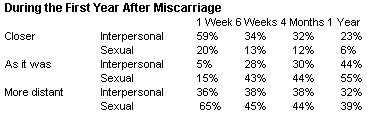
Results of the study showed that women who perceived their partners engaged in mutual sharing of feelings and experiences claimed to grow closer interpersonally and sexually. When partners failed to do things that showed they cared, women felt abandoned. These results combined with the findings of others (2) that men tend to keep to themselves after miscarriage deny their own loss, engage in avoidance, distract themselves through work and, if highly self-critical, experience greater despair and difficulty suggest that couples may need coaching in how best to care for each other after miscarriage.
Should you find that your partner experiences feelings of grief at the same intensity and duration as you, count yourself fortunate. Grief, by definition an extremely uncomfortable emotion, when shared and reflected accurately by another, tends to wane and can actually strengthen us over time. Creating supportive rituals to acknowledge and soothe one another’s pain are tremendously helpful for those who have experienced a miscarriage. Funerals, wakes, and birthday and anniversary routines all serve to give parents healing time; honoring the role that the “child to be†continues to play in their family and restoring a sense of meaning to the loss.
It is important to normalize the fact, however, that men and women tend to experience the impact of miscarriage differently. Coping with loss is a unique experience for each of us and there is no “right way†to go about it. Women, in general, do not need to learn to toughen up and let go. Nor do men need to soften up and express themselves more deeply. Often we choose our partners precisely because of these differences. The health of our long term commitment to one another depends on remaining curious and respectful of how those differences evolve over time.
Should weeks of estrangement from your partner’s grief become months (or years), it would be a good practice to explore new pathways for connection. The topic of miscarriage may seem still terribly hurtful to one, and all but forgotten to the other. Remember that getting outside help is appropriate at any stage of grief. Couples counseling provides neutral territory for safely acknowledging the new terrain of your marriage and what new shared coping strategies might still be available.
References:
(1) Miscarriage Effects on Couples’ Interpersonal and Sexual Relationships During the First Year After Loss: Women’s Perceptions
(2) Kristen M. Swanson, RN, PhD, FAAN, Zahra A. Karmali, BA, Suzanne H. Powell, BS, BA and Faina Pulvermakher, BS, MT (ASCP)
Psychosomatic Medicine 65:902-910 (2003)
© 2003 American Psychosomatic Society
 Perhaps youʼve come across one of the many articles or videos with titles like, “In Love with the Eiffel Towerâ€, or a recent National Geographic Taboo program called “Forbidden Love?†The topic is Objectum Sexuality (OS), a rare sexual orientation which includes affectionate, romantic, and sometimes erotic attraction and relationships with objects. The beloved objects can range from transport to landmarks, from sporting equipment to fisheye buttons.
Such stories may make us shake our heads and mutter, “How can this be?†Are these people delusional, or worse – dangerous? How seriously should we take these stories, and the people who are featured in them?
In April 2009, my interest in autism and Aspergerʼs Syndrome (AS) sexuality led me to contact OS-Internationale, an organization of people who have relationships with objects. I had read on their website that a number of the organizationʼs members reported diagnoses of AS, or showed significant autism traits (while other members simply identified as animists). After some correspondence with Erika Eiffel, one of the most influential and well-known OS activists, I volunteered to do a sexological survey of the membership, so that they could have data to offer other interested professionals, as well as journalists.
I didnʼt know it at the time, but the accumulated information kindly provided by the 21 English-speaking members of OS-Internationale granted me a perspective unique among sexologists and mental health professionals. I suddenly became “the†expert in Objectum Sexuality – though obviously OS people are themselves the true experts on what it is like to live and love in this manner.
The most startling finding, from my perspective, is how natural object relationships feel to those who have this orientation. Most of the people I surveyed rejected the idea of human-to-human romance, and many have never had a desire to experience it. Only two people reported having a sexual human relationship in addition to object loves.
Other findings: A history of sexual trauma does not seem to cause OS – only a couple of respondents reported abuse. And aside from Aspergerʼs Syndrome and autism diagnoses, one case of Tourettes, and two cases of PTSD – object lovers are a fairly balanced bunch. Though some respondents mentioned feeling anxiety and depression due to social ostracism, all but one person said they were happy with their orientation toward object relationships.
And itʼs not because object relationships are simple, either. These relationships include jealousy, breakups, and the heartbreak of unrequited love (especially when the object is an inaccessible public landmark or large piece of public transportation) as well as blissful love. Some people who love objects are monogamous, and others are not.
And when two or more people love the same public object, this too requires a complex negotiation within the human community. You can read more about this research in “Love Among the Objectum Sexuals†in the Electronic Journal of Human Sexuality (vol. 13).
At first I saw autism as containing the most likely explanation for Objectum Sexuality – but this didnʼt account for the people who were adamant that they were not autistic! I knew there had to be some other explanation, or collection of explanations, to account for the feelings of “this is whatʼs natural for me!†held by so many OS people.
Then I happened across an article about object personification synesthesia and realized that if a person senses a pleasing personality in, say, a teapot – it is logical that a person may develop warm feelings for that object, and warm feelings may grow even warmer over time. Humans, being what they are, are capable of eroticizing nearly anything.
Interestingly, synesthesia is also known to be more prevalent among people with autism.
Voila! Object personification synesthesia emerged for me as an area of exploration! About a year later I followed up the first OS survey with a second, shorter one. Many respondents did report various synesthesia-like experiences, including sensing personalities in objects. I am convinced that this area merits more research. My modest (self-funded) efforts can only offer an intriguing glimpse into this mystery of love and brain function. A clever group of well-funded researchers could do so much more.
In the meantime, people who identify as OS have the same needs as the rest of us, and share much in common with other sexual and gender minorities. They need acceptance and understanding from informed helping professionals. They need help dealing with social discrimination, grieving, and all the usual developmental challenges we face in life. OS people ask for the same right to live and love as human-loving humans do, and for access to help as they need it.
OS people, and their lovers, may seem improbable to many of us. But it is my belief that they are not part of a circus side-show, far down the midway, but that they too are in the big tent of trying to make sense of it all. Their erotic and emotional preferences may be rare, but they are real.
As a sexologist, I see the need for professional training in understanding OS, and will begin to offer online classes on this topic next week. While you may never have an OS client yourself, I guarantee that making the effort to understand this group will pay off in expanding your concepts of love and intimacy.
So, is it love? Or is it object personification synesthesia? My answer is: it’s most likely both.
Related Articles:
What Do Your Sexual Fantasies Mean?
An Introduction to Clinical Sexology
Writing Your Personal Manifesto
 Sometimes co-dependents may be identified by their behavior in the workplace. You may think that is impossible, because co-dependents tend to be good employees. They work harder than anyone else, they anticipate the needs of management and the are very dependable. However, there are two types of behavior that often identify them. The first type of behavior may be identified by management and, in some instances, the referral to the Employee Assistance Program may be on a mandatory basis. The second type of behavior generally comes in as a self referral unless it is extreme.
The first type of behavior involves problems with co-workers. The co-workers may complain that the employee is always angry and very stressed. The employee may be bossy, withdrawn or very short with them.. This comes to the manager’s attention and he or she refers them to the Employee Assistance Program. Why does the co-dependent person behave this way? If you remember the first two articles describing how co-dependents are affected in adulthood, you’ll recall that they feel responsible for everybody and everything. They think that it is their job to make certain that everything gets accomplished even if they are not managers. In order to ensure that everything gets done, they over-function. Of course, they expect everybody else to do the same. When people do not, then the co-dependent becomes very resentful. The co-workers can sense the co-dependent’s annoyance. Sometimes, even though it is not their job, the co-dependent may give other workers suggestions. They may also constantly complain to management, implying that the manager is not doing their job. That may or may not be true, but managers do not want that to be implied, especially by someone who reports to them. Occasionally, with this type of problem, the employee may experience enough anxiety or anger, that they decide to seek help, before they are sent to EAP.
The second type of behavior involves a meltdown. This is when the co-dependent becomes extremely upset at work. They may start crying and not stop. They may get so angry that they shout at other people. It may be a co-worker, or it may even be the boss. The co-dependent may be sent home to recover. Sometimes the manager may say to the employee something like, “If you are having some personal issues, the company provides an Employee Assistance Program to help employees with things like that. Or, if the meltdown is severe enough, the co-dependent may finally realize that they could use a little help.
So, what causes such a meltdown? The answer is similar to the last paragraph. Remember that the co-dependent feels that it is their personal responsibility to ensure that everything gets done. If work is behind, they work faster and faster and try to get the impossible done. They may work through breaks and lunch or dinner and come early and stay late. Of course, they would never ask for help because they do not believe that it is okay to do so. They also constrict their anger, frustration and worry until it is coming out of their ears. Just like a pressure cooker or a volcano, they eventually explode. Out comes all the constricted feelings, and to someone who doesn’t know what is happening, it can look pretty scary. Occasionally, I have had managers bring the employee right to our offices, because they are afraid to send them home.
Generally, when the employee comes to see me, we are quickly able to identify that they comes from a dysfunctional family. We identify how they are affected. and try to work on some of their irrational beliefs. They try to figure out what is and what is not their responsibility. This gives them quite a sense of relief. Then we work on the fact that they are powerless over other people, places, and things. Then, we redirect some of the energy they expend trying futilely to control others into working on taking better care of themselves. In just a short period of time they feel dramatically better.
The next article will begin a workbook on healing the co-dependent within us.
Related Articles:
Part I: How Co-Dependents Come into Therapy
Part II – How Co-Dependents Come to Therapy – Teens
 In couples and sex therapy, one of the common themes that come up is that of acceptance. I strongly encourage people to accept their partner, and accept each other. I believe that acceptance is at the core of a successful intimate relationship. I discourage long lists of expectations and/or changes that people often bring into their relationships, which may be ideals of who their partner should or should not be, perhaps based on how a previous partner may have been or how the perfect partner should be. These ‘ideals’ or ‘shoulds’ can be quite detrimental not just to the relationship as a whole, but affect other areas of the relationship along the way, such as a couple’s sex life. Ideals and ‘shoulds’ can sound like judgments and criticisms, and there is just no room for hostility in the bedroom (well, in most cases). So limiting our lists to two very specific items is something I recommend; simply accept the rest. Acceptance conveys the message that we love our partner just the way he/she is, and that quite possibly we even admire them, look up to them, and still love and/or are in love with the same person when we met, and who we fell in love with. If we find we cannot accept our partner much of the time, and that we get angry too much, then taking a look at ourselves is the next step.
But there is another side of acceptance I want to talk about. There is a detrimental aspect of acceptance, and that is when it allows for things like abuse, manipulation, and control to take over the relationship. Being too accepting of all things, especially when they risk harming someone, is where learning to draw the line becomes important. Having boundaries is key, and knowing what one’s boundaries are is a good place to start. Some examples of behaviors that should be at least questioned and looked at include drug and alcohol use and abuse, violence of any kind (this includes physical abuse), sexual abuse towards anyone, including spouse, pets, and children in particular. Yes, there are some things we should not blindly accept. Accepting these often become like shoving things under the rug — a giant pink elephant in the room that everyone knows is there, but no one acknowledges or talks about. This is also sometimes known as denial (a concept that Sigmund Freud suggested was one of our coping mechanisms). Denying that there is a problem may often lead to trying to cover up the problem or fix the problem by accepting our partners behavior. I call this covering-up behavior enabling.
Enabling is simply trying to smooth things over, to keep things in peace and harmony, to keep the relationship together and intact, and while enablers definitely have their personal roots and reasons, enabling may have severe and detrimental costs. In the case of violence, physical abuse, and drug or alcohol abuse, the worst case scenario is death, but along the way there are many other costs. The enabling individual (or, enabler) may have to work harder and harder to make up for the addict or abuser’s behaviors to keep the relationship and family running smoothly. There may be financial hardships. There may be accidents or legal battles, and there may be a lot of physical or emotional suffering. Establishing boundaries for what is acceptable and unacceptable behavior is absolutely key. No, we cannot accept everything, for we risk becoming an enabler. The person who accepts too much must also take a look at him/herself.
Below is a link to some questions from TellingItLikeItIs.Net for you to ask yourself, to help you determine if you might be enabling some sort of otherwise unacceptable behavior. If you answer yes, I strongly suggest making some changes, determining and developing your boundaries and seeking out the help of a mental health professional.
Identifying Early Warning Signs of Enabling Behavior
Related Articles:
How Co-Dependents Come Into Therapy
The Quest for Wisdom
Saying No to the “Disease”
 When the chips are down and your back is to the wall, can you look to your spouse or relationship partner for backup? Do you have assurance that you can count on this person—no matter what?
Our romantic relationships have a high value and we want to trust our partner. Neuroscience tells us we are hardwired to want that close bond with another human.
But how do we know that we can count on our partner? The couples I have seen in my therapy practice all want to know: “Are you there for me?” As a relationship therapist for over 25 years, I have discovered three important factors that let us know, “My partner has my back.â€
How does your partner treat other people?
Are they a loyal friend or dependable family member? Do they show respect and look for ways to support or encourage friends or family? Do they go back on their word in these other relationships? Do they talk badly about them when they are not around? How do they treat past relationship partners? Do they blame past relationship partners for all of the problems in old past relationships? These attitudes and behaviors towards other important people are good indicators of how you will be treated in your relationship.
[fat_widget_relationships_right]
What is your partner’s track record with you?
Do they have a habit of letting you down, then apologizing by saying it won’t happen again? Even if they promise to improve, if you aren’t seeing a reliable track record, then you may have doubts. People make mistakes. It is not a good idea to keep a score card for every transgression—it is better to keep track of the times your partner supported you. However, if you see a pattern, apologies tend to be less meaningful.
It is realistic to assume that our partner won’t be “there for us†100% of the time.
Sometimes they are tired, hungry, sick, or just into their own thing. If your partner hits 80% to 90%, that’s pretty good. But here is the most important aspect to attend to:of those things you can count on with your partner, how valuable or important are they?
For example, maybe your partner never remembers to put her shoes in the closet when she gets home, even though you have thoughtfully and uncritically reminded her on numerous occasions. Maybe she leaves her shoes out three times a week. On one level, that behavior could imply a lack of follow through, or maybe worse, that she doesn’t care about your concerns.
On the other hand, if your partner gets up with you in the middle of the night because you are sick or in pain, isn’t that really more important? The former case is an incidental, while the latter is more meaningful. Chances are, this is a person you can count on.
Another way to think about this is to consider the breadth, depth, and value that your partner exhibits. Breadth includes other important people and your partner’s attitude towards them. Depth involves treatment of you over time. Value implies the importance or meaningfulness of your partner’s actions.
Knowing that your partner is committed to your happiness is part of a solid, loving relationship. We long for that comfort and security. As you think about whether or not you can count on your partner, turn your eyes to yourself. Can your partner count on you? How well are you living up to the test areas listed above?
 I have just finished having my yearly tradition of what I like to call, “a good cry.” It’s my son’s fourteenth birthday, and for the past ten years, I have set aside the morning hours of this day to participate in this cleansing ritual.
My son, Ben, isn’t deceased; he has autism. Not the “you-wouldn’t-know-it-if-I-didn’t-tell-you” kind. Ben has “full-blown-could-melt-down-any-moment-take-off-all-his-clothes-and-run-into-the-woods-requiring-search-helicopters-and-bloodhounds-to-find-him” kind. You get the picture.
As a therapist, I work closely with the Kubler-Ross stages of grief:
- denial
- bargaining
- sadness
- anger
- acceptance
With acceptance usually comes closure; that feeling of relief that the person isn’t suffering any longer, a feeling that you can now let go of the worry that accompanies the loss and go on with living your life.
Ben developed typically until age two, then lost skills until his autism diagnosis at age four. Sometimes I wonder if a traditional loss would’ve been easier. There would be closure. With autism, there is acceptance, but no closure. My grief is what experts call “cyclical.” With autism, as well as many other chronic illnesses and disabilities, the caregiver’s grief over an absence of perceived “normalcy” often recirculates through these five stages.
The combined training I have received as a mental health counselor and autism mom has taught me the following about handling grief in the “Land of Autism.” I’ve organized them according to the words from the wise women who have accompanied me on this journey.
“If you don’t deal with it, it will deal with you.”
This statement is about more than denial. In my counseling practice, I primarily treat parents raising children with autism. While every parent goes through the denial stage, whether it is for ten minutes or several years, “dealing” with our grief requires more than just accepting the diagnosis. We need counselors, friends, and professionals to help us with parenting skills, marital strife, and self-care. After the diagnosis, I took off like a racehorse out of the gate, doing all that could be done to help my child. Two years into it, my son was thriving in a wonderful program, but I was in a fetal position on the couch with severe depression and panic attacks. Take self-care seriously.
“What you can anticipate, you can plan for.”
Being aware of the five stages of grief is helpful because we can tell ourselves it will pass when we are experiencing it. We also need to be aware of “anniversary grief.” This is where an event can trigger a grief response that can correlate to a specific date or time of year. For some parents it’s their child’s diagnosis date. For me, it’s my child’s birthday. I now anticipate this event and make sure I set aside time to process my sadness.
“It is what it is.”
I don’t want to cry on what is supposed to be a happy occasion. The first few years I told myself I was being ridiculous and needed to get over it. This did not help the situation and I found myself suppressing sadness that would end up bubbling over into other areas of my life without warning. Acceptance is not only about our kids, it’s about accepting ourselves and our feelings. Set aside the time you need to grieve.
“Never, never, never give up.”
Autism itself can be a tremendous stressor on families, and it tends to be a leavening agent that brings all the problems that already existed in our relationships “to the top,” so to speak. I have personally had to save my marriage, face my demons, examine my beliefs, eliminate bad habits, make new friends, and change careers. Later today, I will process my mixed feelings about the birthday, in private, with my husband, and we will be closer because of it. And I will wake up tomorrow with a renewed resolve to never give up.
 This article is part of a series that explores the ways specific “clusters†of depression symptoms manifest to create different experiences of depression. The previous article in this series discussed the hopeless experience.
The irritable or angry experience of depression is often not recognized as depression, either by the person who experiences it or by those around then. For the person experiencing this kind of depression, the people around them may seem disappointing, irritating, or intolerable, and the depressed person may feel as emotionally uncomfortable as someone with severe poison oak feels physically. They may feel very frustrated that they can’t get the people who seem to be causing their suffering to change. People around the angry or irritable depressed person may see them as mean, angry, or a bully. It may not even occur to onlookers that this person could be depressed.
[fat_widget_depression_right]
Irritability and Anger in Men and Women
I believe men and women may express this experience differently. Many men feel a great deal of pressure not to cry or express vulnerability, so when they get depressed, anger can be a more acceptable way to experience the emotional pain they’re feeling. Men may also feel more pressure to not feel anything, and so turn to drugs and alcohol when they’re in emotional pain to try to numb themselves. So while we associate crying with depression, men may not cry and yet be just as depressed as those who do. I believe this is the main reason women are diagnosed with depression nearly twice as often as men are: many men who are depressed aren’t getting the help they need.
When men are depressed and express it as anger, violence, or addiction, the consequences may further distract from getting the help they need. These consequences can be extreme, like jail or chasing a high, but they may also take the form of loneliness and isolation after alienating people. Self-hate may grow inside as depression festers, and the consequences of anger create more and more to hate.
Women are certainly not immune to experiencing depression as anger. Often in women it comes out as irritability, particularly with their children. This too may go undetected because sometimes, only their children see it, and children rarely call a therapist for their mother.
How Anger Manifests
There are two types of anger:
- One is a response to something hurtful or unfair happening to or around the person who feels angry.
- The other is a protection against feeling something more vulnerable.
When someone has been abused or traumatized, they certainly have reason to be angry and often don’t have a chance to express it when the trauma occurs. So anger may linger as a symptom of posttraumatic stress or may become incorporated into a person’s personality over time. When that happens, people feel angry a great deal of the time, and the anger isn’t just anger anymore—it becomes a way of life. It’s probable the anger develops this way in order to protect the person from further abuse and from the painful feelings of sadness, hurt, and fear that were also a part of the traumatic experience.
Classic examples of depression expressed as anger include veterans who come home from combat with the experiences of terror of imminent death, sadness from losing friends who were killed, and systematic emotional training to channel all these feelings into anger, revenge, and warfare. Coming home with all of this, it’s not hard to understand why a veteran would be depressed, or why they would express it through domestic violence, picking fights, or even just caustic cynicism. Police officers can have a similar experience, as can people who grow up with angry or sadistic parents who repeatedly abuse them. Even people whose parents used them for their own needs, without concern for their child’s emotional needs, may carry chronic anger that covers the hurt, sadness, and fear.
The Roots of Anger and Depression
In fact, anger almost always covers or is accompanied by hurt, sadness, or fear. When anger is helpfully expressed and begins to resolve, it almost always dissolves into tears and more vulnerable feelings. Usually, as long as a person sticks with the anger, they are stuck in the depression.
One way to look at this is that “frozen” feelings are often at the root of depression. Someone who feels and/or expresses only anger probably has frozen hurt, fear, shame, guilt, or sadness. Someone who never feels or expresses anger may have frozen anger. In either case, the person may be depressed and suffering and probably will continue to suffer until their frozen feelings are safely unlocked, expressed, and resolved.
While feelings of anger caused by depression can feel overwhelming, the support of a therapist helps many people work through these feelings and address their depression in a healthy way. Start here to find a therapist near you who can help.
 One of the most prevalent and harmful misconceptions about eating disorders is that they are all about vanity. Many people believe that sufferers are vain, beauty-obsessed brats that could easily recover if they’d simply stop looking in the mirror and get over their need to be pretty. This isn’t even close to the truth. As someone who has been personally offended by this belief, I wanted to share my story and my thoughts to hopefully shed some light on the vanity myth.
Before anorexia took hold of my life, I believe I had a pretty unusual level of self-esteem when it came to my body and looks. Sure, I had my days when I scowled at my reflection. They often occurred in dance class when I pranced around in my leotard amidst a room of mirrors. With a naturally lean frame and a fast metabolism, I was used to eating what I wanted and easily keeping in shape with my hobbies and lifestyle. I had been called skinny my entire life, and I actually hated it because it was usually said with a derogatory tone. In fact, there were times were I actually felt guilty about being thin and liking the way I looked. How messed up is that? It was so rare among my peers for someone to be satisfied with their looks and to truly love their body that I felt completely awkward and tried my best to always avoid the subject.
In college, after a series of unfortunate, traumatic events, everything changed. Within a few months I went from having good self-esteem and body image to completely loathing my entire being. How did this happen? Nobody had called me fat, I was never teased about my looks, and I didn’t get the sudden urge to pursue a runway career either. No, this wasn’t about beauty. This wasn’t about being thin. It was about becoming trapped in a “perfect storm.”
Eating disorders are about control, fear, anger, punishment, avoidance, rebellion, needs, security; I could go on and on. They don’t instantly develop over night. The circumstances have to be just right, just like the circumstances of nature that contribute to the development of a “perfect storm,†where all the elements of  location, air temperature, wind speed, and direction, levels of condensation, and evaporation. For an eating disorder to develop, it usually takes a vulnerable personality, usually one with heightened emotional sensitivity and perfectionist tendencies. It often involves one or several difficult life changes, like abuse, the death of a loved one, or the start of a new school. Finally, the beauty-obsessed society we live in, the one that values physical appearance more than anything else, creates the recipe for disaster.
To the person with an eating disorder, many of these factors are not apparent. That’s why, when you ask them what they’re feeling, most often the answer is,”Fat.” When you explain to them that fat isn’t a feeling, the next answer is most likely, “I don’t know what I’m feeling.” This discrepancy is where the vanity-myth is born. The person with the eating disorder focuses on their body in order to avoid focusing on all the deep, dark, seemingly uncontrollable and overwhelming feelings and circumstances that lie beneath the surface. The endless pursuit of beauty becomes the scapegoat for dealing with society.
What is beauty to you? Can you even put it into words? The first definition that appears in my dictionary states that beauty, as a noun, is “a combination of qualities, such as shape, color, or form, that pleases the aesthetic senses.” Following this is the definition for the adjective version: “denoting something intended to make a woman more attractive.” Hmm. More attractive than what? More attractive than she already is? More like the air-brushed celebrities that you see in magazines? It is no coincidence that the number of eating disorders is rising drastically. The idea of the perfect body is being forced upon us earlier and earlier in life. While capitalizing on the beauty within, instilling body-appreciation at any size, and drastically altering the size-zero ideal won’t eliminate eating disorders, it is certainly a step in the right direction.
Lesbian, gay and bisexual (LGB) clients may form better alliances with therapists who have similar sexual orientations, according to a new study. This new study done by researchers at the Graduate School of Education at Fordham University examined gay and bisexual men in therapy who had therapists of the same sexual orientation. Trends found in the research may be applicable to the LGB community at large. Thomas I. Stracuzzi, lead author of the study, said that when LGB clients share the same sexual orientation with their therapists, they may achieve better treatment outcomes because the alliance developed between the client and therapist begins with identification and trust. Stracuzzi said, “From this perspective, LGB counselors may be more likely than their heterosexual colleagues to have the knowledge and attitudes associated with successful clinical work with LGB clients and the possibility that LGB clients may fare best with counselors who are LGB or are perceived to be LGB.†Additionally, some experts believe that cultural diversity, including universal-diverse orientation (UDO), self-reported or perceived, provides a common platform from which a LGB client and their therapist can develop a strong alliance. “For some LGB clients, it can be especially meaningful to work with a counselor who also is LGB,†said Stracuzzi. He added, “However, counselor disclosure may inhibit client exploration of issues related to sexual identity due to clients’ assumptions about how their counselor’s sexual orientation might influence the counselor’s understanding of and reactions to the client. For example, a gay male client may mistakenly assume that his gay male counselor understands aspects of his experience due to their shared sexual identity.â€
Stracuzzi and his colleagues interviewed 83 male LGB clients. Of the therapists who worked with the men, some told their clients their sexual orientation, while others did not. The researchers discovered that the clients whose therapists revealed their orientation experienced a smooth, strong, working alliance. But the clients who assumed the sexual orientation of their therapists did not form strong alliances. The team added, “However, findings do suggest that LGB-affirming counselors should be aware that clients do not always accurately perceive their counselor’s orientation and that perceived similarity—whether accurate or not—may negatively affect the therapeutic process.â€
Reference:
Stracuzzi, Thomas I., Jonathan J. Mohr, and Jairo N. Fuertes. “Gay and Bisexual Male Clients’ Perceptions of Counseling: The Role of Perceived Sexual Orientation Similarity and Counselor Universal-diverse Orientation.” Journal of Counseling Psychology 58.3 (2011): 299-309. Print.
 I have been in practice long enough to see many couples and families develop over the past thirty years. While there are countless stories over a full range of topics, one that greatly interests me involves divorce.
Many couples and individuals have come to counseling after divorcing 15, 20, or 25 years earlier. Most are quite happy in their current lives and marriages. Many, however, have looked back on their previous marriage with one very powerful observation:Â Their original divorce did not need to happen!
What an astounding realization! Not only was I impressed by their honesty, but I was also amazed they could look back on their divorces and understand them in a completely new light.
So, what is this all about? As I spoke with these couples it became clear to me that they were looking at how they previously managed emotional reactivity, and how that dovetailed with divorce. Every couple has to manage conflict, but the business of managing emotional reactivity, which is part of managing conflict, is not easy. Knowledge of how the brain works and how to use the brain to one’s advantage is critical to managing reactivity, especially intense reactivity.
Specifically, there are two brains that come into play when managing reactivity. Those two brains are the prefrontal cortex, and the limbic system. The prefrontal cortex and the limbic system are often referred to as the logical and emotional brains, respectively.
Here is a quick overview: the prefrontal cortex is the brain that allows us to make decisions, reductions, inductions, calculations, etc. The prefrontal cortex is the CEO of the brain. The limbic system, otherwise known as the mammalian brain, is the center of all emotions. The limbic system possesses all the pain centers, the pleasure centers, and is the part of the brain that has a very unique connection to the prefrontal cortex. It is the fight-or-flight-brain, among many other things.
Here is how the two brains work in concert: when the limbic brain is activated, it sends an amount of adrenaline up to the pre-frontal cortex commensurate with the degree it wants to inhibit pre-frontal cortex functioning. In short, adrenaline inhibits the pre-frontal cortex from thinking.
Those two brains, in effect, operate in opposition to one another. It is a survival function that allows us to take action without having to think first. Another way to think about these two brains is that they often function inversely. When limbic activity is up, pre-frontal cortex activity is down, and vice versa.
In practical terms this means that the limbic system will inhibit an individual from thinking clearly when they are feeling intense emotions. That is why, in the middle of a heated argument, people may say and do things they wish they could take back—things which sometimes lead to divorce. The one thing that is very important to understand about the brain and conflict is that the limbic brain always wants relief. And the fact that it wants relief is not enough: it wants relief NOW! The lengths to which an individual will go to get relief can include divorce.
An unfortunate artifact of those couples who are in constant conflict is that they become so tired of chronic conflict, and the intense emotional reactivity that comes with it, that they will do anything to reduce their emotional reactivity. When the high emotional reactivity has persisted for many months, or in some cases for many years, couples will often decide to get a divorce. They just can’t stand “it†anymore: they want relief.
After a rear-view look in the mirror several years post-divorce, some couples have realized that had they known how to reduce their reactivity as a way to get relief, they may have been able to avoid a painful divorce.
The Catch-22 that comes with divorce as relief is that the divorce process, rather than decreasing reactivity, actually increases it. That is one of the reasons depression often accompanies the divorce process, especially a protracted one. Ironically, a couple may not experience the emotional relief they went down the divorce road looking for until many years later.
That is why it is very important when seeking couples counseling that the couple and the therapist both understand how the brain works. In addition, the therapist must know how to teach a couple to manage emotional reactivity. Once emotional reactivity is managed consistently, then a couple is able to determine whether or not divorce makes sense.
Divorce as an emotional reactivity reduction strategy is not the best way to achieve emotional equilibrium. In fact, is possibly one of the worst ways to reduce reactivity, while couples who have a smooth divorce process tend to be very effective at managing emotional reactivity.
My purpose in cautioning against “relief divorce†is not to moralize against divorce. Clearly there are many couples for whom divorce is the viable alternative, and it may have little to do with reducing emotional reactivity.
Overall, it is important to understand the distinction between divorce as relief from intense emotional reactivity, and divorce that is not about relief of that sort. Remember: reducing emotional reactivity will allow you to think more clearly about the marriage, and also about divorce, because the pre-frontal cortex will not be inhibited by limbic activity.
Reduce emotional reactivity before you choose divorce. You won’t regret it.
 I can’t tell you how many times I have heard this from couples during a session. Something big happens between them, like one person cheated, the offending party apologizes but the difficulty continues and the person who said sorry wonders why. The person who got hurt wants to feel better. The person who has apologized becomes exasperated because he or she feels they have done everything they can. “I said I was sorry. What else do you want from me?”
Unfortunately this is frustrating for both people. Each person wants to feel better, yet both feel like something is unfinished. The person who hurt the other wants to make their partner whole, but the words “I am sorry” are just not enough. Why not? Why aren’t they enough? Why isn’t just saying I am sorry for what I have done to you enough?
If it were enough we wouldn’t be talking about what isn’t finished. And what’s not finished is the healing that the wounded feels and continues to experience. The person who got wounded is usually in some deep pain. When the person who caused the hurt says “I am sorry”, that usually lifts the guilt of the person who offended, but it doesn’t begin to heal the deep pain the offense caused. That’s why just saying “I am sorry” is not enough.
So what would be enough? What can couples do to really fix a gaping whole that exists between them? The first thing I like to help couples do is understand what happened. It’s much deeper than explaining what a person did to the other. Often couples feel that if they talk about the problem one time, it’s all done. Unfortunately many couples will delve into a difficult topic, talk about it once, and then both will feel the issue is settled. But it’s not. I know that the first conversation is crucial, but it is only a very first baby step. That’s all, just one little tiny baby step.
Think about it. You are wounded by your partner’s infidelity. You are devastated and you don’t know if you can forgive and forget at this moment. Your world is rocked and you aren’t sure if you will even be able to go on living with this person. Now your mate sees your condition and says to you, “I love you. I am so sorry for what I have done. Will you forgive me?”
In a moment of feeling lost and alone you hear those words and they feel like medicine on a very hurt heart. Your partner says he or she is sorry, that they love you, and that they want you to forgive them. They promise they will not leave you and they deeply emphasize how truly sorry they are for hurting you. You feel so sad and lost you just want to make everything better, like it was before you were wounded. You want this so much you say with all the hope in the world, “Yes. I forgive you. I love you too.”
And for the moment you really believe you will be OK. In that one magical moment you hope you will be able to go back to the way you were and make everything the way it was before the affair, before you knew any of this.
And everything is OK for that moment. But that moment doesn’t last very long because in your mind the next image you have is of your partner with the other person. You start to wonder when he or she stopped being faithful to you and became interested in another. You start to think about times when he or she might have lied to you. You begin to wonder about the moments you might have suspected something but you brushed it aside because you believed they would never do anything like that to you. You knew in your heart they could never do anything like that to you.
You live afraid that everything you know is crumbling and you don’t know what to do. You can’t move. You live in disbelief that the one who you committed yourself to has been unfaithful. You try and bring up some of these feelings because they are eating you alive. You try and talk to your mate but when you bring up the subject he or she gets angry and says, “I already said I was sorry. What else can I do?”
Healing after a breach like infidelity takes time and work. An apology is a place to start, but that is all it does; it open the door to the next process. And that next step includes understanding what happened, for both people, and asking all the hard questions like, “Do you still want me?”
To learn more about apologies, anger, and infidelity, contact Linda Nusbaum and read Linda’s blog about couples and relationships.
 Non-demand touch, such as hand massage and other “sensate focus†exercises, are still recommended by many sex therapists who want to help couples struggling with sexual difficulties. Non-demand touch exercises help take the pressure off partners who are too focused or anxious about penis-vagina penetration to stay present with their own or their partner’s responses. These exercises are designed to build or restore emotional safety and sexual trust; cultivate awareness of sensual stimulation and preferences; and facilitate intimate communication through exploratory questions and answers as both partners experience giving and receiving touch.
The giver may ask questions like:
“Is this a good place to touch you?â€
“Do you like this touch to be fast or slow, firm or light?â€
The receiver may say things like:
“No, I don’t like my nipples touched until I am more aroused.â€
“Yes, that feels good. But press just a little more firmly there.â€
You may have experienced these “homeplay†exercises if you have consulted a sex therapist or clinical sexologist. If you are a sexologist or therapist yourself, you may be used to routinely including a program of sensate focus exercises in your clinical practice. However, some people experience anxiety during these exercises, or find them to be a turn-off, or otherwise counter-productive. Some people may resist doing these exercises, but are not sure why, and this resistance can add to the difficulties already experienced by the couple.
It’s time we were all more aware of sensory integration dysfunctions and their potential effects on sexual intimacy. We have to ask ourselves, “what is the impact of sensory dysfunction on sexual behavior?†A couple of years ago I coined an unofficial term for this problem, “adult sexual-sensory dysfunction” or ASSD. And though many of us are fed up with acronyms and the “alphabet soup” diagnoses, I’d like to use this term to advance a new meme and awareness. I see sensory integration dysfunction as one of the missing links in addressing and managing sexual concerns, particularly for people who also have a diagnosis of ADHD or ADD; or Asperger’s Syndrome or another autism spectrum condition; or any other pervasive developmental condition where sensory dysfunction often occurs. However, some people simply experience sensory integration problems which are not co-morbid. Children who are diagnosed with sensory disorders often receive help through “sensory diet†planned by occupational therapists. But for many adults, sensory dysfunction is seldom considered or diagnosed.
What is sensory dysfunction? Someone who has a low threshold for noise, touch, smell, taste, or sound is hypersensitive, and will avoid those things. A person who has a high threshold for various types of sensory input is hyposensitive, and will seek out these sensations. Many people combine low and high thresholds for various kinds of stimuli. For example, a person may crave super-spicy food (hyposensitive to taste) but be unable to tolerate the sound of a humming refrigerator (hypersensitive to sound). If you are hyposensitive, you will seek more of that kind of sensation. You will be a “sensory seeker.†Mosh pits and loud rock concerts are filled with hyposensitive sensation seekers. A hypersensitive person will be sensory avoidant. The person who flinches from touch is tactile avoidant. A person who cannot bear to kiss or give oral sex may have oral sensitivities. The senses of balance and body awareness are also included in sensory integration.
I have had a few clients who cannot bear to give oral sex. As children, these people hated having their face washed or their teeth brushed – any sensation around their face or mouth is unbearable. I have had a few clients who were aversive to certain types of touch. They may go through the roof with gentle stroking but enjoy a firm, non-moving grip. Even certain types of fabric – a change to flannel sheets, for example – can interrupt an otherwise promising sexual encounter.
There is growing anecdotal awareness in the BDSM and kink communities that for many people, consensual bondage, sensation play, and certain fetishes may be providing an eroticized – and much needed – adult sensory diet for people who experience some form of sensory dysfunction. As a “kink aware professional,†I feel we need much more research and understanding of the creative ways in which some adults cope with sensory dysfunction and its impact on sexual behavior and feelings.
Some sensory dysfunction websites provide checklists for sensory issues. While I do not suggest that these checklists will provide grounds for a diagnosis, they may indicate the wisdom of referring certain clients to occupational therapists for assessment. In the meantime, you can also use the results of these checklists to modify sensate focus and other homeplay strategies as needed. In the absence of abundant research on this topic, you may feel that you are “playing detective,†but please persist – this is an area which deserves diligent and careful inquiry.