 As the new year rolls on, I keep thinking about the idea of radical change. My first idea has to do with losing my temper with my kids. Here’s a radical thought: What if I just stopped?
The reason I blow up is because I think it will have the effect I’m looking for. I think the kids will realize I mean business and stop doing whatever they’re doing that’s bugging me. They will—and they should—take me seriously and be frightened into submission, because sometimes kids just need to follow their parents’ rules without backtalk or questioning. And that idea isn’t inherently wrong.
Except that it doesn’t work.
The way I remember it, when my dad yelled, my sisters and I hopped to it. His word was law, we respected it, and if he was mad, we feared him and obeyed. But my kids don’t respond that way. As soon as I get mad, they turn angry, fearful, and hurt. They either yell back and throw stuff, do what I’m asking them to do while sobbing theatrically, or run to their room and slam the door.
[fat_widget_right]
Maybe I’m misremembering my childhood and it’s not true (although it seems that most of my peers agree) that kids used to blindly respect their parents. Or maybe we parent so differently today that we can’t expect—nor do we want—our kids to fear us. Perhaps it’s just me and I’ve spoiled my kids, who wouldn’t know obedience if it was an app on their i-gadgets. But whatever the case, losing my temper isn’t cutting it for me. And a lot of the time, my kids don’t really deserve my anger. They aren’t snorting coke or burning the house down, actions that warrant rage. They’re just being lazy, not listening well, or misbehaving—actions that call for consistent, clear rules and discipline rather than inchoate fury.
So, what if I stopped?
If the value I want to teach my kids is that my husband and I have rules that are there to keep them safe and healthy, and there are times when they need to follow our rules respectfully, then what’s the best way to teach that value? Is it by me acting out of control and nasty? Or is there a better way? Well, sure. Pretty much every parenting book out there will tell you that the best practice is to set rules, communicate them clearly, and have reasonable consequences for failing to comply. Research shows over and over that anger and putdowns (“What is wrong with you?†“Can’t you ever listen?†“You little brat!â€) make our kids feel low self-esteem and therefore more likely to act out, or make them rebellious against us and therefore more likely to act out.
The next time I feel like yelling, instead I’m going to take a deep breath, walk away if necessary, regroup, and then state what I want to happen. I might even ask my daughter what she wants in the circumstance. For instance, my oldest has trouble turning off the TV. Sometimes, to be honest, I get lax on the TV-watching rules and let her go on too long, and by the time I’m ready for her to stop watching, she’s in full TV-junkie phase, watching glassy-eyed and seemingly unable to tear herself away. If, instead of demanding in increasingly loud tones that she step away from the remote, I can catch her attention and get her involved in the process, it works better. “I’d like you to get off the TV now and I know that’s hard for you. How should we handle it?†She generally answers with something unreasonable—“Let me watch until the end of this movieâ€â€”but at least then I can counter with another idea and we can meet in the middle. I usually get close to what I want, while at the same time she feels more respected and more involved in the decision.
I have to admit, it’s hard for me to imagine declaring that I’ll never blow up and following through on it. It feels, well, radical. We want to be able to be the final word in our own homes. We want to be able to lose it sometimes. To a certain extent, we want to be feared. And it’s OK to not always be that perfect, reasonable, calm-headed person the parenting books describe. Instead of shooting for perfection, I’m just going to commit to giving this new, no-explosions regime a shot. It seems like it’s going to feel good for everyone. And I’ll report back as to whether my house declines into anarchy, or whether the most recent parenting intelligence turns out to be true—that clarity and collaboration produce kids who (mostly) listen, are (often) respectful, and (usually) feel good about themselves.
Conduct issues are becoming a global problem for parents, educators, and children. They usually first appear and early childhood and can be identified through behavioral and psychological screenings, such as the Strengths and Difficulties Questionnaire (SDQ). The issues that arise from conduct problems include anger, aggression, hostility, academic challenges, social problems, and other behavioral and emotional issues.
Although the SDQ has been shown to be effective at identifying symptoms of conduct disorder, it is lengthy and time consuming. Therefore, Melissa E. Duncombe of the Psychological Sciences Department at the University of Melbourne in Australia wanted to see if an alternative brief assessment would be as effective and provide results that are equal to that of the SDQ.
For her study, Duncombe used the Conduct Problems Risk Screen (CPRS), a seven-item scale, to identify conduct problems in a group of over 4,700 elementary school children. Because traits found in oppositional defiance (ODD) and attention-deficit hyperactivity (ADHD) have been shown to be precursors for later conduct problems, the CPRS was designed to reveal any specific inattentive or aggressive behaviors as well.
Parents and teachers reported their evaluations of children, and Duncombe found that although there was a much higher rating of conduct issues in the parents’ reports, the overall consistency between the two groups was high. Duncombe believes that parents may witness more behavioral problems and may also incorporate family reactions, disciplinary consequences, and other factors into their assessments when filling out the CPRS. Teachers, on the other hand, can only report on what they witness and experience during the school day.
Another strength of the CPRS is that it only takes a few minutes to administer. Unlike the lengthy SDQ, the CPRS can be completed in under two minutes, and may be viewed as more applicable tool with younger children. This can be especially important for early identification of the children at risk for later conduct, ADHD, or ODD issues. Dunscombe added, “The CPRS is a valid and reliable instrument and could be used effectively as a screening tool to identify those children at risk of developing conduct disorder.â€
Reference:
Duncombe, Melissa E., Sophie S. Havighurst, Kerry A. Holland, and Emma J. Frankling. (2012). Psychometric evaluation of a brief parent- and teacher-rated screen for children at risk of conduct disorder. Australian Journal of Educational & Developmental Psychology 12 (2012): 1-11. Print.
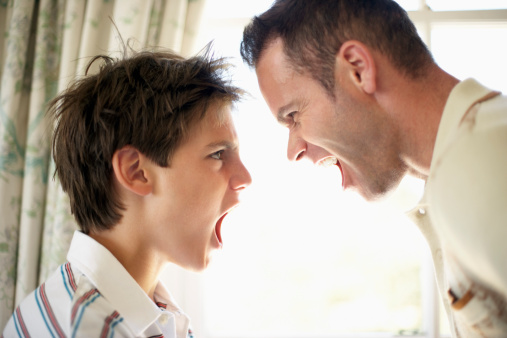 Shouting, yelling, screaming. Nearly all parents have done it; nearly all children age 10 and under have heard it. In small doses, such as in emergencies, yelling is not believed to be harmful. Yet, as common as this interaction is within families, if it happens too often it can break down positive conflict-management skills and flood a family’s emotional field with negative affect.
Why Do We Yell?
The most basic reason we yell in any situation is because, on some level, we feel we are not being heard. Whether literally—the person is in another room, for example—or figuratively, not feeling heard is an incredibly frustrating experience. When we believe we have a valid point and are being intentionally ignored, misheard, or invalidated, inside our brains we are thinking, “They must not really be hearing me. I will speak louder. That should do the trick!â€
Yelling also stems from a need for control. Yelling is a form of verbal aggression; it carries the message that the yeller desires to be the loudest and most dominant person in the room. If someone is yelling, it is a good bet that the yeller is feeling out of control and is feeling the need to dominate the interaction.
[fat_widget_right]
Parents often experience frustrating and even oppositional behaviors from young children. Depending on your child’s age, he or she may be focusing on developmental tasks ranging from establishing a sense of independence to experimenting with rebellion. The act of not listening to you can actually be part of your child’s necessary development.
At various times of the day or week, parents’ reserves of patience and energy can already be low. For example, a full-time parent may feel that he or she can barely make it to nap time with sanity intact. A pre-nap meltdown from their toddler hits them at their absolute lowest point of the day. A working parent’s morning can be so tightly orchestrated that just the slightest alteration in routine can cause a cascade of setbacks and tardiness. Throw in an early meeting and some traffic, and there is a perfect storm of frustration which can come lashing out toward a child. Parents can reach a saturation point at which their own coping skills are no longer carrying them through a particular interaction. At these points, parents often resort to yelling in an attempt to regain a sense of validation or control.
What’s the Case against Yelling in Families?
Yelling raises blood pressure, heart rates, and adrenaline levels. Those who yell exhibit higher levels of the stress hormone cortisol in their bloodstreams over time. These physical consequences are also seen in those who are yelled at. Like second-hand smoke, second-hand anger can take a big toll on health.
That’s a case against yelling in general, but in families with children age 10 and under, there are several other reasons that yelling isn’t healthy.
Children look to their parents to maintain the safety—physical and emotional—of the family. Babies and very young children do not yet have the ability to determine the difference between a real threat to their safety and an upsetting or frustrating circumstance. Many parents can attest to this, hurrying to the scene after having heard their toddler scream as if hurt, only to discover the source of the scream was a minor frustration such as not being able to reach a toy. The child’s cognitions in this stage are quite concrete; circumstances are either “all good†or “all bad†and there is little room for ambiguity. Children under age 5 can therefore mistake a parent’s loud tone with an alert to a true threat. This can be terrifying for a child in this developmental stage.
Fear is one of the most basic and universal emotions—every animal experiences it. Fear is centered on a primitive part of our brain called the amygdala. When fear permeates a young child’s emotional experience, such as in a household with daily episodes of yelling, the amygdala will become overly active and this will inhibit the child’s brain from working on higher-level functions such as concentration, reflection, learning, decision making, and behavior planning.
With older children who are more verbal, the words that are shouted can be even more harmful than the tone itself. Even though yelling is an attempt to gain control through aggression, the irony is that in doing so, we actually lose control of our behavior and our ability to filter and manage what we are expressing. Negative labeling, blaming, and other harsh words are especially harmful to children because children accept unconditionally that what their parents say is true. Children between approximately ages 5 and 10 have the cognitive ability to understand the words themselves, but not the adult’s emotional context. They will internalize the messages from the parent without questioning if they are accurate, and will add those messages to their budding self-concept.
[fat_widget_left]Finally, many parents who yell can relate to this scenario: “When I don’t yell, my child doesn’t listen to me. He or she only seems to respond (do what I want) when I yell.†The escalation involved in yelling can become a self-reinforcing feedback loop. Children can become desensitized over time to their parent’s escalation pattern. The child, who is interested mainly in persisting in play or attending to his or her own agenda, will naturally search for ways out of responding to a parent’s demands. We cannot fault the child for this; it is simply a piece of his or her development. The more parent-free space and time a growing child can carve out, the more he or she can explore the world around him/her and his/her own inner experience. The child learns that the parent will eventually escalate to yelling each time, and so the child learns that he or she does not need to respond until and unless yelling is used. The “pre-yelling†time becomes seen by the child as “don’t have to listen yet†time. And the parent, on the other side of this interaction, keeps needing to up the ante over time to get the same response.
How Do We Break the Yelling ‘Addiction’?
1. Set a SMART goal around yelling: a Specific, Measurable, Attainable, Relevant, and Time-bound goal that solidifies your commitment to changing this behavior. Such a goal may sound like this: “Within the next month, I will decrease my instances of yelling on weekday mornings until I’m yelling once per week or less during that time period.†Write down your goal and put it in a place you will see it every day.
2. Find ways to increase true power, so that false control is less tempting. Yelling is false control. It feels powerful in the moment, but it undermines our internal self-control and the quality of our relationships over time. Ways to gain true power include:
- rearranging your schedule to relieve some of the pressure on certain times of the day or week that you tend to yell
- asking for help and delegating tasks to decrease your overall stress
- planning ahead for triggering moments, such as taking a distracting toy to the grocery store, or laying out your child’s school clothes the night before
- taking advantage of calm times to focus on strengthening a positive relationship with your children which will serve to buffer any episodes of yelling
3. Assume responsibility for the outcome of each interaction. You are the parent. You set the stage for the relationship between you and your child. If your child escalates, this does not mean you must escalate. If the situation escalates, this does not mean you must escalate. No matter how bad the traffic, how frustrating the missing shoe, how grating the whining, or how sassy the defiance—in the end, you always have a choice.
4. Speaking of choices, realize that yelling is only one of hundreds of things you can choose to do in a frustrating moment. Instead of yelling, you could:
- whisper
- sing
- dance a jig
- say a little prayer
- close your eyes and count to 268
- take a lap around the house
- splash your face with water
- go outside and yell at the snowman or rosebush in your yard instead
Some parents choose a grounding object, color, or mantra which they use to bring their attention away from their momentary anger and refocus it on their goal.
5. Return often to a developmental lens through which to view your children. At all times, children must be expected to behave as children. They cannot and do not think, process, or behave as you do. It is entirely predictable that children will lose things, drag their feet, misunderstand you, ignore you, and throw tantrums at inopportune times. The more you can remind yourself that this is developmentally normal, the less you will feel personally offended or annoyed by childish behavior.
6. When—not if—you do yell, be prepared to acknowledge and apologize for this to your children. Parents must be willing to role-model to children the process of owning up to poor choices and the effects they can have on others. If as parents we are not willing to do so, how can we expect the same from our children?
Breaking ingrained patterns of interaction like yelling is not an easy thing to do. Parents must take full responsibility for “being the change they want to see†in their families. Parents must make their tendencies and triggers conscious, face them honestly, and focus their attention on them if they wish to change. Keeping a written goal, a list of alternatives, and a developmental perspective will be of great help to the parent who wishes to reduce yelling. Over time, parents who make these efforts will be able to enjoy a great deal more peace in their family, a reduction in stressful feelings, and an increase in the amount of true power they are able to exert over their lives and actions.
 “I hate you!â€
“You’re the worst parent who ever existed!â€
“I can’t wait to move out!â€
If you have recently heard these words (usually screamed at full volume, followed by the loud slamming of a bedroom door), you may be the parent of a teenager.
Only those of us with halos and wings are consistently able to respond to such statements with perfect compassion and sweetness: “I love you, honey, and I’ll be right here for you whenever you need me!†Parents are human beings, and as such we have a limited set of emotional reserves and resources, which can quickly become taxed by a raging or withdrawn teen.
[fat_widget_right]
In fact, although you love your child as much as ever, you may be struggling with feelings of intense hurt, anger, dislike, distrust, grief, anxiety, and loneliness. You may feel that although you love your teenager, you just don’t like him or her very much right now. It may feel at times that your teenager has his or her finger on every one of your buttons, and is pushing them … all at once!
What can you do when the very child you love and worry over appears to hate and reject you as a parent?
Teens are known for their emotional volatility. Unfortunately, when parents become as overwhelmed by negative emotions as their teens are, they are no longer in a strong position to be stable, loving, or helpful to the teen. In fact, the parents’ hurt and anger can easily add fuel to the fire and bring about a downward spiral that both parents and teens feel helpless to stop.
To say teenagers value their friends and social life is an obvious understatement. However, to family members around that teenager, it can seem as if by “choosing†to value their friends, the teen is showing the family that they no longer matter. Indeed, as illustrated by the quotes above, the average teenager may even say as much in the midst of an angry, hormone-fueled argument.
The traditional task of adolescence is to move away from exclusive identification with family and to explore the greater world outside of the home. Separation of the child from the parents is absolutely necessary and healthy at this stage. However, that separation must be counterbalanced by the availability of the parent to continue to meet the adolescent’s needs. Therefore, this is an extremely frustrating time for many parents. They feel as if the teen is pushing the parent away, only to pull the parent back whenever he or she “wants something from me.â€
In order for the adolescent to explore the larger world in a healthy way, the home and family must be a sort of “home base.†This means the teenager needs to experience his or her family as stable, its identity as stable, its love and acceptance as unconditional, and its boundaries as safe and secure.
Understand that by focusing on his or her peers, your teenager is not rejecting you. Instead, the teenager is simply transitioning through an intense period of changes. The teen needs the family life to remain solid and secure, so that he or she can return to it for comfort and healing when the peer world becomes too intense or overwhelming.
Teenagers may often resemble adults physically, but socially as well as cognitively, they still resemble children much more than adults. We now know that the human brain does not fully mature until the mid- to late twenties. Executive functions such as prioritizing, consequential thinking, and evaluating options are still coming online. Furthermore, teenagers do not have the life experience, confidence, or savvy to navigate the complicated demands of life as adults do.
Because of these factors, it can be useful for parents to see past the bravado and the occasional glimpses of maturity that their adolescent displays; to understand that, inside, there still exists the child who has needs he or she does not have words to express, who cannot meet those needs independently of the parent.
The family itself is also moving through a transition period. They must move into a new life stage, with new roles for each family member. It can be difficult to feel entirely ready for these changes. Many parents of teenagers experience this time as a loss: the loss of the innocent and impressionable child they once knew and enjoyed; the loss of the role of all-knowing nurturer and protector.
Parents often report that they feel that “time is running out.†When your 5-year-old threw a temper tantrum, you knew as a parent that you still had “endless†years in which to heal relationships and correct behavior. When your child is 15, you understand that the years are not endless and that damage done to the relationship now may persist into your child’s adulthood.
Because the family is a “safe launching pad†for their forays into the larger world, teenagers move into and out of their family, and not always on the parents’ timeline. Your teen may refuse to join you for dinner, hiding out in his or her room; he or she may seem to eat, sleep, and shower with iPod headphones on. He or she may argue endlessly over attending important family functions such as weddings or funerals. And, just when you think the teen has disowned the family forever, there he or she is, curling up next to you to watch a movie or opening up from the passenger seat on a long drive.
Recognize your teenager’s attempts to reach out to you for what they are: The teen is looking for reassurance from you that he or she is still a part of the family; he or she wants to know that no matter what he or she screamed at you last week, you still love him or her. The teen needs to feel certain that if the “real world†becomes too scary, he or she still has a safe place to return. In order to practice being an adult, your teen needs to periodically return to being a child—and this will happen when you least expect.
Nobody said being the parent of a teenager is always easy, fun, or fair. As the adult in the relationship, it is you who holds the responsibility. It is you whose role, although different, is still most important in these last years of your child’s development. It is you who must keep the gates of the family open for your teen when he or she needs to reenter them.
Once you can view your teen’s behavior from this developmental context, you can depersonalize it. It is no longer about your teen’s rejection or manipulation; it’s an understandable and necessary stage in his or her journey to reaching his or her own, full potential as a young adult. It becomes easier and more natural to meet the ebbs and flows of your teen’s changing needs. Even when, sometimes, the need is for separation from the parent.
 Last month, we talked about how figuring out why someone is doing something is key to changing his or her behaviors. We learned that most behaviors are motivated by getting something, getting away from or stopping something, feeling good, or are simply automatic (a reflex, for example).
In order to change behaviors, we must learn about reinforcement, not merely the functions of the behaviors.
Case Example
Imagine this scene, one that is played out in countless grocery stores every day around the world. Picture, if you will, a harried mother trying to get the shopping for the house completed. She is tired and in a rush to get home. With her is her young son. In the checkout line, as Mom tries to load the groceries on the little conveyor belt, her child asks for a candy bar (located conveniently an arm’s reach away, at child eye level). Mom, being a kind and benevolent mom, says, “No, we’re going home and having dinner. You don’t need a candy bar right now.†Her son, being like most children of his age, doesn’t like this state of affairs. In response to the denial of sucrose refreshment, he starts wailing at the top of his lungs, “PLEEAAAASEE! I WANNA CANDY! I WANNA CANDY! I WANNA CANDY!â€
Other store patrons stare at the impending debacle. Mom feels embarrassed and more than a little ticked off. She still has to get the groceries home, get them unpacked, and make dinner. Dealing with a tantrum is the last thing she wants to do. At first she tries to calmly explain to her child that dinner will be soon, but the child screams louder. Then she commands him to cease his tantrum. That works about as well as can be expected (not at all). Finally, Mom gives in and buys her little angel the candy bar, at which point he immediately ceases his caterwauling.
Can you name all the reinforcement that occurred in the above example? What do you think will happen next time Mom brings her son to the grocery store?
What Is Reinforcement?
The technical definition of reinforcement is anything that occurs after a behavior that increases the chances of that behavior occurring again. Simply put, when your child does something (a behavior) and you do something immediately afterward, if your child repeats the behavior, whatever you did was a reinforcer.
This idea is key to behavior change. We want to provide rich and powerful reinforcement for the behaviors we wish to see (start behaviors) and avoid reinforcement for the behaviors we do not wish to see (stop behaviors). This interaction is at the heart of everything we wish to accomplish.
Important points:
- Reinforcement occurs only if you see the behavior again. You might feel you are rewarding your child, but if the reward does not result in increased frequency, intensity, or other improvement in the behavior, then the reward is not reinforcing.
- Reinforcement can be anything. It doesn’t have to be pleasant, either. For example, a person who likes fighting might enjoy when he is in a fight and find getting hit or yelled at reinforcing.
- Reinforcement always increases behaviors. Anything that decreases the chances of seeing a behavior is called a punisher.
The bottom line? Reward your kids when they do what you want them to do and they will do those things more. If you simultaneously remove the rewards from the behaviors you want to see less of, you will see less of those behaviors.
Isn’t this just bribery, you may ask? Nope. There are some key differences between bribery and reinforcement. Bribery is typically something (often money) given to someone in advance of behavior. It is generally given to get a person to do something unethical or illegal. Reinforcement always occurs after a behavior, and we are not using it to get our children to do anything unethical or illegal (hopefully!).
You might also ask: Why should I be rewarding my kid for doing what he is supposed to do? Shouldn’t he just do it? In a perfect world, yes, your child would do what he or she is supposed to do. However, in the real world, children are compelled by the “drive-your-parents-nuts accord†to not always follow directions. If we, as parents, want to keep our sanity, it behooves us to use all the tools at our disposal to encourage and reward our children, and ultimately to teach them what to do and when to do it.
Types of Reinforcement
- Positive: This is the most common type. It is something that is added to the situation (money, candy, praise). Basically, if you give your child something because he did something good, that’s positive reinforcement. In the case example, the mother positively reinforced her child’s checkout-line tantrum behavior by buying him the candy.
- Negative: This not punishment. (That decreases behaviors.) It is the removal of something. In the case example, the child negatively reinforced his mother’s candy-buying behavior by ceasing his tantrum when she gave in and bought it.
Classes of Reinforcers
- Primary: These are typically those things that all people need—food, air, companionship, etc.—and are often tied to basic survival. These are good because almost everybody will respond to them. However, they suffer from the “too-much-of-a-good-thing†effect, also known as satiety. When you’ve had enough of something, it loses its reinforcing qualities.
- Secondary: These are learned reinforcers. Typically paired in some way with primary reinforcement, these can be anything. Money is perhaps one of the most prevalent secondary reinforcers in the world. It always amazes me what people will do for colored bits of paper.
Putting This Information to Use
Follow these simple steps:
- Ask yourself: Is this a start behavior or a stop behavior? (Do you want to see this more or less?)
- Ask yourself: What is the function of the behavior?
- For stop behaviors, the answer to question No. 3 will tell you what you need to decrease or eliminate from the situation to make the behavior go away. Do that.
- For start behaviors, the answer to question No. 3 will tell you what you need to do to get the person to do the behavior more (or better).
As with all things simple, there is a lot more to look at, but it ultimately comes down to these four points. (We will discuss more about reinforcement and how to set it up and deliver it in future articles.)
What’s the Best Reinforcer?
The best reinforcer is the one that works in a given situation. However, my preference is praise. I will cover praise in more detail in a future article, but here is why I like it as a reinforcer: Just about everybody responds to praise. The more you praise someone, the more he or she likes you. The more he or she likes you, the more he or she will respond to you. Praise is free. It takes up no space. People rarely get tired of it. It pairs well with every other kind of reinforcer (thus making the praise and the other reinforcer more effective). In your experiments with reinforcement, try adding a little praise to your efforts and see how it enhances things.
I hope this information helps make your day-to-day challenges less challenging. Please comment below, ask questions, or make suggestions. Let me know about creative ways you have found to reinforce your children (or anyone else, for that matter). Hang in there, parents!
What was once considered a rarity—step-siblings, step-parents, and step-in-laws—has become more common than not. When couples marry, there is a very good chance that one of them brings an extended family that branches by halves and steps. And if that couple winds up divorcing, the tree splinters even further. Because there is no biological bond that obligates a step-family member to stay in contact with other steps, the rules of engagement can be confusing and tense. In a recent article, marriage experts explain how to navigate the rocky road of step-relationships after divorce.
Take, for example, the case of an ex-wife who spent decades raising her step-children. Should she continue the relationship with these nonbiological children, even though she has no legal claim to them? Mary T. Kelly, a marriage therapist from Colorado, notes that often step-children can be a contributing factor to divorce. Many blended-family parents disagree over how to raise his, hers, and their children. Tension that exists between step-children and step-parents seems like normal childhood rebellion, but in many cases may actually run deeper.
Paul Hokemeyer, a New York therapist, says couples and children need to determine if they want those relationships to continue after divorce. Many children may not be permitted to make contact with their ex-step-parents while they are minors, but can make the choice whether to have a relationship with that significant person when they reach adulthood. Even step-grandparents get caught in the mix when step-families divorce. Grandparents who become attached to step-grandchildren, only to have them taken away, may not be willing to invest as much into future step-family members.
One Massachusetts psychologist, Patricia Papemow, recommends that clients try to initiate contact through letters rather than personal visits or phone calls. It is important for step-children to be allowed to have time to process the shift in the relationship on their own terms. Letting them know a step-parent is there through cards and letters is a noninvasive and subtle way to continue contact and keep the door open for future communication. Regardless of how an individual chooses to stay in contact with their step-children, Hokemeyer insists that they review their motives so that all parties will be receptive. “Make sure that you are acting out of genuine love and concern for the other person, and not out of anger and attempts to manipulate,†Hokemeyer says. Following these tips could help step-exes maintain important family ties in a world of ever-changing family dynamics.
Reference:
Gootman, Elissa. When branches tangle in a stepfamily tree. (n.d.): n. pag. The New York Times. 3 Oct. 2012. Web. 8 Oct. 2012. http://www.nytimes.com/2012/10/04/fashion/-step-family-trees-with-tangled-branches.html?pagewanted=all&_r=0

A client recently described how thrilling it was to take her daughter to see the Broadway musical Annie. She recalled that her mother took her to see it when she was a child, and it had been an indelibly wonderful experience. Now she had the pleasure of providing the same thrill for her daughter. I thought how special it was for my client to share this with her daughter and how lucky my client was that her daughter had the same feelings about the experience. It also reminded me that so many parents who want to provide what they believe to be all the right things for their children are not always met with such good feelings.
I recalled another client whose desire to recreate his delight for his son was dashed when he took him to the rodeo and was met with the response, “This is stupid.†In spite of their most nurturing and positive intentions, parents may find that their wishes and rules for their children are met with rejection. This can create painful feelings, including insult, hurt, anger, and disappointment. “Drew,†a 42-year-old client, was in a prolonged struggle with his 8-year-old daughter about piano lessons she adamantly refused to take. He told me, “When I was a kid, I refused to continue piano lessons after a few months. My parents never insisted I continue. I’m not going to let that happen to my daughter. She isn’t old enough to know what she wants or what the consequences of her actions will be.â€
As Drew and I explored his feelings, it became clear that he not only felt disappointed, he felt rejected by his daughter. “It feels like she is telling me, ‘Get out of here, you don’t know what’s good for me,’ †he said. I responded: “I can see how upset you are about this, but I wonder what it is that makes you feel so personally rejected. Is it possible that your daughter is different from you?†Drew’s first response was, “She’s my daughter and she is like me. I just know this is very important for her to do. When I was a child, I didn’t know I was making a terrible mistake. My parents should have known and pushed me to continue.â€
It took a lot of talking for Drew to become aware of his many disappointments about the ways his parents had been involved in his life when he was a child. He began to consider that he might not need to protect his daughter from this disappointment. He recognized that his daughter might, like him, regret not learning the piano, but forcing her to take lessons could easily turn her away from the piano. He realized that her experience and development was and will be different from his and she is a different person with her own thoughts and feelings. After all, she has different parents than he did. The more Drew could understand his daughter’s need to differentiate from him, the easier it was not to feel so rejected and hurt.
When parents assert their desires for their children, it is not unusual for them to be met with expressions of different or opposing wants and needs. Pushing back against what parents want is a necessary part of a child’s development. For a healthy sense of self to grow, children need to differentiate from their parents and become unique, separate, individual selves. This doesn’t mean children are totally different from or always in opposition to their parents. It does mean children need to develop minds of their own. Having one’s own mind is about being able to think about your needs and wants without being overly influenced by others. Ideally, the wishes of others are considered, but ultimately one makes his or her own life choices. Obviously, the degree of autonomy for a 4-year-old differs from that of a 13-year-old and again for a 20-year-old. When children are not given the space to differentiate from their parents and don’t develop a self that is confident and strong, they will not have developed the autonomy to make life choices and get what they want as they enter full adulthood.
At age 53, “Anne†was struggling with her teenage son, “Noah.†She came to therapy expressing feelings of anger and insult from their encounters. She explained that he fought her at every turn about anything she asked of him: cleaning his room, doing household chores, getting his college applications completed. “I don’t believe how he treats me,†she said. “He says things like, ‘Leave me alone and mind your own business.’ Is that any way to speak to your mother? I feel so hurt and insulted. Doesn’t he know I only want what’s best for him?†In great distress, Anne added, “He has become a terrible person. He is so mean and inconsiderate. He seems like a completely different person than the son I felt loved me a year ago.â€
As we talked, Anne described how when she was growing up she never went against her parents. When we explored her past and present relationships, Anne began to wonder if her early experiences being compliant are related to her difficulty asserting herself as an adult. She described how difficult it is for her to disagree with her husband and how she doesn’t always feel so good about herself. She realized that it wasn’t just with her son that she felt so badly treated. “I guess I don’t feel very powerful,†she said. “I have a lot of trouble believing that what I think and feel is OK. I always followed the rules with my parents. Maybe I didn’t develop what Noah needs to do—be someone who feels OK asserting himself when there is opposition.†Many parents with teenagers experience difficult feelings in their parent-teenager relationships. For Anne, the feelings of insult and rejection were intolerable. Even worse for her was the terrible shame she felt about her negative feelings toward her son: “I’m the terrible person. Mothers shouldn’t feel this way.â€
How to handle this kind of situation with teenagers is controversial. Furthermore, how any parent hears what a child says is open to interpretation and may be related to how the parent differentiated from his or her own parents. While Anne felt insulted and hurt, another parent in these circumstances might shrug and think, “When will these awful teenage years pass?†On one end of the continuum of parental response, parents might believe that a child of any age should never be permitted to say anything that is hurtful, disrespectful, or angry to a parent. At the other end of the response continuum, parents might accept any expression their child makes without intervening. An extreme example might be if a teenager said, “You’re an awful parent, you have no business having children,†and a parent made no protest about being treated that way. On this far end of the continuum, the lack of a parental response to push against doesn’t provide the child with the feeling that there is a strong parental self to separate from. If there is no other out there to individuate from, it becomes difficult for a child to develop a sense of who he or she is and the ability to be autonomous. The child is left wondering, “Who am I?†Potentially more problematic, the child may be left with a feeling of powerlessness. He or she has not been given the experience of successfully asserting his or her developing self in the world.
There is a lot of room along this continuum for parents to develop responses that feel comfortable to them while allowing some room for their children to develop their unique selves. It helps if parents let their children know what behaviors are acceptable. For instance, telling a child, “You can’t talk to me that way†is not the same as saying, “You can’t be angry at me,†or “You are hurting my feelings.â€
When children respond to parents in disappointing or unacceptable ways, it is important that parents stop and consider how they will meet that response. Each situation requires thought. Sometimes, interfering with the child’s wishes or experiences provides an opportunity for the child to push back against the parent and feel a sense of his or her developing self. At other times, supporting the child’s differentiation provides the child with a sense of confidence and recognition of his or her developing self. No matter the age of the child, parents who are curious and interested in why there is disparity or opposition are communicating their openness to more than one way of behaving and/or feeling. This openness to difference helps children develop into self-confident, autonomous adults. Moreover, parents are less likely to repeat the dynamics of their own childhoods if they consider their children’s behavior from a developmental perspective. They will be in a better position to not take things so personally and will feel less hurt, insulted, or disrespected by their children.
 I am guilty of spanking my children. My oldest has been spanked once, maybe twice, in his entire 17 years. My 7-year-old has received a few prime swats, and other forms of discipline, in her short lifetime. My middle child, a 14-year-old boy, is much more intimately familiar with spankings. As an extremely hyperactive and unruly child, my son was constantly exploring things that were off limits and often dangerous. Undeterred by the threats of toy removal, time-outs, and other nonphysical forms of punishment, he pushed me to my limits and I resorted to the only other method I knew: spanking. At the tender age of 5, he was quite adept at “assuming the position.†He no longer covered his back end with his tiny hands, and as much as it drove me crazy, he developed a stoic resistance and would receive his spanking without so much as a tear.
Was this child abuse? Or was it merely discipline? According to the statutes of my state, Florida, I have not committed child abuse because I did not significantly impair my children’s physical, mental, or emotional health. But if I look at an exception in the same statute, it is not so clear. It reads: “Corporal discipline of a child by a parent does not in itself constitute abuse when it does not result in harm to the child.†So even though I subjected my child—actually, all three of my children—to corporal punishment at one time or another, it is considered abuse only if I harmed them.
[fat_widget_right]
But doesn’t a spanking cause emotional injury? Doesn’t bending over and getting smacked, pretty firmly, on the bottom cause physical pain? Doesn’t this type of action potentially result in a traumatic event for a child who has never been struck by a parent? Did I cause harm?
I don’t know where discipline ends and abuse begins. I know that I was spanked as a child. I know that sometimes I learned the lesson and sometimes I didn’t. But I also know that when I was young, the thought of calling the police and reporting my parents as abusers never even entered my mind, no matter how sore my butt was.
Times changed as I grew up. Cable news outlets expanded, divorces were on the rise, and the stories of children being abused, and others claiming abuse to malign a parent, exploded. As an adult, I became keenly aware of how lucky I was, never having been subjected to horrific physical or mental traumas. My eyes were opened to the fact that what I saw as a form of discipline could be interpreted by some as abuse. I was also very cognizant of the fact that had my parents delivered the punishment out of anger, they could have easily crossed that fine line.
I don’t know where discipline ends and abuse begins. I know that I was spanked as a child. I know that sometimes I learned the lesson and sometimes I didn’t. But I also know that when I was young, the thought of calling the police and reporting my parents as abusers never even entered my mind, no matter how sore my butt was.
I heard members of the media discussing this very topic. They agreed that spanking is an acceptable form of discipline, if done appropriately. They stated that if the punishment is delivered out of anger, as an outlet for frustration and rage, then it is abuse. It is only when the punishment is administered out of love, and with the intention of teaching a child what is right, that it constitutes as discipline and not abuse. But doesn’t the mother who brushes her child’s teeth with steel wool say she does it only to teach her child the importance of dental hygiene? Doesn’t the father who forces his toddler to wear a dirty diaper for two days do so only to help the child become potty-trained?
Children have been spanked for generations. And yes, they have been given alcohol, medicine, and even hot sauce. A relative of mine got hot sauce on her thumb to help her quit sucking it. She ended up crying so hard after she tasted the hot sauce that she rubbed her eyes with the same thumb. The result? Very irritated eyes. But she didn’t lose her eyesight, didn’t call the police, and didn’t suck her thumb again.
I am an extremely fortunate person. I was not abused as a child. I was punished, had pickle juice put on my thumb, was sent to bed with no supper, and was spanked. But I was never beaten. I was never psychologically tortured. I was never burned, locked in a closet, or left hungry for days. And I never, ever had any potentially harmful liquid forced down my throat or got thrown into an ice-cold shower. I could not imagine doing this to any of my children, not matter the circumstances. But mothers, fathers, stepparents, foster parents, and other so-called “guardians†do these things every day to hundreds of thousands of children. And I’d bet that if you asked any one of them why, they would all say the same thing: they did it to teach a lesson; they did it to discipline; they did it out of love.
I’m really glad my parents didn’t love me that much.
 Temper tantrums can be very frustrating to deal with. All children have a temper tantrum at one point in time or another. They can happen in the home, school, in grocery stores, although they may not necessarily happen when the child is at another person’s house.
Temper tantrums are a child’s way of expressing anger and frustration at not getting what he or she desires, when there is difficulty expressing feelings, or when he or she know that the tantrum will result in getting what he or she wants.
Parents can be easily frustrated because the tantrums are not always easily dealt with, especially when the tantrum happens in the grocery store. That seems to be more like the child egging on the parents to actually follow through with what the parents say they will do.
Are tantrums a test from the child to the parent? It could be. When a parent is telling a child that he or she can’t do something if he or she has a tantrum, a child will definitely test that theory. When the tantrums happen, the child is looking at the parent to see if the parent is going to follow through with what is said. When the tantrum is “successful” and the parent gives in, then the child knows that tantrums result in getting his or her way.
When the tantrum is not successful the parents don’t give in, they follow through with what was said and the child learns that the tantrum is not the way to deal with things. That’s a hard thing, mostly for the parent. The child can whine, scream, yell and go on for what seems like hours. At the point that the child continues with the tantrum behavior and does not appear to give up, is when the parent tends to give in which only reinforces that the tantrum is the way to go.
Helpful hints:
- Don’t give in. When the tantrum is not given the attention that is needed to work, the tantrum will fade. As a parent, you will still want to observe your child so they don’t get hurt, or hurt others from their tantrum, but still do not give in.
- Stay calm. It is difficult to stay calm when a child is having a tantrum but you are the parent, the adult, and still know what’s best for your child. If you have your spouse around, and you are getting frustrated, then do a “tag out†but still both parents stay calm.
- Speak calmly to your child: that helps to keep you in control of the situation. The child could get louder, but speaking calmly can help shorten the behavior. You can say that when the tantrum is done, then we can talk about the situation.
- Let your child know what is expected of him or her when they go into the grocery store or other place or activity. You can also let them know that if there is a tantrum then they will not be able to do something later. This is where the follow through needs to happen, so when you say this, make sure the action can be followed through.
- Validate feelings. When the tantrum is done, tell your child that you knew he was able to regain control.
- When a child does not have a tantrum where her or she normally would, provide praise for that. That will help increase improved behavior and her own confidence that she does not need to have a tantrum and will be alright when she doesn’t have one.

Cutting is the physical expression of hidden mental pain. Children may begin cutting or engaging in other forms of self-harm when their mental pain reaches a level that they can no longer deal with. While some children may find positive ways of coping with such pain, others seek negative coping methods including self-harm or drug use. Mental pain can be the result of built-up stress, past traumatic events, hurt feelings, rejection by peers, abandonment by significant others, or other life stressors.
Is My Child Just Trying to Get Attention?
If your child cuts in places that you can see and does not try to hide their wounds, then it is likely that, consciously or subconsciously, they are trying to let you know they are in pain. If they cut, or threaten to cut, in front of you, then they are likely crying for help. If your child has been hiding their cuts for a long period of time and has not told anyone about it, then they are likely trying to deal with their pain privately and are not seeking attention.
[fat_widget_right]
Why Do Children Cut?
This behavior, while it may appear to have no benefit, may actually provide several means to cope. I know what you are thinking: cutting hurts, right? Not for the cutter; for them, it actually releases pain. It allows the person who cuts to express how they are feeling on the inside by letting it outside. The chemical reactions that go on when people cut themselves make the behavior addictive. Once the person who cuts is used to dealing with pain in this way, it is hard for them to choose alternative coping methods. When a child who cuts becomes upset, they may go to the behavior as automatically as a person with alcoholism would turn to drinking to deal with a stressful day.
What Not to Do
It is important not to label self-harming behavior as “bad” or tell your child that they are doing something “wrong.” This kind of reaction will only make the child feel ashamed and desire to cut more to get rid of those negative feelings. Telling your child, “Just stop it,†is just as ineffective. Tell your child that you understand they are going through some difficult things, and that you want to find a way to help them.
Getting Help
Often when we ask teens, “What’s wrong?†they will invariably respond, “Nothing.†Many teens have a hard time opening up, especially to their parents. This is partially because it’s just not “cool,†or because they have a hard time bringing up certain topics our of fear that they will be misunderstood or get in trouble. It is important that they have someone who they are comfortable talking to, whether it is a family member, a friend, or a therapist. When looking for a therapist, it is important to find one whom your child will feel comfortable with so that your child can learn to release their pain in a healthy way.
Resources for Parents and Children
- GoodTherapy.org’s What To Do If You Are In Crisis
- Hollander, Micheal. (2008). Helping teens who cut: Understanding and ending self-injury. New York, NY: The Guilford Press.
- S.A.F.E. Alternatives/Self-Abuse Finally Ends (www.selfinjury.com or 1-800-DONT-CUT)