Research shows that men are far less likely to seek therapy than women when confronted with anxiety, depression, anger or other psychological problems. Although this clearly suggests that many men are being undertreated for significant mental health issues, this dynamic also affects the field of research. C. Edward Watkins, Jr. Ph.D., of the University of North Texas, recently asked an essential question, “How many men have actually been involved in short-term and long-term psychodynamic treatment research?†Watkins looked at 86 separate studies from six reviews over the last ten years to find an answer. “Those six reviews/meta-analyses were selected for scrutiny because they covered a broad spectrum of disorders (mental and physical), have received considerable attention in the medical, psychiatric, and psychological literature, and have appeared in what are well-respected, peer-reviewed medical, psychiatric, or psychoanalytic journals,†said Watkins.
Watkins realized that overall women were represented more than men in clinical studies, 60% versus 40%. Additionally, Watkins noticed that a large portion of the studies that did have male subjects tended to focus on addiction issues, leaving many other psychological treatment studies void of male data. Overall, he found that 11% of the studies had no male participants at all, and 23% of the studies only contained data from six males or less. “We clearly see here both positives and negatives to our picture,†said Watkins. “Male research participants tend to be more difï¬cult to secure than females in psychological research generally; that appears to be no less so for both short-term and long-term psychodynamic treatment research. In our efforts to amass the most complete, fully informed, and ever-informative female and male psychodynamic treatment database upon which to draw, that may well be an enduring problem with which we as researchers will have to continue to struggle and work to creatively address in the decades ahead.â€
Reference:
Watkins, C. E., Jr. (2011, August 29). THE STUDY OF MEN IN SHORT-TERM AND LONG-TERM PSYCHODYNAMIC PSYCHOTHERAPY: A Brief Research Note. Psychoanalytic Psychology. Advance online publication. doi: 10.1037/a0025183
Most individuals who attempt suicide unsuccessfully will only do so once and make that decision within the hour preceding the attempt. “To kill oneself, one must have the means for doing so,†said researchers from the University of Texas Health Science Center at San Antonio and the University of Utah. “It is because of this very simple and undisputable fact that means restriction is often recommended as a risk management strategy.†Means restriction involves limiting access to items that could cause self-harm. Means restriction counseling, which differs significantly from means restriction, is a process by which a therapist educates the suicidal individual and their family members about the hazards of having access to harmful items and encourages limiting availability to them.
The researchers believe that physical means restriction, specifically as it relates to firearms, the leading method of suicide, is critical and has been proven to be effective. They said, “One particularly well-known example is the District of Columbia’s Firearms Control Regulations Act, which was associated with a 38% decrease in firearm suicide rates in the District of Columbia and a total suicide rate decrease of 22%, with no effect on neighboring counties unaffected by the law.â€
Despite these facts, less than one quarter of clinicians in emergency settings offer means restriction counseling. The researchers believe this is due in part to the fact that many clinicians misinterpret the suicide attempt as an effort to kill oneself rather than an effort to decrease psychological pain. “It is therefore recommended that clinicians present means restriction as a method for maximizing environmental safety to accomplish the shared goal of pain remediation,†said the team. To avoid conflict with the client, the researchers recommend utilizing a “Means Receipt†which provides a plan for limiting the client’s access to lethal means, commitment of a supportive ally to ensure the plan is enacted, and the conditions which must be met in order to lift those restrictions.
Reference:
Bryan, C. J., Stone, S. L., & Rudd, M. D. (2011, August 29). A Practical, Evidence-Based Approach for Means-Restriction Counseling With Suicidal Patients. Professional Psychology: Research and Practice. Advance online publication. doi: 10.1037/a0025051
Personality influences nearly every area of an individual’s life. From relationship satisfaction, career stability and even mortality, the five leading personality traits, known as the Big Five, agreeableness, openness, extraversion, conscientiousness and neuroticism, have been shown to have a direct impact throughout. But a new study suggests that an individual’s personality also influences another important role. “Given the importance of personality for the ways in which people live and experience their lives, it is hardly surprising that personality has been proposed to be related to one of the most central, challenging, and affectively charged tasks that many adults are faced with: namely, parenting,†said  Amaranta D. de Haan, Maja Dekovic´, and Peter Prinzie of Utrecht University, who conducted a study to determine exactly how the personalities of parents and adolescents affect the parenting dynamic. They theorized that outgoing and social parents, high in extraversion, would most likely exhibit positive and highly motivating behaviors with their children, while introverted parents would act more withdrawn and unavailable. Additionally, the team noted that children with difficult temperament who are impulsive and distractible may elicit stricter discipline and negative reactions from their parents.
The researchers interviewed nearly 1500 individuals, including mothers, fathers and adolescents, and assessed their personalities using the Five-Factor Personality Inventory and the Hierarchical Personality Inventory for Children respectively. They looked specifically at warmth and overreactive discipline when they assessed them two years later. They found that overreactivity was influenced more by the personality of the parent rather than the adolescent. But the personality traits of both children and parents impacted the level of warmth. “Associations between parental personality and parenting were similarly related to parents of easy versus difficult adolescents, and for mothers and fathers parenting daughters or sons,†said the team. “Together, results show that parent characteristics as well as adolescent characteristics importantly affect dysfunctional and adaptive parenting.â€
Reference:
de Haan, A. D., Deković, M., & Prinzie, P. (2011, August 29). Longitudinal Impact of Parental and Adolescent Personality on Parenting. Journal of Personality and Social Psychology. Advance online publication. doi: 10.1037/a0025254
 “I’ve made up my mind,” Dana sighed deeply. “I’m going to stick it out–for the kids. I won’t cheat. I have no intention of that and I don’t believe he would either. We are two straight-arrow people. But there’s nothing there. We have nothing, absolutely nothing to say to each other. The marriage is basically dead; we just didn’t plan the funeral.”
“That is tragic. Marriage is supposed to be a friendship, not a zero,” I said. “How did this happen?”
Dana didn’t know. At first, she couldn’t put her finger on it; then she hesitantly said, “Maybe I withdraw when I get hopeless. Maybe that’s it.”
She explained how, in the early years, she would tell her husband many times what she wanted, needed, thought, or felt. And when nothing changed, she eventually gave up. “It just dried up like an autumn leaf,” she sighed again.
Dana’s situation is typical of many couples—and it needn’t be.
Here are six questions for Dana to consider:
1. Was there a time when she and her husband were able to talk?
Looking back at the early days, most people can remember that talking to one another was not a problem, that there were always things to say and lots to hear. If listening was once fun and talking felt like there was a real audience, then there is hope. If you once had a connection but lost it, then that connection can be found again. Instead of thinking about not getting her own needs met, perhaps Dana can start listening to what her husband is saying. If she can understand what he wants, then perhaps that can be a starting point for later requesting he listen to what she wants.
2. If there was a time when Dana and her husband could talk, then is there something she may have done to contribute to the current problem?
If indeed Dana and her husband enjoyed talking to each other, then honesty requires some soul searching. Perhaps if Dana looks inside, she will notice that things shut down when she started to ask for what she wanted but her husband was unable to do the same thing. Or maybe they both asked for what they wanted but each person was thinking more about their own unmet needs than fulfilling those of their partner. Alternatively, maybe each would have liked to fulfill the partner’s needs but lacked the tools to know how, or even to understand what the partner wanted. Bridge the gap with some good, strong questions. For example, ask your partner: “Do you know what I want in this marriage?†Or, better yet, ask: “Is there something I could do differently to improve things?â€
3. If Dana and her husband could not talk, did they feel close anyway?
There are people who were never good talkers, but they had great sex or lots of affection and that made them feel close. Just having shared life experiences can bring people close. And if that is the case, then maybe expecting to talk later on is not quite fair. If Dana knew that her partner was not a big talker going into the relationship, then now isn’t the time to say, “Oops, I made a mistake.” Perhaps Dana can consider how to re-capture the original affection. How about taking time to date? Dates that don’t call for talking but do call for interacting such as bowling, miniature golf, rowing, and rollerblading come to mind.
4. What do Dana and her husband both care about? Do they have values, passions in common?
Even if the relationship was never close, can this couple start from the ground up and build on commonalities? Dana mentions that neither one of them will cheat because they are both “straight arrows.” That’s a pretty important value in common. What goes along with that? How could they make that the basis for creating something good out of things that they never considered before?
5. Is there one quality in Dana’s husband that she admires or respects?
Good marriages are built on respect. So, even though Dana and her husband could not talk, it could be that there is something respect-worthy in Dana’s spouse, but she was so focused on not getting her needs met that she lost sight of that. Perhaps Dana could give some thought to what other people like in her husband so as to be able to view him with fresh eyes. How do the children view their dad? How about lifelong friends? Co-workers? Extended family? Neighbors?
6. Has Dana’s husband introduced her to something positive that she can appreciate?
Dana might ask herself if her husband gave her some “gift,” an interpersonal gift, not a tangible thing, that was special. For some people, it could be a sense of humor; for others, it could be the ability to stand up for oneself; for still others, it could be the ability to organize. It could be a silly thing or a heavy thing. Regardless, I’ve noticed that nearly everyone, no matter how annoying, distant, even mean, that they can be, has a gift to offer. It’s not something they even intend to give, but just by being whom they are, they demonstrate a good trait, a trait that their partners would love to have. So can Dana fish out from within her what it was that she “got” from her partner that she never had before?
In this list, you may be surprised that one question I did not ask was, “Do you love him?” That is because feelings change instantaneously. I was at a workshop recently where therapists were learning a new technique. They had to pretend to be one of their clients and express their clients’ feelings about some problem. It was fascinating how negative all the attendees in the room felt after that! And everyone was a therapist! When you get into a negative mood–even when you’re pretending—something bad sticks. Moods fluctuate depending on how the relationship is going at that time.
Love – or the absence of it — is the same way. We can think it’s gone, but that may only be a function of this disconnect you’re experiencing right now. Dana and her husband can work on the suggestions here; watch to see what improves, and then see if their attitudes don’t change, too. Maybe then the ships would consider dropping anchor, sending up flares, and finding out what’s going on.

How often do you want sex? And is that enough? But the majority of these women are heterosexual with male partners who are – you guessed it – complaining. So I guess I should say “relatively low levels of sexual desire!”
Over and over again I’ve found that moving in together does create a drop in the frequency of sexual activity for all couples regardless of gender. Long distance romance remains exciting because it provides space and distance interspersed with sexy weekend liaisons. But which is “normal” – the level of desire we experience early in a relationship or what unfolds later on?
Research consistently shows that low sexual desire affects 10-20% of women generally, with some studies finding that 40% of midlife women report low sexual desire. However, approximately 1 in 3 women experience low sexual desire at some point, making this one of the most common sexual concerns.
This is why couples therapist Esther Perel points out that “good intimacy doesn’t always guarantee good sex.” Her book Mating in Captivity explores the paradoxical union of domesticity and sexual desire, examining what it takes to sustain passion in long-term relationships. In it she points out that “the very elements that nurture love – reciprocity, mutuality, protection, closeness, emotional security, predictability – are sometimes the very things that stifle desire.”
So these guys start to feel like a brother or worse yet a child, and sex with family members is a definite no-no in our culture. Children and pets need caregiving, which we provide as an act of love.
Recent research on heteronormativity theory supports this observation, showing that unequal distribution of household labor places considerable burden on women, leading to feelings of inequity and exhaustion that ultimately diminish desire. The blurring of maternal and partnership roles, where women often find themselves mothering their partners, can lead to feelings of overwhelm and decreased desire.
Research conducted with married women who experienced desire decline found three core themes: institutionalization of the relationship, over-familiarity, and the de-sexualization of roles. For some women, formalizing their relationship through marriage made sex so available and sanctioned that it lost the forbidden and erotic quality that had formerly ignited passion. For others, overfamiliarity with their partner led to a decline in romance and sexual experimentation, as well as loss of motivation for self-care once they had “secured” their relationship.
A third group of women reported that holding down a job, being mom, and being a wife was overwhelming and “highly desexualizing,” making it extremely difficult to shift into romantic mode after changing diapers and fulfilling their professional roles. Many of the participants in all three groups specifically noted that while they were committed to their marriage, they thought desire would return if someone new came along who desired them.
As researchers now understand, women’s desire may be driven to the same extent as it is in men by novelty and excitement. The idea that female desire is simply about loving somebody has proven to be an oversimplification.
Over and above anyone else, we are our own point of reference for how sexy we are. Feeling good about ourselves emotionally and physically appears to be a bigger mediator of female desire than relationship factors alone. Research shows that sexual self-esteem, sexual desire, and sexual assertiveness all correlate positively with sexual function in women. This certainly bears out in my conversations with female clients.
Recently, for example, a woman told me that she no longer wanted to have sex “on top” of or astride her mate, “because my stomach sticks out and it would look terrible to him from that angle!” He shook his head, “Honey, I probably don’t even have my eyes open … that used to be your favorite position because it felt best to you … what else could possibly matter?”
*If you’re experiencing concerns about sexual desire, consider reaching out to one of our qualified therapists who specialize in sexual health and relationships.*
Gewirtz-Meydan, A., Sowan, W., Estlein, R., & Winstok, Z. (2024). Rights or obligations: The extent to which sexual desire and gender roles determine sexual intimacy in romantic relationships. Journal of Sex & Marital Therapy, 50(5), 482-497.
Johansen, E., Harkin, A., Keating, F., Sanchez, A., & Buzwell, S. (2023). Fairer sex: The role of relationship equity in female sexual desire. Journal of Sex Research, 60(4), 498-507.
O’Kane, K. M. K., Goldberg, S. Y., Bouchard, K. N., & Dawson, S. J. (2023). Debunking desire: Sexual science, social media, and strategy in the pursuit of knowledge dissemination. Archives of Sexual Behavior, 52(3), 1087-1099.
Peixoto, M. M., Amarelo-Pires, I., Pereira, H., & Nobre, P. (2023). Solitary and dyadic sexual desire and sexual satisfaction in women with and without sexual concerns. Journal of Sex & Marital Therapy, 49(1), 77-87.
Perel, E. (2006). Mating in captivity: Unlocking erotic intelligence. Harper.
Rowen, T. S., & Goldstein, A. T. (2024). Sexual desire and pharmacologic management. Obstetrics and Gynecology Clinics, 51(2), 259-271.
Sims, K. E., & Meana, M. (2010). Why did passion wane? A qualitative study of married women’s attributions for declines in sexual desire. Journal of Sex & Marital Therapy, 36(4), 360-380.
Thomas, H. N., Brotto, L. A., de Abril Cameron, F., Yabes, J., & Thurston, R. C. (2023). A virtual, group-based mindfulness intervention for midlife and older women with low libido lowers sexual distress in a randomized controlled pilot study. Journal of Sexual Medicine, 20(8), 1060-1068.
Wainberg, M. L., Muench, F., Morgenstern, J., O’Leary, A., Foote, J., Krupitsky, E., & Silverman, E. (2018). Prevalence and predictors of sexual problems among midlife Canadian adults: Results from a national survey. Journal of Sexual Medicine, 15(6), 873-879.
References:
- Gewirtz-Meydan, A., Sowan, W., Estlein, R., & Winstok, Z. (2024). Rights or obligations: The extent to which sexual desire and gender roles determine sexual intimacy in romantic relationships. Journal of Sex & Marital Therapy, 50(5), 482-497.
- Johansen, E., Harkin, A., Keating, F., Sanchez, A., & Buzwell, S. (2023). Fairer sex: The role of relationship equity in female sexual desire. Journal of Sex Research, 60(4), 498-507.
- O’Kane, K. M. K., Goldberg, S. Y., Bouchard, K. N., & Dawson, S. J. (2023). Debunking desire: Sexual science, social media, and strategy in the pursuit of knowledge dissemination. Archives of Sexual Behavior, 52(3), 1087-1099.
- Peixoto, M. M., Amarelo-Pires, I., Pereira, H., & Nobre, P. (2023). Solitary and dyadic sexual desire and sexual satisfaction in women with and without sexual concerns. Journal of Sex & Marital Therapy, 49(1), 77-87.
- Perel, E. (2006). Mating in captivity: Unlocking erotic intelligence. Harper.
- Rowen, T. S., & Goldstein, A. T. (2024). Sexual desire and pharmacologic management. Obstetrics and Gynecology Clinics, 51(2), 259-271.
- Sims, K. E., & Meana, M. (2010). Why did passion wane? A qualitative study of married women’s attributions for declines in sexual desire. Journal of Sex & Marital Therapy, 36(4), 360-380.
- Thomas, H. N., Brotto, L. A., de Abril Cameron, F., Yabes, J., & Thurston, R. C. (2023). A virtual, group-based mindfulness intervention for midlife and older women with low libido lowers sexual distress in a randomized controlled pilot study. Journal of Sexual Medicine, 20(8), 1060-1068.
- Wainberg, M. L., Muench, F., Morgenstern, J., O’Leary, A., Foote, J., Krupitsky, E., & Silverman, E. (2018). Prevalence and predictors of sexual problems among midlife Canadian adults: Results from a national survey. Journal of Sexual Medicine, 15(6), 873-879.
 Most people would agree that having a compassionate stance towards oneself is desirable. But how do you cultivate self-compassion?
Let’s quickly define the term. In this article, “compassion” means tenderhearted recognition of pain or distress, coupled with a desire to alleviate it. Each component of this definition—recognition, tenderheartedness, and a desire to alleviate distress—offers opportunities for cultivating compassion. This article will look at how the skill of “recognition” can help you grow self-compassion.
The ability to recognize your pain or distress requires that you embrace your limits. Each of us has inherent human limits, as well as personal limits that are rooted in our personalities, life experiences, knowledge, skill levels, and more.
[fat_widget_right]
For example, one obvious human limit is that everyone needs sleep on a regular and consistent basis. A less obvious human limit is that everyone needs some amount of play. Other examples may include the amount of money you need in your savings account in order to feel prepared for a “rainy day,” your tolerance for grumpy individuals, the patience you have for slow drivers, and more.
Some people have a difficult time accepting these human and personal limits. This desire to have no limits stems from a variety of sources. One common reason is that people confuse limits, which are neutral facts, with weaknesses. To put it another way, some people (falsely) believe that if they have limits, they are somehow flawed, weak, insufficient, or not capable of great things—therefore, they deny the reality of their limits. Denying your limits does not enhance your worth or value, but does block you from having genuine self-compassion.
By recognizing that you have limits, you can notice when you have been pushed beyond them, and then deem your ensuing emotions as legitimate. For example, if you know one of your limits is that you need a break every three or four hours of work, and you have to work a full day without breaks, you will know it is legitimate to feel exhausted.
Understanding this emotional distress as legitimate sets you up for the next component of compassion, which is tenderheartedness. In order for you to have compassion towards your distress, you must recognize your distress as legitimate: worth noticing, worth caring about, worth turning towards, and worth alleviating. It is by acknowledging, accepting, and allowing your limits to exist that you bestow legitimacy onto your distress.
Another piece of “recognition” is granting yourself permission to accept your limits as they are in the here and now. Your limits are not what you desire them to be or think they should be. Some limits, such as how much sleep you need, cannot be changed. Other limits, like patience for slow drivers, can be changed—but regardless of the flexibility of the limit in question, if you’ve exceeded your limit, you are beyond it.
While it is entirely appropriate, and a sign of maturity, to work on expanding limits, you can’t do that by denying that you have exceeded a limit. Instead, practice noticing when you have passed a limit and acknowledging it, instead of judging yourself harshly for having it in the first place. Rather than berating yourself for being exhausted at the end of a work day that had no breaks, recognize that you are bone-tired not because you are incompetent, but because you eclipsed your work-break limit.
Self-compassion is grounded in the ability to recognize that you are in pain or distress and that this pain or distress deserves and requires attention. Recognizing your limits as they are in this moment in time, personally and as a human being, allows you to acknowledge the legitimacy of your pain and the ensuing need to attend to your distress. You are entirely capable of growing into a person with more self-compassion, and I encourage you in this work. If you desire or need the guidance of a trained professional, do not hesitate to reach out.
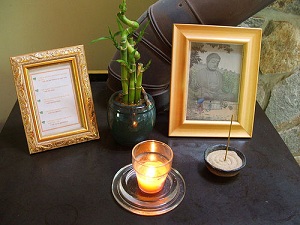 Altars and Shrines: What Are They?
Archeologists have found evidence of altars and shrines in nearly all places where there is evidence that humans have lived. The predisposition to construct these kinds of sacred creations seems almost to be part of our DNA. Traditionally, shrines are memorials or monuments to the dead. We have made shrines for thousands of years throughout the world’s cultures.
Some well-known shrines include the Taj Mahal and the Egyptian pyramids. Public monuments such as the Vietnam Veterans’ Memorial, the Mount Rushmore carvings, the Lincoln Memorial, and the Martin Luther King, Jr., Memorial are all examples of secular shrines that honor the memories of individuals whose lives and deaths have influenced our history as well as countless individual lives.
We create shrines in public spaces, in our communities, in places of worship, and in our own private spaces. We create them after long preparation and fundraising, with thoughtful planning, through elaborate installations, as well as with less expense and fanfare. We may place them in our own private spaces, in a community gathering place, or at specific sites where a death or tragedy occurred.
Shrines may evolve as spontaneous collaborations, such as those created by students, faculty and families at Virginia Tech or Columbine after those tragic shootings. Those types of shrines are usually added to throughout the days following the shootings and provide a community gathering space. They become places where the shocked and grieving may seek comfort and support from others. Shared, spontaneous shrines often evolve into more permanent community memorials where the lives of those who died can be remembered. Street memorials, where family and friends lay flowers, trinkets, card, balloons, or works of art where loved ones died, can be found in cities all over our country.
In New York City, throughout the five boroughs, one can see the hundreds of Street Memorial plaques placed at spots where pedestrians were killed on the city streets. That movement arose from the St. Louis, Missouri’s Ghost Bike Memorial project where bicycles are painted white and locked to street signs near crash sites to memorialize bikers who died there. Think also of the highway memorials and shrines that can be seen along our nation’s roadways at the sites where someone’s family member or partner was killed in a crash.
Shrines may be created outside the homes or at the burial sites of well loved public figures or artists who have died, such as those created in honor of John Lennon, Princess Diana, Jim Morrison, and Edgar Allen Poe. Shrines can serve as places for solitude, reflection, and remembering but they can also be whimsical and celebratory like the brightly colored Day of the Dead shrines in Mexico’s annual festivities which celebrate and honor the lives and memories of loved ones who have died with parades, games, picnics and family gatherings. Shrines connect us to our past, to each other, and to something greater than ourselves. They serve to help us remember and to heal.
Sometimes there may be confusion about the differences between shrines and altars. Often, the words altar and shrine are used interchangeably. For the purposes of personal healing from grief, or your own personal spiritual expression, you can use which ever term you like. If religious connotations make you uncomfortable, you may prefer thinking of a personally created altar or shrine as a memorial, memory box, memory space, honoring space, remembering space, meditation space, etc. Your space can be called whatever you choose to call it.
Shrines are typically dedicated to a specific person, or in religious traditions, to a specific deity or saint. In the case of shrines dedicated to people who have died, those can also be considered as memorials. An altar is usually thought of as a sacred space used for specific functions that may be associated with religious and spiritual purposes, such as worship, prayer, rituals or offerings. In religious traditions, the altar is usually the centerpiece of the worship space, such as in a church, synagogue, temple, mosque or sacred circle.
Many people create home altars as a personal sacred space for prayer, reflection, meditation or other specific spiritual and religious pursuits. Home altars can help us focus our minds on our chosen spiritual path and serve as daily reminders of a spiritual focus or our connection to Spirit. Altars may also be created and dedicated to specific deities or saints.
Altars can also be created with people as a focus. In my own home, I have little altars everywhere, with photos of my son, elements of nature (such as stones, shells or flowers), candles, or incense, place with other objects that help me to focus on peace and comfort, such as a lovely little Jizo statue or a statue of Ganesha. Shrines and altars can be as small or elaborate as you like. You may have many different shrines or altars for different things.
Why Create Shrines and Altars?
As the instructors at Life Path Center for Learning and Healing beautifully put it, “altars and shrines are external representations of interior mysteries.â€Â Shrines and altars are ways of showing in tangible form what might be happening in our hearts and spirits. Creating shrines and altars gives us opportunities to remember, to reflect and to honor, as well as to help heal the pain of loss through the act of creating. The creation of a personal shrine can establish a private place to which you can return to reflect, meditate, grieve, engage in a personal ritual, remember, and honor the one who has died.
Small, portable shrines can be carried with you where ever you go. These might be as small as a matchbook that can fit in your pocket or something a bit larger, like the size of a book, perhaps, that might be slipped into a purse or briefcase. A take-along shrine can allow you to maintain a needed connection with your loved one, or to create a sacred space for remembering or engaging in any type of personal ritual any time or place you may need or want to do so. Or you might prefer to create a more permanent shrine or altar that can be set up in your home or on your property using heavier more substantial elements, or a smaller semi-permanent type whose elements can be taken apart and used in other places or spaces. The choices are yours.
Creating Your Shrine
There are no rules or guidelines for creating shrines. The beauty of creating a shrine is that the ideas and materials are seemingly endless and the process, like the grieving process itself, is completely individual. A few guidelines might be helpful as you engage in the creation your own personal shrine.
Before you plan the look of your shrine, spend some time thinking about your loved one without thoughts or preconceived ideas of what you think your shrine might look like. Here are some ideas that may help the process:
- Make a list of words that come to mind when you think of your loved one.
- Make a list of objects or things that you associate with your loved one.
- Write down any words of wisdom, favorite expressions, funny or loving things your loved might have said. If your loved one never spoke, write down memories that have stuck with you, specific times that you continue to return to, that seem to bring some peace and comfort and to remind you of their love.
- Write down nicknames or pet names you might have used for each other and any associations those words may bring up .
- Write down his or her favorite colors, flowers, foods, hobbies, talents, etc.
- Research and find images that correspond to some of the things you have listed. You may find lots of interesting images on the internet that you can print and cut out for use in your creation or seeing the images may spark other thoughts or ideas that you may wish to incorporate in your memorial shrine.
To Create a Take-Along Shrine
Some artists suggest that a container be decided upon first before proceeding. The container may help guide the process or selection of items used in creating your shrine. Some suggestions for containers which can be re-purposed as your moveable shrine:
- Altoid tins (or other candy or gum tins)
- Sliding matchboxes (these can be the very small sized matchboxes or the large kitchen match boxes)
- Jewelry boxes
- Gift boxes
- Cigar boxes
- Shoe boxes
- Deep frames or shadow boxes
- Drawers
- Books (you can make a book into a box by cutting a rectangular shape into the pages and then gluing the pages together to create a container inside the book)
Gather basic craft supplies:
- Scissors
- Glues
- Paints (acrylic craft paint is inexpensive and works well for this purpose)
- Decorative and colored papers
- Photographs, personal objects or other items related to your loved one
- Anything else that you wish to add to your creation, such as
Ribbons, wires, sticks, dried flowers, string, yarn, decorative paper, wrapping paper, rhinestones, shells, small mirrors, glitter, charms, and beads, as well as anything that you like, that speaks to you, and that can be glued down.
Then, begin your process:
- Prepare your surface by painting or covering the outside and then the inside of your container, allow it to dry completely.
- Add background papers or images on the prepared surface if you wish.
- Place the photo(s) of your loved one where you think it should go. Add your embellishments as desired inside and out: beads, glass pebbles, words, charms, etc., until you feel you have completed your shrine.
To Create a Semi-Permanent or Permanent Shrine
To create a semi-permanent shrine, decide on your location or designate a particular space, such as a table top or a special shelf. You may want to visit thrift and antique shops to find the perfect small table or shelf that will serve as the base for your home altar/shrine. Of course, you can re-finish, paint, and decorate these items as you wish, or you may choose to forgo the paints, glues and embellishments.
Your shrine is yours to create as you see fit. Once you’ve found your base, begin the assembling of your sacred space. Gather together meaningful items that will help you focus on your intentions of memorializing, remembering, honoring, and healing. You might want to cover your altar with a special cloth or decorative mat. Next, you may want to place a picture of your loved one in a special frame as the centerpiece of your shrine. Add to this basic memorial anything you wish.
Some Suggestions:
- Personal objects that remind you of, or which are connected to, your loved one. These might include other photos, jewelry, letters or cards he or she gave you, awards, trophies, caps, hats, and other items of clothing, favorite books, or items he or she used on a regular basis such as sewing scissors, razor, comb or brush. The list here could be nearly endless.
- Natural objects such as flowers, fruits, rocks, crystals, shells, sticks or branches from your back yard, pinecones, leaves, abandoned birds’ nests, etc. You may wish to change the natural objects weekly (such as fresh flowers or fruits) or monthly, changing out stones and shells or other things you may find in nature.
- Candles, oil lamps, or incense
- Small strings of lights
- Chimes or bells
- Religious or spiritual objects that speak to you, such as statues or photos of deities or saints, or other religious or spiritual symbols
You may add to or change the objects on your shrine as often as you wish. Many people like to add seasonal items, such as a small Christmas tree or a Menorah during the holidays, various ornaments and items representing special times of the year such as your loved one’s birthday or other special days.
You can use your shrine or altar space simply as a reminder of your loved one or as an active part of creating and conducting your personal grief rituals. The planning, making, building and “adding to,†of your shrine can itself be a healing ritual. What you do with and how you use your creation is entirely your choice. Your creation is as individual as your personal journey through grief toward healing.
Please feel free to share your experiences with your own shrines and altars. If you do not have your own shrine or altar, whether or not you are grieving, consider creating one. Shrines and altars can bring a great deal of peace and comfort, as well as serve as a reminder for us to slow down and focus on those things that are important in our lives—our loved ones, our hearts, and our souls.
 As a unique form of short-term, complementary and alternative modality (CAM), clinical sexologists are largely under-recognized and under-used. Though it’s said we specialize in studying “what people do and how they feel about it,” sexology touches on everything from erotology to anthropology, law, medicine, psychology, anatomy and physiology (naturally!), gender studies, public policy, history, and so on. That’s because human sexual behavior is pervasive, it affects everything we collectively do and create. As a sexologist, my interests have included Asperger’s Syndrome and sexuality, Native Hawaiian sexual traditions, objectum sexuality, parenting transgender children, the effect of sensory dysfunction on sexual behavior, and the use of hypnosis to address sexual concerns. Almost anything can provide delightful grist for a perpetual, intellectual mill and this has been my joy. Sometimes useful clinical insights emerge from regarding artifacts or incidents through a sexological lens. However, even when there is no immediate clinical application, the overall effect is a deepened respect for the unstoppable and endlessly creative human engagement with eros.
For some, this process accelerates during a “unique baptism by fire” known as the Sexual Attitude Restructuring (SAR) process. At the Institute for Advanced Study of Human Sexuality in San Francisco (which pioneered SARs during an earlier incarnation as the National Sex Forum), this is no mere weekend of “Sexuality 101 and 201”. At IASHS, you are immersed for eight days in everything you always wanted to know about sex and possibly a whole lot of things you may wish you’d never seen. Explicit media and small group processing are integral aspects. The experience is intense. Even seasoned sexologists have been known to melt down. But a good SAR results in a near-unconditional acceptance of one’s own erotic quirks, and those of fellow human beings. One goal of SAR process is to discover exactly what aspects of human sexuality are personal turn-ons or turn-offs, so that clients are not harmed by the reactions of untrained clinicians. I can say, after having experienced two eight-day SARs, that my ability to hear just about anything is pretty good – and I know when and how to gracefully suggest a referral when out of my depth. For this reason, the American Association of Sex Educators, Counselors and Therapists (AASECT) requires a (briefer) SAR experience of everyone seeking certification through the organization.
AASECT certifies the separate categories of sex educator and sex counselor, but not the hybrid practice of clinical sexology, which does both. Though I have recently completed requirements for sex counselor certification, I am sorry my own professional category is invisible within an organization that has so many of us as members. However, I recognize the reasons for this. For one thing, standards for clinical training in sexology are not as defined or generally agreed upon as they should be. For another, right now in the public mind a “sexologist” may be anything from Masters & Jonson to a woman in lingerie groped in a darkened room during an episode of The Pick Up Artist.
However, clinical sexologists practice with Annon’s PLISSIT model: permission (P), limited information (LI), and specific suggestions (SS). We make referrals for intensive therapy (IT) if necessary. Our understanding of human sexual behavior is fostered by our training, which exceeds the sexuality education requirements of other professions. This depth enables us to attend to clients seeking techniques for sexual enrichment and/or short-term management of non-medical sexual problems. As complementary specialists, we work well in consultation with a range of licensed professionals. Within the ethical scope of our practice, we support sexual health, function, self-esteem, and the intimate capacities of our clients.
 I am guilty of spanking my children. My oldest has been spanked once, maybe twice, in his entire 17 years. My 7-year-old has received a few prime swats, and other forms of discipline, in her short lifetime. My middle child, a 14-year-old boy, is much more intimately familiar with spankings. As an extremely hyperactive and unruly child, my son was constantly exploring things that were off limits and often dangerous. Undeterred by the threats of toy removal, time-outs, and other nonphysical forms of punishment, he pushed me to my limits and I resorted to the only other method I knew: spanking. At the tender age of 5, he was quite adept at “assuming the position.†He no longer covered his back end with his tiny hands, and as much as it drove me crazy, he developed a stoic resistance and would receive his spanking without so much as a tear.
Was this child abuse? Or was it merely discipline? According to the statutes of my state, Florida, I have not committed child abuse because I did not significantly impair my children’s physical, mental, or emotional health. But if I look at an exception in the same statute, it is not so clear. It reads: “Corporal discipline of a child by a parent does not in itself constitute abuse when it does not result in harm to the child.†So even though I subjected my child—actually, all three of my children—to corporal punishment at one time or another, it is considered abuse only if I harmed them.
[fat_widget_right]
But doesn’t a spanking cause emotional injury? Doesn’t bending over and getting smacked, pretty firmly, on the bottom cause physical pain? Doesn’t this type of action potentially result in a traumatic event for a child who has never been struck by a parent? Did I cause harm?
I don’t know where discipline ends and abuse begins. I know that I was spanked as a child. I know that sometimes I learned the lesson and sometimes I didn’t. But I also know that when I was young, the thought of calling the police and reporting my parents as abusers never even entered my mind, no matter how sore my butt was.
Times changed as I grew up. Cable news outlets expanded, divorces were on the rise, and the stories of children being abused, and others claiming abuse to malign a parent, exploded. As an adult, I became keenly aware of how lucky I was, never having been subjected to horrific physical or mental traumas. My eyes were opened to the fact that what I saw as a form of discipline could be interpreted by some as abuse. I was also very cognizant of the fact that had my parents delivered the punishment out of anger, they could have easily crossed that fine line.
I don’t know where discipline ends and abuse begins. I know that I was spanked as a child. I know that sometimes I learned the lesson and sometimes I didn’t. But I also know that when I was young, the thought of calling the police and reporting my parents as abusers never even entered my mind, no matter how sore my butt was.
I heard members of the media discussing this very topic. They agreed that spanking is an acceptable form of discipline, if done appropriately. They stated that if the punishment is delivered out of anger, as an outlet for frustration and rage, then it is abuse. It is only when the punishment is administered out of love, and with the intention of teaching a child what is right, that it constitutes as discipline and not abuse. But doesn’t the mother who brushes her child’s teeth with steel wool say she does it only to teach her child the importance of dental hygiene? Doesn’t the father who forces his toddler to wear a dirty diaper for two days do so only to help the child become potty-trained?
Children have been spanked for generations. And yes, they have been given alcohol, medicine, and even hot sauce. A relative of mine got hot sauce on her thumb to help her quit sucking it. She ended up crying so hard after she tasted the hot sauce that she rubbed her eyes with the same thumb. The result? Very irritated eyes. But she didn’t lose her eyesight, didn’t call the police, and didn’t suck her thumb again.
I am an extremely fortunate person. I was not abused as a child. I was punished, had pickle juice put on my thumb, was sent to bed with no supper, and was spanked. But I was never beaten. I was never psychologically tortured. I was never burned, locked in a closet, or left hungry for days. And I never, ever had any potentially harmful liquid forced down my throat or got thrown into an ice-cold shower. I could not imagine doing this to any of my children, not matter the circumstances. But mothers, fathers, stepparents, foster parents, and other so-called “guardians†do these things every day to hundreds of thousands of children. And I’d bet that if you asked any one of them why, they would all say the same thing: they did it to teach a lesson; they did it to discipline; they did it out of love.
I’m really glad my parents didn’t love me that much.
Hoarding is a form of obsessive-compulsive behavior. An individual who exhibits hoarding tendencies has a difficult time letting go of physical items and becomes inundated with possessions, often to the point of causing physical and financial harm. Previous research has identified a link between people who hoard and obesity. Now, a new study led by Kiara R. Timpano of the Department of Psychology at the University of Miami, aims to determine if the brain derived neurotrophic factor (BDNF) is responsible for that link. “Studies with gene-targeted murine models have demonstrated that Bdnf variation is linked with memory impairment, greater avoidance, greater anxiety, aggression, and obesity,†said Timpano. The variation, called the Val66Met SNP, was of particular interest to her and her team. “Considering specific psychiatric conditions, the Val66Met BDNF SNP has been associated with multiple neuropsychiatric disorders, including eating disorders,†she said.
Timpano and her team examined the BDNF gene in 301 participants who were classified with obsessive-compulsive behaviors. They used the Structured Clinical Interview for DSM-IV-TR Axis I Disorders Patient Edition (SCID-P) to identify OCD and the Yale-Brown Obsessive Compulsive Scale (YBOCS) to assess hoarding behaviors. The researchers also measured the body mass index (BMI) of each participant to determine obesity.
They found that more than half of the participants were above average weight, with 25.2% being classified as “overweight†and 27.2% as “obese.†They also discovered that the individuals with the highest BMI were also the most likely to exhibit hoarding behaviors. “Results revealed that individuals in the hoarding group were over two times more likely to be classified as obese compared with non-hoarders,†said Timpano. The team hopes this study helps advance research on this issue. They said, “This finding, in conjunction with our results, brain imaging evidence, and symptomatic and gender differences in hoarding compared with other forms of OCD, provide further credence to the growing notion of hoarding as a separable and distinct phenomenon.â€
Reference:
Timpano, Kiara R., Norman B. Schmidt, Michael G. Wheaton, Jens R. Wendland, and Dennis L. Murphy. “Consideration of the BDNF Gene in Relation to Two Phenotypes: Hoarding and Obesity.” Journal of Abnormal Psychology 120.3 (2011): 700-07. Print.
 Let’s face it, hardly anybody has a completely healthy relationship with food. Unfortunately for our society, disordered eating is the norm, whether it’s crash dieting, stress eating, or whatever else you want to call it. Because of this, it can be really hard for someone in danger of developing an eating disorder to recognize the slippery slope of the diet they’re on until they’re well on their way down. Clearly, not everyone who diets develops an eating disorder, but research does show that 35% of occasional dieters become pathological dieters, and as many as 25% of those diets will progress into full-blown eating disorders. So when does dieting become dangerous? What’s the difference between a diet and an eating disorder? Sometimes the line is an awfully thin one.
A typical diet begins with a longing to lose weight. Often, this longing is coupled with a genuine wish to improve overall health and nutrition. A typical diet ends when either the weight goal is achieved or the dieter stops due to some inadequacy of the regime—too many restrictions, too few calories, etc. An eating disorder often begins the same way—with a longing to lose weight. In fact, 80% to 90% of eating disorders begin with a diet … but that diet never ends. The transition from diet to disorder has no one purpose and no one cause.
While diets are about food and weight, eating disorders become much, much more than that. Food and weight become all-powerful, and people with eating disorders use both in an attempt to better their lives (by gaining a sense of control, numbing painful emotions, earning approval or acceptance, etc.). Eating disorders do not end when a weight goal is reached because a new one will always be set. One begins to believe and behave as if “the perfect body” is attainable, and will strive for this allusion no matter what. Over time, a person’s self-esteem and general outlook on life become dependent on weight and appearance. At that point, nothing else matters.
A common danger in assessment by a professional not familiar with eating disorders is that too much emphasis is placed on a person’s weight and other physical symptoms. While these factors are often good indicators of a problem, they are not always “alarming enough,” if present at all. Equally important, if not more important, are the symptoms that cannot be seen—the symptoms in the mind. The psychological disturbances that both cause and perpetuate eating disorders are often the most difficult to treat. It’s important to understand that although someone does not fit all the criteria for a specific eating disorder, such as anorexia, bulimia, or compulsive overeating, they can still be doing a great deal of damage to their body, mind, and soul.
In a world where not being on a diet is abnormal, and restraint is a sought-after skill, being healthy and loving your body can almost feel awkward. I’m reminded of a scene in the movie Mean Girls when new girl Cady enters public school for the first time after growing up in Africa for 16 years. While her new friends nitpick their appearances in the mirror, Cady muses to herself, “I used to think there was just fat and skinny. Apparently, there’s a lot of things that can be wrong with your body.“ It’s an unfortunate message, but a true one. The body-confident girls and guys are few and far between.
What about you? Are you balancing the thin line between diet and disorder? Do you feel preoccupied with food, weight, calories, or a desire to be thinner? Do you feel the need to rigidly control your food intake or exercise schedule? Don’t let these obsessions rob you of another minute, day, or year of your life. Remember, you’re most beautiful when you are confident and accepting of yourself, just as you are. Then and only then will you be able to make positive, lasting changes in your life.
 Mandy nuzzled her 3 month old baby happily as she warmed his bottle. It felt so good to breathe in his sweet baby smell and touch his soft delicate skin, his little body curled in a warm embrace into the curve of her neck. Mandy was starting to feel like she had her “sea-legs’ as a new mom and was particularly enamored of the fact that her new baby was sleeping through the night. The rough night-time awakenings were beginning to subside as baby Noah matured and slept for longer periods. She was looking forward to meeting a new mom friend in the park with their babies after she gave Noah a bottle.
Suddenly, in the wink of an eye, the tender moment vanished. Mandy watched the water warm Noah’s bottle on the stove. She was blind-sided by a horrific thought, flashing through her mind of the water morphing into hot lava and scalding her baby boy. Mandy flinched, gasping and clenching tightly onto Noah, quickly backing away from the oven. The thought terrified her, and she could not believe such an image threatened to envelop her mind. Mandy’s entire body tensed as she began to pant, shallow breaths. She didn’t know it at the time, but, she was well on her way to her first panic attack after experiencing an intrusive thought…a hallmark symptom of perinatal depression and/or perinatal OCD.
Experiences like Mandy’s are common in some 20% of all child-bearing women who develop perinatal mood/anxiety disorders (the clinical term for depression/anxiety during pregnancy and up through the first year after having a baby). Some women develop symptoms of anxiety with intrusive thoughts while others may not experience these often debilitating and traumatic images. Others may have more depression symptoms with a smattering of anxiety, panic attacks, and sometimes intrusive thoughts.
PMADs (perinatal mood/anxiety disorders) are the clinical term for a myriad of symptoms under the umbrella of depression and anxiety from conception through the first year following childbirth. In layman’s terms, perinatal challenges/neurobiochemical imbalances while pregnant and after having a baby often leave women completely stunned, horrified, and traumatized…because women don’t know what hit them. And no one talks about it.
The reality is that PMADs are very common, and most likely under-reported due to the stigma connected to them. Mothers can be wracked with so much guilt about any of the symptoms, particularly if she has intrusive thoughts, that they are loathe to talk to a specialist to get help or to a family member. Many women report they feel like they are “going crazy†or afraid to be “like that woman on TV who killed her kids.â€
I want to underscore the importance of supporting a woman who is experiencing intrusive thoughts to not delay in seeking help, to get help immediately with a trained specialist in perinatal challenges. The differential amongst these particular perinatal struggles is quite delicate. Furthermore, to receive the best care, she must have help from a skilled perinatal psychotherapist who can provide a comprehensive bio-psycho-social assessment and steer her in the appropriate direction for what is ideally a multidisciplinary approach to treatment.
This article is not intended to be a primer on the difference between perinatal intrusive thoughts and hallucinations since such is the subject of a workshop or conference. And, each set of circumstances requires a different course of treatment (both medically and in psychotherapy). Generally speaking, however, when a woman experiences intrusive thoughts, she is grounded in reality and horrified of the images that are occurring, feeling that her body is betraying her. She will often respond with disgust at the images and in turn demonstrate behaviors that lessen her anxiety and protect her baby (for example, Mandy avoided ovens for a time because such objects were a trigger for her). Intrusive thoughts can be part of perinatal depression and will remit with psychotherapy and in many cases, medication management (typically an SSRI), along with a good self-care plan and social supports in place. Hallucinations, on the other hand, are considered a medical emergency and potentially part of a more rare PMAD, perinatal bipolar disorder or psychosis. In such a case, the woman is not grounded in reality, and hallucinations can cause her to do or say things that she would not normally do and have the potential to be life-threatening to her or the baby. If you suspect that you or a loved one are experiencing hallucinations, call 911 or go to your nearest emergency room immediately. Do not attempt to diagnose.
Fortunately for Mandy, she realized something was amiss in her brain biochemistry and immediately sought help with a trained perinatal psychotherapist. Upon consulting with a psychiatrist specializing in reproductive mental health, she agreed to try an antidepressant (Zoloft) to help her biochemistry restore itself. Mandy’s recovery was swift because she sought help immediately, she received support, non-judgment, validation, psycho-education, as well as cognitive behavioral strategies in psychotherapy to help her diminish the anxiety and intrusive thoughts. She worked with her therapist on a solid self-care plan and put in place the help of a doula (hired caregiver specifically for new parents). Mandy feels empowered now as a new mom, free of intrusive thoughts and filled with pride at the arrival of Noah in her life. She is now on to a full recovery, enjoying her 7 month old son. (Please note: swiftness of recovery times vary with each individual’s unique circumstances).
If you or someone you love appears to have intrusive thoughts after having a baby (or even while pregnant), do not attempt to diagnose her. Do find a trained perinatal specialist to help the woman you care about to get treatment. The good news is that PMADs are treatable and temporary, and with help, women recover fully.
Other useful resources:
- Postpartum Support International—www.postpartum.net – largest non-profit dedicated to PMAD awareness; vast clearinghouse of information on PMADs, down-loadable fact sheets, online support groups for moms and dads, chat with an expert, stellar bibliography of recommended books, latest research findings and trainings in the perinatal world; current legislation in support of PMAD awareness, destigmatization, and treatment; coordinator/volunteers link callers/e-mailers with trained professionals; warmline in English/Spanish
- Postpartum Progress—www.postpartumprogress.com – most widely read blog on perinatal challenges, by Katherine Stone; the reader can subscribe to a daily news feed and a daily affirmation of hope.
- Real Mom Experts - www.realmomexperts.com – website dedicated to supporting women with PMADs, written by perinatal psychotherapists; self-care techniques for moms
Great book on intrusive thoughts:
Dropping the Baby and Other Scary Thoughts: Breaking the Cycle of Unwanted Thoughts in Motherhood by Karen Kleiman and Amy Wenzel (2010). –excellent book for new moms dealing with PMADs, also for perinatal professionals