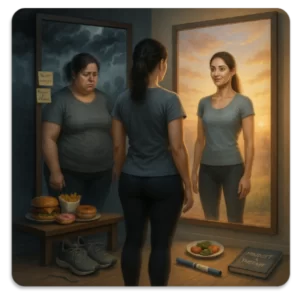
 Nineteen years ago, I made a decision that changed my life: I had gastric bypass surgery. At the time, I weighed 365 pounds, and my relationship with food, my body, and even my self-worth was deeply complicated. Today, I’ve lost and maintained a weight loss of 230 pounds, but what I’ve learned about the weight loss mental health connection has been even more transformative than the physical changes. While the surgery was a powerful tool, the real work, the kind that often goes unnoticed, has been mental, emotional, and deeply personal.
In the last two years, I added a GLP-1 medication to my routine, which has helped support my continued progress. Make no mistake: medication and surgery are not shortcuts. They are tools, and the real, lasting transformation has come from reshaping my mindset and prioritizing my mental health.
The Mental Side of Weight Loss No One Talks About
We often hear about diet plans, workout regimens, and before-and-after photos. What’s less visible is the emotional and psychological journey that runs alongside the physical one. For me, this was the hardest part.
Research consistently shows that bariatric surgery affects mental health significantly, with studies indicating both positive and negative psychological changes post-surgery. Before surgery, food was more than just fuel; it was comfort, distraction, and a coping mechanism. After surgery, I had to relearn how to eat, but even more importantly, I had to relearn why I eat. That’s where mental health came into play.
Healing My Relationship With Food: A Weight Loss Mental Health Journey
Gastric bypass changes your anatomy, but not your mindset. I had to face the habits and beliefs I carried with me for years. I had to confront emotional eating patterns, self-sabotage, and a negative internal dialogue that often told me I wasn’t “good enough” or that I’d always struggle.
Research demonstrates that psychological interventions targeting emotional eating can be highly effective, with cognitive behavioral therapy, mindfulness-based treatments, and acceptance-based therapies showing significant improvements in both emotional eating behaviors and weight outcomes.
Therapy, journaling, support groups, and self-reflection became just as important as meal planning and exercise. I learned to check in with myself emotionally before meals. Was I really hungry? Or was I stressed, bored, anxious, or sad?
Mindset: The Hidden Engine Behind Success
Losing weight and keeping it off for nearly two decades has taught me that mindset is everything. I’ve had to be patient when progress slowed. I’ve had to stay grounded when the scale didn’t move, and I’ve had to keep showing up for myself, even when it felt hard.
A growth mindset, believing that I can change, adapt, and grow, has carried me through setbacks and plateaus. Stanford psychologist Carol Dweck’s research demonstrates that individuals with a growth mindset consistently outperform those with a fixed mindset, particularly when facing challenges.
I stopped seeing challenges as failures and began to see them as part of the journey. This shift in perspective has been crucial to my resilience and long-term success.
The addition of GLP-1 medication over the past two years has given me another helpful tool, especially when it comes to appetite regulation and managing food cravings. The medication didn’t erase the need for mindful eating, therapy, or self-care. If anything, it amplified the importance of those things.
Nutrition Isn’t Just Science—It’s Personal
Nutrition advice is everywhere, but what works for one person may not work for another. I’ve had to learn what my body needs, how to listen to its signals, and how to feed it with both nutrition and self-compassion. Some days I eat to nourish, other days I eat for joy. I’ve learned that both are okay, and balance, not perfection, is the key to sustainable health.
Understanding that weight loss can be difficult helped me set realistic expectations and develop patience with the process. This acknowledgment actually improved my long-term success rather than hindering it.
Final Thoughts
Today, I live in a body that feels strong and capable. More importantly, I live with a mind that’s kinder, more resilient, and more aware. My journey hasn’t been linear or easy. It’s been filled with detours, lessons, and growth. Through it all, the most significant transformation hasn’t just been what I see in the mirror, it’s how I see myself.
If you’re on your own weight loss or health journey, know this: your mindset matters. Your mental health matters. You are so much more than a number on the scale. Consider focusing on positive behavioral changes rather than just the number on the scale, this approach often leads to more sustainable, lasting results.
The Mayo Clinic emphasizes that gaining control over emotional eating requires addressing both the psychological triggers and developing healthier coping mechanisms. Remember, if you’re struggling with emotional barriers to weight loss or need support on your mental health journey, consider reaching out to a qualified therapist who can help you develop the tools and mindset for lasting change.
 Absorbing the constant stream of startling headlines, news sources, political tensions, and global issues can feel overwhelming some days –– but we often can’t look away. If this sounds like you, you’re not alone. Most people (83% of adults) today experience stress about the future of the U.S. and news overload. If your mental and overall health are feeling impacted by the modern age’s constant information flow, this guide helps you recognize your doomscrolling habits and protect your well-being.
What Is Doomscrolling?
Do you find yourself scrolling through headline after news clip after social post that highlights distressing news, even when you know you’re tired or overwhelmed? Many people make doomscrolling a part of their daily life, but it’s taking a toll on our mental health as a society. Defined as constantly consuming distressing news, “doomscrolling†happens because upsetting news triggers your brain’s tendency to scan for danger and remain hypervigilant, even when your mental health is hurting.
You might already have a bad doomscrolling habit and feel its mental effects, but there are ways you can recognize and combat this behavior and better cope with news-related anxiety. As local, national, and global political and cultural landscapes continue to experience tensions and distress, protecting your mental health becomes that much more important.
News Overwhelm: The Mental Health Effects of Doomscrolling
Our self-preservation instinct to absorb more and more news is natural, but that doesn’t mean it isn’t unhealthy if left unchecked. Doomscrolling has proven impacts on society’s mental health, and this issue is growing year by year. A recent American Psychiatric Association study found that in 2024, 43% of adults felt more anxious than they did in both 2023 and 2022.
After doomscrolling, you probably feel anxious, but you might also experience other negative impacts. The following are just a few examples of ways your body reacts when you constantly consume distressing news on social media, television, and other publications:
- Sleep Procrastination: Doomscrolling in the evening can prevent you from getting enough healthy sleep as the scrolling becomes more and more unproductive and upsetting. Your mood and cognitive function might be impacted the next day.
- Worsened Social Connections: Spending significant time and energy scrolling through upsetting news can deplete your mental load, so you have less energy to recharge with friends and family.
- Less Exercise and Sunshine: When you doomscroll inside for hours on end, your body is often sedentary and does not get the exercise and vitamin D it deserves — which can impact your mood and mental well-being.
Staying informed on current events and the news is indeed important, and you might find great value in connecting with others and joining meaningful conversations on social media. Yet, we know that finding the balance between harmful habits and productive change can be challenging. If you are educated on the mental health impacts of scrolling, news coverage myths, and healthy habits for media consumption, you can prevent the negative effects of doomscrolling before they snowball.
Read More: Want to Learn More About the News Cycle and Mental Health? Read Our Guide
Myths About News Consumption and Mental Health: What to Know
You might not be able to completely escape the news, but you can be educated on how to absorb information in a productive, healthy way. As you work to stay informed about current events, keep in mind these three common myths about news consumption:
- Myth 1: Staying Informed Requires Constant Attention: You don’t have to continually consume all media to remain educated. In fact, you can be smart and thoughtful about how and when you take in the news.
- Myth 2: All News Is Complete: News headlines, articles, and stories don’t paint a complete picture. Absorb different perspectives and sources, but know that no piece of news has all the information.
- Myth 3: You Can’t Take Breaks: While it might feel like you have to be in the thick of the news each day, protect your well-being by giving yourself time to learn, space to absorb, and time to reset so you stay healthy.
With these tools, you can balance staying engaged in current events and prioritizing your mental health.
Tips for Managing News Anxiety
A stressful news event might affect you differently than it does someone else. Whether it’s wars, high gas prices, changing healthcare regulations, stories of racism and discrimination, or general violence, the news cycle can trigger different responses in different people. When you’re reading and watching news, keep these general guidelines in mind so you can protect your well-being while you stay informed:
- Be Aware of Your Limits: Taking breaks, muting news, or unfollowing distressing accounts can all help you pace yourself.
- Participate in Your Community: Make an impact by investing time, money, or resources into others for a meaningful cause.
- Use Your Voice: Speak up and act on injustices and distressing events in the world.
- Don’t Neglect Your Feelings: Learn healthy coping mechanisms for managing your feelings, and explore therapy when you need extra support.
- Protect Your Health: You can’t be the best version of yourself without prioritizing your physical, mental, spiritual, and psychological health. Find ways to foster these different components in your life.
Sometimes, news anxiety and overwhelm can feel especially personal and triggering. If you’re seeking support from someone who understands your unique experiences, identities, and feelings, GoodTherapy has a handful of culturally competent professionals prepared to help you navigate mental health challenges related to intersectional identities.
How Therapy Professionals Can HelpÂ
As news and information continue to circulate, you might need the tools to balance being informed with staying mentally healthy. By recognizing the dangers of doomscrolling, keeping general tips in mind, and seeking professional help, you can limit doomscrolling and spend more time making a difference.Â
GoodTherapy’s trusted, patient-centered therapists are prepared to help you navigate through whatever mental health needs you have, including achieving a doomscrolling detox. Find the right therapist for you through GoodTherapy and know that you are not alone: there is help for you.
External Sources:
American Psychological AssociationÂ
 Let’s be honest: Reality television has become America’s not-so-secret obsession. Whether it’s your guilty pleasure after a long day, the background noise while you’re scrolling your phone, or something you swear you’d never watch (but somehow know all the contestants’ names), there’s no denying we’re consuming more reality TV than ever before.
From the drama-filled villas of Love Island to the backstabbing brilliance of The Traitors, from the soaring vocals on The Voice to the rose ceremonies on The Bachelor — these shows have us hooked, and they’re undeniably entertaining. Still, researchers and mental health professionals are increasingly worried about the impact this “harmless” entertainment might be doing to our mental health, especially as it relates to body image.
If you’ve ever felt a knot in your stomach after watching impossibly perfect people find love on a tropical island or noticed your mood dip after a reality TV binge, you’re not alone. These shows are messing with our minds in ways we’re only beginning to understand, and the impact on how we see ourselves, especially our bodies, is becoming impossible to ignore.
Take Love Island USA, for instance. This longtime fan favorite has been called out for years over its harmful body image messaging, yet the most recent season (which premiered June 3rd, 2025) serves up more of the same. It might be your go-to guilty pleasure, but it’s worth asking: What’s the real cost of the “Love Island Effect” on our mental health?
Below is a deeper dive into the show’s impact on our mental health — from the show’s impossible beauty standards to the direct psychological toll it takes on us — plus some practical ways to enjoy your reality TV fix without letting it mess with your self-worth.
Negative Body Image and Mental Health: Understanding the Connection
When it comes to what shapes your mental health, body image plays a bigger role than you may realize. The way you see yourself in the mirror isn’t just about vanity: it’s deeply connected to your overall well-being and self-worth. When those thoughts are persistently negative, your mind can suffer.
Poor body image can trigger or worsen a number of conditions or symptoms:Â
- Anxiety and depressionÂ
- Body dysmorphiaÂ
- Eating disorders like anorexia and bulimiaÂ
- Feelings of shame and guiltÂ
- Self-esteemÂ
- An unhealthy obsession with body type
Learning how body image affects mental health isn’t just important: it’s essential if you want to take care of yourself, feel better in your own skin, and help others do the same. There are four components to body image you should know: what you see when you look at yourself (perceptual), how that makes you feel (affective), what you think about it (cognitive), and what you do as a result (behavioral).
Here’s the kicker: Reality TV and social media can mess with any or all of these layers, creating a perfect storm for mental health struggles.
The good news? If you’re battling negative body image, you don’t have to go it alone. Therapy professionals are specially trained to help you spot reality TV’s toxic influence and flip the script on how you see yourself. They can even coach you through tough conversations about body image with friends and family, helping curate a more positive message to the people you care about.
Read More: Wondering How to Talk to Your Child About Their Body? Start HereÂ
The Popularity of Reality TV
Despite all the hand-wringing about reality TV’s impact on our mental health, we’re watching more of it than ever. In fact, reality shows now make up a staggering 57% of all available TV programming. The message is crystal clear — reality TV isn’t just a guilty pleasure anymore: It’s become part of our daily media diet.
How Reality TV Impacts Body Image
You’ve probably encountered at least one of the Love Island franchises, whether it’s the UK, Australia, France, Germany, or USA version. Yet, what stays consistent across every beach and villa is the show’s basic formula of putting conventionally attractive twenty-somethings in swimwear and watching them compete for love — and the troubling impact it has on how we see ourselves.
The numbers are pretty sobering. New research from the Mental Health Foundation reveals that nearly 25% of 18-to-24-year-olds say reality TV makes them worry about their body image. The newest debut of Love Island USA, season 7, exacerbates this widespread concern. The cast is another lineup of people who fit that narrow definition of “beach body ready” and have likely had cosmetic work done. Love Island is certainly not alone in promoting unhealthy body standards, but researchers are particularly worried about the show’s so-called “Love Island Effectâ€: when viewers don’t just watch the show but also start questioning their own appearance and considering cosmetic procedures.
Despite the show’s lack of body diversity and some franchise changes, like offering mental health support for contestants after the show, Love Island USA celebrates the same, negative idea about body image: that true physical beauty does not include plus-sized bodies and only celebrates those with toned physiques and cosmetic enhancements.
Understanding how your TV habits affect your mental health is just the beginning. Actually building a positive body image, though, is the real work. Learn some concrete steps you can take to reset your perspective and find the support you need to feel good in your own skin.
How to Develop a Positive Body Image
As you grab the remote this week to turn on your favorite reality TV show, stop yourself and remember this key fact: the people you see on TV both represent skewed body ideals and likely struggle with body image issues themselves.Â
While GoodTherapy’s expert therapists are ready to help you tackle any body image challenges head-on, you can start protecting your mental health right now with these three game-changing strategies:
- Set Boundaries: Think of boundaries as your personal protection measures — whether physical, mental, or emotional. They’re your first line of defense in protecting your peace of mind.
- Fight Back With Cognitive Dissonance: Recognize and combat toxic beauty standards. See something unrealistic? Call it out. Challenge it verbally or take action against it.
- Remember the Ultimate Goal: Self-love isn’t one-size-fits-all. What works for your best friend might not work for you, and that’s okay. The freedom that comes with genuine self-acceptance? That’s universal.
These are the big-picture strategies, but let’s get practical. Here are some small but mighty actions that can transform how you see yourself:
- Start your day with positive affirmations (yes, they actually work)Â
- Chase health, not a number on the scaleÂ
- Spread compliments freely to others and yourselfÂ
- Make a list of what you love about yourself (and read it often)Â
- Catch yourself comparing and shut it downÂ
- Notice when your inner critic gets loud and stop it in its tracksÂ
- Remember you’re more than just a body: you’re a whole person
Fighting back against TV’s toxic body standards doesn’t mean you have to give up Bachelor in Paradise or stop rooting for your favorite Survivor contestant. It just means watching with your eyes wide open and recognizing your triggers so you can practice foundational skills in cognitive behavioral therapy (CBT). When you notice yourself making comparisons while watching Love Island, that awareness itself is the first step toward change.
Read More: Want to Learn About the Importance of CBT? Start Learning Now
How You Can Watch Love Island and Protect Your Mental HealthÂ
You don’t have to navigate this mental health journey solo. GoodTherapy’s trained professionals understand how reality TV affects mental health. They’re equipped with tools and strategies to help you build a healthier relationship with your body image.
With the right support, you don’t have to break up with Love Island USA this summer. You can absolutely keep up with all the villa drama while also working on rebuilding your confidence and protecting your mental health. It’s not about choosing between entertainment and self-care: it’s about finding that sweet spot where you can enjoy both.
Ready to take that first step? Find the right therapist for you, today!
Sources:
Multidisciplinary Digital Publishing Institute: Body Perceptions and Psychological Well-Being
Reality TV Statistics by Shows, Franchise, Demographics and Popularity
Which American Genres Have the Highest Global Demand?
Mental Health Foundation Raises Fears About Impact of Reality TV on Young Viewers
The Issue of Diverse Body Representation on Reality TV Goes Way Beyond Love Island
Reality TV Fuels Body Anxiety in Young People, Survey Says
 In fulfilling relationships, it’s natural to want our loved ones to change. We often recognize their potential and believe that if they adjusted certain behaviors, things would improve. But this mindset can lead to frustration and disappointment, because we ultimately cannot control others.
The key to fulfilling relationships lies in focusing on what we can control: our own reactions and expectations.
Why We Try to Change Others in Fulfilling Relationships
Our urge to change others usually comes from a place of love and concern. We want the best for them and for ourselves. Yet, this well-meaning desire can lead us down a path of trying to “fix” someone, which often strains the relationship.
Instead, it’s far more productive to look inward. Ask yourself:
- Are my expectations realistic?
- Am I projecting my own fears or insecurities?
- What do I truly need in this relationship?
Turning Inward: The Path to Self-Awareness
One powerful approach is practicing mindfulness and self-awareness. Becoming attuned to our own thoughts and emotions helps us uncover the roots of our desire to change others.
Consider this: Are you seeking validation through their changes? Or are you fearing rejection if things stay the same? These insights open the door to personal growth and emotional clarity.
For more on this topic, see Self‑Differentiation and Why It Matters in Families and Relationships.
For deeper context on this practice, you might also explore Verywell Mind’s guide to self-awareness.
Setting Realistic Expectations in Fulfilling Relationships
Accepting that we can’t control others is liberating. It allows us to love and appreciate them as they are, not as we wish they would be.
This doesn’t mean tolerating harmful behavior. Instead, it means:
- Setting healthy boundaries
- Clearly communicating your needs
- Letting go of perfectionism
Learn more in Making Love Last: The Importance of Emotional Intelligence.
Communicating for Connection, Not Control
Effective communication is crucial. Rather than blaming or criticizing, share your perspective honestly and respectfully. Use “I” statements:
- “I feel hurt when…”
- “I need support in…”
This approach fosters empathy and connection, making space for understanding and mutual growth.
See Conflict in Relationships: Do You Own Your Responsibility? for strategies to enhance responsibility and connection.
The Power of Outcome Independence in Growth
Outcome independence is a transformative mindset, especially in personal development and therapy. It means focusing less on the result and more on the journey.
When we detach from specific outcomes:
- We reduce fear of failure
- We become open to experience
- We celebrate progress over perfection
Therapists often use this to help clients embrace self-discovery. By trusting the process, we create space for true transformation.
Explore this concept further in Mindfulness and the Art of Letting Go.
Final Thoughts: Creating Meaningful, Fulfilling Relationships
Ultimately, the only person we can change is ourselves. When we shift our focus inward, toward growth, awareness, and intentional response—we enrich not only our lives but our relationships.
Embracing change within can lead to more fulfilling relationships built on balance, understanding, and mutual respect. It’s a journey worth taking.
See how Five Domains of a Healthy Relationship: Mindfulness and Resilience outlines the role of mindfulness in relational well-being.
To further explore the emotional side of healthy connections, see this resource on how emotions influence our relationships from HelpGuide.org.
 Learning how to manage stress effectively becomes essential as we navigate life’s constant changes. This gentle stress management approach through self-compassion offers a sustainable path forward.
As the gift of nature and renewal surrounds us, there’s something comforting about its predictability amidst change. The coolness of the mornings, gentle unfurling of leaves, the first brave blooms pushing through soil—these reliable transformations offer reassurance even as everything shifts.
I’ve been reflecting on how we might find similar comfort in new situations that arise, especially during stressful moments or times in our lives. When uncertainty feels overwhelming, where can we discover that same sense of grounding?
This contemplation has drawn me deeper into exploring our inner worlds. Don’t you find that sometimes our minds also crave that same sense of renewal?
Understanding Stress as a Universal Human Experience
As life happens and we begin to feel the feels, it’s a time to begin to be honest about something we all navigate in our own unique ways: Stress.
Even though stress can feel so intensely personal – that knot in your stomach, the racing thoughts that keep you up at night – it’s also something that connects us all. We might not always see it in each other, but stress is a shared part of the human experience.
Instead of chasing an idea of a completely stress-free life (which can feel like another thing to stress about!), let’s explore a different path together. What if we learned to relate to stress management in a new way?
How to Manage Stress and Shift Your Perspective on it
SHIFT YOUR PERSPECTIVE:
- Talk to ourselves with more kindness: Gently shifting those harsh inner critiques.
- Really listen to what our emotions are telling us: Honoring our needs authentically.
- Build an inner strength and move through stressful times: Learning to live alongside stress with more ease.
At the heart of it, we’re all figuring this out as we go.
Self-Compassion Techniques for Stress Relief
Have you ever noticed how our minds can sometimes be our own toughest critics when we’re feeling stressed? It’s like that inner voice can get really loud and, at times, not very helpful.
Gently reframing your negative thoughts can be empowering and supportive to manage stress and build self-compassion.
For those facing particularly challenging times, these crisis management strategies can provide additional support alongside self-compassion practices.
Practical Examples of Self-Compassionate Inner Dialogue
For instance, if you catch yourself thinking: “I can’t just can’t handle all of this.”
Maybe you can try shifting that to something like: “This is a really challenging time, and I’m feeling it. But I also know I have inner strength and I’ll find a way through.”
Or when those tough days feel overwhelming and you think: “This is absolutely the worst day ever.”
Perhaps you can also acknowledge: “This is a really difficult moment, and it’s okay to feel this way. Even in tough times, there might be small things I can still appreciate.”
The Balance of Gentle and Fierce Self-Compassion
It’s not about pretending everything is perfect. It’s about taking a glimpse at living as if and finding a slightly different, more self-compassionate lens to look through. Self-compassion for anxiety and stress isn’t just about being gentle with ourselves when things are tough; it also is about a deeper inner strength.
That gentle part is about acknowledging when we’re feeling drained or overwhelmed, allowing ourselves to feel it without judgment. It’s about giving ourselves permission to rest and recharge, rather than pushing through until we burn out.
But then there’s that fierce side – the courage to set boundaries, to say “no” to things that aren’t serving us, to really honor our own needs and protect our well-being.
Why Self-Compassion Works for Stress Management
Self-compassion isn’t a magic wand that makes stress disappear. Self-compassion is an act of real self-care that helps us navigate the challenges of life with a little more grace and a lot more inner strength. It lightens the load and reminds us that we’re worthy of kindness.
Embracing a Compassionate Approach to Mental Wellness
As we embrace this season of growth and renewal, I truly hope you’ll join me in exploring what a compassionate approach to stress might look like for you.
It’s about nurturing well-being from the inside out, acknowledging the very real challenges we all face, and remembering that we deserve our own understanding and care along the way.
Explore More Resources:
- How stress management leads to stress reduction techniques
- Knowing your stress threshold and limits
- Working with your inner critic to reduce anxiety
- Research shows that chronic stress can impact both physical and mental health.
- Studies on self-compassion demonstrate its effectiveness for emotional well-being.
- Various stress management techniques for better health.
 Are you looking for mental health counseling but don’t know where to start? It can feel daunting and overwhelming. Here’s a step-by-step guide to finding the right care for you.Â
Online or In-Person Sessions
First, figure out a couple of things. Do you want to use insurance or are you willing to self-pay? Think also about whether you are looking to do in-person sessions or online therapy. Some clinicians provide both in-person and online counseling, while others only provide online counseling, and still others only provide in-person therapy. As a side note, with teletherapy, you have a wider pool of therapists to choose from, because you are no longer confined to just those near you. You can now choose any therapist in your state, as long as they are licensed to practice in that state. For example, my practice is based in San Antonio, TX, but with teletherapy, I can see any client in the whole state of Texas. The format of therapy and your preferred method of payment will inform your search so it’s helpful to have an idea at the outset. Â
If you want to go the insurance route, go to your insurance’s website and search for an in-network provider. Look for the “behavioral health†section of an insurance’s website and search through a directory of providers. This is probably the most straightforward way to search for a provider that accepts your insurance. The downside to this way of searching is that the directory is simply a list of names, credentials, and addresses. The directory does not provide any information that gives you a sense of what each person is like as a clinician – which is often important for many before they are willing to pick up the phone. From this list, you have to do your own googling to find out more about them.Â
Look at Online Therapist Directories
Alternatively, you can go to online therapist directories like GoodTherapy or Psychology Today and search for clinicians. The benefit of this type of search is that you can immediately get a sense of what each clinician is like from how they sound in their profiles, and you can also put a face to the name as most include their pictures. Most also include information about whether they accept insurance and which ones. With this route, you will have to set your own filters to find a clinician that will accept your desired form of payment (insurance vs. self-pay).
Right about now in the process, you might be confused with all the different credentials: MD, PhD, LMFT, LPC, LMSW…which one do I want? Here is a quick breakdown. MD’s in this case are Psychiatrists, who are physicians who specialize in mental or behavioral illnesses. They can prescribe medication, provide psychiatric tests, and some offer psychotherapy. PhD’s are Psychologists, who focus on one area of psychology, including educational, child, clinical, or counseling. They offer mental health and psychological testing, and most offer psychotherapy. Master’s-level clinicians, which include Licensed Marriage and Family Therapists (LMFT), Licensed Professional Counselors (LPC), and Licensed Master Social Worker (LMSW), are clinicians who focus on providing psychotherapy. Unless you are specifically looking for someone who can prescribe medication, in which case you need a Psychiatrist, you don’t need to be too bogged down by which type of credential the clinician has, as much as making sure you feel comfortable with the clinician’s approach and style. For example, some clinicians have an interactive and engaging style, while others have a more reserved style. Whether there is a match between your therapist’s style and what you’re looking for is something that you will most likely be able to only tell once you’ve spoken to them a little – and that brings us to the next step. Â
Then, once you have narrowed down your search to a few clinicians, it’s time to reach out to them. You will need to reach out to find out if they are even accepting new clients. If they are, most offer a brief phone consultation before meeting to connect and get to know one another a little bit. These phone consultations typically are offered free of charge. They will want to know a little bit of what you want to work on, and this is a chance for you to see if you feel comfortable talking to them.Â
Get Ready for Your First Session
Finally, once you find the clinician who meets your criteria and is available, get ready for your first session. Think about what you want to get out of the session – and go in with an open mind. Some people know right away if a therapist is going to be a fit for them, while others need a few sessions to feel them out. Either way, this is your therapy, your life – do what feels right for YOU. Â
And there you have it. I hope you find the right therapist for you. With the right clinician, therapy can be a deeply rewarding journey with long-term benefits.Â
 Loving someone with mental health challenges can be a journey filled with moments of connection, but it also presents unique challenges. As a partner, you can be a source of stability and comfort, but it’s equally important to nurture yourself along the way. Below are practical steps to strengthen both your relationship and your well-being as you support your loved one. Â
Learn and Educate YourselfÂ
Understanding your partner’s mental health condition is crucial in offering genuine support. When you know what they’re going through, you can be more empathetic and less likely to take symptoms personally.Â
For example, if your partner has depression, you might read articles, watch videos, or attend a workshop on the condition. You’ll learn that depression isn’t just “feeling sad†but can cause physical exhaustion and lack of motivation. This knowledge will help you to not feel hurt if they decline activities they used to enjoy, such as going out for dinner or socializing.Â
 Communicate Openly and ListenÂ
Creating a safe space for your loved one to express themselves can be one of the most supportive things you can do. Let them share their thoughts and feelings without interrupting or offering unsolicited advice. Sometimes they don’t need a solution; they just need to feel heard.Â
For example, if your partner struggles with anxiety and mentions feeling overwhelmed by social events, instead of saying, “You’ll be fine†or “Don’t worry about it,†you could say, “I hear that this is really stressful for you. What do you think might help ease your anxiety in those situations?†This invites them to explore their feelings while knowing you’re there for them. Â
Encourage Professional HelpÂ
While your emotional support is invaluable, it’s important to recognize the role of mental health professionals in your partner’s recovery. Gently encourage them to seek therapy or counseling, without being pushy.Â
For example, if your partner experiences panic attacks, you could say, “I want to support you in the best way possible, and I wonder if a therapist might have some tools that could really help with the panic attacks. I can help you find one if you’d like.†Offering assistance in finding a therapist can make the process feel less daunting for them. Â
Set Healthy BoundariesÂ
Boundaries are essential in any relationship, but they are especially important when one partner is struggling with mental health challenges. Healthy boundaries ensure that you can offer support without feeling emotionally depleted.Â
For example, if your partner tends to lean on you for emotional reassurance during their struggles with anxiety, it’s okay to set boundaries. You might say, “I’m here for you, but I also need some time for myself today. Can we talk for 15 minutes, and then maybe you could journal or use one of the relaxation techniques we’ve discussed?â€Â Â
Take Care of YourselfÂ
Caring for someone with mental health challenges can be exhausting if you don’t take time to recharge. Prioritizing your own self-care isn’t selfish; it’s essential for sustaining your ability to be a supportive partner.Â
For example, if you start feeling emotionally drained after several tough days, schedule some time to do something just for yourself. This could be an evening walk, a yoga class, or spending time with friends. You might say to your partner, “I’ve had a tough week and need a little time for myself. I’m going to meet with friends tonight, but I’ll be back and available to talk later if you need.â€Â
Be PatientÂ
Mental health recovery can be a long, winding road, and it’s important to remember that progress often comes in waves. There will be good days and bad days. Patience—both with your partner and with yourself—is crucial in maintaining a balanced relationship.Â
For example, if your partner has bipolar disorder, they might go through phases of elevated mood (mania) and depressive episodes. In moments of mania, they may appear full of energy, only to feel deeply depressed days later. Instead of getting frustrated by these shifts, remind yourself that these mood changes are part of the condition and not a reflection of your relationship. You might say, “I understand that you’re going through a tough time, and I’m here with you through all of it.â€Â
Strengthen Your RelationshipÂ
It’s easy to focus on the challenges mental health issues bring, but it’s equally important to nurture the positive aspects of your relationship. Make time for the things that bring you joy and help strengthen your bond. Balance the serious conversations with light-hearted moments. Â
For example, if your partner is struggling with depression, plan an activity that doesn’t require much energy but brings joy to both of you—like watching a favorite movie together or taking a quiet walk. You might say, “I know things have been hard, but I’d love to spend some time together watching that show we both love. Let’s make it a cozy night in.â€Â
Reach Out for SupportÂ
You don’t have to navigate this journey alone. Reaching out to trusted friends, family, or support groups can provide a sense of relief and understanding. Sharing your own feelings can help you feel less isolated and remind you that it’s okay to lean on others. Â
For example, if you’re feeling overwhelmed by your partner’s mental health challenges, consider joining a support group for partners of people with mental illness. You might also talk to a close friend, saying, “I love my partner, but it’s been hard lately. I just need someone to talk to about how I’m feeling.†Being honest with those around you about your struggles can bring comfort and perspective.Â
 In conclusion, supporting a loved one with mental health challenges is a delicate balance of empathy, patience, and self-care. By educating yourself, communicating openly, and encouraging professional help, you can create a supportive environment where both you and your partner can thrive. Just remember, your well-being is just as important as theirs, and taking care of yourself is one of the best ways to offer sustained support.Â
 In the demands of productivity and high stress at work, it can be difficult to find time to support your mental health needs. Busy workdays filled with back-to-back meetings, managing difficult work dynamics, the lack of time for self-care, or pushing through your day without taking a break, may be part of the norm. This can impact you because your work environment can be a place where you spend the majority of your time. You may find that there are relational dynamics that come up with coworkers, bosses, or within your own process. Maybe you have been successfully able to compartmentalize these dynamics and move on with your work day. Maybe you have found that the emotional pull is so strong that you cannot avoid the feelings that come up.  Â
When you feel anxious or overwhelmed at work, it may be challenging to find time for your own mental health needs, especially when the expectation is to keep engaged and productive. Even so, it is important to find time within those demands to take care of your own mental health. Here are some strategies that can be helpful.  Â
Practice Self-CareÂ
The concept of “self-care†sometimes has the association with being unattainable or connected to the idea that it has to be done in a specific or idealized way. I view self-care as a practice and intention. The idea is to create a space in your life that feels good and where you have some ease. I hold the view that self-care can include, but isn’t only limited to, activities such as doing yoga, meditation, exercise, or healthy eating. Sometimes self-care looks like immersing yourself in a good TV series or a movie, to allow your mind to distract from the problems of today. Sometimes it is taking a step out of a meeting or during your workday to check in with yourself. Going to get water, going to the restroom, or even looking outside the window of your office, could be forms of self-care. The idea is to take care of your- self.  What works for someone else may not work for you. Holding yourself with compassion that you matter and having grace for yourself can be an important step in self-care.  Â
Work Identity and Time Outside of WorkÂ
Your career can be a big part of who you are as a person. There are many things that make up your identity. Work can be a place where you feel grounded and secure. When things do not go well at work, that sense of identity may be under question and you may find yourself wondering who you are. Your work self is a part of you, albeit an important part. Remembering that there are other parts of you as well can help you to have another source of identity.   Â
Think about aspects of your work identity that you value and feel rooted in. You can explore this by spending time thinking about why you feel this way and the positive aspects of this. Then consider what other parts of your identity do you wish you had time for? Finding the other parts of you that might need expression and space could allow you to feel more balanced. Think about aspects that you might have felt connected to in the past. Maybe you have painted in the past or you enjoy dancing or singing. Maybe you enjoy writing or going for walks. Does socializing help you feel more connected to your sense of self or do you prefer quiet time to reflect? Even the thought of what you could do outside of your work role could be an interesting exploration. Â
Remember You Are HumanÂ
We can’t do everything all the time. We all have limits. When the work demands are high, it can feel impossible to get it all done. Pushing forward while feeling overwhelmed is difficult. We can only do things one thing at a time, even when there are ten things that are due.  Â
It can be helpful to explore some questions: How do you know when you feel overwhelmed? Do you ask for help? How much do you take on? What are some indications that you need an emotional break? What are some things that help you to feel good, supported, and valued?  Do you push beyond those limits or are you able to take a step back and regroup? How do you react when you are less than perfect? How do you motivate yourself? What standards do you hold yourself to? How do you honor and recognize your own humanness?  Â
Taking Time to ReflectÂ
Professional relationships in the workplace can have an impact on your work experience and your mental health. There might be dynamics in these relationships that make it difficult to be engaged in your job. It can be helpful when you feel the pull towards taking action or the pull to be reactive, to instead turn towards yourself and to remain curious about your experience without immediately acting on those feelings. One suggestion is to be curious as to why you feel as you do, while still acknowledging the impact that the other person or situation may have had on you. It might be a completely legitimate response to the situation; however, the emphasis is to remain curious about your response. This practice may give you the insight into how to support yourself within these relationships. Â
On the other hand, you may have work relationships that feel supportive and uplifting. These relationships may have supported you in being resilient and give you the encouragement you needed to persevere. Reflecting on those attuned relationships may positively impact your mental health. Â
How Therapy Can HelpÂ
When you are at work, you may find few opportunities to express your emotional side or to process the interpersonal dynamics that come up. The work environment is typically a space where thinking (intellectualization) is highly valued. Giving yourself permission to have a set time every week to freely discuss your feelings and how things are impacting you can give you space for your own emotional and interpersonal needs. Often when we are in a situation, it is difficult to see it clearly. Seeking out a therapist who is trained, skilled, and compassionate can help to create a safe space to allow yourself to be seen and understood.Â
 Â
This blog is for general information purposes only. It is not meant for a substitution for medical or mental health advice or treatment. Please see a licensed professional for medical or mental health advice and/or recommendations specific to your needs. Â
Â
 When someone we care about is struggling with mental health challenges, it can be both heart-wrenching and confusing. Whether it’s anxiety, depression, or another mental health condition, offering effective support requires understanding, patience, and empathy. As a therapist, I’ve seen firsthand how crucial the support of loved ones can be in the journey towards mental well-being. I’ve also seen what a toll it can take on the loved one extending the support. Let’s discuss some guidelines to help you navigate this important role with compassion and effectiveness.Â
Educate YourselfÂ
The first step in providing support is to educate yourself about your loved one’s specific mental health condition. Understanding the symptoms, treatment options, and potential challenges can help you offer informed support. There are many reputable (not TikTok!) and reliable resources available, including books, articles, and mental health organizations. Knowledge will not only help you empathize better but also allow you to engage in meaningful conversations about their condition. Once you have a solid grounding in education, don’t forget to be curious about the individual. Just because many people exhibit a particular symptom of a disorder, doesn’t necessarily mean that your sister does, and yet, she may still qualify for the diagnosis. Marry fact and individuality when developing your own understanding of your loved one’s condition.Â
Listen Actively and Offer Emotional SupportÂ
Active listening involves giving your full attention, acknowledging someone’s feelings, and refraining from offering unsolicited advice or solutions (unsolicited advice can be a form of criticism). Be mindful of validating their experiences which may help them to feel understood and supported. Sometimes, just being present and providing a safe space for your loved one to express themselves can make a significant difference. Other times, it might be helpful for you to reflect back to them what you hear they are experiencing. An example might be, “Gosh, it sounds like you felt really anxious when your boss entered the room.†If this is correct, your loved one will tell you so, and if it is not, they will tell you that, too. Either way, it creates an opportunity to increase understanding and to allow them to feel heard and supported without judgment. Do not minimize their feelings or tell them to “snap out of it.†Instead, let them know that you’re there for them regardless of what they are going through. Simple statements such as “I’m here for you†can go a long way.Â
Encourage Professional Help (for them and you!)Â
While your support is invaluable, professional help is often essential for managing mental health conditions effectively. Encourage your loved one to seek individual or group therapy if they haven’t already (maybe both!). Offer to help them find a mental health professional or accompany them to appointments and wait in the waiting room. Remind them that seeking help is a sign of strength, not weakness.Â
Supporting someone with mental health challenges can also take a toll on your own emotional health. Prioritize self-care and seek support for yourself if needed. You too, can benefit from individual or group therapy. Remember to continue engaging in activities that rejuvenate you and help you maintain your own mental health while providing support to your loved one.
Be patient (but also set boundaries!)
Recovery (or stabilization) related to a mental health challenge can be a slow and non-linear process. It’s important to be patient and avoid putting pressure on your loved one to “get better†quickly. Respect their pace and understand that setbacks can occur. Remember to be mindful of not enabling unhealthy behaviors. Support should encourage positive changes and self-care rather than perpetuate patterns that may hinder recovery. It’s a delicate balance to strike, but aim to be encouraging and supportive while promoting healthy behavior and self-sufficiency. Â
Supporting someone with mental health challenges can be emotionally taxing. It’s crucial to set healthy boundaries to maintain your own well-being and to allow the other person to know clearly, and in advance, what you will, and will not, do. Boundaries are a kindness and setting them doesn’t mean you care any less; rather, it ensures that you’re in a better position to offer consistent support. Your ongoing patience and support can provide them with the stability they need to continue their journey toward wellness.  
Create a Supportive Environment and Offer Practical Assistance
Create a supportive environment by fostering open communication, expressing empathy, and demonstrating unconditional love. Encourage your loved one to engage in activities that promote mental well-being, such as exercise, hobbies, and social interactions, while respecting their boundaries and readiness.Â
Sometimes, practical assistance can be as important as emotional support. This might include helping with daily tasks, providing transportation, or assisting with meal preparation. Small gestures of help can alleviate some of the stress and enable your loved one to focus on their mental health.Â
ConclusionÂ
Supporting a loved one through mental health challenges is a profound act of care and compassion. By educating yourself, listening actively, encouraging professional help, and maintaining healthy boundaries, you can play a crucial role in their journey toward better mental health. Remember, your support can make a significant difference, but it’s also essential to take care of yourself along the way. Together, with patience and understanding, you and your loved one can navigate this challenging journey toward healing and well-being.Â
If you find yourself needing additional guidance, don’t hesitate to reach out to a mental health professional for support and advice.Â
 May is Mental Health Awareness Month, and there’s no better way to start it off than taking the first step in seeking help or assisting those who would like to start counseling. Doing so raises awareness and helps break down negative, long-held beliefs — many of them untrue — about what it means to attend therapy, whether as an individual, couple, or family. Â
For those new to the process, and understandably ambivalent, let’s discuss how you can play a key role in changing societal attitudes toward mental health — even before you even sit in a therapist’s office — and what contributes both positively and negatively to our mental state, and how to go about finding counselor suited to your needs. Â
Create AwarenessÂ
Fortunately or unfortunately — depending on how you look at it — we are always connected, digitally at least. Our smartphones ensure we are only a couple clicks away from responding to a bombardment of text messages, staying up-to-date on current events, responding to work emails, or coordinating your kids’ carpool schedule.  Â
And work pressures remain one of the top stressors in our lives. A Gallup poll showed that U.S. workers report feeling the highest levels of stress, with 57% of respondents stating they feel stressed on a daily basis, even though almost half feel there is a stigma around talking about mental health in the workplace.  Â
While we surely have more convenient lives in many respects, in other ways, life stressors have become more omnipresent, with the separation between work and home life increasingly muddied.Â
We may think this is just how life is — going through the motions, checking things off the to-do list — but if the last decade of heavy smartphone use has taught us anything, it’s that the hyper-connected world we live in is not necessarily better for our mental health. In fact, some studies have found a positive correlation between increased digitization and symptoms of anxiety and depression. Â
That flies in the face of the myth that you should have experienced a particularly tragic event to need therapy. To the contrary, many who find they are experiencing symptoms of depression or anxiety are dealing with a more insidious form of such conditions, ones which are the product of a variety of external factors we often deem positive — working long hours, access to innovative technology and overabundance of material goods. While all these have positive aspects to them, they sometimes prevent us from being present and checking in with ourselves emotionally. Â
Behavior and AttitudeÂ
Lots of progress has been made in de-stigmatizing mental illness and therapy, but more work remains. Current attitudes often vary greatly depending on gender, age, cultural background, religion, socioeconomic status, and upbringing. For instance, data from the American Psychological Association shows the greatest increases in unmet need for mental health services were among Latino and Asian populations, as well as those identifying with two or more races. And women also tend to seek mental health services at higher rates than men. Â
Never before have U.S. companies been so generous with offering employees mental health days — rather than just sick days — as well as added benefits, such as subscriptions to meditation apps and mindfulness coaching. Â
The more therapy and mental health conditions are discussed openly and honestly, the less alone people will feel seeking therapy. And we intuitively understand that the less lonely individuals feel about the struggles they’re enduring, the less likely they are to suppress it.Â
But because different demographics and groups of people view therapy differently, it’s particularly valuable for those harboring particularly stubborn stigmas to take the courageous step of seeking help and discussing it with trusted family members and friends, as well as creating more diverse representation in the field of mental health.  Â
Starting TherapyÂ
Starting therapy, whether it’s with a new therapist or your first-ever experience, can feel overwhelming. After all, the reasons you’re seeking counseling are likely accompanied by feelings of vulnerability, discomfort, or even shame. But the process doesn’t have to be stressful. Â
Know why you are seeking therapyÂ
There may be a defining event that was the genesis of certain symptoms or feelings of despair, anxiety, anger or depression. But it’s also likely you can’t pinpoint specific moments. It’s important to understand what you hope to get out of therapy, as well as what you’re currently experiencing, regardless of how familiar you are with the underlying causes. For example, a husband and wife may not quite understand why they are fighting on a regular basis, but pinpointing what they hope to get out of therapy — a healthier relationship less riddled with accusatory remarks and assumptions — is a good first step. For both couples and individuals, it’s important to seek change, especially internally, and understand what you hope to get out of therapy. Â
Identify important traits and experienceÂ
 There are some logistical considerations to take into account, including insurance coverage or whether you prefer face-to-face or teletherapy. Each option has its pros and cons, and it will come down to your own personal comfort level. But depending on your financial situation and benefits, be sure to research what your bill will look like for both types of sessions. Â
From there, it’s helpful to consider a therapist’s traits and experience you’d find particularly compatible. For some, working with a mental health professional who has worked with clients struggling with substance abuse disorder is critical. Or perhaps seeing someone who shares a similar cultural background or religion is important. Gender can also play a role, as research has shown that nearly 70% of female clients prefer a counselor of the same sex. Â
Use online directory tools like GoodTherapyÂ
Even after taking all of these factors into account, people often abandon the search once it feels difficult and time-consuming. After all, someone seeking a therapist is often already feeling overwhelmed, and meeting regularly with professionals who don’t seem like a good fit is draining and demotivating. Â
To lessen those chances, and before meeting one-on-one with any available therapist who happens to accept your insurance, use online directory tools like GoodTherapy to filter your search for criteria that are important to you. Â
You can also refer to the GoodTherapy guide for a more robust breakdown of what to expect out of therapy and how to start the process. Â
Be an AdvocateÂ
You don’t have to be a mental health professional or have a large social media following to be an advocate for therapy and mental health. Anyone can make a commitment to check in more with loved ones. Â
Four ways to check-in:Â
- Ask to meet up or schedule a time to callÂ
- Express gratitude for your relationship/friendship Â
- Send a message that lets them know they’re on your mindÂ
- Follow up about something they’ve previously discussed with you Â
Remember, small interactions like this play an outsize role in de-stigmatizing mental health conditions, including depression or anxiety. And showing support for counseling and professional help also goes a long way. After all, nine out of ten people have said that stigma and discrimination have impacted their lives when it comes to mental health. Â
Make sure your loved ones know where to find therapists that can respond to their needs and know that getting help is the first step toward a more fulfilling life.Â

People Pleasing Is Not a Personality Flaw.
It is a response to trauma and/or stress that can develop into being one of the primary ways a person deals with challenges. In this way, people-pleasing may look like who you are, but it’s actually something you learned to do.
That’s because we are wired to automatically protect ourselves in different ways. Pleasing (or “fawningâ€) is now recognized as one of four trauma responses (i.e., fight, flight, freeze, and fawn). According to Peter Walker, licensed psychologist and expert in complex trauma, “Fawn types seek safety by merging with the wishes, needs, and demands of others.â€
Since pleasing is initially an automatic response, this protective strategy begins mostly outside of our awareness. Over time, it either becomes one of our go-to strategies for automatically protecting ourselves when we feel unsafe emotionally or relationally. Or we develop some flexibility and ability to choose different responses.
It makes sense that one of the automatic responses is to please or agree with whomever you feel threatened by, especially until you can get some space from this person. But if this becomes how you handle almost everything, then over time, your happiness, physical well-being, and relationship satisfaction will suffer.
Pleasing can be a particularly difficult reaction to change since it is often socially and culturally reinforced in families, the workplace, and in educational systems. What starts as you trying to make others happy, keep the peace, or earn others’ approval, is usually encouraged and conditioned as the right and best thing to do.
If you are ready to liberate yourself from this automatic response and have more choices and flexibility in how you respond to difficult situations, then keep reading. Together, we will explore the possible ways the pleasing strategy became activated within you.
If you are looking to speak to a therapist reach out to one in Las Vegas, NV or find a therapist closer to you.
Experiences That Can Activate the People-Pleaser Response
Which one of these describe your life experience? (It may be one or more than one.)
- Experiencing violence of a parent, caregiver, or partner
- Having an emotionally unavailable parent
- Being in a relationship with a narcissistic parent or partner
- Growing up in a family that avoided conflict or had a lot of conflicts
- Growing up with a parent or family member who struggled with persistent, physical and/or mental health issues
- Experiencing and/or being a part of a group of people who experiences racism, discrimination, exclusion, or micro-aggressions
Each of these situations helps create an environment ripe for not feeling or being safe saying no, disagreeing, or being different. And one of the options in coping with these situations is to either try to become invisible, keep the peace, or put what others need and want above your own well-being.
Whew! Take a deep breath. Acknowledging what you didn’t receive growing up or in your adult relationships can bring up grief, anger, and hurt. Offer yourself some understanding and sincere compassion for not receiving what you needed. And know that today can begin the journey of you learning to give yourself what you need.
Finding Hope After People Pleasing Is Your Go-To Strategy
While at times it may feel impossible to free yourself from this automatic response, there is hope.
Growing up with a parent who was emotionally unavailable due to their own physical and/or mental health struggles may leave you feeling like no one is there for you when you need support too. Over time, you learned it was more important to not rock the boat, to put your needs aside, and to help your parent or family in any way you could.
Chances are you may have even gotten praised in school or your family for being the good, strong, talented, or smart one. And no one, probably not even you, had any idea you needed more from them. You may not have even known you were giving up your own needs, dreams, or beliefs, because it happened so gradually.
Then, you enter the workforce and/or relationship as an adult, and you are both praised for being such a hard worker and assigned more work when others don’t do their part. You take on more and more, absorbing what others don’t, both in terms of tasks and feeling responsible for others. And eventually, you find yourself burned out, resentful, and unhappy.
That’s when you start craving something different and recognizing that you have been ignoring what you need and want. You may even start to speak up, but are met with others’ reactions, anger, and guilt. Often, you find you need a different kind of support than what you have available to you.
This is where working with a counselor, therapist, or trauma-informed coach can help. It can give you a safe place to process feelings that arise, practice new responses, and discern what is working and not working for you.
You may decide to liberate yourself from roles you’ve had in your family and/or relationship for most of your life. And you may be met with loss and/or conflict, so asking for support can help you keep connecting with yourself and what you need and/or want. The more you connect with yourself and what’s best for you, the more choices you can find. Then pleasing becomes less of your go-to and more of a choice, one of the possible responses among many.
I’d love to hear how this lands for you. What is your biggest takeaway or a-ha from reading this?
Here are some additional resources from the GoodTherapy Psychpedia:
The GoodTherapy Registry might be helpful to you. We have thousands of Therapists listed with us who would love to walk with you on your journey. Find the support you need today.
Marci Payne, MA, LPC is a licensed therapist in Missouri and self-love coach globally. She helps ambitious adults heal people-pleasing, perfectionism, and past hurts, so they are free to be themselves. Receive her free “Emotion Self-Care Guide†and begin listening and giving yourself what you need too, even when others don’t.

What’s the Connection Between Physical Health and Mental Health?
To most people, physical health and mental health are two very different things. But that couldn’t be further from the truth. Â
As a matter of fact, physical health and mental health are very intricately related. When you have good mental health, your physical health can improve. At the same time, when you have good physical health, your mental health can improve.Â
By connecting physical and mental health and understanding how they influence each other and the importance of optimizing both, you can live a happier, healthier, more fulfilling life.Â
What Happens When a Person’s Mental Health Declines?Â
When you’re in a good mental state, you can stay physically healthy. In fact, studies show that having a positive outlook on life can reduce the risks of heart attacks and strokes. Additionally, studies show that happiness helps reduce levels of inflammation in the body.Â
On the other hand, when your mental health starts declining, your physical health can follow suit. For example, research suggests depression is linked to cancer, chronic pain, thyroid problems, heart disease, and even multiple sclerosis. Â
Add it all up, and good mental health can go a long way toward helping you live a healthier, more enjoyable life.Â
The GoodTherapy registry might be helpful to you. We have thousands of therapists listed with us who would love to walk with you on your journey. Find the support you need today!
What Happens When a Person’s Physical Health Declines?Â
It’s often said that many of us take our health for granted. When our bodies work as they’re supposed to, we don’t give our health a second thought. Â
Sooner or later, we all reach a point where we realize why we shouldn’t take our health for granted. For example, when someone breaks their leg and can no longer walk without assistance, all that person will think about is how great it would be to walk again. Prior to the accident, they likely didn’t spend much time thinking about their leg at all.Â
Similarly, when an individual is diagnosed with a serious ailment — like cancer, a heart attack, or a stroke — it can be difficult to maintain an optimistic outlook on life, which could lead to depression. As we just learned in the previous section, depression can have an adverse impact on general health, which could further exacerbate their conditions. Â
7 Tips for Improving Both Mental and Physical HealthÂ
Now that you have a better idea about the mind and body connection and how physical and mental health are linked, let’s look at some tips you can use to improve your mental and physical health and live life to the fullest.Â
-
Eat healthier meals
If you’re struggling with your mental or physical health, there could be a relatively easy fix: Make a conscious decision to eat better meals. By ditching things like fast food, soda, and tons of sugar and consuming more healthy meat, vegetables, fruits, and whole grains, you can enhance your mood, reduce your risk of developing cancer, and improve your gut health, among other health benefits. Â
-
Exercise regularly
Exercising on a regular basis can improve your physical health by helping you lose weight and increase your energy and stamina. At the same time, exercise can also help you improve your mental health — and depression and anxiety in particular. The better you feel physically, the easier it is to see the world in a positive light. You spend less time dealing with aches and pains and have the energy needed to accomplish more every day.Â
-
Get a good night’s sleep
When you don’t get enough sleep, you won’t feel great in the morning. It’s that simple. Without enough sleep, you’ll have to operate with less energy, and you might find it harder to concentrate. If you are continuously not getting enough sleep, you increase the chances you develop heart disease, diabetes, and high blood pressure, among other conditions.Â
By getting enough sleep every night — between seven to nine hours is recommended — you can sharpen your learning and problem-solving skills while increasing your attention span, creativity, and decision-making capabilities. Â
-
Don’t abuse drugs or alcohol
If you’ve ever had a hangover after a night of overindulgence, you probably have a good idea of why alcohol and drugs aren’t good for your physical health. What you might not know is that alcohol and drug use is also associated with mental health problems including depression, anxiety, and having an overall negative outlook on life. Â
By ditching drugs and alcohol, you’ll improve your mental and physical health. While you’re at it, substitute those substances for healthy meals and exercise and you’ll compound your gains.Â
-
Practice mindfulness
Many of us go through life without stopping to smell the proverbial roses. By forcing yourself to pay more attention to the present moment, you can become more in tune with your own body, which can help reduce depression and anxiety — and even help you manage chronic pain. This is all possible by practicing mindfulness, a meditative practice inspired by Buddhist teachings.Â
-
See your primary care provider
Chances are you take your car in for regular oil changes and tune-ups. In a similar fashion, you should take yourself into your primary care provider’s office on a regular basis. After all, your health can change rapidly. The sooner you detect something is wrong with your body, the faster you can be on the road to recovery. By developing a strong relationship with a primary care doctor and committing to it, you can increase your physical and mental well-being.Â
-
Talk to a therapist
Similarly, if you’re struggling with your mental or physical health, you might need more help than a doctor can give you. This is where it makes perfect sense to join forces with a trusted therapist who can help you overcome problems, change the way you think about things, and manage any mental health issues you may be experiencing. Â
Since there’s a strong connection between a healthy mind and body, a therapist can be particularly helpful when it comes to resolving the issues you face. When you have a strong relationship with a therapist, you’ll have someone to lean on as needed, which can help you maintain a good quality of life no matter what curveballs come your way.Â
That said, you can’t just choose any therapist and expect great results. Instead, you’ll need to do your due diligence to increase the chances you pick the best therapist for your needs.  After you determine what you’re looking for in a mental health professional, start your search for a therapist online and begin the healing process.Â
If you think you need more than a therapist, check out the GoodTherapy Recovery Treatment Centers (RTCs) who are your allies in fighting any addictions you might be experiencing.
Â
Â