 The loss of a child before it is born naturally stirs intense and conflicting emotions. Women might feel an intense physical bonding and grief for a being with whom they have already grown attached. Whereas men might feel more ephemerally connected and cheated from the opportunity to begin their bond. When miscarriage affects couples, it may stimulate growth or, conversely, unearth an inability to support each other through troubling times. The confusion surrounding one’s own feelings as well as how to be of real support to one’s partner after the loss tends to disrupt the balance of our relationships. This is especially true if some of that balance lay in the shared anticipation of parenthood. The inability to share and understand each other’s grief can be an isolating experience.
One week after the loss, most women report feeling closer interpersonally with their partner while feeling more distant sexually. As time progresses and different coping strategies for grief kick in, the feelings of closeness fade even when their sexual relationship recovers. Partners with significantly different grieving patterns may be at particularly high risk for subsequent marital conflict or emotional withdrawal.
A recent study on women’s perceptions on their relationship after a miscarriage (1) shows a dramatic decrease in interpersonal and sexual intimacy for most couples up to one year after a miscarriage. At that point only about half of women interviewed report a return to normalcy in their relationship (there is no data available on men’s perceptions).
Percentage of Women Claiming Their Interpersonal and Sexual Relationships Were Closer, As It Was, or More Distant
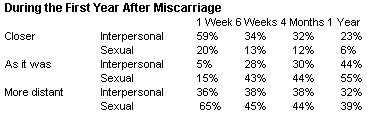
Results of the study showed that women who perceived their partners engaged in mutual sharing of feelings and experiences claimed to grow closer interpersonally and sexually. When partners failed to do things that showed they cared, women felt abandoned. These results combined with the findings of others (2) that men tend to keep to themselves after miscarriage deny their own loss, engage in avoidance, distract themselves through work and, if highly self-critical, experience greater despair and difficulty suggest that couples may need coaching in how best to care for each other after miscarriage.
Should you find that your partner experiences feelings of grief at the same intensity and duration as you, count yourself fortunate. Grief, by definition an extremely uncomfortable emotion, when shared and reflected accurately by another, tends to wane and can actually strengthen us over time. Creating supportive rituals to acknowledge and soothe one another’s pain are tremendously helpful for those who have experienced a miscarriage. Funerals, wakes, and birthday and anniversary routines all serve to give parents healing time; honoring the role that the “child to be†continues to play in their family and restoring a sense of meaning to the loss.
It is important to normalize the fact, however, that men and women tend to experience the impact of miscarriage differently. Coping with loss is a unique experience for each of us and there is no “right way†to go about it. Women, in general, do not need to learn to toughen up and let go. Nor do men need to soften up and express themselves more deeply. Often we choose our partners precisely because of these differences. The health of our long term commitment to one another depends on remaining curious and respectful of how those differences evolve over time.
Should weeks of estrangement from your partner’s grief become months (or years), it would be a good practice to explore new pathways for connection. The topic of miscarriage may seem still terribly hurtful to one, and all but forgotten to the other. Remember that getting outside help is appropriate at any stage of grief. Couples counseling provides neutral territory for safely acknowledging the new terrain of your marriage and what new shared coping strategies might still be available.
References:
(1) Miscarriage Effects on Couples’ Interpersonal and Sexual Relationships During the First Year After Loss: Women’s Perceptions
(2) Kristen M. Swanson, RN, PhD, FAAN, Zahra A. Karmali, BA, Suzanne H. Powell, BS, BA and Faina Pulvermakher, BS, MT (ASCP)
Psychosomatic Medicine 65:902-910 (2003)
© 2003 American Psychosomatic Society
 I have been in practice long enough to see many couples and families develop over the past thirty years. While there are countless stories over a full range of topics, one that greatly interests me involves divorce.
Many couples and individuals have come to counseling after divorcing 15, 20, or 25 years earlier. Most are quite happy in their current lives and marriages. Many, however, have looked back on their previous marriage with one very powerful observation:Â Their original divorce did not need to happen!
What an astounding realization! Not only was I impressed by their honesty, but I was also amazed they could look back on their divorces and understand them in a completely new light.
So, what is this all about? As I spoke with these couples it became clear to me that they were looking at how they previously managed emotional reactivity, and how that dovetailed with divorce. Every couple has to manage conflict, but the business of managing emotional reactivity, which is part of managing conflict, is not easy. Knowledge of how the brain works and how to use the brain to one’s advantage is critical to managing reactivity, especially intense reactivity.
Specifically, there are two brains that come into play when managing reactivity. Those two brains are the prefrontal cortex, and the limbic system. The prefrontal cortex and the limbic system are often referred to as the logical and emotional brains, respectively.
Here is a quick overview: the prefrontal cortex is the brain that allows us to make decisions, reductions, inductions, calculations, etc. The prefrontal cortex is the CEO of the brain. The limbic system, otherwise known as the mammalian brain, is the center of all emotions. The limbic system possesses all the pain centers, the pleasure centers, and is the part of the brain that has a very unique connection to the prefrontal cortex. It is the fight-or-flight-brain, among many other things.
Here is how the two brains work in concert: when the limbic brain is activated, it sends an amount of adrenaline up to the pre-frontal cortex commensurate with the degree it wants to inhibit pre-frontal cortex functioning. In short, adrenaline inhibits the pre-frontal cortex from thinking.
Those two brains, in effect, operate in opposition to one another. It is a survival function that allows us to take action without having to think first. Another way to think about these two brains is that they often function inversely. When limbic activity is up, pre-frontal cortex activity is down, and vice versa.
In practical terms this means that the limbic system will inhibit an individual from thinking clearly when they are feeling intense emotions. That is why, in the middle of a heated argument, people may say and do things they wish they could take back—things which sometimes lead to divorce. The one thing that is very important to understand about the brain and conflict is that the limbic brain always wants relief. And the fact that it wants relief is not enough: it wants relief NOW! The lengths to which an individual will go to get relief can include divorce.
An unfortunate artifact of those couples who are in constant conflict is that they become so tired of chronic conflict, and the intense emotional reactivity that comes with it, that they will do anything to reduce their emotional reactivity. When the high emotional reactivity has persisted for many months, or in some cases for many years, couples will often decide to get a divorce. They just can’t stand “it†anymore: they want relief.
After a rear-view look in the mirror several years post-divorce, some couples have realized that had they known how to reduce their reactivity as a way to get relief, they may have been able to avoid a painful divorce.
The Catch-22 that comes with divorce as relief is that the divorce process, rather than decreasing reactivity, actually increases it. That is one of the reasons depression often accompanies the divorce process, especially a protracted one. Ironically, a couple may not experience the emotional relief they went down the divorce road looking for until many years later.
That is why it is very important when seeking couples counseling that the couple and the therapist both understand how the brain works. In addition, the therapist must know how to teach a couple to manage emotional reactivity. Once emotional reactivity is managed consistently, then a couple is able to determine whether or not divorce makes sense.
Divorce as an emotional reactivity reduction strategy is not the best way to achieve emotional equilibrium. In fact, is possibly one of the worst ways to reduce reactivity, while couples who have a smooth divorce process tend to be very effective at managing emotional reactivity.
My purpose in cautioning against “relief divorce†is not to moralize against divorce. Clearly there are many couples for whom divorce is the viable alternative, and it may have little to do with reducing emotional reactivity.
Overall, it is important to understand the distinction between divorce as relief from intense emotional reactivity, and divorce that is not about relief of that sort. Remember: reducing emotional reactivity will allow you to think more clearly about the marriage, and also about divorce, because the pre-frontal cortex will not be inhibited by limbic activity.
Reduce emotional reactivity before you choose divorce. You won’t regret it.
 I can’t tell you how many times I have heard this from couples during a session. Something big happens between them, like one person cheated, the offending party apologizes but the difficulty continues and the person who said sorry wonders why. The person who got hurt wants to feel better. The person who has apologized becomes exasperated because he or she feels they have done everything they can. “I said I was sorry. What else do you want from me?”
Unfortunately this is frustrating for both people. Each person wants to feel better, yet both feel like something is unfinished. The person who hurt the other wants to make their partner whole, but the words “I am sorry” are just not enough. Why not? Why aren’t they enough? Why isn’t just saying I am sorry for what I have done to you enough?
If it were enough we wouldn’t be talking about what isn’t finished. And what’s not finished is the healing that the wounded feels and continues to experience. The person who got wounded is usually in some deep pain. When the person who caused the hurt says “I am sorry”, that usually lifts the guilt of the person who offended, but it doesn’t begin to heal the deep pain the offense caused. That’s why just saying “I am sorry” is not enough.
So what would be enough? What can couples do to really fix a gaping whole that exists between them? The first thing I like to help couples do is understand what happened. It’s much deeper than explaining what a person did to the other. Often couples feel that if they talk about the problem one time, it’s all done. Unfortunately many couples will delve into a difficult topic, talk about it once, and then both will feel the issue is settled. But it’s not. I know that the first conversation is crucial, but it is only a very first baby step. That’s all, just one little tiny baby step.
Think about it. You are wounded by your partner’s infidelity. You are devastated and you don’t know if you can forgive and forget at this moment. Your world is rocked and you aren’t sure if you will even be able to go on living with this person. Now your mate sees your condition and says to you, “I love you. I am so sorry for what I have done. Will you forgive me?”
In a moment of feeling lost and alone you hear those words and they feel like medicine on a very hurt heart. Your partner says he or she is sorry, that they love you, and that they want you to forgive them. They promise they will not leave you and they deeply emphasize how truly sorry they are for hurting you. You feel so sad and lost you just want to make everything better, like it was before you were wounded. You want this so much you say with all the hope in the world, “Yes. I forgive you. I love you too.”
And for the moment you really believe you will be OK. In that one magical moment you hope you will be able to go back to the way you were and make everything the way it was before the affair, before you knew any of this.
And everything is OK for that moment. But that moment doesn’t last very long because in your mind the next image you have is of your partner with the other person. You start to wonder when he or she stopped being faithful to you and became interested in another. You start to think about times when he or she might have lied to you. You begin to wonder about the moments you might have suspected something but you brushed it aside because you believed they would never do anything like that to you. You knew in your heart they could never do anything like that to you.
You live afraid that everything you know is crumbling and you don’t know what to do. You can’t move. You live in disbelief that the one who you committed yourself to has been unfaithful. You try and bring up some of these feelings because they are eating you alive. You try and talk to your mate but when you bring up the subject he or she gets angry and says, “I already said I was sorry. What else can I do?”
Healing after a breach like infidelity takes time and work. An apology is a place to start, but that is all it does; it open the door to the next process. And that next step includes understanding what happened, for both people, and asking all the hard questions like, “Do you still want me?”
To learn more about apologies, anger, and infidelity, contact Linda Nusbaum and read Linda’s blog about couples and relationships.
 “I don’t know.†Is it the stock answer teens give their parents for every question? Does it mean more than just a lack of an answer? How do we get them to speak to us and to have a conversation? There are ways to talk to teens, develop relationships through communication and not feel like an interrogator.
To get around the “I don’t knowâ€, start by changing your attitude, mood, and how you start the conversation. Connect with them with a high energy greeting showing your good disposition. The frame of mind that you display sets the tone for the conversation. A high energy, happy greeting and smile goes a long way towards setting the mood and showing your child that you are happy and that they have nothing to fear by being open and honest with you. Teens, unless they prove to you otherwise, want their parents to be proud of, and accepting of, them. Set the stage of your conversation so that they are comfortable; help them by making it as easy as possible for them to talk to you. Ask questions that cannot be answered with just a simple ‘yes’ or ‘no’ response.
“I don’t know†is a response with many different meanings; it can be “no one has asked me that before†and “I genuinely have no idea how to answerâ€. This is your chance to be silent and let them mull it over for a few moments. When you are silent, it puts the emphasis back on to the adolescent to come up with an answer. Show them that you are interested and receptive to what they are going to say. Your body language conveys your curiosity – lean forward, face them, make good eye contact without being overbearing, and be aware of the voice you use when you talk. After a few moments of quiet, change the question subtly but ask them the same basic question; continue to show them interest. You can give them an idea by rephrasing your question to help spark their response.
At times, the response “I don’t know†means, “I have thought about it and I really do not have an idea or opinion one way or anotherâ€. If you think their response means this, clarify it with them. This is a valuable time to teach them and to share yourself openly to increase trust and amplify the quality of your relationship. Kindly ask questions and have a conversation about their thought process, find out where they were stuck in searching out an answer. You can share your experience in how you would answer the question that you had asked. When you share about yourself, keep it simple, brief and to the point. Remember that the conversation is about your child and their concerns; they have to grow and learn to live their own way.
Occasionally “I do not know†can mean, “the question you asked me is a poor oneâ€, or “I do not understand what you are asking meâ€. After you have given your teen a few moments to come up with a better answer and they appear not to understand, clarify your question by asking it in a different way. Remember to avoid asking “why†questions. These questions start with “whyâ€, or include only the word “whyâ€. Often people do not understand why they did something, but just went through an action without a lot of consideration. When you ask someone “why”, they are often put onto the spot and have to come up with a reason for their act instead of working with you to increase understanding. A teenager put on the spot is frequently going to say anything that pops into their mind instead of really thinking through what they are being asked; hence, parents often are told, “I don’t knowâ€.
Lastly, “I don’t know†can signify “I do not want to talk to youâ€, or “I do not want to talk about that subjectâ€. There are many ways to defuse this situation, including silence with receptive body language, clarifying that you need an answer, and giving an example answer. An additional way to communicate when told “I don’t know†includes explaining to your teen that you understand that it is a sensitive subject and that you respect that they may not want to talk about it. You can respect and understand that it is sensitive to them and you will treat them with respect, and offer to talk to them about the subject later or when they are ready, or after you both take a break from the conversation.
As your child uses “I don’t know†to push you away and tell you they do not want to talk to you, explain that your conversation is important and that you want to understand what is happening or are seeking an explanation. Offer to help them help you, and seek out ways to understand what is happening when they push you away with their words. Avoid creating a confrontation and an argument because you cannot make them talk to you; getting into an argument works to their advantage to avoid discussing what you are asking. Recognize when you are getting upset or your teen is trying to get away from the conversation. Be receptive to letting the conversation wait for a better time in order to avoid a fight. As they keep using “I don’t know†time and again, recover the conversation by explaining to them that you know what it means and that you are trying hard to communicate, respect them, and their opinions.
Talking to your children does not have to feel like a cross-examination, but can instead be satisfying banter. Remember, “I don’t know†means: “no one has asked that before”; “I really do not know”; “I do not have an answer”; or, “I do not want to talk to you”. You can try different means to get past the dismay that “I don’t know†causes parents and adults. Keep your body language receptive and encourage communication with your silence, clarify your question, relate about yourself and explain that you understand them. Following these steps can help you increase communication and fortify the relationship you have with your child.
 “I’ve made up my mind,” Dana sighed deeply. “I’m going to stick it out–for the kids. I won’t cheat. I have no intention of that and I don’t believe he would either. We are two straight-arrow people. But there’s nothing there. We have nothing, absolutely nothing to say to each other. The marriage is basically dead; we just didn’t plan the funeral.”
“That is tragic. Marriage is supposed to be a friendship, not a zero,” I said. “How did this happen?”
Dana didn’t know. At first, she couldn’t put her finger on it; then she hesitantly said, “Maybe I withdraw when I get hopeless. Maybe that’s it.”
She explained how, in the early years, she would tell her husband many times what she wanted, needed, thought, or felt. And when nothing changed, she eventually gave up. “It just dried up like an autumn leaf,” she sighed again.
Dana’s situation is typical of many couples—and it needn’t be.
Here are six questions for Dana to consider:
1. Was there a time when she and her husband were able to talk?
Looking back at the early days, most people can remember that talking to one another was not a problem, that there were always things to say and lots to hear. If listening was once fun and talking felt like there was a real audience, then there is hope. If you once had a connection but lost it, then that connection can be found again. Instead of thinking about not getting her own needs met, perhaps Dana can start listening to what her husband is saying. If she can understand what he wants, then perhaps that can be a starting point for later requesting he listen to what she wants.
2. If there was a time when Dana and her husband could talk, then is there something she may have done to contribute to the current problem?
If indeed Dana and her husband enjoyed talking to each other, then honesty requires some soul searching. Perhaps if Dana looks inside, she will notice that things shut down when she started to ask for what she wanted but her husband was unable to do the same thing. Or maybe they both asked for what they wanted but each person was thinking more about their own unmet needs than fulfilling those of their partner. Alternatively, maybe each would have liked to fulfill the partner’s needs but lacked the tools to know how, or even to understand what the partner wanted. Bridge the gap with some good, strong questions. For example, ask your partner: “Do you know what I want in this marriage?†Or, better yet, ask: “Is there something I could do differently to improve things?â€
3. If Dana and her husband could not talk, did they feel close anyway?
There are people who were never good talkers, but they had great sex or lots of affection and that made them feel close. Just having shared life experiences can bring people close. And if that is the case, then maybe expecting to talk later on is not quite fair. If Dana knew that her partner was not a big talker going into the relationship, then now isn’t the time to say, “Oops, I made a mistake.” Perhaps Dana can consider how to re-capture the original affection. How about taking time to date? Dates that don’t call for talking but do call for interacting such as bowling, miniature golf, rowing, and rollerblading come to mind.
4. What do Dana and her husband both care about? Do they have values, passions in common?
Even if the relationship was never close, can this couple start from the ground up and build on commonalities? Dana mentions that neither one of them will cheat because they are both “straight arrows.” That’s a pretty important value in common. What goes along with that? How could they make that the basis for creating something good out of things that they never considered before?
5. Is there one quality in Dana’s husband that she admires or respects?
Good marriages are built on respect. So, even though Dana and her husband could not talk, it could be that there is something respect-worthy in Dana’s spouse, but she was so focused on not getting her needs met that she lost sight of that. Perhaps Dana could give some thought to what other people like in her husband so as to be able to view him with fresh eyes. How do the children view their dad? How about lifelong friends? Co-workers? Extended family? Neighbors?
6. Has Dana’s husband introduced her to something positive that she can appreciate?
Dana might ask herself if her husband gave her some “gift,” an interpersonal gift, not a tangible thing, that was special. For some people, it could be a sense of humor; for others, it could be the ability to stand up for oneself; for still others, it could be the ability to organize. It could be a silly thing or a heavy thing. Regardless, I’ve noticed that nearly everyone, no matter how annoying, distant, even mean, that they can be, has a gift to offer. It’s not something they even intend to give, but just by being whom they are, they demonstrate a good trait, a trait that their partners would love to have. So can Dana fish out from within her what it was that she “got” from her partner that she never had before?
In this list, you may be surprised that one question I did not ask was, “Do you love him?” That is because feelings change instantaneously. I was at a workshop recently where therapists were learning a new technique. They had to pretend to be one of their clients and express their clients’ feelings about some problem. It was fascinating how negative all the attendees in the room felt after that! And everyone was a therapist! When you get into a negative mood–even when you’re pretending—something bad sticks. Moods fluctuate depending on how the relationship is going at that time.
Love – or the absence of it — is the same way. We can think it’s gone, but that may only be a function of this disconnect you’re experiencing right now. Dana and her husband can work on the suggestions here; watch to see what improves, and then see if their attitudes don’t change, too. Maybe then the ships would consider dropping anchor, sending up flares, and finding out what’s going on.

How often do you want sex? And is that enough? But the majority of these women are heterosexual with male partners who are – you guessed it – complaining. So I guess I should say “relatively low levels of sexual desire!”
Over and over again I’ve found that moving in together does create a drop in the frequency of sexual activity for all couples regardless of gender. Long distance romance remains exciting because it provides space and distance interspersed with sexy weekend liaisons. But which is “normal” – the level of desire we experience early in a relationship or what unfolds later on?
Research consistently shows that low sexual desire affects 10-20% of women generally, with some studies finding that 40% of midlife women report low sexual desire. However, approximately 1 in 3 women experience low sexual desire at some point, making this one of the most common sexual concerns.
This is why couples therapist Esther Perel points out that “good intimacy doesn’t always guarantee good sex.” Her book Mating in Captivity explores the paradoxical union of domesticity and sexual desire, examining what it takes to sustain passion in long-term relationships. In it she points out that “the very elements that nurture love – reciprocity, mutuality, protection, closeness, emotional security, predictability – are sometimes the very things that stifle desire.”
So these guys start to feel like a brother or worse yet a child, and sex with family members is a definite no-no in our culture. Children and pets need caregiving, which we provide as an act of love.
Recent research on heteronormativity theory supports this observation, showing that unequal distribution of household labor places considerable burden on women, leading to feelings of inequity and exhaustion that ultimately diminish desire. The blurring of maternal and partnership roles, where women often find themselves mothering their partners, can lead to feelings of overwhelm and decreased desire.
Research conducted with married women who experienced desire decline found three core themes: institutionalization of the relationship, over-familiarity, and the de-sexualization of roles. For some women, formalizing their relationship through marriage made sex so available and sanctioned that it lost the forbidden and erotic quality that had formerly ignited passion. For others, overfamiliarity with their partner led to a decline in romance and sexual experimentation, as well as loss of motivation for self-care once they had “secured” their relationship.
A third group of women reported that holding down a job, being mom, and being a wife was overwhelming and “highly desexualizing,” making it extremely difficult to shift into romantic mode after changing diapers and fulfilling their professional roles. Many of the participants in all three groups specifically noted that while they were committed to their marriage, they thought desire would return if someone new came along who desired them.
As researchers now understand, women’s desire may be driven to the same extent as it is in men by novelty and excitement. The idea that female desire is simply about loving somebody has proven to be an oversimplification.
Over and above anyone else, we are our own point of reference for how sexy we are. Feeling good about ourselves emotionally and physically appears to be a bigger mediator of female desire than relationship factors alone. Research shows that sexual self-esteem, sexual desire, and sexual assertiveness all correlate positively with sexual function in women. This certainly bears out in my conversations with female clients.
Recently, for example, a woman told me that she no longer wanted to have sex “on top” of or astride her mate, “because my stomach sticks out and it would look terrible to him from that angle!” He shook his head, “Honey, I probably don’t even have my eyes open … that used to be your favorite position because it felt best to you … what else could possibly matter?”
*If you’re experiencing concerns about sexual desire, consider reaching out to one of our qualified therapists who specialize in sexual health and relationships.*
Gewirtz-Meydan, A., Sowan, W., Estlein, R., & Winstok, Z. (2024). Rights or obligations: The extent to which sexual desire and gender roles determine sexual intimacy in romantic relationships. Journal of Sex & Marital Therapy, 50(5), 482-497.
Johansen, E., Harkin, A., Keating, F., Sanchez, A., & Buzwell, S. (2023). Fairer sex: The role of relationship equity in female sexual desire. Journal of Sex Research, 60(4), 498-507.
O’Kane, K. M. K., Goldberg, S. Y., Bouchard, K. N., & Dawson, S. J. (2023). Debunking desire: Sexual science, social media, and strategy in the pursuit of knowledge dissemination. Archives of Sexual Behavior, 52(3), 1087-1099.
Peixoto, M. M., Amarelo-Pires, I., Pereira, H., & Nobre, P. (2023). Solitary and dyadic sexual desire and sexual satisfaction in women with and without sexual concerns. Journal of Sex & Marital Therapy, 49(1), 77-87.
Perel, E. (2006). Mating in captivity: Unlocking erotic intelligence. Harper.
Rowen, T. S., & Goldstein, A. T. (2024). Sexual desire and pharmacologic management. Obstetrics and Gynecology Clinics, 51(2), 259-271.
Sims, K. E., & Meana, M. (2010). Why did passion wane? A qualitative study of married women’s attributions for declines in sexual desire. Journal of Sex & Marital Therapy, 36(4), 360-380.
Thomas, H. N., Brotto, L. A., de Abril Cameron, F., Yabes, J., & Thurston, R. C. (2023). A virtual, group-based mindfulness intervention for midlife and older women with low libido lowers sexual distress in a randomized controlled pilot study. Journal of Sexual Medicine, 20(8), 1060-1068.
Wainberg, M. L., Muench, F., Morgenstern, J., O’Leary, A., Foote, J., Krupitsky, E., & Silverman, E. (2018). Prevalence and predictors of sexual problems among midlife Canadian adults: Results from a national survey. Journal of Sexual Medicine, 15(6), 873-879.
References:
- Gewirtz-Meydan, A., Sowan, W., Estlein, R., & Winstok, Z. (2024). Rights or obligations: The extent to which sexual desire and gender roles determine sexual intimacy in romantic relationships. Journal of Sex & Marital Therapy, 50(5), 482-497.
- Johansen, E., Harkin, A., Keating, F., Sanchez, A., & Buzwell, S. (2023). Fairer sex: The role of relationship equity in female sexual desire. Journal of Sex Research, 60(4), 498-507.
- O’Kane, K. M. K., Goldberg, S. Y., Bouchard, K. N., & Dawson, S. J. (2023). Debunking desire: Sexual science, social media, and strategy in the pursuit of knowledge dissemination. Archives of Sexual Behavior, 52(3), 1087-1099.
- Peixoto, M. M., Amarelo-Pires, I., Pereira, H., & Nobre, P. (2023). Solitary and dyadic sexual desire and sexual satisfaction in women with and without sexual concerns. Journal of Sex & Marital Therapy, 49(1), 77-87.
- Perel, E. (2006). Mating in captivity: Unlocking erotic intelligence. Harper.
- Rowen, T. S., & Goldstein, A. T. (2024). Sexual desire and pharmacologic management. Obstetrics and Gynecology Clinics, 51(2), 259-271.
- Sims, K. E., & Meana, M. (2010). Why did passion wane? A qualitative study of married women’s attributions for declines in sexual desire. Journal of Sex & Marital Therapy, 36(4), 360-380.
- Thomas, H. N., Brotto, L. A., de Abril Cameron, F., Yabes, J., & Thurston, R. C. (2023). A virtual, group-based mindfulness intervention for midlife and older women with low libido lowers sexual distress in a randomized controlled pilot study. Journal of Sexual Medicine, 20(8), 1060-1068.
- Wainberg, M. L., Muench, F., Morgenstern, J., O’Leary, A., Foote, J., Krupitsky, E., & Silverman, E. (2018). Prevalence and predictors of sexual problems among midlife Canadian adults: Results from a national survey. Journal of Sexual Medicine, 15(6), 873-879.
 It’s a classic. Of all the themes in the history of relational strife, the I’m Right, You’re Wrong story is by far the most common.
Like many things, we often take this argument for granted or overlook the magnitude of its influence. When couples enter into therapy together, it may be a hidden goal for each of them to convince their therapist that one of them is right and the other is wrong. They demonstrate this in many ways—either subtly or in more painfully blatant ways. By doing so, they hope to feel validated, and that feels good.
Being right gives you a rush of dopamine—the brain chemical associated with winning and victory. You may feel strong—even invincible. The problem with needing to be right is that if we hold it too tightly, it becomes a necessary component for feeling good in the relationship. Any time you are outsmarted, out-shouted, or out-whatever, you feel bad in the relationship. So if this is the game you’ve set up for yourself and for your partner, the relationship cannot logically thrive for both of you. When one is right, that partner is elevated to a higher power position and the other is knocked down a peg.
Effectively, this game creates division. We all want to be on the right side of the wall—not the wrong side. But that means your partner has to be on the wrong side. The more this dynamic is strengthened, the thicker that wall becomes, creating more division. You may feel nice and superior on your side of the wall, but you are drifting further and further from your partner. You become less connected, less caring, and may end up contributing less to the relationship.
[fat_widget_right]If you are convinced you are not the problem, and it is your partner that needs fixing, how does clinging to this belief affect the way you treat them or your attitude toward them? In therapy, I am never going to argue whether or not something is true. I am only interested in what works. What is it going to take for you to increase intimacy, compassion, and loving action in your relationship? I’m guessing that being right hasn’t worked so well in the past. Let’s try something different.
The first step will be to knock down that wall. After all, it isn’t made of bricks and mortar, but simply attitudes and beliefs that you alone are holding in place. How do you knock it down? Simply let go of it. Loosen your grip on it, and you will start to see it crumble. Let it go completely, and it will completely disappear.
One way to do this is to give your story a name or a title. The next time it comes up, say to yourself, “Here goes I’m Right, You’re Wrong again.†By doing this simple exercise, it creates a cognitive space between you and your thoughts about being right. It is the difference between being right and just being while having the thought about being right. It may not sound like a huge shift, but try it. You may find it makes a big enough difference that you are not compelled to react in ways that you might have when you were fused to your beliefs about being right.
Put down your weapons, and take off your armor. Nature has endowed us with the proclivity to feel protected and safe, so stripping your defenses may feel vulnerable and weird. This is the part where you have the uniquely human freedom to make an important choice. Many will take a quick look at the prospect of being unguarded and will clench their armor even more tightly. Being vulnerable means you might get hurt. But how do you expect to be intimate while swathed from head to toe in battle armor? Intimacy is best experienced naked—physically and emotionally. Vulnerability is an essential part of being open and deeply connected, and it’s a risk. There’s no other way, but once you make the choice to get naked—so to speak—the rest can be pretty fun.
 Even when it is unintended, some people find it intolerable to hurt someone they love. To experience hurting the other can create shame, guilt and strong “I am a bad person†feelings. As a result, we may avoid saying what is on our mind and put aside our own feelings and needs. This inhibiting of the self can be harmful to our relationships and can create the conditions for developing anxiety and depression.
Marlene, a 27 year old married woman, came into my therapy office feeling anxious and depressed. She described how unhappy she was in her marriage to Ben. She told me she loved her husband but was feeling like she was in a straight jacket. If she expressed a need that conflicted with his wishes, his feelings would get hurt. She couldn’t tell him that she didn’t want to play tennis with him every weekend or that she was tired of going out every Friday night with his friends from work. She explained to me that when she told him these things, he told her that she made him feel unimportant, criticized and pushed away. She felt ashamed that she was the cause of his feeling so terrible. She would apologize to him and try to keep her feelings to herself, but then she would attack herself and feel like a bad person. She was shutting herself down and feeling depressed. She also reported that when she was aware of a need that she felt she shouldn’t express to Ben, she would get anxious for fear that she couldn’t contain herself.
What Marlene described to me suggested that she had issues she needed to work on as an individual and that as we did this she would be more able to address the difficulties in her relationship with Ben.
While Ben might be particularly subject to feeling hurt or slighted, Marlene’s inability to tolerate hurting Ben and talk with him about these issues, made the relationship difficult. It also became apparent as I spoke with Marlene that she suffered in all of her relationships by worrying how she was impacting on everyone. She had never considered that we all hurt people, even those we love, unintentionally. She didn’t understand that it is impossible to be in a relationship without hurting those we love. When I suggested this to her, it didn’t make sense. How could she possibly bear watching Ben be so hurt? She would have to give him what he wanted.
As Marlene and I talked, I wondered what made it so painful for Marlene to consider that something she said or did had the unintended consequences of hurting someone she cared about. I asked Marlene how she thought she got the idea that it was totally unacceptable to hurt someone she loved. We also explored Marlene’s idea that when someone feels hurt they are horribly harmed. Marlene thought my questions were strange. How could it not be painful to see someone you love hurting because of you? How could you not feel like a very bad person? Of course hurt causes terrible damage. I replied that it was appropriate to feel sorry or sad that you had been the cause of someone’s hurt, but that it didn’t have to make you feel like such a bad person. I said that you can’t always be sure how the hurt is affecting someone unless you are told or ask. Each hurt is different. I said that these experiences could be talked about and the other person might be able to listen and understand the intent. I added that this was something she could work on with Ben.
Marlene considered my ideas with some skepticism. She remembered how her mother would get so hurt when she was little. She had one memory where her mother started to cry and tell her how hurt she was when Marlene didn’t like the dress she was given for her sixth birthday. She recalled how her mother told her how much Marlene hurt her feelings and how could Marlene not appreciate all the time and money her mother had spent to pick out such a perfect dress. Marlene remembered how scared she was when her mother was so distraught and how much shame she felt to have done such harm to make her mother feel that way.
Over the many months that Marlene and I continued to talk in therapy, she began to make connections between how her mother, on many occasions would be hurt if Marlene didn’t have the “right†response. She became clearer that she would do anything to ensure that she was not the cause of her mother’s distress. In fact, Marlene had given herself the job of making her mother happy. As Marlene became aware of this, she also began to realize that with her strong need to keep her mother happy and not cause her any hurt or distress, she had learned to overlook her own needs and desires, especially when they conflicted with what she knew her mother needed.
When Marlene talked about how she had learned to disregard her own wishes and squelch her own voice, she started to make connections to her behavior with Ben. Her fear of increasing Ben’s hurt when their needs conflicted, gave way to the idea that maybe she could talk with Ben about this. She recognized that Ben’s reaction when he was hurt was nothing like her mother’s intensely distraught response. Perhaps, there was a way for them to talk and negotiate and consider both of their needs.
In fact, Ben was surprised to learn that Marlene was scared to assert her needs for fear of hurting him. He told her that even though he felt hurt, he didn’t feel she had done any harm to him. He told Marlene that he didn’t think he was so fragile. He thought he could try to consider that when she expresses her needs, it didn’t have to mean that she was dismissing him. He told her he wanted to keep talking about this. He knew he could get hurt easily, but he didn’t want it to affect Marlene by causing her to inhibit her thoughts and feelings.
Marlene continues to come to therapy to work on becoming more comfortable expressing her own thoughts and feelings and dealing with her impact on those around her. She has gotten much better at dealing with conflict and asking for what she wants in the world. She is worrying less about being a bad person. Marlene has become more tolerant of herself and more respectful of her right to say what she wants. She is increasingly able to say no to what someone she cares about wants and risk the possibility that they will feel hurt. As she is able to allow fuller expression to her true voice, she is feeling less anxious and depressed. She and Ben are doing better at talking with each other and they are much more able to address the conflicts between their needs in a constructive and loving way.
When we become overly interested and vigilant about the impact we have on others and design our behaviors to make sure they don’t have feelings we can’t tolerate, we are putting our authentic selves on hold. This denial of who we are causes us to build up feelings consciously and unconsciously. Preventing ourselves from expressing what we think and feel, and shutting up our true selves, puts us at risk for anxiety and depression. If we can learn to become more comfortable with how we impact others, and address what we think our impact is, instead of trying to control the other’s feelings, we will be promoting the development of our true selves.
 If you read last month’s blog, Creativity vs Shadow, you will remember a brief mention of Deepak and Gotham Chopra’s book, The Seven Spiritual Laws of Superheroes. In the book Chopra identified shadow as a “force of the unconscious that can be destructive, divisive and/or self-sabotaging if it remains unconsciousâ€. Shadow is difficult to recognize because left to it’s own devices it remains unconscious. Shadow is a zapping energy that lurks in the area of emotional suffering caused to oneself or to another. The concept can be broadly applied to families, groups, religions, governments, countries, etc. if we consider them bodies of energy.
It is often easy to recognize someone else’s shadow energy because it is not unconscious to us. It is recognizable it in the behavior of someone who is ‘acting out’ or conversely, someone who appears emotionless. Pointing out someone’s shadow is often met with resistance because shadow is tenacious. It develops as a coping mechanism over time. It pulls vital energy to it to enforce its stronghold.
Shadow is often the very issue that brings someone into therapy, although they may not recognize that aspect of themselves when they begin therapy. They come to therapy because they are suffering in some way and are looking for relief. Often therapy provides relief by helping people to understand their part in their own suffering and to develop new strategies to cope with their emotions.
Art therapy is a powerful tool for helping to get in touch with shadow. Art therapy brings images out from the unconscious to the surface where they can be experienced and felt through the senses and processed verbally. Creative arts therapies can include painting, drawing, collage, movement, sound, video, performance art, writing, dreams, digital media: such as dating profiles, pornography choices, avatars, gaming environments, etc.
Therapists often try to help clients to transform their emotional suffering (shadow) into well-being (freedom) through awareness and change of behaviors that do not ultimately serve their goals. Many of the blogs here on Good Therapy.org provide examples of shadow work. For example: Darren Haber, MFT, Addictions & Compulsions Topic Expert Contributor wrote about The Abused Husband a topic that is gravely under-reported. In Haber’s scenario, the most obvious example of shadow resides with the abuser. The abuser often does not know how s/he gets caught in the cycle of abuse that often escalates and can become very dangerous. The abused person on the other hand, not only suffers the abusers wrath but s/he is not able to understand how to stop the cycle of abuse by recognizing their complicity in it. I realize that my statement may jar strong reaction. Abuse is a dynamic between people. Darren Haber’s blog also contains a subtle example of shadow in the Abused Husband scenario. It resides with the onlooker who “even pumped her fist happily as she watched the woman slapping her partner.†Shadow is present in any violent act, or superficial judgment against another. In this example the onlooker’s shadow was triggered. It is particularly difficult to unravel a dynamic of abuse when it involves people whose lives are closely bonded.
Shadow is the part of the self that most humans get glimpses of but ignore or deny in favor of a self-perception that is ‘inflated’ or in some cases ‘deflated’ by ego. Neither ego inflation nor ego deflation can be sustained without some form of destructive result. For example: Jim Hutt, Ph.D., Family Problems Topic Expert Contributor too Good Therapy.org recently wrote in his blog, Resentful Compliance vs Commitment about a relationship where one person is “resentfully compliant†by doing what their partner wants, while they are “resentful about doing itâ€. Resentment falls to shadow. The resentful person may say to themselves, “oh, it doesn’t matter that my partner is getting their way again, it’s no big dealâ€, (ego deflation) when in actuality, resentment grows into a big deal because their true feelings are denied. The result can often be passive-aggressive behavior. The other partner may think that there is nothing wrong with being persistent and that getting their way is a sign of strength (ego inflation). Oftentimes that ego inflation comes out of a profound fear and vulnerability. Most of the time, without realizing how they are complicit in the toxic environment of the relationship both parties continue to project their emotions out onto the other.
In therapy, the therapist encounters shadow in the painful experiences that their clients share. The therapist and client build a safe relationship where shadow can be explored. Shadow is very difficult work because of resistance. The outcome of examining oneself and facing what has happened in one’s life, however, gives a person freedom to create change and use the wealth of energy that was tied up in shadow.
 Yesterday Ellen walked into my office looking annoyed and confused. “I don’t know what to do. Robin invited me to her wedding and I don’t want to go, but I think I should. It’s a destination wedding, a long weekend in Mexico- four days! It might be fun but I can’t afford it, and I can’t take time off from work either. But I have to go.â€
“Why do you have to go?†I asked.
“Because of what happened. Her parents both died in an auto accident last year, and she will feel awful getting married without them.â€
“That is tragic. Who is standing up for her?â€
“Luckily, Robin has brothers and a sister, aunts, uncles and cousins- a big family, and they will all be there.â€
“That’s good. Are you and Robin close friends?â€
“No. But I helped her out a lot when her parents died, and I feel like I have to go. I’ve been worrying about this all week, ever since I got the invitation. I went out and charged plane tickets and bought some really nice presents right away. Maybe I can find somebody to share a hotel room so I can save some bucks. I’m really over my head financially. I just can’t afford this…..â€
“You feel you have to go, even though you can’t,†I said.
“What should I do? I’m driving myself crazy.â€
“Well, explain to me why you think you have to go.â€
“I told you, Robin’s parents died in an accident.â€
“That’s awful, but why does that mean you have to go to the wedding?â€
“To make up for her parents.â€
“Oh, can you?â€
“Of course not. But Robin expects me to be there. What should I do?â€
So there you have it. That’s the problem. Ellen wanted me to tell her what to do, but I thought it was more important for Ellen to figure this out for herself. Perhaps I’ll tell you her decision- but maybe it’s more interesting to ask you what you think about the situation she found herself in. Difficult decisions like this have to be made by the person involved, not by the therapist. There are many answers; Ellen has to find out what is the best answer for herself. What does she really want to do? Maybe we can figure it out.
We have some clues to help with our detective work:
- Ellen bought the tickets immediately, even though she couldn’t afford to.
- She bought wedding presents- more than one, right away too. And she charged everything.
- After she spent the money, she worried about going. Ellen really didn’t have the money or, equally and maybe more important, the time. She had just started a new job and had no vacation time. Her boss might not like her taking time off right away.
- She feels like she HAS TO go. She never said she WANTED TO GO. I wondered if she was feeling guilty in her relationship with Robin. Ellen told me once that she feels like she has a charmed life- a loving family, a promising relationship, and a meaningful vocation. Robin’s life, by comparison, is far from charmed. Her parents both died young, her career is not going well. She is getting married, though. And, unlike Ellen, she has no money problems- she came into a lot of money when her parents died.  Clearly, she would rather have her parents and not the money, but a hefty financial back up is some compensation.
- There are lots of things we all have to do; was going to the wedding a “have to� It conflicted with Ellen’s job obligations; she was afraid her job might be in jeopardy if she just took time off. It was not easy to get this job, and she really liked it and needed it too.
- Ellen didn’t seem very excited about Robin’s wedding. Was she envious because she wanted to get married too?
- Ellen seemed stuck between obligation and generosity. If she really wanted to go, she would deal with the problems involved and get on with it. I know Ellen; she’s that kind of person. She sounded like she felt forced.
Generosity must come from the heart. If your head is telling you that you must, and your heart is saying otherwise, take another look at the situation. Ellen’s body language was pinched up and uncomfortable- anxious looking. She needed to find a free place inside herself to listen deeply and find out what she really wanted to do.
There are many answers. What would you do? What do you think Ellen decided to do?
Related articles:
Part II: Should You Attend a Friend’s Wedding Even If Your Heart Says “No”?
A Picture of Lasting Love
Love Is Not Enough
I recently stumbled across a new blog called Infinite Daze where the author poignantly writes about her daily struggles with Fibromyalgia and Chronic Fatigue Syndrome (CFS). In a recent post titled Should I Stay or Should I Go Now, she has this to say about her marriage:
“I had a revelation today. During my son’s graduation ceremony at his high school, my husband came up to me and squatted down next to my wheelchair to share a story with me. Without thinking I ran my hand over his hair and down his arm. I’m still in love with this guy. He can be very nice. He can be very sweet. I married him because of this. This is why I find his behavior so baffling. I’ve known this guy just shy of 25 years. That is a long time. The meanness, the temper tantrums, the spitefulness is all new. I’ve never seen this in him before. Living with someone for 25 years means this isn’t behavior that has been hidden away. It is brand spanking new. It is why I’ve been blindsided with it. I so didn’t see this coming. It also makes the whole idea of divorce so messy. If he was always nasty this would be a no-brainer. I would up and leave in a heartbeat. But he swings hot and cold. One day he is super nice to me; takes good care of me and even gives me hugs. The next day he is slamming doors and telling me he wants out. I am so very confused.â€
Ever feel like you’re living with Dr. Jekyll and Mr. Hyde? Your partner is warm, loving and compassionate one moment and angry, silent or indifferent the next. What’s up with that? You’ve most likely rubbed your partner’s “raw spot.”
We all struggle with vulnerable feelings in love whether we want to admit it or not. It’s inevitable that we will hurt each other with careless words or selfish actions. While these occasions sting, the pain is often fleeting and we get over it quickly. But according to Dr. Sue Johnson, founder of Emotionally Focused Therapy, almost all of us have at least one hypersensitivity – a raw spot in our emotional skin– that is tender to the touch, easily rubbed, and deeply painful. When this spot gets rubbed often enough, it can bleed all over our relationship.
For those of us in chronic marriages, this hypersensitivity can emerge seemingly out of nowhere at the onset of our illness when the need for support from our partner is particularly intense, but it doesn’t come. When our need for attachment and connection is repeatedly neglected, ignored or dismissed, it results in two potential raw spots: feeling emotionally deprived or deserted/abandoned.
I know my raw spot rather well. When I hear a tone of impatience in my husband’s voice (chronic illness-related or not), I get angry and defensive. It sends me back to days when my father would dismiss me as not being important or worthy enough of his time. My father’s impatience was his way of disconnecting from the relationship. This experience made me hypersensitive – impatience signals emotional abandonment to me.
Many of us have no idea what our own raw spots are, let alone our partners’. We simply get caught up in the same old vicious cycle of petty squabbles and conflicts when in actuality they are symptoms of a raw and tender spot on our emotional skin.
So how do you identify your raw spot?
Think about a time in your marriage when you got suddenly thrown off balance, when a small response or lack of response suddenly seemed to change your sense of safety or connection with your spouse, or when you got totally caught up in reacting in a way that you knew would spiral you into your usual dysfunctional pattern of relating. Maybe you are aware of a moment when you found yourself reacting very angrily or numbing out.
Let’s unpack this incident:
- What was happening in the relationship? What was the trigger that created a sense of emotional disconnection for you? What was your general feeling in the split second before you reacted and got mad or numb? What did your spouse specifically do or say that sparked this response?
- As you think of a moment when your own raw spot is rubbed, what happens to your body? You might feel spacey, detached, hot, breathless, tight in the chest, very small, empty, shaky, tearful, cold, on fire.
- What does your brain decide about the meaning of all this? What do you say to yourself when this happens?
- What did you do then? How do you move into action?
- See if you can tie in all these elements together by filling in the blanks below:
In this incident, the trigger for my raw feeling was _________. On the surface, I probably showed _____________. But deep down, I just felt (pick one of the basic negative emotions, sadness, anger, shame, fear). What I longed for was ___________. The main message I got about our bond, about me or my love was _________________.
Here are some common scenarios:
You experience a flare-up and it’s worse than usual. You are really struggling and looking for support and empathy from your husband. He begins to suggest ways you can get your flare-up under control. You hear his suggestions as him lecturing you. In your head you say to yourself, “He’s judging me. He’s not with me in this. I have to do this all on my own. My need for support doesn’t matter. This is scaryâ€. What happens next? You start yelling and tell him he’s a jerk and you don’t need his help anyway.
Or how about this scenario?
Your husband asks you to watch a movie with him on the couch after dinner. Your head is pounding from a migraine and you tell him you’re tired and going to bed. The next morning you ask him if a certain outfit looks good on you. He says “it’s OK but since when does my opinion really make a difference here? Wear what you want. What I want is irrelevant.â€Â Still stuck in feelings of rejection from the previous night, his sadness over lack of connection with you force him into withdrawal and giving you the silent treatment.
In both scenarios, rage and withdrawal mask the emotions that are central in vulnerability: sadness, shame, and most of all, fear.
If you find yourself continually stuck in an unhealthy pattern of relating with your spouse, you can bet it is being sparked by attempts to deal with the pain of a sore spot, or more likely, sore spots in both of you. And unfortunately, your raw spots almost inevitably rub against your spouse’s. Rub one in your spouse, and his or her reaction often irritates one in you.
What’s the dead giveaway that tells you your raw spot or your spouse’s raw spot has been hit?
First, there is a sudden and radical shift in the emotional tone of the conversation. You and your spouse were joking just a minute ago, but now one of you is upset or angry, or, conversely, aloof and cold. You are thrown off balance. It’s as if the rules changed and no one told you.
Second, your spouse’s reaction to a perceived offense seems way out of proportion.
These signs are all about attachment needs and fears popping up. They are all about our deepest and most powerful emotions suddenly taking over. We get set to move in a particular way, toward, away from, or against our spouse. This readiness to act is wired into every emotion. Anger tells us to approach and fight. Shame tells us to withdraw and hide. Fear tells us to flee or freeze, or in real extremes to turn back and attack back. Sadness tells us to grieve and let go.
All this happens in a nanosecond.
Stopping these destructive patterns depends not only on identifying and stopping our unhealthy ways of relating but also on finding and soothing our raw spots and helping our spouse to do the same.
Here’s how you do just that:
- Stop the Game – one or both of you has to say “Can we stop this? This is the place we always go. We get trapped here and we end up totally exhausted and defeated.â€
- Claim Your Own Moves – together come up with a short summary of your moves. e.g. you lose it while your spouse pretends not to be affected; you get louder and threaten; your spouse sees you as impossible and withdraws.
- Claim Your Own Feelings – talk about your own feelings rather than focusing on your spouse and blaming everything on him/her.
- Own How You Shape Your Partner’s Feelings – Recognize how your usual way of dealing with your emotions pulls your spouse off balance and turns on deeper attachment fears.
- Ask About Your Partner’s Deeper Emotions – Look at the big picture and slow down a little. Begin to be curious about your spouse’s softer, underlying emotions, rather than just listening to your own hurts and fears and assuming the worst about your spouse.
- Share Your Own Deeper, Softer Emotions – Although voicing your deepest emotions, especially fears around not being connected or attached to your spouse, may be the most difficult step for you, it is also the most rewarding. Let your spouse see what’s really at stake when you argue.
- Stand Together – Take the above steps and forge a renewed and true partnership. You now have a common ground and cause. You no longer see each other as enemies but allies. You can take control of escalating negative conversations that feed your insecurities and face those insecurities together.
Content for this article has been adapted from the book Hold Me Tight by Dr. Sue Johnson.
 Are you a person who takes care of everyone else before yourself? Do you believe you should put yourself last? If you routinely take care of others’ needs before your own, then you may have codependent tendencies. In a relationship, codependent behaviors can potentially sabotage your relationship success. If you neglect your personal needs and wishes and care for others instead, then you may begin to feel resentful and empty. Taking care of yourself enables you to then be available to take care of others.
Codependent Behaviors
Let’s explore some codependent behaviors. Ask yourself the following questions:
- When you are criticized, do you become defensive and angry because your behavior was questioned?
- Do you feel better about yourself when you are helping (and only when you are helping) others?
- Do you settle for being needed when you really want to be truly loved?
- If you are a caretaker, do you anticipate others’ needs?
- Do you feel responsible for others’ feelings, thoughts, actions, choices, wants, needs, well-being or their lack of the aforementioned topics?
- Do you find it easy to change your plans for another person’s needs?
- Do you often feel angry and used even though you choose to ignore yourself?
- Do you always say “yes” even when you want to say “no?”
- Do you say “yes” even when it is not in your best interest?
- Do you feel you do more than your fair share?
If you tell yourself that your circumstance will improve later, get depressed or sick without understanding the reason why, over-eat, feel overextended, or if you stay busy to keep from addressing the issues you need to address, you may be in a state of denial.
[fat_widget_right]
Do you find it difficult to feel joy, to have fun, or to do something at the spur of the moment? Do you find it hard to enjoy sex? Do you have sex when you really don’t want to have sex? Do you make up reasons to avoid having sex? Do you have sex when you really just want to be held and loved? Do you look for happiness in others and not within yourself? Do you choose partners who are not available (physically or emotionally) to love you? Do you stay in a relationship long after it is clear it is not working? Do you think you are not loveable? Is your communication poor? Do you blame, threaten, or beg for your needs to be met? Do you ask for your needs and wants indirectly, thinking people will just know what your needs are because they love you enough? Do you think what you have to say is unimportant? Do you avoid talking about yourself, thoughts, or dreams? Do you ignore your thoughts without voicing them? Do you fail to voice your opinions for fear of being rejected or put down?
From an early age, women are usually taught about the importance of nurturing and taking care of others. Mothers generally focus on meeting the needs of the children, husband, and household before addressing their own needs. Simultaneously, society and the media send women the message that they must be perfect. They are given the message they need to be thin, beautiful, young, perfectly dressed, and in all ways flawless. Men are taught to be outwardly strong. They are taught it is acceptable to be angry, but not sad, vulnerable, or outwardly emotional. These incorrect, constant messages will destroy us if we allow them to.
Do you often feel overwhelmed, depressed, or anxious? Are there times where you feel like an empty shell wanting to isolate yourself from the world? Do you also find it difficult to connect with others? If so, it may indicate that certain needs aren’t being addressed. Addressing neglected aspects of your inner and outer world is related to self-care.
What is “Self-Care?”
Self-care can have a different meaning for each of us. Essentially, self-care is associated with taking care of your needs, asserting yourself to increase the possibility of those needs being met, and monitoring your time and energy given to others. To feel balanced in today’s world, we must address both our inner and outer needs. Taking care of yourself will allow you to be there for your relationship. It will allow you to feel the Goddess or God you truly are inside. Your partner will respond to you in a more positive manner, and emotional intimacy will be more easily deepened when your needs are satisfied.
As parents, we get caught up in the family fast track. We are consumed by school, homework, little league, karate, dance class, and on and on. There is little time left to focus on self-care. Parents get caught in this cycle, leaving little to no energy left to meet their own physical, emotional, mental, or spiritual needs. There is no time left for themselves, much less their intimate relationships.
When we neglect self-care by focusing on trying to meet the needs of others before taking care of ourselves, we can lose our identity and power. We also harvest a great amount of resentment and self-hatred when we neglect ourselves. Ultimately, it is when we connect and address our needs that we can find balance and happiness. When this happens, we can give to others from a full heart. In other words, we can enhance our relationships by taking care of ourselves.
The list of things you can do to develop a self-care practice is endless! Learning to respond to your needs with acceptance, compassion, and a willingness to make healthy changes can begin to bring balance into your life and allow you to connect with joy. Self-care does not mean spending money. A spa day or week is great, but self-care can mean much more than having services performed.
Make a list of your needs: spiritual, emotional, physical, intellectual, and relationship intimacy needs. Under each heading, record activities that will support self-care in that area. Keep space for additions as you think of them.
Here are some suggestions:
- Journaling, meditating, yoga class, moving to your favorite music, taking time to enjoy your favorite music, lunch with the girls/guys, overnight romantic time with your honey, walk in the rain, bubble bath with candles and music, taking a lunch to the river, reading a book, or anything you enjoy. Search your soul for those things that really nurture you.
- Make a list of things that nourish your spirit and make you come alive. Is it music, art, writing, cooking, or dancing? If you’re not sure what would be on this list, then explore new activities or hobbies.
- Connecting with nature can be extremely nurturing. Take a walk on the beach or in a park and really listen to the surrounding sounds and sights. Allow your senses to open and let yourself be nourished by nature. “Taking time to smell the roses” is good advice after all.
- Laughter can be the best medicine. Play. Play with your partner. Find ways to put humor and playfulness into your everyday living. Let that “inner child” out often. Allow yourself to be silly. Allow yourself to enjoy. Allow yourself JOY.When you are filled with joy, even part of the time, all of your relationships will benefit, not just your romantic relationship.
Accept the fact that the road of life will have bumps. Instead of resisting or personalizing these bumps, accept that there are things you cannot change. Realize that the only thing you truly have control over is yourself. Be present in what is happening in your life. Reflect on whether you’re responding to your emotional, mental, spiritual, or physical needs. Are you taking good care of both outer and inner needs? Are you listening to your inner voice when it tells you to slow down, set boundaries, take care of your body, rest, or exercise?
Take care of yourself. Have fun. Life is short, so enjoy every moment. May your day be interspersed with joy.