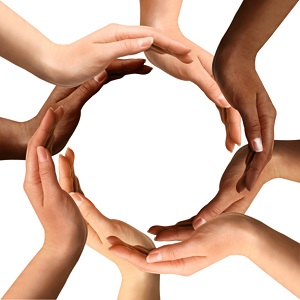
 A dear friend was telling me the other day about a bumper sticker that had symbols of some of the world’s religions and writing that said “coexist.†What a shame that as we approach the start of the Easter/Passover season, in which many of the world’s believers participate, people are far from accepting the right of others to worship as they see fit without judgment or condemnation. Why is it that many people feel that their religion is the one true way to believe in and connect to God?
I can only speculate from my perspective as psychotherapist and Yoruba/Lucumi priest. Here are some random guesses.
- This attitude is a hedge against feeling inferior or less than. If someone follows the “superior†faith, then that means that they are superior and everyone else is beneath them.
- It is a means of wielding control or having power over others. In other words, only the truly enlightened are capable of ruling, decision-making, or governing. This entitles them to natural resources, land, livestock, workers and so on.
- It satisfies a sense of entitlement—to more wealth, power, prestige, position, material things, and opportunity. In reality, a sense of entitlement is just a defense against feeling shame, unworthiness, and powerlessness.
- It is a way of fighting fear—of annihilation, conquest, enslavement.
- It represents an urgent demand for respect and reverence. However, in reality, one cannot demand respect; it must be earned. And reverence should be reserved for the divine.
- It justifies conquest and oppression of others—nations, individuals, a particular gender (in most cases, women).
- It serves as a substitute for good parenting and can be used to threaten children with punishment on a divine level if they don’t behave.
- It is a statement that people feel threatened by anyone who is different than themselves. Perhaps that goes back to instinct—the hardwired flight or fight response.
So what can we as individuals do to combat this worldwide pathologic response of religious fundamentalists who are ironically supposed to have a love of God and God’s children?
- For one, we can be aware of our own biases and judgments. This can be a challenge, especially in extremist situations, such as in some parts of the world where women are treated so badly. We can try to all be New Yorkers as described on a New York City subway poster: NYC: where we accept your personal beliefs; where we are judgmental about your shoes. (That’s a joke.)
- We can challenge others who claim religious moral superiority when we are in their company, pointing out the weaknesses of their positions (of course, only if it is safe to do so).
- We can support individuals, groups, and others who promote tolerance and acceptance of religious differences (and other differences).
- By the same token, we can boycott, whenever possible, those who/that promote intolerance. This statement is ironic in view of a recent news item I heard about the Christian right wanting people to boycott Starbucks, which was supporting acceptance of choice in relationships. (Asking New Yorkers to boycott Starbucks is totally unrealistic, I might add.) Probably goes for other parts of the country as well.
I’m sure my readers will have something to say about what I have written in this article. Please feel free to offer your own list of examples of reasons why it is so hard for many to coexist and what solutions are possible.
And if you’re a practitioner, have a joyful Easter-Passover holiday.
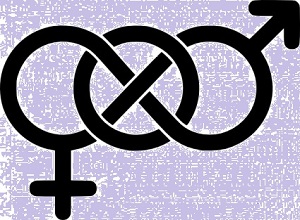 The only queer people are those who don’t love anybody. – Rita Mae Brown
Queer is a sexual identity that can be both a place of great pride and one of pain.
The term itself is a reclaimed one: Queer was once widely used—and is sometimes still used—as a slur against lesbian, gay, and bisexual people. Many people still view the term as derogatory and do not choose to use it. To many others, it is an inclusive term that grants the community power in its reclamation of the word.
Though “queer” was once intended to hurt those who now choose to use the term as an identifier, this word has become for many a word full of promise and hope. For some, it is the best way they can authentically describe their personal identity.
Queer is an umbrella term that describes sexual identity. The sexual orientation, sexual behavior, and sexual identity (OBI) model provides a way to talk about sexual identities with more accuracy (Cook & Pawlowski, 1991). In the OBI model, each of these concepts is different and separate from the others. Sexual orientation describes a person’s sexual or romantic attraction to another person. It’s not about behavior. It’s about the experience of attraction itself. Sexual behavior is used to describe the physical act of sexual activity. Sexual identity describes the way people identify themselves. Identity is personal; it’s something that each person can only decide for themselves. Gay, lesbian, bisexual, straight, and queer are all sexual identities (though there are many others). [fat_widget_right]
The OBI model provides a way to look at how these three pieces of ourselves interact. Typically it’s assumed that orientation, behavior, and identity are the same. For example, there’s an assumption that a man who identifies as gay is attracted only to men and participates in sexual behavior only with men. However, real life is much more complicated, and there is no “right” way for a person’s orientation, behavior, and identity to line up. For example, a woman might be attracted to both men and women, participate in sexual behavior with only men, and identity as bisexual.
The way we typically describe sexual identity is dependent on gender. For example, if a man says that he is straight, he is stating that he identifies as being attracted to women. Straight, gay, lesbian, and bisexual are categorical markers that designate a person’s gender and the gender they are attracted to. Typically, lesbian describes a woman who is attracted to other women, gay describes a man who is attracted to other men, straight describes a man attracted to women or a woman attracted to men, and bisexual describes a person attracted to members of their gender and of the “opposite” gender.
But what happens when someone who identifies as neither a man nor a woman? As both a man and a woman? As a feminine man or a masculine woman? What is the sexual orientation of someone who is attracted to people of any/all genders?
“I know I’m not a man…and I’ve come to the conclusion that I’m probably not a woman either. The trouble is, we’re living in a world that insists we be one or the other.” –Kate Bornstein
In the book Gender Outlaw: On Men, Women, and the Rest of Us, author Kate Bornstein lays out how a binary gender system, where being a man or being a woman are the only two choices, can be limiting. A person’s biological sex does not determine that person’s gender. Biological sex is the combination of hormones, chromosomes, and gonads a person is born with. Gender identity, however, describes a person’s internal sense of being a man, woman, neither, both, or other gender—it’s not based on the physical body but on how someone feels inside.
For many people, gender identity and biological sex seem interchangeable—A person’s sex as determined at birth is equivalent to their gender identity. But sex and gender are separate concepts and can line up in many different ways.
Transgender is one term that can be used to describe the experience of identifying with a gender that is different from the one that was assigned at birth. People who are transgender have discovered that their gender identity differs from their biological sex. Their true identity might be male, female, neither, or both. They might have a different gender expression entirely. Cross-cultural and historical views of gender suggest gender variance is a normal variation in human expression.
Gender identity and sexual identity are not the same thing, though we often treat them like they are. For example, a person can be a woman (gender identity) and be straight (sexual identity). Or she could be a woman (gender identity) and be a lesbian (sexual identity). Transgender describes gender, not sexual orientation. Trans people, no matter their gender, might identify as straight, gay, lesbian, bisexual, or queer (sexual identities).
To me, being queer isn’t who you’re sleeping with; it’s just an idea that sexuality isn’t gender-based, that it’s love-based.
—Ani DiFranco, Entertainment Weekly, May 2, 1997
Queer, as a sexual identity, is notably different than gay, lesbian, bisexual, and straight because it does not depend on gender. As an identity, the term queer has the flexibility to be inclusive of all people, not just those who identify as men and women. It describes someone whose identity is not heterosexual, but who may not fit into the other available gendered sexual identity categories.
If we look back at the OBI model, queer can be used to describe the interaction between orientation, behavior, and identity for many people who find their experiences much more complex than the terms gay, lesbian, straight, or bisexual allow for. While once a term of hatred, “queer” offers a range of possibilities today.
References:
- Bornstein, K. (1994). Gender outlaw: On men, women and the rest of us. New York: Routledge.
- Cook, A. T., & Pawlowski, W. (1991). Issue paper: Youth and homosexuality. The Respect All Youth Project, PFLAG.
People who are discriminated against can suffer significant negative consequences. General well-being, self-esteem, self-worth, and social relations can be severely impacted as a result of discrimination. But recognizing exactly how perceived discrimination affects an individual is much less understood. Previous research has suggested that perceived discrimination can lead to mental health problems such as increased stress, depression, and anxiety. In an effort to better comprehend the exact relationship between perceived discrimination and psychological health, Que-Lam Huynh of the Department of Psychology at California State University recently led a study that examined the effects of this type of prejudice on Latin American participants.
Past studies have demonstrated that African-Americans report varying levels of stress relative to the context of the discrimination they perceive. Overall, research indicates that discrimination in professional settings is more stressful than discrimination in social settings. Additionally, studies have provided mixed results on how the effects of discrimination vary based on severity and frequency. To clarify these influences, Huynh analyzed data from 168 Latino individuals, who reported the severity and frequency of perceived discrimination. The study also evaluated the distress levels, specifically anxiety and depression, of the participants.
[fat_widget_right]
The findings revealed that the higher the frequency of perceived discrimination, the higher the levels of reported anxiety and depression in the participants. The results also showed that participants who did experience extreme discrimination, although infrequently, were equally adversely affected. The research team was able to determine that, overall, the frequency of less stressful discrimination was more detrimental to the participants’ psychological well-being than less frequent high-stress discrimination experiences. Huynh believes these findings will help clinicians treating cultural minorities who struggle with mental health problems resulting from perceived discrimination. Huynh said, “Thus, it is important for researchers to examine both perceived frequency and perceived stressfulness, as the interplay between these two dimensions of discrimination has meaningful relations with psychological adjustment.â€
Reference:
Huynh, Q.-L., Devos, T., Dunbar, C. M. The Psychological Costs of Painless but Recurring Experiences of Racial Discrimination. Cultural Diversity and Ethnic Minority Psychology 18.1 (2012): 26-34. Print.
Working Alliance (WA) describes the relationship between a client and therapist and the underlying bond formed during the therapeutic process. The majority of researchers believe that a strong WA is essential to a positive treatment outcome. Ethnic and racial differences between clients and therapists can impair the working alliance and therefore influence the outcome as well. “Members of racial/ethnic minority groups may experience greater challenges in establishing a trusting therapeutic relationship due to perceived or actual cultural differences or cultural biases,†said Sherry Muterspaugh Walling of the Department of Psychology at Fresno Pacific University.
Because half of the therapists in the United States are Caucasian or of European decent, Walling believes this presents an obstacle, especially for men seeking treatment for violent crimes. “White therapists working with clients who are members of racial/ethnic minority groups may symbolize past experiences of mistreatment or discrimination or experiences of racism within the criminal justice system,†said Walling, lead author of a recent study that evaluated WA in interracial client-therapist settings. “The current study seeks to address this important research need by examining therapist and client reports of working alliance (WA) by client race/ethnicity across four time points during a 16-week cognitive– behavioral treatment program for male perpetrators of intimate partner violence (IPV).â€
The participants included 107 male offenders, half of whom were Caucasian. The other half was Hispanic, American Indian, Asian American or African American. Walling discovered that the Caucasian clients who met with white therapists experienced an increase in WA over the 16 weeks. However, the minority participants did not. “The interaction between client race/ethnicity and WA was also a significant predictor of treatment outcome at 6-month follow-up,†said Walling. “The current findings point to the importance of race/ethnicity in the development of the therapist– client relationship.†She added, “Further exploration into the mechanisms underlying these differences is essential to enhance the effectiveness and quality of treatment programs for partner-violent men.â€
Reference:
Walling, S. M., Suvak, M. K., Howard, J. M., Taft, C. T., & Murphy, C. M. (2011, December 19). Race/Ethnicity as a Predictor of Change in Working Alliance During Cognitive Behavioral Therapy for Intimate Partner Violence Perpetrators. Psychotherapy: Theory, Research, Practice, Training. Advance online publication. doi: 10.1037/a0025751
Each of us has our own unique identity made up of a combination of personality traits, personal and family history, and other attributes. But what happens inside when an identity is not celebrated by a person’s community?
In Stigma: Notes on the Management of a Spoiled Identity (1963), author Erving Goffman uses the term “spoiled identity†to refer to an identity that causes a person to experience stigma. For Goffman, “stigma†describes the experience of moving through life with an attribute that is deeply discrediting. This attribute divides people into those-who-are-normal and those-who-are-not, thereby making those-who-are-not less worthy. Spoiled identities include racial minority, ethnic minority, sexual orientation, gender, sex, and religious identities, body size, and visible and invisible disabilities. (more…)