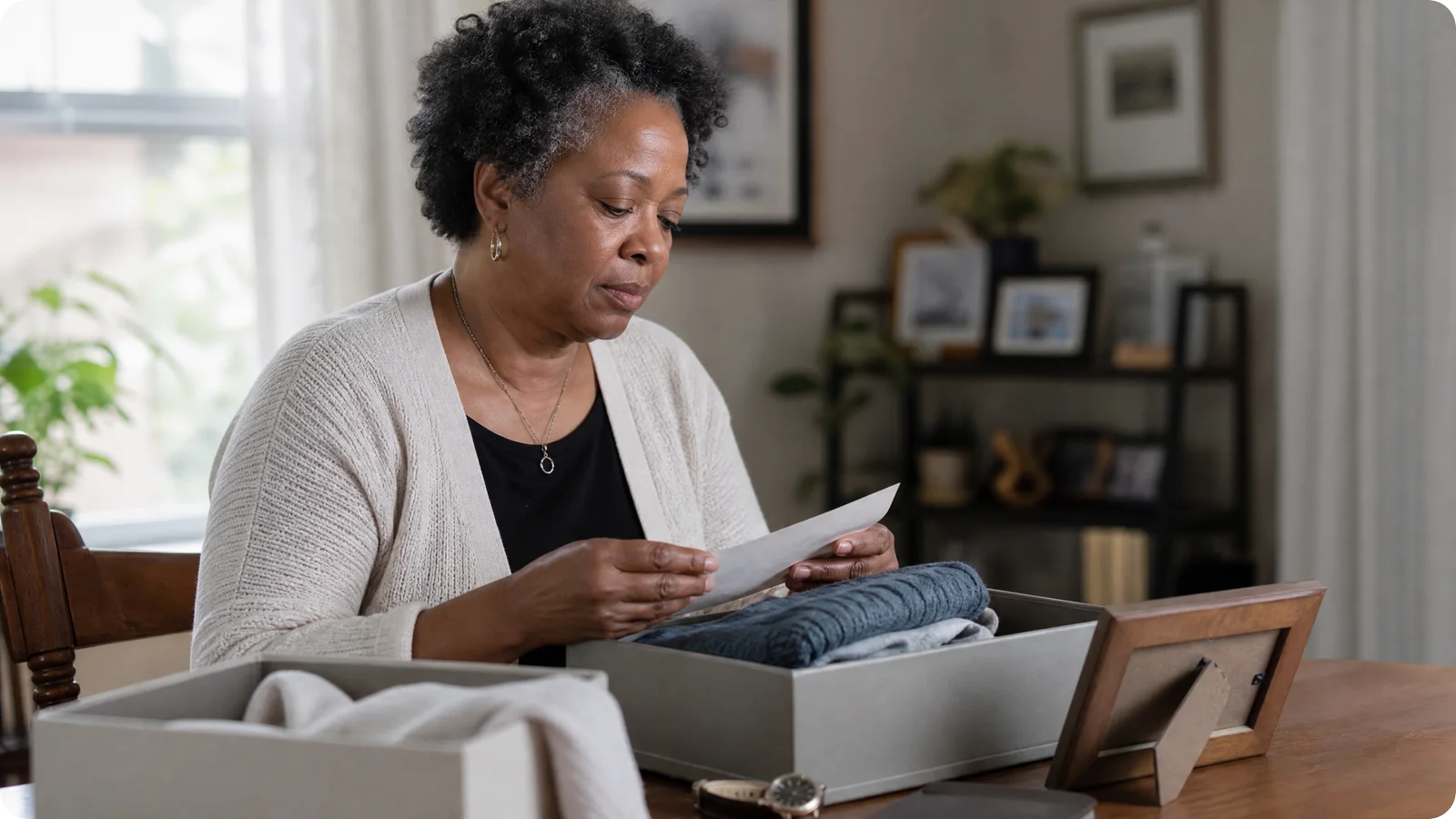
Grief and belongings can feel overwhelming after loss. One of the most challenging aspects of losing a spouse, partner, relative, or friend, or of ending a relationship, is determining what to do with the stuff that remains. Sorting through boxes and papers, as well as your heart and mind, can bring material, emotional, and mental questions together.
Coming to terms with what to release and what to hold onto is part of the healing process. It is a time of reflection when the same memory might cause you to simultaneously laugh, cry, and sigh. Your memories and the stuff that remains belong to you, and it is perfectly fine to feel your feelings without judgment from yourself or others.
Why grief and belongings can feel so heavy
And yet, even knowing this, the process is rarely simple.
Some days, the “stuff that remains” feels manageable, like something you can sort, organize, and place neatly into categories: keep, give away, discard. Other days, it feels like every item holds a story, and every story holds a piece of you. A shirt is no longer just a shirt. A message is no longer just words. A space in the home is no longer just a space. Everything carries meaning, and meaning carries weight.
There are also moments when the process feels unexpectedly physical, with fatigue setting in after going through just one box, or a heaviness when you come across something you weren’t prepared to see. Grief and transition are not only emotional experiences; they can affect the body too. It is okay to pause. It is okay to step away and return when you feel ready. The National Institute on Aging’s guidance on grief and loss describes some of these emotional and physical responses.
Grief and belongings: what to keep, release, or revisit
This is where many people find themselves stuck, not because they are unwilling to move forward, but because moving forward can feel like leaving something or someone behind.
Healing can include
- Integrating what matters
- Holding memories in a different way
Healing does not require
- Erasing the past
- Deciding everything at once
There is no single “right” way to decide what stays and what goes.
Keep
For some, keeping tangible items brings comfort: a way to stay connected, to honor, to remember.
Release
For others, letting go creates space: room to breathe, to begin again, to redefine life without the constant physical reminder.
Revisit
For many, the answer is not one or the other, but a gradual, evolving balance between both.
You may find that what you choose to keep today feels different six months from now. What once felt impossible to release may later feel like a gentle act of self-care. What you once held tightly may find a new place, perhaps not in your home, but in your story. And that is okay.
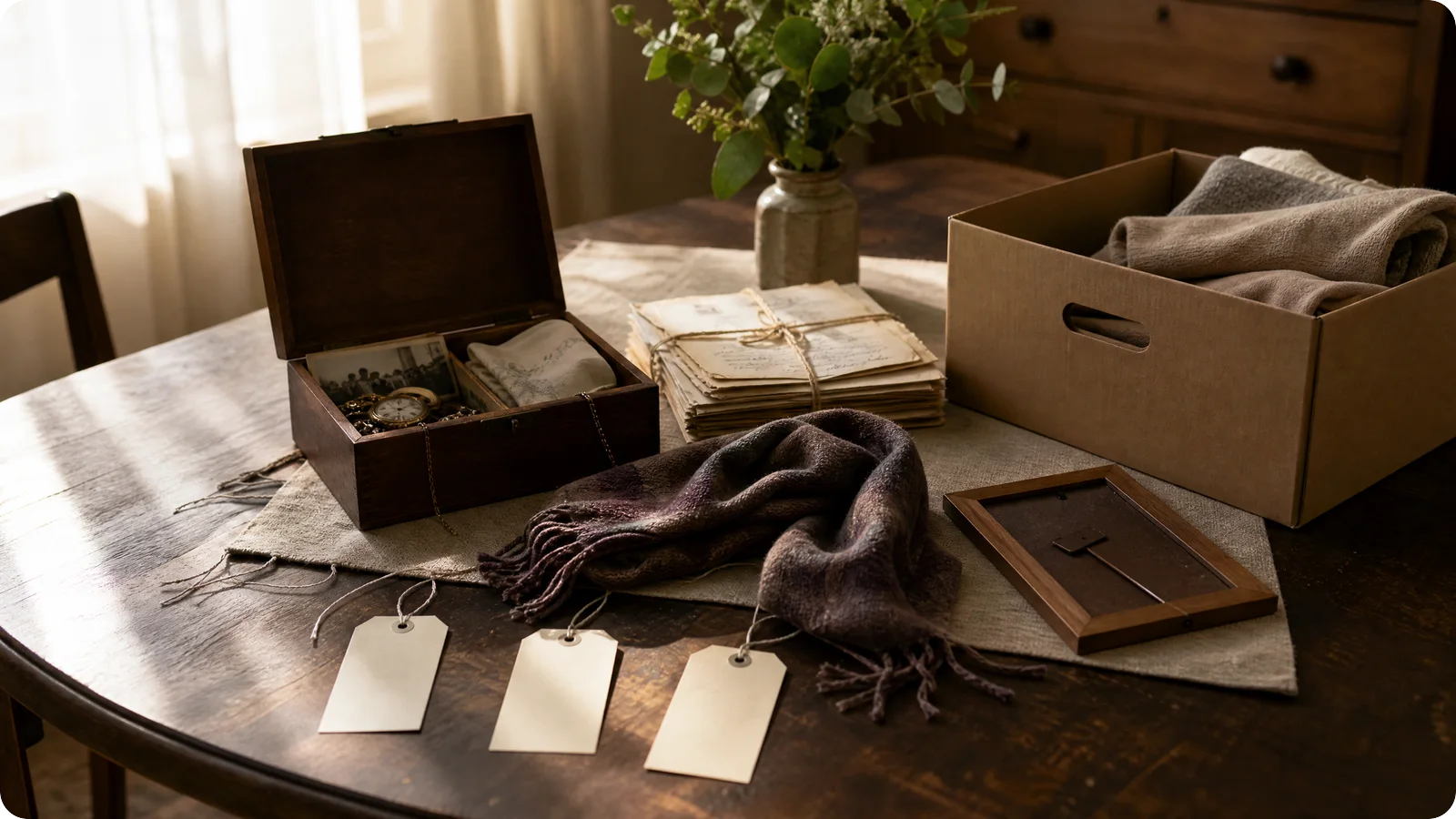
The identity question beneath the sorting
The “stuff that remains” is not just about objects. It is about identity. It is about the life you shared, the roles you held, and the version of yourself that existed in that space. When a relationship changes, whether through loss or ending, there is often an unspoken question beneath the surface:
Who am I now, with all of this… and without them?
Rosa Johnson
That question doesn’t need to be answered all at once. In fact, it rarely can be. Instead, it is lived through moment by moment, choice by choice. GoodTherapy’s reflection on mourning an actual loss or the loss of an ideal explores forms of loss that other people may not immediately recognize.
You do not have to carry grief alone
One small step at a time
Sometimes, the most meaningful step is not deciding what to do with everything but choosing just one small thing. One drawer. One box. One memory. Approaching it with care, not pressure. With curiosity, not judgment.
You might ask yourself:
- What does this represent for me?
- Does holding onto this support my healing right now?
- If I let this go, what am I making space for?
- Can I allow myself to take my time?
Take your time—this is your stuff. Healing does not rush; it unfolds one day at a time, one moment at a time, one choice at a time.
There will be moments when you feel strong and clear, and moments when the weight of it all feels unexpectedly heavy. Both are part of the process. Both are valid. The goal is not to get it “right.” The goal is to move through it in a way that honors your experience, your connection, and your growth.
Over time, the intensity may soften. Not because love or significance disappears, but because you may begin to carry it differently. The memories may become less painful and more integrated. The spaces may feel less empty and more redefined. The “stuff that remains” may become less about what was lost and more about what continues within you.
A quiet, calm, and resilient strength can begin to emerge, not abruptly or with force, but gradually and steadily. You may notice that you are not only sorting through the stuff that remains. You are also thoughtfully and courageously creating what comes next.
Grief and belongings: frequently asked questions
Belongings can hold memories, routines, relationships, and parts of your identity. Sorting them may bring up feelings that make the task more demanding than ordinary organizing.
There is no single right answer. Notice what brings comfort now, what you feel ready to release, and what you would rather revisit later. You do not have to decide everything at once.
Letting go of an object does not have to mean erasing its significance. Memories can continue through your story, relationships, or personal rituals, and keeping a meaningful object can also bring comfort.
You can take your time and pause. If you want a starting point, choose one small item or drawer. Support from a trusted person, a grief group, or a therapist may help when you want company with the process.
Further reading and support
- National Institute on Aging: Coping With Grief and Loss
- American Psychological Association: Grief and Coping With Loss
- SAMHSA: Coping With Bereavement and Grief
- GoodTherapy: Creating Shrines and Altars for Healing from Grief
- GoodTherapy: Grief After a Spouse’s Death
Make space for support
If grief and belongings feel hard to sort through alone, you can look for a therapist who supports grief, loss, and life transitions.
Find a therapist When you are grieving the loss of a loved one, parent, or friend, your grief may take many different forms. It can be debilitating, causing your life to come to a screeching halt while you endeavor to sort out your feelings about the loss of a person who was such an important part of your life. At the same time, it might be a relief, a rejoicing that your loved one is no longer suffering from illness or pain.
Complicated grief is a complicated mixture of emotions, and it can keep us off balance and further the grieving process in ways we didn’t expect. This can go on indefinitely. There’s no timeline for grief—it continues for as long as we need to process our feelings and adjust ourselves to life without that person. If we experience regret over things we may have left unsaid, if we had unresolved issues with that person, it may take a while to come to terms with that.
Honoring Those We Have Lost
One thing that often comes up among the people I work with is their desire for a real way to honor their lost loved ones. Doing something concrete and meaningful that pays tribute to the life that was lost is one way people are often able to find closure. If the person who passed away didn’t leave a clear legacy to carry on, such as charity endowments or a pet cause, a bereaved person can still honor their memory by taking what they remember to be the best part of their loved one and making an effort to share those qualities and attributes in their everyday life. There isn’t much more of a fitting memorial to a loved one, in my opinion, than the continued sharing of those things that mattered to them most. [fat_widget_right]
Do good works and service.
Doing acts of service in the name of your loved one is a great way to honor their memory. Not only does it generally feel good to help others, we all have something we can give, whether this something is money, time, advice or mentoring, or even simply a listening ear. Each act of service can be a tribute to your loved one, and this tribute can help you to find a purpose for your grief.
Carry on their work.
If your loved one had a cause that was important to them, you can honor their life and memory by continuing their work. Working on issues your lost loved one felt passionate about is a wonderful way to remain connected and help keep their memory alive after they have passed. Directing your grief and loss into something real and positive that can make a difference may not only help you work through your pain but also establish something lasting that will keep their cause alive.
Develop what they admired.
Which of your particular strengths or qualities did your loved one see in you and admire and point out? Consider trying to direct your energy into developing those qualities to honor your loved one as you go forward in life. If your kindness was what drew them into contact and friendship with you, then continue to be kind. If they admired your honesty and forthright attitude, continue to be genuine and authentic with those you meet. This type of personal development serves both as a way to grow and develop your own goodness and to keep your loved one close in mind and heart.
Directing your grief and loss into something real and positive that can make a difference may not only help you work through your pain but also establish something lasting that will keep their cause alive.
Develop in yourself what you admired in them.
A friend of mine recently lost a friend and coworker to a tragic car accident involving a drunk driver. She was understandably angry and bitter about the driver, as their actions led to the loss of her dear friend. When we talked about her feelings, I encouraged her to channel her anger into a positive direction and to think of the legacy her friend had left for the world.
As it turned out, the woman who died had been a social worker and advocate for the poor who was known for her warm and giving personality. She had radiated joy and happiness to everyone she met. My friend resolved to transform her anger by spreading the warmth and happiness her friend had embodied, and her grief began to change into resolve when she realized that anger and bitterness were likely not the inheritance her friend wanted to leave.
It’s not easy to see beyond the pain when we lose someone we love. It’s certainly expected that we are likely going to be in a place of hurt and anguish for some time. I want to restate that no one can put a timeline on the grieving process, as each person must be able to fully grieve for as long as they need to. Time does not necessarily heal all wounds, not for everyone, but time can often be helpful by changing your perspective and helping you realize you do have the ability to live without that person in your world.
Finding ways to honor your loved one’s memory, and giving a purpose to your pain by learning to transform negative emotions to positive results, are positive and helpful steps toward making peace with the fact that your loved one is gone. If you struggle with the grief process, or with finding ways you can keep your loved one’s memory alive, a compassionate and qualified counselor can offer help and support.