 We all experience losses, big and little, throughout our lives. When enduring a big loss, people fall into patterns that may be considered masculine or feminine ways of reacting.
Men and women tend to process their losses differently, but the way they grieve is affected by many other factors besides gender, such as culture, personality, and temperament. Grief and loss are experienced in unique ways by each individual.
A generalization about gender differences in grieving would be that men tend to focus on feelings of guilt and anger. They are likely to spend more time thinking than feeling. They also tend to act independently rather than rely on others.
Women typically need more support and are expressive with their emotions, which is behavior we tend to associate with grief and loss. However, there is no cookie cutter approach to mourning. In recent years, experts like Kenneth Doka, PhD, have recategorized these types as intuitive and instrumental grief.
Intuitive grief can be associated with our generalizations of the way that women grieve, which includes the following:
- Strong, affective reactions (waves of powerful emotions)
- Expressions that mirror feelings (more like an open book)
Moving forward involves exploring and expressing feelings, progressing through the pain in order to heal.
Instrumental grief can be associated with the masculine way of grieving, which includes the following:
- More thinking than feeling (an inward, quiet process, less expression of emotions)
- Being physical, expressing grief through doing something (I could not fix my son, but
I can fix this broken fence)
So how do you help someone who doesn’t want to talk or ask for help?
- Use logical analysis—figuring out problems by breaking them down into manageable steps (to be less overwhelming)
- Gather information—on new roles (in your household, family, work, etc), supports, faith, to do lists, etc., in order to start implementing
- Use humor—It has much of the same release as crying does, and it’s still okay to laugh
- Provide diversions/distractions—list all supports and assign them to categories
- Good doers (who could take care of the pet, get the paper, etc.)
- Good listeners
- Good respite (who could take a break from the grief and will not ask you about your loss)
Instrumental grievers would benefit more from groups that focus on a how-to (like being a single parent), adventure based, informal or educational, than a traditional support group.
Like any other model for grief, there are several tools you can use with variations for each person. There are always ways to help. You can start by figuring out which support is needed and offer it. And if you need help, ask for what you need. Just know that there is never a wrong way to grieve.

We breathe all the time, right? So, what’s the big deal?
Most of us are not breathing properly throughout our days for optimum health and well-being. Most of us have poor posture, we sit at our desks for long periods of time, slump in our seats, stare at screens, move very little… This is a problem for much of the population.
If grief is added on top of those bad habits, our situation becomes even more difficult. Grieving on its own makes us feel like we want to be slumped down, curled into a ball. It makes us want to protect our hearts. The chaotic yet static state sometimes even stops our breath entirely. If you are grieving, you may notice that your breathing is very shallow, or that you are holding your breath without even realizing it. You may suddenly find yourself gasping for a breath, as if you’ve been under water, reaching for the surface. This is not abnormal in grieving. Grief affects every part of us, including our breathing. Here is your chance to learn to breathe through grief.
[fat_widget_right]
Finding a quiet time at any point in your day to simply breathe can be a wonderfully healing tool. Anytime you notice that you are feeling anxious, particularly tired, or that you are holding your breath, take a moment—right then and there—to breathe.
Stoplights make good cues to practice your breathing as well. In addition to helping you notice your breath and serving as reminders to practice your breathing exercises, breathing at stoplights can help to counteract the stress we experience when we are confronted with the stress of the rest of the world—other drivers, traffic jams, errands that must be run—while we are in the midst of our grief. Inside your car, you can create a space of calm and peace simply with your breath. Practicing your breathing, and any other coping techniques, when you are calm, helps you be able to put them to use when you need them, such in the midst of anxiety or a panic attack (also not uncommon in grief).
Additionally, noticing your breath and increasing your use of breathing practices can also help you to become more mindful of your own thoughts and feelings, giving you a sense of control and stability in an otherwise incredibly chaotic time of life. The more you notice how you feel, what your thought patterns are, how your body is affected by your responses to the world around you, your grief experience, your thoughts and feelings, the less out of control you can begin to feel. A greater sense of calm and control can help you along your healing process.
Many people are told, “Take a deep breath.” But in my practice, I have found that when I ask people to show me how they take a deep breath, they often suck in their stomachs and fill up their chests. This is actually the opposite of deep breathing. Breathing this way restricts our lungs’ ability to take in oxygen and to release carbon dioxide. The result is an excess of CO2 in our bodies. Not inhaling enough oxygen and failing to exhale enough CO2 can create fatigue, mental fog, and decreased tissue function. For a grieving person, this can intensify many of the normal grief reactions that we go through as part of the grief experience. Breathing deeply and fully can be a helpful tool to decrease stress, increase clarity of thought and help to counteract fatigue. Not only that, but chest breathing stimulates our sympathetic nervous system—our fight or flight stress response. Think about it: When we are startled, what do we do? We open our mouths with a sharp intake of a chest breath. This alerts our brains that there is a danger. Breathing into our chests stimulates the very response we are trying to counteract. Learning to take deep belly breaths is essential to decreasing anxiety and getting more oxygen to the brain.
Read on to learn some simple but truly effective breathing exercises to decrease anxiety, clear your mind, and counteract some of the natural symptoms of grief.
Breathing Exercise: Just Breathe
This is an exercise in simply noticing your breath, helping you to become more aware and mindful of your own breath as it moves in and out of your body.
- To begin, sit in any comfortable position, on the floor or on a chair, with your spine long and straight but not stiff.
- Find a comfortable position for your hands, either folded gently in your lap or resting on your thighs or knees—palms up or down, whichever feels right to you.
- You may close your eyes if that feels comfortable. If not, find a spot on the floor a few feet in front of you and allow your gaze to soften. As you sit, begin to notice the temperature of the air on your skin, notice any sounds you may hear within or outside the room. Begin to notice your body’s weight as it is supported by the chair or the floor. Notice the feel of the floor or the chair under your sitting bones, under your legs. Notice the feel of the floor beneath your feet. Expand your awareness to noticing the sensations of your entire body without feeling the need to change anything, simply notice.
- Now, begin to notice and follow the movement of your breath as it moves in and out of your body, as you inhale and exhale. As you inhale, notice the temperature and the vibration of the air as it flows through your nasal passages, down your throat and trachea, on its way into your lungs. Notice the different sensations of your belly, your ribs, and your chest as they gently expand. As you exhale, notice the temperature of the air, the movement of the tiny hairs of your nose, the feeling of your lungs empty of air as it leaves your body. Simply notice these things and any other sensations that occur as you continue to breathe, easily and naturally, in and out.
- Simply notice your breath as it moves in and out of your body without the need to change anything at all. Just Breathe.
Breathing Exercise: Simple Deep Breathing
For this breathing practice, sit in a comfortable position with your hands relaxed, either in your lap or resting on your thighs or knees. Then begin.
- Relax your shoulders. Pull them up toward your ears, and then roll them back and down, creating space between your shoulders and your ears. Allow your shoulders to relax.
- Breathe normally in and out for a few breaths. Notice how your belly rises and falls easily as you breathe naturally. Your chest should not expand a great deal as you breathe in and out. If you like, you can place a hand on your abdomen to help notice the movement as you breathe in and out.
- When you are ready, breathe in—and on the next exhalation, breathe out slowly from your nose, counting to five. During this exhalation, tighten your abdominal muscles, and pull your diaphragm inward, toward your spine, squeezing all the excess air out of your body. When all the air is squeezed out, pause for two counts, and inhale slowly again, to the count of five, allowing your belly to expand as you breathe in. A very useful tip in learning to breathe deep into your belly is to imagine you are about to take a deep inhalation of your most favorite smell. When we smell something delicious, we almost always instinctively belly breathe.
- If you are comfortable doing so, close your eyes and continue to repeat this easy deep belly breath for 5 to 10 times.
- If you find that your mind wanders during this exercise, don’t worry. Simply bring your focus back to your breathing and begin your counts to 5 again.
- You may find it helpful to think of a happy color (such as yellow or pink) or a calming color (like blue or green) as you breathe in and a dreary color (like grey or tan) as you breathe out. Or, you might choose to imagine breathing in a calming pleasant emotion such as peace or love as you inhale and breathing out stress or anxiety as you exhale.
- As your awareness of your breath increases, it will become easier to practice your deep breathing without focusing so much of your attention on it.
Breathing Exercise: The Three-Part Breath
The three-part breath is a specific breathing technique used in many yoga practices and can be very useful in times of stress or whenever you need to relax. This type of breathing triggers your parasympathetic nervous system or the “relaxation response” (the opposite of the fight/flight stress response) and allows your body and mind to more easily release stress and tension. It is physiologically impossible for your body to be in a stress mode when you practice the deep three-part breath.
Obviously, you can’t breathe this way all the time, but when you do, it can help you think more clearly and decide on another coping skill or something else you can do to move away from the anxiety you may currently be feeling. Or you may decide to use the breath to sit with the pain of grief. This is okay too. Calmness in the midst of pain can help us know that we can survive the next moment, and then the next.
- Again, find your comfortable sitting position, allowing your hands to be relaxed. The three-part breath may also be done lying down. Practicing this breath while lying in bed before sleep is a good choice if you have difficulty clearing your mind and falling to sleep.
- To begin, inhale normally. Then, with your mouth closed, exhale slowly through your nose as you did with the simple deep breathing exercises, using your abdominal muscles to pull your diaphragm inward. Squeeze all the stale, excess air completely out of your lungs.
- As you prepare for your next inhalation, imagine your upper body as a large pitcher. As you inhale, you are filling the pitcher from bottom to top.
- First, fill the diaphragm and lower belly, allowing them to expand and completely fill with air. You can use the “smelling something delicious” tip here as you begin to fill your lower lungs with air, allowing your belly to expand.
- Next, continue to allow your “pitcher” to fill as you notice the lower, and then the upper, parts of the ribcage expanding outward and up.
- Next, fill the upper lungs, noticing the chest expanding, the collar bones and shoulders rising, as your pitcher is filled completely to the top.
- Pause for 2 beats.
- Exhale the opposite way, allowing the “pitcher” to empty from top to bottom.
- Slowly exhale, allowing the shoulders and collar bones to slowly drop, the chest to deflate, the ribs to move inward. Again, pull your diaphragm in, using it to completely empty the air from the bottom of the lungs.
- Repeat the process, refilling the pitcher slowly from bottom to top. Continue with the complete and full exhalations and inhalations, emptying and filling your pitcher.
- The three parts are bottom, middle, top—expanding and contracting as you slowly and completely fill your body with fresh, cell-nourishing, life-giving oxygen and then slowly and completely empty it of carbon dioxide, toxins, and tension held in the body and mind.
- As you increase your practice and the muscle movements become familiar, you may wish to add the counting of your breaths or your color visualizations. Ideally, the exhalations should be about twice as long as the inhalations. Initially, if you count to five as you inhale and exhale, gradually try to make your exhalations to the count of six, then seven, then eight, and so on until you feel more comfortable lengthening your exhalations.
If you feel dizzy or lightheaded while practicing the three-part breath, or any other breathing exercise, stop the practice immediately and allow your breathing to go back to normal. Sometimes if we are not used to a great deal of oxygen, the change can cause lightheadedness or dizziness. Know your own body and be mindful of the changes you notice.
I hope that these breathing lessons may help you through your grief journey and beyond. Just breathe.
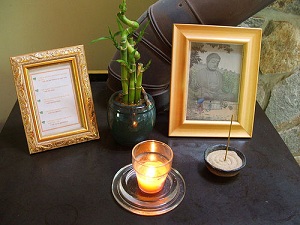 Altars and Shrines: What Are They?
Archeologists have found evidence of altars and shrines in nearly all places where there is evidence that humans have lived. The predisposition to construct these kinds of sacred creations seems almost to be part of our DNA. Traditionally, shrines are memorials or monuments to the dead. We have made shrines for thousands of years throughout the world’s cultures.
Some well-known shrines include the Taj Mahal and the Egyptian pyramids. Public monuments such as the Vietnam Veterans’ Memorial, the Mount Rushmore carvings, the Lincoln Memorial, and the Martin Luther King, Jr., Memorial are all examples of secular shrines that honor the memories of individuals whose lives and deaths have influenced our history as well as countless individual lives.
We create shrines in public spaces, in our communities, in places of worship, and in our own private spaces. We create them after long preparation and fundraising, with thoughtful planning, through elaborate installations, as well as with less expense and fanfare. We may place them in our own private spaces, in a community gathering place, or at specific sites where a death or tragedy occurred.
Shrines may evolve as spontaneous collaborations, such as those created by students, faculty and families at Virginia Tech or Columbine after those tragic shootings. Those types of shrines are usually added to throughout the days following the shootings and provide a community gathering space. They become places where the shocked and grieving may seek comfort and support from others. Shared, spontaneous shrines often evolve into more permanent community memorials where the lives of those who died can be remembered. Street memorials, where family and friends lay flowers, trinkets, card, balloons, or works of art where loved ones died, can be found in cities all over our country.
In New York City, throughout the five boroughs, one can see the hundreds of Street Memorial plaques placed at spots where pedestrians were killed on the city streets. That movement arose from the St. Louis, Missouri’s Ghost Bike Memorial project where bicycles are painted white and locked to street signs near crash sites to memorialize bikers who died there. Think also of the highway memorials and shrines that can be seen along our nation’s roadways at the sites where someone’s family member or partner was killed in a crash.
Shrines may be created outside the homes or at the burial sites of well loved public figures or artists who have died, such as those created in honor of John Lennon, Princess Diana, Jim Morrison, and Edgar Allen Poe. Shrines can serve as places for solitude, reflection, and remembering but they can also be whimsical and celebratory like the brightly colored Day of the Dead shrines in Mexico’s annual festivities which celebrate and honor the lives and memories of loved ones who have died with parades, games, picnics and family gatherings. Shrines connect us to our past, to each other, and to something greater than ourselves. They serve to help us remember and to heal.
Sometimes there may be confusion about the differences between shrines and altars. Often, the words altar and shrine are used interchangeably. For the purposes of personal healing from grief, or your own personal spiritual expression, you can use which ever term you like. If religious connotations make you uncomfortable, you may prefer thinking of a personally created altar or shrine as a memorial, memory box, memory space, honoring space, remembering space, meditation space, etc. Your space can be called whatever you choose to call it.
Shrines are typically dedicated to a specific person, or in religious traditions, to a specific deity or saint. In the case of shrines dedicated to people who have died, those can also be considered as memorials. An altar is usually thought of as a sacred space used for specific functions that may be associated with religious and spiritual purposes, such as worship, prayer, rituals or offerings. In religious traditions, the altar is usually the centerpiece of the worship space, such as in a church, synagogue, temple, mosque or sacred circle.
Many people create home altars as a personal sacred space for prayer, reflection, meditation or other specific spiritual and religious pursuits. Home altars can help us focus our minds on our chosen spiritual path and serve as daily reminders of a spiritual focus or our connection to Spirit. Altars may also be created and dedicated to specific deities or saints.
Altars can also be created with people as a focus. In my own home, I have little altars everywhere, with photos of my son, elements of nature (such as stones, shells or flowers), candles, or incense, place with other objects that help me to focus on peace and comfort, such as a lovely little Jizo statue or a statue of Ganesha. Shrines and altars can be as small or elaborate as you like. You may have many different shrines or altars for different things.
Why Create Shrines and Altars?
As the instructors at Life Path Center for Learning and Healing beautifully put it, “altars and shrines are external representations of interior mysteries.” Shrines and altars are ways of showing in tangible form what might be happening in our hearts and spirits. Creating shrines and altars gives us opportunities to remember, to reflect and to honor, as well as to help heal the pain of loss through the act of creating. The creation of a personal shrine can establish a private place to which you can return to reflect, meditate, grieve, engage in a personal ritual, remember, and honor the one who has died.
Small, portable shrines can be carried with you where ever you go. These might be as small as a matchbook that can fit in your pocket or something a bit larger, like the size of a book, perhaps, that might be slipped into a purse or briefcase. A take-along shrine can allow you to maintain a needed connection with your loved one, or to create a sacred space for remembering or engaging in any type of personal ritual any time or place you may need or want to do so. Or you might prefer to create a more permanent shrine or altar that can be set up in your home or on your property using heavier more substantial elements, or a smaller semi-permanent type whose elements can be taken apart and used in other places or spaces. The choices are yours.
Creating Your Shrine
There are no rules or guidelines for creating shrines. The beauty of creating a shrine is that the ideas and materials are seemingly endless and the process, like the grieving process itself, is completely individual. A few guidelines might be helpful as you engage in the creation your own personal shrine.
Before you plan the look of your shrine, spend some time thinking about your loved one without thoughts or preconceived ideas of what you think your shrine might look like. Here are some ideas that may help the process:
- Make a list of words that come to mind when you think of your loved one.
- Make a list of objects or things that you associate with your loved one.
- Write down any words of wisdom, favorite expressions, funny or loving things your loved might have said. If your loved one never spoke, write down memories that have stuck with you, specific times that you continue to return to, that seem to bring some peace and comfort and to remind you of their love.
- Write down nicknames or pet names you might have used for each other and any associations those words may bring up .
- Write down his or her favorite colors, flowers, foods, hobbies, talents, etc.
- Research and find images that correspond to some of the things you have listed. You may find lots of interesting images on the internet that you can print and cut out for use in your creation or seeing the images may spark other thoughts or ideas that you may wish to incorporate in your memorial shrine.
To Create a Take-Along Shrine
Some artists suggest that a container be decided upon first before proceeding. The container may help guide the process or selection of items used in creating your shrine. Some suggestions for containers which can be re-purposed as your moveable shrine:
- Altoid tins (or other candy or gum tins)
- Sliding matchboxes (these can be the very small sized matchboxes or the large kitchen match boxes)
- Jewelry boxes
- Gift boxes
- Cigar boxes
- Shoe boxes
- Deep frames or shadow boxes
- Drawers
- Books (you can make a book into a box by cutting a rectangular shape into the pages and then gluing the pages together to create a container inside the book)
Gather basic craft supplies:
- Scissors
- Glues
- Paints (acrylic craft paint is inexpensive and works well for this purpose)
- Decorative and colored papers
- Photographs, personal objects or other items related to your loved one
- Anything else that you wish to add to your creation, such as
Ribbons, wires, sticks, dried flowers, string, yarn, decorative paper, wrapping paper, rhinestones, shells, small mirrors, glitter, charms, and beads, as well as anything that you like, that speaks to you, and that can be glued down.
Then, begin your process:
- Prepare your surface by painting or covering the outside and then the inside of your container, allow it to dry completely.
- Add background papers or images on the prepared surface if you wish.
- Place the photo(s) of your loved one where you think it should go. Add your embellishments as desired inside and out: beads, glass pebbles, words, charms, etc., until you feel you have completed your shrine.
To Create a Semi-Permanent or Permanent Shrine
To create a semi-permanent shrine, decide on your location or designate a particular space, such as a table top or a special shelf. You may want to visit thrift and antique shops to find the perfect small table or shelf that will serve as the base for your home altar/shrine. Of course, you can re-finish, paint, and decorate these items as you wish, or you may choose to forgo the paints, glues and embellishments.
Your shrine is yours to create as you see fit. Once you’ve found your base, begin the assembling of your sacred space. Gather together meaningful items that will help you focus on your intentions of memorializing, remembering, honoring, and healing. You might want to cover your altar with a special cloth or decorative mat. Next, you may want to place a picture of your loved one in a special frame as the centerpiece of your shrine. Add to this basic memorial anything you wish.
Some Suggestions:
- Personal objects that remind you of, or which are connected to, your loved one. These might include other photos, jewelry, letters or cards he or she gave you, awards, trophies, caps, hats, and other items of clothing, favorite books, or items he or she used on a regular basis such as sewing scissors, razor, comb or brush. The list here could be nearly endless.
- Natural objects such as flowers, fruits, rocks, crystals, shells, sticks or branches from your back yard, pinecones, leaves, abandoned birds’ nests, etc. You may wish to change the natural objects weekly (such as fresh flowers or fruits) or monthly, changing out stones and shells or other things you may find in nature.
- Candles, oil lamps, or incense
- Small strings of lights
- Chimes or bells
- Religious or spiritual objects that speak to you, such as statues or photos of deities or saints, or other religious or spiritual symbols
You may add to or change the objects on your shrine as often as you wish. Many people like to add seasonal items, such as a small Christmas tree or a Menorah during the holidays, various ornaments and items representing special times of the year such as your loved one’s birthday or other special days.
You can use your shrine or altar space simply as a reminder of your loved one or as an active part of creating and conducting your personal grief rituals. The planning, making, building and “adding to,” of your shrine can itself be a healing ritual. What you do with and how you use your creation is entirely your choice. Your creation is as individual as your personal journey through grief toward healing.
Please feel free to share your experiences with your own shrines and altars. If you do not have your own shrine or altar, whether or not you are grieving, consider creating one. Shrines and altars can bring a great deal of peace and comfort, as well as serve as a reminder for us to slow down and focus on those things that are important in our lives—our loved ones, our hearts, and our souls.
 We humans like things to stay the same. Even if we are open to change, change can be very difficult. There is nothing more disruptive than the death of someone you love, someone whose existence is part and parcel to your own. When those people die, we are left floundering. That person may be your child, your husband or wife, your companion, your friend, your sister, or your brother. The depth and breadth of your grief depends on the connectedness you feel to the person who has died—your spiritual, emotional, or physical connectedness, and often, your perception of your very existence. The more intertwined your life with a person, the more affected you are by your experience of grief when that person dies.
When someone you love dies, you experience deep, soul-wrenching pain. Your life changes. You change. Everything changes. Things are very different than you thought they would be. Yes, it hurts terribly. But there is nothing wrong with you. Grief is not pathological. Grief is normal. It totally sucks, but it is normal. Grief is a part of life—a very painful, difficult part of life. And it flat out just sometimes sucks, but it is normal. There are things you can do to help grief along its way; one thing I believe can be the most helpful is to engage in ritual.
[fat_widget_grief_right]
What Is a Ritual?
Rituals are actions done in purposeful ways that symbolize something much more than the acts themselves. Rituals are made up of actions that represent ideas, thoughts, myths, or beliefs about a particular thing. Rituals give purpose to action and always serve to connect us to something else, generally something greater than our own solitary selves. We may engage in ritual as we seek peace, clarity of mind, or to become more grounded. We may seek connectedness to family, a particular person, our culture, society, traditions, ancestors, or even to our own selves.
We perform mini-rituals daily. Most of us have a specific routine associated with preparing for bed each night; we may wear a particular piece of jewelry or clothing for specific occasions; or we may make our beds each morning. We might repeat a particular phrase when we make a toast, or perhaps we close our texts or emails in a certain way. Whether small or elaborate, the rituals we engage in tell stories about who we are, who we want to be, and what is important to us in our lives. Your own rituals may be derived from your family, culture, ethnicity, or a particular religious or spiritual tradition. No matter what stories they tell, rituals always provide structure, meaning, and connectedness.
Perhaps the most significant thing that rituals provide is a certain order to an existence that otherwise might be full of confusion and chaos. Human life is full of confusion and uncertainty and, undoubtedly, the most chaotic times in our lives are the times when we are grieving. Grief is chaos. Times of grief are when we need ritual most. Unfortunately, in our society, there are few rituals that are specifically designed for grieving people, aside from the funeral or memorial service. These are necessary and helpful, but grieving people need more than a couple of rituals to help quell the deep chaos the death of a loved one can bring.
Create Your Own Rituals
Creating your own personal rituals to remember your loved ones allows you to access and work through your grief in a safe and constructive way. Some people plan rituals in honor of a loved one’s birthday or an anniversary. Others choose to express their grief through small daily or weekly rituals. A ritual can be as elaborate as a public memorial service or as small as a quiet moment alone with your loved one’s picture. Some examples of small rituals include:
- Lighting a candle at certain, special times of the day or week to remind you of your loved one (for example, at dinnertime to represent sharing meals with him or her)
- Creating a memory scrapbook and filling it with photographs, letters, postcards, notes, or other significant memorabilia from your life together
- Spending time listening to your loved one’s favorite music or creating a special mix of music that reminds you of that person
- Watching his or her favorite movie
- Planting a tree or flowers in your loved one’s memory
- Making a donation to a charity that your loved one supported
- Visiting your loved one’s burial site
- Carrying something special that reminds you of your loved one that you can take out and hold when you feel the need
- Creating a work of art in your loved one’s memory
- Preparing and eating a special meal in honor of your loved one
- Developing a memorial ritual for your loved one on special days or whenever you wish
Some people engage in the smaller, spontaneous rituals listed above on a regular basis. You may do something similar, or you might choose to create a more structured ritual. You may decide to create a special ritual only one time, or you might decide to hold your ritual (or some version of it) on a regular basis—daily, weekly, monthly, or on special days like birthdays, anniversaries, holidays, or other special occasions.
When selecting activities for a more structured grief ritual, choose specific things to mark the opening and the closing of your ritual:
- Light a special candle used only for your ritual purposes
- Light some incense
- Read or say aloud an inspirational verse, poem, or prayer
- Sing a song
- Chant
- Play a particular selection of music
- Ring a chime or a bell
Clearly marking the beginning and the end of the ritual will help you transition into a different frame of mind at the opening, and it will signal that it is time to shift consciousness back to the mundane at the closing.
Remain Open: Do What Feels Comfortable to You
Before starting the ceremony, take a few deep breaths to center yourself. Remember that it is okay if you cry. This is your space and time to express your grief in whatever ways you need to do so. If all you can do is cry during your planned ritual time, most likely, that is what you need to do. Whatever happens in between the opening and closing of the ritual is completely up to you. You can have an activity planned, or you may be the sort of person who feels more comfortable planning nothing at all. Perhaps you’ll choose to do whatever you are moved to do once you are in the ritual space—you might wish to simply sit quietly for as long as you need to, listen to music, spend time crying, look through photos of your loved one, meditate, pray, or read some healing literature or a sacred text. It is okay to remain open and do whatever comes to you in the moment.
Sometimes you may feel the need to communicate something to your loved one. The sacred, safe space of a ritual is an ideal place to do this. When you need to communicate, you may choose to speak aloud, meditate on your thoughts silently, or write your thoughts in a letter. Consider incorporating the burning, burying, or floating of the letter that you write in a future ritual.
You may simply feel the need to release energy in your ritual space. Yell, scream, or cry as much as you need to. If you’re working through feelings of anger in your grief, keep pillows nearby that you can hit, punch, or throw. Tearing and ripping paper or stomping cardboard boxes can also help release anger. You may wish to include some movement, dance, or vocal expression such as singing, chanting, or yelling. You might want to beat on a drum or play some other instrument to release energy and emotion through sound.
Consider Inviting Others
You can conduct your grief rituals alone or with others. Your ritual could be an ideal time to share your grief with friends and family members grieving the same loss. If you invite others to join your ritual, you may wish to ask each person to share something about your lost loved one—a memory, story, or thought. Ask guests to bring something to read or share as part of the ritual, and invite them to participate in any ritual activity you develop, such as chanting, drumming, or letter-writing.
Continue Your Ritual as Needed
Conduct your grief rituals for as long and as often as you need to. As you heal, you may find that your need to engage in ritual for your grief will wane. Continuing to maintain some of your small rituals, such as continuing to carry your loved one’s photograph or wearing a particular sentimental piece of jewelry may serve you. Your more elaborate rituals may change over time, or you may feel the need to hold them only on special occasions, such as birthdays or anniversaries. If you have created a shrine or altar that you have used in your rituals or kept in your home, you may find that you wish to make changes to it over time. This is okay, too. The changes mean that your personal process through grief is progressing, and your rituals have helped you move from chaos and pain to wholeness and stability.
I hope that this has helped you think about ritual and how you might use it as you move through your own grief process. Please feel free to comment about how ritual has helped you, what kinds of ritual activity has helped you—large or small—and what your thoughts are on engaging in ritual to help us move toward healing.
“For years it lay in an iron box buried so deep inside me that I was never sure just what it was. I knew it carried slippery, combustible things more secret than sex and more dangerous than any shadow or ghost. … I saw things I knew no little girl should see. Blood and shattered glass. Piles of skeletons and blackened barbed wire with bits of flesh stuck to it…The iron box contained a special room for my mother and father, warm and moist as a greenhouse. They lived there inside me, rare and separate from other beings. … I knew my parents had crossed over a chasm … The box became a vault, collecting in darkness, always collecting; pictures, words, my parent’s glances, becoming loaded with weight. It sank deeper as I grew older, so packed with undigested things that finally it became impossible to ignore.”
-Helen Epstein, Children of the Holocaust
 Experiencing a traumatic life event is horrific and terrifying, but this experience does not have to become your defining moment.
It is possible to grow through a traumatic event, or series of events, and there are loosely-structured phases of healing for that growth to follow. For a moment, stop and reflect on what it means for experts to have identified these patterns of healing: it means that you are not alone in having experienced trauma, and you are not alone on the healing journey.
The healing journey follows three loosely linear stages or phases. The rate of growth through each of the phases, as well as the details of what that growth looks like, will be unique to you. You will develop your own unique pattern of healing, which means that you will enter, exit, and revisit phases at various times in your life.
Always keep in mind that revisiting is not backwards movement. It is like the outer layers of a spiral: you pass by the same issues, but are in a different, deeper state of healing. As you near the end of your healing journey, you will be able to look back and notice an overarching progressive nature to your growth and healing.
[fat_widget_trauma_ptsd_left]This article will look at the first phase of healing, while future articles will address the second and third phases.
Understanding the Safety Phase
As you begin the first phase of healing, safety is both your main concern and the hardest task to achieve. Establishing safety—both within yourself and within your environment—can take days, weeks, or even years. The length of time required to develop genuine safety depends on your unique attributes, such as past life experiences, personality, and pretrauma baseline. The length of this phase also depends on how chronic the trauma. In general, the longer you were exposed to the trauma, the longer it will take to develop a sense of safety.
This is not an easy stage. Establishing safety requires a lot of hard work and may require that you, the survivor, dramatically change your life or lifestyle. While this is a difficult part of the healing journey, absolutely no survivor can skip this stage.
Safety Within
In order to truly have safety, you must establish safety within yourself. Focusing on your physical health lays the foundation for internal safety. Establishing internal safety requires you to tend to any ailments, as well as to eat healthy foods, exercise regularly, and sleep sufficiently. Self-harming behaviors preclude genuine safety, so cutting, burning, or addictions to drugs, alcohol, food, or sex, must be grown through and terminated.
Many self-harming behaviors are efforts at managing emotions or thoughts. Learning how to manage your thoughts and emotional world, including your trauma reactions (especially hyperarousal and intrusive reactions), is fundamental to being safe within yourself. Many people find it difficult to engage in this healing without the assistance, support, and guidance of a trained professional. Do not feel ashamed or hesitant to reach out for help.
Safety in the World
Safety within oneself is only half of the equation. No one can be fully safe unless the environment they live and interact in is also safe. Creating safety within your environment requires safety within your physical and relational spheres.
- Attaining a safe physical space includes your ability to move physically in society with a sense of safety and security. It may help to work on your ability to identify dangerous situations or individuals and, to the best of your ability, to get out of a dangerous situation if at all possible. Consider developing safety plans or learning self defense.
- Assess the physical and emotional safety of your social support network. It may be necessary to remove people from your life who are a potential source of physical or emotional danger, or to increase the number of people who can and do provide emotional support, protection, or practical help.
- For those who experienced trauma at the hands of other people, assess the degree of continuing threat and the potential for re-victimization or revenge, and develop appropriate precautions. Ensuring your safety is not 100% within your authority, since to live means to be vulnerable. But that does not mean it is 0% within your authority either.
Moving Through the First Phase
This phase of growth is gradual. It can have a sometimes halting stop-and-go pattern, and it can take a long time. However, if you continue to work on developing safety, and allow trustworthy others to help you, you will be able to grow through this phase.
Some indicators that you have grown through this phase include no longer feeling utterly vulnerable; having a degree of confidence in your ability to protect yourself physically and emotionally; knowing who to count on for safety and support, and being able to effectively manage most of your trauma reactions, including emotions, thoughts, and behaviors.
If learning about the tasks involved in this first phase of healing feels daunting, don’t give up. Reach out to a trained therapist and harness their skills and abilities in order to engage in this healing work. You have a right to reclaim the quality of life you deserve.
If this first phase of healing sounds like a review of work you have already completed, take a deep breath of congratulations and gratitude. You are on your way to continued and ever-deeper healing and growth.

The onset of disabling illness or physical or sensory impairment is often accompanied by complicated grief processes, including depression and posttraumatic stress disorder. These grief processes are frequently developed in response to the concurrent losses people may experience when living with new abilities.
Most obviously, people who acquire a disability or disabling disease lose a part of their bodies and/or the functionality of parts of their bodies. Additionally, they may lose physical comfort, vigor, mobility, spontaneity, the ability to engage in certain activities, aspects of their previous lifestyles, privacy, a sense of dignity, a sense of control, a sense of efficacy/agency, a degree of independence, actual or perceived life roles, friends and other social supports, the ability to work, financial stability, their previous sense of identity and purpose, the ability to pursue previously established dreams, their previous body image, and, all in all, their previous sense of self as a whole. Therapists should be attuned to what a newly disabled person may have lost, or may perceive themselves to have lost, beyond the obvious loss of physical or sensory functionality.
[fat_widget_right]
How well people adjust to this potentially staggering array of losses is usually much more closely correlated to who they have been prior to the disability, and what social, emotional, and financial resources they have available to them, than to how “severe” the impairment itself is. The huge importance of social support after a disabling event cannot be overstated; people with new-onset disabilities may realize how lucky they are to have loving people in their lives as they have never realized it before, or they may feel almost completely socially and emotionally isolated. The most difficult disabilities to deal with in regard to social support seem to be “disenfranchised” disabilities (e.g., those resulting from Fibromyalgia/Chronic Fatigue Syndrome) in which others do not quite believe.
Non-professionals wishing to support a newly disabled person can be most helpful by being available to him or her as a friend who is willing to listen and meet him or her where he or she is emotionally. Trying artificially to cheer the person up or suggest that the person does not, or will not, have losses is not helpful. Newly disabled people will “cheer up” once they have finished grieving their losses and reorienting themselves to their new situation, often with the assistance of a counselor or therapist.
Another key to successful adaptation to a new disabling condition seems to be successful identity reconstruction, a process in which therapists can be particularly helpful. This may often entail psychological, existential, and/or spiritual shifts in perspective toward valuing innate qualities (as opposed to physical or comparative ones), authenticity, and taking life slowly and savoring it. Identity reconstruction, it should be noted, is not necessarily a finite process, as some disabling conditions are progressive and require constant readjustment.
Keep in mind that a large number of the losses with which a person with an acquired disability must learn to cope are not due to the physical impairment itself but rather to limitations imposed on the person by society. Therefore, therapists should not insist that people with disabilities “accept” their condition of disablement as theirs to adjust to, rather than, say, as an invitation to fight injustice.
Ultimately, it is much more helpful for therapists to view identity reconstruction, rather than “acceptance” of one’s disability, as the end-stage of grieving an acquired disability.