 Next Friday, August 31, 2012, GoodTherapy.org is thrilled to welcome Dr. Laurie Moore, who will present Healing Betrayal Caused by Infidelity, a FREE CE teleconference for GoodTherapy.org members available with 1.5 CE Credits. We encourage you to join us for this exciting event, so if you have not already, register today!
Working with clients who are suffering from betrayal caused by infidelity is complex, including grieving stages, posttraumatic stress (PTSD), and additional factors. This article refers to infidelity as a breach in agreed emotional and sexual monogamy. Some couples agree to open relationships or polyamory, which is a different situation. Infidelity as defined in Wikipedia is “a breach of an expectation of sexual and or emotional exclusivity.†This involves a lie and broken promise, causing feelings of intense betrayal for many people.
Infidelity has become a common problem. Some infidelity statistics state that over 50% of both men and women engage in infidelity (Journal of Marital and Family Therapy, 2012) and others say 30% to 60% (Wikipedia, 2012).
Those suffering from infidelity betrayal commonly go through Kubler Ross’s well-known stages of grief:
- Denial: This didn’t really happen or it’s not really as upsetting as I feel it is.
- Anger: How could you?
- Bargaining : If only I had communicated differently, this would not have happened.
- Depression : I feel helpless. Nothing I can do changes this discomfort.
- Acceptance : I have been hurt and disillusioned but I am at peace with myself.
The experience of grief due to infidelity includes additional factors that are absent from grief occurring from a death. Grief due to death is felt in a finite situation that contains an end. It is understood that the one who is gone is gone from the body permanently. Grief due to a breach in trust has no finite or predictable container. The one suffering finds him- or herself in unpredictable circumstances, which often feel very dismantling and excruciatingly unsettling.
Feelings that challenge self-confidence and worth are more common to infidelity betrayal than loss alone. Death is socially expected. Infidelity is shunned. The one who is betrayed is prone to feel guilt, shame, and embarrassment because the situation remains privately hidden or is condemned by a variety of reactions when exposed.
When death is the cause of grief, a solo journey is required. When betrayal is the cause of grief, two people are involved, so the situation is more complicated. Once one is lied to, the relationship is uncertain. This person can’t tell whether he or she is being lied to or told the truth. The one experiencing this challenge is often upset again in the aftermath of the partner relationship. This is different than the one abandoned by a death whose loss cannot re-emerge in a repeating scenario.
Clients with heartache caused by infidelity and betrayal can also go through fight-or-flight syndrome:
Fight: Arguing with, controlling, or managing the person who betrayed me will solve this.
Flight: Leaving will solve this.
Once fight or flight proves useless, a person will seek comfort in other ways. By assisting this person to fully meet the helplessness, sorrow, anger, anguish, disillusionment, and heartache that has come, peace can be found.
I have found that client-centered talk therapy, hypnotherapy, eye movement desensitization and reprocessing (EMDR), and the 12-step program are all deeply valuable for clients healing from infidelity. I also use my own Success Love Now (SLN) process effectively in these situations. Here is how and why each of these methods is valuable.
Someone who is suffering from loss and feeling isolated due to the taboo nature of this loss needs to be witnessed compassionately and caringly. This in itself helps to relieve the tremendous burden one carries from feeling alone. When being accepted within the context and emotions one is truly feeling, without being corrected or judged, peace can start to return. Acknowledging your understanding and compassion for a clients’ diverse set of feelings can be a profound help to a suffering client.
Because the shock of betrayal can be extreme, disrupting normal life in many ways, EMDR assists the hurting person to digest the deep emotions that are arising. Just getting through the day becomes a challenge for people who are betrayed. EMDR makes the healing time for this upheaval much faster in many cases.
Hypnotherapy allows the person who was hurt to re-find stability, meet parts of him- or herself that were hurting before the situation occurred, heal parts of him- or herself that are hurting now, and find a new basis for equanimity that is deeper than the circumstances. Taking a client into a deep, relaxed state in which the client can bring in peaceful parts of him- or herself to help the hurting parts enables a client to rebuild self-esteem and strength.
S-Anon Twelve Steps allow people to find the value in surrender, the gift in their challenge, and the support of others enduring similar pain. Twelve Steps also help the one who was betrayed to find out if addiction was involved in the betrayal, as commonly is the case. Letting your client know that S-anon is an option can be a valuable part of her or his healing process.
SLN provides a new framework for the person to feel empowered and at ease within the undesired circumstances. Encouraging the client to focus on what his/her purpose and aim are for him- or herself and gratitude for the good that is occurring within the context of the undesired happenings is beneficial. This will bring a client out of a victim mode and into a creative mode.
Of course, if the person who was betrayed plans to stay in the relationship, couples counseling and counseling for the one who was betrayed are necessary.
When working with clients who have been betrayed due to infidelity, it is important to understand the complexity of loss, mixed with PTSD, combined with humiliation–this situation causes a long period of overwhelm and readjustment. When the client is treated with compassion, the healing can go well.
Sources:
- Infidelity statistics. (n.d.). Retrieved August 20, 2012, from http://www.statisticbrain.com/infidelity-statistics
- Infidelity. (n.d.) Retrieved August 20, 2012, from http://en.wikipedia.org/wiki/Infidelity
Related articles:
Cheating
Can a Couple Recover From Infidelity?
In-Depth Map for Three of the Eight SUCCESS LOVE NOW Steps
As people age, they face challenges that they may never have experienced before. Loss of friends due to death, loss of independence as a result of diminished income, and loss of physical health can all create significant stress in a person’s life. The way that people choose to cope with that stress is directly related to the skills they learned throughout their lives. Attachment styles developed in early childhood can dictate the response people have to a variety of stressors, including ones encountered in later years. Additionally, an individual’s ethnic origin influences how he or she will respond to stress at various stages. To better understand how attachment style affects coping and overall well-being in older adults and what role ethnicity plays, Eva-Maria Merz of the Netherlands Interdisciplinary Demographic Institute at The Hague in the Netherlands recently conducted a study of 1,116 older adults from varying cultural backgrounds.
The participants, which included European Americans, African Americans, Eastern European immigrants, and Caribbean immigrants, were examined to determine how attachment style affected their well-being. Specifically, Merz looked at secure or dismissive attachment styles in comparison to avoidant and fearful attachment styles. “As expected, secure attachment and dismissive attachment were associated with greater well-being, whereas ambivalent/fearful attachment was related to reduced well-being in this older cohort,†said Merz. The link between secure attachment and positive well-being was most evident among the Caribbean and African American participants and weakest among the other two groups. When she looked at avoidant/fearful attachment styles, Merz discovered that it negatively impacted well-being in all the ethnic groups with the exception of the Caribbeans.
The results of this study support previous research highlighting the importance of healthy attachment styles on well-being. This new evidence extends the existing data by demonstrating that attachment styles are especially important in later life when unique challenges arise. Further, attachment styles are influenced by ethnicity. Taken together, this information provides new insight into the underlying factors that contribute to the general physical and mental health of older adults and should be considered when implementing interventions to help older adults cope with life’s stressors.
Reference:
Merz, E.-M., Consedine, N. S. (2012). Ethnic group moderates the association between attachment and well-being in later life. Cultural Diversity and Ethnic Minority Psychology. Advance online publication. doi: 10.1037/a0029595
Related articles:
Patterns of Attachment in Adults
Individuation Issues with Elderly and Ailing Parents
The Importance of Attachment in Early Caregiving
 The following is an open letter to my sister Andrea Haber, who died from complications due to alcoholism on 10/31/11.
Dearest Anj:
Just a note to let you know how much I miss you. It’s still so bitterly ironic to me that what killed you is the very disease I’ve devoted my life to battling. But in a way, your alcoholism never gave you a chance.
I’m sorry we never talked about it, although you can’t say I didn’t try. There was a time, a few years back, when you told me you wanted to talk about it, and my heart leapt. But that talk, like so many hoped-for moments, never materialized.
I believe when I first got sober I wrote you a somewhat long-winded, pompous letter about the perils of drinking. I’m sorry again that I preached at you like that. You handled it with grace but I cringe now at the thought of my presumptuous rambling. Newly sober people often think they can save the world with a few well-chosen phrases. I guess I thought there was really something I could do. Naïve, yes, but even at the end, and maybe even now, I often feel the same way.
I miss your letters. They really made me laugh. You were a fabulous writer and I think that you, as with so much else, underestimated yourself. Their absence has created a very loud silence.
I’m sure you’re thinking, “Gee bro, nice cheery letter!†I only wish I could be more cheery. This is an occasion I never wanted— that even with the grim medical news coming from Pittsburgh, I never really saw coming. There’s just no good way to spin the loss of someone so young, so beautiful, so amazing. Part of the tragedy for me is, I don’t think you ever truly understood just how loved you were. Mom told me you were shocked when she said to you, near the end, how much you’d be missed should the worst happen. This too, is another symptom of addiction: the disbelief that we matter to people, the certainty that we’re really “only hurting ourselves.â€
Hard to be cheery when feeling so cheated…
Of course, denial is the hallmark of this loathsome affliction. We grew up with rationalizations and minimizations aplenty when it came to Dad’s drinking and the family’s Nixonian “cover upâ€â€”i.e., “Don’t talk about it, too embarrassing†(Dad’s favorite) and “It’s not that bad†and “Don’t exaggerate,†all repeated like mantras. Even I, near the end, felt that chances were good you’d come around; see the light, get sober. Your disease made a mockery of my optimism.
So hard to sit on the sidelines and simply try to accept. I’ve struggled lately with, “Did I really do enough?†Should I have gone all out and planned an intervention, John Wayne style? Should I have demanded you listen to me until “the truth†sank in? I already felt like a stick in the mud, the voice of gloom, whenever you called or wrote me and wanted to laugh or kid around; I loved the jokes but was so terribly worried about your well-being. We had a trove of inside jokes, a bulwark against the despair of growing up in that chaos and emotional violence. I cherished the humor but wondered what might be going on underneath. There is a pain we can’t hide from, I have found, no matter how clever or humorous we are. When your doctor handed you that grim prognosis last year, that you either stop drinking or die, I thought “well this is it, she can’t ignore it any longer.†Wrong again, bro!
Of course the cliché is that there’s nothing you can do to get a person to stop; no amount of begging or pleading or coercion will ever do the trick. Maybe briefly, superficially, but it’s an “inside job†(as they say) when it comes to lasting change. We can give someone just about anything, except motivation to do the hard but necessary thing. I kept thinking you’d finally “hit bottom†when the doctors told you your liver was shot…until mom told me this wasn’t the case, that she feared nothing was changing. I backed off a bit because I know how she hounded you. Maybe that was a mistake. Maybe hearing it from me would’ve got you moving.
I cringe when I see the pride and ego in that last sentence. Yes, you should have heard it from ME, your big brother, sober white knight on the West Coast, brandishing a master’s degree in psych., saving souls and fighting the good fight. I wonder if you’re chuckling as you read this.
Perhaps it’s pretentious of me to think I had the slightest idea of what might be good for you. I had no idea what was really going on in your life, and I suppose it was none of my business. Maybe the long, hard climb back to sobriety might have been too difficult; perhaps too many skeletons, whatever they were, had accumulated in the closet for any one person to face.
But saying “There’s nothing I could have done†doesn’t seem to help. Maybe that’s why I’m writing you now; perhaps, in my Jewish neurotic guilt, I struggle towards some kind of absolution. Doubt has always dogged me; so hard to not look over my shoulder in almost every instance. This is no exception. Could I have somehow said more, done more, pushed harder to help you “see the light� (Am I hearing that chuckle again?)
Just this morning I advised the mother of a patient that there was nothing she could do to “get†her daughter to stop using and go to meetings. I thought, “Wow she really thinks there’s something she can do!†So easy to sit in one’s cozy office chair and dispense wisdom to the struggling, misguided souls asking for help…
Here’s the hard part (as if there’s an easy part!): You can detach, stop trying, accept another’s addiction, respect their “life choices†and move on. But how to really “move on†when it’s your own flesh and blood? You can stop obsessing, stop letting the person’s disease hold your serenity hostage, attend Al-Anon meetings, seek counseling…but the kind of Zen-transcendent it’s-all-good acceptance I’ve perhaps subtly advocated to others isn’t possible, at least not for me, at this point in time.
Because I can’t stop loving you. Can’t switch off the caring. How could it be otherwise?
Maybe the idea is to make room for both, the love and the acceptance. It’s not either-or (as I’m fond of telling my patients). You can love the person and hate the disease. It’s just hard to stand by and watch a loved one fall to pieces and to try and pretend it’s not happening. It’s like a fatal car accident happening in slow motion right outside your door. I prayed every night for you to find the desire to stop drinking. I struggle to accept it never happened.
I know you meant no harm, Sis, and I never took it personally. I think if you could have stopped, you would have; as I say, the odds were seriously stacked against us from the get-go. I don’t know why I hit the lucky number; I just know it’s a gift that I protect with my life, and I would have given anything to have shared it with you. I tried.
I hope you know that somehow, wherever you are, I was worried but not condemning you. There is so much shame with this thing but I always longed to say to you, How could you not be an alcoholic, with all the crap we had to deal with? Even so, I underestimated the awesome power of this thing, and can only guess at how you suffered beneath the chuckles, the jokes and that wonderful wit of yours. It’s just hard to accept that, in this case at least, love was not enough…so difficult at those times when I think of our private jokes and laugh and want to email you…hard to really accept that my kid sister—my first friend, my loyal ally—is really, undeniably gone…
 Related articles:
The Pendulum of Grieving
Over-Extended: Thoughts on Boundaries in Addictive Families
In Case of Emergency: Seeking Help When a Loved one Struggles with Addiction
 Grief arises as a product of a loss that we have experienced. It is associated with losses that may include a person’s health, job, relationship, pet, or loved one. We may not be able to describe the roller coaster of emotions, yet we do know that we are not ourselves. When we feel out of sorts, sensations surface such as low self-esteem, illness, depression, and confusion, which can manifest into thoughts that our feelings are out of our control. As a result, this full-body experience may be difficult to process or verbalize. To mend this sorrow, the expressive arts can create a doorway to the unspeakable by opening all channels to the grieving body.
[fat_widget_grief_right]
Opening Up to Grief
Expressive arts therapy encourages movement of the imagination that we may struggle with during our grieving process. Our art influences how we look at, unblock, wrestle with, and shed light on the need to distance and detach from our pain. When we dodge grief to avoid, deny, or block the inevitable pain, the arts invite the imagination of these stuck places to come to the surface in images, movement, color, and sound. Our art process releases the tension of grief, allowing it to expand and contract, while providing a safe container in which this process can take place. When we create, we give ourselves permission to examine all that is happening within our grieving bodies.
“Art shows how the difficulty can contain its cure if channeled into life-affirming expression.â€
-Shaun NcNiff
Understanding the Experience of Grief
There are five to seven stages often associated with the grieving process. They may be experienced as denial, pain, anger, bargaining, depression, upward turn, reconstruction, and acceptance. The experience can feel like a roller coaster ride of ups and downs, mood swings, and erratic behavior. When we drop in to our art-making, the grief is given containment—a place to be held. This containment permits the pain to speak and encourages our healing. Making sense of what is happening comes to light. We may notice this in a color that strikes a mood, or a picture that recalls a memory, or an emotion to be felt. It is an opportunity for the most vulnerable parts of a grieving body to speak, feel safe, be heard, and be externalized. Once the art is created, we can then dialogue with it further and support our need to metabolize all that is going on within us.
“The reward for attention is always healing.â€
-Julia Cameron
Facing Grief and Piecing Life Together
Fragments of memories, like bits of broken glass, can be difficult to hold emotionally around anniversary dates, picture books, and mementos. They can feel like a jab to the heart, invite an unwanted memory, or open a floodgate of emotion. These fragments seek meaning and solace, yet can wander in and out, tugging and vying for attention at awkward moments. As we seek to piece our lives together after a loss, the expressive arts can heal us by giving these bits and pieces the attention they deserve and need. For a moment, we can sink into ourselves and allow our memories, thoughts, and feelings—those we desperately struggle with—an opportunity to speak, to be heard, and to be felt. Each time that we engage the process using the arts, we give ourselves a break, a breath, and a reprieve from the pain that seeks expression beyond talk therapy.
References:
- Cameron, J. (1992). The Artist’s Way. New York: Tarcher/Putnam Publishing.
- McNiff, S. (2004). Art Heals. Boston, MA: Shambhala Publications.
 The idea of there being stages of grief has been greatly popularized and accepted over the last few decades. It is an idea that gives us perspective on our grief, like the red dotted line going across a map in an old movie to show the itinerary of the protagonists.
However, among professionals, theses stages have been slowly phased out of use over the years for lack of evidence from both research and casual observation.
Now, the old saying that “If you have a hammer, the whole world looks like a nail†comes to mind. Our preconceptions predispose us to experience things a certain way. If we look at our thoughts, feelings, and actions during grief, surely some of it will fit into the five stages Kübler-Ross described: denial, anger, bargaining, depression, and acceptance. This is because these are some of the reactions to loss. Yet these reactions do not tell the whole, or accurate, story of our grief experience.
Most people, according to recent research, do not arrive at acceptance last. Even when people express feeling shock and numbness, they have accepted their loss—they know that someone has died, or that they are divorced, or that they lost their jobs. Wishing something has not happened, or forgetting something that has happened, or feeling the surreal quality of what has occurred, is not the same as denying that it ever happened. To be truly in denial, we cannot consciously acknowledge what it is we deny, for the sake of our psychological well being. It is the very opposite of acceptance.
These days, new knowledge about how we grieve is beginning to filter through and influence how professionals provide grief counseling, and, it is hoped, how we support each other in grief as lay people. There is no longer any point in insisting that someone go through a stage he or she appears to be “skipping†or to feel that one is not “grieving right†if one does not experience certain stages of grief.
According to researchers Stroebe and Schut, we grieve by swinging between two main kinds of activities: loss and restoration.
Loss activities involve missing who or what was lost, crying, feeling sad, etc. This is what we usually associate with grief.
Restorative activities include feeling normal again, socializing with friends and family, enjoying good weather, remembering better times, etc. This is usually the unsung hero in grief, because it looks like what we think of as “normal†behavior, but in the context of grief, it is definitely a part of the experience of mourning and also what helps us to endure, and eventually integrate, our losses into our lives.
The back and forth of our thoughts, feelings, and actions between loss and restoration also give us a different road map for our grief. Rather than conceptualizing ourselves as “backsliding†or “getting worse when I thought I was getting better,†which happens with an idea like stages, using a model of grief that recognizes a natural and wavy progress helps us to know that we are moving forward, even when wistfulness strikes unexpectedly after some time basking in the sun.
It is natural to miss and yearn for someone, just as it is natural to feel better. We may not always want to feel better for fear of forgetting our loved ones or not showing how much we loved by how inconsolable we are, but it is part of our humanity that we can grieve and heal, lose and reconnect. Our pain helps us to remember, but let us not forget that our joy has the same capacity, too.
Reference
Stroebe, M., Henk S. (1999). The dual process model of coping with bereavement: rationale and description. Death Studies 23, 197-224.
Related articles:
Psychotherapy and the “Middle Way”
A Season of Grieving and Transformation
How to Be With Someone Who Is Grieving
 A death, divorce, illness, sudden unemployment, or any major loss can create chaos in your life. This emotional fracturing, as well as the practical aftershocks of dealing with estates, lawyers, housing, finances, and doctors often yields intense feelings that can be overwhelming.
When you can’t assimilate another thing, it is crucial to just stop. Even if you have never meditated, simply sitting or lying down and paying attention to your breath can calm your nervous system and give you the literal breather you need.
If it is too hard to stay still, take a walk. It is imperative you give yourself a break from the internal chatter and incessant activity that may be consuming every waking moment. When you think you do not have a minute to sit, lie down, or walk, that is when you need the break the most. Take it, and watch the world continue to spin on its axis.
Practice Beginner’s Mind, Witness Consciousness, and Self-Compassion
[fat_widget_grief_right]A big part of healing through grief is connecting with yourself while putting all the parts back together in a new way that makes you feel safe and whole. This process of reconnecting all the emotional, physical, and spiritual dots can be an exhausting and chaotic ride. One minute, there is a sense of control and growing mastery; the next, you are surfing a sea of feelings.
Part of the immediate task is showing up with what yogis call beginner’s mind and witness consciousness. Beginner’s mind refers to an attitude of openness when approaching something new—without preconceived notions—just as a beginner would. This particular grief experience is terra incognita; you haven’t had it before. By abandoning all your ideas about how you “should†feel or behave, you allow yourself to safely feel what is true in the moment. That cosmic permission slip, coupled with open awareness, allows you to fully experience the moment and all it entails emotionally. While you may want to run from it, the only way out is through it. Avoidance may provide short-term relief, but it often brings long-term pain.
Achieving witness consciousness means retraining your mind to detach enough for objectivity. It is practicing watching something with a neutral perspective and not identifying with it. Both of these yogic techniques encourage you to leave your ego outside. You might never succeed in completely detaching from your ego, but these practices can allow you to experience the freedom and joy of not taking everything personally, while enhancing your chances for greater inner peace.
Beginner’s mind, witness consciousness, and self-compassion can be the trifecta for healing from almost anything. They shore you up, increase your perspective, and allow for enough detachment to see things more clearly.
Simple Routines Can Help Ease the Chaos
Just as in yoga, where each visit to the mat reveals something new, the process of unraveling the threads of grief is fresh every minute. Whether it’s a crying spell, a fit of anger, guilt, or deep sadness, recognizing how each one is unique can keep you open to change and transformation.
The chaos of grief is sometimes caused, in part, by the old issues it triggers, such as abandonment and posttraumatic stress. During times of acute emotional turmoil, being gentle with yourself can ease the pain. Recognizing unhelpful thought patterns and challenging them as much as possible may help you to feel better and more in control.
The chaotic emotional fallout of grief can also be assuaged by establishing simple routines, such as:
-  Taking a tea break at the same time every day
- Getting some exercise
- Listening to soothing music
- Meditating
- Talking on the phone with someone supportive
- Eating at regular intervals
- Watching the sky
- Spending time with your pet
Simple and readily available tasks can have a greater chance of providing you with an enjoyable way to calm the chaos.
Related articles:
Learn to Sit with Discomfort in Your Life
Surviving Suffering
How to Be With Someone Who Is Grieving
Turning points are life experiences that permanently change the course of one’s life. The death of a parent, a divorce, or even a geographical move are all examples of turning points that can have a positive or negative affect on an individual. “The most defining characteristic of a turning point, however, remains that the event is perceived as significant or life-changing to the individual,†said Royette Tavernier of the Department of Psychology at Brock University, St. Catharines in Canada, and author of a recent study. How individuals process those turning points is referred to as meaning-making and is theorized to affect well-being. “The purpose of this study was to examine whether meaning-making within turning point narratives, as well as the timing of these turning points, would be associated with psychological wellbeing among a sample of Grade 12 high school adolescents,†said Tavernier.
For their study, Tavernier and a team of colleagues analyzed the life stories of 418 12th grade students, half of whom had experienced a significant turning point in their lives. All of the students had been previously assessed for well-being while in the 9th grade, as part of another ongoing study. Tavernier discovered that although the earlier assessment of well-being did not influence meaning-making in 12th grade, those who described meaning-making as part of their turning point narrative had much higher levels of well-being than the students who did not describe using meaning-making strategies in their life stories.
“This important finding suggests that the significant positive association between meaning-making and psychological well-being was not necessarily a function of preexisting differences on this variable, prior to adolescents’ turning point experiences but instead may be related to the meaning-making process.†Tavernier added, “In conclusion, adolescents, counselors, parents, and other sources of support can benefit from the knowledge that navigating life’s unpredictable paths is not necessarily solely associated with negative affect. Although much more research in this area is needed, these findings provide some support for the possibility that when adolescents engage in a more intimate exploration of their life experiences—particularly those that cause significant change—positive consequences can emerge at the personal and relational level.â€
Reference:
Tavernier, R., & Willoughby, T. (2011, November 28). Adolescent Turning Points: The Association Between Meaning-Making and Psychological Well-Being. Developmental Psychology. Advance online publication. doi: 10.1037/a0026326
When a child experiences the death of a parent, the emotional trauma can be devastating. But until recently, few studies have examined the impact of this type of loss relative to the age of the child and the quality of parenting that the child received after the loss. In her study, Angela Nickerson, of the Massachusetts Veterans Epidemiology Research and Information Center at the University of New South Wales in Sydney, Australia, sought to determine how this dynamic affected these children across their life span. “As the life span progresses and the individual reaches adulthood, the psychological and interpersonal consequences of this disturbance may manifest in long-term mental health problems,†said Nickerson. “There is strong evidence that aspects of the family environment, such as quality of parental care and relationship with the surviving parent, are important in affecting long-term psychological reactions following parental loss.â€
[fat_widget_right]
For her study, Nickerson and her colleagues analyzed data from 2,823 adults who had all experienced the death of a parent during childhood. They used the World Health Organization Composite International Diagnostic Interview to assess psychological impairment, parental care, and other factors that could contribute to difficulties later in life. They found that the younger a child was at the time of the loss, the more likely they were to develop mental health problems, including anxiety, mood, or substance abuse issues. The study also revealed that family conditions after the death played a significant role. “While the current study focused on the impact of adverse parenting practices on psychological distress, it is possible that positive family relationships and good parenting practices may act as a protective factor against psychopathology following the loss of a parent,†said Nickerson. She added, “These findings have important implications for theoretical conceptualizations of psychological reactions following the loss of a parent across the life span.â€
Reference:
Nickerson, A., Bryant, R. A., Aderka, I. M., Hinton, D. E., & Hofmann, S. G. (2011, October 17). The Impacts of Parental Loss and Adverse Parenting on Mental Health: Findings From the National Comorbidity Survey-Replication. Psychological Trauma: Theory, Research, Practice, and Policy. Advance online publication. doi: 10.1037/a0025695
 The loss of a child before it is born naturally stirs intense and conflicting emotions. Women might feel an intense physical bonding and grief for a being with whom they have already grown attached. Whereas men might feel more ephemerally connected and cheated from the opportunity to begin their bond. When miscarriage affects couples, it may stimulate growth or, conversely, unearth an inability to support each other through troubling times. The confusion surrounding one’s own feelings as well as how to be of real support to one’s partner after the loss tends to disrupt the balance of our relationships. This is especially true if some of that balance lay in the shared anticipation of parenthood. The inability to share and understand each other’s grief can be an isolating experience.
One week after the loss, most women report feeling closer interpersonally with their partner while feeling more distant sexually. As time progresses and different coping strategies for grief kick in, the feelings of closeness fade even when their sexual relationship recovers. Partners with significantly different grieving patterns may be at particularly high risk for subsequent marital conflict or emotional withdrawal.
A recent study on women’s perceptions on their relationship after a miscarriage (1) shows a dramatic decrease in interpersonal and sexual intimacy for most couples up to one year after a miscarriage. At that point only about half of women interviewed report a return to normalcy in their relationship (there is no data available on men’s perceptions).
Percentage of Women Claiming Their Interpersonal and Sexual Relationships Were Closer, As It Was, or More Distant
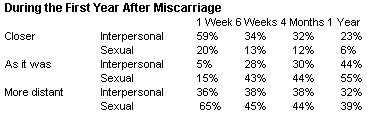
Results of the study showed that women who perceived their partners engaged in mutual sharing of feelings and experiences claimed to grow closer interpersonally and sexually. When partners failed to do things that showed they cared, women felt abandoned. These results combined with the findings of others (2) that men tend to keep to themselves after miscarriage deny their own loss, engage in avoidance, distract themselves through work and, if highly self-critical, experience greater despair and difficulty suggest that couples may need coaching in how best to care for each other after miscarriage.
Should you find that your partner experiences feelings of grief at the same intensity and duration as you, count yourself fortunate. Grief, by definition an extremely uncomfortable emotion, when shared and reflected accurately by another, tends to wane and can actually strengthen us over time. Creating supportive rituals to acknowledge and soothe one another’s pain are tremendously helpful for those who have experienced a miscarriage. Funerals, wakes, and birthday and anniversary routines all serve to give parents healing time; honoring the role that the “child to be†continues to play in their family and restoring a sense of meaning to the loss.
It is important to normalize the fact, however, that men and women tend to experience the impact of miscarriage differently. Coping with loss is a unique experience for each of us and there is no “right way†to go about it. Women, in general, do not need to learn to toughen up and let go. Nor do men need to soften up and express themselves more deeply. Often we choose our partners precisely because of these differences. The health of our long term commitment to one another depends on remaining curious and respectful of how those differences evolve over time.
Should weeks of estrangement from your partner’s grief become months (or years), it would be a good practice to explore new pathways for connection. The topic of miscarriage may seem still terribly hurtful to one, and all but forgotten to the other. Remember that getting outside help is appropriate at any stage of grief. Couples counseling provides neutral territory for safely acknowledging the new terrain of your marriage and what new shared coping strategies might still be available.
References:
(1) Miscarriage Effects on Couples’ Interpersonal and Sexual Relationships During the First Year After Loss: Women’s Perceptions
(2) Kristen M. Swanson, RN, PhD, FAAN, Zahra A. Karmali, BA, Suzanne H. Powell, BS, BA and Faina Pulvermakher, BS, MT (ASCP)
Psychosomatic Medicine 65:902-910 (2003)
© 2003 American Psychosomatic Society
 I have just finished having my yearly tradition of what I like to call, “a good cry.” It’s my son’s fourteenth birthday, and for the past ten years, I have set aside the morning hours of this day to participate in this cleansing ritual.
My son, Ben, isn’t deceased; he has autism. Not the “you-wouldn’t-know-it-if-I-didn’t-tell-you” kind. Ben has “full-blown-could-melt-down-any-moment-take-off-all-his-clothes-and-run-into-the-woods-requiring-search-helicopters-and-bloodhounds-to-find-him” kind. You get the picture.
As a therapist, I work closely with the Kubler-Ross stages of grief:
- denial
- bargaining
- sadness
- anger
- acceptance
With acceptance usually comes closure; that feeling of relief that the person isn’t suffering any longer, a feeling that you can now let go of the worry that accompanies the loss and go on with living your life.
Ben developed typically until age two, then lost skills until his autism diagnosis at age four. Sometimes I wonder if a traditional loss would’ve been easier. There would be closure. With autism, there is acceptance, but no closure. My grief is what experts call “cyclical.” With autism, as well as many other chronic illnesses and disabilities, the caregiver’s grief over an absence of perceived “normalcy” often recirculates through these five stages.
The combined training I have received as a mental health counselor and autism mom has taught me the following about handling grief in the “Land of Autism.” I’ve organized them according to the words from the wise women who have accompanied me on this journey.
“If you don’t deal with it, it will deal with you.”
This statement is about more than denial. In my counseling practice, I primarily treat parents raising children with autism. While every parent goes through the denial stage, whether it is for ten minutes or several years, “dealing” with our grief requires more than just accepting the diagnosis. We need counselors, friends, and professionals to help us with parenting skills, marital strife, and self-care. After the diagnosis, I took off like a racehorse out of the gate, doing all that could be done to help my child. Two years into it, my son was thriving in a wonderful program, but I was in a fetal position on the couch with severe depression and panic attacks. Take self-care seriously.
“What you can anticipate, you can plan for.”
Being aware of the five stages of grief is helpful because we can tell ourselves it will pass when we are experiencing it. We also need to be aware of “anniversary grief.” This is where an event can trigger a grief response that can correlate to a specific date or time of year. For some parents it’s their child’s diagnosis date. For me, it’s my child’s birthday. I now anticipate this event and make sure I set aside time to process my sadness.
“It is what it is.”
I don’t want to cry on what is supposed to be a happy occasion. The first few years I told myself I was being ridiculous and needed to get over it. This did not help the situation and I found myself suppressing sadness that would end up bubbling over into other areas of my life without warning. Acceptance is not only about our kids, it’s about accepting ourselves and our feelings. Set aside the time you need to grieve.
“Never, never, never give up.”
Autism itself can be a tremendous stressor on families, and it tends to be a leavening agent that brings all the problems that already existed in our relationships “to the top,” so to speak. I have personally had to save my marriage, face my demons, examine my beliefs, eliminate bad habits, make new friends, and change careers. Later today, I will process my mixed feelings about the birthday, in private, with my husband, and we will be closer because of it. And I will wake up tomorrow with a renewed resolve to never give up.
 A person I’ve been close to for many years is going through the dying process. It has been slow and painful; at times evoking one of the most beautiful and poignant musical pieces I’ve ever encountered. It is “Agnus Dei” by Samuel Barber, a choral version of his beloved and well-known “Adagio for Strings.” The text is from the Latin mass and includes the phrase, “Have mercy on us.â€
Now, mercifully, there is an end in sight for my loved one, but for those she leaves behind, the grief is palpable—at times dull and weighty, at others raw and biting, and frequently overwhelming.
Those who have gone or are going through the grieving process know how often all of our psychic resources are consumed with just getting through another day. It can feel like there is no room for creativity—only emptiness. But grieving presents an opportunity for both creativity and renewal; just as we have been changed by the relationship with our loved one, we will also be changed by the process of navigating through grief.
The weight of grief often feels like being imprisoned. One might wonder whether the pain will ever cease, and sometimes the restoration to function fully and enjoy life can seem far away. I imagine that it’s much like the feeling of a condemned prisoner.
I am reminded of the struggle of Viktor Frankl, an Austrian psychiatrist who founded the discipline of logotherapy (a therapy based on existentialism—not the nihilist variety of much existentialist literature, but one founded in hope and understanding of the power of the individual to find meaning in suffering).
[fat_widget_grief_right]Frankl was imprisoned in four German concentration camps during World War II. He was initially accorded an elevated status because he was a doctor, but eventually he was consigned to the life of an ordinary inmate, not knowing what the outcome of each day would bring. Frankl refused to accept that he might not survive the camps. Realizing the power of thought and creative visualization, he resolved to envision a positive outcome to his ordeal. It was out of this experience that logotherapy was born.
Later, Frankl wrote a small, but powerful, book, titled Man’s Search for Meaning, in which he outlined his struggle and how—through the power of visualization—he triumphed over despair. Part one is devoted to sharing his personal story with the reader, and the second part discusses the essential questions that form the basis of logotherapy: “What is the meaning of this experience for me?” and “How can I have hope for the future?”
Frankl believed that the process of finding answers to these questions would provide a foundation for coping with adversity and a path toward living a more full and fruitful life. This allows for a person to be changed by the experience of their journey. A person can reinvent an understanding of both the journey’s significance and of personal capacity and strength.
Herein lies the connection between grief and creativity. Working through the meaning of the loss creates not only a new self-concept, but also a new worldview.
I often utilize logotherapy in my sessions with people who are dealing with painful issues related to death and dying, grief and loss, adjustment to illness and disability, and caregiver stress. Utilizing the core questions involved in the re-creation of one’s understanding of suffering and the meaning of life has often been equally helpful to those who believe in an afterlife or a higher purpose and those whose envision our mortal life as finite with no overarching meaning. Although I believe this work is difficult to do without the help of a trained professional, merely asking the questions—such as “What does this mean to me?”, “How am I changed by this experience?”, and “How can I go on?”—sets the framework for conceptualizing a beginning, middle, and ultimate ending to the grief process.
If you are finding it difficult to cope with your own losses, perhaps seeking help from an experienced grief counselor who will be present for you, listen, ask the right questions, and guide you through the grief process would be useful. By all means, reach out to others in your support system. Remember that humans have great capacity for resilience, and the process of developing, recognizing, utilizing, and celebrating that resilience is a highly creative one.
It’s OK to be fully present with our sense of loss, but we should try not to lose sight of the promise of change or the expectation of renewal. You can see your way through this loss, and you may be re-created in a way that is most unexpected.
Reference:
- Frankl, V. (2006). Man’s search for meaning. Boston: Beacon Press.
 “Which is harder – mourning an actual loss or mourning the ‘ideal’ of something you never had?â€
This question was recently posted to the wall of my professional services page on a popular social networking site. I thought this was an intriguing question and one you yourself may have pondered in one version or another.
Grief is a natural feeling we have in response to a loss. Many people immediately associate grief with the deaths of those we love, but there are many kinds of loss that can plunge us into the deep well of grief. Loss comes in seemingly endless varieties. Loss of a relationship, loss of your job, loss of your home or a treasured object. Loss of the feeling of safety after a trauma. Loss of functioning after an accident or a medical crisis. Loss of your sense of security or self-assurance. Loss of freedom or independence. Loss of property or material goods. We can feel grief in response to the loss of anything we love and cherish. Being bereaved is the state of having lost something precious to us. I feel grief, I am bereaved. Mourning is a verb. Mourning is the outward expression of the feeling of grief. Mourning, in a broad sense, includes whatever acts we engage in to help us express our grief. Crying, wailing, wearing particular items of clothing or jewelry, building altars or shrines, creating art that reflects our feelings, engaging in grief rituals, writing, whatever it is that we do with the purpose of expressing our grief. Alan Wolfelt, internationally noted author, educator and grief counselor, said, (and I completely agree with him), “Everybody grieves…but only people who mourn really heal and move on to live and fully love again.”
[fat_widget_right]
So, can we mourn something we never had? At first, the answer may seem to be no. If we must lose something in order to feel grief and the something was never a real thing that actually existed, it can’t really be lost, right? As so many seemingly straightforward questions are, the question of whether we can mourn the loss of an ideal is more complex than it first appears. I don’t know what the “ideal†was that the questioner lost, but I can imagine many kinds of “ideals” that can be lost. We often find ourselves in the position of having to face the realization that what we once thought was ours was never really ours to begin with. I believe there can absolutely be grief and mourning over those kinds of losses. Let’s imagine that her loss was what she once thought was her ideal relationship. If the person she had pinned all her dreams on turned out not to be the person they seemed to be, and the relationship seems now a sham, that kind of loss can be heartbreaking. Perhaps you have experienced such a loss. There may have been painful betrayals, realizations that the person you loved, and who you thought loved you, did not really share your values, or feel the same way you felt. You may have trusted and believed that you had found your soul mate, your ideal, and then when the relationship ended, the realization that it was never the beautiful dream you had believed in, came crashing down. So, was it real? I think the answer is yes. And so is the loss and the grief that comes with it. Therefore it can be mourned.
Another example of mourning the loss of an ideal is the very real grief caused by the loss of hopes and dreams of the future. Families whose children are diagnosed with disabilities such as Down Syndrome, or who receive a diagnosis on the Autism Spectrum, understand this kind of grief and mourning for the loss of an ideal all too well. When a beloved child is diagnosed with a disorder that will absolutely impact his or her future, quality of life, learning, or functioning ability, parents can feel a multitude of losses. Most of us imagine what our “perfect” child will be like before he or she is born. We imagine the wonderful things she will accomplish, the goals he will achieve. Our hopes and dreams for our children’s lives do not include hardships or pain that they may have to endure. Many families’ hopes and dreams for their children can seem all but destroyed when a diagnosis of a life-altering condition is given. Many families eventually learn to move forward and discover that their children possess amazing gifts. Eventually, they can come to celebrate their children’s unique qualities and see them as treasured testaments to the beauty and diversity of the human condition. This doesn’t mean that they don’t grieve and mourn the loss of the ideal life they imagined, a typical existence for their family, or an uncomplicated, usual course of development for their child.
The questioner on my page also asked though, “which is harder?”–mourning an “actual” loss or the ideal? I think in looking at what loss is, and the huge spectrum therein, we can conclude that “actual”, doesn’t necessarily mean something tangible. The loss of  hopes, dreams, or an envisioned future, is definitely included in the arena of genuine losses. No, those are not concrete things that we can touch or see, but they are very real nonetheless. Grief comes in many packages. Whether one kind of loss, and the grief felt as a result, is harder to grieve or to mourn than another, is not a question that I can answer. There are many who feel that the death of a child is the “worst” kind of grief imaginable. In my personal experience, I can say that for me, in my life, based on my own experience of the death of my own child, I cannot imagine that any other loss I will experience will ever compare to that. The death of my son and my subsequent grief, I don’t think could ever be rivaled by any other loss in my life. This is true for sure of losses past, and I think I can accurately predict that it will remain true for losses future. The only other loss I could ever conceive in my own life that could bring the same kind of pain is if I ever have to endure the loss of my now living child. Hope is not a big enough word to describe my wish to never, ever have to live through that kind of pain again. However, that is only my experience.
Each person’s unique experiences of loss and grief cannot be held to another’s for comparison. Every one of us is different and responds in different ways to loss and to grief. I used to try to compare my own loss following the death of my son to that of a mother whose child had died of murder or violence, whose last moments were spent in fear or pain, and think, my loss is not as terrible as hers. I was trying to somehow make myself feel better, to help myself come to a place where I could stop feeling sorry for myself. But I came to realize that I was being terribly unfair to myself in thinking those kinds of things. I deserved to feel sorry, and to feel sorrow, for myself. Sometimes, I still feel sorry for myself. And that’s ok. My son will not be here with me, or any other member of our family, for the rest of our lives. I am sorry for all of us who don’t get to experience his physical presence, and all that would entail, for the rest of our lives. I know that things can almost always be worse, and I am grateful beyond words that my child died peacefully, surrounded by love, but to live in those kinds of comparison based thoughts is to diminish my experience as well as his. So, I stopped trying to make comparisons and I feel better for it. The same would apply for someone who tries on a regular basis to compare his or her loss to those of others in order to prove somehow that his or her loss is worse than others. That sort of comparing of grief never really works.
How an individual reacts to loss is very individual. Generally, the more we identify with, and the closer our emotional lives are entwined with the person, object or state of being that is lost, the more intense our feelings of grief. How entwined are your emotions and your identity with your home and all of your possessions? With your spouse or partner and all that relationship represents in your life? What about with your career? Your place of worship? Your friends? Your pets? Your investments? Your family? Various places and things and distinctive aspects of all that makes you who you are and which you hold dear? What if by some tragic turn of events any of those things were gone tomorrow?
The most important thing in getting through grief and loss, coming through to the other side, is having hope and having support. Research has shown that grieving people, no matter how acute the loss, who are able to identify some aspect of hopefulness, are able to move through grief with a better outcome. What is a “better outcome”? I think that means with the ability to feel functional, to feel as though you can contribute to the world, that you can feel happiness again, that you can begin new endeavors, and even though you may be left with a scar, you can move forward and not only survive, but thrive, in your life after loss. You may be in a place where hope seems hard to reach. But sometimes just hoping that you can get out of the bed today may be enough. You may hope to get out of the grocery store without crying, or hope that tomorrow will be a little bit better than today, or hope that you can get through the next five minutes. Honestly, having that little remnant of hope may get you through it. Without hope, you’d likely find yourself breaking down in the cereal aisle.
Find someone you can talk to who will not tell you what you should or shouldn’t be doing. Non-judgmental support that will allow you to express and explore your feelings. Look for a support group in your area. Finding others who have experienced similar losses can be very encouraging and empowering. If you feel that you need some extra help, seek out a counselor or therapist experienced in working with people dealing with grief and loss. Above all, do mourn your loss. Find a way to express your feelings, do something, create something, engage in some activity that allows you express your grief, even if only for yourself. While you are hurting, remember to be gentle with and take care of yourself.