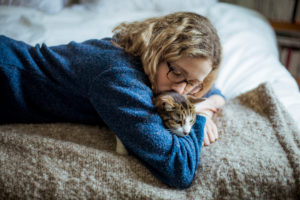
 Pets can offer an unmatched level of support to trauma survivors attempting to cope with the emotional aftermath of a traumatic event. A beloved and trusted pet can act as a lifeline when the person they live with experiences posttraumatic stress (PTSD) or is otherwise emotionally distressed. In short, a pet’s very presence can often work a particular kind of healing magic.
Pets known to offer support through the roller-coaster journey to heal from emotional trauma may be referred to as emotional support animals. Emotional support animals differ from working service animals in that the latter are trained rigorously for the purpose of helping people with particular, individualized needs. Our pets, on the other hand, do not need to be trained to provide natural healing. By simply playing with or cuddling our pets, we can benefit from the calming, soothing effect of their company. Even without training, our pets can help us cope with symptoms of anxiety and depression, fear, and the handful of other tough emotions likely to follow a traumatic experience.
How Do Pets Help People Cope?
Emotional support animals do not require any particular training, but they are still often able to soothe the emotional upsets of owners who have experienced trauma by being present as loving friends and offering support and connection through simple companionship. This offers us a unique way to cope with emotional entanglements and other challenges throughout the process of addressing trauma-related struggles. [fat_widget_right]
One way animals can provide emotional support is by helping increase oxytocin levels. Oxytocin is beneficial because it slows heart rate, lowers blood pressure, and helps prevent stress hormone production. Thus, increased levels of this hormone in the body can help people feel calmer and more at peace. This chemical alone can help us battle the negative emotions and mental health effects often experienced following trauma, and scientific observation supports an increase of the release of this so-called “happiness” chemical as a result of animal interaction.
Pets can also help us learn to let go of feelings of anger and resentment. These emotions are experienced by many who have faced trauma, and they can be some of the most challenging to expunge in its aftermath. Releasing these emotions, though, can have a lasting positive impact on mental health, and many individuals work with mental health professionals to reach a place where they are able to let these and other related feelings go. Pets do not hold on to these emotions, and the support of animal companions may allow many people to shake off anger and resentment more easily.
Dogs and other pets who provide emotional support can also help us learn how to remain mindful and aware of the present moment. People can reap many benefits by being more mindful, including learning to make the best use of their time and experiencing a regular boost in mood and overall increased emotional stability. People who have not faced trauma can still benefit from mindfulness, but practicing mindfulness can be an essential aspect of stress relief when trauma has been present in a person’s life.
Remaining Mindful with the Help of a Pet
We encounter difficult emotions after a traumatic event in part because these events can become haunting and preclude us from living in the present moment. We may find ourselves overthinking what happened, ruminating, and re-experiencing it. Mindfulness, a concept gaining prominence in recent mental health discussions, can help thwart these effects.
Playing with, cuddling, or even just touching our pets is another way to practice mindfulness, though this act may be both underrated and overlooked.
By definition, mindfulness is the ability to both live each moment as it unveils itself and accept every moment without judgment. The practice of mindfulness has been proven to reduce stress and enhance overall health and well-being. Many activities can enhance mindfulness. Among these are yoga, massage, prayer, meditation, crafts, art, and running, as well as any number of others. Playing with, cuddling, or even just touching our pets is another way to practice mindfulness, though this act may be both underrated and overlooked.
We can learn mindfulness from our pets in other ways, too:
- Pets do not always adhere to the plans their humans have mapped out, plans that can often make us feel as if we are on autopilot. This may seem like a disadvantage initially, but when we consider more carefully, we may find something in this to appreciate. When we embrace distractions and accept the fact we are not in control of everything around us, we can begin to come unstuck from self-imposed or preconceived ideas and restrictions on how things should be. Letting go in this way can be empowering and help us tremendously as we work to lead a better life. As a result, we are often able to more clearly connect with things as they really are and accept the fluidity of life.
- Pets do not ruminate about the past and what could have happened or worry about what the future holds. Pets live in the moment. By following their example, we can more easily overcome counterproductive mental activities and stay focused on the present. Remaining mindful and focused on the present can help reduce anxiety symptoms, for one, but numerous findings support other lasting positive effects on mental health as a result of mindfulness practices.
- Pets accept us as we are, which can help us accept ourselves. AÂ key aspect of the healing process from the emotional aftermath of a trauma is self-acceptance. Pets love us unconditionally and accept us without question. When we love and accept ourselves in the same way, we may find a smoother path toward healing.
- Pets demonstrate the importance of self-care. A hungry pet needs to eat. A pet who needs to go out needs to go out. When pets are tired, they sleep. When we are mindful of and able to prioritize and satisfy our own basic needs in the way our animal companions do, we are taking care of our physical and mental health so we can better address symptoms of anxiety, depression, and other effects of trauma and PTSD. If we aren’t taking adequate and proper care of ourselves, we are putting our mental and emotional well-being at risk. Taking care of our pets can help us get started on the self-care process, too—needing to walk a dog might help a person coping with PTSD get up in the morning.
While the many, varied, and often difficult psychological effects of exposure to traumatic events can be debilitating, by putting in conscious efforts to both prevent and work through them, many people are able to find a sense of peace and joy once more. Living with a pet can facilitate and hasten this process, as pet ownership allows individuals to enjoy endless offerings of companionship, structure, and affection. Beyond these benefits, our pets can teach us some important life lessons.
In fact, many people who felt as though they could not help themselves after a trauma went on to report the advantages of living with an adopted pet after the trauma were disproportionately high, even when compared to the additional costs of living with an adopted pet.
Owning a pet may not be for everyone, but for those who have a pet or are considering adopting, it’s worth exploring just how much a furry friend may have to offer.
References:
- Bauer, A. (2015, April 23). Why do pets make us feel better? Retrieved from http://www.cancer.net/blog/2015-04/why-do-pets-make-us-feel-better
- Cimons, M. (2016, September 19). Your dog can make you feel better, and here’s why. The Washington Post. Retrieved from https://www.washingtonpost.com/national/health-science/your-dog-can-make-you-feel-better-and-heres-why/2016/09/19/fde4aeec-6a2a-11e6-8225-fbb8a6fc65bc_story.html?utm_term=.55bca0bc4166
- Mindfulness practices may help treat many mental health conditions. (2016, June 1). APA Blog. Retrieved from https://www.psychiatry.org/news-room/apa-blogs/apa-blog/2016/06/mindfulness-practices-may-help-treat-many-mental-health-conditions
Integrating live animals into the therapeutic process has been gaining recognition as a viable and effective approach in a clinical setting. Equine-assisted therapy is a widely popular form of therapy that has shown remarkable results with clients who do not respond well to other types of treatment. Similarly, children who are resistant to traditional therapies have demonstrated improvement in animal-assisted therapies. For individuals who experience disassociation, animals represent an unconditional source of love and acceptance. For people who may have experienced early life trauma, especially trauma or abuse that undermined attachment relationships, animals can replace missing secure attachment bonds.
Although animals as therapy adjuncts, even pets, can help reduce anxiety, depression, loneliness, and isolation, owning or working with an animal may not be a viable option for everyone in need. Therefore, stuffed animals, which represent a source of comfort in times of stress for young people, may serve as a suitable replacement. Rose M. Barlow of the Department of Psychology at Boise State University in Idaho wanted to see if stuffed animals would serve clients equally as well as live animals. In a recent study, Barlow surveyed a sample of high and low dissociative female college students and those with dissociative identity disorder (DID) about attachment to live and stuffed animals. She found that the DID women had significantly stronger attachments to both live and stuffed animals than any of the other women. She also found that those with high dissociation and those with DID reported higher levels of attachment to stuffed animals than live animals when compared to the low dissociative group.
The findings of this study have several important clinical implications. Even though comorbid issues such as depression, anxiety, and bipolar were not considered in this research, the evidence suggests that stuffed animals may be particularly helpful to those with high levels of dissociation. Because symptoms of dissociation, even disorganized attachment, can begin in childhood and result from emotionally unavailable parents, divorce, or abuse, integrating stuffed animals into therapy for young children can provide a sense of security and help to rebuild impaired attachment bonds. “Animals, live or stuffed, can aid therapy for both children and adults by providing a way to experience and express emotions, a feeling of unconditional support, and grounding,†Barlow said.
Reference:
Barlow, Rose M., Lisa DeMarni Cromer, Hannah Prairie Caron, and Jennifer J. Freyd. Comparison of normative and diagnosed dissociation on attachment to companion animals and stuffed animals. Psychological Trauma: Theory, Research, Practice & Policy 4.5 (2012): 501-06. Print.