 Many people associate a sandbox with children’s play. However, there is a special type of expressive therapy in which a tray of sand is used to create and explore imaginary worlds. This modality, called sand tray therapy, can be appropriate for people of any age. Many adult clients enjoy sand tray therapy as a way to bypass the logical and intellectual parts of themselves in order to access a deeper, creative aspect.
Sand tray therapy has been in use since the 1940s. It emerged in the form of Jungian sandplay, a type of psychoanalytic expressive therapy in which clients were asked to “create a world†in the sand. In current times, sand tray therapy has evolved to be used by therapists from a variety of backgrounds, including humanistic or transpersonal.
How It Works
The sand tray that is used in therapy with adults and adolescents is a rectangular, wooden tray, several inches deep and painted blue on the inside. Typically, the tray is placed on a wheeled table that is about regular table height. The tray is filled about two-thirds full with clean, white sand.
In the same room, there is an open shelf containing a broad variety of small toys or figurines. These usually include human figures of different types, as well as animals, plants, buildings, vehicles, and other types of things that are commonly seen in everyday experience. Any of these figurines can be placed within the sand tray to create a small, imaginary world. In addition, the sand in the tray can be shifted to make an evocative landscape. Sand can be piled up to show a hill or mountain, or it can be scraped away from the bottom of the tray to show the blue interior in order to represent water.
How It Helps
Sand tray therapy can be used with adults when success with verbal therapies is stifled, or when a therapeutic modality that allows more access to innate creativity is desired. An excellent use for the sand tray can be with grief or trauma, when words are difficult to utter or fully process. When clients touch the sand, it can be very soothing to the psyche, offering a healing beyond what we can visibly understand.
“When the beginnings of self-destruction enter the heart, it seems no bigger than a grain of sand.†—John Cheever
There are several components of sand tray therapy that make it effective for many people, including:
- The design of the sand tray environment is a safe, contained world that is fully controlled by the client, and can be manipulated or changed by adding, subtracting, or moving figurines within the scene.
- It does not require any artistic skill to have a satisfying sand tray experience—only selecting and placing objects.
- Physically moving representational objects within the sand tray container has a beneficial effect on the body, especially in people who have undergone traumatic experiences—more so than simply talking about memories or ideas.
What to Expect
In a session using sand tray therapy, the therapist will typically begin by encouraging the client to explore the sensory experience of the sand tray itself. Many clients may spend a few minutes just experiencing the cool, smooth sand on their fingers.
The client can leave the sand smooth and flat or create a landscape by shifting the sand in the tray. Then the therapist will explain how to choose figurines in order to create a world or scene in the sand tray. The therapist will instruct the client to choose several figurines that elicit a strong reaction, either positive or negative, and reassure the client that it’s OK not to “know†what each figure represents. Then the client will decide where to place each object in the sand landscape. The scene may be static, or it may evolve over the course of the session. The therapist will encourage the client to observe what has happened in the world of the sand tray and discuss the meaning that the client sees in this experience. A photograph of the scene may be taken in order to keep a record of the session.
My Experience
Having sand trays in therapy rooms can provoke a client’s curiosity. I recall a non-sand tray client in the sand tray room stroking the sand as he was talking to me. I called his attention to this and he remarked, “It’s soothing.†Just having the sand tray nearby to touch supported his ability to relax in the room. Another example is when I was working with a couple. After a turbulent session with his wife, the man took the opportunity before he left the therapy room to put a shark head down in the sand—a visual and nonverbal communication about his feelings.
As I allow each and every client to have his or her own experience, I find the benefits of sand tray therapy useful. It allows clients to have experiences they may not if they were to use only language.
Reference:
The Columbia World of Quotations (1996), Columbia University Press. Retrieved April 11, 2013, from http://quotes.dictionary.com/search/sand_?page=3
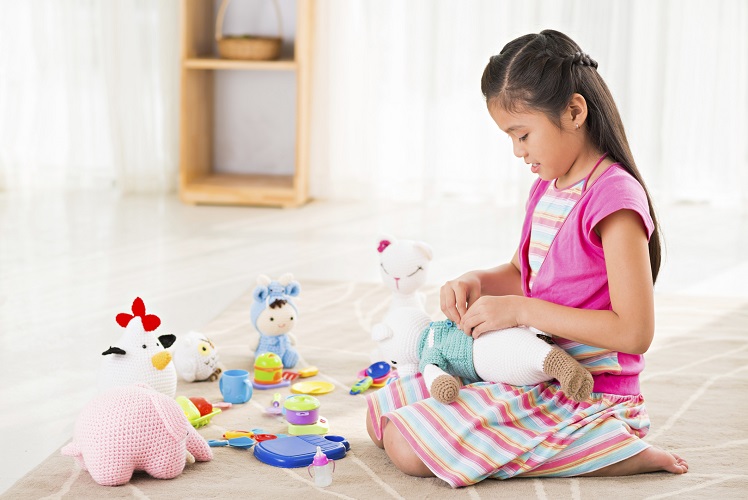
During therapeutic play with children, therapists watch, listen, and interact during moments when a child may be giving voice to images, emotion, and story.
“Image†implies an object or person of attachment from the child’s past, “emotion†implies feelings from past relationships or that the child may be feeling in current relationships or in the moment, and “story†implies the coming together of a narrative that all children accumulate piece-by-piece over time.
As children work to make sense of their world, they often try on different ways to communicate meanings, experiences, and identity. Usually this work occurs in the context of ongoing parent-child relationships, through the form of brief questions and conversation, and meaningful experiences over years and years.
Sometimes a child’s context, when tumultuous, unpredictable, and even harmful, can deter such work and leave a child with only collected fragments of identity. Those fragments may be confusing and contradictory and may leave a child without the confidence that comes through securely attached relationships with caregivers.
Sandplay therapy and other forms of therapeutic play, both directive and nondirective, are tools in a process of nurturing more secure attachment bonds with caregivers and beginning a journey of co-construction of identity.
[fat_widget_child_counselor_right]Take, for instance, a child who, after experiencing chronic abuse or neglect, begins to settle into a supportive family who can provide consistency and nurturance. Oftentimes families are surprised when a child responds to all their outpourings of love and support through varying modes of ambivalence or avoidance. In these cases, it is not only the child, but also the adults who have a tremendous amount to gain from experiencing the child’s underlying anxiety in a therapeutic context, deriving new, more positive and safe experiences, and working together to develop a new approach and a new narrative to coincide with it.
As therapeutic play facilitates relationship-bonding and identity co-construction with caregivers, volatile survival-oriented behaviors often decrease. The words of Susan Johnson, a leading proponent of emotionally focused therapies, ring in my ears: “Emotion must replace emotion.â€
A caring, creative, and collaborative approach assists such children and their families—and in the cases of adoption, their new families—in launching a journey of defragmentation, meaning-making, and identity formation that may have for years been delayed by a focus on more primal needs.
Over time, caregivers have opportunities to become more involved and less involved in the child’s play as it feels comfortable to them and to the child.
As children participate in sandplay therapy, I make a point to remain only peripherally engaged in their play, allowing them to take control of their play worlds with minimal interference. I often mirror the degree of participation of caregivers in the room. Over time, caregivers have opportunities to become more involved and less involved in the child’s play as it feels comfortable to them and to the child.
These new fragments of experience and exploration, in the safe presence and amidst dialogue from caregiver(s) and counselor, are building blocks in this co-construction of identity. Images, emotion, and story can emerge in unexpected ways and at unexpected times.
Much of the work of this co-construction is already occurring by this time in the context of a new, safe, and more predictable family home environment. The families supporting these children should be encouraged by signs that emotional and social development is roaring down the tracks once again, much due to the fuel of their care and affections.
Recommended Reading
Gil, E. and Sobol, B. (2000). “Engaging families in therapeutic play.†In C.E. Bailey (Ed.), Children in Therapy: Using the Family as a Resource. NY: W.W. Norton & Company.