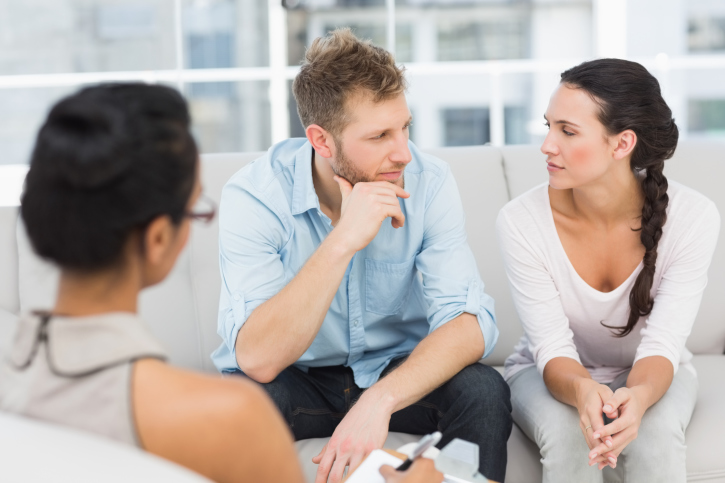
 Next Friday, August 31, 2012, GoodTherapy.org is thrilled to welcome Dr. Laurie Moore, who will present Healing Betrayal Caused by Infidelity, a FREE CE teleconference for GoodTherapy.org members available with 1.5 CE Credits. We encourage you to join us for this exciting event, so if you have not already, register today!
Working with clients who are suffering from betrayal caused by infidelity is complex, including grieving stages, posttraumatic stress (PTSD), and additional factors. This article refers to infidelity as a breach in agreed emotional and sexual monogamy. Some couples agree to open relationships or polyamory, which is a different situation. Infidelity as defined in Wikipedia is “a breach of an expectation of sexual and or emotional exclusivity.” This involves a lie and broken promise, causing feelings of intense betrayal for many people.
Infidelity has become a common problem. Some infidelity statistics state that over 50% of both men and women engage in infidelity (Journal of Marital and Family Therapy, 2012) and others say 30% to 60% (Wikipedia, 2012).
Those suffering from infidelity betrayal commonly go through Kubler Ross’s well-known stages of grief:
- Denial: This didn’t really happen or it’s not really as upsetting as I feel it is.
- Anger: How could you?
- Bargaining : If only I had communicated differently, this would not have happened.
- Depression : I feel helpless. Nothing I can do changes this discomfort.
- Acceptance : I have been hurt and disillusioned but I am at peace with myself.
The experience of grief due to infidelity includes additional factors that are absent from grief occurring from a death. Grief due to death is felt in a finite situation that contains an end. It is understood that the one who is gone is gone from the body permanently. Grief due to a breach in trust has no finite or predictable container. The one suffering finds him- or herself in unpredictable circumstances, which often feel very dismantling and excruciatingly unsettling.
Feelings that challenge self-confidence and worth are more common to infidelity betrayal than loss alone. Death is socially expected. Infidelity is shunned. The one who is betrayed is prone to feel guilt, shame, and embarrassment because the situation remains privately hidden or is condemned by a variety of reactions when exposed.
When death is the cause of grief, a solo journey is required. When betrayal is the cause of grief, two people are involved, so the situation is more complicated. Once one is lied to, the relationship is uncertain. This person can’t tell whether he or she is being lied to or told the truth. The one experiencing this challenge is often upset again in the aftermath of the partner relationship. This is different than the one abandoned by a death whose loss cannot re-emerge in a repeating scenario.
Clients with heartache caused by infidelity and betrayal can also go through fight-or-flight syndrome:
Fight: Arguing with, controlling, or managing the person who betrayed me will solve this.
Flight: Leaving will solve this.
Once fight or flight proves useless, a person will seek comfort in other ways. By assisting this person to fully meet the helplessness, sorrow, anger, anguish, disillusionment, and heartache that has come, peace can be found.
I have found that client-centered talk therapy, hypnotherapy, eye movement desensitization and reprocessing (EMDR), and the 12-step program are all deeply valuable for clients healing from infidelity. I also use my own Success Love Now (SLN) process effectively in these situations. Here is how and why each of these methods is valuable.
Someone who is suffering from loss and feeling isolated due to the taboo nature of this loss needs to be witnessed compassionately and caringly. This in itself helps to relieve the tremendous burden one carries from feeling alone. When being accepted within the context and emotions one is truly feeling, without being corrected or judged, peace can start to return. Acknowledging your understanding and compassion for a clients’ diverse set of feelings can be a profound help to a suffering client.
Because the shock of betrayal can be extreme, disrupting normal life in many ways, EMDR assists the hurting person to digest the deep emotions that are arising. Just getting through the day becomes a challenge for people who are betrayed. EMDR makes the healing time for this upheaval much faster in many cases.
Hypnotherapy allows the person who was hurt to re-find stability, meet parts of him- or herself that were hurting before the situation occurred, heal parts of him- or herself that are hurting now, and find a new basis for equanimity that is deeper than the circumstances. Taking a client into a deep, relaxed state in which the client can bring in peaceful parts of him- or herself to help the hurting parts enables a client to rebuild self-esteem and strength.
S-Anon Twelve Steps allow people to find the value in surrender, the gift in their challenge, and the support of others enduring similar pain. Twelve Steps also help the one who was betrayed to find out if addiction was involved in the betrayal, as commonly is the case. Letting your client know that S-anon is an option can be a valuable part of her or his healing process.
SLN provides a new framework for the person to feel empowered and at ease within the undesired circumstances. Encouraging the client to focus on what his/her purpose and aim are for him- or herself and gratitude for the good that is occurring within the context of the undesired happenings is beneficial. This will bring a client out of a victim mode and into a creative mode.
Of course, if the person who was betrayed plans to stay in the relationship, couples counseling and counseling for the one who was betrayed are necessary.
When working with clients who have been betrayed due to infidelity, it is important to understand the complexity of loss, mixed with PTSD, combined with humiliation–this situation causes a long period of overwhelm and readjustment. When the client is treated with compassion, the healing can go well.
Sources:
- Infidelity statistics. (n.d.). Retrieved August 20, 2012, from http://www.statisticbrain.com/infidelity-statistics
- Infidelity. (n.d.) Retrieved August 20, 2012, from http://en.wikipedia.org/wiki/Infidelity
Related articles:
Cheating
Can a Couple Recover From Infidelity?
In-Depth Map for Three of the Eight SUCCESS LOVE NOW Steps
 Dressing up can take extra effort, but it also feels good, especially if you receive extra compliments. A new study suggests what many women have experienced: dressing in nicer clothes makes you feel better.
According to a recent news release, one study has shown that women who are depressed or sad are more likely to wear baggy tops, jeans, and a sweatshirt or jumper. Women who are happy or positive are more likely to wear a favorite dress, jewelry, and jeans. These clothing choices seem to mean that women who are feeling down put less effort into what they’re wearing, and women who are in a good mood tend to try and look nicer to match their mood.
[fat_widget_right]
There were 100 women interviewed for the study, and their ages ranged from 21 to 64 years, according to the news release. The researchers also found that 73% of women in the study “shopped for clothes at least every few months.” The majority of women, or 96%, “believed that what they wear affects how confident they feel,” according to the news release.
Researchers determined from the results that there is a possibility that wearing certain clothes can affect emotional states. “The strong link between clothing and mood state suggests we should put on clothes that we associate with happiness, even when feeling low,” according to the news release. The author of the study, Karen Pine, who is the coauthor of Flex: Do Something Different and a professor in the School of Psychology at University of Hertfordshire, added in the news release that jeans are more associated with a depressed mood state and that women should consider abandoning them for a different clothing choice in order to feel better.
“Jeans don’t look great on everyone. They are often poorly cut and badly fitting,” Pine said in the news release. “Jeans can signal that the wearer hasn’t bothered with their appearance. People who are depressed often lose interest in how they look and don’t wish to stand out, so the correlation between depression and wearing jeans is understandable. Most importantly, this research suggests that we can dress for happiness, but that might mean ditching the jeans.”
In the study, 51% of women would wear jeans when they felt sad or depressed, and only 33% of women would wear jeans when they felt happy or positive, according to the news release. So if people still wear jeans when they are happy, just to a lesser degree, why are they such a bad choice? Why are baggy clothes associated with a sad or depressed emotional state and dresses and jewelry associated with a happy or positive emotional state? Pine addressed these issues in an email.
“All the findings apply, but because jeans are so ubiquitous (everyone seems to have a pair, women on average have eight pairs each) we chose to ‘lead’ on this finding. It is interesting that many women wear them a lot but there’s still a variation according to mood. I think the finding that women will only wear their favourite dress when happy or will likely wear a baggy top when depressed is just as compelling.”
She said that the research didn’t go into certain details, like the fact that some women are more into a “jeans and T-shirt” type of fashion, and other women wear skirts and dresses every day as part of their style. It’s also uncertain whether results would’ve changed if researchers took into consideration the emphasis some women put on fashion and beauty and if women who shopped less were interviewed. “Of course there will always be individual differences, but nonetheless recent research into enclothed cognition … confirms there is a strong association between what we wear and our psychological processes,” Pine said.
Results would also possibly look different if men were included in the study. “A lot of my research concerns women’s issues .. and I think the emotional link is probably stronger for women than for men, although there is research that shows men’s clothes affect how they behave (e.g. sports teams that wear all black act more aggressively),” Pine said.
Overall, Pine believes the research provides a look into how we can improve our moods. “It shows that clothes impact strongly on how we feel and may also influence how we think (as the above research also suggests), which we’ll be exploring further in our research,” Pine said. “It suggests we should give more thought to what we wear and even dress for happiness, irrespective of how we are feeling. If we knew more about which clothes could lift a person’s mood perhaps there’d be less need for anti-depressant medication.”
Shauna Mackenzie Heathman, a certified image consultant and owner of Mackenzie Image Consulting in South Carolina, said in an email that the results of the study are expected. “When we are feeling depressed or unhappy, looking our best is not on our minds,” Pine said. “In fact, it becomes a hassle and waste of time. Mental energy is turned inwards towards emotional thoughts. Dressing simply becomes function versus adornment or fun.”
She said that people shouldn’t necessarily make assumptions about the feelings and emotions of another person based on their clothing though. “We have the power to wear items that represent our personalities and feelings,” Heathman said. “With that being said, who knows how other people will interpret it. We make [judgments]/assumptions based on our own experiences. Bottom line: I would be careful to assume one’s feelings based on what they wear. To a certain extent, you can read whether someone is feeling insecure based on their clothing, but body language and nonverbal communication is much more representative of one’s feelings.”
She thinks there could also be a separate study on men that explores their clothing choices and emotional states. “I think it was okay for this study to be focused around women,” Heathman said. “A separate study on men should be considered. However, first you would need to discover the underlying differences between men and women and how they interpret clothes. Men are much more focused on functionality in their wardrobe than women, regardless of emotional state. So I do think there may be some general similarities, but overall women’s results would probably be more dramatic.”
One of the main parts of the study Pine focused on was jeans and their association with a depressed or sad mood state, and Heathman thinks this could be because jeans are an easy choice that doesn’t require a lot of thought. “I don’t think it’s the fact of wearing jeans that suggests sadness or depression as it is just wanting effortlessness and functionality,” Heathman said. “As I mentioned before, when we are depressed or sad, we’re not focused on how we look. We stop caring. We turn to what’s easy and comfortable. Prolonged long enough, you then fall in ‘the rut.’ Often, altering one’s mood by enhancing wardrobe can be done. However, it generally only has short-term results if working on one’s emotional and mental state is not at play as well.”
“The study mentions that happy clothes include well-cut, figure-enhancing items made from bright and beautiful fabrics,” Heathman said. “To this, I ponder, isn’t this obvious? If something makes our figure look poor, we generally don’t like this and thus are unhappy about it. When we don’t like what we wear, we focus on it throughout the day. It takes away the focus from the daily tasks that are important—work, relationships, family. A woman should walk out of the door and not have to think about what she’s wearing for the rest of the day. You’d be amazed at how much mental energy is exhausted pondering about how we look.”
Overall she thinks the study could have gone more in-depth to provide more useful information. “I think the study lacks depth. What is revealed seems fairly obvious,” Heathman said. “I would be curious to hear why women choose to wear a hat more often when they are happy. Is it because it’s fun? Is it because it draws attention towards them? Also, the psychology of color comes into play much more than the study presents. I think it’s informative more than it is useful.”
Donna Stellhorn, a Feng Shui expert and author of 2012 Year of the Water Dragon, interprets the study from a unique perspective involving her experience with Feng Shui. For those who are unfamiliar with Feng Shui, it is “the study of how the environment affects those who dwell in it,” according to the American Feng Shui Institute website. The “science” of Feng Shui suggests that there are “different energies” in our planet, and learning how to balance these energies can help improve various aspects of life.
“In Feng Shui we understand how you dress is associated with the five elements. Each element has an energy, and we’ll gravitate to the energy that’s in harmony with how we feel at the moment,” Stellhorn said. “The study says when we’re feeling down we’re more likely to reach for jeans and loose-fitting tops. These boxy shapes relate to the Earth element, a desire for stillness and stability. There are five elements (Earth, Wood, Fire, Water, and Metal), each with an energy, feeling, and a related style. Besides the shape of clothes, also the color and material indicates the element. For instance, animal prints are associated with the Fire element and a desire to be noticed and feel alive.”
She said for men, color would probably be more of an indicator of emotional states. “Because men tend to stick to a limited wardrobe, emotional states can be read in the choices of colors and the slight changes in what they normally wear,” Stellhorn said. “Men who usually sport a T-Shirt and suddenly start wearing a button-down shirt in greens or browns has moved from the Earth element to Wood, showing a desire to grow, to add to their life financially and socially, they’ve become curious about the world.”
She agrees that jeans are less effort when people are already preoccupied with other areas of life. “It’s not that jeans specifically suggest sadness, but that the desire to throw on a pair of jeans can indicate that life’s been too chaotic, there are too many choices and we want some quiet stillness to contemplate what’s ahead,” Stellhorn said. “When we reach for jeans we want something familiar because things around us are stressful.”
Accessories can also affect mood, like the study suggests. “Women’s hats bring attention (from others and our own) to our heads and indicate a person with power,” Stellhorn said. “A man in a ball cap might be covering thinning hair, but by wearing the hat he feels more powerful and better able to interact in the world. Jewelry and handbags also bring an energy, and therefore an emotion, to the person.”
Linda Froiland, an image consultant and personal shopper, said in an email that jeans don’t need to always be associated with depression, although sometimes it can be difficult to find the perfect fit. “Jeans are not just for tennis shoes. If you have a great fitting pair in a dark wash they can be quite sexy with an elevated heel, high heel, or wedge shoes,” Froiland said. “I wear mine out dancing, dinners at friends or restaurants, shopping, everywhere really, but they fit like a glove and have attitude. I can honestly say I am not depressed when wearing jeans, nor are my clients once they know how they should fit, what they should look like, and what to pair them with.”
Rosa Mae Neel, a stylist for professionals and the founder of Prune, agrees with Froiland that jeans don’t necessarily mean depression. “In a place like New York, where women commonly spend up to $300 for a pair of jeans and wear them with heels and a sexy top to go out at night, jeans do not necessarily equal depressive state,” Neel said. “Perhaps in other parts of the country or for older generations, jeans that are not designer jeans and that are more comfortable than flattering are a go-to for depressive states. Again, blousy tops can be trendy and hip if expensive or worn with gusto, or they can be a medium through which to hide extra pounds or negative feelings.”
Froiland said that clothing can be important in not only affecting mood but also in making impressions on other people. “Whenever I talk to a group, large or small, I always start out my presentation with telling everyone that ‘It’s in less than 3 minutes someone has already decided who and what you are. First by your appearance (87%), second your body language (8%), and then your verbal communication (5%). It takes another 20 times meeting that person to change that original perception,’” Froiland said. “So the value in our clothing is profound.”
Caroline Adams Miller, a professional coach, author of “Creating Your Best Life” and a graduate of University of Pennsylvania’s Master’s in Applied Positive Psychology program, said in an email that baggy clothes in general can indicate more of a lackluster mood. “Baggy jeans that could be perceived as asexual probably don’t correlate with happiness unless paired with more individualistic shirts or accessories,” Miller said. “The baggy tops reference doesn’t surprise me because they would ‘hide’ someone, and unhappy people don’t want to interact with people—they want to ruminate and be alone, and these clothing choices are perfect indicators of not feeling worthy of being ‘seen.’”
She believes that men could be affected by clothing choices as well, although they might put more effort into choosing a car to express their personality and mood. “I do believe that many men use clothing to express and change their moods, though, so I think a future study would find similar results,” Miller said.
Overall she believes the study makes sense and that there is a real connection between clothing and mood. “The science of happiness has found that we have ‘positive interventions’ that can change our mood, and when we deliberately intervene on our happiness by wearing things that evoke positive feelings, positive reactions from others, or that remind you of positive experiences, you will be happier,” Miller said.
Related articles:
Are You Your Own Worst Enemy?
Seven Mistakes People Often Make When They Get Depressed
Depression as Trickster and Communicator
Did you know that according to Patrick Carnes, Sex Addiction Expert, he reports that relapse happens for most individuals who struggle with sex addiction in the second six months of recovery? Most individuals gain traction in recovery through counseling, support groups and establishing strong boundaries. It is very important that individuals who struggle with sex addiction stay proactive in their recovery and the journey to having healthy and satisfying relationships.
These are three effective ways to avoid relapse in a sexual addiction recovery program:
1. Be humble:
For many individuals who struggle with sex addiction the first six months to a year is the first time in a long time that their mind and actions are not filled with double mindedness including acting out, lying, etc. When individuals start to feel good about their progress, there can be a temptation to loosen their established boundaries. This can be dangerous which is why most individuals who struggle with sex addiction relapse in the first year (second six months) of recovery. It is imperative to stay on a plan that they review with accountability partners especially early in the recovery process. Being humble recognizes that this will be an ongoing battle and that they will need to stay sharp every day to stay consistent and free. By staying humble, one will recognize when temptations or compromise is coming and be willing to take an even stronger stand rather than backing off! If they want to continue their journey, they must stay humble and they will stay on the right path! (more…)
“For years it lay in an iron box buried so deep inside me that I was never sure just what it was. I knew it carried slippery, combustible things more secret than sex and more dangerous than any shadow or ghost. … I saw things I knew no little girl should see. Blood and shattered glass. Piles of skeletons and blackened barbed wire with bits of flesh stuck to it…The iron box contained a special room for my mother and father, warm and moist as a greenhouse. They lived there inside me, rare and separate from other beings. … I knew my parents had crossed over a chasm … The box became a vault, collecting in darkness, always collecting; pictures, words, my parent’s glances, becoming loaded with weight. It sank deeper as I grew older, so packed with undigested things that finally it became impossible to ignore.”
-Helen Epstein, Children of the Holocaust
 Experiencing a traumatic life event is horrific and terrifying, but this experience does not have to become your defining moment.
It is possible to grow through a traumatic event, or series of events, and there are loosely-structured phases of healing for that growth to follow. For a moment, stop and reflect on what it means for experts to have identified these patterns of healing: it means that you are not alone in having experienced trauma, and you are not alone on the healing journey.
The healing journey follows three loosely linear stages or phases. The rate of growth through each of the phases, as well as the details of what that growth looks like, will be unique to you. You will develop your own unique pattern of healing, which means that you will enter, exit, and revisit phases at various times in your life.
Always keep in mind that revisiting is not backwards movement. It is like the outer layers of a spiral: you pass by the same issues, but are in a different, deeper state of healing. As you near the end of your healing journey, you will be able to look back and notice an overarching progressive nature to your growth and healing.
[fat_widget_trauma_ptsd_left]This article will look at the first phase of healing, while future articles will address the second and third phases.
Understanding the Safety Phase
As you begin the first phase of healing, safety is both your main concern and the hardest task to achieve. Establishing safety—both within yourself and within your environment—can take days, weeks, or even years. The length of time required to develop genuine safety depends on your unique attributes, such as past life experiences, personality, and pretrauma baseline. The length of this phase also depends on how chronic the trauma. In general, the longer you were exposed to the trauma, the longer it will take to develop a sense of safety.
This is not an easy stage. Establishing safety requires a lot of hard work and may require that you, the survivor, dramatically change your life or lifestyle. While this is a difficult part of the healing journey, absolutely no survivor can skip this stage.
Safety Within
In order to truly have safety, you must establish safety within yourself. Focusing on your physical health lays the foundation for internal safety. Establishing internal safety requires you to tend to any ailments, as well as to eat healthy foods, exercise regularly, and sleep sufficiently. Self-harming behaviors preclude genuine safety, so cutting, burning, or addictions to drugs, alcohol, food, or sex, must be grown through and terminated.
Many self-harming behaviors are efforts at managing emotions or thoughts. Learning how to manage your thoughts and emotional world, including your trauma reactions (especially hyperarousal and intrusive reactions), is fundamental to being safe within yourself. Many people find it difficult to engage in this healing without the assistance, support, and guidance of a trained professional. Do not feel ashamed or hesitant to reach out for help.
Safety in the World
Safety within oneself is only half of the equation. No one can be fully safe unless the environment they live and interact in is also safe. Creating safety within your environment requires safety within your physical and relational spheres.
- Attaining a safe physical space includes your ability to move physically in society with a sense of safety and security. It may help to work on your ability to identify dangerous situations or individuals and, to the best of your ability, to get out of a dangerous situation if at all possible. Consider developing safety plans or learning self defense.
- Assess the physical and emotional safety of your social support network. It may be necessary to remove people from your life who are a potential source of physical or emotional danger, or to increase the number of people who can and do provide emotional support, protection, or practical help.
- For those who experienced trauma at the hands of other people, assess the degree of continuing threat and the potential for re-victimization or revenge, and develop appropriate precautions. Ensuring your safety is not 100% within your authority, since to live means to be vulnerable. But that does not mean it is 0% within your authority either.
Moving Through the First Phase
This phase of growth is gradual. It can have a sometimes halting stop-and-go pattern, and it can take a long time. However, if you continue to work on developing safety, and allow trustworthy others to help you, you will be able to grow through this phase.
Some indicators that you have grown through this phase include no longer feeling utterly vulnerable; having a degree of confidence in your ability to protect yourself physically and emotionally; knowing who to count on for safety and support, and being able to effectively manage most of your trauma reactions, including emotions, thoughts, and behaviors.
If learning about the tasks involved in this first phase of healing feels daunting, don’t give up. Reach out to a trained therapist and harness their skills and abilities in order to engage in this healing work. You have a right to reclaim the quality of life you deserve.
If this first phase of healing sounds like a review of work you have already completed, take a deep breath of congratulations and gratitude. You are on your way to continued and ever-deeper healing and growth.