 Many years ago, I was betrayed by a friend I admired. If I had been asked to forgive her, my immediate answer would have been, “No.” But if someone had asked if I wanted to be free from the anguish and distress that I felt from her betrayal, I would have shouted, “Yes!”
Forgiveness is more than releasing your hands from the neck of the person who hurt you. It is truly about releasing your hands from your own neck. Forgiveness is about your own freedom from the grip of pain caused by someone else. In reality, forgiveness has nothing to do with the other person; it’s about you. Forgiveness does not need to be asked for because it isn’t done for the sake of the “offender.” It’s done for our own healing and well-being.
[fat_widget_right]
It goes without saying that when we’re considering forgiveness, it is because we’ve been hurt, wronged, or betrayed. Someone has done something to us that caused us pain. A pivotal component of forgiveness is the recognition of the intensity of your pain. You have to sit in and with your pain. You can’t ignore, rationalize, or wish it away. You must simply let it be. You can talk, journal, cry, or scream about the hurt and painful emotions, but they must be allowed to surface.
Another key step to forgiveness is in understanding how the pain and betrayal affected you. Pain isn’t an isolated experience or emotion. When we are hurt, it affects all aspects of ourselves and our relationships. Consider a man who just learned that his wife was cheating on him. Understandably, he is hurt, sad, and angry. He also has trouble focusing at work, his patience with his children is low, and he begins to withdraw from his friends because he is too embarrassed to discuss his wife’s infidelity. His emotions go beyond his wife’s betrayal; now the pain seeps into other relationships.
Part of understanding the intensity and depth of the pain is in comprehending how your pain affects you in other ways. Ask yourself the following questions:
- Have your feelings of betrayal and sadness spilled into other relationships?
- Has it affected how you view yourself?
- Are you less willing to be emotionally intimate and vulnerable with people because you’ve been hurt?
- How are you restricted or imprisoned by this pain?
Take time to write, think, or talk about your answers to these questions. Revisit the questions over time, perhaps at three months, six months, and one year. Have your answers changed? Do you notice anything different each time you answer? Are your feelings the same or have they shifted?
You cannot simply decide to forgive someone and expect it to be done. It takes time, compassion for yourself, and the support of others to work through the pain that you endured. Often when we are hurt or grieving, there is internal pressure and external pressure from family, friends, and society to “get over it”: “It’s been six months; why haven’t you forgiven him for cheating? Are you still upset about what she said to you?” These statements suggest a time limit for moving on after being hurt, but everyone has a different time frame. What takes one person two weeks to forgive may take another person one year to forgive. We all have our personal and individual processes of forgiveness that cannot be rushed.
When you are in the process of forgiveness, it is crucial that you have compassion toward yourself. Enlisting the support of people who are also compassionate toward you and will not rush your process is also beneficial.
Once you’ve acknowledged your pain and you understand how it has affected you, you can ask yourself: What do I need in order to be free from this pain?
What are your stories and experiences of forgiveness? How have you been able to forgive? When have you struggled or been unable to forgive? I want to hear from you!

What happens to a relationship when one person changes?
“Vanessa” is on a path of self-discovery and change, but that does not mean that her husband, “Mark,” is on the same path. Nor does it mean he wants Vanessa to be on that path or to change who she is. Many times I see couples who come to therapy because someone has changed. “Vanessa didn’t used to be this way,” Mark said. “When we were first married, she liked staying home and watching television. I don’t know what happened.” Complaints like Marks are often more than criticism: in Gottman’s terms, most recurring conflicts are failed bids for connection. Underneath “I don’t know what happened” is usually a quieter question – “Do I still matter to you?”
When you are in a committed marriage or partnership, it stands to reason that you will change. Can you imagine being the same person at age 55 as you were at age 25? But what do you do when your changes and journey do not match up with where your partner is or what they desires? What if you find yourselves on different paths?
Research shows that personal growth goals have become increasingly important in modern marriages, with couples expecting relationships to provide not only support and bonding but also an environment that nurtures both partners’ individual development. However, when one person changes significantly, it can create challenges that require intentional navigation.

First, acknowledge the change. Talk about the elephant in the room. Not only is it OK to tell your partner about the changes that you are making in your life, it is imperative to do so. An intimate relationship is about two people and what they create together. In order to keep the health of your relationship and respect it, you must speak to your partner about what is going on for you. Your partner needs to know about the personal changes that you are making, as they affect your marriage. Because these personal changes are long-lasting, not fads or temporary, it will require that the couple have multiple conversations over an extended period. This ongoing conversation may last months and even years.
Couples therapy research bears this out: in a 2024 trial of integrative behavioral couple therapy, strengthening constructive communication went hand in hand with better marital adjustment. Carol Dweck’s work on mindset offers a useful frame for these ongoing conversations—growth minded couples treat communication as an act of curiosity rather than a performance to be managed.
Second, check in with your spouse. Ask about his or her feelings and needs. Yes, you may be changing, but you also need to tend to the needs of your relationship and your partner. What does your partner need during your process of change? While you may be changing and growing, being in a committed and intimate relationship means that the needs of your partner are essential to you. Considering what they need must be part of your process as well.
Third, determine if you or your spouse is growing in different directions. Notice that I did not say “growing apart” but “growing in different directions.” If you are in a long-term relationship, it makes sense that you and your partner will not always be focused on the same thing at the same time. There will be differences even if there were not previously. Acknowledging that you are on different paths and that you have different goals and desires is helpful to your relationship. Once you acknowledge this, you can take the necessary steps to maintain the health of your relationship. In the Gottman model, this is the work of “making life dreams come true”-a level of the Sound Relationship House in which each partner actively supports the other’s goals, orienting away from self-interest and toward the advancement of the other.

Personal growth within a partnership is best understood as a mutual evolution: each person flourishing independently while the couple grows together. Healthy boundaries in relationships foster individuality and personal space that is critical for both partners’ growth and well-being, allowing each partner to mature, discover their interests, and pursue their goals.
Finally, be respectful of your relationship or marriage. Just because you have different goals or desires does not mean that you cannot be together. It does mean that you need to be more active and conscious about tending to your relationship. When clients see me for couples therapy, my first statement is that their relationship is my primary client and I work for what is best in that relationship.
What does your relationship need to stay strong even if you are making personal and individual changes? Does it need time and attention? Does your relationship need activities that are special and specific to you and your partner? What can remain the same and unchanged that you both enjoy? What compromises do you and your partner need to make? These are a sampling of questions to ask yourself and for you to discuss with your spouse/partner if you want to navigate personal growth while also tending to and allowing your relationship to grow.
A solid and healthy marriage is about how effectively couples can support each other in becoming the best versions of themselves, creating a balanced ecosystem where individual growth and collective happiness coexist and reinforce each other.

*If you are experiencing significant relationship distress, consider seeking support from a qualified mental health professional. The information in this article is not intended to replace professional counseling or therapy.*
To find a therapist who can help you navigate relationship changes, visit our Find a therapist directory.
© Copyright 2026 GoodTherapy.org. All rights reserved.
*The preceding article was solely written by the author named above. Any views and opinions expressed are not necessarily shared by GoodTherapy.org. Questions or concerns about the preceding article can be directed to the author or posted as a comment below.*
- Capozzi, F. (2025). A research-driven flowchart to approach change in couples. Frontiers in Psychology, 15. https://doi.org/10.3389/fpsyg.2024.1438394
- Christi-Degen, N., Preißler, S., & Kröger, C. (2024). Effects of integrative behavioral couple therapy on communication patterns and marital adjustment. Frontiers in Psychology, 15. PMC11414875
- Li, X., Lamis, E., & Chan, W. (2024). Dual-earner couples’ sharing of work-related experiences: Effects on relational and personal well-being. Applied Psychology: Health and Well-Being. https://doi.org/10.1111/aphw.12574
- Strauss Cohen, I. (2024). The role of individual growth in marital happiness. Psychology Today. https://www.psychologytoday.com/us/blog/your-emotional-meter/202404/the-role-of-individual-growth-in-marital-happiness
- Wittenborn, A., et al. (2023). Couple therapy in the 2020s: Current status and emerging developments. Journal of Family Therapy. PMC10087549
References:
- Capozzi, F. (2025). A research-driven flowchart to approach change in couples. Frontiers in Psychology, 15. https://doi.org/10.3389/fpsyg.2024.1438394
- Christi-Degen, N., Preißler, S., & Kröger, C. (2024). Effects of integrative behavioral couple therapy on communication patterns and marital adjustment. Frontiers in Psychology, 15. PMC11414875
- Li, X., Lamis, E., & Chan, W. (2024). Dual-earner couples’ sharing of work-related experiences: Effects on relational and personal well-being. Applied Psychology: Health and Well-Being. https://doi.org/10.1111/aphw.12574
- Strauss Cohen, I. (2024). The role of individual growth in marital happiness. Psychology Today. https://www.psychologytoday.com/us/blog/your-emotional-meter/202404/the-role-of-individual-growth-in-marital-happiness
- Wittenborn, A., et al. (2023). Couple therapy in the 2020s: Current status and emerging developments. Journal of Family Therapy. PMC10087549
 The loss of a child before it is born naturally stirs intense and conflicting emotions. Women might feel an intense physical bonding and grief for a being with whom they have already grown attached. Whereas men might feel more ephemerally connected and cheated from the opportunity to begin their bond. When miscarriage affects couples, it may stimulate growth or, conversely, unearth an inability to support each other through troubling times. The confusion surrounding one’s own feelings as well as how to be of real support to one’s partner after the loss tends to disrupt the balance of our relationships. This is especially true if some of that balance lay in the shared anticipation of parenthood. The inability to share and understand each other’s grief can be an isolating experience.
One week after the loss, most women report feeling closer interpersonally with their partner while feeling more distant sexually. As time progresses and different coping strategies for grief kick in, the feelings of closeness fade even when their sexual relationship recovers. Partners with significantly different grieving patterns may be at particularly high risk for subsequent marital conflict or emotional withdrawal.
A recent study on women’s perceptions on their relationship after a miscarriage (1) shows a dramatic decrease in interpersonal and sexual intimacy for most couples up to one year after a miscarriage. At that point only about half of women interviewed report a return to normalcy in their relationship (there is no data available on men’s perceptions).
Percentage of Women Claiming Their Interpersonal and Sexual Relationships Were Closer, As It Was, or More Distant
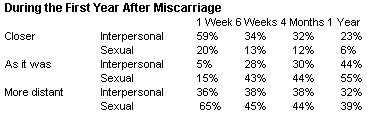
Results of the study showed that women who perceived their partners engaged in mutual sharing of feelings and experiences claimed to grow closer interpersonally and sexually. When partners failed to do things that showed they cared, women felt abandoned. These results combined with the findings of others (2) that men tend to keep to themselves after miscarriage deny their own loss, engage in avoidance, distract themselves through work and, if highly self-critical, experience greater despair and difficulty suggest that couples may need coaching in how best to care for each other after miscarriage.
Should you find that your partner experiences feelings of grief at the same intensity and duration as you, count yourself fortunate. Grief, by definition an extremely uncomfortable emotion, when shared and reflected accurately by another, tends to wane and can actually strengthen us over time. Creating supportive rituals to acknowledge and soothe one another’s pain are tremendously helpful for those who have experienced a miscarriage. Funerals, wakes, and birthday and anniversary routines all serve to give parents healing time; honoring the role that the “child to be” continues to play in their family and restoring a sense of meaning to the loss.
It is important to normalize the fact, however, that men and women tend to experience the impact of miscarriage differently. Coping with loss is a unique experience for each of us and there is no “right way” to go about it. Women, in general, do not need to learn to toughen up and let go. Nor do men need to soften up and express themselves more deeply. Often we choose our partners precisely because of these differences. The health of our long term commitment to one another depends on remaining curious and respectful of how those differences evolve over time.
Should weeks of estrangement from your partner’s grief become months (or years), it would be a good practice to explore new pathways for connection. The topic of miscarriage may seem still terribly hurtful to one, and all but forgotten to the other. Remember that getting outside help is appropriate at any stage of grief. Couples counseling provides neutral territory for safely acknowledging the new terrain of your marriage and what new shared coping strategies might still be available.
References:
(1) Miscarriage Effects on Couples’ Interpersonal and Sexual Relationships During the First Year After Loss: Women’s Perceptions
(2) Kristen M. Swanson, RN, PhD, FAAN, Zahra A. Karmali, BA, Suzanne H. Powell, BS, BA and Faina Pulvermakher, BS, MT (ASCP)
Psychosomatic Medicine 65:902-910 (2003)
© 2003 American Psychosomatic Society
 Lois has five minutes left to her fifth session and is now having a flash of insight. “I’m bored to death with therapy,” she thinks. “This is getting me nowhere.” She feels close to her therapist and decides that he deserves more than a false excuse. “Look,” she says, “I think we can both agree that we’re nearing the end here.” Unsure about how to respond to his neutral facial reactions, Lois plunges forward. “Believe me, I’m as bored of myself as you probably are. There’s no reason to pretend that we’re making progress here when I’m just going over the same issues, again and again. You’ve been trying. I know you have. But I’ve got nothing else to discover about myself. I’m done. That’s all there is. I’m just done.”
There is nothing wrong with gaining the sense of well-being that comes with having a professional provide reflection and insight on one’s life. Lois is pleased with her therapist’s support and feels the first four sessions were a success. Brief therapy may have provided her the supportive boost she needs as she continues to apply new coping skills on her own. If, on the other hand, there are uncomfortable symptoms plaguing her (sleeplessness, worry, loss of interest in pleasurable activities, intense relational conflicts, etc), it will be worth her while to take a second look at the boredom that is blocking her way.
Lois and her therapist are at a common juncture in treatment. Research into the phases of therapy conducted by Kenneth Howard of Northwestern University outlines a progressive, three-stage sequence of change. In the first phase, the client experiences a restoration of subjectively experienced well-being. The second phase focuses on the resolution of the client’s symptoms. This phase occupies a greater number of sessions—generally, between the 5th and the 15th session of therapy. Curiously, over one-half of his clients had discontinued therapy by session four.
The Problematic Skill of Emotional Insulation
As children, most of us learn to create emotional boundaries around ourselves to keep us safe. Trapped with a negative or mean-spirited crowd, our emotional insulation kicks in and we can feel somewhat removed from harm. Dropping layers of emotional insulation while with a nurturing friend allows us to take in the nutrients of their care. By the time we become adults, this unconscious defense mechanism regulates our relationships automatically.
For those impacted by big or small experiences of neglect or harm from others, it follows that they would be prone toward a self-sufficient stance. This insulation might be felt in the emotional brain as apathy and irritability when the “threat” of an ongoing relationship is apparent. The cognitive messages associated with these feelings may be something like, “I’m fine not caring about this person. I’m waiting for them to leave so I can feel more safe.” Such feelings and thoughts get activated without permission from the conscious mind. Sometimes, as in the case with Lois, the realization of boredom can occur quite suddenly and emphatically.
Repairing Flaws in the Insulation
One does not need to be engaged in long-term psychoanalytic care to see the importance of the therapeutic bond. Even in brief, solution-focused therapy, progress results in large part from the trust established between those two people sitting in that room, taking time together to see what surfaces. Boredom is simply one of the body’s natural resistances to this process. Touching into that boredom gives one the opportunity to test and perhaps readjust one’s automatic reactions. Similar to removing an unnecessary layer on a hot day, the act of staying in a relationship even when bored can yield surprisingly pleasant results.
“So you’re feeling annoyed. I see that. Care to look at that feeling a little bit further?”
Lois laughs. Another minute or two, she thinks, and this will be over. “Oh, great. So now I’m going to pay you for the chance to look at my boredom.” She rolls her eyes and opens her pocketbook.
“Only if you want to,” he answers. She hands her check to him. The two stand as she makes her way to the door. Lois takes one last moment to collect herself before reaching for the doorknob.
“You know,” she says, “I’ve never done this before. I don’t know what comes next.”
She watches her therapist nod and smile. “I can be here if you want to find out.”
Navigating Boredom and Longing
Taking a look at the automatic effort to prevent intimacy is just as important as putting effort into stepping past the resistance. Examining the body’s reactions to closeness and distance can be an unasked for but enlightening part of therapy. As Lois drives home, she is no doubt reexamining that nod and smile from her therapist as she stood at the door. The boredom that prompted their last interaction has now been unmasked to reveal an underlying uncertainty and frustration. Beneath that lies an unanswered longing for connection.
There is no quick answer to Lois’s dilemma of whether to return for another session. There’s neither certainty that therapy is the ideal site for her to place that longing, nor an assurance that it’s better to listen to the call of her boredom and move on. She has her own mind to make up and her own body to tend to as she manages the ebb and flow of her tolerance for relationships. She is not alone in her struggle, though. Boredom and longing carry their unspoken and magnetic influences on our interpersonal behaviors, driving each of us to our own true north. Effective therapy simply offers us a safe place to unmask the process.
While managing the ebb and flow of your capacity for intimacy, remember that every moment offers an opportunity for healing. I find this piece of wisdom encapsulated within the following excerpt:
Empty yourself,
So that you may be filled.
Learn not to love
so that you may learn how to love.
Draw back,
so that you may be approached.-St. Augustine Narration on Psalm 30:30
References:
Howard, K. I.; Lueger, R. J.; Maling, M. S.; & Martinovich, Z. (1993). A phase model of psychotherapy outcome: Causal mediation of change. Journal of Consulting and Clinical Psychology, 61(4), 678-685.