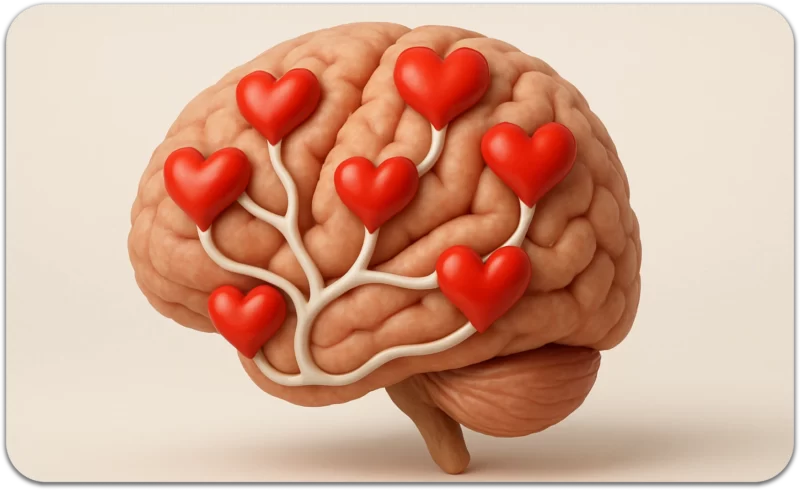
Key Takeaway: Falling out of love isn’t just emotional, it’s biological. When dopamine fades and stress hormones rise, relationships suffer. But here’s the hopeful part: through neuroplasticity and couples therapy, your brain can literally rewire itself to feel love again. This article explores the science behind why we fall out of love and the proven therapeutic approaches that can help you reconnect.
Ah, love, that magical mix of butterflies, late-night texts, and pretending you actually like their favorite band. At first, everything feels cinematic. But somewhere between “I can’t stop thinking about you” and “Why do you breathe so loud?” something shifts. You might find yourself falling out of love, and it can feel confusing and painful.
It’s not that you suddenly stop caring, it’s that your brain chemistry changes. Falling out of love isn’t just an emotional story; it’s also a biological one rooted in neuroscience and attachment patterns.
The Brain on Love: Nature’s Most Addictive Drug
When you first fall in love, your brain throws a full-blown chemical party. Dopamine (the “pleasure” chemical) lights up your reward system every time you see or hear from your partner. Add a dash of norepinephrine (the excitement hormone) and a heavy pour of oxytocin (the cuddle chemical), and suddenly you’re in the throes of what scientists call “romantic love”, and what your friends call “being obsessed.”
Research published in the journal Brain Sciences confirms that the coordination of oxytocinergic and vasopressinergic pathways, coupled with the dopaminergic reward system, contribute to the formation and maintenance of both maternal and passionate love. Basically, early love is the brain’s version of a chemical binge, all thrill, no chill.
The Science Behind the Spark
The ventral tegmental area (VTA) and nucleus accumbens; key regions in your brain’s reward circuit, become hyperactive during early love. Georgetown University neuroscience research shows this activation is similar to what happens with highly rewarding stimuli, explaining why new love feels so intoxicating.
The Come-Down: When the High Wears Off and You Start Falling Out of Love
Unfortunately, the brain can’t keep partying forever. Over time, it adapts, dopamine receptors stop firing at full blast, and that rush of excitement begins to fade. This is called hedonic adaptation, which is science’s polite way of saying, “you got used to it.”
What once made your heart skip now just… exists. You start noticing little annoyances (why do they breathe so loud again?) because your brain isn’t running on pure dopamine anymore. This biological shift is a primary reason why people experience falling out of love, even when they still care deeply about their partner.
Feeling emotionally disconnected from your partner? Learn effective strategies with our article on what couples who stay together do every day to maintain emotional connection.
Stress Enters the Chat: Cortisol Crashes the Party
As the honeymoon glow fades, real life rolls in, bills, chores, emotional baggage, and along with it comes cortisol, the stress hormone. When stress rises, oxytocin (your bonding hormone) drops. The brain’s alarm system, the amygdala, becomes more active, and suddenly your partner’s quirks start feeling like personal attacks.
This isn’t because love disappeared, it’s because stress hijacked the chemistry that keeps you connected. Studies suggest that chronic stress (via cortisol) may disrupt oxytocin and bonding pathways, weakening emotional closeness.
Serotonin and the End of Obsession
When you first fall in love, serotonin levels drop, making you think about your partner constantly. (Yes, love makes you a little obsessive, it’s biology, not madness.) But as the relationship settles, serotonin balances out. The fixation fades, and you start noticing other things: your needs, your goals, your sleep schedule.
That shift can feel like falling out of love, but in many cases, it’s your brain just finding balance again. Understanding this biological reality can help couples normalize what they’re experiencing rather than interpreting it as relationship failure.
Quick Science Fact:
A study by Marazziti et al. found that people in early romantic love had reduced platelet serotonin transporter density, levels similar to those seen in unmedicated OCD patients
Withdrawal: When Love Ends (and It Feels Like You’re Dying)
Breakups, or even emotional distance, can feel physically painful because your brain goes through withdrawal. Those same dopamine and oxytocin pathways that once fired with joy suddenly go quiet. It’s why we crave contact, even when we know it’s not healthy.
But here’s the hopeful part: your brain heals. Through neuroplasticity, the brain’s ability to rewire, new sources of connection and joy eventually form. Research on neuroplasticity demonstrates that you really can feel that spark again, sometimes even with the same person.

How Therapy Can Help When You’re Falling Out of Love
Here’s the part many people don’t realize: therapy isn’t just for breakups, it’s for makeups. When you’re experiencing falling out of love, professional support can be transformative.
A good couples therapist can act like a guide for your nervous systems, helping you both learn to connect again instead of defaulting to old defenses. Emotionally Focused Therapy (EFT), which is grounded in attachment theory, has been shown to be highly effective for couples experiencing emotional disconnection.
How Therapy Rewires Your Brain for Love
-
Creates emotional safety: When you feel heard instead of blamed, the brain naturally shifts from defense mode to connection mode
-
Reduces cortisol (stress): Learning better communication and emotional regulation skills lowers stress hormones
-
Boosts oxytocin: Small moments of eye contact, shared laughter, or vulnerability can reignite bonding hormones
-
Activates neuroplasticity: Therapeutic relationships can help form new neural pathways over time, as shown in neuroimaging studies of psychotherapy.
In therapy, partners experience emotional safety, and that’s when oxytocin (the bonding hormone) starts flowing again. Therapy also helps reduce cortisol (stress) by teaching better communication and emotional regulation skills. Small moments of eye contact, shared laughter, or even vulnerability can reignite dopamine, reminding your brain why you fell in love in the first place.
The Role of Attachment in Falling Out of Love
Research shows that early caregiving experiences shape adult romantic attachment styles (secure, anxious, avoidant, disorganized), which influence how people think, feel, and relate in relationships.
Therapy helps couples move from insecure attachment patterns toward earned secure attachment, where both partners feel safe expressing vulnerability and responding to each other’s needs. This transformation doesn’t just improve feelings, it literally changes brain structure through repeated positive interactions.
The Takeaway: Falling Out of Love Doesn’t Mean Failure
Falling out of love doesn’t mean you’ve failed, it means your brain is doing what it’s designed to do: adapt and seek balance. But just as the brain can unlearn closeness, it can relearn it, too.
With care, curiosity, and sometimes the guidance of a good therapist, the chemistry of love can evolve, not back to the dizzying early rush, but toward something deeper, calmer, and more real. Couples counseling offers multiple pathways to rebuild connection, from improving communication to addressing underlying trauma.
Signs You Might Benefit from Couples Therapy:
-
You feel emotionally disconnected from your partner
-
Arguments escalate quickly or lead nowhere
-
You’re considering separation but still have hope
-
Life stressors are straining your relationship
-
You want to prevent small issues from becoming major problems
-
You’re ready to invest in your relationship’s future
Because love isn’t just a feeling, it’s a relationship between two nervous systems learning to feel safe again. And with the right support, that safety can be rebuilt, one moment of connection at a time.
Ready to Reconnect and Rebuild Your Love?
You don’t have to navigate falling out of love alone. Professional couples therapy can help you understand the neuroscience behind your disconnection and provide practical strategies to rebuild emotional intimacy.
 Many of us learned in high school biology class that genetic traits are passed down to us from our parents. We were taught that we have brown, blue, or green eyes because a parent did, we’re thin or fat because a parent was, and so on. Recent research expands this idea in a way that would have seemed inconceivable a few decades ago. We know the traits we pass down to our children can not only change based on our life experience. But we also know we can continue to alter our children’s pattern of genetic activity after they’re born. This area of genetics research is called epigenetics. It’s the study of alterations in gene function caused by changes in gene expression rather than in the genetic code.
This could all seem a bit disheartening to those of us dealing with anxiety, depression, anger issues, or other mental health concerns. If we’re depressed because of our parents’ experiences or how they treated us when we were babies, what hope is there for us? But if we couple epigenetics with research into cognitive behavioral therapy and neuroplasticity (the brain’s ability to form new neurons and glial cells and forge new connections), we have reason to be hopeful.
[fat_widget_right]
In 2010, scientists at the University of Copenhagen fed male rats a diet high in fat and then watched as their offspring gained more weight than the babies of rats fed a regular diet. If traditional theories about genetics had been true, the diet of a rat’s parent shouldn’t have affected the weight of their offspring. The old thinking about genetics—that either you’re born with a gene that predisposes you to obesity or you’re not, and nothing you do in your life changes what gene you pass onto your children—is, according to studies like the Copenhagen one, incorrect.
To discover how gene alteration in rats occurs, scientists studied their sperm. “The genes in sperm cells are regulated by swarms of molecules, so-called epigenetic factors. These molecules can respond to environmental influences by silencing some genes and activating others as needed†(Zimmer, 2015). The research suggests the male rats were handing down epigenetic factors to their offspring.
A 2011 study at the University of Wisconsin showed that “when parents are under emotional, financial, or other forms of stress, it can alter their children’s patterns of genetic activity at least through adolescence and perhaps longer. And since some of the altered genes shape brain development, the effects of parental stress might permanently wire themselves into children’s brains†(Begley, 2011).
It was an earlier 2004 study that showed us how parents can alter a baby’s genes by their behavior toward them. Another rat study, this time at McGill University, revealed that when a mother rat licks and grooms her offspring, “it activates a gene that makes a receptor for stress hormones in the baby rats’ brains, which causes more receptors to be produced, which causes fewer stress hormones.†Thus, the offspring are more “well-adjusted, curious, and mellow†as adults (Begley, 2011).
So, the question becomes: If our parent’ lives before we’re born and their treatment of us when we’re children can have a huge effect on our mental and physical health as adults, what can we do about it if we, as adults, are suffering the consequences? Whether we’re dealing with childhood trauma, anxiety, or another mental health issue, believing so much of our personality is baked-in can be, well, depressing.
Learning more about epigenetics and neuroplasticity gives us a reason to strive to be healthier and happier people.
This brings us to another fascinating area of research: neuroplasticity and cognitive behavioral therapy (CBT). According to a study published in Translational Psychiatry in 2016, “patients with anxiety disorders exhibit excessive neural reactivity in the amygdala†and there is “compelling evidence that CBT for a common anxiety disorder simultaneously changes the physical structure and neurofunctional response of the amygdala†(Månsson, 2016).
This is good news for those of us who just got discouraged reading about epigenetics. CBT is the most widely used evidence-based psychological treatment. It focuses on patterns in cognition, coping strategies, and emotional regulation. CBT subjects learn extensively about the relationship between thoughts, feelings, and behavior, and they practice identifying maladaptive thoughts such as catastrophizing—jumping to worst-case scenarios.
In CBT, one learns to separate faulty thoughts and beliefs from one’s emotional responses and, consequently, one’s unhealthy behaviors. For example, when the thought “everything will turn out horribly†leads to the feeling “I might as well give up now,†you are likely to give up and thus prove to yourself that you were right all along. After weeks or months of successful CBT treatment, a person should learn to recognize when they catastrophize and change the thought from “everything will turn out horribly†to “I can’t predict the future; things may work out and surprise me,†changing the emotional response and thus the behavior.
Learning more about epigenetics and neuroplasticity gives us a reason to strive to be healthier and happier people. One, because they tell us that we can break negative thought patterns that keep us trapped in unhealthy behaviors. And two, because our actions impact our children—both before we decide to have them and after we bring them into the world.
If you struggle with negative thoughts and related behaviors, contact a therapist.
References:
- Begley, S. (2011, September 12). Parents’ depression and stress leaves lasting mark on children’s DNA. Daily Beast. Retrieved from https://www.thedailybeast.com/parents-depression-and-stress-leaves-lasting-mark-on-childrens-dna
- Essex, M. J., Boyce, W. T., Hertzman, C., Lam, L. L., Armstrong, J. M., Neumann, S. M. A., & Kobor, M. S. (2011, September 2). Epigenetic vestiges of early developmental adversity: Childhood stress exposure and DNA methylation in adolescence. Child Development. Retrieved from https://onlinelibrary.wiley.com/doi/abs/10.1111/j.1467-8624.2011.01641.x
- Kays, J. L., Hurley, R. A., & Taber, K. H. (2012, April 1). The dynamic brain: Neuroplasticity and mental health. Neuropsychiatry and Clinical Neurosciences, 24(2). Retrieved from https://neuro.psychiatryonline.org/doi/full/10.1176/appi.neuropsych.12050109
- MÃ¥nsson, K. N. T., Salami, A., Frick, A., Carlbring, P., Andersson, G., Furmark, T., & Boraxbekk, C.-J. (2016). Neuroplasticity in response to cognitive behavior therapy for social anxiety disorder. Translational Psychiatry, 6(2). Retrieved from https://www.ncbi.nlm.nih.gov/pmc/articles/PMC4872422
- Weaver, I. C., Cervoni, N., Champagne, F. A., D’Alessio, A. C., Sharma, S., Seckl, J. R., … & Meaney, M. J. (2004). Epigenetic programming by maternal behavior. Nature Neuroscience, 7(8). Retrieved from https://www.ncbi.nlm.nih.gov/pubmed/15220929
- Weinhold, B. (2006). Epigenetics: The science of change. Environmental Health Perspectives, 114(3). Retrieved from https://www.ncbi.nlm.nih.gov/pmc/articles/PMC1392256
- Zimmer, C. (2015, December 3). Fathers may pass down more than just genes, study suggests. The New York Times. Retrieved from https://www.nytimes.com/2015/12/08/science/parents-may-pass-down-more-than-just-genes-study-suggests.html