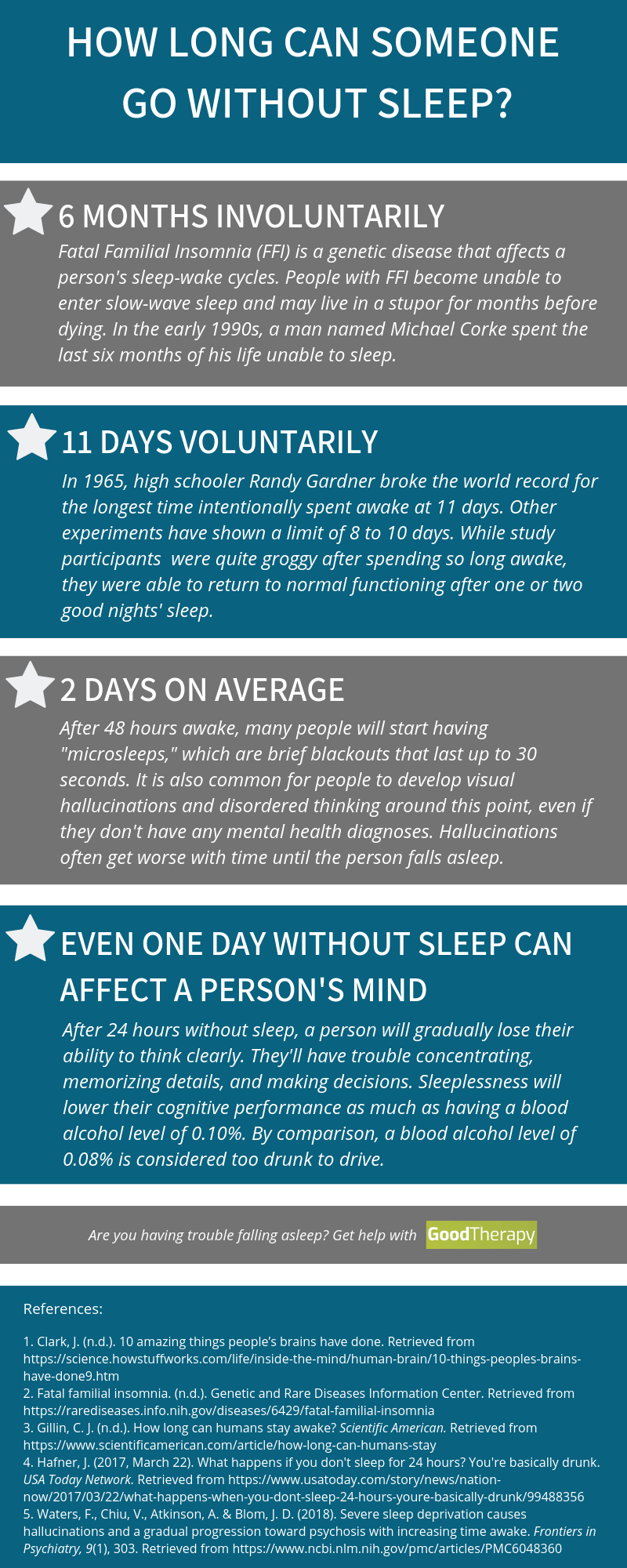
Infographic Text: How Long Can Someone Go Without Sleep?
6 MONTHS INVOLUNTARILY
Fatal Familial Insomnia (FFI) is a genetic disease that affects a person’s sleep-wake cycles. People with FFI become unable to enter slow-wave sleep and may live in a stupor for months before dying. In the early 1990s, a man named Michael Corke spent the last six months of his life unable to sleep.
11 DAYS VOLUNTARILY
In 1965, high schooler Randy Gardner broke the world record for the longest time intentionally spent awake at 11 days. Other experiments have shown a limit of 8 to 10 days. While study participants were quite groggy after spending so long awake, they were able to return to normal functioning after one or two good nights’ sleep.
2 DAYS ON AVERAGE
After 48 hours awake, many people will start having “microsleeps,” which are brief blackouts that last up to 30 seconds. It is also common for people to develop visual hallucinations and disordered thinking around this point, even if they don’t have any mental health diagnoses. Hallucinations often get worse with time until the person falls asleep.
EVEN ONE DAY WITHOUT SLEEP CAN AFFECT A PERSON’S MIND
After 24 hours without sleep, a person will gradually lose their ability to think clearly. They’ll have trouble concentrating, memorizing details, and making decisions. Sleeplessness will lower their cognitive performance as much as having a blood alcohol level of 0.10%. By comparison, a blood alcohol level of 0.08% is considered too drunk to drive.
References:
- Clark, J. (n.d.). 10 amazing things people’s brains have done. Retrieved from https://science.howstuffworks.com/life/inside-the-mind/human-brain/10-things-peoples-brains-have-done9.htm
- Fatal familial insomnia. (n.d.). Genetic and Rare Diseases Information Center. Retrieved from https://rarediseases.info.nih.gov/diseases/6429/fatal-familial-insomnia
- Gillin, C. J. (n.d.). How long can humans stay awake? Scientific American. Retrieved from https://www.scientificamerican.com/article/how-long-can-humans-stay
- Hafner, J. (2017, March 22). What happens if you don’t sleep for 24 hours? You’re basically drunk. USA Today Network. Retrieved from https://www.usatoday.com/story/news/nation-now/2017/03/22/what-happens-when-you-dont-sleep-24-hours-youre-basically-drunk/99488356
- Waters, F., Chiu, V., Atkinson, A. & Blom, J. D. (2018). Severe sleep deprivation causes hallucinations and a gradual progression toward psychosis with increasing time awake. Frontiers in Psychiatry, 9(1), 303. Retrieved from https://www.ncbi.nlm.nih.gov/pmc/articles/PMC6048360
 It’s 3 a.m. You see the clock and realize you have four hours left before your alarm sounds. You think about everything you must do the next day and how miserable it will feel doing it exhausted. You toss and turn. You try counting sheep. You’re awake, and it feels like the entire world is sleeping.
You’re not suffering alone. Nearly 60% of adults lack sufficient sleep (Jacobs, 2009). How did this happen? Let’s start by looking at root causes of sleep problems and then identify ways to address them.
Root Causes of Sleep Problems
Behavioral
Bad habits breed many of our sleep problems. Staying up too late doing projects. Playing on the phone or computer. Responding to text messages or emails at all hours of the night. Engrossing oneself in a television show, particularly one with disturbing content, can negatively impact sleep. All these behaviors teach the brain that nighttime is a great time to be awake. The fear of missing out (i.e., FOMO) on an important post or text can keep our brains combing through social media or emails for hours.
[fat_widget_right]
Environmental
Having a dark, quiet, and comfortable place to sleep promotes rest. The glow of an energy-efficient light bulb, computer screen, TV, or phone can stimulate the wake center of the brain (“Blue Light Dark Side,” 2017). Environmental disturbances including noisy neighbors, a snoring partner, or a playful pet in bed can make it challenging to catch some Z’s. Having a bed that is too firm or provides inadequate support can leave you tossing and turning. Sleep can also feel elusive when the temperature is too hot or cold.
Emotional Distress
Stress, anxiety, and depression can adversely impact sleep (Jacobs, 2009, van Mill et al., 2013). When our brains perceive some type of threat (e.g., a meeting with a difficult coworker tomorrow, loss of a loved one), it activates the limbic system. This system controls the brain’s emergency response signal. It sends chemicals into our bodies which prepare us to fight or flee danger. We cannot fight of flee if we’re asleep, so the limbic system shouts, “Stay awake!” This response is wonderful if we’re being chased by a bear, but it creates problems when we need to rest. The limbic system can become particularly sensitive and activated when one has experienced a traumatic event.
Beliefs About Sleep
Negative thoughts about sleep, such as, “I’ll never sleep well again … I am not going to sleep tonight … If I don’t sleep, I am going to fail my test/perform poorly at work,” can perpetuate sleep problems (Jacobs, 2009). Additionally, beliefs that one must have sleep medication to sleep can interfere with the body’s ability to sleep on its own.
Substance Use
Caffeine, nicotine, and alcohol can negatively affect sleep (Lichstein, 2000). In addition to the common sources of caffeine (e.g., coffee, soda, and energy drinks), we also need to consider hidden sources. Certain protein bars, decaf coffee, chocolate, and some over-the-counter medications contain caffeine. A review of major sleep studies suggests alcohol users may fall asleep faster, but the second half of sleep will be poorer compared to those who don’t drink (Ebrahim, Shapiro, Williams, & Fenwick, 2013). Both prescribed and illegal substances can leave one feeling wound up, depending on amount and frequency of use. Common contributors include stimulating antidepressants, anti-hypertensives, bronchodilators, diuretics, beta blockers, and corticosteroids (Litchstein, Gellis, Stone, & Nau, 2006).
Health Conditions
Individuals with the following physical conditions commonly experience sleep problems: heart disease, asthma, lung disease, gastrointestinal disorders (e.g., heart burn), kidney disorders, endocrine disorders (e.g., hypothyroidism), diabetes, HIV infection, fibromyalgia, menopause, and cancer (Parish, 2009).
Ways to Address Root Causes
Behavioral
Creating a bedtime routine can play a vital role in getting good sleep. My grandmother followed the same routine every night. She would take a bath, put on her pajamas, feed her cat, turn down her bed, make a cup of tea, read for an hour, and then go to bed. She did this every night and never complained of poor sleep. Bedtime routines teach our brains it is time to go to sleep. Tips for a good bedtime routine include:
- Avoid blue light (e.g., TV, smartphone, computer) approximately one hour before you want to fall asleep.
- If you shower or bathe at night, do so at least one hour prior to bedtime. You could have trouble falling asleep if your body temperature is too warm.
- Cover the clock once your bedtime routine starts. Go to bed when your body feels tired (e.g., eyelids are heavy, head is drooping) as opposed to when a certain time shows on the clock. If you lay in bed awake more than 30 minutes, your brain could associate your bed with wakefulness instead of sleeping.
- Wake up at the same time every day, even on weekends. You may feel groggy the first several days. However, sticking with this wake time teaches the body to go to sleep earlier and faster.
- Do something relaxing and enjoyable before bedtime, such as reading a light-hearted book, knitting, or coloring. If you can’t think of something relaxing to do, consider listening to a guided relaxation recording. You can find many free ones online.
It may seem like you’ll never have a good night’s sleep again, but there is hope. Addressing the root causes of sleep problems and enlisting support can lead to better sleep.
Environmental
Create a comfortable sleep space. If possible, keep electronics such as TVs, computers, and smartphones out of the bedroom. Consider room-darkening shades or curtains if your room is exposed to bright light. A sleep mask is also an inexpensive alternative. If your bed is uncomfortable, explore options for supportive bedding. A new mattress can be expensive, but mattress toppers can be found for a fraction of the cost and make a positive difference in the coziness of one’s bed. A supportive pillow can also provide great comfort. If intermittent noise keeps you awake at night, consider a white noise machine, fan, and/or earplugs. If your partner is snoring, consider sleeping in a separate location (if possible) until your sleep is back on track.
Emotional Distress
Consider establishing care with a therapist if emotional distress is playing a role in poor sleep. Often, sleep improves over the course of therapy. Enlisting the support of caring others, such a friends and family members, can be helpful when you’re trying to regulate your sleep. For example, it could be helpful to ask for support with implementing some of the strategies discussed in this article. It can be frustrating when well-intentioned others ask, “How did you sleep last night?” when you’re having sleep problems. It may be beneficial to ask them to support you in ways which feel more helpful—for example, having them ask, “How can I support you right now?” or sending a funny meme or encouraging quote.
Beliefs About Sleep
Reframing our thoughts about sleep problems can help reduce the of suffering of sleeplessness. Some helpful sleep thoughts include:
- “I am taking positive steps to get my sleep back on track.”
- “I will likely sleep better tomorrow night.”
- “I have lived through sleepless nights before.”
- “My sleep will improve as I work through some of these stressful events/health issues.”
Substance Use
Stopping caffeine use can help if you’re having trouble sleeping. If giving it up completely feels too intimidating, try limiting use to the morning or decreasing the amount (e.g., half-caffeinated coffee). Scrutinizing labels on food and over-the-counter medicines can help you make informed choices about the amount of caffeine you consume. Talk to your primary care physician or a therapist if you are using illegal/nonprescribed drugs to learn how they impact sleep and to obtain support with stopping use. If insomnia is a side effect of a prescribed medication, talk with your prescriber about ways to manage this.
Health Conditions
Consider scheduling a checkup with your doctor, particularly if you have not had a physical within the past year. Your doctor can determine if lab work or other testing would be helpful in ruling out physical causes for sleep problems. If you have a preexisting condition but continue to experience sleep problems, scheduling an appointment with your provider to discuss concerns could help.
Conclusion
Most importantly, be kind to yourself. Talk to yourself as you would a friend who can’t sleep: “I know this is tough. You’re taking steps to sleep better, and it will improve in time.” It may seem like you’ll never have a good night’s sleep again, but there is hope. Addressing the root causes of sleep problems and enlisting support can lead to better sleep.
References:
- Blue light has a dark side. (2017, December). Harvard Health Letter. Retrieved from https://www.health.harvard.edu/staying-healthy/blue-light-has-a-dark-side
- Ebrahim, I. O., Shapiro, C. M., Williams, A. J., & Fenwick, P. B. (2013). Alcohol and sleep I: Effects on normal sleep. Alcohol Clinical and Experimental Research, 37, 539–549. doi:10.1111/acer.12006
- Jacobs, G. D. (2009). Say good night to insomnia. The 6-week program proven more effective than sleeping pills. New York, NY: St. Martin’s Press.
- Lichstein K. L. (2000). Secondary sleep problems. In K.L. Lichstein & C.M. Morin (Eds.), Treatment of late-life sleep problems (297-319). Thousand Oaks, CA: Sage.
- Lichstein, K. L., Gellis, L. A., Stone, K. C., & Nau, S. D. (2006). Primary and secondary insomnia. In S. R. Pandi-Perumal & J. M. Monti (Eds.), Clinical pharmacology of sleep (133-152). Basel, Switzerland: Birkhauser Verlag.
- Parish, James M. (2009). Sleep-related problems in common medical conditions. Chest, 135(2), 563–572. doi:001: lO.1378/chest.08-0934
- van Mill J. G., Hoogendijk W. J., Vogelzangs N., van Dyck R. & Penninx, B. W. (2010). Sleep problems and sleep duration in a large cohort of patients with major depressive disorder and anxiety disorders. The Journal of Clinical Psychiatry,71, 239–46. doi: 10.4088/JCP.09m05218gry