 “what am I missing; I keep relapsing and don’t know why I have such a difficult time remaining clean and sober?”
How we treat addiction in treatment must change. The idea that we can provide information and teach an individual how to remain clean and sober is a fallacy. Most addicts and alcoholics are above average in intelligence and the question is “Don’t you think if they could be taught how to stop destroying their life they would merely read a book and the problem would be eliminated?” The answer is “Of Course.” Who would choose to drink, drug, or addictively act out knowing their life is over if they do?” Nobody. Thus, people know and they still partake in these behaviors.
Therefore, the answer is not merely education.
Facts:
- 9% of the U.S. population meets the criteria for substance use disorder (SUDs) (Substance Abuse and Mental Health Services Administration 2010);
- Drug-related suicide attempts increased by 41% from 2004-2011 (Drug Abuse Warning Network (DAWN);
- Therapeutic alliance is one of the greatest predictors of positive treatment outcomes (Straussner, 2012).
“Until an addict or alcoholic develops the capacity to establish mutually satisfying relationships, they will remain vulnerable to relapse and the continual substitution of one addiction for another (Phillip Flores)
What is Attachment Theory?
“Most of the psychopathology seen in the alcoholic is the result, not the cause of alcohol abuse.” (Valiant, 1983).
If we don’t begin treating the problem, which quite possibly stems from a lack of secure attachment modeled during childhood, as opposed to the solution, addictive behavior, we can count on continued treatment failure, often called resistance to treatment. Resistance to treatment seems to be a way of saying it’s the patient’s fault not ours. Therefore, we put the cart before the horse.
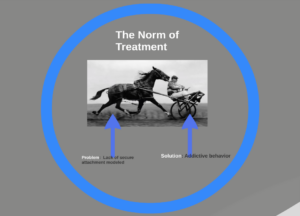
The result of putting the cart before the horse is the following:
- We admit a patient to treatment with distorted definitions of concepts learned as a child, i.e., honesty, hope, faith, courage, integrity, willingness, humility, brotherly love, discipline, perseverance, awareness, service
- The patient learned these definitions from their caregiver or parent from the models presented to them as children.
- How would the patient know these definitions are potentially dysfunctional if it is all they know?
- How effective will step work be if the patient doesn’t have a model or healthy definition of what the principles of the steps espouse?
Attachment theory assumes that the experience of childhood relationships shapes adult attachment styles. These experiences create the road map or internal working model for how the individual will perceive himself and others relationally (Bowlby, 1973).
The basic premise is that we only know what we know. For example, two men are sitting in the park discussing zoo animals. The one man asks the other if he has ever seen an elephant, to which the other man replies ‘no, what does it look like?’ The man states, ‘it is a large grey animal that has four hoofs, rough skin, floppy ears and trunk in the front’. The other man states ‘you mean like the tree trunk outside?’ The man replies ‘no, not a tree trunk’. To which many asks ‘You mean like the trunk of my car?’ The point is that the man will only know what an elephant looks like if he sees a picture or goes to the zoo. Similarly, if a child grows up with caregivers who are physically present although not emotionally present, thus, lacking a functional definition of emotional availability and intimacy, the child is more likely to have a stunted view of being emotionally present for others in their life. It is very possible that when this child becomes an adult, their innate need for secure attachment will not be met unless they see a model of what healthy attachment looks like.
The basic principle of Attachment Theory is that those with secure attachment (stronger emotional relationship with caregiver) are better able to regulate emotions and have fewer relationship problems. However, disruptions in the attachment system (insecure attachment) can lead to vulnerabilities in the sense of self and others as well as relationship problems; thus, leading to shame, co-dependency, and a need to numb pain via addictive behavior. Therefore, if we don’t address and model secure attachments to patients, they will stay stuck in the solution of continuously seeking to avoid and discharge pain through addictiveness.
Research suggests that relationships influence brain development and “relationships have the capacity to rebuild certain parts of the brain that influence social and emotional lives; clinicians can help clients to alter their attachment patterns with a secure clinical relationship. (Miehls, 2011, p. 82).
The bottom line in defining Attachment Theory is that the goal of treatment needs to be focused on changing the definition and model of what it means to feel included, loved, and secure. “The inability to establish healthy relationships is a major contributing factor to relapses and the return to substance use.” (Flores, 2004). Thus, the answer to “sh*t what am I missing?” is: Not having had a clear model of secure attachment because it was partially or completely missed during childhood. As Flores stated:
“Therapists must be able to challenge, soothe, care, love, and if necessary, fight with a patient if they are able to provide a full range of emotional experiences that can potentially come alive in an authentic relationship. (Flores, 2004, p. 259).
To sum up part one of this article, unless we provide a solid definition of concepts that we see as normal (based on definitions that were modeled) albeit dysfunctional and damaging, the way we work the 12 steps will be flawed and based on dysfunctional definitions, lacking much change in behavior. Alternatively, we can utilize the 12 steps as a corrective experience by interpreting each step as follows:
Interpreting the 12 Steps from an attachment perspective:
Step 1: The experience of abandonment;
Step 2: Permission to hope; integration to others;
Step 3: Taking a risk (vulnerability) to attach
Step 4: Taking a risk to attune with self
Step 5: Taking a risk to attach to another person
Step 6-7: Correcting and repairing relationship with self
Step 8-9: Correcting and repairing relationships with others
Step 10: Personal responsibility for securely attached relationships in my life
Step 11: Solidifying a secure attachment to my Higher Power
Step 12: Increasing my ability to model securely attached relationships to others
 Recovery from substance abuse is a long and complicated process. While much of the literature focuses on early recovery—a fragile and critical time—there are thousands of folks in long-term remission from substance use. The issues we face in long-term recovery are just as critical to our progress, relapse prevention, and ongoing health.
A person is considered in long-term recovery or remission when they have stopped or moderated their substance use and improved their quality of life for at least five years. The early stages of crisis stabilization are past, the damage drug use has inflicted is undergoing repair, and a “normal” life is being built. The critical issues of early recovery—staying clean, finding safe housing and employment, confronting legal consequences, and making new, sober friends—often feel more manageable by the time we enter long-term recovery.
At this point, a lot of us think we’re in the clear. We can breathe a little easier and begin to trust ourselves again. But we can’t make the mistake of thinking we’re done with recovery. With this false sense of complacency, we’re increasing our risk of relapse.
The truth is, long-term recovery has its own set of obstacles to overcome. It’s critical that we stay vigilant about our personal growth to increase our long-term chances of success. This can be done through self-study or by working with a counselor. Below are four tips to ensure success in long-term recovery.
4 Keys to Success in Long-Term Recovery
1. Healthy Relationship Skills
Many folks who struggle with substance use also struggle with finding and maintaining healthy relationships. Interpersonal struggles can wreak havoc on all areas of our lives, so it’s critical that we learn the skills to keep our relationships healthy. Whether our struggles are due to developmental trauma, unhealthy family relationships, or past hurt or abuse, developing healthy interpersonal skills is essential to continued success in recovery, stress management, and overall health.
Early recovery is often fraught with interpersonal difficulties that should stabilize as our lives and emotions do. However, intimate relationships can remain difficult at best. If this is the case, it’s important to engage in the work of building values, beliefs, and habits that support healthy, harmonious relationships.
Many of us with past substance use issues also struggle with a dichotomous personality. We feel there are two people living inside us: the person we were when we were using, and the person we are now.
2. Identity Integration
Many of us with past substance use issues also struggle with a dichotomous personality. We feel there are two people living inside us: the person we were when we were using, and the person we are now. The devil and angel sitting on each of our shoulders, both personalities try to pull us to their side.
It’s normal to want to push down our dark side in early recovery. We are scared of this other person living inside us and the damage they are capable of inflicting. Eventually we must integrate these two opposites and invite that dark side in. We must make peace with the person we were when we were using and become one whole human being.
3. Confronting the Wreckage of the Past
Bad decisions are one of the elements of substance use. These decisions can range from embarrassing to criminal. It’s normal to begin cleaning up that damage in early recovery, whether it’s completing jail sentences and probation, apologizing to loved ones, or living down a bad reputation.
But the impact of our past can last years into recovery, especially if our drug problems involved the legal system. This can be a source of great shame, stress, and embarrassment and can derail an otherwise strong recovery program if not managed appropriately.
4. A Balanced, Healthy Life
As many people in recovery know, stopping problematic substance use does not equal a healthy, happy life. In fact, early on we can be more miserable than ever as we learn to deal with stress while sober. Often, we are unhealthy people in general, not just in our relationship with drugs or alcohol, and we need to work on our physical, emotional, spiritual, and social health.
Developing and maintaining a balanced and healthy life is a critical piece of long-term recovery. This can include things such as exercise, mindfulness meditation, new relationships, eating healthier, or changing thought patterns.
Long-term substance use remission is a great achievement, but it is not a panacea for all our issues. In fact, this stage of the journey involves transitioning to different issues that must be addressed, including developing healthy relationships, integrating our dual identities, dealing with our troubled past, and establishing balanced lives.
Long-term recovery is a great time to review progress and set new goals for personal and professional development. As someone once told me, recovery is like going up a down escalator. You’re either moving forward or moving backward. The key is to keep going!
I would love to hear from those of you with five or more years of recovery. What are you dealing with? What should other folks entering this stage look out for?