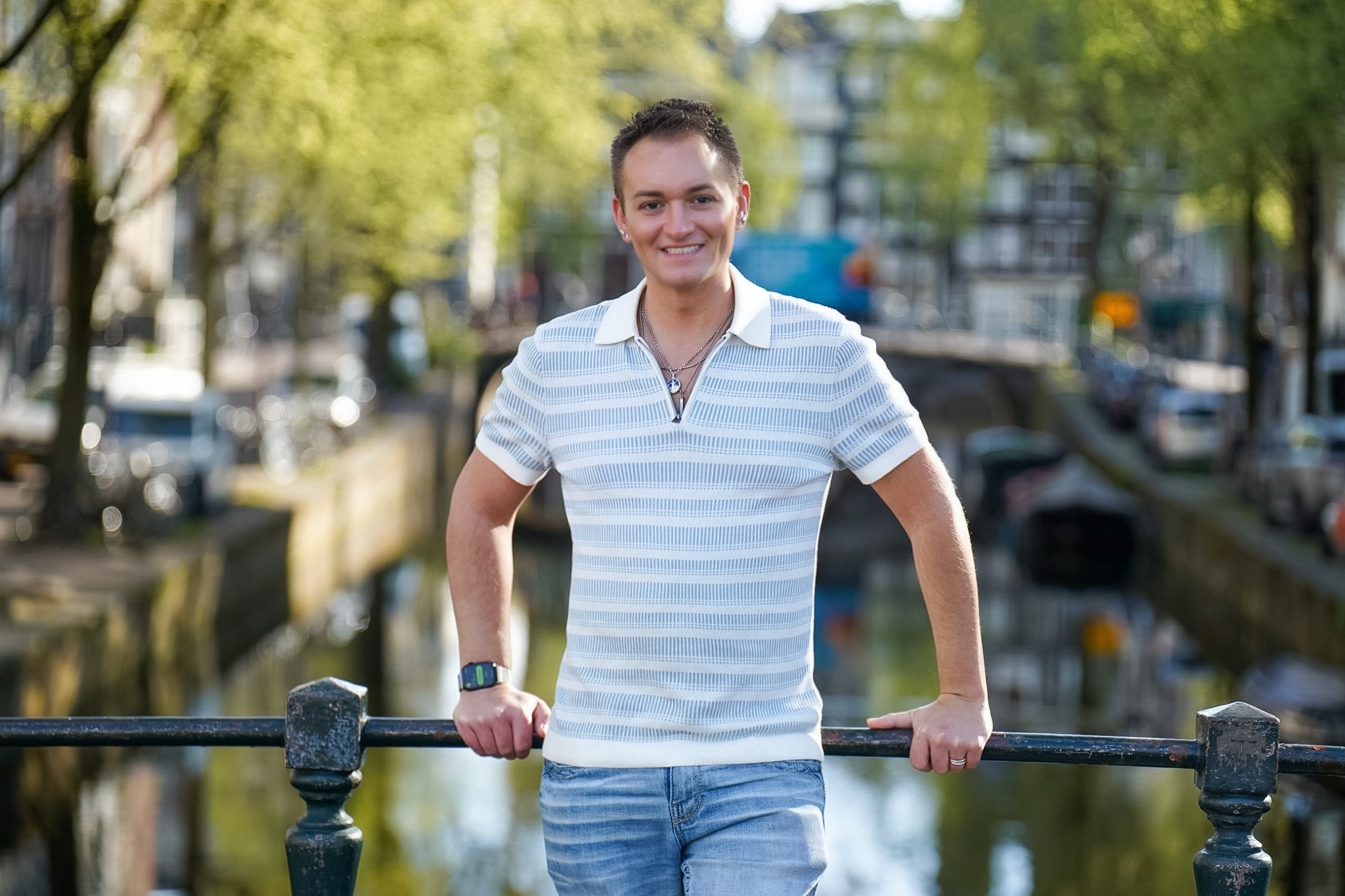
My Approach to Therapy
Therapy should be a place where you can show up as your full, authentic self — not the polished version you think you're supposed to be.
I'm not the distant, silent, smile-and-nod kind of therapist. Clients tell me they appreciate the validation and empathy I bring, and that I'm not afraid to be direct when it matters. You'll hear me curse once in a while. We'll laugh together, and we'll sit with the hard stuff, and I'll say the honest thing about what's keeping you stuck. At some point one of my dogs or ferrets will make a surprise appearance on screen. I can't ask you to be real with me if I'm not willing to be real with you.
My work is grounded in relational and interpersonal approaches, which means the trust between us is central to the healing — not a preliminary to it. Our relationships, with ourselves and with the people and systems around us, tend to be where our deepest wounds come from and where growth actually happens.
I'm also trauma-informed, holistic, and multicultural in how I work. I want to understand you in the context of your identity, your history, your culture, and your strengths — not just your symptoms. Depending on what you need, our work might include evidence-based trauma interventions, practical skills, psychoeducation, exploring relationship patterns, creative and expressive approaches, or body-focused techniques. No two people need the same thing, so I don't work from a formula.
My job isn't to tell you who to become. It's to help you reconnect with who you already are.
Your first consultation is free — a relaxed chance to tell me what's on your mind and ask me anything. Let's get you to more than surviving.
My Practice & Services
Rising Phoenix Therapy is my solo private practice, based in State College, PA and operating entirely by telehealth. As a PSYPACT-authorized provider, I can work with clients in Pennsylvania and in participating states across the country — you can check whether yours is one of them at psypact.org.
Working remotely means you aren't limited to the therapists who happen to be near you. If you need someone with specific expertise, you can find that person regardless of where you live.
Beyond individual therapy, I offer:
Adult ADHD and autism assessments, including comprehensive telehealth evaluations with clear diagnostic feedback and practical recommendations for treatment, accommodations, or academic support.
Gender-affirming assessments and letters of support for hormone therapy or surgical care, written promptly and respectfully. My approach here is affirming, not gatekeeping.
Relationship counseling. I use that term rather than "couples counseling" because it's more inclusive of open relationships, polyamory, ethical non-monogamy, and other structures. I hold a limited number of openings for partners, so it's worth checking with me directly — and if I'm full, I'm glad to refer you to someone who isn't.
Clinical and organizational trainings for practices, agencies, and organizations.
I'm an out-of-network provider. Depending on your policy, you may be able to submit paperwork for out-of-network benefits and receive partial reimbursement, and I can provide the documentation you'd need for that.
Most clients meet weekly. Every new client starts with a free phone consultation — a low-pressure conversation about what's bringing you in, what you're hoping for, and whether we're a good fit.
What to Expect From an Adult ADHD or Autism Assessment With Me
The process is thorough and it isn't a pop quiz. There's no way to fail it.
We start with a consultation about what you're experiencing and what you're hoping to learn. From there, the evaluation includes a clinical interview covering your history from childhood to now, standardized testing measures, and rating scales completed by you and sometimes by people who know you well. It's all done by telehealth.
Then we meet to go through the results in detail — not just what the findings were, but what they mean and where they came from. You'll get a written report you can actually use, whether that's for workplace or academic accommodations, medication consultation, or simply your own understanding.
A few things worth saying: adults who mask well are frequently missed by evaluators who don't know what to look for, and I do. A diagnosis is not the finish line, and neither is not receiving one — plenty of people leave an evaluation with a clearer picture of themselves either way.
If You Suspect You're Autistic or ADHD but Aren't Sure It "Counts"
You're in good company. Most of the adults I assess arrive apologizing.
They tell me they've probably just got bad habits. That they're functioning fine, mostly. That they'd feel ridiculous taking a spot from someone who really needs it. That they only started wondering because of something they read, and isn't everyone a little bit like this.
Here's the thing: if you've spent your whole life building workarounds so elaborate that you now look fine from the outside, that's not evidence against you. That's often the strongest evidence for you. The cost of that effort is usually invisible to everyone but you — and sometimes even to you, because you've never known anything else.
Late-identified adults are frequently missed precisely because they're doing well by external measures. Doing well while exhausted is still worth understanding.
You're allowed to be curious about your own brain without having to justify it first.
Working With Couples Where One Partner Is Neurodivergent
This is one of my favorite kinds of work, and one of the most commonly misunderstood.
The usual version: one partner withdraws or shuts down under conflict, and the other reads that as not caring. Meanwhile, the partner who shut down is genuinely lost about what went wrong. Both people end up feeling unloved and slightly crazy. It's a painful loop, and it's often not a values problem or a commitment problem — it's two nervous systems running different operating systems and each assuming the other works the same way.
My work here isn't about diagnosing one partner as the problem to be managed. It's about building an accurate translation between you. That means understanding what shutdown actually is, what a request for connection actually costs, and how to communicate needs in ways your specific partner can receive.
Both of you get to have needs. Neither of you has to become someone else.
Specific Issue(s) I'm Skilled at Helping With
Trauma, including childhood abuse, sexual and physical violence, and intimate partner violence. I've spent much of my career here — my dissertation research was on recovery from intimate partner violence among gay men — and I work with both recent trauma and the kind you've been carrying so long it just feels like your personality.
Religious trauma, including recovery from environments where your identity was treated as a defect. I don't bring my own beliefs into the work, and I'm not here to repair your relationship with anyone's god.
Adult ADHD and autism, including assessment and the identity work that follows a later-in-life diagnosis. Years of masking takes a real toll, and unwinding it is its own process.
Relationship difficulties: communication breakdowns, emotional disconnection, infidelity and betrayal, and the particular friction that comes up when partners process the world differently.
Anxiety, depression, burnout, low self-esteem, and minority stress. Identity exploration around sexual orientation, gender, and relationship structure. College and graduate student mental health. And the harder-to-name experience of feeling disconnected from yourself and not knowing when that started.
My Role as a Therapist
My job isn't to tell you who to become. It's to help you figure out who you already are and what you need.
Practically, that means I'm engaged rather than blank. I'll ask direct questions. I'll name patterns I see, including ones you might not love hearing about. I'll push a little when I think you're avoiding something, and I'll back off when I've misjudged it. I'll also tell you when I think you're right and everyone else in your life has been wrong.
What I won't do is hand you a verdict on your life. You're the one who has to live it, and you know things about your situation that I never will.
I take the power difference in this room seriously. You get to disagree with me, correct me, and set the pace. That isn't resistance — it's you being the authority on yourself, which is the whole point.
What I Usually Need to Know to Help
Less than you'd think, and you don't have to arrive organized.
Mostly I want to know what's happening in your life right now and what made you reach out at this particular moment. Something usually tips a person from "I've been meaning to" into actually filling out the form, and that thing is often the most useful place to start.
Beyond that, I'll be curious about your relationships — past and present, including the difficult ones — and about the patterns you notice repeating. I'll want to understand your history, your identities, your culture, and the environments that shaped you. And I'll ask what you're actually hoping for, which is a harder question than it sounds.
You don't need to have language for any of this yet. Plenty of people start with "I don't really know why I'm here, I just know something's off." That's a real answer and we can work from it.
Had a Negative Therapy Experience?
A lot of my clients have. Some spent years being treated for anxiety when the actual issue was undiagnosed ADHD or autism. Some had to spend their sessions educating their therapist about being queer or trans or nonmonogamous, which is exhausting and is not therapy. Some got a therapist who nodded a lot and never said anything useful. Some got one who pushed too hard, too fast, and left them feeling worse.
If that's you, I want you to know that a bad fit is information, not a verdict on whether therapy can work for you.
It's also completely fine to tell me directly if something I do isn't landing. I won't be wounded by it. I'd genuinely rather you say "that didn't help" than quietly decide therapy isn't for you. Being able to talk about what's happening between us is part of the work, not an interruption of it.
How My Own Struggles Made Me a Better Therapist
I'm a gay man. I have ADHD. And I've survived trauma — including in relationships that were supposed to be safe, and in a religious environment that taught me there was something wrong with who I am.
I bring that up for a reason.
I know what it's like to be on your side of this. To wonder if it's worth it. To sit with something you're not sure you can say out loud. To reach the point where the pain of carrying it finally outweighs the effort of dealing with it.
Being queer means I've done my own work on shame, on family, and on what it costs to grow up being told your existence is a problem. You will not have to explain that to me or brace for my reaction to it.
Having ADHD means I know what it's like when your brain won't do the thing you've decided it should, and to have spent years assuming that was a character flaw rather than a wiring difference. When you tell me you meant to, I believe you.
I can't ever fully know your experience, and I'd be suspicious of anyone who claimed they could. But I don't need to have lived your exact life to sit in it with you without flinching. What I have is a real understanding that pain isn't a character flaw, that healing is uneven and unglamorous, and that it's possible.
My View on the Nature of 'Disorders'
I don't think most of what brings people to therapy is best understood as something broken inside them.
Much of what gets called a disorder is a reasonable response to something unreasonable — trauma, chronic invalidation, a world built for a different kind of nervous system than yours. Symptoms usually made sense once. They were adaptations that helped you get through something, and they're causing problems now mostly because the situation changed and the adaptation didn't.
I'm especially clear about this with neurodivergence. Autism and ADHD are differences in how a brain is built, not deficits to be corrected. My work isn't about helping you pass as neurotypical. It's about understanding how your brain actually works, building a life that fits it, and grieving what it cost you to spend years pretending otherwise.
Diagnosis can be genuinely useful — for access, for accommodations, for language, for self-understanding. I just don't confuse it with a description of who you are.