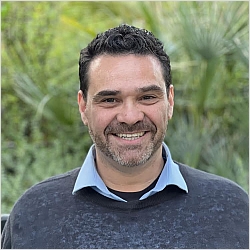
George Martin, Licensed Marriage and Family Therapist
Los Angeles, California
VerifiedTelehealth Available
Professions: Counselor, Marriage & Family Therapist
Languages: English, Portuguese
Telephone: 424-842-3787
Website: Visit Website
My Approach to Therapy
You have spent a long time holding it together, but underneath, there is a quiet, persistent feeling that something about you is off or just not quite enough. It shows up in how hard you are on yourself, in a nagging worry that your relationship is in danger or that the people you love might leave. In the exhaustion of managing how you come across. You have tried to understand it. Maybe you have been in therapy before. But insight alone has not moved it.
I work with people ready to go somewhere real, willing to slow down, go inward, and do work that actually reaches what is driving the pattern. My approach is relational and experiential. We pay attention to what is happening between us as much as what happened before. People often come asking for a specific technique and stay because of what unfolds in the relationship.
My Practice & Services
I am trained in IFS (Level 3), AEDP, and Emotionally Focused Therapy, with a psychodynamic sensibility. I work with individuals and couples via telehealth throughout California. I am fluent in Portuguese.
Specific Issue(s) I'm Skilled at Helping With
- Anxiety and chronic self-doubt
- The quiet, persistent feeling that something is fundamentally wrong with you
- Relationship insecurity and fear of abandonment
- People-pleasing and losing yourself in relationships
- Childhood emotional neglect and early relational wounds
- Immigration, cultural dislocation, and navigating life between two worlds
- Life transitions and loss of direction
- Depression and persistent emptiness
- Patterns you understand intellectually but cannot seem to change
My Role as a Therapist
My job is to listen. Not the kind of listening that waits for its turn to speak, but something deeper, more engaged, more intimate, and more specific than that. And not only to your words.
I listen to how you say things, to what your body carries, to the emotions that surface and the ones that do not. I listen to the different versions of you that show up sometimes in the same sentence, each with their own story, their own fear, their own way of trying to protect you. And I listen to how you relate to me in the room, because that relationship is itself a window into how you relate to the world - inside and outside.
My role is not to fix you or guide you toward a predetermined destination. It is to accompany you ? to help create a space where you can finally slow down enough to meet yourself. To notice what you carry, how you carry it, and what it has cost you. Not to have those things explained to you, but to experience them differently, in the presence of another person who is genuinely paying attention.
I believe, as the psychologist Jonathan Shedler has written, that lasting change comes not from insight alone but from the experience of a relationship that makes new ways of being possible. My role is to be that kind of presence ? steady, curious, and honest ? so that the patterns that have been deciding for you can gradually loosen their grip, and you can begin to choose.
My Therapy Focus
I track experience in its totality.
Your words, your stories, the way your body shifts when something lands close to home. The emotions that rise and the ones that get quietly pushed aside. What is being communicated but not said. What I notice in myself as I sit with you. The patterns that emerge between us, the themes that surface and resurface, the symbols and images that carry more than they seem to.
All of it is information. All of it is important. All of you matter.
What I am orienting toward, what I hold as the horizon of the work, is something that is difficult to name but recognizable when it arrives. A sense of clarity. Of spaciousness. A sense of comfort under your own skin. The experience of having room to breathe inside your own life. Not the absence of difficulty or pain, but the gradual loosening of the grip that unconscious patterns have had on how you move through the world.
Most of us spend our lives reacting, driven by implicit, habitual ways of being that were formed long before we had any say in the matter. They made sense once. They were adaptations, protections, ways of surviving what was too much to bear. But they have a cost. And at some point, the cost becomes impossible to ignore.
That is usually when people find their way to therapy.
My focus is on helping you move from reaction to choice. Not by eliminating the patterns, but by bringing them into the light, understanding what they were for, and gradually creating enough space that you actually have a say in how you show up.
How My Own Struggles Made Me a Better Therapist
I came to this work not from a textbook or a romanticized idea of what it means to help, but from the inside.
For most of my life, I carried a quiet, persistent feeling that I did not quite belong, that something about me was fundamentally off. Not broken in any obvious way. Just somehow not quite right, not quite enough. I learned early to manage it, hide it, work around it. I became competent, functional, and capable. But underneath, the feeling never really left.
I was born in the United States and moved to Brazil at age two, where I grew up. When I returned at twenty, I came back to my birthplace as a stranger, alone, without family, without the language or cultural footing, without anyone to guide me through what I was stepping into. Being othered, seen as less than, carrying an identity others define before you can define it yourself, that experience did not create the feeling that something was off about me. But it confirmed it in ways that have taken me years to undo and understand, and that I am still working on.
It was that experience of carrying something unnamed that shapes everything that drew me toward understanding human suffering from the inside out. Not to fix it quickly or explain it away, but to sit with it long enough to understand what it is really about.
My own therapy was a turning point. In that relationship, I experienced something I had not known was possible - being seen not for how I managed or performed, but for what had always been there underneath, quietly driving everything. That experience changed how I understand what healing actually is. It is notinsight. It is not a technique. It is the experience of being genuinely known by another person, and discovering that what you find there is not what you feared.
That is what I try to offer my clients. Not a protocol, not a technique. A relationship in which the thing that has never quite been seen finally gets seen.
Importance of the Client-Therapist Alliance
Research consistently shows that the quality of the relationship between therapist and client is the single strongest predictor of therapeutic outcome. More than any specific technique, modality, or approach. I take this seriously. Many therapists know and say this. Few really know what it means. Here is what my experience has taught me.
In my clinical work, the alliance is not just warmth or rapport. It is something more specific - a shared, felt understanding of where it really hurts, and a mutual agreement about how we are going to work with it together. When that is present, something shifts. The work stops feeling like something being done to you and starts feeling like something you and I are doing together.
That felt sense of connection - of being genuinely understood rather than assessed or managed - is not a byproduct of good therapy. It is the mechanism. It is how change actually happens. At its deepest, it is the experience of undoing aloneness, the discovery that what you have carried privately, sometimes for decades, can be held by another person without judgment, without flinching, and without being turned into a problem to be solved.
This is why I am less interested in applying a technique than in building something real between us. Because in my experience, it is inside that reality that the most important work takes place.
Expertise & Specialties
Age Groups I Work With
Adults
Groups I Work With
Individuals adults
Couples
Immigrants and 2nd generation immigrants
Tech professionals
Creatives
Entertainment industry
Therapy Services & Specialties
Concerns & Challenges Addressed
Adjusting to Change / Life TransitionsAnxietyAttachment IssuesDepressionGrief, Loss, and BereavementSelf-Esteem
Therapeutic Approaches & Evidence-Based Methods
Accelerated Experiential Dynamic Psychotherapy (AEDP)Coherence Therapy / Depth-Oriented Brief TherapyEmotion Focused TherapyEmotionally Focused Couples TherapyInternal Family Systems (IFS)Psychoanalysis / Modern PsychoanalysisPsychodynamic
Industries & Communities
BIPOCEntertainment IndustryFirst Responder/Medical ProfessionalsLGBTQ+Professional SportsSelf-Employed and Freelance Professionals