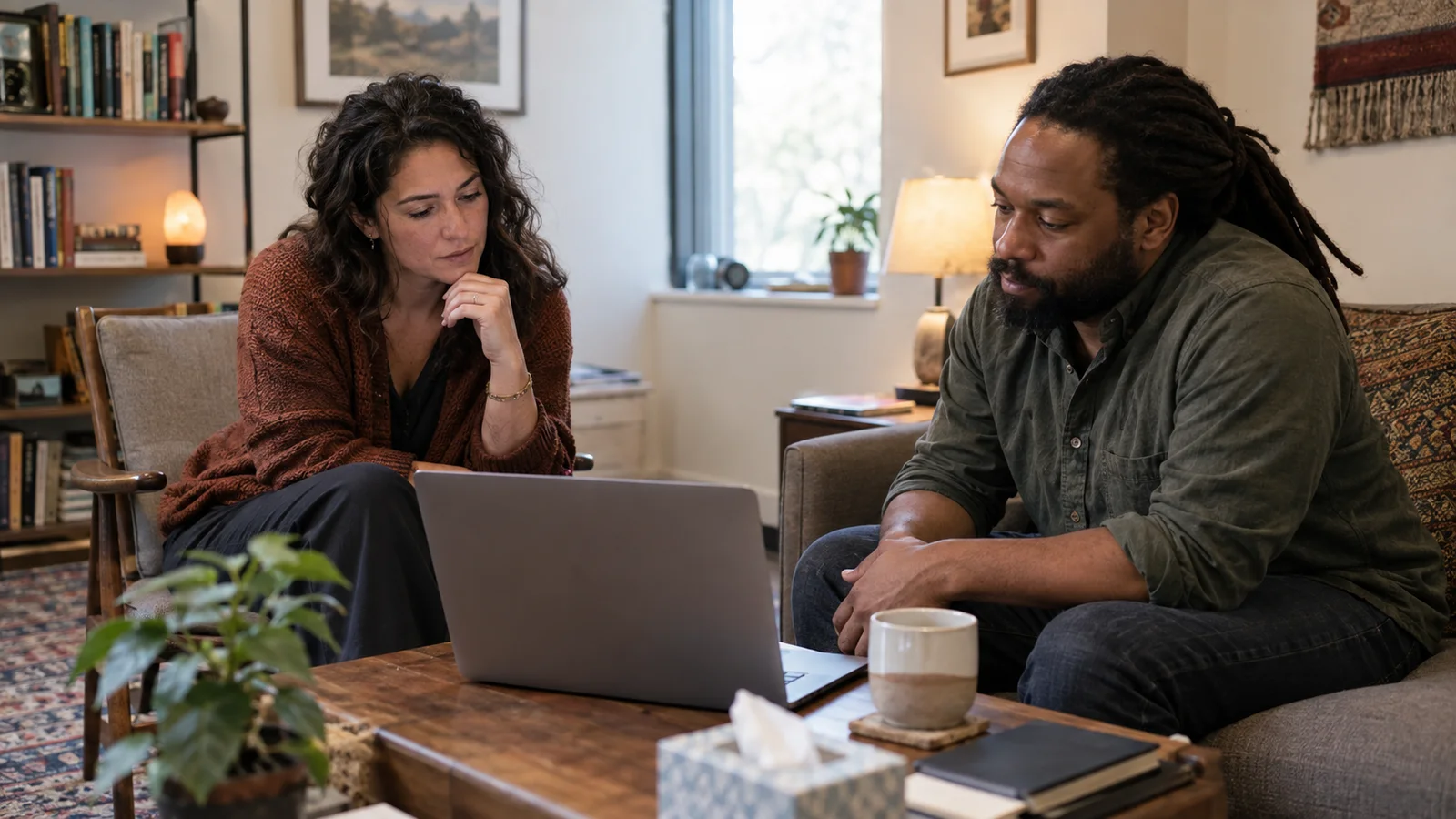
A continuing education training on how couples can manage illness-related stress together.
When one partner faces a serious illness, both partners experience profound emotional, relational, and practical challenges.
Research shows that dyadic coping, "the process of coping that transpires between couples challenged by one partner's illness, is an important predictor of disease adjustment and patient well-being" and "contributes to a sense of togetherness, encouraging couples to develop strategies as a unit to respond to stressful events." This 2-hour continuing education training equips therapists with the tools to support couples in dyadic coping—the process of managing stress together in ways that strengthen their bond rather than strain it.
Drawing from attachment theory, communication frameworks, and health psychology, participants will learn how illness disrupts established relational patterns and how partners can adapt through supportive, delegated, and mutual coping strategies as "dyadic coping (DC) refers to the processes where one partner aids the other or both partners work together to cope with stress." The training will also explore how factors such as chronic stress, caregiver burden, role shifts, and grief influence relational dynamics, as studies show "when using dyadic coping strategies more often, patients and partners felt more satisfied, close, and sexually satisfied."
Through research discussion and case studies, participants will learn to recognize how couples cope together when facing illness, including supportive, ambivalent, or negative patterns. This training will offer practical guidance on helping couples communicate openly, stay emotionally connected, and adjust to shifting roles, as "successful dyadic coping with romantic partners has been associated with positive psychosocial adjustment, better disease management, and survival from serious illnesses." It will also touch on the emotional weight of caregiving, changes in identity, and the grief that can come with illness, addressing how "the time commitment and responsibilities of caregiving can place an undue emotional, economic, and physical burden on caregivers" with "caregiver burden being a growing social issue." By the end of this training, therapists will have a framework to help couples strengthen their partnership in the face of medical and emotional challenges.
This introductory continuing education webinar is designed to help mental health professionals:
- Identify common dyadic coping patterns in couples facing illness, including supportive, ambivalent, and negative strategies, as "dyadic coping (DC)-the ways couples cope in dealing with a stressor such as chronic illness-has received increased attention over the last three decades."
- Explain how illness-related stress impacts relational dynamics, including caregiver burden, role shifts, and identity changes, noting that research shows "female caregivers were more likely to have higher stress" and "spouses, sons, and daughters-in-law were more likely to have higher caregiver stress."
- Utilize the Dyadic Coping Inventory (DCI) in their therapy practice to help couples improve their stress management strategies, as this "68-item Questionnaire measures dyadic coping as a multidimensional construct" and "can help clinicians assess dyadic coping styles, guiding interventions tailored to improve relationship dynamics."
Statement of program material's accuracy, utility, and risks: This training presents clinical and scientific information on dyadic coping in couples facing illness, drawing from empirical research including recent meta-analyses and systematic reviews. The material is intended for mental health professionals seeking to enhance their work with couples navigating medical and emotional challenges, as current research demonstrates that "CI management has been viewed as a dyadic process by theorists and clinical practitioners." While research supports the effectiveness of dyadic coping interventions in improving relationship quality and emotional well-being, with studies showing "for couples facing chronic and uncontrollable stress (such as chronic illnesses), common dyadic coping efforts seem to be particularly valuable for relationship functioning," outcomes may vary based on individual circumstances. Therapists should exercise clinical judgment in applying these concepts, as misinterpretation or misapplication could lead to unintended relational strain or emotional distress for clients.
Declaration identifying any potential conflict of interest and/or commercial support: The presenter of this training has no relevant financial or commercial conflicts of interest to disclose. This training is designed solely for educational purposes and does not promote any specific therapeutic product, service, or organization.
If you have any questions or would like information regarding disability accommodations, please contact GoodTherapy here.
Continuing Education (CE) Information
2 CE contact hours will be provided by GoodTherapy for attending this web conference in its entirety.
GoodTherapy is an NBCC-Approved Continuing Education Provider (ACEPTM) and may offer NBCC-approved clock hours for events that meet NBCC requirements.
GoodTherapy.org, provider #1352, is approved as an ACE provider to offer social work continuing education by the Association of Social Work Boards (ASWB) Approved Continuing Education (ACE) program. Regulatory boards are the final authority on courses accepted for continuing education credit. ACE provider approval period: 3/30/2025 – 3/30/2028. Social workers completing this course receive 2 continuing education credits.
GoodTherapy is approved by the American Psychological Association to sponsor continuing education for psychologists. GoodTherapy maintains responsibility for this program and its content.
GoodTherapy, LLC is recognized by the New York State Education Department's State Board for Social Work as an approved provider of continuing education for licensed social workers #SW-0395. GoodTherapy, LLC is recognized by the New York State Education Department's State Board for Mental Health Practitioners as an approved provider of continuing education for licensed marriage and family therapists #MFT-0022 and for licensed mental health counselors #MHC-0031.
To receive CE credit hours for an archived event, you will need to complete a survey as well as a 12 or 15-question exam, verifying that you listened to or watched the event in its entirety. Archived CE events generally are considered "homestudy" by licensing boards.
Registration Information
Premium and Pro Membership with GoodTherapy includes access to this web conference at no additional cost, as well as other member benefits such as a profile listing in GoodTherapy's Therapist Directory. Not yet a member? Sign up for a Premium or Pro Membership, here.
Just want CE credits? Sign up for a monthly or annual CE Subscription with GoodTherapy to get unlimited access to our CE Program, including this event, other live CE web conferences, and hundreds of hours of homestudy courses.
Mental health professionals who are not members can attend this live web conference for $30.95 or access the homestudy recording for $15.50. Sign up here to purchase this CE course and earn a CE certificate.
If the event is canceled by GoodTherapy, registrants who purchased the event will be notified and the charge for the event will be refunded.
If you have any questions or would like information regarding disability accommodations, please contact us.
Register Now: Please Login to Member's Area
Not a Member? Click here for information on membership
Medical Disclaimer: This training is for educational purposes only and does not constitute medical advice, diagnosis, or treatment. Mental health professionals should consult with their clinical supervisors and follow their professional guidelines when implementing any techniques discussed. Individual circumstances may vary, and professional judgment should always be exercised when working with couples facing medical challenges.
References
Mittinty, M. M., Mittinty, M. N., Buchbinder, R., Lassere, M., Chand, V., Whittle, S., March, L., & Hill, C. (2024). Interpersonal process of dyadic coping in rheumatoid arthritis: A perspective from the Australian Rheumatology Association Database. The Journal of Rheumatology, 51(9), 862. https://doi.org/10.3899/jrheum.2023-0664
Hou, J., Fu, R., Jiang, T., et al. (2025). Delineating the dyadic coping process in HIV serodiscordant male couples: A dyadic daily diary study using the common fate model. Quality of Life Research, 34, 1317–1332. https://doi.org/10.1007/s11136-025-03903-4
Shrout, M. R., Weigel, D. J., & Laurenceau, J. P. (2024). Couples and concealable chronic illness: Investigating couples' communication, coping, and relational well-being over time. Journal of Family Psychology, 38(1), 136–148. https://doi.org/10.1037/fam0001136
Yang, Y., & Mischkowski, D. (2021). Dyadic coping in couples facing chronic physical illness: A systematic review. Frontiers in Psychology, 12, 631754. https://doi.org/10.3389/fpsyg.2021.631754
Lau, N., Ramos, K. J., Aitken, M. L., Goss, C. H., Barton, K. S., Kross, E. K., & Engelberg, R. A. (2024). "We'll deal with it as it comes": A qualitative analysis of romantic partners' dyadic coping in cystic fibrosis. Journal of Social and Personal Relationships, 41(2), 678–702. https://doi.org/10.1177/02654075231190617
Choi, J. Y., Lee, S. H., & Yu, S. (2024). Exploring factors influencing caregiver burden: A systematic review of family caregivers of older adults with chronic illness in local communities. Healthcare, 12(11), 1121. https://doi.org/10.3390/healthcare12111121
Centers for Disease Control and Prevention. (2024). Changes in health indicators among caregivers in the United States, 2015–2016 to 2021–2022. MMWR Morbidity and Mortality Weekly Report, 73(34), 754–761. https://www.cdc.gov/mmwr/volumes/73/wr/mm7334a2.htm
Bodenmann, G. (2008). Dyadisches Coping Inventar: Testmanual [Dyadic Coping Inventory: Test manual]. Huber.
Randall, A. K., Totenhagen, C. J., Walsh, K. J., Adams, C., & Tao, C. (2017). Dyadic coping in the U.S.: Psychometric properties and validity for use of the English version of the Dyadic Coping Inventory. Current Psychology, 36, 570–582.
Ham, Y., Jin, Y., Hong, I., & Park, J. H. (2025). Association between chronic illnesses in older adults and caregiver burden: A cross sectional study in the United States. Aging & Mental Health, 29(7), 1306–1312. https://doi.org/10.1080/13607863.2025.2468891